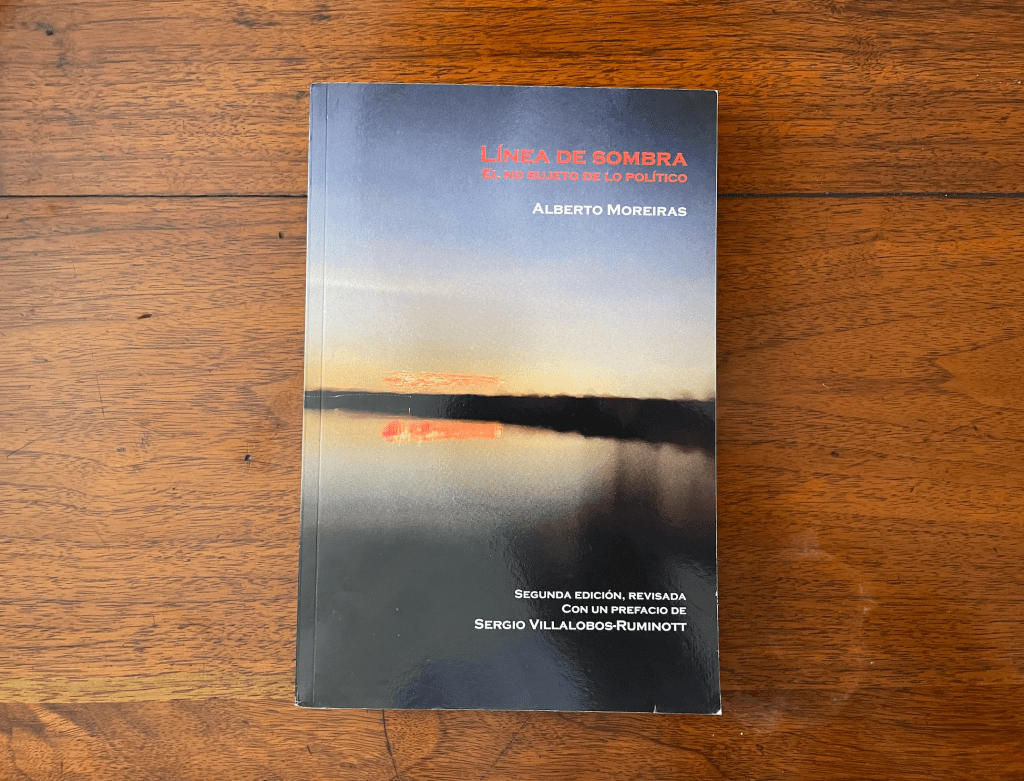
The core of my present intervention was prompted by a joke recently told by a friend. This friend said: “Alberto Moreiras is Spain’s most important Italian philosopher”. I felt I had to respond to it, in my own sort of way, such as this brief intervention. I will offer at least three hypotheses as why that was said. First, what is obvious: Moreiras’ analytical reflection is irreducible to the dominant Spanish philosophical or cultural reflection, however we take that to be (taking in consideration that Moreiras’ work is hardly defined solely by the Spanish archive or historical tradition). Second, that Moreiras’ reflection is somewhat close to the Italian philosophical tradition, particularly in the wake of the contemporary turn of “Italian Difference”. Thirdly, that Moreiras’ own singular thought shares a vinculum with the Italian philosophical culture as “thinking on life”, as perhaps best defined by Roberto Esposito in his Living Thought (2011). There is probably no way to find out the original “intention” of said friend in terms of the Italian signatura of Moreiras’ work, and it is not my desire defend any of three hypotheses. Rather, in what follows what I want to develop is a preliminary exploration of the way in which Línea de sombra: el no-sujeto de lo político (2006) could be very well read a horizon of thought that retreats from community vis-à-vis the non-subject that transfigures the “democratic kernel of domination” (Moreiras 94).
In this analytical development I want to ‘actualize’ Línea de sombra’s potential not very rehearsing the arguments against the so called decolonial option, the metaphysical concepts of Empire and multitude, or the critique of the humanism of the politics of the subject, all of them contested in the book. It is not that I think that those discussions are closed, but rather that I want to suggest that a different politics of thought that radicalizes and abandons those very notions – nomos, legacy, and subject – through the practice of infrapolitical reflection. Hence, I will take up two instances of this nomic sites of contemporary reflections in the so called school of “Italian Difference”; mainly, Remo Bodei’s “Italian” entry in the Dictionary of untranslatables (Princeton U Press, 2014), and Roberto Esposito’s articulation of “Italian philosophy” in his Living Thought: the origins and actuality of Italian Philosophy(Stanford U Press, 2011). I would like to anticipate a critique that could perhaps note that I am putting off Italian thought, or even antagonistically clashing two schools of thought. I am not interested in establishing what could well said to be a legislative clash between theories. I am also aware that Italian Difference is a topological heterogeneity that organizes variations of common themes among thinkers, but that it is not reducible to what singular thinkers generate in their own effective elaborations. In this way, you could say that what I am interested here is in the way in which a certain nomic grounding under the name of ‘Italian Thought’ has been articulated, grounded, and posited as a tradition between conservation and rupture. In the remaining of this intervention, I would like to offer some preliminary speculative ideas about the way in which infrapolitical reflection decisively emerging from Línea de sombra divergences from the general horizon of radical democratic politics advanced by Italian theory.
For reasons that are not just chronological, I think Remo Bodei’s entry in the Dictionary of the untranslatables is preparatory for Esposito’s own take on the territorial and exterritorial force of “Italian Philosophy” in his 2005 book. Indeed, Esposito records in a footnote Bodei’s entry, as well as other recent contribution to the topic such as Borradori’s Recording Metaphysics: New Italian Philosophy (Northwestern, 1988), Virno & Hardt’s Radical Thought in Italy: A Potential Politics (Minnesota, 1996), and Chieza’s The Italian Difference Between Nihilism and Biopolitics (2009). An important predecessor reflecting on Italian philosophical culture – ignored by both Esposito and Bodei – is Mario Perniola’s early “Difference of the Italian Philosophical Culture” (1984), which already establishes the conditions for thinking this nomic specificity beyond the encompassing paradigm of the nation-state, and against the grain of the organization based Italian identity of the Risorgimento. For Perniola, “this is now over, and that natilistic ways, based on a comparison and vindication of identities have completely exhausted their historical function” (Perniola 105). The exhaustion of a national philosophical script is what reversely makes the case for Italian thought to be a thinking measured by civic activism, which entails that the conditions for transmission and interruption of tradition is essentially through a distance between history and language (Perniola 108-09).
sIn a profound way, Italian philosophy is what speaks without historicizing itself, or what speak the non-historiciable to put in Vico’s terms in the New Science. This amounts to an interruption of any philosophy of history, since it discloses a region of what cannot be rendered a science of history. Italian philosophic reflection opens up to the collapse of narration not as consequence of State persecution or constitutive violence, but as a function of a politics incapable of coinciding with the Italian nation-state (as we know this is the symptom of Gramsci’s formulation of the subaltern, and the North-South relations the Prison Notebooks). Perniola’s early essay is an important salient informant of Bodei’s entry, since what arouses the second’s reflection is precisely the drift towards a civil philosophy, or what is the same, a philosophy based on a civic vocation. Thus, writes Bodei:
“From a broad historical perspective and taking into account the limits imposed by its irreducible complexity the Italian language has been character by a constant and predominant civil vocation. By civil I mean a philosophy that is not immediately tied to the sphere of the state, nor to that region of interiority. In fact, ever since its humanist and Renaissance origins, its privileged interlocutors have not been specialist, clerics or students, attending university, but a wider public, a civil society one has sought to orient, to influence, to mold” (Bodei 516).
Italian language, which for Perloina was constitutive of Italian thought, here takes a civic function that exceeds the proper limits of the philosophical act. This is why Bodei’s most important symptomatic definition is Machiavelli’s ‘verità efffecttuale della cosa’, which is guided by desire at the intersection between tradition and innovation, revolution and rupture. For Bodei’s Italian vernacular language necessarily breaks away from the very containment of the philosophical nomos, spilling over an excess that is anti-philosophical or ultra-philosophical. By proxy of Leopardi’s writings, Bodei argues against the ‘German poem of reason’, defending a poetical space of thought that knows (according to Leopardi) “the true and concrete…the theory of man, of governments, and so on, that they Germans have made none”. The point being is not just that Italian philosophers are ultra or non-philosophical, but that an antiphilosophy of praxis, of what citizens already do. The difference, according to Bodei vis-à-vis Croce, only rests upon critico-practical reflection as the central determination of thinking in Italian (523).
As it is for Esposito – but we can say also for Agamben in the last volume of the Homo sacer series, L’uso dei corpi (Neri Pozza, 2014) – philosophy is a praxis that provide immanent validation for Aristotle’s treatment of dunamys and energeia, as well as his general typology of causation. What is at stake here is nothing less than the actualization of the question of technology (technê), which Bodei reads in Galileo’s as a contestation to the systematization of maquination (Gestell). The scientific thought of Bruno or Galileo bring to halt the machination that Heidegger understood as the end and realization of epochality through gigantism, by positing the artificiality of the apparatus (of the ‘thing’) as an extension of nature, and not as its mere opposition (Bodei 527). Although he does not explicitly thematizes it on its proper terms, one could very easily read in this argumentation the polarity that structures Italian non-philosophy: the question of civic vocation (klesīs) and the question of nihilism (the co-belonging between technique and philosophy of history).
What is rather puzzling about Bodei’s argumentation is that at no point does he account for a genealogy of what I would call the non-philosophy of life, or even the life of non-philosophy as the excess of the philosophical life in the Italian republics. In other words, Bodei leaves out the sophist, and it is the figure of the sophist what ultimately lead a positive civic contemplative life outside the constrains of philosophical schools, such as stoicism (Bonazzi & Bènatouïl 2006). Instead, what he does offer and reconstructs is the paradigm of an Italian philosophical tradition that still structures itself between tradition and interruption, thought and action, immanence and life. This is the conflictivity or differend – we could also call its krisis, which Cacciari’s studied in relation to the labor of the negative in his important book Krisis: Saggio sulla crisi del pensiero negative (1976)– that in Bodei remains unresolved at the political register, still organized around the concept of the “civil”.
Roberto Esposito’s Pensiero vivente (Giulio, 2010) shares many of the basic premises advanced by Bodie, but there is little doubt that it is the most sophisticated and sustained reflection on thinking the nature and the political consequences of “Italian Difference” in the wake of nihilism and biopolitics after Michel Foucault’s critique of governmentality. Although unlike Bodei, Esposito pushes the political consequences to its limits on the relation between philosophy and history. According to Esposito, it is on this threshold that a region beyond the impasse of the philosophical and political categories of Western modernity, would allow an actuality of thought with transformative capacities and innovative energy (Esposito 21). Departing from Deleuze & Guattari’s anarchic definition of philosophy as de-territorializing, Esposito affirms not an ultra-philosophy or a non-philosophy, but the development of an uneven grammar that is universal due to its very singularity, that is, it could travel unbounded throughout Europe with arguments, formulations, and images that everyone could make their own and share (20).
Esposito outlines three different paradigms of Italian difference: a political one that solicits conflict in every instance; a radical historicity of the non-historical; and one of life, which is to be understood as both the worldliness of the modern subject and the deconstructive gesture of the dual theological machine folded on the person. I want to limit myself to elaborate on the first and third declinations (political conflict and life). Esposito also thinks against the German or English traditions understood as State traditions – the traditions of Locke, Hegel, or Fichte – which he sees as constituting the state knowledge of the political (Esposito 21). Esposito views them as philosophies of history, whose nexus to the political is one of consensus and not of disagreement or antagonism. Instead, “Italian philosophy has shown a critical and sometimes antagonistic potential not commonly found in other contexts. Sometimes, in special situations, and under certain conditions – in the case of a drastic transition between epochs like the one we have been experiencing for some hears now – what appears to be, an is, in effect, a lack or an antimony can transform itself into advance compared to more stable, well-established situations” (21).
This ‘antagonistic potential’ defiantly avoids the nihilism of acting according to the presenting of principles of the normative order. However, so it seems to argue Esposito, the antagonistic politics feeds off crisis, is born out of transitional or inter-epocal subsumption. The question is similar to the one that one could formulate against the hegemonic principle overriding the populistic logic, which Moreiras frames it in this way in Línea de sombra: “if hegemony is the democratic horizon of domination [because it is not consensual], the search for a politics of the closure of sovereignty begs the question about the end of subalternity in a radically democratic horizon” (Moreiras 94). But the truth of democratic politics is only possible against the condition of hegemonic attainment. Esposito writes this much: “…[against] the Hegelian identification between politics and state, the world of life is cut through by pervasive struggle, in a fight to idea for hegemony: whether like it or no, we are always forced to take a position in favor of one part against the other” (Esposito 25).
I would not go as far as to say this exhaust the horizon of Esposito’s political thought, from the intricacies of the impolitical to his most recent turn to the impersonal. However, this does mark a fissure from the possible of generating a radical theory of de-theologizing the political, an operation of thought not alien to the infrapolitical horizon (132). Essentially, the problem here is not about the theory of hegemony, or the continuation of hegemonic principle of Roman politics, as what continues to divide and administer life through domination. More so, I would argue, give that we are seeing here a second order of interior domination that posits the life of infrapolitics at the expense of the political and the community (munus). This means, that if one takes seriously the articulation of infrapolitics as the possibility of action outside the subject, that it is not enough to think the politics of Italian difference as a pre-statist that is always already the promise of a democratic or post-democratic infrapower as governed by a counter-hegemony of decision (Moreiras 224). Secondly, this leads to the question of contingency that underlines the very co-belonging between history and philosophy of the Italian Difference. Stefano Franchi is right in noting that the “sporgenza” or protrusions are processes that punctuate the body and archive of Italian thought. Protrusions are also what allow for the development of epochs, constituting the excess and contingent foundation of the historical unfolding as such. Of course, the pressing question is: “and how do we know if ‘Il Pensiero vivente’ as such – not the book Esposito wrote, but though he advocates in its last sentence as a breach capable of renewing contemporary philosophy as a whole – is capable to uncover those events in unprecedented ways?” (Franchi 31). And what is more: how does one establishes a co-substantial difference from an epochal presence of living thought to Esposito’s own thought (impersonal / third person)?
My purpose here is not to resolve this aporia in Esposito’s characterization of Italian Difference, because to cross its nihilism. Infrapolitics has something to say here in regards to location. In the chapter on infrapolitics in Linea de sombra, Alberto argues: “The difference between an imperfect experience and one reducible to an aporia is also the difference between understanding the aporetic as the end of thinking, and that of understanding as a reflexive opening that is the beginning of an infrapolitical practice in the same location where the suppression against the aporia reinforces the exorbitant violence of the imperial biopolitical hegemony” (Moreiras 235). But infrapolitical dwells necessarily in a non-space or alocation, since is very excess is the falsification of life; that is, what is no longer structured around an enemy for political antagonism. Italian Difference necessitates a non-supplementary exodus that is infrapolitical life, what escapes biopolitical life of the community.
Here one must ask, what is the relation between alocationality and democracy? Is there a democracy of the impersonal or the unequal? This is a difficult question to ask at this moment, but it is pertinent if the question about civic duty (Bodei) or immanentization of social strife is constitutive Italian thought. Following the political historian of Ancient Greece, Christian Meier, Agamben concludes his recent Stasis (2015) by suggesting that the politization brought by the isonomic foundation carries the latent possibility of social strife or stasis, which is the obfuscation of the ontology of war (politics) within the polis. This runs counter to Arendt, who in On Revolution attributed non-rule to the principle of isonomy as antecedent to democracy as majority rule (Arendt 30). It also seems insufficient to end at Esposito’s determination of the community based on the logistics of binding-debt (munus), intensified today by the total unification of existence and world, in what Moreiras has called the principle of equivalence (Moreiras 2016). Is infrapolitics then, always, a shadow of civil war? If the non-subject cannot constitute isonomic citizenship; infrapolitics disjoints the mediation between the political and the differential absorption of differences. In other words, posthegemonic democracy prepares a different institutionalization for political relation that no longer covers the empty space of the One at the heart of the civil.
* A version of this text was written on the occasion of a roundtable on Alberto Moreiras’ book Línea de sombra: el no-sujeto de lo político (2006, 2021), which Sergio Villalobos-Ruminott and I organized for the ACLA 2016 at Harvard University. I am actualizing it here with minor changes in light of the first discussion on “Italian theory” in the framework of the Foro Euroamericano, at 17/instituto, which I am co-organizing along with José Luis Villacañas, Benjamin Mayer Foulkes, and José Miguel Burgos-Mazas. The first session is mow available here: https://www.youtube.com/watch?v=0BjW4euQduE
Bibliography
Alberto Moreiras. Línea de sombra: el no-sujeto de lo político (Palinodia, 2006).
______. “Infrapolitical Action: The Truth of Democracy at the End of General Equivalence”, Política Común, Vol.9, 2016: https://quod.lib.umich.edu/p/pc/12322227.0009.004?view=text;rgn=main#N7
Giorgio Agamben. Stasis: civil war as a political paradigm (Stanford University Press, 2015).
Hannah Arendt. On Revolution (Penguin Books, 1986).
Mario Perniola. “The difference of Italian philosophical culture”. Graduate Faculty Philosophy Journal, Vol. 10, N.1, Spring 1984.
Mauro Bonazzi & Thomas Benatouïl. Theoria, Praxis and the Contemplative Life after Plato and Aristotle (Brill, 2012).
Reiner Schürmann. Broken Hegemonies (Indiana University Press, 2003).
Remo Bodei. “Italian”. Dictionary of untranslatables (Princeton University Press, 2014), 515-527
Roberto Esposito. Living thought: the origins and actuality of Italian Philosophy (Stanford University Press, 2012).
Stefano Franchi. “Living thought and living things: on Roberto Esposito’s Il pensiero vivente“. Res Publica: Revista de filosofia politica, 29 (2013), 19-33.

 Infrapolitical Reflections