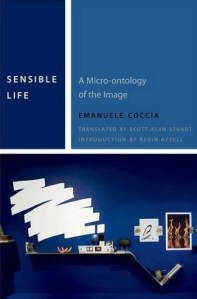
Esse extraneum: on Emanuele Coccia’s Sensible life: a micro-ontology of the image. by Gerardo Muñoz

coccia sensible lifeLa vita sensibile (2011) is Emanuele Coccia’s first book to be translated into English. Rendered as Sensible Life: a micro-ontology of the image (Fordham U Press, 2016), it comes with an insightful prologue by Kevin Attell, and it belongs to the excellent “Commonalities” series edited by Timothy Campbell. We hope that this is not the last of the translations of what already is Coccia’s prominent production that includes, although it is not limited to La trasparenza delle immagini: Averroè e l’averroismo (Mondadori, 2005), Angeli: ebraismo, cristianesitimo, Islam (co-ed with G. Agamben, 2011), and most recently Il bene nelle cose: la pubblicità come discorso morale (2014). One should take note that in Latin America – particularly in Chile and Argentina – Coccia’s books have been translated for quite a while, and have been part of a lively debate on contemporary thought. We hope that a similar fate is destined in the United States. For some of some of us working within the confines of the Latinamericanist reflection, an encounter with Coccia has grown out of our continuous exchange with friends like Rodrigo Karmy, Gonzalo Diaz Letelier, and Manuel Moyano. It would be superfluous to say that Coccia’s work is nested in the so called contemporary ‘Italian Philosophy’ (pensiero vivente, in Roberto Esposito’s jargon), although one would be committing a certain violence to reduce it to another ‘theory wave’ so rapidly instrumentalized in the so called ‘critical management’ within the North American university.

Coccia’s tropology (not entirely a set of fixed “categories” or “concepts” for a philosophical program), such as imagination, the sensible, and the averroist intellect are signatory relays for a potential history of thought against the grain of grand conventional histories and historiographies of Western philosophy, or even more so, against the reaffirmation of a principle of philosophy of history in the wake of nihilism and biopolitics. It is most certainty true that Coccia’s investigations share a horizon that we can call the “form of life” – some of us also call it “infrapolitical existence”, which for Coccia himself has translated as the vita sensibile – although both his approach and condensation of thought always presuppose an efficient interrogation of the singular indifferent to “influences” or “schools of thought” (even when Coccia moves deep into scholastic and medieval philosophy). Perhaps no less important of a metacritical index is the unreserved service for a reconsideration of the philosophical tradition – and more importantly, the transmission and disposition of a thinking that remains unwritten – beyond the history of metaphysics and political theology.

Sensible Life is not a book about the ontology of the image in the pictorial or phenomenological sense, but an investigation into the metaxy of existence and being in the world. As Coccia argues early on in the book, ‘the sensible life is a world given to us, and only as sensible life are we in the world’ (2). Against biopolitical or vitalist (neo-positivist) remnants of understanding as fated in the subject (or the persona), Coccia prepares the ground for a physics of the sensible that affects, without really transforming, the human as subject, although it does seek to exhaust itself in subjectivity. Coccia argues, as if implicitly taking up Simone Weil’s suggestion, that the form of sensation is always a modal relation with the outside, an improper distance (metaxu) of the ‘in between’, necessary for any schematization of concrete existence [1]. Hence, perception or sensing is only possible because there is metaxy, and not because there is a subject as the producer and commander of capacities and substances. Against distributive ontologies that design complex arrangement and division of ‘life’, Coccia’s sensibly maps out a region that has always already been there, and that turns to another relation with ontology and language.

In a large part, Sensible Life is vastly informed by his prior study on Averroes and the averroist tradition Averroè e l’averroismo (Mondadori, 2005), where Coccia studied the ways in which conventional Christian history of philosophy convicted the twelve century Iberian philosopher for the madness of positing a common and universal unity of the intellect. What Coccia thematizes in that study, but also in Sensible life with greater speculative freedom, is the extent to which reason depends on the potentiality of the intellect understood as the capacity for imagination. What is common and at the same time ‘improper’ to all beings is the potentiality of imagination that remains outside of life, never constituting a principle of sufficient reason nor the ground for dogmatic belief. The ‘scandal of averroism’, as Rodrigo Karmy has called it, was followed by the Scholastic ban on teaching averroism and removing averroists from the university. It is no surprise that this coincided with the development of the category of the person as a secondary reserve of Christian political theology and Roman Catholic ratio [2].

This is what lays bare in Coccia’s explicit condemnation of the Cartesian cogito, and his affirmation of the sensible as a de-metaphorized image without proper location, since it only dwells ‘where one no longer lives and where one no longer thinks’ (17). This impersonal drift of the sensible is what allows for an extreme de-localization in multiplicity of reproduction of images that serve to dislocate the very inside and outside of the constitution of the subject, but also of any constitution of life itself (31-32). Indeed, the first part of the book is said to write a physics of the impersonal and immaterial ‘third space’ (sic) – what in Aristotle’s vocabulary is the relation with the ‘externals’ [tōn exōthen], and in medieval scholasticism is the esse extraneum – that like marrano existence, it dwells on a dual exteriority. In a key moment of the development of Sensible life, Coccia writes:

“How, then, can we define an image? In his work on perspective John Peckham held that an image is “merely the appearance of an object outside its place (extra locum suum) because the being appears not only in its own place but also outside its own place”…Our image is nothing but the existence of our form beyond what makes up, the substance that permits this form to exist in an entirely extraneous matter to that in which one exists and mixes with. Every form is born from this separation of the form of a thing from the place of its existence: where the form is out of place, an image will have a place [ha luogo]. […] Thus, an image is defined by a dual exteriority: the exteriority from bodies and the exteriority from souls – because images exist prior to meeting the eye of the subject who observes a mirror” (19).

The reproductive machine of the sensible image does not ground itself unto the subject or the purely sensorial; a movement which would have produced yet another schism between mind and body, senses and reason, the visible and the invisible. Against the categorial arrangement of the persona (and its attributes, genus, and divisions), Coccia pushes forth a general theory of productions of forms that could account for the natural life of images (31). What is really at stake here is a medial process (provided by the medieval intentio) of multiplicity beyond being and substance, property and the proper of ontological assertion. Instead, Coccia affirms a cosmological understanding of the One. In fact, one could stress this a little bit further and argue that the averroist potential intellect is a singularization of the henological neo-platonic substance into one of pure externality beyond metaphysical structuration. But the question of henology and the overcoming of metaphysics is one that we cannot raise in the space of this commentary.

For Coccia the medial extension of the image (and the imagination) leads to a metaxy of coming together (simpatizzano, which is Italian ‘third person’ indicative for sharing, is the word he choses) that conspire to form a sort of clinamen effect of singularities. Not long ago Fabián Ludueña thematized this negative community in his important La comunidad de los espectros (Miño & Dávila, 2010) as a ghostly disfiguration that, vis-à-vis the nature of mediality, enters into relation with what is always unhomely and foreign (extraneum). That is the only possible form of the communitas in the sensible life.

The second part of the book made up of seventeen scholion unveil the way in which the sensible immaterial metaxy also provide for the man’s body that accounts for a mundane relation that exceeds and subceeds the psychological and the culturalist materialisms. By reassessing vita activa and mediality, dreams and the ‘intra-body’ (Ortega y Gasset), clothing and cosmetics, Coccia situates the sensible incarnation on the very surface of the body as momentary dwelling (52). As a general anthropology of the sensible, Coccia recoils back to the ‘subject’ and even ‘identity’, but only insofar as one recognizes in this an intention that he calls an ‘ontological indifference’ that allows for an outside projection of an “infra- or hypersychic consistency – a consistency that is almost hyperobjective. Here, “the intentional sphere does not coincide with the sphere of the mind even it includes the mind; it is, rather, the state of existence of all forms when they keep themselves beyond objects and on this side of subjects, or vice versa” (55). This “infra-subjective” solicits a concrete intentional relation of dwelling in the world.

Although the space of the political is not elaborated explicitly – and perhaps for Coccia there is no need for embarking on such a task – one could say that this region is consistent with the infrapolitical relation of the non-subject vis-à-vis the ontological difference. In fact, the marrano whose existence is necessarily infrapolitical in nature is consistent with the multiplied imposture that clothes every identity and every oikos an un-homely as being-in-the-world (91). In fact, Coccia is correct in taking this cue to the limit: “only those can make up and disguise themselves can truly say “I” (86). Marrano life is also the life of the outside, a borrowed life. It is in fashion understood as a tropological site of existence, where according to Coccia a style of the multiple is given its proper place, precisely because it lack costumes, essence, or meaning. On the contrary, fashion brings to bear that only modal relations can constitute forms of life (habits). Fashion has freed life to the sensible, through a suspension of all meditation with the metaphor as its end. Indeed, it is style and not metaphorization what provides for the sensible life.

The dwelling of the sensible is also incarnated multiplicity: it is the improper relation between man and animal, between living and dying. The sensible life as pure immersion, as Coccia has argued in another place, is a flow where movement and detention, action and contemplation become inseparable [3]. It comes as no surprise that Sensible life closes with a meditation on images for life and with a general economy of natality. Here perhaps one could raise the question about averroism as philosophical transmission, but also regarding its staging of ‘living with images’. Coccia argues that life is, above all, ‘what can be transmitted, the very being of tradition” (98). But to transmit is to re-enact a style that never took place: it is a becoming of singularity. In this sense, continues Coccia, ‘Life never stops producing and reproducing, and multiplying’. However, can there be ‘inheritance’ or even ‘legacy’ of that which lacks proper place, and that is always alocational? Is not the becoming of the reproduction of the sensible the very end of transmission, the very form of dis-inheritance from any nomic determination?

It is in this aporia where Coccia’s account of the sensible life (perhaps as a flight from the form of life) touches on the question of natality as a central problem for thought, which is fundamentally a question for the history of thinking. This is also the problem that Reiner Schürmann contemplated in his posthumous Des hégémonies brisées (1996) without really unrevealing its major consequences (except in the problem of finitude posed by the tragic denial). Coccia’s invitation is for us to reimagine imagination (la vita sensibile) outside of its proactive and transcendental saturation into a region that co-belongs with thought. To this end, the vita sensible cannot amount to another anthropology, since its taskless work is to render a life that is no longer one for labor and action, but affected by the immanence of what can be imagined.


Notes

  1. Simone Weil. “Metaxu”. Grace and Gravity. New York: Rutledge, 1999.
  1. Rodrigo Karmy. “La potencia de Averroes: para una genealogía del pensamiento de lo común en la Modernidad”. Revista Plèyade, N.12, 2013.
  1. Emanuele Coccia. “Speaking Breathing”. New Observation, N.130, 2015.

Línea de sombra ten years after: introductory remarks at ACLA 2016 Harvard University. by Gerardo Muñoz & Sergio Villalobos-Ruminott

linea de sombra

Ten years have passed since the publication of Línea de sombra: el no-sujeto de lo político (Palinodia, 2006). It seems that this seminar received neither the most appropriate of titles, nor the most desirable one. At the end of the day, others are the ones that live by anniversaries, ephemerides, and revivals. In a way, to commemorate is a convoluted and dangerous move that recaps the jacobinist principle ‘down with the King, long live the principle!’

Something radically other is at stake here, or so we wish to propose. To the extent that something is ‘actual’ is so because it allows conditions for thinking and thought; that is, conditions of doing in thought. Then, of course, there are activities and activities. As Lyotard observed, there are some activities that do not really transform anything, since ‘to do’ is no a simple operation (Lyotard 111). So much is needed for this encounter to happen – and the purpose of this encounter with many friends here is Línea de sombra ten years after. This was Alberto’s fourth major book – after Interpretacion y diferencia (1992), Tercer espacio (1999), and The Exhaustion of Difference (2001), and that is without counting his early La escritura política de José Hierro (1987). Línea, we should not forget it, was published in Chile in 2006, under turbulent circumstances. We are referring here of course to Alberto’s exodus to Aberdeen, and in a way his “exile” from the enterprise of Latinamericanism. The drift to suspend the categorial structure of the Latinamericanist reflection was already underway in Tercer espacio and Exhaustion, books that radically altered the total sum of reflections on and about Latin America, in the literary and the cultural levels, and whose consequences were felt, though we are not too sure that they have been fully pursued and taken to its outermost transgressive limits. As Alberto has repeated often, the issues on the end of the 1990s and the beginning of the 2000s are still among us, but we have yet been able to deal with them radically, which means, to deal with them without just reproducing the constitutive limited structures and categorical systems that have informed Latinamericanism and Hispanism at large through the twentieth-century.

In this sense, Línea de sombra is an unfinished intervention. In part because it did not produce many interlocutors and readers when published, or perhaps because it was taken (and it is understood as such still today) as a book that transgressed the ‘Latinamericanist reason’, opening itself to a region of thought that was in itself undisciplined, savage, and for the same reason, considered an outlaw intervention (and we should keep in mind this tension between thinking and law). It does not matter. But what really does matter is that we consider the silences around Alberto’s intervention not as a personal affair, but as a particular effect of a certain disposition of hierarchies and prestige within the contemporary university. As if Línea (and the other books) were dammed from the beginning due to the constitutive limitation of Hispanism and due to the lack of interest in theoretical approaches coming form Latinamericanism, a field that was usually identified with the exoticism of political conundrums and the curiosities coming out of Third World countries.

Of course, the reverse side of this underprivileged condition of Spanish language for intellectual reflection is that it (re)produces reactive effects. For example, the decolonial option demands a constant revision of the privilege that Spanish has had in the process of representing Latin American realities. However, the paradox arises when this decolonial turn limits itself to the glorification of native languages as if they carry with them a more authentic access to the real, without questioning the self-limitation that both, Latinoamericanist criollo scholars and decolonial ones, show in restricting themselves to the same ethnographic task, avoiding not an explicit politics of identification, but avoiding the most urgent and radical politics of thinking. This politics of thinking doesn’t belong to disciplines and doesn’t follow University structruration. This is what we call infrapolitics.

In fact, we recently called this self-imposed limitation in Latinamericanism ‘late criollismo’ in relation to the last manifestations (political practices and historical forms of imagination) of a particular tradition of thought that, reactively, is confronting the dark side of modernity and globalization with a dubious re-territorialization of affects, practices and politics: from neo-indigenism to neo-communitarianism to literary New Rights, from neo-progressism to neo-developmentalism and neo-extractivism.

On the other hand, we should not forget it, Spanish was an imperial language, and the current (rhetoric of) privilege for ‘Spanish’ is also at the heart of the neoliberal university. In fact, it is what allows the expansion of the language programs, and by consequence, the expansion of ‘adjunct professors’ and ‘part-time post-PhD students’ that carry departmental duties. An exponential process of subalternization that professors that defend far-away subalterns always seem to forget. One might say, the psychotic decolonial affect is possible by the foreclosure of a minimal distance in favor of the maximization of their subjective drive, in a process of identification that is also a process of libidinal investment and insemination.

Línea de sombra appeared in this context, but we do not think it wants to take part on either the side of defending the underdog or assuming a counter-hegemonic capitulation of Spanish as the master language or even the variations of Spanish as a sort of a new pluralism against Iberian hegemony. Línea renounces what Derrida calls in an essay of Rogues the ‘presbeia kai dunamei’, which is roughly translated as ‘majesty and power’, but it also renounces to the privilege of the predecessor or forbear, the one that commands, the archē (Derrida 138). Alberto’s text is a call for releasement of such a demand as principle of reason into a different relation with thought – now we think it is fair to say that that relation is always an infrapolitical relation – positing the archē of the political parallel to the category of the subject. In the introduction Alberto lays the question:

“El subjetivismo en política es siempre excluyente, siempre particularista, incluso allí donde el sujeto se postula como sujeto comunitario, e incluso ahí donde el sujeto se autopostula como representante de lo universal…el límite de la universalidad en política es siempre lo inhumano. ¿Y el no sujeto? ¿Es inhumano? Pero el no-sujeto no amenaza: solo está, y no excepcionalmente, sino siempre y por todas partes, no como el inconsciente sino como sombra del inconsciente, como, por lo tanto, lo más cercano, y por ello, en cuanto que más cercano, al mismo tiempo como lo ineludible y como lo que más elude” (Moreiras 12-13).

So, el no sujeto is an excess of the political subject, an incalculable and unmanageable rest, since the non-subject of the political just is, without a why. Just like the counter-communitarianism cannot constitute a principial determination, the non-subject does not wish to do so either. Indeed, Línea de sombra unfolds a complex instantiation against every nomic determination that guarantees the truth of the idea or the concept. But the non-subject haunts its violence, its transgression. Following our recent encounter with Schürmann’s work, we can say it confronts the latent forgetting of the tragic condition of being.

Indeed, the political has rarely been thought against the grain of its nomic and decionist principles, and Línea de sombra was (and still is) an invitation to do so. Our impression is that it is a book that does not want to teach or master anything, but thematizes something that has always been already there, even if some prefer to sublimate it into the principle of satisfaction. The price to be paid for that is quite high. Hence the desire to move thought elsewhere: indifferent to legacy, proper name, inheritance, masters, and subjects.

We propose, then, to think collectively these days around the promise, the offer, and the gift of this book, but not necessarily to place it in a central canonical position. Rather we intend to open its questions to interrogate our own historical occasion.

Notes

Alberto Moreiras. Línea de sombra: el no-sujeto de lo político. Santiago de Chile: Palinodia, 2006.

Jacques Derrida. Rogues: two essays on reason. Stanford University Press, 2005.

Jean François Lyotard. Why Philosophize? Polity, 2013.

*Image by Camila Moreiras, 2016.

Movement and Sacrifice. On Samuel Steinberg’s Photopoetics at Tlatelolco, Afterimages of Mexico 1968 (2016). by Gerardo Muñoz.

Photopoetics SamSamuel Steinberg’s Photopoetics at Tlatelolco, Afterimages of Mexico 68 (U Texas Press, 2016) is a timely contribution to the field of Mexican Studies. It posits itself as a sort of culmination of that field, and we would not exaggerate to say by saying that it is an archive of an archive that thrives to undo ‘Mexicanist ideology’ towards a different opening. Steinberg powerfully states at the end Photopoetics: “Mexicanism, in turn, is the name of the ideology that regulated the dutiful carrying-out of the relation between art and the people that the Mexican state organized until Tlatelolco…According to this procedure, one can constantly make art speak the name of Mexico as its truth, as the discontinuous thought, the spirit that haunts and must be revealed by thought” (182). This is a strong and devastating assertion that should also be strategically posited in whatever remains of ‘area studies’ structuration as institutional inertia as well as against its dominance over knowledge production of Latin America within the contemporary university. Photopoetics’ boldness lays precisely in this intersection within archive and reflection, between cultural inscription and disciplinary containment in the wake of the Tlatelolco massacre during the Mexican 68. This ‘event’ is symptomatic of the hegemonic haunting of principial Mexicanist reflection and of its multivalance inscription that continuously translates and archives itself as ‘defeat’ (37).

But Photopoetics is more than a book about the co-belonging between photography and literature, the image and life. Rather this very relation, and the limits thereof, is what is tested and taken to the edge in the different folding case studies that make up the book – from Monsivais to Poniawtoska, from Paz and Volpi to contemporary artist Francis Alÿs. The name of that operation depends largely on ‘photography’ as a medium but is not entirely reducible to it. Indeed, photopoetics is the term that establishes a transversal relation with the archival 68 without necessarily being a master trope that seeks to subordinate the archive to “photographic studies” or the “visual culture” discipline (in the W.J. T. Mitchell line or otherwise). The ‘photopoetic’ is not even a concept, but rather a dispositif that varies according to the object in question, allowing for a phenomenology of the onto-photographic effect on the Real and process of encrypting the event as event, as well as the indexical repetition of the archive (25-28).  

This has potent consequences for an analytical comprehension of the political, which fundamentally entails the displacement of hegemonic structuration (not only for ‘Mexicanism’ or the ‘global 68’). Indeed, for Steinberg, hegemony is the consignation of an archive, if by the latter we understand the reduction and principial limitation of the political to calculation (27). It is thus not surprisingly that Steinberg situates his own reflection within a post-hegemonic horizon primarily defined as the destruction of the differend between theory and practice (and throughout the book there is critical engagement with Moreiras, Williams, Yúdice, and Beasley-Murray) (8). This is the unsaid ‘althusserianist’ wager in Steinberg’s book, which is, at the same time, consistent with a politics beyond the subject and a defiant a-principial thought. There are two major and unexpected figures that support this general horizon: José Revueltas and Francis Alÿs. In fact, the book opens with Revueltas and closes with Alÿs; a double movement that although not fully developed, is preparatory for an atopic ground in relation to a post-Mexicanist horizon of reflection, a new form of thought, and a democratic (and communist?) promise.

The first two chapters – “Archive and Event” and “Postponed Images” – situate the general economy of the book, that is, the relation between archive and event and archive as the hegemonic force proper to the 68. The hegemonic phantasm is that of situating the 68 as a sacrificial horizon of history against what should be read as the contingent and democratic student movement that remains encrypted or translated into a reiterated and diversified figures of closure (victims, heroes, the people, or melodrama). Understood in a rancierean key, Steinberg’s post-hegemonic articulation rests principally on the contingent heteronomy of the movement:

“…What we call 1968: “an unforeseeable coming of the other, of a heteronomy; “the event of what or who comes” as incalculable exposure to that other and to the event that is other. […]. No: it is “the event of what or who comes”, that change encounter in which ‘students are confused with workers”, and in which the peasants are also present – absent from where they properly should be. Unconditionally”. (44).

It is not just that the archival event orders them into a grammar of visibility, but also the fact that it translates it (them: the students, or what is to come) into a principle. This is what in “Postponed images” Steinberg sees in Monsivais’ popular melodrama and “national unity” that reinserts “mexicanidad” within the general analytical economy. In a similar way, although folded, this is what is analyzed in the chapter on testimonio (“Testimonio and the future without excision”) taking Elena Poniatowska’s famous La noche de Tlatelolco as interchangeably positing the sacrificial structuration of history vis-à-vis civil society. La noche de Tlatelolco tames the democratic dis-order of the movement into one of the “People” within a broad ‘collective memory’ of the nation (112). We are not too far here from a ‘fictive ethnicity’ grounded in testimonio and its politics of truth. Again, an indexical photopoeticology is what guarantees – in Monsivais’ melodrama as well in Poniatowska’s civil society deposition – the encryption of 68 and its ‘afterlife’.

“Exorcinema” and “Literary restorations” are secondary moments of the 68 archival fantasies and unusual atopics for carrying out the lasting effect of this event. “Exorcinema” takes up films, such as Fons’ Rojo Amanecer and Raygadas’ Silent Light as resurrections of the photopoetic act, but it also has strong declinations that spill over Chris Marker monumental Grim without a cat (1967-77), as well as other figures of Mexican cinema. In “Literary Restoration”, the transition is folded from the ‘spirit of revolutionary sixties’ to the ‘neoliberal age of restoration’. Restoration here is not deployed lightly. Following Badiou, the staging of restoration announces an impasse in the face of historical nihilism, but also makes evident the fascination with the ‘past’ as melancholic repetition and restitution. In this sense, the work of Jorge Volpi centrally figures itself as the symptom of neoliberal restoration, and more specifically his pedagogic novel El fin de la locura (Seix Barral, 2003) sketches something like a narratological aleph of the sixties, revolving around “French theory”, Fidel Castro, psychoanalysis, the “Padilla Case”, and revolutionary ethos. This is an ‘after the fact’ historical novel that condenses – meant for a middlebrow public – major events of the leftist politization and heroic drives. Against Volpi’s own authorial intentions, however, Steinberg concludes that Volpi’s narrative halts at complete politization (hegemony) making possible an infrapolitical register. This is not to say that Volpi is an infrapolitical writer himself. There is no doubt that Volpi’s literary program – the Crack Manifesto, his novels, also his journalism – amount to literary nihilism in the wake of Mexico’s turn towards neoliberalism after NAFTA trilateral economic adjustments. Steinberg pushes for what I would call an infrapolitical interruption in Volpi as a secondary effect of what hegemony and counter-hegemonic literary depolitization cannot hold itself up to.

The last chapter, “An-archaeologies of 1968”, is the fleeing territory from the Mexican archive, and it does so with the help of contemporary artist Francis Alÿs. In this chapter, there are at least two major problems at stake for Steinberg: on one hand is the question of the de-territorialization of the Mexicanist disciplinary (and disciplined) boundaries of knowledge formation, and on the other, the possibility of rendering inoperative any ideal of emancipation (and resistance) based on history, subject, and work (192-93). The relational aesthetics piece “When faith moves mountains” is taken as a precarious negative community that exceeds national borders, as well as any possibility of subjectivation for the Mexican being. Alÿs is resistant to the resistance of Mexicanism. While this is true, perhaps some readers are left desiring further confrontation but this time not against the Mexican archive, but on the grounds of what I would call the transnational circuit of global contemporary art. Bourriaud and Claire Bishop’s theories on relational aesthetics make an entry into the discussion, but I am tempted to say that both of these critics, in different ways, are fully committed to hegemony theory, or at least to hegemony for contemporary art relations to the political, whether in consensual or antagonistic terms [1].

I am not arguing here that Steinberg endorses either Bourriaud’s or Bishop’s assessments or “contemporary art”, but that the an-archeology releasement opens to a critical assessment of the very machinistic operation of contemporary art in its very economical precocity, autonomous circulation, and so called “democratic inclusion” of extended practices and subjects. In this sense the problem of “faith” (189-91), is also about “the faith” of contemporary art: the “pistis” (credit) that in the aura of participation and immateriality ends up repeatedly bounded within a logic of exchange value through the practice of documentation.

Photopoetics at Tlatelolco inaugurates a post-sacrificial reflection on Mexican culture and its conditions of possibility. Making no concessions to ideological or locational authorities, Steinberg calls for a post-hegemonic desire that affirms the real movement of thought that is the concrete potentiality of politics beyond principles and idle chatter.


Notes

  1. I am thinking here of Nicolas Bourriaud’s Relational Aesthetics (Les Presses du Réel, 1998) on the side of consensual political practice, and the article “Antagonism and Relational Aesthetics “ (October, Fall 2004), by Claire Bishop on the side of antagonism.