In the November-December issue of Revista Sur in 1955, Jorge Luis Borges famously published “L’illusion comique”, an indictment against Peronism as a form of social theater, where melodramatic and overacted public liturgy energized the orchestrated pace of the modern mass politics. But unlike in Cornille’s baroque play, for Borges the political ensemble of the l’illusion comique is one in which social actors have become autonomous and fully aware of the script of their acts, and if they would play along fully conscious and in “willing suspension of disbelief” (the expression is cited directly from Samuel Coleridge) [1]. This secularized form of the l’illusion comique is one in which theatricality is ever-present and unabsorbed, since its ultimate purpose is to conceal and justify a “terrible reality” (una realidad atroz) even when it aims to invert or dislocate it. It is clear that in our time, the l’illusion comique is an extension of a political agency that has convinced itself that the street topos is in radical opposition to the crisis of modern state form. No greater l’illusion comique than that which imagines that one more rush of goliardic spirituality will produce the dawn of a new beginning.
The order of the sentimentalization and pathos was the way that Borges described the l’illusion comique of the 1940s, the era of the high modern state conducting the social masses; however today the illusion is flat and rhetorical, always assertive of its metonymic mediation. In just one example of rhetorical inflation, the Prime Minister of Spain recently constructed a analogy that stopped short of a full personification: “It is time for the Parliament to have the appearance of the streets”. If Parliaments or legislatures bodies cannot truly provide legislative acts any more on behalf of those that they allege to represent, what follows is the last gasp of the legislative state that appeals directly to its naked constitutive sources as “streets that speak”. We are thus in a strange and bizarre world in which streets act and speak, and parliamentary houses become mute and sterile. And yet, what does it mean that the streets speak or have spoken?
It is obviously nothing like the coming to the possibility of a unison voice, but rather the form that politics undergoes once cybernetics becomes effective through its optimization of public opinion. If Heidegger in “The Origin of the Work of Art” would write facing Van Gogh that the “painting speaks” (it is that which speaks), it was because truth is disclosed in the proximity of what is being shown. Obviously, this disclosure has little to do with intentionality or the function of a commodity or utensil that tries to drag the viewer into the mirror of semblance. The proximity to a voice or picture severs us from the common place in which we are customarily gathered, which is why painting remains an exclusive site for unmediated truth.
Hence, when we are told that “streets speak” there is nothing being disclosed except what is already enacted by the theatre of the l’illusion comique: the management of opinions to be decided on the plane of force and struggle, submission and rhetoric, hegemony and the cheap thrills of affection later absorbed in representation. As Pedro Sánchez has told us in the open, streets and parliaments today are not in opposition, on the contrary, they are the two poles that hold up the l’illusion comique that energizes whatever little remains for what we call “politics” under the defunct notion of social mobilization. It has been said that the machinery of the modern sovereignty revolved around tripartite structures of ‘crown, parliament, people’ oriented towards election, debate and statute. In the waning of modern politics, we are left with the dual structure of executive power and streets that act in place of the void of statute and the legislative state.
Any attempt to escape the undisclosed world of opinions needs to break free from the illusion comique that continuous to parody both reason and comedy. The verses from Ciaran Carson’s The Irish for No (1987) obviously come to mind: “Since everything went up in smoke, no entrances, no exits. In the ruins: obliterated streets, the faint impression of a key” [3]. There are no real exits when there are only ghastly impressions that lead us to the penumbra of the l’illusion comique, merely enough to survive in nihilism.
The recent response to Nelly Richard’s stance against infrapolitics, has prompted an ongoing conversation although not always public. However , there has been a public reaction in a column by Samuel Toro Contreras, “El poder ya no está donde creemos” published in El Mostrador. I do not think that this reply is necessarily critical of Contreras’ article, since I tend to agree with its main framework. I mean this comment as a sort of recalibration of Contraras’ observation, which ultimately hinges upon on two central elements: first, that there is no need for “cultural war”; and second, that a debate regarding the centrality of politics (the hegemonic position) or the non-centrality of politics (infrapolitics) is already a duality surpassed by the question of technology.
Of course, I agree with the analytical intuition deployed by Contreras that the essence of concrete domination today is to be analyzed in the organization of infrastructure. The transformation of sovereign power into the molecular and administrative dispersion of control has been invariably present in what infrapolitics has tried to think through in its different approaches. And not only infrapolitics, of course, but also other theoretical positions that refuse the fantasy of hegemonic politics. I do think that infrapolitics does not think this problem factually; what we continue to call “politics” – inherited from the Greek dispensation of the polis, in contrast to the chôra and the Arcadia, just to name two counterfigures – is already functioning as proto-infrastructure of the social community of norms and reproduction and the economy. The meson of the polis is the infrastructural design, to use the terminology of Alejandra Castillo, in which life is only possible as determined by the equivalent. The problem of technology does not begin with the locomotive, “cybernetics”, “Artificial Intelligence”, or what have you.
When Contreras writes that “la pregunta de base seria anterior, sobre que infraestructura técnica produce hoy aquello que todavía seguimos llamando política”, he is inadvertently endorsing infrapolitical thought, with the caveat that infrapolitics is not merely invested in the objective conditions of politics, but on those conditions of thought cannot be absorbed by politics. To say that politics amounts to infrastructure in our time is to say that the “destiny as political” as defined in European modernity can be paragraphed today as “our destiny is geopolitical”. This is another way to say that politics is no longer organized around time and decision, but on space and administration.
To simply call this “politics” responds to the inertia of language that tends to obscure the terms of exchange. Infrapolitics does not claim clarity, but in the wake of the absolutization of infrastructure of the Gestell, it does favor the possibility of thought rather than exerting a new political primer of action or reform. In light of this, it is not the relation between technology and politics what is at stake; the authentic step back is the difficulty presented by the non-relation of technology and thinking. This might be a slight displacement from Contreras’ own position about infrastructure, and it is one that never really wanted to align itself with either politics or culture.
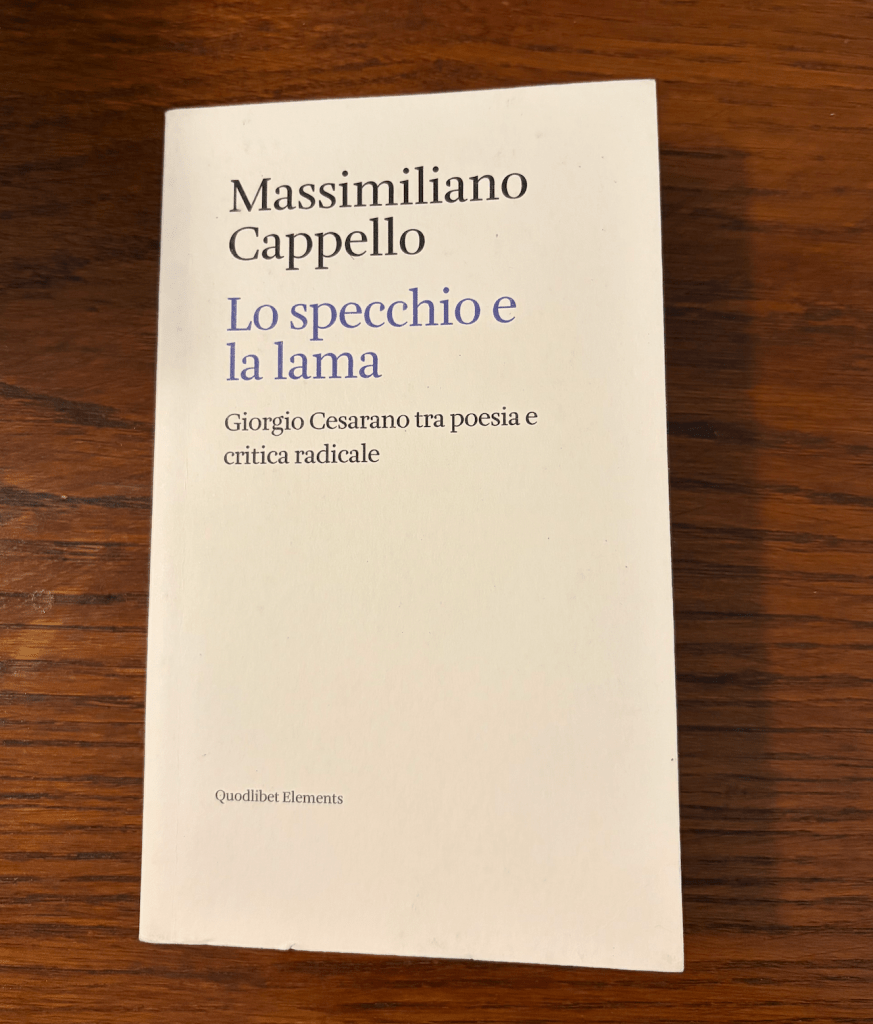
One has to begin by saluting Massimiliano Cappello’s Lo specchio e la lama: Giorgio Cesarano tra poesia e critica radicale (Quodlibet, 2026) for being the first book on the Italian thinker that takes an obvious point of departure that for too long it has been ignored: the well known fact that first and foremost Cesarano was a poet. At the heart of Cappello’s argument in his short monograph, however, is the thesis of continuity between his later philosophical thought, located under what has become known as ‘critica radicale’ of Italian 1970s, and that of his poetic laboratory. A poetic laboratory that Cappello magnificently documents in its genesis with post-war Italian poets and critics. The young Cesarano of the late fifties and early sixties was an avid interlocutor with figures such as Vittorio Sereni and Andrea Zanzotto and Eugenio Montale, and of course Franco Fortini, who introduced his first poetry collection L’erba bianca (1959).
In the milieu thematized by Cappello first chapters, it is evident that Cesarano the poet was a bit of an outsider, not really the man of letters of Italian postwar culture, as he was already looking for something like a renewal of a sensible experience that was becoming increasingly commodified and dead (Cappello 29). Albeit the mannerist tropology of the early L’erba bianca, Cappello notes that already in subsequent books, Cesarano’s preoccupation was that of mirroring of language in world that was oriented towards the highest stage of human alienation and emptiness. For Cesarano the history of human civilization was the successive stages of the reification of the human towards “survival”; a wound that was overtly present in the very texture of language. And poetic language as no exception; remaining oblivious to this totalization could only make the poet an harlequin among ruins of his present, always hungry for fictitious meaning and illusory transcendence.
Cappello tells us that already L’erba bianca staged the originary trauma of the impossibility of poetry, which shed lights unto his later transition into the prose of the ‘critica radicale’ – and in fact, one could only wish that Cappello would have said more about the transition between poetry and prose, which is also at the center of this intense autobiographical experience. In any case, the repression of the trauma starts to become more palpable in books such as La pura verità (1963) La tartaruga di Jastov (1966), and Romanzi naturali (1980), where the moribund plane of factical life not only becomes “apparent”, but it is situated at the very level of the fictitious appearance (some of the language is truly dreadful, and one can understand why Cesarano at some point could not longer follow that route without stepping into a vulgar expressionism, or, to that effect, the Lukacsian ‘naturalism’).
Cappello tells us that for Cesarano the evil of the experience of National Socialism and fascism, was not just a political system that took place at the heart of Europe; it was a phenomenon that extended into the totality of culture and life under total capital (Cappello 75). This is a bit like Pasolini’s position, except that for Cesarano there was no medium from which one could stay afloat and find an exit. Cappello cites these verses from La pura verità (1963): “…divorati dalla terre per / dal verme / che’sera / dal verme che s’era ricominciare” (Cappello 77). It does not come to a surprise, since for anyone that has read Cesarano & Camatte already in the stage of ‘critica radicale’ and ‘Invariance’, the only chance for the liberation of the generic human community (Gemeinwesen) was to start all over again, that is, from the point of view of the prehistoric inversion [1]. In the milieu of Italian literary culture, one has to agree with Cappello’s assessment: to start all over again means to start “dopo Fortini”, to leave behind the function of the critic and the writer, two beautiful soul functionaries (but functionaries nonetheless) mediating between the spheres of culture and politics in the public life. But to start again means to recoil to a hole in the temporality where the becoming of that social totality is no longer possible; even at the risk of losing the lyricism of modern poetry from Virgil to the present. This is most difficult task in a sense, because to “start all over again” seems to depart from somewhere else than language, but fundamentally we know that language is the event of every commencement. This is perhaps the aporia that runs through Cesarano’s own impossibility to effectively “finding a way out”, except a catastrophic one that we know all too well.
Can there be another resource in the face of the mounting pressure of the Spectacle and what Cesarano later called the “un-essence” (inessenza) of the Capitalist international and nihilism? In La tartaruga di Jastov (1966), Cesarano opts to still name this nothing through a giant turtle that Cappello tells us that it is a symbol of gigantomachy very much like Melville’s white whale. It is a very intelligent parallel that needs to be unpacked. Of course, Melville’s Moby Dick is the monster of the new American dominance over land and water; the monster of the incipient industrial division of labour through the whales’ oil business that sedimented United States’ nineteenth century economic growth. In contrast, Cesarano’s enormous turtle is the symbol of what takes place at the end of formal capitalist subsumption, once surplusvalue colonizes the totality of human temporality. A seamonster slowly creeps into the land signifying absolutely nothing, and yet dominating every directive of sensible reality. In the formless time of the turtle, there is no epic to be written nor a lyricism capable of offering emancipation from its images – as Cappello tells us, there is a state of infancy and innate failure (Cappello 101) . And if poetics is anything it stands alone in documenting that failure, the irreducible site of the nascent fragment, as in Schlegel’s dictum. Cappello reminds us that Cesano thought it was be infinitely worse: poetry had become a game and a publicist “operation” (Cappello 110). The autonomy of lyrical poetry could not deliver to the highest task; that is, to “recover another sensibility with the world at the heart of the epoch”, as Cappello puts it towards the end of the book (Cappello 115).
The interior of the world of un-essence (inessenza) for Cesarano will revolve around two competing figures of radical evil: the hitman (sicario) and the collector (entomologo). The first is the paid assassin that sees a price in anyone’s head, whereas the collector will be the administrator of corpses and moribund passing of beauty to be consumed. It is a world without possible evasion, because both living and dying have been rendered indistinguishable, and perhaps also unthinkable and unsingable (Cappello 127). This is Cesarano’s most extreme indictment to the late modern epoch, in which the hallucination of fictitious languages will still provide the illusion of actual living human beings. In this hellish world, it is not up for the poet to prepare a fresh start, and yet language still remains. Cappello concludes where our task begins: “Che il reale attenda una lingua non alienata per potersi esprimere compiutamente, può anche darsi. Questa lingua non sembra essere, in ogni caso, quella della poesia” (Cappello 138). And it might be the failure of language what awaits and invites the possibility of a different beginning.
.
.
Note
1. On the notion of “inversion” in Giorgio Cesrano in relation to Jacques Camatte’s thinking on the prehistoric, see my conversation with the thinker in my book Pensamiento insumiso: Coloquio con la teoría italiana (Irrupción Ediciones, 2024).
Just a few days ago there was an esoteric exchange between Giorgio Agamben and Alberto Moreiras on the difficulty of the ‘other beginning’ and the ‘via di uscita’, a propos of a recent meeting on desecularization and theology that took place in Granada, Spain. The notion has been in the air for some time now, since two years ago this was the central problem in a 2024 meeting in Berlin. That the exchange was esoteric is not in question, since it presupposes undertaking the conditions of the conversation and papers of the meeting as well as multiple books from both Moreiras and Agamben, and I do not think that the nuances have been taken into consideration. But it must be noted that there is an exoteric dimension to the contention as well: Giorgio Agamben has favored the ‘via di usicita’ in different figures (mainly Pulcinella, Pinocchio, Hölderlin; and we know that Agamben’s overbeckian urgeschichte is a clear cut rejection of an epochal beginning); and, from his end, Alberto Moreiras has also thematized the other beginning of thought and aleotropic excess in his most recent Tiempo Roto (2025), which cuts through Heidegger’s thought, and thus not limited to what is understood as heideggerianism. I want to reject the idea that these two notions – ‘via di uscita and other beginning – are just two forking paths in postheideggerianism, as complicated as it is to go beyond Heidegger’s end of Western metaphysics. And I think – and in fact I am convinced- that both Agamben and Moreiras are soliciting something that radically escapes Heidegger’s thought even when it emanates from it; a bit like what Derrida says that the chôra escapes the categorial order of Plato even though it emerges from the Timeus.
There is no doubt that at stake is a breakthrough in thought. Of course, stating this puts a finger into something fundamental; but, alas, the devil is always in the details. I am in no position to unravel the implications of the two options – new beginning and via of exodus – and to that extent I am still taken by Moreiras’ interpellation in the first day of the meeting about my own position regarding the new beginning, which I am in no way ready to respond. Of course, Nicolas Poussin comes to mind (I cite from memory his epistolary words to Chantelou): “I am in the profession of mute things”. A claim of silence that in no way refrains from language and writing. Yes, I am no painter, although I am interested in painting and what painting can offer and donate to thought and philosophy. And we live in an epoch at the end of painting, and yet painting outlives everything as in a metaphysical remnant, as Kurt Badt reminds us in his great work on Cézanne.
Giorgio Agamben notes in his little Il tempo del pensiero (2023) how Heideger declared his Le Thor seminared that he always thought that Cézanne was the other figure of the tradition that resembled his own path. It is a curious analogy to a painter and the painterly praxis in the age of technological subsumption. Or perhaps I am reading too much into it, since I am working on a small book on the communication between painting and thought, and I want to understand what painting has to offer.
As a preliminary response to the difficulty that emerged in the ‘new beginning’, I am left wondering if the threshold is an intermediary space to arrest the jump beyond nihilism, which is ultimately what is at stake. This has been my way- I am all for changing that – of reading Agamben’s work: to remain at the threshold in order not to force the overcoming of nihilism, even if that anti-nihilism takes the force of antiphilosophy or thought of the unthinkable (Moreiras). Can thought breathe from the rest and imperturable dwelling in the threshold, if understood as mediated by the hand and the eye at a distance? This is for me the problem of painting as the last activity at the end of metaphysics – a theological remnant that intercepts the reduction of a historical cosmos. A duration that escapes the regime of the ontic but that does not dare to point to transcendence nor does it accept the inevitability of anthropological struggle. Yet, duration is the condition of breathing in a landscape: if we face it, is there even the need to begin or retreat?
At least since Ernst Böckenförde declared the end of secularization and the exhaustion of the liberal state form in the late sixties, the distinction between theology and politics has experienced a profound schism across Western social life, which once served as the ground and mediation to the homogeneity of “ethical life” (Sittlinchkeit) of civil society. It is still useful to recall Böckenförde’s theorem as a refresher: “What does the state live on, and where does it find the force that sustains it and guarantees its homogeneity, after the binding force emanating from religion is no longer, and can no longer be, essential for it? Until the 20th century, in a world that was first interpreted in a sacred way and then as a religious world, religion had been the most profound force involved in the political order and in the life of the state. But is it possible to find and preserve life in a completely earthly and secular way? […] Therefore, the question of binding forces is raised again, and now at its true core: the secularized liberal state lives on prerequisites that it can no longer guarantee” [1].
Indeed, one could say that in our era, clearly marked by the collapse of political mediations and categorial order, the schism between theology and political forms inherited from the Judeo-Christian eon has increasingly become full fledged and patently visible at a global scale. In a certain sense, and leaving behind all nuances, the operating horizon of thought today implies from and through the energy of this schism. If this meeting attempts anything however modest, is precisely the intuition that in the wake of the schism of political theology, the “theos”, following the trumpeting of the death of God proclaimed by Nietzsche or the flight of the gods as orphanage from the divine declared by Hölderlin, presents with an opportunity to think a non-rarefied style on the reverse of historical collapse. In recent years, a certain theological latency has been present in many contemporary theoretical projects, insisting on approaches related to mysticism and life, the gods of language and nominalism; the insistence on the communication between souls, the messianic and presence, to name just a few figures of thought without pretending to be exhaustive.
As machination and the spiritualization of technology subsumes the totality of social life in the West, existence enters a region of thoughtful and cunning marranismo, which could be taken as a form of life in the desert and a keeper of its depth of the ethos. How does one make sense in this moment of delirium and relentless decline, which include although it is not limited to, the defeat of the cycle of global uprisings and the solicitation of positions of exodus and desertion? In other words, we are trying to think of a language that we speak across distant places, and come to terms with the tonality of pain and despair. Is there a non-nihilistic way out of a civilizational project governed by the cybernetic dominium, continuous predatory extraction and lethal destruction of worlds? “Desecularization” is not naming a historical moment after “secularization” – something that has taken place in its own historical dispensation – just like posthegemony is not naming a temporal sequence to principial hegemonic politics. And of course, “desecularization” is not a program of any sort, although it is interesting in positing the possibility of “a new beginning” in the wake of the ruin of political theology as the orienting strategy of division and orderability, which fundamentally colored capitalist civilization on the abstraction of work and the work of abstraction proper to the historical modulation of Christian metaphysics and its theological rubrics. And if “desecularization” is neither a concept nor a program, I still would like to retain at least its resonance to other positions that have I have called for lack of a better term, the quadrant of positions of refusal [2].
Can theology, a confrontation with theology, drag us out of the via negativa towards something else? It is easier said than done. And it is never sane to get caught up in the spinning wheel of a term, whether it is “desecularization” or “desistence”, or “destitution”; a sort of rhetorical enchantment of the “-des”. Ultimately words say very little at the level of the concept, and they tend to offer a cell in which the process of amnesia and ratification can take place – the task of refusal, then, I take it, is also watching over, what the Cappadocian Fathers called the nepsis – what thought cannot elevate to the luminosity that emerges from the term. We are interested in theology and theos, but only insofar it opens itself to thought and the place of language, as well as the irreducibility of existence and death, to the imagination and the endurance of an ethics that undeniably invites makes itself present whenever we hold on the incommensurable distance between language and world. And if we have invited both Monica Ferrando and Alberto Moreiras to open up this seminar with us, it is because their styles of thinking are clearly devoted to pursue this question to the end. Of course, this means something consequential: they both affirm a path wherever it might take them (one can even visualize this in Monica’s extraordinary nocturnal paths in painting, such as the series “Paessaggio Perduto”, or “Lost Paths”). And it is a commonplace to say that both of them have been grappling with the problem of theology from almost opposite directions of the meridian distance awakened to the horrific abyss of our present, which means that perhaps the marrano and Pan do meet as fugitives in the forest passage both lost and found.
One word must be said about the term that is meeting is trafficking with – and perhaps “trafficking” is, alas, a good verb since none of us (perhaps with the exception of one person, and even he might feel stranger with that label) are professional theologians, nor do we have access to revelation, but perhaps this is too much on the side of intimate matters that one should refrain from commenting upon. Of course, the trafficked word is “desecularization”, which alludes to a certain rupture with the very essence of the saeculum, or the political institutional authority and its institutional arrangements in this world. When Schmitt says that all political concepts of modernity are secularized theological concepts, he is also assuming the irreversibility of secularization as internal to the historical matrix of Christianized West. In fact, according to theologian Robert A. Markus, desecularization has already become operative within the early Christian epoch of Saint Augustine. In his Christianity and the Secular (2006), Markus writes the following: “[in dialogue with Peter Berger] We may leave sorting out the complexity of that relation to the sociologists. All we need to note for our purpose is that the reverse, what some have called ‘desecularization’ has become a more recent preoccupation of sociologists of religion – and not only of sociologists. “This is just what came into being in the course of the emergence of Western Christendom from Roman Late Antiquity – a ‘deseculariation’ which is the reverse of what happened in the Wars of Religion. If the notion of the secular were to apply in such a society, it would have to be defined in more problematic terms: as what does not form part of a religious discourse … .The core of my argument in this book can be briefly summarized. Its substance is that Christian tradition has a legitimate place for the autonomy of the secular, even though for many centuries this was eclipsed in its awareness, and despite the perpetual undertow of what we have become costumed to call ‘triumphalism’ in Christian political and cultural attitudes” [3].
Of course, as Märten Bjork has recently shown, in Markus’ theological understanding of the saeculeum, the government of the Earthly city grounded in principial politics must also be relativized by the eschatology of the Kingdom – facing the event of death and the dogma of resurrection of life – that can take step back (or beyond) the libido domininandi, that generates the solipsistic desire for government and administration necessary for the circulation of a “libidinal economy” [4]. We can thus call the Markus’ position as the architheological position that dissolves the polarity of secularization and desecularization as an enterprise of Western philosophy of history and its homogeneous temporality of survival and reproduction. Secondly, it is also important to note that the notion of ‘desecularization’ made an important entry in the famous Capri conference of 1994 organized by Gianni Vattimo and Jacques Derrida, where the French philosopher mobilized Plato’s chôra to avoid relapsing into religious faith, and thus uprooting revelation as the ur-site of Christianity. Thus, for Derrida, ‘desecularization’ is a figure of thought that seeks a third space of the a priori of the nonsecularizable. In the brief dossier “Christianity and secularization” later published in Il Pensiero: Revista Di Filosofia in 1998, Deridda sheds light unto this path of his thinking, which he never fully develops:
“….. The desert, the figure of the desert, which we discussed extensively in Capri, is clearly charged with biblical memory; and it’s not enough to say desert, or even “the desert grows,” to achieve or, conversely, abandon secularization. The desert within the desert is a radically heterogeneous desert. The motif of the chôra serves me, in general, as a guiding thread for thinking about a place, and chôra means place, to take place; and of the event, it is said that it takes place, and chôra means place or spacing, interval. This is a place that is, to use Plato’s terms, neither sensible nor intelligible, and which is spoken of in a bastardized discourse, in that it gives rise to neither a metaphorical nor a proper language, and in Plato’s text itself, it escapes all Platonic concepts and even Plato’s self-interpretation. This place is neither divine nor human… The chôra is the place where the demiurge, gazing heavenward, contemplating eternal ideas or models, inscribes the sensible copies for the formation of the world. Therefore, it is neither sensible nor intelligible, neither human nor divine; it is absolutely impassive, totally neutral with respect to all conceptual or dialectical oppositions; it is therefore the place that resists any reappropriation or reduction within the poles of anthropotheology. Chôra is that which cannot be reached even by a discourse of negative theology” [5].
The nonsite of the chôra is also what is heterogenous to the polis, and so for us the absolute differentiation between chôra and polis is precisely as important, and parallel to Monica Ferrando’s distinction between the musical nomos of the mythic topos of Arcadia, and the modern allocation of the nomoi of spatial dominium as appropriation, concrete order, and reproduction; the three pillars for the constitution of the ideological revolution of survival. Of course, the chôra can be said manifolds, but it allows us the temptation of political subsumption, of an inversion of a new “theological political” (as it is already taking place in many circles in the United States, with the unfortunate but expected in Leo XIV as equidistant, alas, the new self-delegated commissar of an “Anti-Cybernetics” point de capiton. Alas, once again hegemony knocks at the door, this time with theological garments). This reservation speaks, if not directly, at least tangentially to Alberto Moreiras’ recent affirmation against the ‘retheologization of the world’, which would entail the hegemonization of the total space of social reproduction [6]. Here we might find room for fruitful dispute and elaboration. Indeed, because it is never about re-theologization of the world, but perhaps in the old formulation of Guy Landreau and Christian Jambet’s L’Ange: Ontologie de la révolution (1976) that any gesture of true refusal or revolt requires at least the partition of two worlds, if we are to avoid the eternal dialectic of desire between Master and Rebel that nourishes the ideological projection sustained through the amnesia of any ethical elaboration.
Perhaps by ‘desecularization’ we are pointing to an exit through the liquidation of this world, in the same way that the task of thinking is a schism against calculative representation and the eccentric plane of objectivity. As Landreau and Jambet claim in El Ángel (1979): “There are two kinds of thought, just as there are two worlds: one kind of thought that belongs to God, and one kind of thought that belongs to the world; one kind of thought entirely devoted to salvation, and another kind of thought animated only by an abject desire for knowledge—a searching thought, vain curiosity: precisely what we, intellectuals, philosophers, call Thought. Gregory of Nazianzus famously asserted that one can philosophize safely about the world, about good and evil beings. The monks, on the other hand, responded to him with the words of Sirach: ‘Do not seek what is too difficult for you, do not scrutinize what is beyond your strength. The simpler the symbol, the better” [7]. In other words, against the absolute immanence of an infernal materialism and its frozen fictions of the immaterial – where all that exists subsists as equivalent – there is a reality of the soul, the abolition of sexual difference, and by that matter the libidinal bond that generates the autonomy of the revolt of the Rebel perfectly comfortable under the shadow of the Master [8]. In this sense, if another parallelism is allowed here, the chôra is the collusion of the outside world to the polis in order to start anew from scratch from the site of the sensibility of our existence.
If this position has been repeatedly called “gnostic” or maniquean by the executioners of modern irreversibility, so be it [9]. And perhaps these critics are right, and we can grant them that much: already Susan Taubes noted with scholarly precision that there are even Gnostic elements in Heidegger’s thought, even when his polemic with the architectonics of metaphysics becomes explicit against the reduction and adequatio of the medieval Aristotelian metaphysics, opening himself to a secret and clandestine tradition, in which the last god has his recollection in the excess or abyss of all vital experience (erlebnis); in what is outside of life at the entrance of another world [10]. The overcoming and taming of the gnostic manicheism has been precisely the infrastructure through the rarification of Christian theology took place – in Landreau and Jambet’s terms – which transforms the conditions of the cultural revolution (existence) into an autonomous and spectral ideological productivity, which is the limit in which theological contemplation narrativizes itself into Christian community of salvation once necessity and deficiency bind you to political dominion – it is here where the Master and the Rebel coincide in their projected goals: that there is nothing other than political struggle. But the gnostic culture of existence never disappeared as readers of modern poetry know well, even though that might not be the site for the emergence of the angelic life of beatitude today either.
As Pacome Thiellement says towards the end of his beautiful The victory of those without kings: gnostic revolution (2025): “In the absolute embrace of those without Kings, the fading of the initial eroticism is transmitted in every instant of life. It creates neither anger nor remorse, but rather gratitude and a multiplication of protected powers. It appears at the moment when solitude is profound, not from the absence of love, but as a consequence of the pleromatic state inscribed in the man with memory: the overflowing of unitive eroticism into all the possibilities that life offers, whether in this world or others” [11]. It is this theology of the infraworld – not so much of heaven, but of a memory of the worlds and the humus of the dead that becomes one with the mirror of the heavens – allows the metaphysical gnosis to breathe out in thought, allowing for the pending encounter with the metaphysics of the schism of n-1 worlds to emerge [12]. It seems to me that this subtractive movement brings back, in interesting new ways, a metaphysics of purity and inoperativity; an imperturbable existence no longer seduced nor corrupted by the images of this world.
.
.
Notes
1. Ernst Böckenförde. El surgimiento del estado como proceso de secularización (Editorial Trotta, 2024), 45,57.
2. Gerardo Muñoz. “Quatre positions du refus”, in Entêtement: Tenir une sensibilité (Pli, 2024), 20-26.
3. Robert A. Markus. Christianity and the Secular (Notre Dame Press, 2006), 8-9.
4. Märten Bjork. “Deliver me from my necessities: R. A. Markus and Erik Peterson on the End of Law”, Political Theology, Junio 2026, 13-14.
5. Vincenzo Vitiello. “Cristianesimo e secolarizzazione”, in Il Pensiero: Rivista Di Filosofia, XXXVII, 1998, 155-157 .
6. Alberto Moreiras. “Gnosis marrana”. Paper read in Universidad Complutense, October 2025. Unpublished.
7. Guy Lardreau & Christian Jambet. El Ángel: ontología de la revolución (Ucrania, 1979), 128.
8. Ibid., 105-106.
9. See, José Luis Villacañas. Tierra o Ser. La gran decisión de la filosofía contemporánea (Akal 2026), specifically the section “Gnosis y excentricidad”, 416-419. His recent column against Heidegger’s philosophical legacies and afterlives also deals with the gnosis, see “Heidegger, a la distancia de medio siglo siglo”, Levante, May 25, 2026: https://www.levante-emv.com/postdata/2026/05/23/heidegger-distancia-medio-siglo-130551106.html
10. Susan Taubes. “The Gnostic Foundations of Heidegger’s Nihilism”, The Journal of Religion, XXXIV, Julio 1954, 160-162.
11. Pacome Thiellement. La victoria de los Sin Rey: Revolución gnóstica (Granica, 2025), 159.
12. It is notable that Derrida in the exchange with Vitiello, Vattimo, and Ferraris already cited, he goes out of his way to claim that he never had anything against metaphysics per se. Could the same thing be said of Heidegger if one posits the differentiation between metaphysics and the holy, and onto-theology and the adequatio of Medieval Aristotelian metaphysics? Along this line, Laurence Hemmings has suggested a fertile dialogue between Heidegger and the sacred in his Heidegger’s Atheism: The Refusal of a Theological Voice (University of Notre Dame Press, 2002).
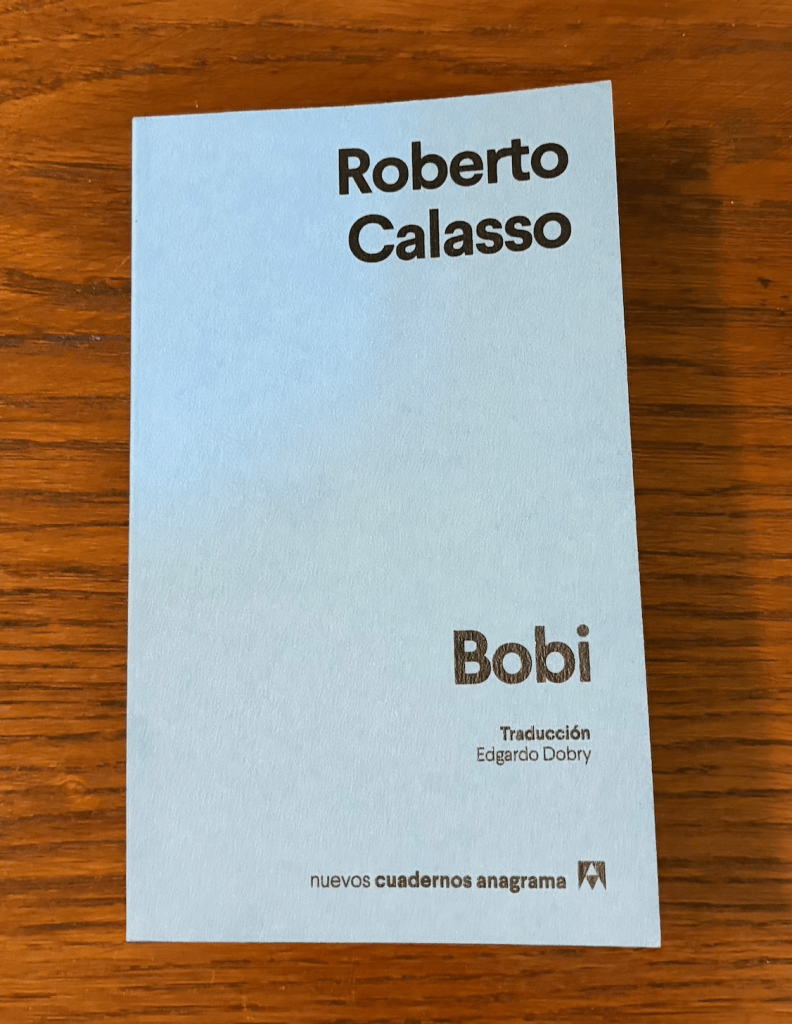
Roberto Calasso’s short and epigrammatic posthumous book Bobi (Anagrama, 2026) on the opaque figure of Roberto Bazlen has just appeared in Spanish. It is a nebular autobiographical book that does not attempt to render legible the subterranean and oblique figure of Robert Bazlen, but rather to filter some of his obsessions and tonalities, many times through his own voice. Calasso is well qualified to write such book as a frequent stroller companion of the anonymous man of Trieste. There is no aura of the detective mystery about the person’s auratic psychic life, establishing a sharp contrast to Del Guiudice’s polyphonic narrative in Lo stadio di Wimbledon (1983). But in this short memoir book, I am particularly intrigued by a moment when Calasso inscribes Bazlen’s vortex of thought and life as an affinity for the acoustic.
Calasso quotes Bazlen (we assume that from his own memory): “Bazlen used to say regularly: “This does not sound too good”, and immediately we knew what he meant. His capacity to recognize sound was thorough” [1]. Calasso tells us, moreover, that he cared little about cultural or intellectual polemics of his time. All that matter was sound, the grain of the voice. His meridian crossing was the song and rhythm of another. It is this proximity to the light of the voice what allowed Bazlen to conceive life and writing as a unified sensible reality; mutually interdependent, and always intertwined like the threads in a rigged tablecloth. To inhabit the world without judgement – of History, of morality, of punishment and guilt, of retribution – means to secure an aperture to an acoustics that will remain close to us, albeit incomplete, in the dissonance and impropriety of meaning.
To be able to attune oneself to the voice is a practice that retreats from the order of the world; that is, to descend into anonymity in order to inhabit a subterranean region, which speaks to Bazlen’s insistence on tugurios or spelonche, which Calasso does not hesitate to render as naked spaces, miniature deserts or caves to immunize oneself from the chatter of the world: minima chôra where something could take place or not. It is hard to define them but we know perfectly well what these are. Perhaps we can be more emphatic: to listen to the voice is already the encounter. And very much like Osip Mandelstam’s figure of the interlocutor, true poetics (and first and foremost that of life) “is ever moving toward that more or less distant, unknown addressee, whose existence the poet cannot doubt without also doubting himself. Only a reality can bring to life another reality” [2].
Bazlen’s notion of writing as the writing of life, experience as writing, very much like Mandelstam’s dialogic poetics, finds a tugurio so that language can emerge in absolute presence. And this is precisely what Bazlen understood in the becoming of life against the metabolic strain of survival, since the repression of the voice will result in the annihilation of what is most alive. Calasso recalls Bazlen’s affirmation: “In a world of death – there was an epoch where one was born alive and would later die. Today, on the contrary, one is born dead – and only a few are able, little by little, to be alive” [3].
For Bazlen there is no community of the living granted in immanence, because to live means to conquer the putrefaction of the culture of death, which is only permanent revolution and hostility. But one cannot conquer death from death; that is, by means of the beautiful soul’s literary prose of the world. It does not take Hegel to say that this is still unwarranted insubordination and permanent bondage. What is then to be alive? It is a resurrection that takes place as an existential decision, that is “at a point in life when a fundamental decision has to be made. I believe that was his passion, and his masterpiece” [4]. This is Del Giudice’s indictment, although surely not fully at odds with Calasso’s autobiographical sketch of Bazlen. In the melodic contact the possibility of a vita nuova is transfigured in not-knowing because the Western modernity is devoid of any notion of ethical destiny. Indeed, “et tout le reste est littérature”, as Verlaine famously wrote. For Calasso’s spectral portraiture in Bobbi (2026), the adventure is to remain alive well beyond completion and needs, as evidenced in our encounter with his languishing voice and memory.
.
.
Notes
1. Roberto Calasso. Bobi (Anagrama, 2026), 83.
2. Osip Mandelstam. “El interlocutor”, en Gozo y misterio de la poesía (El Cobre Ediciones, 2005), 71.
3. Roberto Calasso. Bobi (Anagrama, 2026), 55-56.
4. Daniele Del Giudice. A Fictional Inquiry (New Vessel Press, 2021), 123.
It is noteworthy to remember that around the same moment in mid-twentieth century, two dissertations on the notion of sin were written by two emblematic representatives of late liberal political thought: John Rawls’ undergraduate thesis A Brief Inquiry Into The Meaning of Sin and Faith written at Princeton University in 1942; and only a few months later Torcuato Fernández-Miranda’s El pecado como concepto fundamental del problema filosófico, a través del pensamiento agustiniano (1943), a doctoral dissertation written at the Law School of the Universidad de Madrid. Both scholars would soon become exemplary figures of Atlantic liberalism in their own ways; the first developing the most consequential and systematic work of normative political thought since Kant; and, his Spanish counterpart, becoming the leading constitutional reformist in the Spanish transition to democracy and architect of the “Ley para la Reforma Política” of 1976 enacted that year in parliament.
Leaving aside major conceptual difference between the two programmatic works, what is symptomatic of them is precisely that a fundamental theologicalconcept is transplanted and weaved for the needs of a political vocabulary that aims at the reinvention of a tradition that could not longer sustained its own secular commitments to individual autonomy and the rational control of state authority. And if we are to follow Eric Nelson’s reading, the intrusion of the doctrine of sin in late modern political thought was the last nail in the coffin of a secularized Pelagianism that dominated the basis of the different normative projects of modern political theory.
In the new administered world the ground of mediation and legitimacy is wobbly and precarious, thus the notion of sin will infuse an exoteric desecularizing anthropology that ironically attempts to “save” politics through its impolitical other that deploys an instrumental conception of original in order to redeem human collective action through divine grace and mercy (clearly a benevolent inversion of Calvinist damnation). This is why in Rawls’ dissertation levels a critique of individual egotism and moral arbitrariness through the operative efficacy of sin. Rawls traced this morphology from Philip Leon who had already articulated it in his Ethics of Power (1935): “What is the nature of this delight in sin itself? It is, Augustine suggests , a delight in at least a factional opposition to the right, in doing unpunished what one ought not to do, in an imitation of godliness, in a shadowy symbol of omnipotence in the search for a shadow – in sort, in the romantic adventurous for the absoluteness” [1]. What political thought in its reduction of civil society– now distinct from the source of authority and concerted legislation – will craft is the regulatory and counterbalancing mechanisms of social ordering without exception. Precisely, one could say that in the wake of the introduction of sin into late political philosophy the new heresy becomes the shadow or the conspiracy against the social domain that will amount to absolute infraction, a plain crime.
If the primal scene of sin originally emerged in the context of a fratricide – and thus, in relation to the dead and to the burial and wandering, which will lead to the justification of territorial settlement – it is altogether symptomatic that this snapshot of the slowpaced instance of desecularization appears as a force that only makes living possible within the social bond, fusing Kingdom and justice, compensation and salvation, punishment and rewards, retribution and distribution in an endless cycle that, because it has lost any mediation to redemption, it can only outlive itself by the coordinating services of social force (and there is no surprise that post-rawlsian thinkers precisely developed a theory of exclusive positive law from the conception of service).
One of the consequences is this mutation is that it allows us to think how the end of secularization is not just the usurpation of the theological sphere, but also the realization of the subsumption of human deficiency and stratification as social leveling (a central operative notion that will later enter Rawls’ A Theory of Justice with decisive consequences) will offer legitimation through the total administration of social life even when done in heuristic ideal of a “classless society” dependent on the enforce of a “priestly service” (hierourgounta) that deifies itself as an indivisible administrative of the social temple. Sin guarantees a vicarious subjectivity that is the starting point for implementing the social distribution of needs and services.
At this point, one can recall Erik Peterson’s humorous exposition of this closure that speaks to the ‘social progressive politics’ that still dominates well into our days: “There is perhaps no better symptom of this than the construction of roads between China and Tibet with the purpose to destroy the places in which there are still ascetic practices outside society…our capacity for leveling, as least theologically understood, will ultimately generate the collapse of Heaven and Hell” [2]. For Peterson, the inaccessibility of exteriority [of the desert of the Fathers, and the ‘desert of deserts’ that opens a place] leaves us with the unbreathable and darkening atmosphere of the Social.
.
.
Notes
1. Philip Leon. The Ethics of Power or the Problem of Evil (George Allen&Unwin, 1935), 240-241.
2. Erik Peterson. “Fragmentos”, in Tratados Teológicos (Ediciones Cristiandad, 1966), 251.
I remember that around 2007 there was a graffiti in Venice that read: “Non c’è nessun Virgilio a guidarci nell’inferno”, which can be rendered as “There is no Virgil that can guide us in this hell”. Many street graffitis come and go, and are easy to forget, but not this one. What does it mean that we live in an epoch without the company of the Roman poet Virgil? The suggestion prima facie is quite clear: if our voyage in the present entails a concrete hell (the subjection into economic domination and nihilism), it is an evermore so repulsive voyage as we lack the presence of the poet who can bear witness to the passing of an epoch and the possibility of the coming of a new earth.
But why Virgil? As Erich Auerbach already noted, for Dante the historical Virgil is both the poet and the historical witness, given that the Roman poet’s exemplary descent into hell was the preparation of a “terrene Jerusalem (earthy Jerusalem), the universal peace that came to pass during the Roman Empire, proposed and glorified in light of its future mission…Virgil led the way as a poet because of his description of the realm of the dead; he was thus a guide through the afterlife because he knew the way. But it was not only as a poet that was destined to lead. He was destined because he was a Roman and a human being” [1]. It would follow that an age dominated by the realization of absolute indifferentiation – this is the frame of nihilism after all – highly repressive of any proximity with the dead, can have no use of any Virgil even if one would offer to open a path to leave hell behind. The artist will not be understood or recognized as either human or poet, but rather taken as fully inhuman and incomprehensible. And this perhaps speaks to the tonality of terror and blindness that defines the undifferentiated suspended posthistorical time.
That there are no Virgils to cast a forward light outside the epocal hellish condition entails that we are left with an absolute politicization over life and death that takes the form of a novel technical imperium. We know that in Antiquity, political unhappiness and disarray was a common state of affairs (and also exile from civil life); life was conditioned, although not totally subsumed, by cycles of domination and insubordination during volatile civil stasis. But still in that historical epoch, a poet like Virgil, as both human and poet, was able to turn away from the “harsh and evil world, and sets out for Arcadia where he allows no hope, not even any desire to do something about the suffering world, to lighten his sorrow and despair” in the communion of friendship and concordia to retreat from static political absorption [2]. When we say that our predicament is that of a a world without Virgil, this should not be understood as a reiteration of Max Kommerell’s paradigmatic Jugend ohne Goethe (“a youth without Goethe”); but rather, more fundamentally, as the impossibility for the human species to imagine a sense of redemption in world that reduces itself to exchange and strife. In other words, the absence of the memory of Virgil speaks directly to the ever-increasing incapacity of existence to dwell beyond the imperatives of a calamitous attenuation of destruction and oblivion. We should keep in mind that Dante’s memory of Virgil was a symbol for the poetizing myths of a new life; and, in turn, Virgil’s own Arcadian nomos was the confabulation of reality and myth expressed in a language that measured itself against the orderability of imperial force. The triumph of total politicity, which is to say the coupling of the political into effective dispensation of technology, mutes not only the voice of the poets, as much the contact of speech and the passing of the world into nothingness.
In The Death of Virgil, Hermann Broch describes this very passage through the mystical death and cosmic transcendence of the Roman poet himself, who now enters “a primal darkness which had held itself hidden behind the furthermost starry orb and now, independent of the arching path of lights, indeed, without putting out a single one of them it filled the dome of existence with impenetrable darkness: the essential world-darkness burst forth, that uncreated darkness which is infinitely more than the mere loss of light or absence of light…” [3]. For Broch, the passing of the world in the wake of the death of the poet does not coincide with the silence constitutive of speech, but with the severability of a language transformed as fully transparent and unmediated, in Broch’s words “all understanding, consummating, might and commanding; the world of pledge, the pure word, becoming so overpowering that nothing could withstand it” [4].
Extrapolated to our times, the liquidation of language takes form of absolute theatricality of the word, ascending to rhetorical and computational transparency. And in this unnerving cacophony, where everything is communicated, is realized in the historical project of cybernetics and automatized languages. The ethical texture of speech becomes unattainable for both humans, as poetizing beings, as they become incapable of inhabiting the dislocated abyss between myth and reality, now pivoted to a linguistic closure that commands them into the high noon of despair. An endless despair that has relentlessly lost with the inception of the divine.
.
.
Notes
1. Erich Auerbach. “Figura” (1938), in Selected Essays: Time, History, and Literature (Princeton University Press, 2014), 108
2. Bruno Snell. The Discovery of the Mind (Dover Publications, 1982), 293.
3. Hermann Broch. The Death of Virgil (Vintage, 1972), 471.
In the section of the unclassified “pensées”, Pascal’s meditation on the notion of “opinion” is so incandescent that it is hard to imagine that this was, in fact, written in age of deep religious conflict, an epoch increasingly transformed by the fascination of bodies in space (this is the substance of the counter-reformation and the Newtonian thematization of the limit afterall). In particular gloss 554 strikes a tenor for our current epoch: “Power rules the world, not opinion, but it is opinion that exploits power. It is power that makes an opinion. To be easygoing can be a fine thing according to our opinion. Why? Because anyone who wants to dance the tightrope will be alone, and I can get together a stronger body of people to say that there is nothing fine about it” [1]. In the world after the fall, the intramundane system of felix culpa, is already one of dual power.
In many respects, this image is stronger than that of nihilism as the oblivion of walking upwards gazing at the abyss, because it connects the social pressure of “opinion” to that of the common ground that makes out of blindness the legitimacy of vacuous enlightenment. In the very void that truth will carve out for authority, Pascal seems to imply that the imperium of opinion will reign as a dual power of administration and mediation with the world. This is why for Pascal, force without opinion is indocile; but opinion without force amounts to the persuasion of solitude of the last man in the earth. At the heart of the groundlessness of modern legitimacy there is the necessary organization of opinion or doxa that will regulate the community of the living and the dead because ultimately its end is to master the mystery of language in its inability to name.
Of course, Pascal thought that language could overcome the fictive empire of opinion, which in its modern avatar of propaganda is meant to design apocalyptic tendencies towards self-destruction in the course of historical development. As a “properly speaking wholly animal”, the human can only dwell in a poetic region “entre-deux”, that is, between the abhorrent light and the infinite depth of darkness, where language endures through the symbol well beyond the experience of the fallen corruption of nature. As Lezama Lima reminds us in a short essay on the French thinker, the poetic region in Pascal is ultimately the experience of language as a mystery of creation that refuses to accept the post-mythic condition of nature and human boredom that will euthanize the use of linguistic creation [2]. Now it can be said that the intrusion of the infinite chatter of opinion takes place precisely in the logged forest of speech, which consolidates its rhetorical autonomy of language away from the possibility of distance and self-constrain of the sayable. The statecraft of rhetoric is the infrastructure of the reign of opinion, because here the draining of the depth of being is supplanted by alienated voluntary participation at the very ground of nothingness. Nihilism takes a decisive step forward when language can become any differential sign to communicate what has become impossible to be said outside the cubicle of the enthymeme.
Paraphrasing the ancient wisdom of Pindar’s famous opening verse in Fragment 169 (“Law, νόμος, the king of all”), Pascal assures us of the fragility of this imperium: “An empire based on opinion and imagination resigns for a time, and such an empire is mild and voluntary. That force reigns for ever. Thus opinion is like the queen of the world, but force is its tyrant” [3]. Is it possible to separate, nevertheless, the reign of opinion from that of force; and, secondly, the circulation of force as grounded in a fabric of language that has already descended into the empire of opinion without any trace? In a way, there is no modern politics without the presupposition of the autonomy of a field of opinion integrated into “rational control”, to use the expression of American political theorist Harvey Mansfield. And even if Carl Schmitt could state in his Constitutional Theory (1928) that no democratic secular state could effectively exist out without opinion as a diffused and disorganised form of acclamation, it is now completely obvious to us that the post-liberal state configuration, persists in a constant state of the fluctuation, compartmentalization, and archic steering of opinions. What survives the utter collapse of the category of political modernity is the flattening of language into “opinion” that provides standing to the epochal anomia.
Following classical philologists we are tempted not to ignore that in the word anomia entails not just the suspension of legislated norms and positive commands, but also the decline of the distance between existence and the divine that in antiquity, in the age of Pindar, subsisted under the notion of eunomia as harmonious attunement of the very lived experience. In other words, the consolidation of opinion is a long historical effect of the erosion of distance and perspective that restricts the capacity to “ascertain a spiritual excitement…and if worth anything, a language, a witness to reality” [4]. To bear witness in language is a poetic enactment that, at heart of its solitude, refuses the glacial ripples of the force of opinion vested in reality.
How to overcome the consummation of rhetorical force and the privation of language integrated to the transparency of the present? This is a question that weighs heavily on those that remain too attached and mesmerized by a present that ultimately remains unmoved, alien to any epochal breakthrough. Hence, the almost fetichistic fascination of seizing the “new”, even though the price to be paid is always on the side of an overachieving cynicism and hypocrisy mediated by discourses of all kinds. At one moment of his dialogue Eupalinos or the Architect, Paul Valéry claims that whenever deep reflection is pushed by raw force, this unnatural attitude almost always misses truth: “The truth, the discovery of the new is almost always the price of some antinatural attitude. The deep reflection is forced…we must do or suffer violence to see better or differently” [1]. The claim to see clearly beyond the immanent veils of the rhetorical commonplaces is still our question, although rarely posed. If our suspended epoch is that of formless rubble and extinction, one way in which this question could be reformulated today is to ask what does it mean to envision and live in the desert? Is not the desert condition, its suspended and dead temporality that gathers existence in the void, the only authentic event of posthistorical time?
This is the problem that haunts Dino Buzzati’s novel Il deserto dei Tartari, (1940), in which the waiting for an invasion and hoarding armies is conflated to the event of a wait that is infinite and excruciating, very much like the video art of Douglas Gordon at the end of the century. The steppe is a form of deserted land without forestation and depth; it is the very triumph of the symbolization of time stretched into a unified surface that recalls the emptying momentum of every form. It is nothingness as an absolute event, as Buzzati writes: “….the ramparts, the very landscape, breathed an inhospitable sinister air…At this moment Drogo was looking at the northern world – the uninhabited land across which, or so they said, no man had ever come. No enemy had ever out of it; there had been no battles; nothing had ever happened” [2]. How to account, and how to live, beyond mere survival, in a world nothing happens; that is, where the “nothingness” is the very schism between existence and world? When speaking hyperbolically of the Fortress in the steppe where the protagonist Drago is stationed, Buzzati will refer to this mundane condition as a “thankless world”.
It goes without saying that a world beyond “thanking” is a world that is unworldly in its sensible and intelligible mediations, because it no longer appears to grasp the irreductibility of presence; it needs to repress what appears figuratively in its disclosure. This is why in the vast openness of the steppe, in its blinding clearing of legibility, there is only blindness and hallucinations that are always compensatory to the pain endured by the nihilism of a disjointed time. The waiting of the barbarians does not longer hold the concept of prefiguration once held by situated or concrete politics (Turgot’s high-modernist axiom comes to mind: “we always perceive events too late, and politics always needs to foresee, so to speak, the present”); it is rather the impossible, contingent and retroactive narration that fictive communities need to elaborate to endure the ongoing pain at the end of the social bond. This is the price to be paid to survive in the glacial habituation of nihilism.
It might be very well that what can be glimpsed in the temporal wreckage of the steppe is nothing but the mute language of pain that brings presence near without political translation, because it is always an excess to the stabilization of forms. In an interview published in Milan’s Il giorno in 1959, Buzzati referred to the landscape of the steppe as “Nothing better than a fortress at the extreme frontier…it seemed to me, could be found to express precisely this strain of waiting”. But this strain of waiting is the thrownness of existence and its absolute distance from the world. In fact, towards the end of the novel we read a condensation of this inconspicuous tonality: “It was at this period that Drogo realised how far apart men are from their affection for reach, that if you suffer the pain is yours and yours alone, no one else can take upon himself the least part of it; that if you suffer it does not mean that others feel pain even though their love is great: hence, the loneliness of life” [3].
What remains is language not because it can describe or narrate, but because only the voice can measure up to the tonality of pain. In his short prologue on the Spanish edition of the novel, Borges claimed that Buzzati’s desert is both real and symbolic of the void, although the symbol no longer transmits any legible sense of totality; it prefigures a certain exhaustion of symbolization. The truth of language in the absence of form can no longer adequate itself to events or situations; it is now the voice that gathers the turbulence of pain in the waiting of the coming of presence already inhabited. Whenever that voice fails to speak, as René Daumal observed in his unfinished Mount Analogue (1952), life amounts to an empty carcass and a restless cadaver of oblivion. As presence fails to materialize in the world of forms and events, the only realist position is the conjuration of life as a form of expressive self-exile refusing to participate in the hallucinatory social pressure that desperately masks the serenity of a static and inapparent landscape – it is the passive eye that contemplates the plain silence of the steppe while preparing the schism for a possible transfiguration [5]. It is perhaps this passive contemplation what Andrew Wyeth’s faceless Christina laying on the grass has always been yearning for.
.
.
Notes
1. Paul Valéry. “Eupalinos or The Architect”, in Dialogues (Princeton University Press, 1989), 75.
2. Dino Buzzati. The Tartar Steppe (Canongate Books, 2018). 31.
3. Ibid., 220-221.
4. Jorge Luis Borges. “El desierto de los tártaros”, in Biblioteca Personal: Prólogos (Alianza Editorial, 1988), 22.