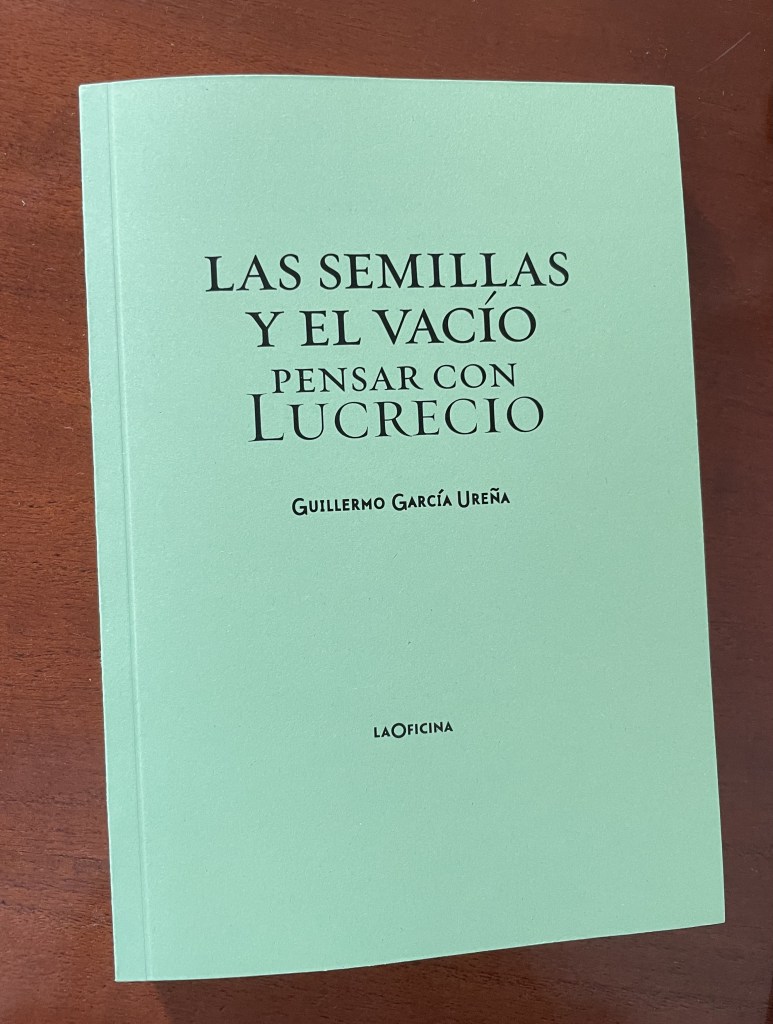
Lucretius’ poem De rerum natura is one of the most used and abused texts of the tradition, and like all classics it has had the most diverse receptions imaginable: the poem of modern science, a baroque expression of creationism for the English metaphysical poets, the precursor of historical materialism and atheism, and a tract of scientific positivism that laid the foundation for the regulation of nineteenth century social order. Once a text becomes an emblem, it usually means that it has lost its prehistoric imprint and place in the tradition. Against this backdrop, Guillermo García Ureña’s just published Las semillas y el vacío: pensar con Lucrecio (La Oficina, 2023) has the prudential gesture of disclosing the great Roman poem to its fundamental structure; attentively listening to its original complex articulation difficult to grasp with the categories of modern philosophical thought. In this sense, Ureña’s purpose is not to deploy another “philosophical account” of De rerum natura – endorsing and subscribing the influence of Epicurus and its later resonances in modern theories of physicalism and materialism of the continental schools – but rather to engage in its own ground exerting an original philological exploration of the text that opens up an array of different problems for thought. Whoever is looking for a “theory” of Lucretius will find none in this brilliant and well articulated essay. But the reader will find, nonetheless, a comprehensive hermeneutics of a text that stands as a threshold between the closure of Greek classical antiquity and the Roman reintegration of the tradition. Now, for Ureña De rerum natura proem discloses the originary understand of the epic, or épos, through which the stability of the things as they appear takes place; whether it is the Muses, the gods, being and language, the simulacra or the soul, the physical declination of creation (the atomic clinamen) and the final document of language invigorated in the corpus of the poem itself. De rerum natura is both a cosmology and a poetics with the ambition of elucidating the most obscure things of this world: Lucretius’ text defies a fixed representation through a choreography (a term that it is not used by Ureña, it must be said) that discloses the possibilities of worlds; the combination of worlds only to posit the question of how to live within them, which is another way of saying how to account for a form of life.
One of Ureña’s commitments is to hold on to Lucretius’ aesthetic and philosophical autonomy. This implies treating the influence of Epicureanism with great care; engaging with Epicurus insofar as the aesthetic autonomy and its loci of poetization reject the classical structure of the epic hero incarnated by the soteriological impulse of the great poet-philosopher (we know that this is the same problem that centuries later Hölderlin will identify through the tragic drama of Empedocles). Lucretius is writing after the twilight of the classical Greek genres. Furthermore, there is no community under an organized program of leadership and telos; on the contrary, there is only an existence that “one day will want to desert all of us” (41). True, the Epicurean notion of serenity (ataraxía) is retained and treasured; but only as the aspiration of every living being who seeks to transfigure the shadows of superstitiousness and fear that govern over the perceptive mediating forces in the world. In this sense, to dwell in the world does not consist in the limitless relationship with the simulacra; it is rather, the self-transformative exercise of freeing possibilities within the void in which forms of life can emerge. As Ureña reminds, the rainfall of the atom is as fast as that of thought itself. It is already an image of thought, as well as the figure of imagination. And the image of thought validates the history of cosmos as a patchwork of accumulations and deflections, creations and destructions, repetitions and disintegrations in a swerve of forms that infinitely recline on its ethical possibilities (139). It is altogether interesting that Ureña reminds us that, in fact, De rerum natura is not interested in staging the things in Nature; on the contrary, at the center there is the question of the ‘nature of things’ in the luminous expression of their irreducibility. This is what modern onto-theological closure brings to a process of domestication, whether through the composition of the civil structure (limitless exchange according to philosopher Felipe Martínez Marzoa, who figures prominently in Ureña’s book) or through the progressive historical structure commanded by the essence of technology that blurs the relations between forms and techniques.
If De rerum natura abandons universal history and historical narration, it is because its structure is profoundly kenotic: it can only be assigned as contingent historical transmission of the most immediate and sensorial (not necessarily “true” in the metaphysical sense) that allows the convergence of the history of forms of life and natural history (140). The operation of subtraction implies the transfiguration of freedom through the becoming of forms – their interests, constructions, and pacts (foedera naturae) as guarantee for a plastic relationship between things in a world that is always already a fragment in the void. The highly attractive Lucretian notion of foedera or “pact” (that expresses separation in coming together: a com-pact that de-compacts) is almost the inversion of the modern principle of irreversibility, if one were to take Hans Blumenberg’s legitimation hypothesis at face value. And this is so because a foedus or pact is insufficiently strong to resist the impact of the clinamen, but indispensable for the emergence of a body that materializes its own fate towards dissolution.
The lack of unity of being allows for the existence of simulacra as that which does not have sufficient matter to compose itself as foedera; and so, it is a material semblance as an image without figure that makes it an ephemeral entelechy. In this choreography between the downwards of atoms and ephemeral intermittence of events the taking place of the world emerges a topoi of a combination of rhythms that intertwine the weight of bodies and the animation of souls. The possible combination and stylization of multiplicities in separation is the way in which a form of life emerges as the desertion from superstition and fear that hinges upon the irreversible stabilization of a principle of reality. Ureña does not go this far into the wager of Lucretius’s text – and he does not have to in his close reading of the text – but it is precisely this thick dimension of the ethical primacy that makes Lucretius’ dislocated comprehension of materiality a vibrant tune against the weight of alienation that we are still struggling to abandon.
The struggle against the alienated life – the alienation from the world, and the external manipulation of the simulacra that has become a gnostic planetary form of “TV Democracy’ (Schmitt) of the “society of the spectacle” (Debord), which implies the usurpation of our imaginal and erotic relationship with the world – well understood, does not mean to relocate the confrontation at the level of political order; it rather, rests on what we have understood by order and disorder for the reconstitution of a happy or contemplative life (naturae species ratioque). This serene life declines the offer to negotiate at the arena of sacrifice and legitimate domination, favoring the event of friendship. At this point Lucretius comes closest to Epicurus’s society of friends – studied by Carlo Diano in an important 1966 conference in relation to the organization of the passions and the transmission of love – that can guarantee a content life in the presence of “other joyous gazes” (glossing Diano’s terms) away from the persistence of war and the compensatory administration of pain. This is the ultimate treat of De rerum natura: the exemplary dimension of the serene life takes shape through the community of friends, the civilizational invariant of the human experience (prehistoric times, the classical epoch, and in our times) that abandons the paradigm of perpetual war that obfuscates omnia cordi.
It is not too ambitious to claim that only at this point we finally grasp the full extent of the Lucretian épos: not just an ephemeral and contingent declension of the primacy of atoms in the void; but, more importantly, it can disclose the irreducibility of an experience with friends. Ureña wisely closest his book with an image of the “buena vida en compañía” (the good life in companion) that insists that serenity is only possible (or desirable) in the open landscape, a nowhere-land of an eternal foedera (or a sinousia, as it appears in Plato’s Symposium) that even if temporarily too short-lived or inconsequential it paints an earthly paradise just above the grass: “poder tendernos unos juntos a otros en el césped suave, cabe un arroyuelo, a la sombra de un árbol copudo, y regalar el cuerpo sin grandes dispendios; sobre todo si el cielo sonríe y la estación del año esparce de flores el verdor de la hierba (II, 29-33)” (203). It is this inconspicuous and mute experience that strangely holds on to the passing of the world.
 Infrapolitical Reflections