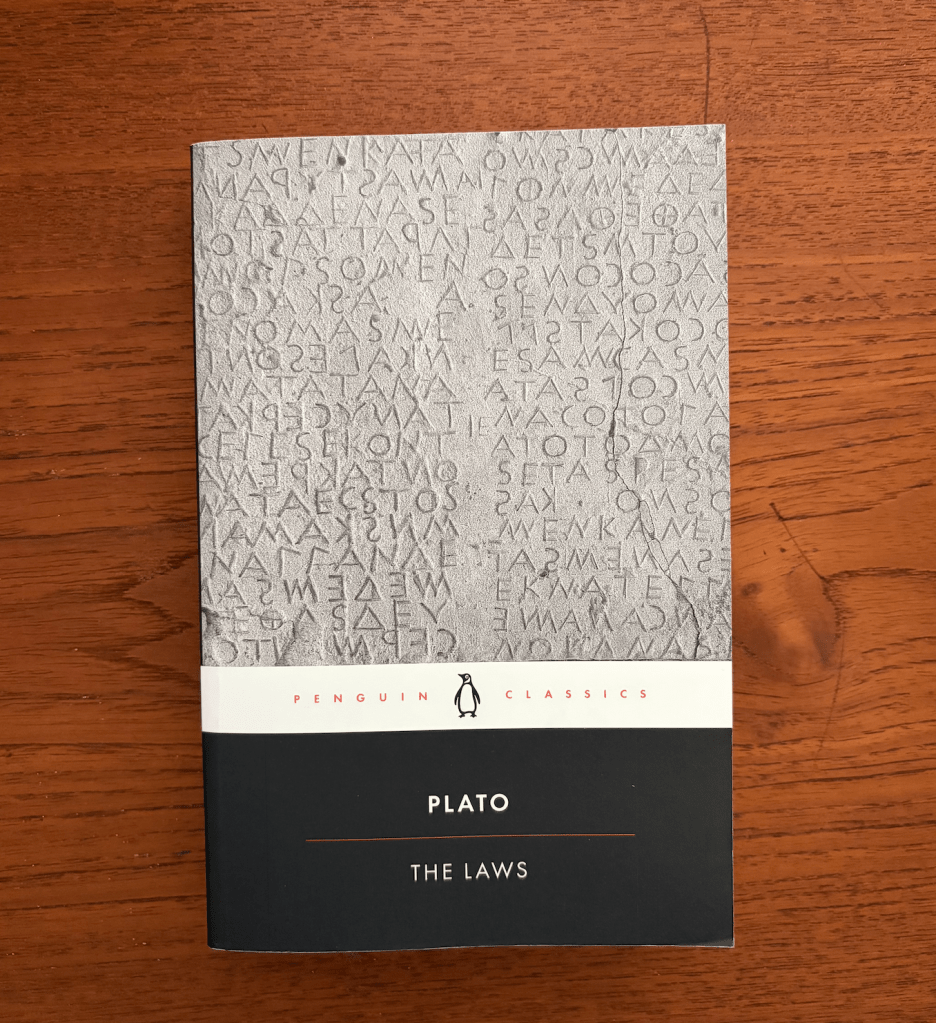
Plato’s Laws remains one of the least read and explored dialogues in the platonic corpus. This is a fact that might be worth pondering upon in the course of a systematic reading of the dialogue. According to André Laks in his book Plato’s Second Republic: An Essay on the Laws (Princeton U Press, 2022), the very last dialogue of Plato is a substantial rewriting of the core arguments of The Republic in terms of its grounding of politics and the organization of the polis, but also not just in terms of the political question. Laks speaks of a “structural paradox” in Laws regarding the nature of politics that takes an “unusual” (aesthesteron) path “beyond legislation” that constitute the very essence of the nomoi (Laks 2024, 142). We are interesting in exploring this ‘beyond legislation’ that is also a “before legislation” that speaks, either directly or indirectly, to the notions of the chôra and the theological foundation of the legislative enterprise itself, and ultimately to language as it pertains to preambles and argumentation (kalliston kai ariston prooimion). These are difficult questions that also exceed any philological exploration of Plato’s philosophical horizon, and that land on our own preoccupations regarding political metabolism.
So, this “beyond legislation” will be a guiding thread (one of the several) in a systematic reading of Plato’s Laws. In an important and rare observation, Monica Ferrando in Un anno con Platone (Neri Pozza, 2024) has noted that the notion of “chôra” appears more than thirty times in the Laws with all sorts of operative injunctions that speak to space and sensation, distance and cosmos, beauty and music, as well as the dwelling place for life to flourish without unlimited predatory force. How is one to understand the notion of “chôra” as a mediating distance that precedes the ground of politics? What is the relation between chôra and space in light of the isonomic arrangement of the polis? In what sense is having a handle on the notion of the chôra a precondition for a beautiful city, what Socrates calls the kallipolis in The Republic that is also the city of pigs? Is the chôra irreducible to eidos as it enters the polyphony of the Laws? And how does the chôra escape the political field and law’s authority as it appears in Laws? One of the angular goals of a systematic reading of Plato’s Laws is to make some progress in the understanding of the notion of the chôra that has been percolating in many recent discussions.
The fact that Laws has remained on the sidelines or in opacity in the canon of Western political philosophy might speak to its relevance, and to the fact that it has yet to be a text to be confronted and reckoned with. Of course, this does not mean that at stake is an effort to recalibrate its political task to amend the history of political thought; it is perhaps more interesting to approach it from the external perspective of canonical tradition that modern categories project to the past. In his posthumous book on the Laws, Leo Strauss noticed that this dialogue, unlike all the rest in the Platonic corpus, begins and ends with an appeal to “god” (theon). For us today this could mean: what is the status of the gods after the death of god and the end of politics? A systematic reading of Plato’s Laws has the depth to reopen these difficult questions in the present state of our discussions.
 Infrapolitical Reflections