Even if it is appalling to witness the brute amount of executive force in the current American political system, it is nonetheless “business as usual” if understood within the internal development of its own legal order. In other words, what is emerging is not a drastic rupture or abdication due to external pressure against “legal liberalism”, broadly understood as a package of normative rights to solve social conflicts in a political community, but rather the consequential effect of the decline of the legitimating force of positive law, the modern legislative state, and the principles such as the right to due process – which includes but it is not limited to a public hearing, a defense, the right to a defense, cross-examination of witnesses, or an impartial jury. The slow erosion of constitutional due process has not only resulted in an unprecedented upsurge of civil cases resulting in “guilty pleas” devoid of legal process (about 95% of cases according to Supreme Court Judge Neil Gorsuch), but also in the collapse of remedies from government even if a federal court decides against the state. As Aziz Huq shows in The Collapse of Constitutional Remedies (2021), the demise of legal remedies means that the federal courts at large can only “interpret the constitution” but remains silent and inoperative in terms of the practical solutions to amend injuries, seizures, or plain violence enacted.
Any attentive student of the history of law does not second guess that many centuries before the ratification of the Constitution of 1789, the principles of modern criminal procedure, such as due process, fair trial and reasonable doubt, were already sedimented to such an extent that the Medieval canonist Guillaume Durand in Speculum iudiciale (1291) claimed that the right to defend himself should not be denied even to the devil if he were summoned to the court. In this sense, the so-called “Due Process Clause” of the Fifth Amendment of the U.S. Constitution that claims that “No person shall be deprived of life, liberty, or property, without due process of law” is a latecomer to the internal development of Common Law’s theological secularization. And it should not go unnoticed that the clause explicits states “person”, instead of the narrow privilege to the “citizen” or the “legal resident”, which is why during the Founding Era even foreign pirates accused of illegal activities were still subjects of the Due Process clause under the international and domestic legal order. As crude as it may sound, in the current moment one could very well say that the “concept of piracy” had more footing in a juridical concrete order than in the current legal stasis operative in a post-positive scenario.
Even those constitutional scholars that in the wake of the “War on Terror” defended the Sedition Act of 1798 in order to defend a “process reduction” during an instance of political emergency, also warned of governmental overreach could very well upset political opposition and public support or loyalty (Vermuele & Posner, 2007, 235). Today we are in muddier waters (although fully “rational”) in which the punitive juridical order increasingly acts without a “process”, and the Federal Courts are incapable of offering clear cut remedies. This begs the question: what comes after the classical paradigm of due process inherited from the historical dispensation of Common Law? In other words, if the rule of law can now fully prescind, under ordinary times (there is no “emergency declaration”), of the right to due process and to the guarantee of remedies, what is the source of its legal authority?
This is an ambitious question that we cannot even attempt to answer here, but there is at least one possible working hypothesis: mainly, that post-positive rule of law adjudicates from the production of its own justification. It goes without saying that legal justification has always been an internal mechanism of legal authority; but only now is the force of justification taking over formal procedures, normative guarantees, and written and unenumerated rights. Justification makes its way as a rhetorical subsumption of any sphere of social reality. This is why, for the Federal Judge James Ho, “migration” can be understood as hostile forces if properly justified as an “invasion”. As a further task to be explored, one should bear in mind as a symptom that the most influential and enduring legal philosophy to have emerged within the crumbling edifice of modern legal positivism was precisely a concept of law defined by two guiding criteria: “fit and justification”. This means that law’s empire is no longer ordered through the “process” but through what becomes “justified”.
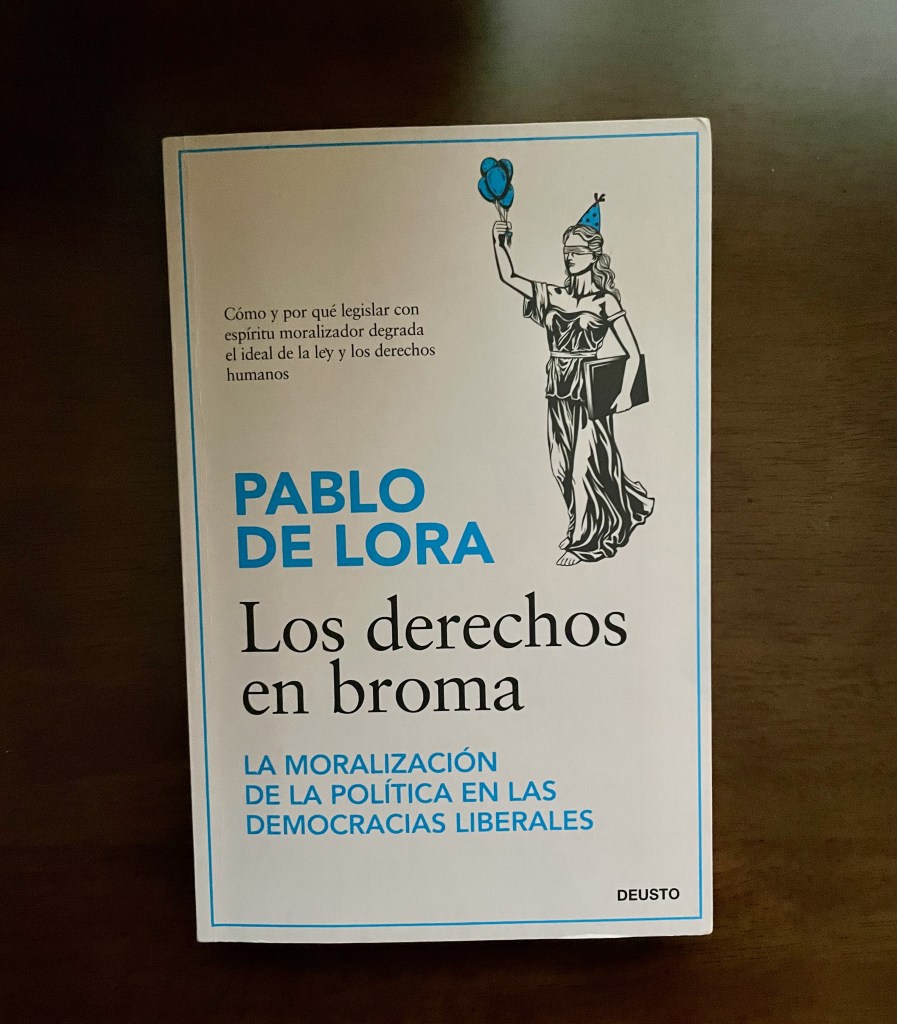
The crisis of the liberal legislative state is almost as old as the very project of the modern liberal state itself. And if we are to believe Carl Schmitt, the rise of the supreme values of the French revolution and ‘human rights’ (with its corollary of universal recognition within its normative system) also meant walking the fine line from the political theology of generative reform to the nihilism of ius revolutionis commanded by new discharges of individual will, political and technical movements, and immanent forces bringing the collapse of the separation between state and civil society. We are still living under its protracted shadow, albeit with a different intensity and intent. In his new book Los derechos en broma: la moralización de la política en las democracias liberales (Deusto, 2023), Pablo De Lora co-shares this point of departure, while daring to suggest a new sequence after the collapse of modern political form and legal order: we are currently living under a particular epochal transformation that is anti-legalist (sic) in nature – precisely because of its surplus of legal motorization – that erects a “nursery state” for the totality of the political community’s reasons and justification for action (De Lora 23).
Although De Lora case studies shown are almost entirely derived from the Spanish and Latin American contemporary social contexts, I do think that his sharp diagnosis could be extended to the epoch itself without blurring the important nuances. This is an epoch of a reigning “emphatic constitutionalism” (Laporta) or the total Constitution (Loughlin), at the same time that it no longer takes too much effort to imagine a political community devoid of a legislative body, as one eminent constitutional scholar has said repeatedly [1]. We are already here. In other words, whether by excess or deficit, the overall purpose of moral driven legislation announces the internal transformation of modern politics as we know it, extending itself to a civilizational regression from the ideals and norms of the Enlightenment rooted in the fiction of the citizen, the binding of the social contract, and the invention of the principle of sovereign authority.
De Lora does not quite says it in this way, but I think I am not diverting too much of his cartography when extracting some of the central consequences of these internal moral substitutions that are palpable everywhere across the West: ecological legislation that increases social conductivity and expansion of natural destruction; ‘feminist’ anti-sexual aggression that leads to lowering of sentences for convicted sexual predators; the inflationary instrumental use of “Human Rights” for persons and things, but only defined narrowly by those that, under the thick haze of institutional hegemony, can deprive their political adversaries and enemies of the most basic legal guarantees of due process transforming them into non-persons. These ‘moral substitutions’ is part of the “ironic” and “futile” consequence of the sacralization of morality whose end is the management of the “social model” at all costs. According to Pablo De Lora, within the limits of confronting a social dilemma such as disability, the specificity of the “case” is turned on its head; what matters is the overall structural design of the social order and its infinite adaptive changes (De Lora 71-72).
This mutation generates all sorts of unintended consequences when the rhetoric of “social benefit” takes the lead. As De Lora writes: “No hay apoyo anticipado a la discapacidad mental sin reconocimiento de que el discapacitado mental no puede ejercer su autonomía en el futuro. Dicho de otro modo, la institución de las voluntades anticipada de la lógica desideratum de modelo “médico” de la discapacidad mental que se rehuye en beneficio del modelo social” (De Lora 85). And in spite of normative incoherence within an institutional system, the deflection to the “social model” requires ever-expanding commands, rules, principles, and hyper-amendments to guide the adverse proliferation of reasons for action within the social state (in the United States this is soften by the police powers of inter-agency statutes of the administrative state through cost&benefit balancing of discretionary principles under the supervision of the executive branch). This transformation entails the collapse of the internal mediation between the validity of norms and its foundation in social facts as in the classical construction. Thus, the expansion of value-driven legislation that also requires of specific adjudicative constitutional theories, such as legal interpretation and the theory of balancing of principles advocated by Robert Alexy, the sponsors of social neo-constitutionalism, but also the embedded dialogic ideological positions of constitutional scholars such as Roberto Gargarella (or in the United States context, the work of Mark Tushnet and the so-called anti-originalist ‘living constitutionalists’).
All things considered, the fundamental problem for De Lora is that this specific transformation enacts what he calls a “Estado parvulario” or ‘nursery state’ that he defines as: “El que denominado “Estado parvulario” da pábulo a que el poder público, en sus diversos instancias y encarnaciones, escamotee las realidades y consecuencias que conllevan algunas discapacidad per oa que lo haga de manera internamente inconsistente: tratando a los menores como adultos, pero sólo simbólicamente, y, en cambio, de manera efectiva, a todos los ciudada como menores, congénitamente desvalidos, incapaces de encarar la realidad” (De Lora 87). In the framework of the nursery state within its specific moral legislative apparatus, children become adults and the mature civil society regresses to an infantile stage. And like in a nursery setting, the democratic virtues pave the way for new dramatic effects where the function of rhetorical annunciation – so central for the any credentials of moral hegemony – forecloses the void between morality and politics in the wake of the unification that the social model requires to begin with (De Lora 89).
This slippery slope can only lead straight to a sacralization of the political system that runs co-extensively with the infinite expansion of social rights; which, in turn, leads to an ever increasing conflict over the assumptions regarding its social facts (De Lora 151). In this narrow form, De Lora is audacious when citing Martin Loughlin’s recent indictment from his Against Constitutionalism (2022): “En la era de la Constitución total, el gobierno bajo el imperio de la ley ya no significa el gobierno sujeto a reglas formales independientemente pulgadas. Significa gobierno de acuerdo con principios abstractos de legalidad que adquieren significado sólo cuando son insuflados con valores…” (De Lora 188). And we know perhaps too well that values cannot be reasoned, but only weighted; values are commanded and taxed on the permanent devalorization of other values. This is why the rise of the value fabric of constitutionalism coincides with the ‘weighting’ proportionality of principles of law’s ideal social efficacy, to paraphrase Robert Alexy’s influential position as claim for “anti positivist legal justice” [2]. The nursery social state cannot be corrected merely from the position of the legislator; it can also be tracked as a triumph of moral jurisprudential theories of law that seek to overcome (and provide answers) to the overall crisis of institutional authority that characterized the so-called ordered liberty of the moderns.
Is there anything to be done beyond a description? It is quite clear that Pablo De Lora’s ambition is not so much the proposition of a new political or legal philosophy as much as the sketch of the current epochal predicament in its current practice. This is already enough to welcome a robust analytical discussion of our predicament in Los derechos en broma (2023). However, there is a cobweb of affinities in De Lora’s own position towards the end of the book that, even if not fully developed, must be registered as a mode of conclusion. First, there is an affinity with John Hart Ely’s deferential conception of judicial power that aims at overseeing the procedural mechanism for the democratic deliberation and legislation over a hot-button issues. In this vein, De Lora shares Akhil Amar’s position regarding the overturning of Roe in the Dobbs’ decision; a conception that fully embodies judicial deference to diverse legislative majorities [3]. Secondly, De Lora favors a judicial minimalism associated with the doctrinal theory sponsored by James Bradley Thayer over the practice of judicial review of the Court (De Lora 233). And last, but not least, De Lora sees transformative potential in John Rawls’ assertion in his late Political Liberalism (1993) that the use of public reason is a comprehensive doctrine to deal with our fundamental disagreements and contentions over shared political values (De Lora 241).
I am not sure how deep or for how long does De Lora wants to go with Rawls; however, it is important to remember – and specially given the treatment of the ‘social model’ in the morality presented in Los derechos en broma (2023) – that insofar as social paternalism is concerned, Rawls’ late liberal political philosophy at the heart of the crisis of the secular liberal state amounts to a political conception that, as Eric Nelson has brilliantly shown, abandons the commitment of individual non-cooperation or refusal to cooperate with unjust moral legislative burdens, and thus making everyone stuck in the same ship [4]. This ship is the management and balancing of the totalization of the values being trafficked in the Social as ‘egalitarian’, although they are fully endowed as a seterological scheme of “election” (and who is elected) balanced by secondary compensations.
On a larger canvas, if the current political structure is defined as a nursery state of social rights, then this means that appealing to ideal positions of justified reasons, “diaphanous” deliberation, and well crafted citizen arguments belong to the age of maturity of the Enlightenment, but not to the stage of social infantile disorder. And demanding political qualifications to the contemporary citizen today is not only naif, but at odds with what what institutional thinking requires. In other words, the concrete transformation of the post-liberal state is one of permanent optimization of conflict, which is why John Gray has lucidly defined the (contemporary) ‘new Leviathans’ are “engineers of the soul” with broad and sweeping capacities to govern over every inch of the social space [5]. In the wake of these institutional mutations, the call endorse a “moral critique” might be taken as a post-enlightened lullaby that among the blasting and striding cries of infants of the nursery will most likely just pass unheard.
I recently attended a conversation around Luigi Ferrajoli’s most recent book translated into Spanish, Por una Constitución de la Tierra (Trotta, 2022), where the eminent Italian legal positivist defends the construction of a world constitution. The proposal is meant to be taken at face value; that is, unlike world constitutionalism and constituent revolutions models, Ferrajoli departs from the fact that sovereign states are no longer efficient to deal with international indirect powers. For him, a global constitutionalization of the Earth will bring about much needed juridical protection to natural resources, commercial, and migratory disputes that, unlike the already existing international law decrees, will generate binding guarantees between the different global actors. There is a sharp realism in Ferrajoli’s proposal in at least two levels: on the one hand, the insufficiency of state sovereignty is incapable of stable and long term adjudication; and on the other, the lack of guarantees of international law not only do not prevent serious violations of human rights, but also repeatedly provoke it for special interests. What legal positivism promises to achieve at the national level becomes the mirror of international principles that appeal to the concrete techno-geopolitical equilibrium of a historical conjecture.
Perhaps Farrojoli is not willing to admit it, but the crisis of legality is now best understood as the loosening of the formal mediation between principles and norms, which can only complement each other through the executive force and expansion of police powers. This explains why the figure of “equity” has become predominant in both domestic and international legal systems, since ‘aequitas’ is what allows a broad discretionary rule making and norm elasticity in any given situation. It is not difficult to identify the crystallization of “equity” as the highest axiom that seeks to hold up the structural positionality of social order. But an unchecked legality – now fully detached from modern judicial review – becomes increasingly removed from the conditions of secularized liberal politics. In fact, police powers and principles of equity are no longer dependent on judicial review; on the contrary, it is judicial review that becomes adapted to the balancing of equity of social principles. Obviously, this can only unleash an unbound legal process that is no longer rooted in judicial minimalism or countermajoritarian rule.
I am not sure that Ferrajoli is able to escape this problem; in fact, he seems to aggravate it when claiming that what we needed today was “something like a global principle of subsidiarity”. That a great European legal positivist philosopher fully coincided with anti-positivist jurist Adrian Vermeule’s “common good constitutionalism” based on delegated bureaucratic powers of the executive’s discretion, confirms the deep crisis of contemporary legal thought. But such collision is expected, given that the principle of subsidiarity is at the center of a project like that of a constitutionalization of the Earth: the subsidium is no longer understood here as the secularized meeting point between belief and reason, but rather as a policing reserve required to intervene whenever an perturbance in equity takes place.
It does seem that application of a principle of global subsidiarity rather than crafting a new principle of authority is the result of a “unity of the world” that has turned the world increasingly smaller given the large scales of technological integration, as Carl Schmitt understood early in “La unidad del mundo” (1951). And technological integration presupposes the capacity for total legibility and total transparency, and thus total extraction – it is not difficult to see here a homologous ambition in the Chinese civilizational principle of Tianxia. In this framework, the subsidium can only become compensatory to the ongoing malignant epoch where all authority fails, and thus, in the words of Joseph Roth, “performs unworthy imitations…with barbarism and falsehood” [1]. A global constitutionalism can only exist through the ongoing production and consumption of mimetic debris; and this is the anomic make-believe that shouts that the world will be given to us in return.
.
.
Notes
1. Joseph Roth. “Our homeland, our epoch”, in On the End of the World (Pushkin Press, 2013), 70.
The posthumous volume Lo cóncavo y lo convexo: escritos filosóficos-político (Guillermo Escolar, 2022) of essays by the late political theorist Jorge E. Dotti is a very much needed contribution that opens up a conversation about a theoretical corpus that witnessed the collapse of the modern state and the crisis of its political categories in times of postliberal forms of global domination. Although an astute observer of the key moments in modern Argentine political history (from Peronism to the dictatorship, from the return to democracy to the failure of the democratic socialist party experiment), Dotti’s intellectual stamina remained on the margins of political adventurism, while openly rejecting the organic intellectual political advisor to heads of state. As editor Damian Rosanovich writes in his introduction, Dotti refused to subordinate his political thinking to immedaite ideological projects; a rather unique position to undertake in a national context like the Argentine, historically inclined towards philosophia militants of the national popular type[1]. Complementary to this inclination, Dotti’s political thinking also had little to say (at least in a direct manner) to the Latin-Americanist disputes about state modernization, regionalism as supranational identity, or cultural formation hegemonies that dominated twentieth century discussions in the region.
Dotti’s theoretical ambitions had a more prudential wager: a confrontation against all kinds of abstract universalities, as well as its partner in crime, locational exceptionalism always ready to infuse doctrinal flavor unto nominal situations and practical problems. A modernist political thinker at heart, Dotti was also a keen observer of the the modern state genealogical crisis, which he read in a tripartite scheme that included the classics of modern political thought (Hobbes, Rousseau, Hegel, Kant), modern philosophy of positive law (infomed by his research years in the Italian context), and finally the work of Carl Schmitt on sovereignty, divisionism, the exception, and the difficulty of “revolution” as the esoteric form of political crises. As an heir to this modern tradition, for Dotti modernity is best defined not as predicated on contingency or anthropological reserves, but rather about a certain ethos, historical in nature and spatially grounded (in this way his vision was close to that of JGA Pocock and the Cambridge School, although less emphatic to the centrality of concepts), which claimed that the political thinking of the classics had to their disadvantage the idealization of every practical situational problems encountered in concrete determinations [2]. In this way, Modernity was best defined as a struggle against abstraction and the taming of indirect powers over the configuration of social stability and endurance.
The classics of political thought, while claiming the intrinsic political nature of man and the primacy of organic totality over every principle of differentiation, imposed a nomalist metaphysics that turned its back to discrete and discontinuous situations. For Dotti at the heart of modern politics – very much in line with Hobbes’s critique of Aristotelian critique of the virtuous politics – is rooted in a practice that is attentive to practical reasons for action and the normative foundation of a social order. Hence, the modern ethos was able to favor the primacy of authority (auctoritas non veritas facit legem) as a minimalist non-substantive framework of public law. In other words, prior to doctrinal and categorical arrangement of modern political theories (social contract, constituent power, or individual conscience), authority helped dissolve the anarchy over words and actions proper to the European civil wars. Needless to say, legal positivism had to walk along modern subjectivity (“Quiero, luego existo…”) inadvertently promoting, while neutralizing, the latency of civil war from its inception. As Dotti claims in an essay on Melville too long to be included in this volume: “Quien contrata se concede el derecho de desencadenar la guerra civil” [3]. The concrete situation of the modern ethos, in this sense, is never enough for containment; and its positive arrangements, being insufficient, will ultimately depend on direct police powers. The story of political modernity is that of legality trumpeting legitimacy for optimal reasons of political control. The insufficiency of the modern political order entails that politics and nihilism walked every step of the way too near each other.
This outlook towards political modernity renounces all nostalgia as it is a genealogical critique. This position speaks to Dotti’s systematic dialogue with Carl Schmitt’s juristic thinking regarding the polemic over secularization of the state and its political categories. Like very few political thinkers of modernity, Dotti accepts Schmitt’s lessons without prejudices and against the political black legends (Schmitt as the poisonous enemy of legal positivism, political liberalism, archaic Catholic, or ally of Nazism) that have been incapable to comprehend the German jurist lessons. If according to Raymond Aaron Schmitt was far from thinking like a Nazi, Dotti take this promises to more refined elaborations: the combination of decisionism and institutional rule of law coagulate an compossitum whose main aim is to regulate the internal functions of validity of the every political order [4]. The force of political theology, then, is neither doctrinal nor axiological, but rather attentive to situational stress of instances as to deter the indirect powers and the logistics of immanence [5]. Dotti understands Schmitt’s political theology as a decision that is only possible within a normative system in order to guarantee the authority of the state. The minimalist conception of political-theology stands as the antithesis of immanent factional ends, which, ultimately, reality will venge in the worst possible ways [6]. Adjacent to the modernist ethos against indirect powers, Dotti’s stages the copernican discovery’ of Schmittian thought: the autonomy of the political as the only category capable of defending the sovereignty of the state in an energetic manner without stepping into either a hyperpolitical or an apolitical vectors common to messianic and subjectivist positions. If for Schmitt there were few things more modern than the battle against the political, for Dotti the consecration of global postmodern time opened a crisis of the political and the expansion of the field of immanence which freely drives “por la autopista preferential de la corriente antipolítica” in which all politics is exception and all exceptions are treated as antagonism for the political [7]. The epochal dispensation of total immanence of power means a liquidation of the regulatory conception of the political as well as the formal recognition of enmity within the modern state now vested into the global fabric of Empire.
Dotti’s scene of writing is that of the closure of the eon of the liberal secular state from its very conditions that made possible the development of its genesis. It is in this specific sense that Dotti’s prognosis is similar to that of Ernst W. Böckenförde’s famous theorem: the liberal secular state survives by conditions that it can no longer guarantee [8]. For both Böckenförde and Dotti the epigonal process of secularization meant the end of state authority and the exhaustion of the separation of state legitimacy and the internal legal rules for social action. Dotti, however, introduces a minimal although fundamental nuance to Böckenförde’s theorem: the liberal state collapses not at the apex of the compilation of secularization, but rather at its very origins in the notion of revolution. This is a lesson extracted from Political Theology II: the ius reformandi of the ecclastical powers soon became an unlimited ius revolutionis of subjective domination during the nineteenth century. [9]. It is to this transformation that political theology effectively looks to respond to. In fact Dotti suggests that the category of revolution is the strongest force to be secularized, which entails that what paved the way for the modern liberal state becomes an open ended indirect force against all mediations of legitimate rule. As Dotti writes in his late essay “Incursus teológico político”: “Estado y revolución son inseparables en su complementación y en su simultánea oposición inconciliable. Esta relación es el cogollo mismo de la legitimación de todo orden político moderno: está en el origen y la muerte de la era de la estatalidad.” [10] The immanent force of revolution has no single figure: it is the movement against state sovereignty, the emergence of the total state in the twentieth century, as well the legal interpretation of statutes as idealistic forms (as in the jurisprudence of Robert Alexy) that intensifies a permanent state of exception whose real end is now a power for “definition, differentiation, regulation” as the tripartite form of political struggle. In this framework, the revolutionary spirit against formal mediation and authority can only take the form of an uninterrupted holy war against its enemies without end [11].
To the extent that revolution does not disappear but becomes unmatched immanent power, it becomes possible to understand Dotti’s central theorem in its proper light: “the problem with the revolution is not how to make it, but rather how to bring it to a close” [12]. There are at least two things we can say regarding the theorem: first, political modernity was fundamentally understood as the making of the revolution without any attention to formal mediation and the autonomy of the political; secondly, even the exponents of political liberalism during the second half of the twentieth century did not think of a revolution as closure, but rather they continued to foment an aperture based on a necessary retheologizaiton. It is in this way that John Rawls’ social state depends on a specific conception of original sin for equity; while Ronald Dworkin’s defense of principles and moral interpretative constitutionalism reintroduces a secularized form of the old iusnaturalist model. The socialization of the modern state at the historical instance of its eclipse had to pay the price of abandoning its commitments to both Pelagianism and positive law on behalf of a permanent exceptionality now dressed as the balancing of social equity. It is an irony that the two strongest attempts at the secularization of the concept of the revolution provided, in turn, a restitution of theological hidden subtleties that are ultimately optimal for the transformation of the rule of law into an instrument of world legal revolution. And, it is no coincidence that the closure of the eon of the state meant the end of exclusive legal positivism, while socializing the state police powers as compensatory for the collapse of the modern transcendental authority. The alleged neo-liberal state now subsists as an all encompassing administrative rule that mimics the practice of the confessional state. This could explain why today some jurists continue to understand the practical function of the administrative state as the concrete instance to constitute an uninterrupted iustitium. Dotti’s comprehensive and panoramic view of the modern tradition and its conceptual fulmination leaves open a task for future political thought: how would the closure of revolution might look like? This is no optimist question, as the only honest answer must depart from the farewell of the modern state, while also rejecting the substantive, doctrinal, and militant reallocations of power that steer, but never bring to an end, the violence of a planetary unity devoid of separation or enmity.
.
.
Notes
1. Jorge Dotti. Lo cóncavo y lo convexo: los escritos filosoficos-polilicos (Guillermo Escolar, 2022)
2. Ibid., 133.
3. Ibid., 28.
4. Ibid., 174.
5. Ibid., 176.
6. Ibid., 26.
7. Ibid., 79.
8. Ernst W. Böckenförde. “The Rise of the State as a Process of Secularization”, en Religion, Law, and Democracy: Selected Writings (Oxford U Press, 2022). 167.
9. Carl Schmitt. Political Theology II (Polity, 2008 ), 101.


 Infrapolitical Reflections