It is a commonplace to think that populations feel ‘lonely’ and ‘alienated’ from society, but perhaps this diagnosis is more of a prefigured talking point than the description of the state of things. In our present, solitude and retreat is a scarce good, as the chatter of automatized languages and images revolve without a moment of pause. In a recent book, the vice-president of a major technological software company, in fact, argues that “mobilization” extends to all aspects of the temporality of social life, which makes his “technological security” system unavoidable for the very motion of living’s one life. This is why in this configuration, the notion of “creation” as poesis has waned, and its institutional inertia is increasingly delegated to machines and market values. Precisely, the promise of “Artificial Intelligence” all things considered is not just productivity growth, it is also grounded in alleviation of a postpoetic social bundle where every form of self-possession – writing and singing, reading and painting, just to name a few – are slowly replaced. And this “replacement” – which is the only true replacement of our epoch – is an absorption of our relation to our own excess of existence.
This is what Kafka understood with outstanding clarity more than a century ago in his well known letter to Felice dated February 1913: “‘Writing means revealing oneself to excess … This is why one can never be alone enough when one writes, why even night is not night enough. I have often thought that the best mode of life for me would be to sit in the innermost room of a spacious locked cellar with my writing things and a lamp. Food would be brought and always put down far away from my room, outside the cellar’s outermost door. The walk to my food, in my dressing gown, through the vaulted cellars, would be my only exercise. I would then return to my table, eat slowly and with deliberation, then start writing again at once” [1].
What does it mean that ‘writing means revealing oneself to excess’? For one, it does not mean to create a well crafted story or essay, but something much harder: to appropriate the relation with exteriority of life that makes the truth of writing to emerge, at least for a moment. This appropriation is what solitude guards and treasures, not as a “good” that can be administered and shared, but as a form of life where language and the idea connect in an instance of time. If the total mobilization of technology succeeds wiping this relationship, we should be reassured that the nocturnal excess of writing will be transformed into a white night of inert knowledge, which is contrary to the very practice of writing. One never writes what one “truly knows”; what attempts to write in order to know that which we did not know that already knew. And only this can be called a relation of excess.
In her beautiful book A horse at night (Dorothy, 2022), the writer Amina Cain similarly says that: “To write, to do any kind of work well, I believe we must at least have a solitude of mind, a solitude of seeing. Of course there are those whole collaborate, but even then there must be moments of retreat. We retreat to read. We retreat to think….There is life that finds each one of us that one else should enter, lest they drive it off” [2]. The closure of the self-sufficient subject of technological mobilization is precisely the one that, by giving up his solitude and retreat that is constitutive of language, has ceased to have the creation and by extension the time of life. What is given up in the name of a faustic “Intelligence” is the most sacred, the access to oneself.
.
.
Notes
1. Franz Kafka. Letters to Felice (Schocken, 1988), 156.
2. Amina Cain. A horse at night: On writing (Dorothy, 2022), 35.
There is an extraordinary description in Jorge Luis Borges’ “Funes el memorioso” that depicts his state of absolute nominalism as literally a landfill, a pile of trash. We read the following: “Y también hacia el alba: mi memoria, señor, es como un vaciadero de basuras”, which James Irby translates as “My memory, sir, is like a garbage heap”. The absolutization of memory without oblivion and forgetting renders all the possible and imaginable names as already present, but also useless to the point that they cannot be voiced, let alone retained at a distance. The world of Funes is analogous to that of the advanced world of technology that we are currently experiencing at an accelerated pace: the so called Artificial Intelligence remembers every name and all entities as if it were picking up items from a landfill container. It does not really matter if the names picked are correctly or falsified; it is precisely that naming as such no longer has any enchantment that is only granted by the divinity of the voice. As language becomes contained as a “heap of garbage” any relation between remembrance and the human voice that for centuries had been the source of affection is eliminated.
Exactly two decades after the publication of Ficciones (1944) in his Seminar of Le Thor, Heidegger will also take note of Heraclitus’ Fragment 124 in relation to a heap of garbage as a definition of the cosmos: “…in its complete appearing as fire, “the most beautiful ordering of all is surely comparable to a heap of randomly spilled garbage. This means that the innaparent joining together is superior to every visible ordering, even if it is the most beautiful possible (fragment 54)” [2]. The emphasis is placed on the order of the random that in its inappearance discloses appearance as order (κόσμος). Immediately Heidegger notes that the archaic notion of “world” in Heraclitus, his “heap of trash”, is radically different from the standard of the world today that secures all possible predictions and calculation, where there is room for everything insofar as every-thing is taken as an extension of energy.
This garbage heap realizes itself through the force of “speaking” in the name of technological orderability, efficiency, and promises of economic growth. The new order of the world as trash is proportional to the slow erosion of language that in its accelerating caducity loses its capacity to remember and forget. It goes without saying that in our present, and especially in the United States, the educational and academic institutions have been at the helm in the process of facilitating this compulsive destruction of language and memory, which evidences the intimate liaison of the technician and the pedagogue in the configuration of the immonde.
Borges’ Funes will ultimately die from a pulmonary congestion, which is a testament of death in spite of the horror of a language incapable of naming and letting go. And in his lecture, according to the transcription of one of his students, Heidegger concluded with this recommendation: “What remains essential is to continue along the same path without having concern for any of the publicness around us”. A hidden and conjured language would be the only last standing order, a keeper of truth and beauty, because unlike the machine it voices the names while also exposing itself to the possibility of forgetting them.
.
Notes
1. Jorge Luis Borges. “Funes el memorioso”, in Ficciones (Emecé, 1958), 76.
2. Martin Heidegger. “Seminar in Le Thor 1966”, in Four Seminars (Indiana University Press, 2012), 8.
At least since Ernst Böckenförde declared the end of secularization and the exhaustion of the liberal state form in the late sixties, the distinction between theology and politics has experienced a profound schism across Western social life, which once served as the ground and mediation to the homogeneity of “ethical life” (Sittlinchkeit) of civil society. It is still useful to recall Böckenförde’s theorem as a refresher: “What does the state live on, and where does it find the force that sustains it and guarantees its homogeneity, after the binding force emanating from religion is no longer, and can no longer be, essential for it? Until the 20th century, in a world that was first interpreted in a sacred way and then as a religious world, religion had been the most profound force involved in the political order and in the life of the state. But is it possible to find and preserve life in a completely earthly and secular way? […] Therefore, the question of binding forces is raised again, and now at its true core: the secularized liberal state lives on prerequisites that it can no longer guarantee” [1].
Indeed, one could say that in our era, clearly marked by the collapse of political mediations and categorial order, the schism between theology and political forms inherited from the Judeo-Christian eon has increasingly become full fledged and patently visible at a global scale. In a certain sense, and leaving behind all nuances, the operating horizon of thought today implies from and through the energy of this schism. If this meeting attempts anything however modest, is precisely the intuition that in the wake of the schism of political theology, the “theos”, following the trumpeting of the death of God proclaimed by Nietzsche or the flight of the gods as orphanage from the divine declared by Hölderlin, presents with an opportunity to think a non-rarefied style on the reverse of historical collapse. In recent years, a certain theological latency has been present in many contemporary theoretical projects, insisting on approaches related to mysticism and life, the gods of language and nominalism; the insistence on the communication between souls, the messianic and presence, to name just a few figures of thought without pretending to be exhaustive.
As machination and the spiritualization of technology subsumes the totality of social life in the West, existence enters a region of thoughtful and cunning marranismo, which could be taken as a form of life in the desert and a keeper of its depth of the ethos. How does one make sense in this moment of delirium and relentless decline, which include although it is not limited to, the defeat of the cycle of global uprisings and the solicitation of positions of exodus and desertion? In other words, we are trying to think of a language that we speak across distant places, and come to terms with the tonality of pain and despair. Is there a non-nihilistic way out of a civilizational project governed by the cybernetic dominium, continuous predatory extraction and lethal destruction of worlds? “Desecularization” is not naming a historical moment after “secularization” – something that has taken place in its own historical dispensation – just like posthegemony is not naming a temporal sequence to principial hegemonic politics. And of course, “desecularization” is not a program of any sort, although it is interesting in positing the possibility of “a new beginning” in the wake of the ruin of political theology as the orienting strategy of division and orderability, which fundamentally colored capitalist civilization on the abstraction of work and the work of abstraction proper to the historical modulation of Christian metaphysics and its theological rubrics. And if “desecularization” is neither a concept nor a program, I still would like to retain at least its resonance to other positions that have I have called for lack of a better term, the quadrant of positions of refusal [2].
Can theology, a confrontation with theology, drag us out of the via negativa towards something else? It is easier said than done. And it is never sane to get caught up in the spinning wheel of a term, whether it is “desecularization” or “desistence”, or “destitution”; a sort of rhetorical enchantment of the “-des”. Ultimately words say very little at the level of the concept, and they tend to offer a cell in which the process of amnesia and ratification can take place – the task of refusal, then, I take it, is also watching over, what the Cappadocian Fathers called the nepsis – what thought cannot elevate to the luminosity that emerges from the term. We are interested in theology and theos, but only insofar it opens itself to thought and the place of language, as well as the irreducibility of existence and death, to the imagination and the endurance of an ethics that undeniably invites makes itself present whenever we hold on the incommensurable distance between language and world. And if we have invited both Monica Ferrando and Alberto Moreiras to open up this seminar with us, it is because their styles of thinking are clearly devoted to pursue this question to the end. Of course, this means something consequential: they both affirm a path wherever it might take them (one can even visualize this in Monica’s extraordinary nocturnal paths in painting, such as the series “Paessaggio Perduto”, or “Lost Paths”). And it is a commonplace to say that both of them have been grappling with the problem of theology from almost opposite directions of the meridian distance awakened to the horrific abyss of our present, which means that perhaps the marrano and Pan do meet as fugitives in the forest passage both lost and found.
One word must be said about the term that is meeting is trafficking with – and perhaps “trafficking” is, alas, a good verb since none of us (perhaps with the exception of one person, and even he might feel stranger with that label) are professional theologians, nor do we have access to revelation, but perhaps this is too much on the side of intimate matters that one should refrain from commenting upon. Of course, the trafficked word is “desecularization”, which alludes to a certain rupture with the very essence of the saeculum, or the political institutional authority and its institutional arrangements in this world. When Schmitt says that all political concepts of modernity are secularized theological concepts, he is also assuming the irreversibility of secularization as internal to the historical matrix of Christianized West. In fact, according to theologian Robert A. Markus, desecularization has already become operative within the early Christian epoch of Saint Augustine. In his Christianity and the Secular (2006), Markus writes the following: “[in dialogue with Peter Berger] We may leave sorting out the complexity of that relation to the sociologists. All we need to note for our purpose is that the reverse, what some have called ‘desecularization’ has become a more recent preoccupation of sociologists of religion – and not only of sociologists. “This is just what came into being in the course of the emergence of Western Christendom from Roman Late Antiquity – a ‘deseculariation’ which is the reverse of what happened in the Wars of Religion. If the notion of the secular were to apply in such a society, it would have to be defined in more problematic terms: as what does not form part of a religious discourse … .The core of my argument in this book can be briefly summarized. Its substance is that Christian tradition has a legitimate place for the autonomy of the secular, even though for many centuries this was eclipsed in its awareness, and despite the perpetual undertow of what we have become costumed to call ‘triumphalism’ in Christian political and cultural attitudes” [3].
Of course, as Märten Bjork has recently shown, in Markus’ theological understanding of the saeculeum, the government of the Earthly city grounded in principial politics must also be relativized by the eschatology of the Kingdom – facing the event of death and the dogma of resurrection of life – that can take step back (or beyond) the libido domininandi, that generates the solipsistic desire for government and administration necessary for the circulation of a “libidinal economy” [4]. We can thus call the Markus’ position as the architheological position that dissolves the polarity of secularization and desecularization as an enterprise of Western philosophy of history and its homogeneous temporality of survival and reproduction. Secondly, it is also important to note that the notion of ‘desecularization’ made an important entry in the famous Capri conference of 1994 organized by Gianni Vattimo and Jacques Derrida, where the French philosopher mobilized Plato’s chôra to avoid relapsing into religious faith, and thus uprooting revelation as the ur-site of Christianity. Thus, for Derrida, ‘desecularization’ is a figure of thought that seeks a third space of the a priori of the nonsecularizable. In the brief dossier “Christianity and secularization” later published in Il Pensiero: Revista Di Filosofia in 1998, Deridda sheds light unto this path of his thinking, which he never fully develops:
“….. The desert, the figure of the desert, which we discussed extensively in Capri, is clearly charged with biblical memory; and it’s not enough to say desert, or even “the desert grows,” to achieve or, conversely, abandon secularization. The desert within the desert is a radically heterogeneous desert. The motif of the chôra serves me, in general, as a guiding thread for thinking about a place, and chôra means place, to take place; and of the event, it is said that it takes place, and chôra means place or spacing, interval. This is a place that is, to use Plato’s terms, neither sensible nor intelligible, and which is spoken of in a bastardized discourse, in that it gives rise to neither a metaphorical nor a proper language, and in Plato’s text itself, it escapes all Platonic concepts and even Plato’s self-interpretation. This place is neither divine nor human… The chôra is the place where the demiurge, gazing heavenward, contemplating eternal ideas or models, inscribes the sensible copies for the formation of the world. Therefore, it is neither sensible nor intelligible, neither human nor divine; it is absolutely impassive, totally neutral with respect to all conceptual or dialectical oppositions; it is therefore the place that resists any reappropriation or reduction within the poles of anthropotheology. Chôra is that which cannot be reached even by a discourse of negative theology” [5].
The nonsite of the chôra is also what is heterogenous to the polis, and so for us the absolute differentiation between chôra and polis is precisely as important, and parallel to Monica Ferrando’s distinction between the musical nomos of the mythic topos of Arcadia, and the modern allocation of the nomoi of spatial dominium as appropriation, concrete order, and reproduction; the three pillars for the constitution of the ideological revolution of survival. Of course, the chôra can be said manifolds, but it allows us the temptation of political subsumption, of an inversion of a new “theological political” (as it is already taking place in many circles in the United States, with the unfortunate but expected in Leo XIV as equidistant, alas, the new self-delegated commissar of an “Anti-Cybernetics” point de capiton. Alas, once again hegemony knocks at the door, this time with theological garments). This reservation speaks, if not directly, at least tangentially to Alberto Moreiras’ recent affirmation against the ‘retheologization of the world’, which would entail the hegemonization of the total space of social reproduction [6]. Here we might find room for fruitful dispute and elaboration. Indeed, because it is never about re-theologization of the world, but perhaps in the old formulation of Guy Landreau and Christian Jambet’s L’Ange: Ontologie de la révolution (1976) that any gesture of true refusal or revolt requires at least the partition of two worlds, if we are to avoid the eternal dialectic of desire between Master and Rebel that nourishes the ideological projection sustained through the amnesia of any ethical elaboration.
Perhaps by ‘desecularization’ we are pointing to an exit through the liquidation of this world, in the same way that the task of thinking is a schism against calculative representation and the eccentric plane of objectivity. As Landreau and Jambet claim in El Ángel (1979): “There are two kinds of thought, just as there are two worlds: one kind of thought that belongs to God, and one kind of thought that belongs to the world; one kind of thought entirely devoted to salvation, and another kind of thought animated only by an abject desire for knowledge—a searching thought, vain curiosity: precisely what we, intellectuals, philosophers, call Thought. Gregory of Nazianzus famously asserted that one can philosophize safely about the world, about good and evil beings. The monks, on the other hand, responded to him with the words of Sirach: ‘Do not seek what is too difficult for you, do not scrutinize what is beyond your strength. The simpler the symbol, the better” [7]. In other words, against the absolute immanence of an infernal materialism and its frozen fictions of the immaterial – where all that exists subsists as equivalent – there is a reality of the soul, the abolition of sexual difference, and by that matter the libidinal bond that generates the autonomy of the revolt of the Rebel perfectly comfortable under the shadow of the Master [8]. In this sense, if another parallelism is allowed here, the chôra is the collusion of the outside world to the polis in order to start anew from scratch from the site of the sensibility of our existence.
If this position has been repeatedly called “gnostic” or maniquean by the executioners of modern irreversibility, so be it [9]. And perhaps these critics are right, and we can grant them that much: already Susan Taubes noted with scholarly precision that there are even Gnostic elements in Heidegger’s thought, even when his polemic with the architectonics of metaphysics becomes explicit against the reduction and adequatio of the medieval Aristotelian metaphysics, opening himself to a secret and clandestine tradition, in which the last god has his recollection in the excess or abyss of all vital experience (erlebnis); in what is outside of life at the entrance of another world [10]. The overcoming and taming of the gnostic manicheism has been precisely the infrastructure through the rarification of Christian theology took place – in Landreau and Jambet’s terms – which transforms the conditions of the cultural revolution (existence) into an autonomous and spectral ideological productivity, which is the limit in which theological contemplation narrativizes itself into Christian community of salvation once necessity and deficiency bind you to political dominion – it is here where the Master and the Rebel coincide in their projected goals: that there is nothing other than political struggle. But the gnostic culture of existence never disappeared as readers of modern poetry know well, even though that might not be the site for the emergence of the angelic life of beatitude today either.
As Pacome Thiellement says towards the end of his beautiful The victory of those without kings: gnostic revolution (2025): “In the absolute embrace of those without Kings, the fading of the initial eroticism is transmitted in every instant of life. It creates neither anger nor remorse, but rather gratitude and a multiplication of protected powers. It appears at the moment when solitude is profound, not from the absence of love, but as a consequence of the pleromatic state inscribed in the man with memory: the overflowing of unitive eroticism into all the possibilities that life offers, whether in this world or others” [11]. It is this theology of the infraworld – not so much of heaven, but of a memory of the worlds and the humus of the dead that becomes one with the mirror of the heavens – allows the metaphysical gnosis to breathe out in thought, allowing for the pending encounter with the metaphysics of the schism of n-1 worlds to emerge [12]. It seems to me that this subtractive movement brings back, in interesting new ways, a metaphysics of purity and inoperativity; an imperturbable existence no longer seduced nor corrupted by the images of this world.
.
.
Notes
1. Ernst Böckenförde. El surgimiento del estado como proceso de secularización (Editorial Trotta, 2024), 45,57.
2. Gerardo Muñoz. “Quatre positions du refus”, in Entêtement: Tenir une sensibilité (Pli, 2024), 20-26.
3. Robert A. Markus. Christianity and the Secular (Notre Dame Press, 2006), 8-9.
4. Märten Bjork. “Deliver me from my necessities: R. A. Markus and Erik Peterson on the End of Law”, Political Theology, Junio 2026, 13-14.
5. Vincenzo Vitiello. “Cristianesimo e secolarizzazione”, in Il Pensiero: Rivista Di Filosofia, XXXVII, 1998, 155-157 .
6. Alberto Moreiras. “Gnosis marrana”. Paper read in Universidad Complutense, October 2025. Unpublished.
7. Guy Lardreau & Christian Jambet. El Ángel: ontología de la revolución (Ucrania, 1979), 128.
8. Ibid., 105-106.
9. See, José Luis Villacañas. Tierra o Ser. La gran decisión de la filosofía contemporánea (Akal 2026), specifically the section “Gnosis y excentricidad”, 416-419. His recent column against Heidegger’s philosophical legacies and afterlives also deals with the gnosis, see “Heidegger, a la distancia de medio siglo siglo”, Levante, May 25, 2026: https://www.levante-emv.com/postdata/2026/05/23/heidegger-distancia-medio-siglo-130551106.html
10. Susan Taubes. “The Gnostic Foundations of Heidegger’s Nihilism”, The Journal of Religion, XXXIV, Julio 1954, 160-162.
11. Pacome Thiellement. La victoria de los Sin Rey: Revolución gnóstica (Granica, 2025), 159.
12. It is notable that Derrida in the exchange with Vitiello, Vattimo, and Ferraris already cited, he goes out of his way to claim that he never had anything against metaphysics per se. Could the same thing be said of Heidegger if one posits the differentiation between metaphysics and the holy, and onto-theology and the adequatio of Medieval Aristotelian metaphysics? Along this line, Laurence Hemmings has suggested a fertile dialogue between Heidegger and the sacred in his Heidegger’s Atheism: The Refusal of a Theological Voice (University of Notre Dame Press, 2002).
I still remember quite well how, a few years back at the Harvard University Bookstore, the Loeb Collection of Latin And Greek Classics, with their crimson and green covers respectively, were nowhere to be found on the shelves. And a slim store clerk when asked told me that those books on “dead languages” were no longer carried at the store. If this anecdote transmits anything is precisely the central question that still lingers from the pulsating notion of “dead languages”. What does it mean that a language is dead; if there is, in fact, such an ontological status for any language that has been traced from our past? This question returns to us today with some urgency as the most recent avatar of cybernetics, “Artificial Intelligence”, positions itself high above not just the alleged “dead languages” of the antiquity that many readers cannot longer master, but also the living spoken languages of human race as a whole.
Prophetically, this was the problem confronted by W.H.D Rouse in a short text titled “Machines or Minds?”, and published in The Classical Weekly in winter of 1913. And as we know, Rouse, a trained philologist who translated Homer and Plato, was also the creator of the Loeb Classical Collection published by Harvard University Press beginning in 1912. The task of reviving the “dead languages” in Rouse’s program was a way to contest what he saw as the collapse of civilization in the face of rise of machine and the colonization of “leisure time”, as it was becoming a world of pure “electric force” (a topoi of modern civilization that will also finds its place in the writings of Warburg, Schmitt, and Florenski as we have recently noted ).
In a description that resonantes in form and spirit with Carlo Michelstaedter’s forecast that the future of language will amount to an international language composed of technical terms, Rouse was more refined and precise in defining this instrumental transport by connecting the rise of science with that of English as a homogenous planetary language. Thus, inverting the assumption that “dead languages” are the defunct and no longer spoken idioms of past civilizations and archaic cultures; for Rouse it is “English”, and more specifically, scientific English that is ultimately a dead language, as it transmits nothing, as it is fundamentally detached from linguistic experience and imagination. As Rouse writes in one moment of his essay: “The very languages give what English does not give. Modern English is full of roundabouts, of metaphors without meaning, verbiage, shams; Greek and Latin are plain. The English language is largely dead: Greek and Latin are living languages. […] The scientific English sentences are all dead: they either wrap a single sense in meaningless words, or they seem to have a meaning when they have none [1]”. The rhetorical artifice to which language succumbs expresses itself not through the use of words, signs and icons, but in a proliferation of discourse that no longer communicates anything precisely because it has communicated everything out of the fallacy of absolute representation and absorption of a flat system of wordless objectivity. In Rouse’s indictment of human decline finds its correspondence in what language’s entry into what he called the “Dagon of Science”, opening a new scenario for human historical destiny: “never was there a world that cared less for truth in speech and thought” [2].
There is a huge risk in reading Rouse’s defense of the “classical languages” (Latin, Greek) as a humanist blueprint for a forthcoming antiquarian revival, a nihilist outlook that is being fulfilled in the United States as a parodic reiteration of Winckelmann’s neoclassical imitation ideal. Against the reification of dead languages as fictive “living entities” positioned as tools for knowledge and expertise, division of labor notwithstanding, what was fundamental for Rouse in the dead languages of the past – and in this sense, any language – is the ability of bringing about the experiential dimension of its use, thus connecting thinking and the experience without separations [3]. In other words, Rouse, very much like the last Émile Benveniste, found interest in classical languages not as a moral principle of civilization and identity foundation, but rather a site for the immediate experience between speakers embedded in a degree of the lived [4]. This is also why a poet like Eliseo Diego would state in Conversación con los difuntos (1991) reading other languages is a form of friendship beyond presence of the living. The conversation in languages is a way to keep open the passage from the living to the dead and back.
And whoever lives in language dwells in the memory and traces of all the dead languages, inscriptions, voices, and rhythms, because these contain the past as a reservoir of the figure of life. The consolidation of basic English as the hegemonic medium of communication with the return of extreme nationalism emerges, as Erich Auerbach wrote from his Istanbul exile, “to a ruse of providence designed to lead us along a bloody and tortuous path of an International of triviality and a language of Esperanto”. In this scenario, the slow annihilation of the human species takes place outside the world; that is, in the field of language, which has now become the central historical program of domination against the lived experience that connects the dead and the living. As languages become an autonomous frame of order and force, human beings’ existence is transformed into a mobile receptor of rhetoric, information, and opinion.
.
.
Notes
1. W.H.D Rouse. “Machines or Mind?”, The Classical Weekly, V.6, 1913, 85.
2. Ibid., 86.
3. W.H.D Rouse. “Latin as a Universal Language”, Nature, February, 1916, 706.
4. Émile Benveniste. Last Lectures: Collège de France 1968 and 1969 (Edinburgh University Press, 2019), 67.
In his 1982 novel Aladdin’s Problem (1982), Ernst Jünger defined planetary domination through the actualization of the trope of Aladdin’s lamp. Whenever a symbol of this sort is used, we know that it always carries weight of ambivalence more than that of synthesis. The mythic lamp is a trope for magic and enduring power; of countering visibility and invisibility, but it is also made from a material that has been extracted from the Earth. In other words, raw materials are manipulated as a reservoir of energy that dispense the world of forms. In the most succinct moment of the novel, Jünger writes: “Aladdin’s lamp was made of pewter or copper, perhaps merely clay. The lamp guaranteed domination as far as the frontiers of the traveled world – from China to Mauritania. Aladdin preferred the life of a minor despot. Our lamp is made of uranium. It establishes the same problem: power streaming towards us titanically” [1]. Aladdin’s lamp is no longer a tool deployed by governments and armies, it is rather the autonomous commanding force that opens to human domination and technological catastrophe that generates calculable objectivity in the world.
In his conversations with Julien Hervier, Jünger stated that the “problem of Aladdin” is not a political problem, but rather one that involves the administration of energy and intelligence that is already beyond our hands, because it has been set loose by ongoing compulsion necessary to meet the indexes of production and transference of technology [2]. Of course, energy defined the broad design of modernity as the necessary condition to amplify historical forms and mediations (and deform, since it was always dialectic) of worldly events and relations. One should only be reminded that in the beginning of the 1920s three major texts by European thinkers – I am thinking of Pavel Florensky, Carl Schmitt, and Aby Warburg – saw the necessity to allude to the settled hegemony of electricity as the defining feature of the dominion of the world.
As Warburg understood it prophetically in his lecture on the serpent ritual of the Hopi Indians: “But myths and symbols, in attempting to establish spiritual bonds between man and the outside world, create space of devotion and scope for reason which are destroyed by the instantaneous electrical contact – unless a disciplined humanity reintroduce the impediment of conscience” [3]. And it goes without saying that this “instantaneous electrical contact” has become so thoroughly engrained in human existence, that it is now clear that life on Earth, as advanced by the latest phase of Artificial Intelligence (AI), is no longer point to the destruction of space but of the total disruption of electricity and energy that exceeds any sensible contact. Electricity as the paradigm of artificial mediation can only liberate the spiritualization of ongoing decline.
It is no historical accident that empires and nations have always been driven by the accumulation of energy, although at its historical exhaustion, there is no longer a veneer of development and production between energy and empire, but only a unified empire of energy in a lamp that quenches and overruns itself towards extinction. This means that what defines the darkness of our times is neither disorientation nor political violence (although there is much of that too), but the blinding darkness of a translucent expropriation of the world of the living and the dead. It is through this assumption that Jünger makes the last business of the epoch of Aladdin – extractive energy as domination of objects and objecthood between worlds – as a large necropolis called Terrestra, financed by a banker named Jersson, where there is no longer any need for the liturgy or cults proper to myths, but naked exchange between gold and the material corpse that suppresses, via technological titanism, any possible relations to the irreducible. It remains to be thought whether the moment when the lamp goes off in the drained excess of its energy will also lead to the end of this world.
.
.
Notes
1. Ernst Jünger. Aladdin’s Problem (Marsilio Publishers, 1992), 118.
2. Julien Hervier. Conversaciones con Ernst Jünger (Fondo de Cultura Económica, 1990), 100.
3. Aby Warburg. “A Lecture on Serpent Ritual”, Journal of Warburg Institute, V.2, April 1939, 292.
We owe an untimely intuition about the enduring seduction of patriotism and nationalism to Leo Tolstoy’ essay “Patriotism and Government” (1900), in which he captured a paradoxical phenomenon: mainly, that at the same time that the integration of humanity and its historical consciousness reached its civilizational peak, patriotism instead of disappearing became increasingly more destructive and fierce. Looking at the outset of the First World War in Europe and its nascent total mobilization of industries, the Russian novelist claimed that, from that moment, government organization will depend on patriotism as a source to conduct total war within the human species. But what surprised Tolstoy – which has clear contemporary overtones in the impolitical movements that dominate Western societies – was the degree that this lethal patriotism infiltrated the very worldview and orientation of the Christian vocation. Tolstoy writes in the most most potent passage of the essay:
“All the peoples of the so-called Christian world have been reduced by patriotism to such a state of brutality, that not only those who are obliged to kill or be killed desire slaughter and rejoice in murder, but all the people of Europe and America, living peaceably in their homes exposed to no danger, are, at each war – thanks to easy means of communication and to the press – in the position of the spectators in a Roman circus, and, like them, delight in the slaughter, and raise the bloodthirsty cry, ‘Pollice verso.’ [1].
This should suffice to note that for Tolstoy patriotism is neither a political ideology nor a formal principle of community; patriotism is rather a social liturgy born of the absolute sacrazalization of human life and whose hyperbolic figure will be that of the war-slave trained to endure “the act” (especially the slave that participates in the carnage through his words and attention). And just like in a theater play or in the Catholic liturgy where there are “acts” (and the service can only subsist through its enactment), the unleashed force of patriotism becomes a form of destruction as the essence of government organization.
This is why for Tolstoy the inception of total war recalibrates the grotesque spectacle through the “hypnotism of patriotism”, positing a fictional belonging of salvation – that is nontheological because it is unredeemable – through the destruction of another community of the human species. True, the end of politics always results in war; although Tolstoy introduces a nuance to this axiom: war is able to subsist thanks to the self-affirmation of patriotism as the triumph of a wordless inhumanity.
It is no coincidence that Tolstoy observed the rise of patriotic strife in tandem with modern science as conquest over Nature and the reality of human experience [2]. Thus, government patriotism and instrumental sciences are two interconnected regimes of the organization inhumanity that speak the rhetoric of growth and prosperity as stagnation deepens. In our days, this social cohesion, as Tolstoy warned with precision more than a century ago, has entered a new phase of domination that some called a “lethal form” integrating technology and war without any reminder [3].
.
.
Notes
1. Leo Tolstoy. “Patriotism and Government” (1900), in Last Steps: The Late Writings (Penguin Books, 2009), 318.
2. Leo Tolstoy. “Modern Science” (1898), Last Steps: The Late Writings (Penguin Books, 2009), 252.
3. Alexander Karp. The Technological Republic (Crown Currency, 2025), 154.
In an entry of Dopo Nietzsche (1974), Giorgio Colli states that after the overcoming of all values and taboos, the contending moral strife finds its highest value in hypocrisy. Colli goes on to say that “hypocrisy is the last bastion where moral forces have found their refuge” [1]. One can clearly see that for Colli hypocrisy as the highest value is quite distinct from morality, since it is the “refuge” where the contending moralities invest themselves in rhetorical encroachment. That hypocrisy has become – as Colli saw with clarity in the 1970s – the last alcove of humanity, means, for one thing, that the human species have ceased to have any faith in the language that they use, and that for this very reason there is only an estimation of rhetoric, procedure and technical terms abstracted from the sensible world. If understood as such, it would come to no surprise that the majority of public institutions in advanced societies are embracing, and for the most part promoting, the incorporation of Artificial Languages and Intelligence to organize the interactions of their lives. Ultimately, the order here is clear: it is not that new technological advances will lead to a rise in untruthfulness; rather, these instrumental mutations are a consequence of the deep hypocrisy that runs through the social bond.
In fact, one can only assume that Colli was pointing at something more profound and obscure in his gloss when he referred to hypocrisy as the last refuge, and in this sense he was pointing beyond Nietzsche. After all, Nietzsche understood hypocrisy as mimesis and appearance that if incorporated over a long period of time ceases to be hypocrisy to become real [2]. A series of good acts and deeds in the spirit of friendship makes a person benevolent. In the same way that Miguel de Unamuno’s San Manuel Bueno Martir through his public faith and habits, was a symbol of Catholic faith for all the believers of his tightly knit community in spite of his interior doubts (this is the Knight of Faith). Now, Colli is pointing to a second degree hypocrisy that is no longer explicated by mimicry, but by its dependence to an ethereal value that governs and justifies any set of given actions. The actions are no longer in relation to faith or non-faith, but are properly acts of “bad faith”, since they make belief captive to the justification of the highest moral value. This will be consistent with Nicola Chiaromonte’s description that the end of secularization is not an epoch lacking faith, but one that dwells in “bad faith”.
And what is ultimately “bad faith”? It is the realm of hypocrisy that, due to its impossibility of communication, understands its mission waged on the petty negation of one value over another. It is a mutation of Goethe’s nemo contra deum nisi deus ipse into the sphere of prevailing forces. The civilizational stage of enlightened hypocrisy prepares the human being to renounce the use of language and unmediated appearance. This means that the triumph of the technoadministration of the world would not be possible without the alluring refuge of hypocrisy that conquers reality through the very means that renders inaccessible the real presence of the world. It is not that politics and politicians have become hypocritical; it is that politics can only subsist thanks to its refuge in hypocrisy. The hypocrite is the last figure that steers in unworldliness.
..
Notes
1. Giorgio Colli. Dopo Nietzsche (Adelphi Edizioni, 1974), 50.
2. Friedrich Nietzsche. Human, All Too Human (Cambridge U Press, 1996), 39-40.
In his most decisive confrontation with the scientific method and the legitimacy of science through objective knowledge, Carlo Michelstaedter introduces a rather loosely expression from Plato’s Gorgias to lever his position against the sufficiency of the scientific experiment: the “kallopismata” (καλλωπίσματα), which can be rendered as “embellishments” or “ornaments” that is constituted in figures such as matter, law, the final cause, or ruling principles (archein) that align the conditions for calculative and sufficient reasoning [1]. For Michelstaedter, the world of objectivation and scientific neutrality proceeds through figures of rhetorical ornamentation, kallopismata, which allows conquering the future; that is, what remains completely foreign and inaccessible to the domain of calculative reason waged upon a series of expressed goods.
It could be said that kallopismata is the artifice that allows the absorption of those goods to the historicity of civilization as they undergo their own ‘corruptio optimi pessima’ a process of functional realization of their entelechy: the desert becomes a cloister, the banquet an academic, the artist’s studio a school of beaux artists…imitative technique assumes the name of art; any virtuosity assumes the name of virtue [2]. In a language similar to that of Heidegger’s, Michelstaedter speaks of the constitution of an “exceptional machine”, which positions the organization of the world through rhetorical deployment (and it was not by coincide that Heidegger referred to Aristotle’s Rhetoric as “the first systematic hermeneutic of everydayness with one another”), and hence the fundamental metalinguistics of any social economy. The exceptional machination not only deploys generic meaning from the irreducibility of things, but also organizes the mediations between the subjective plane and the objective reality. In this way, the rise of the hegemony of science in the hands of the ‘pioneers of civilization’ and a “community of the wicked”, as Michelstaedter calls the endeavor of modern scientists, can violate nature offering security and comfort to the totality of mankind. This will explain their civilizational endurance and the recursive positionality for historical self-amendment and renewed adaptation.
How can this community of the wicked achieve absolute consent and domination through their practice? The domination over nature is not exclusively an anthropological process extended outwardly; it posits a nexus between interiority and exteriority where the question of language itself is entirely redefined. This is why the most stealth invention of the practice of scientists for Michelstaedter is to “infiltrate life with certain words….on which meaning unknowingly prop themselves for their daily needs, without acknowledging them they pass them on as they were received” [3]. The ultimate experiment of the techno-scientific understanding of the world amounts to the elaboration of cybernetics (a term that Michelstaedter never uses but that obviously colors the effect of his general scheme of civilizational nihilism); that is, the unification between the phenomena of the world and the human’s sayable language. To this end, Michelstadter will emphasize this proximity: “Technical terms give men a certain uniformity of language. In vain do the proponents of internally created international languages dream. The international language will be language of technical terms; of kallopismata orphnes, ‘ornaments of the darkness’ [4]. Whereas darkness denotes the harboring of language and its limit – and one can recall Fridugisus’ De nihilo et tenebris – its slow decay in darkness, kallopismata orphnes, outlives itself by the artificial luminosity that tears all mediation from the sensible world, now realized as fully alien to the appearance of truth and the truth of appearance. As Giorgio Agamben has noted, in what could be read as an esoteric gloss on the triumph of the kallopismata orphnes in our times, the technical question in the scientific paradigm is not merely a problem of the modes of techniques and instrumentalization, but more concretely a process that brings to an end the use of language as a sensible experience with the world [5]. And insofar as “sense” is only an idea of the sayable, it might as well be senselessness has been fully integrated into the infinite production of “informational differences” (“data run”), a final hypertrophied form of an unworldly logoi.
It would not have passed Michelstaedter that the context in which the degraded notion of kallopismata (embellishment, ornament, decoration as adjectives do the work, but one should also register the kallos, a central tonality in Plato’s musical thought) happens in a rebuttal of Callicles to Socrates’ critique of force and personal interest as requirement for a conception of Justice. In 492c of the Gorgias Callicles will reply to Scorates stating the following: “No, in good truth, Socrates—which you claim to be seeking—the fact is this: luxury and licentiousness and liberty, if they have the support of force, are virtue and happiness, and the rest of these embellishments (kallōpismata)—the unnatural covenants of mankind—are all mere stuff and nonsense” [6]. In other words, for Callicles anything that does not have the force of principle or justification has already fallen to the level of “stuff” and “nonsense”, even though that nonsense is itself the use of language in its contact with the “thereness” of appearances. It is no coincidence that in his lecture of ethics, Wittgestein will press upon the nonsensical expressions of language in order to elude the escaping and impossible essence of language every time that it seeks to move beyond the world” [7]. In other words, if Callicles is the hyperbolic figure of the rhetorician-scientist, what is at stake in the inception of kallōpismata as veil of language is nothing else than the effective liquidation of its ethical dimension, which in turn transforms the use of language into a mere coding instrument at the altar of philopsychia, or, in the words of Callicles, of empty “unnatural covenants” (para physin synthēmata), depleting language to exclusive semantic and and metaphoric correspondence [8]. In other words, the ascendancy of the nonlanguage of the kallopismata will now entail abandoning the imperative mode in which language and life can enter a secret relation as defined by itsuse[9].
Can one even speak of human life after the ascension of the kallopismata orphnes as the civilizational matrix of the world? A life without the use of language, under the veil of kallōpismata, represents an unprecedented milestone and perhaps something beyond the rhetorical enthymemes. Perhaps one could elucidate this point in this way: according to Hans Blumenberg, the most important rhetorical form ever invented was that of the prayer because through its practice one is ultimately trying to persuade a God. In contrast, in the complete darkness prefigured by kallōpismata orphnes that dwells in a civilization eclipse – the rise and fall of modern secularization and political idolatry – the gods can no longer be posited as exteriority towards the taming of the gnosis for the anthropological need of self-affirmation [10]. Because the process of fictitious anthropomorphism has reached its own limit to the point of becoming itself an “exceptional machine” (macchina eccezionale), the mystery of the senselessness of language has lost the world not necessarily by becoming mute and silent, but by enslaving itself to the endless chatter and infinite consensus by the moral equilibrium of the social age that for Michelstaedter ultimately meant “the machinery of dispersing interests, where the paths of existence are no longer clearly traced, but become confused and disappear; hence it is up to every existence to create the luminous path among the universal chaos; as if were, an art of practical life” [11]. It is that existential path granted by the nonsense of language (soul to soul) that grants beauty in the event of appearance, that cuts through and overcomes the civilizational allure of linguistic kallopismasta whose radiant heliotropism can only result in the most spectacular of blindness.
.
.
Notes
1. Carlo Michelstaedter. Persuasion and Rhetoric (Yale University Press, 2004), 98.
2. Ibid., 96.
3. Ibid., 98.
4. Ibid., 98.
5. Giorgio Agamben writes in “Sul dicibile e l’idea”, Che cos’è la filosofia? (Quodlibet, 2016): “Technics is not an “application of science”: it is the fundamental production of a science that no longer wants to save appearances, but obstinately tends to replace its hypothesis with reality, to “realize” them. The transformation of the experiments – which now takes place through machines there so complex that they do have anything to do with real conditions, but purport to force them – eloquently shows that the translation between languages is no longer at stake. As science that renounces saving appearances can only aim at their destruction; a philosophy that no longer calls itself into question through ideas, in language, loses its necessary connection with the sensible world”, 115. The attempt to escape appearance and experience to turn the world into a mimetic illusion administered by the aesthetic dominance of the pseudos was also elaborated by Gianni Carchia in his analysis of Plato’s aesthetics in L’estetica antica (Editori Laterza, 1999), 89-100.
6. Plato. Gorgias (Loeb, 1967), 413.
7. Ludwig Wittgstein. Lecture on Ethics (Wiley & Sons, 2014), 50-51.
8. Carlo Michelstaedter. Persuasion and Rhetoric (Yale University Press, 2004), 97.
9. Carlo Michelstaedter “Appendici I: Modi Della Significazione Sufficiente”, in La persuasione e la rettorica (Adelphi Edizioni, 1995), 142.
10. Hans Blumenberg. “Una aproximación antropológica a la actualidad de la retórica”, in La realida en que vivimos (Ediciones Paidós, 1999), 133. Philippe Theophanidis recently suggested in a discussion that we should read kallopismata orphnes in mind with the formulation “God help me”—because I haven’t the courage to help myself” that Michelstaedter introduces in the chapter “Rhetoric”, 69. “Notes on The Constitution of Rhetoric”, unpublished, February 2025.
11. Carlo Michelstaedter. Epistolario (Adelphi Edizioni, 1983), 159.
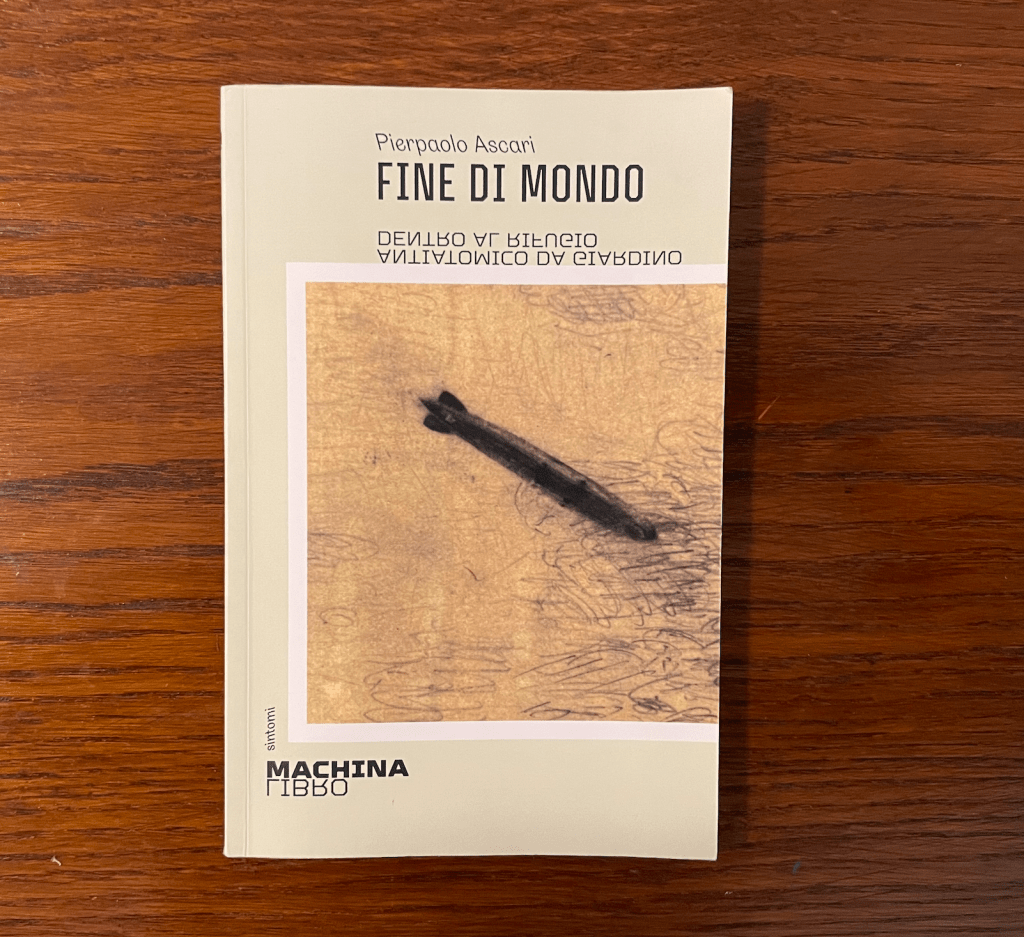
Pointing to a methodological clarification, Pierpaolo Ascari’s Fine di mondo: dentro al rifugio antiatomico da giardino (DeriveApprodi, 2024) opens with an untimely advice: the threat of atomic extermination of human life can only be told and appealed through the irony deployed in all areas of consumerist culture. Undoubtedly, this fits pretty well to the case on point, since American modernization is both the hotbed of Hollywood and the atomic bomb, two poles of the regime of a vicarious life consisted with Henry Adams’ well-known assertion that, in spite of everything, America civilizational passion has always been generalized optimism. And it is not surprising that Stanley Kubrick, when asked about the thesis of Dr. Strangelove (1964), also claimed that the only possible form to tell a story about the bomb of total extermination was through a black comedy (Ascari 11). This self-serving optimism is tested in Ascari’s Fine di mondo (2024) by looking at the construction of an apocalyptic underworld fantasy; that is, in the garden of anti-atomic sheltering that reveals the true arcana of modern Americanism as a subterfuge – but also a civil current in plain sight – parallel to the rise of mechanized labor under the conditions of the triumphant Fordism. Of course, now that our farewell to Fordism has been longed trumpeted, it does not take much to see that what remains is the infrastructure of schizophrenia and general terror in the social fabric that colors the specific tune of American apocalypticism. Ascari’s book is a superb elaboration of this tonality as historically rooted and articulated, but also open to its (pseudo)theological mutations undergoing in our present.
On the surface, Ascari’s Fine di mondo (2024) is a short compendium of the civil responses and techniques towards atomic destruction and survival; but, more deeply, is also a history of Americanism as a historical project committed to a long process of civil domestication, enclosure, and endurance of survival. Of course, the nuances here are important to grasp the subtle hypothesis of Ascari’s working scene, since we also know that modernity at large (considering both its contingency and contradiction as features of its emergence) was also a process of an optimized gnosis through alienation and the enclosure of private property towards commerce stabilization and productive growth (the nomos). But for Ascari the specificity of the American nomoi through the lenses of atomic sheltering and refuge implies a microphysis; that is, a “way of life” validated through theological premises tailored in the organization of subjective deificatio (Ascari 23). This means that the apocalyptic apparatus driving American philosophy of history is not just one of realization towards the absolute objectivation of the world – even if such endeavor is necessary and preparatory – but rather that the sheltering and self-imposed domestication of human existence has become naturalized as a threshold of the conditions of finite human life. The paradigm of sheltering as the unit of survival is a form of self-regulation of grace that is consistent with the evangelical dispensationalism and technical election analyzed in Monica Ferrando’s recent important book.
The concrete examples abound in Ascari’s short but densely illustrated book: from the Civil Protection comic to the details of the emergence of “do it yourself” assemble manuals (discussed in the correspondence between Adorno and Sohn-Rethel); from the Hulk to Godzilla in a post-atomic bombed world; form the resilient speeches on atomic menace by JFK to a 1950s study conducted at Princeton University that reassured that “fathers” will get to know their children better in conditions of total sheltering even if it results in an “ethics of the jungle” (Ascari 34). Following Guy Oakes’ groundbreaking The Imaginary War: Civil Defense and American Cold War Culture (1994), what is distilled in Ascari’s pop culture puzzle is the panorama of the “Cold War” not as a war that did not take place between two imperial powers; but rather a total war that took place beneath the crust of the earth (and this is why the topoi of the refugee becomes so telling) and at the thicket of human existence waged as psychic management of the civil sphere. In fact, the “imaginary war” is nothing else than the stazion once social life that has yet to cease to exist in our days (Ascari 48-49).
For Ascari this implied an interiorization of the ‘sublime’ in the reification of the social fabric, which cannot be divorced from the lobotomized subjectivity of the crisis of “social man” that Gianni Carchia identified as the steering project of post-enlightenment Romantic negativity. In the turbid vaults of the self-made man we encounter the liquidation of everything that is living and the projection of fictitious death that clings into “salvation” in spite of absolute destruction; because, after all, those that survive total destruction are only there to confirm the soteriological greatness of the American destiny (Ascari 78-79). The thorough “Ubu” dimension of American psychic political power definitely speaks to this well sedimented conviction of sacrificial subjectivity. Who does not remember the glorious chants for resilience and isolation of the American political elites during the peak of the COVID19 crisis management? If it came to no one’s surprise that a large majority of Americans accepted the pandemic arbitrary rules (monetized whenever needed, it goes without saying), it was because the American subjectivity has been adapted for quite too long to the ongoing separation of refugee and domestication. After reading Ascari, in fact, we think whether the emergency policies were not just another episode in the history of American sheltering now extended at a planetary scale.
There is another idiosyncrasy to American apocalypticism that must be accounted for. And this is introduced towards the end of Fine di mondo (2024), when Ascari quotes Ernesto De Martino about nuclear war; mainly, that when it comes to atomic annihilation there is no longer the symbolic mythic-ritualistic process of reintegration, but rather the mere technification of the hand that gathers scientific knowledge in convergence with the death drive” (Ascari 81). In other words, this technico-apocalypticism brings to absolute unity the originary response of the human species (the movement of the hand) with the organization of scientific rationality that, like Günther Anders saw, brings no re-symbolization of the principle of reality, but rather it can only reaffirm the layering of the principle of reality to govern over it (Ascari 85). In a way, if it as if the essence of American apocalypticism is instituted as if beyond time, since the endurance of a “time of the end” means that the triumphant death (and the dead fueling the demagoguery of its process) foreclosing the symbolization without an exit. Indeed, an apocalypse without redeeming kingdom. For Ascari the only anticipation – primordial mechanism of anthropological capacity – is that of “money”, and hence the dominance of the principle of general equivalence entails gaining the temporal illusion of some distance from the ongoing production of death. But it is evident to anyone today, as it was said not long ago, that the true dead are those petit bourgeoisie living in the American suburbs. And they keep coming as the embers of domestic happiness try to ferociously shut down the latency of a piercing pain.
Yes, the nature of permanent apocalypticism confirms that the true and final object of techno-capitalist force has always been the possibility of multiple life worlds. And its erosion implies the endless possibility of ordering the life of the city, as Elon Musk just a couple of weeks ago told the former president of the Republican Party: “Hiroshima and Nagasaki were bombed and now they are full cities again. Yeah, it is not as scary as people think”. If the enterprise of civilization has largely been understood as springing from the crust of the earth upwards, one of the important lessons of Ascari’s Fine di mondo is that it trains us to look downwards and inwards as the cruxes of America’s persistent government over the garden of our souls.
The rhetoric of “decadence” now prevalent in United States has reached such heights that, regardless of political orientation, it is clear that it has become a pretext for a desired take off and accession from the objective stagnation and paralysis. Paradoxically, the assumption that there is “decadence” is revered as a moment of forthcoming light and rejuvenation; and, thus, as a “crisis” that can be identified and managed through the end. As it is well-known, for some critics of decadence the Golden age of American life was the landing on the moon and the population boom of the 1950s; technology and family. The elements are self-serving: to accelerate the reproduction of the human species, and to lead technological gigantism against new geopolitical competitors (AI, chip wars, Green economy, etc).
In the early twentieth century Americanism was a benefactor of private Fordism (everyone could enjoy his or her car, that is, their increasing isolation), but in principle things have not changed much a century later in terms of the outlook and the techno-administrative power. But the one thing that has changed is that the age of increasing productivity and formal production is no longer the objective coordinates of social relations; rather, depopulation and stagnation are the new variables that public powers that must be governed through its effective processes. Ultimately, this also implies that the waning of the high-modern state is no longer effective, and so the established discussion about “race to the bottom” fails to understand that there is no bottom. Hence, the only race is toward planetary destruction.
And what is curious to note is that even those that have identified the epochal crisis of Liberalism can only exacerbate and contribute to the acceleration of the ongoing destruction with cultural and rhetorical veneers notwithstanding. The ‘postliberal’ commitment to the fantasy of a “new policy of re-industrialization” cunningly allows the autonomy of state-sovereign capacity as the main orientation within the growing desert of administrative functions. In fact, this is a fort da moment in which policy makers can be in favor of empowering the nexus between executive power and the federal bureaucracy; while, at the same time, the mouthpieces of these policies can promise a dismantling of the administrative state in a post-Chevron era. This schizophrenic position is not a symptom of mere anachronistic derailments of a political movements, it is also an expression of the desperate attempts of American failed (and to a large extent non-existent) political elites to find a formal mediation between state, administrative coordination, and constituent power, precisely because this nexus is broken and in shackles.
And truth be told, no piecemeal or nudge-driven re-industrial protectionism is “enough” to cure the social angst and despair of contemporary American subjectivity at all levels of human experience. It has been two honest economists, Anne Case & Angus Deaton in the book Deaths of Despair and the Future of Capitalism (2021), who taken noted that what they call “deaths of despair” is the central social affection of contemporary America, which fuels the slow but steady self-annihilation of the life that no longer truly lives (and paralyzes the economic framework as well). And, in turn, what outlives the hegemony of social domination is the regulation of pain and despair as the last dispensation of this unliving.
The necessary oblivion of the social production of the deaths of despair is what remains necessary so that a pseudo-theological framework of imperial “decadence” can retain its competitive narratives in the abyss. The end of real forces of autonomous production have led the way into the production of pain, which as Gianni Carchia clearly saw in his reading of Michelstaedter (Retorica del sublime, 1990), is a form of active ethical communication between souls. For all the alleged talk about spiritualism, theology, and instrumentalized Christianity in times of “decadence”, the high point of Americanism remains a techno-administrative apparatus that can only produce and conceal the prolongation of social pain. Precisely, “the parabola of the impossible so that any notion of the ‘good’ fails to be affirmed in this world”.