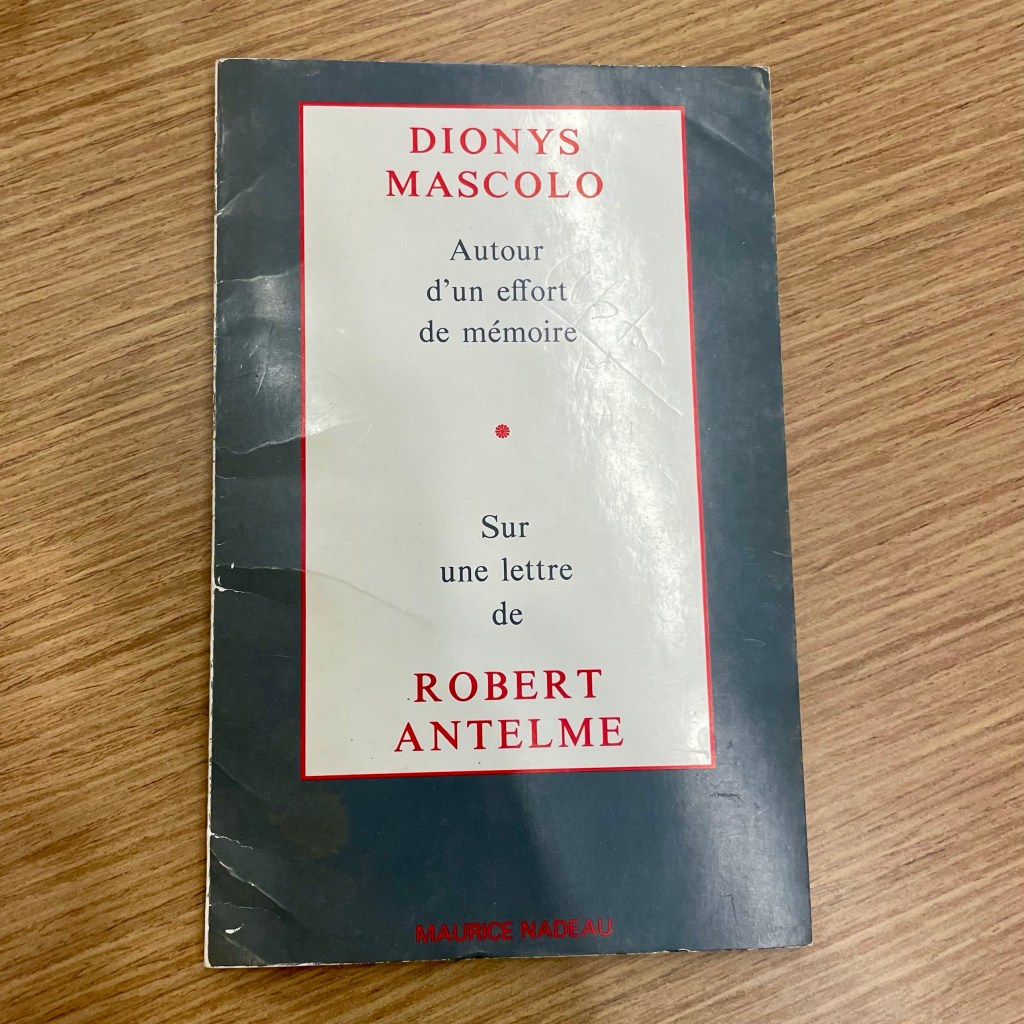
Rereading Dionys Mascolo’s Autour d’un effort de mémoire: sur une lettre de Robert Antelme (1987) in preparation for an upcoming course with Philippe Theophanidis, one gets the sense of beginning backwards or at the very end, since this late essay is a recapitulation of what the Rue Saint-Benoît Group embodied and stood for. And it is so obvious that for Mascolo what is at stake in Antelme’s letter is not a particular practice of confession (and the coupling of secrecy and extraction), but rather an integral register of an experience that belongs to “friendship in thought without reserve” [1]. And that it would not have been possible without friends, as simple as that. Of course, the condition of possibility of this shared thought in friendship has less to do with general principles, norms, or creative acts, and more with what Mascolo does not hesitate to qualify as “a sensibility that was common to us”.
What is this sensibility, and is it possible to describe it? This is a question that I do not think that is attempted to be resolved in Mascolo’s commentary nor in Antelme’s letter so consumed by its internal lacunae and effacement (I am definitely not capable of saying a word about it at the moment, and this might be one of the questions in the ongoing dialogue in the seminar). Mascolo does offer a little more when he states that this sensibility, however broad and partial, was always elevated against all totalitarianisms that were hegemonizing the political positions of the epoch. Obviously, it names the political totalitarianism (Fascist and state planned communism alike), but also the “the soul of the project” (‘est l’âme du projet et sa forme aboutie’) that must retract from it [2]. The last pages of Mascolo’s reflection is a shallow-deep, an insinuation, into the possibility of saying something in relation to this difficult proximity.
Hence, against total subsumption of life into political planning (whether on the right or left, whether ecclesiastical or in the name of the secularized forms of militant communist parties), Mascolo’s insistence on the ‘soul of the project’ is sustained by the “missing word” give that dispenses human necessities as infinite. He writes: “Et par mille et mille détours, il me (nous) fallait toujours en revenir au même point : Je suis ce qui me manque est la sentence que je porte (nous portons) inscrite à l’intérieur du front. La moindre des choses alors est de proposer que, sauf mensonge, elle vaut pour tout homme”. [3]. But what could it mean that “what I am” is always constituted by the missing word? It is definitely not a substantive attribute to a person (and thus what I can acquire), but a word that in its ideal absence and lack of epistemological validity stands as a form of seeking (zēteîn) that Nicoletta Di Vita has recently linked to the form of the ancient hymn [4]. The missing word is the passive and pure voice that calls out the rhetorical fiction of political totalitarianism. In other words, the missing word does not enact a present state of things, articulating the denomination in language with distinct objects of the world; it only has transformative weight when revealing what remains under the capes of morality.
This is why the experience of the camp constitutes a central threshold: on the one hand, it is an extreme and sharpened image of social alienation between classes; and, on the other, it is the experience that by depriving the human of its humanity it brings to an effective end the polarity between rich and poor that structured the economy of salvation and damnation of Western civilization. This is what Antelme describes in his essay “Poor Man – Proletarian – Deportee”, which according to Mascolo brings the rich to a psychotic night of desperation towards destruction and death of the specie. Hölderlin’s definition that “we have become poor in order to become rich” as a clement predicament in the face of the modern is here-forth suspended in the spiritual crisis generated by the social engineering whose most extreme case is the model of the camp.
And yet the missing word remains irreducible even after the corrupted stage of innocence and the impossibility of redemption. Mascolo, reader of Nietzsche, does not believe in the theos. This is why for him the missing word, far from being an apostrophe that offers consolation in the wake of the catastrophe, it remains concretely attached to the experience of the friend that no longer finds solace in abstract peace, but in the profound musicality of what remains inconsolable: “cette heureuse absence de paix qui est sa musique profonde, et que donne en partage l’être aimé, l’inconsolable qui console” [5]. This transfigured word – the unending capacity for hymn in the human, its nomoi mousikos – is both an excess to memory and appearance, and perhaps, more importantly, an excess to the experience of living and the dead. And is not this “seeking” passage of the missing word what the Rue Saint-Benoît Group was obsessively after?
__
Notes
1. Dionys Mascolo. Autour d’un effort de mémoire: sur une lettre de Robert Antelme (Maurice Nadeau, 1987), 82.
2. Ibid., 83.
3. Dionys Mascolo. Autour d’un effort…,82.
4. Nicoletta Di Vita, Il nome e la voce. Per una filosofia dell’inno (Neri Pozza, 2022), 27.
5. Dionys Mascolo. Autour d’un effort…, 89.
 Infrapolitical Reflections