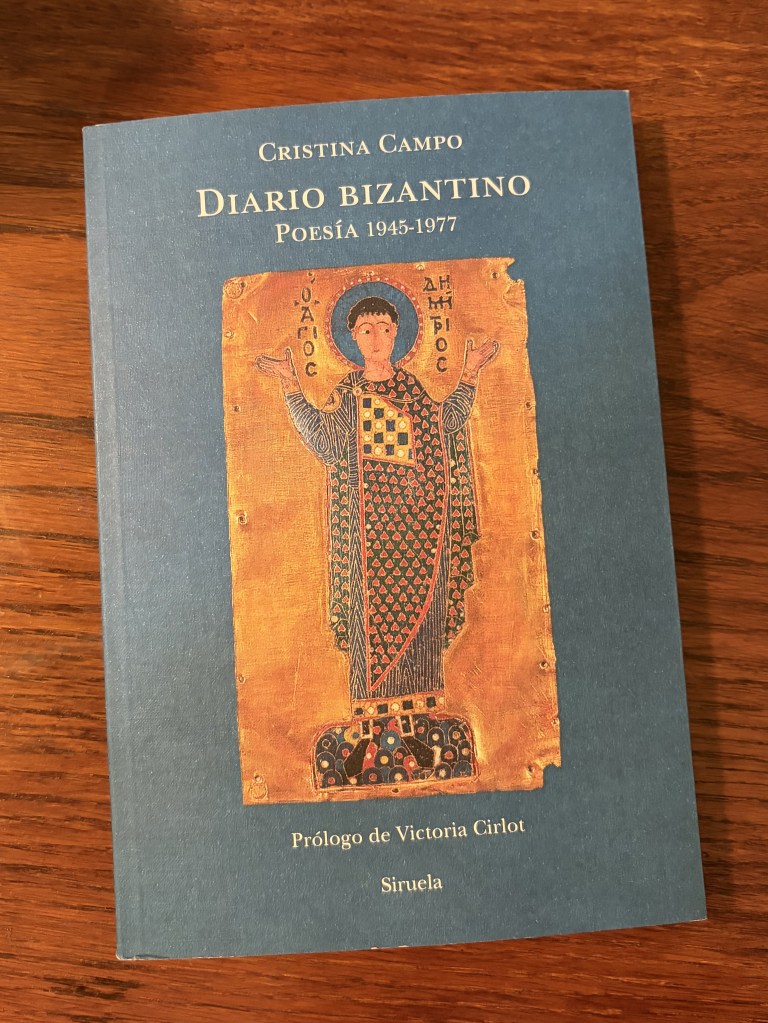
Cristina Campo was a modern mystic who gravitated towards the liturgy of the poetic word. Now thanks to the scholarship of Victoria Cirlot, the Spanish reader is able to read her complete poetry in the bilingual edition Diario Bizantino: Poesía (1945-1977) (Siruela, 2026), which serves the missing companion to the essays collected in Los imperdonables (Siruela 2020). It is difficult not only to differentiate modern genres in Campo’s writing scene, given that both essays and poems (and also her letters, published in multiple volumes by Adelphi, but not yet collected in Spanish) revolve around the same concern around the liturgical depth of the word and the image as indispensable units of raising to the divine transcendence lodged in a treasure chest of secrets. For Campo modernity is the temporal movement that laceration this longing for the mystery, where language insofar it serves the purposes of justification never ceases to participate in the spectacle of imagery and the tradition of the rite that grants access to the experience of the senses. Hence, mutilation does not seem a harsh verb: to slash and separate becomes a misnomer for the closure of “this world”, which is not only the material world of immanence, but one in which the autonomy of imagery – and thus the passive act of imagining – enters into a terminal pauperization elevated by fictitious, at times melodramatic, ornamentation of meaning.
To leave the reduction of meaning implies a sense of the liturgical. As Cirlot notes in her brief, yet lucid introduction to the volume, it is impossible to not read Campo’s poetic word within the coordinates of her understanding of the liturgical praxis as a mode of artistic development. In fact, in her essay “Note on the liturgy” (1966), Campo would claim that liturgy was a celebration of the divine mystery that is instantiated by the charity of language as an “ecstatic mirror of creation” [1]. If liturgy is a mode of an ongoing work of art in the shadow between the living, the dead, and language it is because, as Florensky also noted – another figure revered by the Italian writer – it is the abyss of a sense of freedom raises to the freedom of the senses beyond fixity of mimetic representation through objective spatial groundness. Around the same years that Campo was meditating on the need to alleviate modern poetics from the maladies and the self-inflicted wounds of the Ego, the Catholic poet Octavio Smith, a member of the Orígenes group, would also celebrate the liturgy as the condition of an image that carries forth folded in the vocative, the offices and rites made possible by pure charity [2]. The partition and participation of poetic language is not just an abstract entelechy of the koine for human language; but, more importantly, it is the charitas that saves language because it appeals to the extasis of beauty. Campo will write that the liturgical scene: “…as in poetry is a splendorous charity, more on the side of necessity than of the useful. It is regulated by harmonious forms and rites that, inspired by creation, surpasses itself in extasis” (Campo, 17). It is the excess of language beyond language that finds dwelling space in the abyss that enacts as witness of a comprehensive cosmic reality.
And charity will be less than nothing if it would not carry in its interiority the nexus with the dead and the transmigration of the soul that are now joined with the living. The examples abound: “…se nel mio trachea / contemplarai di un’altra migrazione….nessun vincolo univa questi morti / nella necropoli deserta” (Campo 38). In Campo’s poetry the liturgical charitas is not an event of absolute faith overturning, but what is already occurring, a rhythm, that is both fixed and suspended between actual presence and the non-present, “the destiny between the hand and the flower” (como il destino tra la mano e il fiore)”, that has clear echoes of Coleridge romantic dream (Campo 48). And yet in Campo’s poetic liturgy there is no moment of awakening, but realization that existence is transnatural, never hidden in the order of the natural world, but in the “perfumed cloud of language” (nell’odorosa nube della lingua) (Campo 84). If language participates in the flaming and enduring rite of the living and the dead, it is because it keeps track of the pure absence and the negative of the voice, that is both present and absent in the mouthing of every prayer, and as the symbol that longs to devour language itself: “la Tigre Assenza, ha tutto divorato, di quetso volto rivolto a voi!” (Campo, 92). In the praxis of liturgy, the highest celebration through hymns and chants seem to permanently reveal – and perform its revelation – of the abyss that cross language towards its own rebirth and pulsating elucidation. This passion for absence that devours speech becomes the transport of Campo’s poetic dwelling from beginning to end.
Obviously, the major poem in the collection is “Diario bizatino”, that is structured around four parts and published posthumously in 1977, and whose first verse can easily become the vortex of the poetic exploration: “Due modi – e io vengo dall’altro” (“Two worlds – and I come from the other one”) (Campo 94). The poetic word assumes the reality of the gnosis as a threshold that is no longer between the past and future time of salvation, but the very schism that allows the passage from the living and the dead to resurface. It is a threshold that cuts through the soul itself: “…è il taglio vivente ed efficace / più affilato della duplice lama / che affonda sino alla separazione dell’anima veemente dallo spirto delicato” (Campo 94-96). To come from “other world” and to transit into “this one” is perhaps to be a little bit dead or undead among the living in the whirlwind of the names. As Campo writes in a defining verse of the long poem: “…al centro del Sole là dove il Nome! Rapisce in vortice immoto alla vita del mondo, zampilla nuovi sensi dal mondo della morte” (Campo 96-98). To be with the dead is no theatrical imposture of a void ritual that questions the meaning of “this life” – perhaps the most commonplace Hamletian condition inherited by modernity – but it is the instance that allows the senses of the world of the dead to creep on us as an unexpected ambush.
This is why the mirage of the Byzantine becomes the new Sun in the middle of the darkest Night, and the moon soon gives way to eventual coming of the Sun (Campo 99). The liturgical plane of the senses extends to what language can receive in both giving and receiving through the analogical being that is lacking in sequential time. Here Campo’s East is in sharp contrast with Yeats’ “Sailing to Byzantium”, where all that lives is “caught in that sensual music / all neglect monuments of unageing intellect. An aged man is but a paltry thing” [3]. If for Yeats Byzantium is a site of alchemical rejuvenation and rebirth, Campo’s ageless Byzantinism nourishes the dead in which language finds beauty and pain as the supreme witness. In all accounts of what is invested in a language that cannot speak of the unfathomable revelation, for Campo the poetic word is weighted as a song to “testimonaire, a ferire / a insolibuilmente saldare / a inguaribilmente separate” (Campo 118). The influx is the ultimate liturgy of separation, between language and being, the idea and reality is never completely lost. Or it could very well be lost, but only in what remains merely visible in this world.
This is why Campo never felt the need of the production of writing, not when the liturgy brings closer the excavated eyelids of pavid “gazes ingrained to the memories, to the ground, and to the dying psyche”, as she writes in the last verses of “Ràdonitza” (Campo, 120). In the way of “Burnt Norton” well-known bird – “human kind cannot bear very much reality”, and that is about right when it comes to what can be abandoned from the viewpoint of language. Between this world and its other – the triumph of Manichaeism outlives in the celebration of the fluvial depth of poetry – the divine apokatastasis of what remains unsaid, and yet well kept in the form of a diary.
.
.
Notes
1. Cristina Campo. “Note sopra la liturgia” (1966), in Sotto falso nome (Adelphi, 1998), 129-135
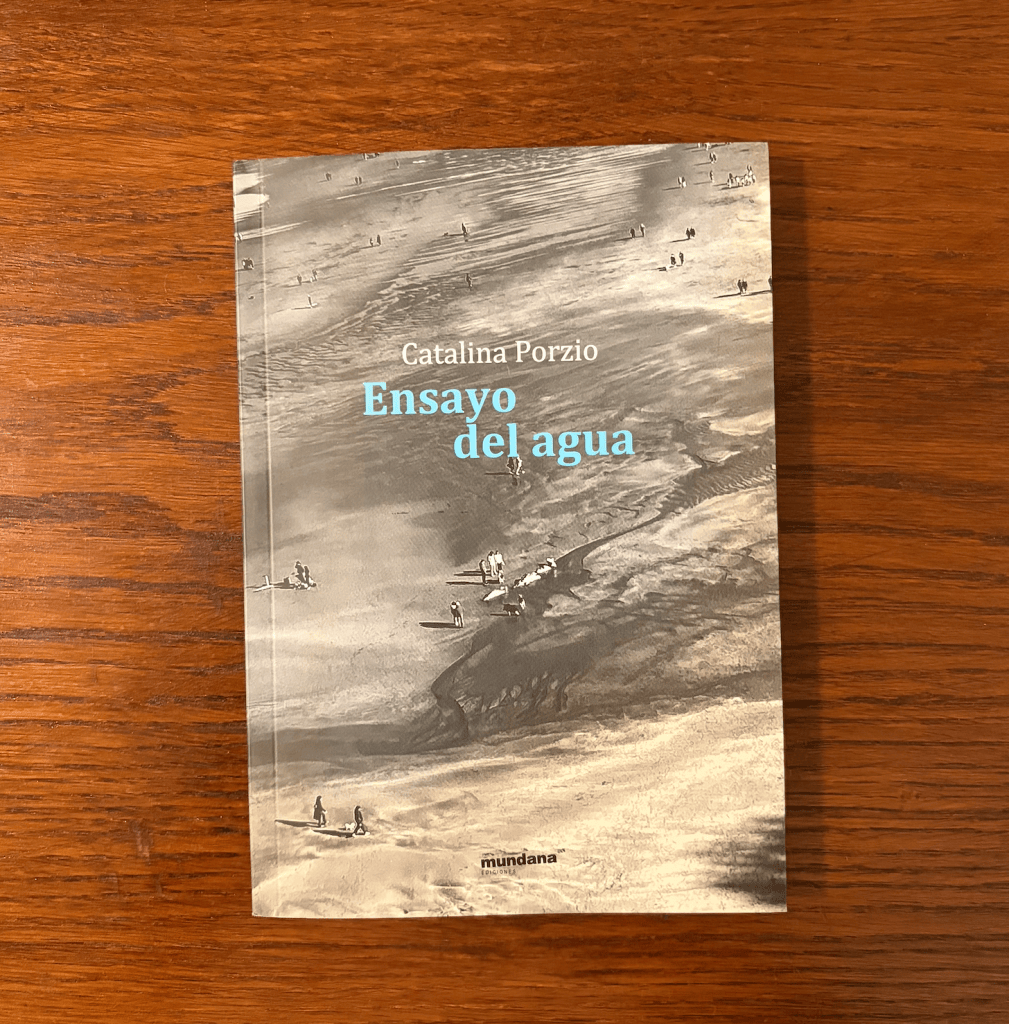
A hymn to the overflowing currents of water and language, Catalina Porzio’s Ensayo del agua (Mundana Ediciones, 2026) opens with a pindaric scene of celebration: “Una vez que la mano se ensambla a la copa olvida la autonomía que las rige….en esa comunión indisoluble, chocamos los cristales con estridencia y porfía por la satisfacción repetitiva de oírlos tintinear. Descontando que un exceso de entusiasmo haga estallar en mil pedazos la escena” (Porzio 12). Water is the pouring of wine and liquor; but it is also the mystery of oceans and the human necessity of quenching one’s thirst. It is all of this, sure, but a series will not do given that water is formless and defies the mimetic faculty that has allowed humans to draw associations high above in the sky. Porzio’s prose defies this temptation of crafting a topoi of water, opting for a dance of forms, descriptions, and enchantment brought together and dissolved by the sargasso sea of her own prose. To claim that writing is like swimming or paddling in water is a poor description to pin down what Porzio achieves in this essay. Her gesture is more versatile without stepping into an abyssal onanism, and this means that to begin to understand water, a certain levitation prose might be in order. A levitation that brings water both near and far. And this is because water escapes the metaphorical reduction of language, and it is always the event as such (just like the title insinuates it: it is not an essay about water, but the essay of water or a water essay).
I am tempted to write “splash!” but this brings to mind David Hockney’s visual world, which is always frozen and imperturbable, at times undisclosed; whereas Porzio’s prose is agile, elegant, and strangely inviting, and thus uninterested in the mute surroundings of the West Coast. Perhaps it is much better to enact Joyce’s lexicon: riverrun down by the waters forms of Viña del Mar, coastal central region of Chile, and into the fragments of infancy and balnearios, and finally making a turn at Tolousse-Lattrec’s La Toilette. As Porzio tells us while making a stop: “Parece imposible hablar del agua a secas, pues dada la fluidez de su naturaleza, cambiante y escurridiza, invita continuamente a la deriva, haciendo inevitable los desvíos, las disgregaciones” (Porzio 44). A riverrun from a certain attachment – uninterested in the play of signifiers and graphism – of writing, which means that Porzio’s poetic prose is highly engaged in vivid synesthetic imagery. In fact, this overflowing prose is accompanied by the light of painting, and most importantly of the hand that orients the voyage throughout the book.
The experience of the prose, in this sense, is not just an exercise in writing, but one of absorption, because it is only after being arrested that jubilation triumphs over reason (and one could also add: over grammar). “La algarabía desconoce la razón”, we read about halfway (Porzio 64). Of course, it is silly to say that good prose needs pictorial supplementation and artifice; what I am trying to say is that, while reading Porzio’s essay, absorption is the hand that discloses the world of sensorial celebration. The hand retains in the overflowing currents of riverrun downstream. Painting is both an instance of the light that absorbs and that renders imperturbable the errant topography of experiences. And this is why Porzio is right in reminding us that “y es que navegamos gracias al olvido” (Porzio 66). If there is a work of memory it is because we are deep in the waters of Lethe, and perhaps the unfathomable image of experience is what gives us a hand in the dangling spiral motion.
As we know, this is at the heart of Hölderlin’s “Andenken”, where the verse “But it is the sea that takes and gives remembrance” validates both memory and oblivion of a human experience that quenches its thirst in the mystery of time (ultimately only a letter separates “sed” from “ser” says Porzio towards the end of the book). At the risk of vulgarizing Porzio’s essay – although her writing is not fully disconnected from the handles of the present – I would claim that precisely the ongoing barbarism of our technological epoch is precisely that it has failed to endure its voyage to Lethe, which is why it is committed to untruth and permanent lies at the same time that forces the human species to permanent memorization, while drying up its once opulent rivers of the West. And if rivers have become a scarce resource in our times, it only makes sense that the same can be said of human language, which is increasingly devoid of dialogic interlocution and the possibility of naming now replaced by automatized coding (some scholars have noted that Finnegans Wake’s “riverrun” also lodges “-ren” might be referring to the name). What happens when riverrun, which is the speculum of human experience in both language and water, dries up? This is the central question that arises from Porzio’s beautiful experiential essay.
In the last pages of Ensayo del agua (2026), Porzio tells us that when an old man of her acquaintance was asked what he will miss most of this world he responded with great conviction: talking (Porzio 104). And as it is also quite obvious for Porzio that the necessity of conversation is not just an intrinsic institution of our social life; it is also the cave (to recall here Porphyry’s reading of the nymphs water caves in Homer) where the living and the dead enter into the purest of conversations, because “…ambos gesticulan, y en la fantasía de encontrarse, transporatados ilusoriamente en la cámara del tiempo, no cabe duda, se entenderían” (Porzo 105). If language is always downstream, at the riverrun outlet, it is because it is both the communicating vessel as well as the immaterial gesture that flourishes without beginning and beyond the imagination of the end times. Avoiding the self-assigned role of the doctor of civilizational decay, Catalina Porzio’s Ensayo del agua (2026) ultimately unfolds a unique choreography: a gesture of language that allows us to move throughout the epochs in order to feel at home anywhere.
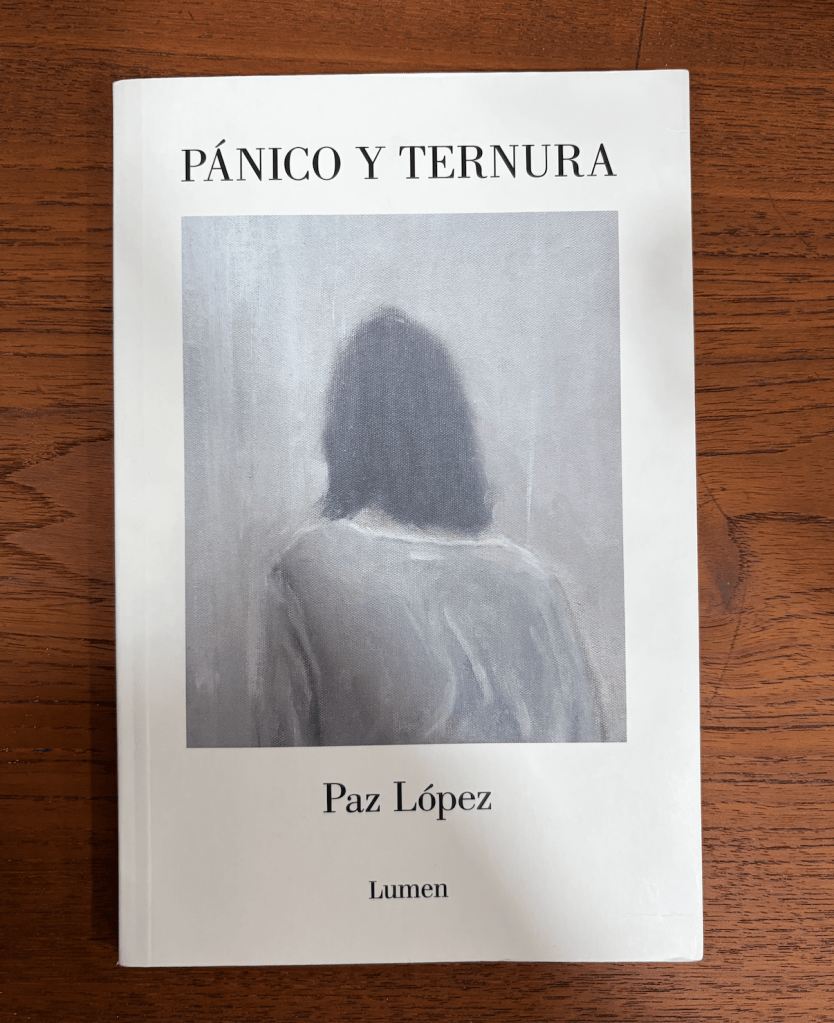
Paz López’s Pánico y Ternura (2026) opens with an analogy between life and school that immediately places us in attention to her writing: “Entramos a la vida como entra un niño a la escuela: mirando hacia atrás, con los ojos llorosos buscando la mano de quien hace un rato nos había variado el pelo, la nariz, las rodillas heridas, los diminutos labios” (López 14). Although the synecdoche (“la mano”) does not reveal to whom it belongs, in a way the mother is spectrally present, a figure overtly present in Paz’s writing. We enter life in the wake of separation and caesura, and that is the site of the original wound that will lead to all sorts of civilizational and mimetic compulsions that unfortunately we know too well. And yet, López does not say we enter the “law” (although this is also presupposed of course), but rather we enter school. Our civilization has slandered and tainted the notion of “schooling” and “school” to such an extent that we have entirely forgotten the fact that school is schola; that is, time of rest and interruption, “free time”, a lagging duration of contemplation of language and being, and of being in language. And if the notion of “school” is under ruthless attack in our present by an infantry of pedagogues and technicians, it is mainly due to the fact that what is being threatened is the very possibility of a form of life. Of course, our epoch is one in which the chatter of “life” is continuous and intoxicating, but the form of life is something altogether different: it entails to inhabit a space of a convergent and planar movement between language and world.
This is one of the regions that opens in López’s book; one out of many, allow me to follow it. As López says toward the end of the essay: “…cada vez que hay un corte tenemos la posibilidad de inventar una nueva lengua, de poner de movimiento el mundo” (López 128). It would be too convenient to follow up this claim and say that this is precisely what Paz López does in her writing; clearing language in order for a tonos or a vibration of the voice to unearth tropes that have been traced almost at the level of the flesh. This is something to this autographic practice that moves gently without fetishing the body and its materiality. Ultimately, a body is always more than surface. I want to retain from López’s scene of writing a responsive form of thought that in its inconspicuous relation to writing it refrains from the certitude of both philosophy and the letter. López’s search could perhaps be one of “tanteo”, a beautiful Spanish verb that refers to the hand that seeks and reaches out for something in space, and in my memory it immediately recalls some short stories of Carmen Martín Gaite’s fiction where this gesture figures in a cinematic fashion. Hence, for López ‘tanteo’ is to refuse the hell of a world of acrimonious security and confirmations that discards the inexorable presence of doubts and fissures (López 39). But the hand that seeks is also not a pure gesture in the void; it is one that asymptotically discloses an erotic mediation with the passing world without ever abandoning it; yet unequivocally assertive in the lamentation of the state of the world (López 56).
In other words, because we can seek (here López is enrolled in the school of Hölderlin), there is no end to the world now configured as a fragile fishing net of relations, unsaid words, glances, and incommensurable distances that make up, without exhausting it, the spectacle of life. Not “this life”, of course. For López, the brutality of our times (I am less prudent and I will say ‘onto-theology’) is precisely the general concerted opinion that we are all owners of our own little and mediocre lives, the last avatar of a self-serving will to power. Rather, for López life is always elsewhere, and this is why the “escape” or “exile” from oneself is not a place of arrival or destiny, but precisely the disposition that is always traversing every relation and every touch between bodies and souls (López 65). We are creatures of the outside, and by extension, only the cohabitation of the outside, can redeem the pain of the original laceration, as in the first image of the infant walking his path to school with his eyes turned. This is not a messianic or monastic retreat, it does not depend on the parousia, but rather one of poetic dwelling in the spaces that are both familiar and strange. It is only in them (through them) that we can only cultivate through the garden of our language. López’s anti-messianic orientation, devoid of the fiction of future time and its anxieties, is proportionally a prose of hanging spaces, of curvatures of language that affects the reader deeply without ever renouncing to the beauty that thinking that defies being brutalized through the crushing weight of technical terms or philosophical concepts.
In this sense, López’s writing is already an autographic writing at the threshold of onto-theology convinced that only style through the resources of the voice is the path that mitigates between poetry and philosophy, painting and memory, experiences and the unlived. López’s prose, if anything, is a lot about “gathering” through the tenderness; a contact where image and eros become the medium of life: “No es eso también la ternura, una forma de “recortar nuevos espacios en el vacío informa del exterior y conquistarlos a la medida de la vida (Claudio Magris)?” (López 94). To gather and to cut through the spaces: this is the highest task of the ethics of a form of life that requires a new theology of the sensible. Theology can be taken as a strange word in López’s lexicon, and I do not think that it appears even once in Pánico y Ternura. And yet, López’s proposal is completely theological if we take the theos as the highest and most beautiful light that can nominally allow for depth through the analogy of things in the net of the world. Hence, the importance of the sighting to the inner most depth in some moments of López’s writing, such as when she ponders on the fact that every time that she plunges eyes on a minuscule element or figure of the world, she senses that “se revela el elemento bestial que se enceuntra en el centro de nuestro mundo, como si la mirada fuera un cordon umbilical….amarrados todavia al vientre brumoso del origen” (López 121). And theology is not just the highest, but also the science of the first things: through the piercing expression of our senses, we elevate ourselves not with some revealed transcendence, but with the proximity with the things that have found us.
And yet we have been automatized – this is the sensible devastation that Pánico y Ternura is responding to without ever taking a political stance, because politics is thoroughly insufficient – to see every-thing, and every being at all times; all entities realized in the feast of interchangeability and availability. The heliotropic force of modernity now truly blinds and burns our skin, which means that no access to the solar totality of social existence can guarantee anything except continuous conflagration and commanded muteness. We cannot but feel “panic” in this current predicament López is completely right. Thus, we must find the flickering light and flames elsewhere, such as in the lamp of a dark night that can illuminate the page of a book that keeps us in attention without any real purpose. Nabokov’s suggestion comes to mind: in the lamp of our study, we reject the nihilist demands of the cacophonous social world. Paz López has given us a delicious essay to read under this tenuous light. It is a present memory of an abode that keeps the secret of secrets, a resting place of the soul where still some melody is heard.
First published in the Chilean publishing house Mundana back in 2016 and long out of print, Victoria Cirlot’s Imágenes Negativas: las nubes en la tradición mística y en la modernidad (2026) finally appears in a new and upgraded edition from Siruela Ediciones. This short essay, initially a conference delivered at the Universidad Católica de Valparaíso, is another contribution to Cirlot’s important work on European mystical tradition of European early modernity, but like other of Circlot’s book its value also resides in its prudential contribution to contemporary thought. In this sense, Cirlot’s visual exploration of the cloud allows us to raise the question without much hesitation: what is a cloud in a field of vision, anyways? In Kurt Badt’s John Constable’s Clouds (1950), a book that is curiously missing from Cirlot’s commentary and bibliography, the cloud is merely a modern phenomenon in painting; a specular effect of the rise of meteorology in post-Enlightenment England that paved the way for a new construction of the modern landscape painting.
If Cirlot does not need to follow Badt’s insights, it is due to the fact that she wants to take a step back, even if her point of departure is Von Dillis’ drawings from the nineteenth century that she encountered in the Alte Pinakothek in Munich. These are relatively small works, and more profusely unfinished than Constable’s cloud exercises in oil painting. I seriously wonder if Cirlot’s would have taken another direction in her analysis if she had confronted another series of cloud paintings of the modern tradition. Perhaps not. Following Gombrich’s dictum that clouds are accidental forms reserved in the mind and extended to the pictorial space, Cirlot immediately goes on to document the long mystical tradition where the cloud stands for theosgnophos, or the incandescent light that descend from the divinity right into the human’s heart (Cirlot 18). In the mystical tradition the cloud of the story of Moses, later deployed as a trope by Pseudo-Dionysus and Gregory of Nyssa, the cloud refuses to be an accident of substance; it is rather the image of substance itself: the impossibility of knowing and having access to the divine, and thus the need for the recollection of the light of ignorance.
If mysticism and painting go hand in hand it is because what the divine cannot be said in language, but it be disclosed through the spectacular persuasion of an image that is carved in the veil of theology. In this way, the cloud is a bit like a dress in a painting, both conceptually and figuratively: Cirlot does not fail to note that in Medieval representations one can grasp the figure of God swerving in a cloud before a horned Moses, but it is also the turbulence in the depth of the picture that allows for the ascension of the gaze that fails to establish a horizon and the linear perspective. Although Cirlot does not put it in this way – she is obviously more refined and attentive to her historical sources – one could easily find an opposition between clouds (and perhaps clouding of the background of a picture, an activity) and horizon of pictorial representation. It is in this sense that Cirlot defines the “via negativa” that clouds appeal to the impossible knowledge of God (in my translation): “The images of ascension and clouds are modes of making visible the negative way of the proximity with God…the fact that the experience of god takes place through the mode of negative images is something that persist from Pseudo-Dionysus to Mechthild of Magdeburg, and San Juan de la Cruz” (Cirlot 23-25).
In other words, the cloud is the non-human figure of a mode of cohabitation in God – Cirlot goes as far as quoting that it is the medium, “el entre”, the incommensurable distance between the sensible being and god (Cirlot 27). This is why the cloud, in virtue of what it discloses in its non-disclosure, is a bit like a hole in the picture, and we fail to account for its potency to stabilize its mystery through the categories of the autonomy of the work of art. This is why it is very fruitful when Cirlot tells the reader that the cloud defies vision in its very appearance, since through its clearing and light, it can only “sense through the inner soul” (Cirlot 30). This was also present, at least residually in Badt’s Constable Clouds, when referring to the externalization of the clouds as the spiritual organ of the living. But it is precisely this exteriority that defies the epistemological grounds of meteorological knowledge that would facilitate the technical ability to condense the cloud into force and energy, whose ultimate expression is crowned in a work such as Hans Haacke’s Condensation Cube (1963). A fallen cloud from the sky that can only be experienced in the abstraction degrees and measurements of its objective “data”.
There is an intimate and communicate vessel between painting and clouds that can be derived from Imágenes Negativas (2026), and that can be sound in the state of imperturbable contemplation where life and thought convergence without the energy of struggle that would define modern artistic creation and its fall into autonomization (Cirlot 33). If painting is to release and live as a mode folded in God; the modern sensibility would require the energy of creation in order to open the passage between worlds. Following Puech’s important work on Gnosticism, Cirlot sees that the nebular trope of the cloud persists in modernity well beyond San Juan de la Cruz: one can sense in the attempts to “escape this world” – from Piranesi’s ladders to Thomas De Quincety’s prose, and of course, Charles Bauderlaire – a hymnal longing for the clouds that depends on the energy of the reversibility of the modern seen as a form of confinement (and from the pictorial space, I would argue also as the triumph of flatness in modern painting) (Cirlot 44). The cloud becomes a window for gnostic imagination, although this could very well be a sort of self-serving pleonasm, given that the “possible” of the gnostic remnant in the work of art only appears as momentary reversibility; a temporality that necessarily subsists without transforming the plane of sensibility. These are wonderful experiments in poetry, painting, photography; and yet, the negative, I take it, cannot be refused its place in the historical wealth of historical capture of exteriority. Both Hölderlin and Baudealire’s clouding of poetry is already the document of the impossible attempt to live the serene life in god. Thus, any attempt at a full-fleshed exodus via negativa, runs into catastrophe and possibly madness in the wake of disenchantment.
In her final and short essay of the volume, titled “La estrella y la nube”, Cirlot speaks of the return of the cloud in modern photography, concrete the work of André Kertész, as ‘laceration in the sky” (“agujerear el cielo”), or a tear in the heavens (Cirlot 60). The passage here appeals to an inverse tonality, where lamentation becomes an inexorable dimension of affection in the world now organized through massification and urbanization of all spaces. Disenchantment is ultimately spatial enclosure. But this tear in the sky is a remnant of a memory of the divine, as well as the absence of the divine in the world; the failure of establishing a transcendence with the unknown and the inapparent. But it is thanks to Victoria Cirlot’s pictorial explorations that we can raise these questions, which are also more than mere questions pertinent to theology and art.
At least since Ernst Böckenförde declared the end of secularization and the exhaustion of the liberal state form in the late sixties, the distinction between theology and politics has experienced a profound schism across Western social life, which once served as the ground and mediation to the homogeneity of “ethical life” (Sittlinchkeit) of civil society. It is still useful to recall Böckenförde’s theorem as a refresher: “What does the state live on, and where does it find the force that sustains it and guarantees its homogeneity, after the binding force emanating from religion is no longer, and can no longer be, essential for it? Until the 20th century, in a world that was first interpreted in a sacred way and then as a religious world, religion had been the most profound force involved in the political order and in the life of the state. But is it possible to find and preserve life in a completely earthly and secular way? […] Therefore, the question of binding forces is raised again, and now at its true core: the secularized liberal state lives on prerequisites that it can no longer guarantee” [1].
Indeed, one could say that in our era, clearly marked by the collapse of political mediations and categorial order, the schism between theology and political forms inherited from the Judeo-Christian eon has increasingly become full fledged and patently visible at a global scale. In a certain sense, and leaving behind all nuances, the operating horizon of thought today implies from and through the energy of this schism. If this meeting attempts anything however modest, is precisely the intuition that in the wake of the schism of political theology, the “theos”, following the trumpeting of the death of God proclaimed by Nietzsche or the flight of the gods as orphanage from the divine declared by Hölderlin, presents with an opportunity to think a non-rarefied style on the reverse of historical collapse. In recent years, a certain theological latency has been present in many contemporary theoretical projects, insisting on approaches related to mysticism and life, the gods of language and nominalism; the insistence on the communication between souls, the messianic and presence, to name just a few figures of thought without pretending to be exhaustive.
As machination and the spiritualization of technology subsumes the totality of social life in the West, existence enters a region of thoughtful and cunning marranismo, which could be taken as a form of life in the desert and a keeper of its depth of the ethos. How does one make sense in this moment of delirium and relentless decline, which include although it is not limited to, the defeat of the cycle of global uprisings and the solicitation of positions of exodus and desertion? In other words, we are trying to think of a language that we speak across distant places, and come to terms with the tonality of pain and despair. Is there a non-nihilistic way out of a civilizational project governed by the cybernetic dominium, continuous predatory extraction and lethal destruction of worlds? “Desecularization” is not naming a historical moment after “secularization” – something that has taken place in its own historical dispensation – just like posthegemony is not naming a temporal sequence to principial hegemonic politics. And of course, “desecularization” is not a program of any sort, although it is interesting in positing the possibility of “a new beginning” in the wake of the ruin of political theology as the orienting strategy of division and orderability, which fundamentally colored capitalist civilization on the abstraction of work and the work of abstraction proper to the historical modulation of Christian metaphysics and its theological rubrics. And if “desecularization” is neither a concept nor a program, I still would like to retain at least its resonance to other positions that have I have called for lack of a better term, the quadrant of positions of refusal [2].
Can theology, a confrontation with theology, drag us out of the via negativa towards something else? It is easier said than done. And it is never sane to get caught up in the spinning wheel of a term, whether it is “desecularization” or “desistence”, or “destitution”; a sort of rhetorical enchantment of the “-des”. Ultimately words say very little at the level of the concept, and they tend to offer a cell in which the process of amnesia and ratification can take place – the task of refusal, then, I take it, is also watching over, what the Cappadocian Fathers called the nepsis – what thought cannot elevate to the luminosity that emerges from the term. We are interested in theology and theos, but only insofar it opens itself to thought and the place of language, as well as the irreducibility of existence and death, to the imagination and the endurance of an ethics that undeniably invites makes itself present whenever we hold on the incommensurable distance between language and world. And if we have invited both Monica Ferrando and Alberto Moreiras to open up this seminar with us, it is because their styles of thinking are clearly devoted to pursue this question to the end. Of course, this means something consequential: they both affirm a path wherever it might take them (one can even visualize this in Monica’s extraordinary nocturnal paths in painting, such as the series “Paessaggio Perduto”, or “Lost Paths”). And it is a commonplace to say that both of them have been grappling with the problem of theology from almost opposite directions of the meridian distance awakened to the horrific abyss of our present, which means that perhaps the marrano and Pan do meet as fugitives in the forest passage both lost and found.
One word must be said about the term that is meeting is trafficking with – and perhaps “trafficking” is, alas, a good verb since none of us (perhaps with the exception of one person, and even he might feel stranger with that label) are professional theologians, nor do we have access to revelation, but perhaps this is too much on the side of intimate matters that one should refrain from commenting upon. Of course, the trafficked word is “desecularization”, which alludes to a certain rupture with the very essence of the saeculum, or the political institutional authority and its institutional arrangements in this world. When Schmitt says that all political concepts of modernity are secularized theological concepts, he is also assuming the irreversibility of secularization as internal to the historical matrix of Christianized West. In fact, according to theologian Robert A. Markus, desecularization has already become operative within the early Christian epoch of Saint Augustine. In his Christianity and the Secular (2006), Markus writes the following: “[in dialogue with Peter Berger] We may leave sorting out the complexity of that relation to the sociologists. All we need to note for our purpose is that the reverse, what some have called ‘desecularization’ has become a more recent preoccupation of sociologists of religion – and not only of sociologists. “This is just what came into being in the course of the emergence of Western Christendom from Roman Late Antiquity – a ‘deseculariation’ which is the reverse of what happened in the Wars of Religion. If the notion of the secular were to apply in such a society, it would have to be defined in more problematic terms: as what does not form part of a religious discourse … .The core of my argument in this book can be briefly summarized. Its substance is that Christian tradition has a legitimate place for the autonomy of the secular, even though for many centuries this was eclipsed in its awareness, and despite the perpetual undertow of what we have become costumed to call ‘triumphalism’ in Christian political and cultural attitudes” [3].
Of course, as Märten Bjork has recently shown, in Markus’ theological understanding of the saeculeum, the government of the Earthly city grounded in principial politics must also be relativized by the eschatology of the Kingdom – facing the event of death and the dogma of resurrection of life – that can take step back (or beyond) the libido domininandi, that generates the solipsistic desire for government and administration necessary for the circulation of a “libidinal economy” [4]. We can thus call the Markus’ position as the architheological position that dissolves the polarity of secularization and desecularization as an enterprise of Western philosophy of history and its homogeneous temporality of survival and reproduction. Secondly, it is also important to note that the notion of ‘desecularization’ made an important entry in the famous Capri conference of 1994 organized by Gianni Vattimo and Jacques Derrida, where the French philosopher mobilized Plato’s chôra to avoid relapsing into religious faith, and thus uprooting revelation as the ur-site of Christianity. Thus, for Derrida, ‘desecularization’ is a figure of thought that seeks a third space of the a priori of the nonsecularizable. In the brief dossier “Christianity and secularization” later published in Il Pensiero: Revista Di Filosofia in 1998, Deridda sheds light unto this path of his thinking, which he never fully develops:
“….. The desert, the figure of the desert, which we discussed extensively in Capri, is clearly charged with biblical memory; and it’s not enough to say desert, or even “the desert grows,” to achieve or, conversely, abandon secularization. The desert within the desert is a radically heterogeneous desert. The motif of the chôra serves me, in general, as a guiding thread for thinking about a place, and chôra means place, to take place; and of the event, it is said that it takes place, and chôra means place or spacing, interval. This is a place that is, to use Plato’s terms, neither sensible nor intelligible, and which is spoken of in a bastardized discourse, in that it gives rise to neither a metaphorical nor a proper language, and in Plato’s text itself, it escapes all Platonic concepts and even Plato’s self-interpretation. This place is neither divine nor human… The chôra is the place where the demiurge, gazing heavenward, contemplating eternal ideas or models, inscribes the sensible copies for the formation of the world. Therefore, it is neither sensible nor intelligible, neither human nor divine; it is absolutely impassive, totally neutral with respect to all conceptual or dialectical oppositions; it is therefore the place that resists any reappropriation or reduction within the poles of anthropotheology. Chôra is that which cannot be reached even by a discourse of negative theology” [5].
The nonsite of the chôra is also what is heterogenous to the polis, and so for us the absolute differentiation between chôra and polis is precisely as important, and parallel to Monica Ferrando’s distinction between the musical nomos of the mythic topos of Arcadia, and the modern allocation of the nomoi of spatial dominium as appropriation, concrete order, and reproduction; the three pillars for the constitution of the ideological revolution of survival. Of course, the chôra can be said manifolds, but it allows us the temptation of political subsumption, of an inversion of a new “theological political” (as it is already taking place in many circles in the United States, with the unfortunate but expected in Leo XIV as equidistant, alas, the new self-delegated commissar of an “Anti-Cybernetics” point de capiton. Alas, once again hegemony knocks at the door, this time with theological garments). This reservation speaks, if not directly, at least tangentially to Alberto Moreiras’ recent affirmation against the ‘retheologization of the world’, which would entail the hegemonization of the total space of social reproduction [6]. Here we might find room for fruitful dispute and elaboration. Indeed, because it is never about re-theologization of the world, but perhaps in the old formulation of Guy Landreau and Christian Jambet’s L’Ange: Ontologie de la révolution (1976) that any gesture of true refusal or revolt requires at least the partition of two worlds, if we are to avoid the eternal dialectic of desire between Master and Rebel that nourishes the ideological projection sustained through the amnesia of any ethical elaboration.
Perhaps by ‘desecularization’ we are pointing to an exit through the liquidation of this world, in the same way that the task of thinking is a schism against calculative representation and the eccentric plane of objectivity. As Landreau and Jambet claim in El Ángel (1979): “There are two kinds of thought, just as there are two worlds: one kind of thought that belongs to God, and one kind of thought that belongs to the world; one kind of thought entirely devoted to salvation, and another kind of thought animated only by an abject desire for knowledge—a searching thought, vain curiosity: precisely what we, intellectuals, philosophers, call Thought. Gregory of Nazianzus famously asserted that one can philosophize safely about the world, about good and evil beings. The monks, on the other hand, responded to him with the words of Sirach: ‘Do not seek what is too difficult for you, do not scrutinize what is beyond your strength. The simpler the symbol, the better” [7]. In other words, against the absolute immanence of an infernal materialism and its frozen fictions of the immaterial – where all that exists subsists as equivalent – there is a reality of the soul, the abolition of sexual difference, and by that matter the libidinal bond that generates the autonomy of the revolt of the Rebel perfectly comfortable under the shadow of the Master [8]. In this sense, if another parallelism is allowed here, the chôra is the collusion of the outside world to the polis in order to start anew from scratch from the site of the sensibility of our existence.
If this position has been repeatedly called “gnostic” or maniquean by the executioners of modern irreversibility, so be it [9]. And perhaps these critics are right, and we can grant them that much: already Susan Taubes noted with scholarly precision that there are even Gnostic elements in Heidegger’s thought, even when his polemic with the architectonics of metaphysics becomes explicit against the reduction and adequatio of the medieval Aristotelian metaphysics, opening himself to a secret and clandestine tradition, in which the last god has his recollection in the excess or abyss of all vital experience (erlebnis); in what is outside of life at the entrance of another world [10]. The overcoming and taming of the gnostic manicheism has been precisely the infrastructure through the rarification of Christian theology took place – in Landreau and Jambet’s terms – which transforms the conditions of the cultural revolution (existence) into an autonomous and spectral ideological productivity, which is the limit in which theological contemplation narrativizes itself into Christian community of salvation once necessity and deficiency bind you to political dominion – it is here where the Master and the Rebel coincide in their projected goals: that there is nothing other than political struggle. But the gnostic culture of existence never disappeared as readers of modern poetry know well, even though that might not be the site for the emergence of the angelic life of beatitude today either.
As Pacome Thiellement says towards the end of his beautiful The victory of those without kings: gnostic revolution (2025): “In the absolute embrace of those without Kings, the fading of the initial eroticism is transmitted in every instant of life. It creates neither anger nor remorse, but rather gratitude and a multiplication of protected powers. It appears at the moment when solitude is profound, not from the absence of love, but as a consequence of the pleromatic state inscribed in the man with memory: the overflowing of unitive eroticism into all the possibilities that life offers, whether in this world or others” [11]. It is this theology of the infraworld – not so much of heaven, but of a memory of the worlds and the humus of the dead that becomes one with the mirror of the heavens – allows the metaphysical gnosis to breathe out in thought, allowing for the pending encounter with the metaphysics of the schism of n-1 worlds to emerge [12]. It seems to me that this subtractive movement brings back, in interesting new ways, a metaphysics of purity and inoperativity; an imperturbable existence no longer seduced nor corrupted by the images of this world.
.
.
Notes
1. Ernst Böckenförde. El surgimiento del estado como proceso de secularización (Editorial Trotta, 2024), 45,57.
2. Gerardo Muñoz. “Quatre positions du refus”, in Entêtement: Tenir une sensibilité (Pli, 2024), 20-26.
3. Robert A. Markus. Christianity and the Secular (Notre Dame Press, 2006), 8-9.
4. Märten Bjork. “Deliver me from my necessities: R. A. Markus and Erik Peterson on the End of Law”, Political Theology, Junio 2026, 13-14.
5. Vincenzo Vitiello. “Cristianesimo e secolarizzazione”, in Il Pensiero: Rivista Di Filosofia, XXXVII, 1998, 155-157 .
6. Alberto Moreiras. “Gnosis marrana”. Paper read in Universidad Complutense, October 2025. Unpublished.
7. Guy Lardreau & Christian Jambet. El Ángel: ontología de la revolución (Ucrania, 1979), 128.
8. Ibid., 105-106.
9. See, José Luis Villacañas. Tierra o Ser. La gran decisión de la filosofía contemporánea (Akal 2026), specifically the section “Gnosis y excentricidad”, 416-419. His recent column against Heidegger’s philosophical legacies and afterlives also deals with the gnosis, see “Heidegger, a la distancia de medio siglo siglo”, Levante, May 25, 2026: https://www.levante-emv.com/postdata/2026/05/23/heidegger-distancia-medio-siglo-130551106.html
10. Susan Taubes. “The Gnostic Foundations of Heidegger’s Nihilism”, The Journal of Religion, XXXIV, Julio 1954, 160-162.
11. Pacome Thiellement. La victoria de los Sin Rey: Revolución gnóstica (Granica, 2025), 159.
12. It is notable that Derrida in the exchange with Vitiello, Vattimo, and Ferraris already cited, he goes out of his way to claim that he never had anything against metaphysics per se. Could the same thing be said of Heidegger if one posits the differentiation between metaphysics and the holy, and onto-theology and the adequatio of Medieval Aristotelian metaphysics? Along this line, Laurence Hemmings has suggested a fertile dialogue between Heidegger and the sacred in his Heidegger’s Atheism: The Refusal of a Theological Voice (University of Notre Dame Press, 2002).
There is a wonderful poem titled “Midston House”, where the now forgotten American poet David Schubert defines the poetic task as the possibility of freeing a path through conversation capable of transposing both experience and language. The verses, also quoted in John Ashbery’s lectures on “minor poetic traditions”,taking the form of the imperative read as follow: “What is needed is a technique of conversation / but not the limited vocabulary of our experience, the surface irritations which pile up, accumulate a city, – but the expression, metamorphosed, of what they are the metaphor of– and their conversion into light” [1]. This technique of conversation and the living words should not be understood as a mere transposition or vehicle for the grounding of meaning that makes exchange possible; rather it is first and foremost an ethical mode rooted in experience that can enact the clearing, between sense and silence in order for something to appear. What emerges from the cloud of the phenomena is not the blinding light of truth; what is true can only be taken as the effortless coming in what has been cleared. This is why for Schubert the task of poetic speech is concerned with coming into “light” not as an exclusive effect of language, but as the distance between language and sensation that sparks the soul momentarily, to use an eckhartian figure.
Conversation allows for the simplification between things through a detachment in a path where the possible supersedes that of the deficiencies and needs. This fleeting state of serenity is confirmed in further verses when Schubert endorses the possibility of the eternal place of concordia: “To a place where life is simple and decent, not too demanding …That man, whose handshake was happiness” [2]. This is not a sublimated state of bliss in a subject, but the crossing over, an event, which is usually at hand distance and yet ungraspable. In this way, it becomes pertinent to assume that what Shubert mysteriously solicits as a “technique of conversation” nourished in experience but always as excess to it, never comes to fulfill the autonomy of poetry and life, corrupted by the exclusionary modalities of rhetorical dispensation.
But the technique of conversation is the coming of the poetic at the end of its tradition; a poeticity completely aligned with Osip Mandelstam’s revocation of the value of “poetic work” in order to recover, as the only possibility of presence, the tension that the voice lends to the contemplation of thought. In his short poetological statement, Schubert seemed to have grasped this problem when writing that “this rather unimportant novelty [poetry] is sometimes a play of possibility and sometimes a genuinely new insight” [3]. The poetic task of conversation both proceeds and exceeds life, appearingas a formof nepsis, a workable vigilance of interiority, that run through every ethical intensity. And if the poetic conversation takes the form of light, it is because its verbal illumination is far from announcing a new world; it is merely the witness to the sensation in thought that has cleared a site for cohabitation.
If the task is to measure up to a techne conversationis of language it is because the poetic tradition guarded by the age of the poet is no longer viable, since it has run astray without any possibility of legitimate restitution. In her new biography of Paul Celan, Anna Arno comments that in the early years, in a poem titled “The Arrows of Artemis”, the poet considered the Arcadian topos with great skepticism in the wake of catastrophe and historical barbarism: “….not ponder that Artemis’ arrow still lurks in the forest and in the end will strike him?” [For Celan] mythical lands provided no shelter against the shockwaves of history. Celan was declaring a new path” [4]. What is the essence of this new path? Of course, it is the path of the meridian, which in its asymptotic drift towards conversation and alterity shatters the illusion of the self-sufficient and embellished order of discourse, whether as inflationary rhetoric or as absolute muteness atrophied by delegated systems of communication. The poetic word, on the contrary, is the moment when persuasion looks at the face of the homelessness for those “who speaks truly, who speaks the shade” [5]. It is in this capitulated assortment of clearing and shadows where one can locate what Schubert called the ‘fragment of life’.
.
.
Notes
1. David Schubert. Works and Days (Quarterly Review of Literature, 1984), 56.
2. Ibid., 57.
3. Ibid., “A Short Essay on Poetry”, 2.
4. Anna Arno. Paul Celan: A Life (Harvard University Press, 2026), 61.
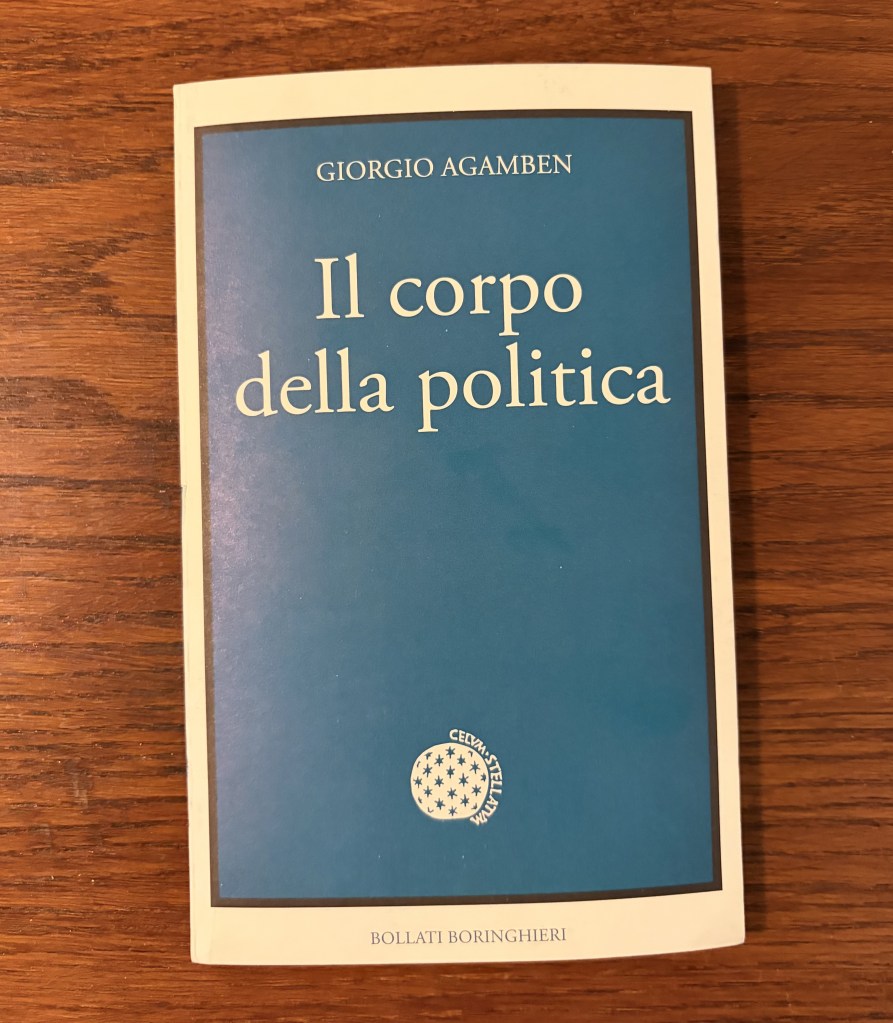
One of the decisive lessons of Giorgio Agamben’s archeological examination of Western politics is that the imperative to confront the closure of representation, sooner or later it must also come to terms with the notion of the body (corpo) as a central metapolitical condition in the genesis of modernity. If L’uso dei corpi (Neri Pozza, 2014) brought to its final stage the philosophical exploration of Western ontology of politics defined by efficacy and realization; in most recent opuscules, Agamben has shown how the fixation and regulation of the body is also embedded in the regions of language and sensation of human life as well. In this sense, it is impossible not to read Il corpo della politica (Bollati Boringhieri, 2026) along with Il corpo della lingua (Einaudi, 2024), as two parallel commentaries on the defining stature of political representation. If a new beginning is one of the decisive questions of our times, then one of the pending tasks is precisely to think the body (corpo) against the ontotheological assumptions of calculative reason.
Similar to Il corpo della lingua (2024), Il corpo della politica (2026) starts with the treatment of the Copernican revolution of bodies in Hobbes and Newton, which in the face of the cosmological infinity inscribed a notion of two bodies in order to allow for representation within spatial coordinates. In other words, Hobbes’ artificial sovereign represented by the mortal god Leviathan (state normative authority) will have an autonomous colorary in the autonomy of the subject that will become “political” as long as it becomes coterminous with the civic body of the “People”. Thus, to speak of “bodies” is not just to rationalize physicality in space – although it is also this from a technical viewpoint that state legibility will soon demand of the incipient civil society – but more importantly, it entails the administration of energy and movement (in Agamben’s well known lexicon, the domestication of potency to the realization of purposeful ends). For Agamben, Spinoza’s conatus, which appears in the Baroque period in critical dialogue with Hobbesian and Newtonian frameworks should be read precisely a way to think past the body as substance, following the steps of the tradition of ancient Stoicism in which beings are corporeal insofar as they are in tension with the world, allowing the tonos or acoustics to animate being in its movement towards preservation and exposure (Agamben 20-21).
If all beings are traversed by a tonos – a tension that crosses as its medium in virtue of its contact with the world – this means that they are no longer defined by a substance, but as intensity within a field of forces once thrown in the world. As Agamben writes in passing with explicit confrontation with Heidegger’s Being and Time: “…con la tesi perentoria ‘l’essenza dell’esserci giace (liegt) nell’esistenza’. L’esserci è stato “gettato” nel mondo, ma si direbbe che, una volta gettato, non cade in piedi, ma giace (liegen significa innanzitutto essere sdraiato). E questa concezione sub-stanziale dell’essere che il conatus mette radicalmente in questione” (Agamben 23). In an archeological gesture that is already signatura of his work, Agamben reminds us that Hobbes’ substantive and artificial division of the “two bodies” that anchors modern politics can be traced to the corpus mysticum and the theological debates concerning transubstantiation that will later be recasted in the intersecting works of both Ernst Kantorowicz and Carl Schmitt, in which the impolitical dimension of the multitude becomes political through the artifice of decision and representation of a unified and indivisible body (Agamben 25-26).
The catastrophe of modern politics takes place when the body, once reduced to a substance and computable object in space, ceases to be understood as an inteusum or intensity of an irreducible multitude that expressed a generic and universal human species, as it was for Dante: “La politico – il finis totius humanae civilitatis che Dante intende definirie nel suo trattato – è ancora una volta un campo di tensioni interne allo stesso genere umano e questa intensità ha la foram di una moltitudine” (Agamben 39). In other words, for Agamben following the implicit tonus present in Dante’s Monarchia, the political is neither action nor mediation, but what names the very site of the possible. Agamben calls the hypothesis of an “anarchic politics” (politica anarchica), which no longer defines itself in relation to a formal mediation of government and state, but rather as the intensity of the multitude through the generic being (Marx) or the universal humanity (Dante) that takes the form of sensible Empire devoid of principial politics mediated by constituent power (Agamben 47).
Where does the multitude dwell outside the constituted representation of a community of belonging or the social mediation of the state? Already in 1990s Agamben had written a gloss on the politics of exile collected in Mezzi senza fine (1996), and the last part of Il corpo della politica (2026) he returns to philosophical and theological notion of the exile vis-a-vis the historical experience of the Jewish tradition as an errant or stateless people, as Erich Unger called it in 1922, whose existence has been defined by exile or galut (Agamben 48). It is a bit of a misnomer to call the exilic experience a “politics”, since for Agamben the authentic tradition of exile does not entail the right or duty fixed to a community of belonging; rather, what outlives the law is the only path capable of deposing it (in the manner of Paul, that is, as katargeo). In this way, justice is now understood not as a procedure in a normative system, but as a written tradition that can only be studied and reflected upon and ultimately experienced as a state of passivity.
Hence, the exilic experience is the caesura between language and world, in which we touch the exteriority with a renewed intimacy that unfolds the uncommunicative solitude that keeps the mystery of our use of language. Following the neoplatonic formulation “phygé monou pros monon” – understood by Erik Peterson as an expressive mystical relation of a “fuga di un solo presso un solo” – there is intimacy and authentic belonging whenever there is sensible separation in being (Agamben 55). Following Plutarch and Plato, for Agamben the exilic dimension is the very home of philosophy and thought, which confirms, against Crito’s suggestions at the end of Socrates’ life, that there life outside of the polis and the conglomerate of the demos, because life is outside itself once it is assimilated in the virtuality of a divine that nourishes its own potency. In what stands as one of the most precise formulations of the pheugein (exile) condition as a figure of existence, Agamben writes of its precise ascesis:
“La celebre definizione ascetica della fuga dal mondo come assimilazione a Dio andrà resa, pertanto, restituendo tutta la sua forza alla metafora politica: “l’assimilazione a Dio virtualmente un esilio” (kata ton dynaton significa qui, secondo il sense più proprio del termine dynatos, “virtualmente, secondo la potenza). L’affermazione e tanto piu significativa in quanto, con queste parole, Platone rompe con l’insegnamento socratico del Critone, secondo cui la possibilità di phygé offerta al condannato non potrà che essere rifiutata, perché non vi è vita possibile fuora dalla polis” (Agamben 57).
This region that precedes and exceeds politics – in the language of Sophocles, the well known ypsipolis apolis – is akin to the tone that runs to the forgetting of any substantive ontology of politics that seeks to subsumes life into the confinement of external forces. It is in this paradoxical situation of assimilation in exile, and a permanent exile that assimilates itself in God as shared thought that politics can be transfigured as an apodemia that refuses the closure of life into principles of government and dominium, and away from the community form of propriety and rooted belonging. Agamben recalls that in the history of Christianity, it is the time of the parish (paroikias) what allows the soul to live in earth as foreigner and exile, in proximity of the medium of the kingdom, and that only later with Saint Augustine it was transformed into a territorial institution for the communio and communal salvation (Agamben 60-61). In the paroikias, Agamben returns to the kingdom not as a retheologization of the politics, but as a figural parable in which a poetic dwelling is enacted in the measureless passivity of a form of life, a project consistent with the formulation of the singular whatever being articulated in La comunita che viene (1990).
The assimilation in the exile of the divine, which recalls the forgetting of oneself and the god announced by Hölderlin in“Note on the Oedipus”, is refined in the last essay of the book entitled “Il corpo dell’Europa”, which reproduces a lecture delivered in Venice in May 2024 about idea of Europe. As a sort of concluding reflection or apostilla, we are now able to say that for Agamben the only possibility of dwelling in the vestiges of the European tradition and memory is to rescue, from the wreckage of its history, the sediments of a texture of the phygén: to be exiled is not just a vitalist affirmation of this life, but more importantly, it also implies disclosing the possibilities buried in the past with the dead, that is, in contact not only with Gaia, but also in the downward movement to the domus of the infraworld (a figure that receives a novel treatment Agamben’s recent book La lingua che resta). Agamben exemplifies this exile with the dead with three poetic moments of high european modernism: Ezra Pound’ Cantos, T.S. Eliot’s The Wasteland, and Eric Auerbach’s masterpiece Mimesis written from his exile in Turkey – and of course, we could also think here of Kafka’s parables and Joseph Roth’s narratives of Jewish errancy; as well as Alexandre Lerrnet Holenia’s phantasmatic crumbling of Empire in The Standard and Osip Mandelstam’s “The Fourth Prose”, where the end of the work leads to the human voice as the supreme poetic task in the face of nihilism and political totalitarianism.
It should be clear, however, that the problem is not found a temporary refuge or a last stand in the fortress of modern literature, but of coming to terms with the phygé as a fundamental problem of language that, in virtue of its unique and irreplaceable experience, delivers a world nested in the affection of remembrance. As Agamben asks towards the end of the lecture: “Is there a sensibility and a form of life that we can call European?” (Agamben 82). This question can only be answered when we dwell and assimilate into the exile of thought that harbors the residues, figures, and voices that speak to us from the dead in a tradition because it is no longer transmitted, we can only access it poetically. In the only moment that the word anima (soul) appears in the text, in the very last sentences, it becomes clear that it is only in the intensity of thought that life accounts for the inseparability of the body and the soul that historical abstraction has rendered oblivious and alien from the tonos of presence. We are not yet ready to declare a return to the appearance between being and world, and for that very reason even the presence of the divine, as Agamben says following Isaac Luria, is itself exiled from the creation of the world until the advent of the tiqqun in the night of restitution. The exilic dwelling of life outside itself is marked by this sort of secret unfaithfulness in the absence of the god. In the meantime, the task of an ethical life is to passively reside in an exile where the reality of the soul returns what is possible and breathable to the appearance of the real.
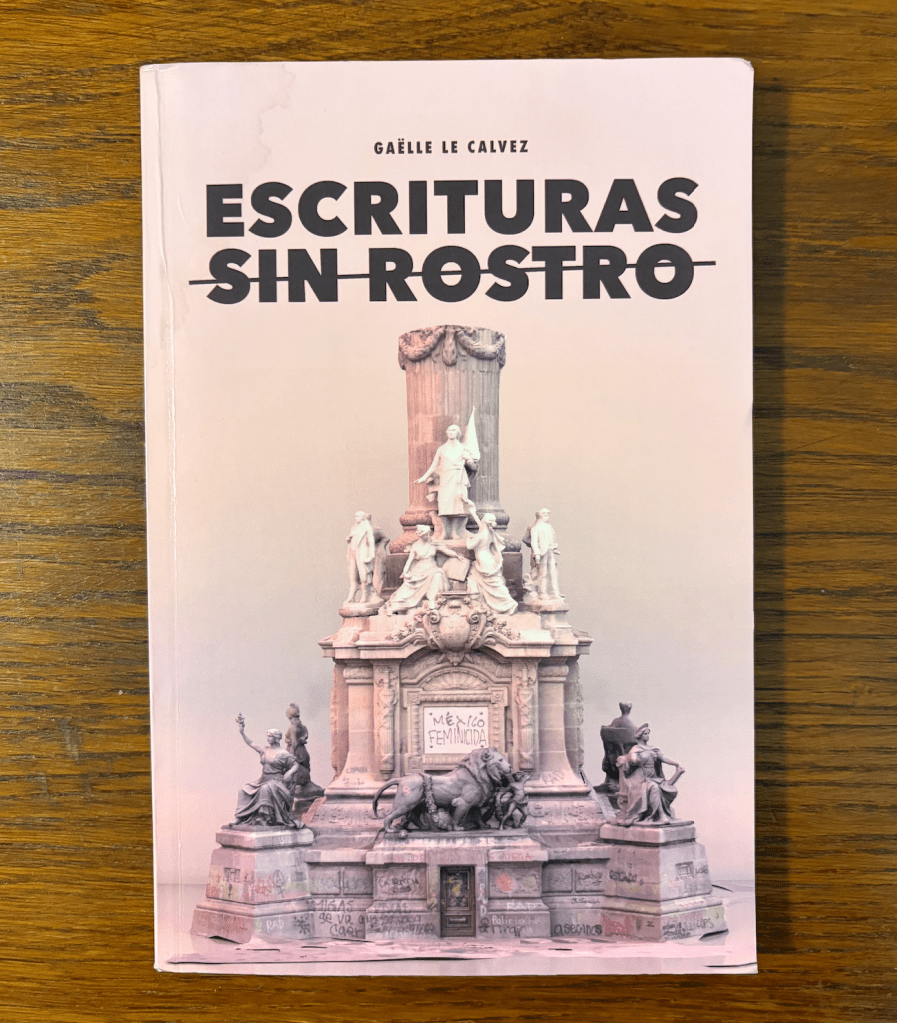
Every book has a history of its own, its subterranean itineraries, and oblique paths that are only disclosed when entering in contact with its future readers. There is no question that Gaëlle Le Calvez’s Escrituras sin rostro (University of North Carolina Press, 2025) has plenty of merits that we cannot begin to elucidate. For one, it is a monograph that should be of interest to students of Latin American studies, but also to any fellow travellers wanting to confront and think through the problem of writing at the wake of the epochal crisis of the state form and the exhaustion of the historical subject. Can thinking overcome the deficiencies proper to cultural studies and populist hegemony to understand the ongoing fragmentation visible everywhere? One can start by saying that Le Calvez’s books points to a positive direction from this impasse, avoiding the shortcomings of sociological epistemology and the auratic reflexes of subaltern subjects as the master oppositional category to State form in the becoming of modernist development and global neoliberalism. In Gaëlle Le Calvez’s Escrituras sin rostro (2025) the object of study is the irruption of EZLN or Zapatismo, and more specifically the scene of writing of the Zapatistas through the genealogy of their declarations, public letters, gestures, and signatures of all kinds that speak to the persistence of a writing of defacement; a scene of writing beyond the social function of the author, and on the margins of the legitimacy of the “lettered city” of the Latin American criollo uneven modernism. In the space of this commentary, I would like to list three levels of Le Calvez’s arguments that hope will further contribute not just to the themes proper to her study, but more fundamentally to a constellation of problems that exceed Latin America as a region of studies.
First, Gaëlle Le Calvez’s Escrituras sin rostro (2025) withdraws itself from understanding Zapatismo as a sociological political phenomenon of the late Mexican State, or a belated product of the shortcomings of the Mexican Revolution and its process of modernization. Unlike other studies of Zapatismo in Latin American studies Escriturassin rostro (2025) is not invested in the restitution of new political subject of resistance in the face of global war and the anarchy of political action; rather, what is presented is the redrawing of a genealogical scene of writing subsumed by its excess and dislocation, stubbornly out of place that evidences the negativity of the collapse of the autonomous spheres of actions that once defined the apparatuses of historical development and legibility. As Le Calvez convincingly points out, the defaced and non-authored writings of the Zapataistas are neither literature nor political manifestos, and they also refuse the autonomy of literature and its incorporation into the objective ornaments of the Avant Garde projects. The defacement of writing for the Zapatistas is neither Avant Garde nor kitsch, because it is no longer interested in weighting itself on the rhetorical scale of social compartmentalization. In my terms, which are not those of Le Calvez, one could say that “escritura” or writing in this study is the vortex of flight from rhetorical submission; that is, what cuts through the enthymemes to refuse ossification and reproduction of language. The freedom of writing is always measured by the possibilities that is able to generate against rhetorical abstractions.
Secondly, because there is no justification in social or political principles, Le Calvez argues that Zapatista writing and negative gesture is a refusal of hegemony, and thus properly posthegemonic. If “escritura sin rostro” makes no demands, seeks no identification, and avoids the prefiguration of rhetorical subsumption, it means that Zapatismo openly rejects the articulatory nature of hegemony as the last avatar of the administration of identity at the end of metaphysics. As Le Calvez claims succinctly, the dispersal of writing cannot adequate itself to Laclau’s theory of hegemony and its “rhetorical foundations” of the social (Le Calvez 67-68). In this sense, posthegemony is not merely what interrupts the closure of politics in the neutralization of a new social consensus, but what transfigures language into its autographic, experiential, and faceless excess that overflows every identity and every place of enunciation. In very subtle and elegant ways, Le Calvez’s hermeneutics of the Zapatalistas’ Declaraciones confirm that the solicitation of hegemony in both discourse and political practice is an inversion, almost an hallucination in political form of the money form and the general equivalent in the historical process of real subsumption of capitalist value. If Zapatistas are indeed a “realist” political formation it is not because they parody of modern guerrillas or enact a new communal organization; the realism at its best is grounded in the capacity to discern that hegemony in the wake of end of the modern liberal state only serves to deepen the ongoing process of the capitalist utopia.
Thirdly, and more surprisingly, is the fact that Gaëlle Le Calvez’s Escrituras sin rostro (2025) does not just reconstruct moments of the Zapatista inscription, it also considers its intensity to its very end. And to think something to the end means to reveal its limits, disclose its fissures, and open a site to move pass the object of reflection. This maximum point of reflection is when philological exploration outlives itself in the intensity of an uncharted path. Thus, the story that Le Calvez tells us about Zapatista writing concludes with a series of aporias and contradictions that announce a certain “decline” and eclipse of its poetic intensity. This is a moment where its poetic elevation begins to deflate; and, in its decline we are confronted with a persistent drift to “civil society”, “self-critique”, the appeal to plurality of “indigenous people” (what Gareth Williams once called “fictive ethnicity” as master representational fiction), or an internationalist appeal in order to generate a “counterbalance” to global neoliberalism (Le Calvez, 106-108). And we are putting aside the nomination of Marichuy for the 2018 Mexican presidential election. Does not this recomposition of social recognition, both global and national, seek to replenish the void in representation as it appears in the third Declaración that evoked “para nosotros nada”? (Le Calvez, 93). The waning of the poetic moment of Zapatista appears to project a flickering shadow of its dependency to political movements.
Does this mean then that the “rise and fall” of Zapatismo ends in a tenuous archē embedded in the ‘movement’? In his Latinamericanism after 9/11 (2011), John Beverley projected his unfiltered Leninism towards antiquity and Ancient Christianity when stating that the central political question for our times in the face of Empire, is to find ‘who are the real Christians today’ [1]. But ideological Leninism distorts the past, since as we know well, the central question for the Christians of the Early Church of the desert, such as Origen, was not who was going to mobilize the masses in the material world, but rather in what way to retreat and avoid worldly political power [2]. Zapatistas as the new and last Christians, then? It is a tempting question, but one that will only contribute to the Leninist reduction of historical political fictions. Our times is not one for Leninism and the Vanguard Party to carry a breakthrough. But perhaps Zapatistas are residually Christians in another country way; that is; in the internal dynamics of its own language. I would like to suggest that this language can be understood especially in the last phase of the Declaraciones, a late rhetorical style of the sermo humilis. As Erich Auerbach has shown, the sermo humilis was the rhetorical innovation of the early Christian community at a moment of the political decadence of the Roman Empire, at the entrance of the interregnum. The sermo humilis appeals to a low or popular style, seeking legibility and pathetic understanding of the difficult mysteries of faith. The humilis also designates the ground level of the land, the humus, which elevates through the persuasion for the humble and the humiliated common men of this world [3].
In other words, the sermo humilis could be said to be a sublime of the everyday life that is refractory to the mystery. It is obvious that if we now turn to the Zapatista late writing, something like the sermo humilis codifies a symptom that is no longer the mystery of revelation, but rather in its secularized form of the revolution. Does not the sermo humilis functions as a secularized artifice to guard and elevates hopes (all too human, alas) on behalf of the “revolution” to come? However, it is precisely political revolution, just like hegemony, what cannot longer account to the effective revolutionary force of the autonomization of capital. If according to Le Calvez the formation of the Zapatista is analogous to an “artificial movement” (masa artificial) like the Church, then one could say that the rhetorical construction of the sermo humilis functions as a linguistic prayer for the revolution whose only certitude is the apophatic metaphorization in the name of the “people”, the “homeland” (la patria), or the antagonistic and oppositional “we” (nosotros), or any other compact grouping. Of course, this is the terrifying question for the sermo humilis in its secularized form: to what extend the communitarian and autonomous ideal, through its appeal to the humiliated and subaltern class, does not transform itself into an apotropeic instrument devoid of true redemption? [4].
Is writing, and witnessing through writing the practice where the possibility of redeeming human experience is lodged? This is the fundamental question that Le Calvez’s book puts forth to us as readers, without entirely coming to an effective resolution. And yet, in the last part of Escrituras sin rostro (2025) seems to offer us another possibility through the writings of Cristina Rivera Garza, Alejandra Pizarnik, and Sergio Gónzalez Rodríguez in the face of a fragmented and disarticulated social body and the night of history in which social protection and protracted civil war become indistinguishable (Le Calvez 186). This writing is no longer tailored in the Christian shops of the sermo humilis, but in an open plain where the voice becomes “un anhelo de prosa”, or a longing for prose, crossed by the finitude of being and the collapse of mediating forms of totality (Le Calvez 174).
This longing for prose as it appears in Cristina Rivera Garza’s work – in the Spanish anhelo one can also hear the echo of breathing that is constitutive of life’s exteriority with the world, to conspire – is not the letter of the law as in Hegel’s spiritual prose of the world (“in the slave prose begins”, we read in Aesthetics), but the clearing of a voice that can register the world because it speaks from the witnessing of the ruins of representation, and the conviction that there is no political mystery high above, but only the irreductibility of writing in spite of it all. In the shipwreck of perpetual global war, writing’s redeemable elevation is the caritas that puts us in a permanent exodus from the order of representation (Le Calvez, 186). Writing, escritura becomes the passage of the chiasmatic and breathable imagination that, because it has cleared a via poetica, it can name what can also be properly inhabited.
.
.
Notes
1. John Beverley. Latinamericanism After 9/11 (Duke University Press, 2011), 26.
2. David Nirenberg. Anti-Judaism: The Western Tradition (Norton, 2014), 108.
3. Erich Auerbach. “Sermo humilis”, in Literary Language & Its Public in Late Latin Antiquity and in the Middle Ages (Princeton University Press, 1993), 39.
4. Gianni Carchia. “Eros y Logos: Peitho arcaica y retórica antigua”, in Retórica de lo sublime (Tecnos, 1990), 29.
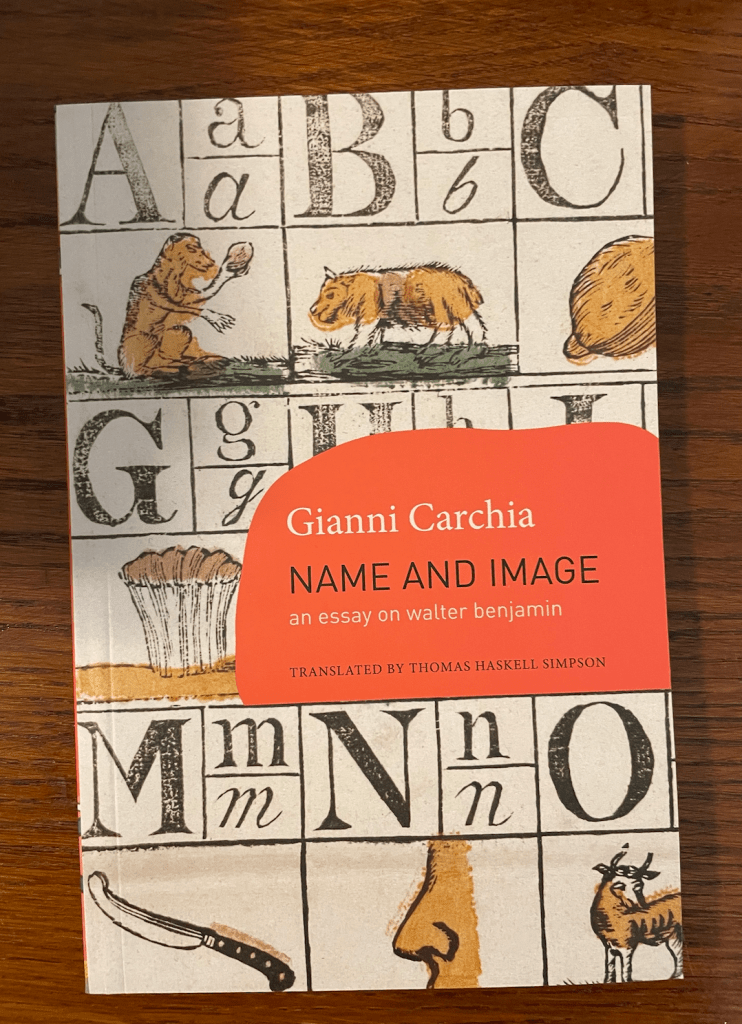
At long last readers in the English speaking world will be able to read Gianni Carchia’s work in translation thanks to the publication of Name and image: an essay on Walter Benjamin (Seagull Books, 2025), which was the Italian philosopher very last book published posthumously in 2008. This is not a work of late style as such, since these four essays on Walter Benjamin serve as an oblique and angular entry point to the thinking form of Carchia’s own philosophical concerns on sensibility, the survival of the myth through aesthetic mediation, and the post-kantian elaboration of the appearance as the condition for experiencing the world. This is a project without systematic architecture that dates back to his first books of the late seventies such as Orfismo e tragedia (1979) and Estetica ed erotica (1981), both published in the Milanese publisher Celuc Libri. It must be noted that although this is a marvelous introduction to Carchia’s philosophical idiosyncrasies and recurring themes, it is perhaps not the best introduction to Walter Benjamin, who in these four essays is read against the grain of dominant hermeneutical frameworks; that is, beyond Frankfurt Critical Theory and dialectics of the image, and on the other hand, the theologico-political concerned with messianic temporality as a transformative philosophy of history.
It does not mean that Carchia is oblivious to these constitutive elements in the corpus of the German thinker; but it does mean that the profile constructed is one that favors a critical project that has disinhibited affinity with the Platonist project of beauty as condition of the critical endeavor committed to truth. For Carchia it is at this vortex where one should locate the “brilliant degree of illumination” that awakens philosophy from its slumber, overturning the texture of thinking to an erotics of the lost detail and the enduring fragment. Citing the correspondences to Florens Rang and The Origin of the German Tragic Drama, we know that for Benjamin “without at least an intuitive grasp of the life of the detail in the structure all love of beauty is no more than empty daydreaming” (Carchia 33). The task of the critic is one capable of arresting the inexpressible, only because beauty lives in the world as a state of silence and expressed revelation (Carchia 38). And it must be said that platonism in Carchia never manages to crystallize into a doctrine of being, pivoting to persuasion as the route to an idea without form.
Carchia shows that for Benjamin the reinvention of the critical method cannot aspire to the totalization of origins and principles – or even that of the status of the visible (Schau), as he brought to bear in his comment to Max Kommerell’s Der Dichter als Führer in der deutschen Klassik (1928) – underpinning the emergence of the idea where the seeds of truth germinate to unfold the interstices of historical sedimentation (Carchia 62). Unapologetically, Carchia suggests that Benjamin’s critical method, if there is such a thing, must be read as a “philosophy of the infinitesimal aim to shatter the prejudice that attributes to totality predominance over phenomena…at the price of their insignificance” (Carchia 61-62). In turn, this means that “the smallest cell of visualized reality outweighs the rest of the world” (Carchia 63). The infinite cuts through the world as a remnant that must be redeemed precisely because of its incongruence in the face of the triumph of immanence and the distribution of forms. And this is yet another sign that Carchia’s Benjamin must read as a thinker of a platonism of the immanence that by folding forms it is able to escape modernity’s temporalization of the sensible reality and its lethargic material objectivity [1]. This hits a hight note about Benjamin’s philosophical thought as anointed in the ancient currents of Stocism, since as Pohlenz taught us, the material forms of this world are the hurdles that neutralize the inception of the divine in a reality governed by the necessity of kakia.
Hence the confrontation with language occupies the center of every critico-historical reflection, which means how to live the immemorial language that is neither an instrument nor the “medium of prophecy or domination” (Carchia 85). Carchia reminds us that for Benjamin Karl Kraus’ language is platonische sprachliebe, or platonic love of language, which means a voice that overcomes the separations of signification and symbol, object and subject, and the consolidation of exchange through the voice of gratitude and use: “thanking and dedication – for to thank is to put feelings under a name” (Carchia 85). The word as apophantic revelation places judgement under erasure, enacting not a return to Edenic pristine nature of divinization or virtuality that attests to the figure and repetition of appearances and the medium of the “spiritual verbalization that animates reality” (Carchia 92). The abdication of an original language survives as the mythic memory of a voice porously open to translation: “All higher language is a translation of lower one, until the ultimate clarity the word of God unfolds, which is the unity of this movement made up of language” (Carchia 92). If for Benjamin the problem of translation is coterminous with that of the mystery of language, it is because it reveals the fragments of a vessel that removes the ground of rhetoric through “variation and discontinuity” (Carchia 96).
In fact, reading Carchia one can infer that rhetoric is to language what the destiny is to human existence in its becoming. Thus, the destitution of language, its internal rhetorical and objective liquidation, appeals to the possibility of the event of happiness and bliss that is the only well illuminated path for redemption, that is, for the flourishing of the “nexus of truth and beauty” of the liberty of the soul. We are painfully aware that modernity is many contradictory elements at once, but Carchia tells us following Simmel, it is ultimately the historical project of Entseelung or loss of soul of the world, and thus “the faculty of memory as particular gift of the soul” (Carchia 121). The historical time of progress, its formal assumption and increasing autonomization, means a ritual situation that “seizes control in exteriority – as as continuum of temporal unfolding – of that entertainment, flashing, discontinuous awareness of the irrevocability of the past held firm by the image-memory” (Carchia 121). Hence, the exercise of thought and memory through the redemption of appearance is the necessary struggle against the usurpation of caducity, and thus the only promise of salvation through the dead, the defeated, and the forgotten. There are clear echoes of Hölderlin’s “Andenken” here that Carchia formulates as the necessity of memory in the repeated dispensation for the clearing of appearance. As he writes in one of the most formidable moments of the book when discussing the self-offering of the memory that guards the catacombs of the dead:
“…for Benjamin, aesthetic temporality, as temporality of the soul absorbed in the contemplation of the nexus of truth and beauty, is the very origin of temporality’s self-offering, of temporality tour court as the space of memory. The salvation of appearance and the dimension of memory are all one: here is rooted the connection between temporality and the aesthetic dimension. The appearance constitutive of the space of redemption, and the beauty whose sacrifice would sacrifice the space of truth itself, are nothing other than memory continuously rescuing them from the space of historical time. It is precisely this connection, between the sphere of appearance as the sphere of the irremediable caducity, and the counter-movement of memory in the involuntary image, that forms the nexus that some of the most subtle passages struggle to delineate as the world of the soul, or rather the world of the past” (Carchia 120).
Thinking the fragment becomes indistinguishable from retaining the sensible participation of the soul. It is this arresting breath (Hauch) of the soul that clears a path on which appearance is saved from the crushing weight of historical self-sufficiency. This confirms, if anything, that Benjamin’s sensibility for Carchia does not end in the confines of postromantic critique, nor in the utopia of totality and abstraction imposed by the metaphysics realized in money form over the living and the dead. As Carchia asserts: “utopia is the end of the constructive and generative ideal of knowledge” at the base of human anthropology and material conditions of social existence, but a whole “redirection underpinning what we have called thinking the informal” (Carchia 127, 135).
What does it mean to think the informal, and what accounts a thought of the informal where Carchia posits Benjamin’s most enduring and clandestine signature? Avoiding all false exists in neopaganism of worldly immanence, Carchia connects the formless dispensation of thought with a nirvana state of para-rūpa (a hypostasis of God that does not presuppose a form, but that it is transformational), the instance of imagination without an image and place that speaks of a chôra as the last refuge of the living. A refuge that, like the platonic cave, does not entail the accumulation or wealth of signification, but that retreats from the perils of insignificance and unhappy consciousness of nihilism. This is one way to understand what Benjamin writes in one of the glosses in “Short Shadows”: “…an image that has already crossed the threshold of the image and property, and knows only the power of the name, from which the lover lives, transforms, ages…and imageless, is refuge of all images”. An existence devoid of a central and authorized image can only prepare for the idea of justice that, because it is experienced it can retreat from the aleatory predication of the world. This enacts a descent into “an anarchy of being in this side of form”, as Carchia would beautifully call it towards the end of book; an inward saturation that is also a reservoir of sensibility because it is able to take a breath. And because it is breathing, it can assent to the external penumbra that restores the appearance of every thinking being in its very image and name.
.
.
Notes
1. On the platonic immanence and the soul, the central reference is Gianni Carchia’s essay “Platonismo dell’immanenza: Fenomenologia e storia in Hans Blumenberg”, Hans Blumenberg: Mito, Metafora, Modernità (il Mulino, 1999), 215-26.
In a recent lecture about the different strands of political liberalism in the American tradition – a lecture that in its own way was presented as a synthesis of his lifelong teaching now collected in the book titled The Rise and Fall of Rational Control (Harvard U Press, 2026) – the political theorist Harvey Mansfield made a claim that was left unquestioned by the audience, but that has some strong pungent resonances in our present: “You cannot conceive of a political [liberal] regime without some kind of abuse”. These words were not meant as a way to prevent the intrusion of this protuberance in a political order, but rather as a way to indicate that liberal politics is always, to some degree and arraignment, the administration of abuse. In Manfiesld’s own conception, the classical legal order of the American founding now chattered into “a thousand particles” (his words), dispersed in bureaucratic commands and executive arrangements, dispense a direct form of abuse. It is noteworthy that although Liberalism has always been thought in relation to fear (from the conception of auctoritas in Hobbes to the minimalist form of government of Skhlar), it is important to dwell on the initiate relation between liberal politics and abuse; or rather, about its kernel of truth in the notion of abuse.
That liberalism’s ultimate objective can be understood as the regulation of abuse can easily be inferred, at least implicitly, in Mansfield’s own normative assumptions laid out towards the concluding pages of The Rise and Fall of Rational Control (Harvard U Press, 2026). Towards the end of the book, and commenting on Nietzsche’s declaration on nihilism and erosion of rational control for the efficacy of political order, Mansfield notes that when politics takes the form of an unconstrained form of subjectivity oriented towards survival, it must be supplemented by a new virtue of nobility and sacrifice: “Modern rational control, we have seen, does not work through an effort of reason by its citizens; its government is indirect, using irrational moves to gain a rational result. It does not appeal to human pride, as would a liberalism attuned to the virtue of citizens in the exercise of their rights. That liberalism would return from an unnaturally constrained self, interested only in survival, to a reliance on the soul, which contains a concern for nobility and sacrifice as well as survival” [1]. In this framework of late liberalism, that in recent years in the American context has been called “post-liberalism”, can properly be understood as liberalism of abuse where force and executive power takes priority over legitimacy and social hegemony. The liberalism of abuse is not interested in the renewal of the social contract and the juridical capacity for rights and obligations; rather, it deploys a prerogative decision making over the souls of the living. Those that have recently claimed that the sphere of the soul is the new theater of operations have unlocked an important door of our epoch.
To govern in this framework means to allow abuse to flourish in the social bond not just as a tributary of penal codification and retribution of punishment, but as a transference of hostilities through the grammar of values and willful possession. The old form of patrimonial form of legitimation, as some have recently emphasized it, does not just pertain to the transformation of political elites, it is also coextensive to the totality of civil society and its mediations [2]. And the normalization of patrimonial abuse casts the long shadow of the Roman Law’s notion of ius abutendi that transformed the concept of abuti into property destruction through the sovereignty of the subject of ownership. As the nineteenth legal scholar Ferdinando Piccinelli showed in his important study on this notion of Roman Law, the ius abutendi passed from being the the capacity of “using to the end” or the “consummation” of a thing as registered in Ulpian’s writings, into a plena in re potestas denoting the sovereign power of a subject over objects and things in the world [3]. This means that the notion of “abuse” in late political liberalism, at the threshold of the modern social contract and rational control, is structurally the way in which the destruction of our use of the world is legitimized and fostered. In this sense, the operativity of ius abuntendi is not exclusive to punitive practices, punishment and public police powers of the administrative state; more importantly, it should be understood as the ossification of subjects and objects that permanently enacts the unlimited destruction of the relations with exteriority, that is, with the world. When we use we are not decreeing modes of organized distribution, rather we are enabling the freedom of transit between things, the territories, and the proportional transmission of techniques.
The deployment of abuse as technology of dominance is proportionally inverse to the obliteration of our capacity to use that defines the human experience. It is in this light that we can understand Hölderlin’s well known dictum in a letter to his friend Casimir Bohlendorff that “the free use of the proper is the most difficult thing”, as a refusal to disengage life from the political constrain of ius abutendi. It is only when use is thought, or brought into thought, beyond and outside political rational control that we can make room to inhabit the world beyond the perversions of abuse and judgment over the human species. In our historical conjuncture, we can say hyperbolically that all political thought is indirectly infused with ius abutendi, since it is incapable of seeing that the use of life never fully coincides with the circular polarity of domination and servitude; because there is a third figure beyond these two that allows use to unsettle the ground of force. If American political liberalism has entered a phase of self-infliciting abuse as the essence of political rule, destruction, and lethality of social forms, it is precisely because what it is desperately trying to conceal in the deep waters of Lethe is the pathway of a worldly use. After control, we are left with an expansive regime of socialized abuse even when it purports to speak on behalf of the preservation of the living community: “Because that is truly tragic among us, that we quietly leave the realm of the living inside some ordinary box, and not that, ravaged by flames, we pay for the fire we failed to control” [4].
.
.
Notes
1. Harvey Mansfield. The Rise and Fall of Rational Control (Harvard University Press, 2026), 305.
3. Ferdinando Piccinelli. Studi e ricerche interno a lla definizione ‘Dominium est ius utendi et abutendi res sua, quatenus iurius ratio patitur’ (Firenze Presso L’Autore, 1886), 101-103.
4. Fredrich Hölderlin. Cartas filosóficas de Hölderlin (La Oficina, 2020), 191.