Justification and the demonic State. by Gerardo Muñoz

In the broadest sense of the term, questions about the law are predominantly about its justifications, and more specifically about where to locate the act of justifying. That one of the most important elaborations of exclusive positive authority was dependent on a theory of justification to transfer norms of authority (a theory labeled the “normal justification theory”) goes to show that the traditional opposition between positive law as pertaining to the sphere of rights and guarantees and natural law to that of justification comes short in the understanding of the internal development of judicial reasoning in the second half of the twentieth century that unsurprisingly coincides with the crisis of the secular liberal state [1]. The reliance on a “justification theory” will imply not only a new conception of legitimation, but also the outsourcing of the self-referential determination of “Nature” through which Roman Law constructed its principle of the rule of law and the validity of adjudication. As we know, Roman Law did not speak of “justification” but rather of necessity emanating from Nature, which could not oblige to performance or act through by what by nature is impossible or wrong [Ius plurimis modis dicitur: uno modo, cum id quod semper aequum et bonum est ius dicitur, ut est lus naturale]. The natural source of law, as famously defined by Ulpian in the Digest, is in this way permanently tilting between the good and the equitable (ius est ars boni et aequi). This is a matter of first principles of the law (ius), which did not solicit “argumentation” or second order reasoning to uphold its internal legal validity. 

The passage from natural necessity in the “hands of the priest”, in Ulpian’s conception, to the modern autonomy of justification takes place when principles are no longer the exclusive framework parameters for operative claims, but the very activity that defines the elasticity of an actual norm and its argumentation within a concrete positive order. This is one way in which one should define the specificity of the American practical legal order (not just its legal philosophies, which tends to run counter to this, cloaked under the vestigates of positivism vis-à-vis the letter and spirit of the Constitution) through juridical administration, whose structural polarity of command and justification defines the administrative process. Early in the twentieth century, Guglielmo Ferrero noted that one of defining characteristics of the American political model rested on a magistrate judicial power that fundamentally differed from European Common Law or positivist tradition in its practice [2]. Contrasting the independence of a limited bureaucracy to the predominance of an all encompassing “juridical administration”, Ferrero noted (although lacking the legal vocabulary to articulate it positively) that the administrative nexus will infinitely expand over social practical reasoning due to the unrestricted force of justification. And the need for justification is what outsources the ancient principles of natural law (ius) to the executive authority that renders operative every sphere of social action and interaction even if they are not explicitly declared prima facie by those principles. The efficacy of justification is the linguistic deployment – a rhetorical craft through rational argumentation – that will generate specific verisimilitude to the otherwise arbitrary and uncontested enactment of its principles. Justification could be said to appear as the work of language that provides internal cohesion of an array of coordinated conditions for secondary social actions. 

Since the inception of modern secularization, the nature of justification is the realization of the works without end, which inverts the notion of “justification” in the theological sphere that we owe to Paul. For the Apostle the idea of justification or dikaiōsis implies the making of righteousness through the soteriological narrative of Christianity that subsumes humanity’s fall (sin) for a redeeming liquidation of law. This means that man’s just act in faith generates “justification” (dikaiōsis) of life for all people (Roman 5:18). And as we read from Galatians 2:6: “Know that a person is not justified by the works of the law, but by faith in Jesus Christ. So we, too, have put our faith in Christ Jesus that we may be justified by faith”. The force of justification (dikaiōsis) trumps the production of the works of law that divides human beings in the immanence of this world between the saved and the condemned, the free and the imprisoned, the friend and the enemy. Whereas justification in the theological sense can only imply the ‘end of law’ for righteousness (Roman 10:4), in its late secularized rendition it implies exactly its distorted mirror image: to justify is transformed into the binding force over the void of authority that renders effective the hollow machinery of its own self-validation. 

It is telling that in an essay that was first published in German in 1938 under the title “Justification and Justice” (“Rechtfertigung Und Recht”), the German theologian Karl Barth takes note on the transformation of the State becoming “demonic” not due to its utter demise, but as a profanation of the theological justification of “unwarrantable assumption of autonomy as by the loss of its legitimate, relative independence, as by a renunciation of its true substance, dignity, function, and purpose…a renunciation which out in Caesar worship, the myth of the state and the like” [3]. The emergence of the “demonic nature” of the State was internal of its own making , since it conflated faith and people at the same level of social immanence, while preparing the actual realization of an authoritarian world without escape. Following Heinrich Schlier’s work on the figure of the State in the New Testament, Barth will suggest that this political totalization secularized the limit posited by the suum cuique of justification into an instrument of endless domination that characterized the emerging political reality. In fact, in his essay “The State according to the New Testament”, Schlier will define the phase of the demonic State as one colored by the inception of the sphragis, that is, “the sign of the state party as it were the secularized seal of baptism which levels all differences between men and only distinguishes between friend and energies of the ruling system. Those who refuse the new metaphysical slave are deprived of their economic foundations. Even economic life is directed by the spirit of the beast” [4]. 

Only in such context does the true light of the force of justification comes in full display: the sphragis can only labour to justify the vicarious social existence of the mystery of iniquity infinitely redressing itself as legal argumentation and juridical principles, administrative determinations and executive commands. And Schlier could not let the question pass: “What will Christians do in this situation? They will no longer want to have any part in this caricare of a state, they will “go out…they will simply be outlawed and persecuted” [5]. More than ever today, we are in desperate need of elaborating the elementary aspects of a political theory of demonology that defines a certain point where there is no turning back. To outlive persecution and tear the bond of justification shatters the civilizational course that has sublimated the end of time as an instrument of daemonic absorption into endless legal statues.

Notes 

1. Joseph Raz defines “normal justification thesis” of legal authority in this way: “I shall call it the normal justification thesis. It claims that the normal and primary way to establish that a person should be acknowledged to have authority over another person involves showing that the alleged subject is likely better to comply with reasons which apply to him (other than the alleged authoritative directives) if he accepts the directives of the alleged authority as authoritatively binding and tries to follow them, rather than by trying to follow the reasons which apply to him directly”, in “Authority and Justification”, Authority (NYU Press, 1990), 129.

2. Guglielmo Ferrero. “American characteristics” (1910), The Atlantic. 226. 

3. Karl Barth. Community, State, and Church (Peter Smith, 1968), 118.

4. Heinrich Schlier. “The State  according to the New Testament”, in The relevance of the New Testament (Herder and Herder, 1968), 236.

5. Ibid., 237.
Constitutionalism and sense. Text for “Legal Crisis in Chile” Session, Red May Forum, 2023. by Gerardo Muñoz

It has been said repeatedly – in the best hyperbolic spirit, no doubt – that Chile always stands, regardless of the angle from which we are looking, for what is to come in our epoch. The Chilean laboratory prefigures the coming mutations and solidifies the effective tendencies of public powers. The 2019-2023 political cycle is no different: it began with the experiential revolt at the heart of the metropolitan center, and it culminated with yet another constitutional scene seeking to replace the “constitución tramposa” now at the mercy of those that hold a deep admiration for the post-dictatorship subsidiary state. The newly elected advisors and experts will place the final cap to the momentum of institutional transformation, which welcomes back the official garments of public legality, official languages, and grammars of public security. And even if it is true, as Rodrigo Karmy has argued, that the most recent electoral results confirm the exhaustion of the Chilean post-dictatorship regime, the question posed to us is what capacity can constitutionalism and the constituent scene contribute for any possible transformation. [1]. In other words, can a breakthrough be produced from within the conditions of constitutionalism? As Martin Loughlin has recently demonstrated, our historical epoch is one marked by the irreversible triumph of constitutionalism; a design that differs from the modern constitutional state of representation and legislative legitimacy, envisioning an encompassing “dynamic order of an evolving society rather than an authoritative text, the basic ideals of constitutionalism have been realized” [2]. Constitutionalism emerges in the wake of the end of the liberal presuppositions of modern political theology and everything that it implies for the stability, separation, and judicial control of public powers.

The system of constitutionalism presupposes a total governmental nexus whose legality (discretionary, exceptional, based on the application of general principles / ius) will be treated as “an order of values that evolves as social conditions change” [3]. The passage into an administrative system of legal order presupposes a suture between principles and political necessity, state and civil society, economic rationality and executive planning and oversight. The old paradigm of the modern “dual state”, theorized by Ernst Fraenkel in the 40s have now supplied an internal abdication of positivist jurisprudence and minimalist constitutional framework, paving the way for the total constitutionalization as a flexible art of governance. Although it has been said that the first constitutional drafting of the new Chilean constitution was confusing and overtly ideological (a “magical realist” menu of rights and everything under the sun, one contemporary jurist called it), there is still something to say about the veneer of “social rights” within the epochal system of constitutionalism [4]. It is at times forgotten that the abundance of enumerated social rights implies the infrastructure of constitutionalism to bind legal, political, and social spheres into a regulatory apparatus without fissures. To govern the social means steering over the abstraction of social values. There are good reasons to discharge skepticism against constitutionalism, and they keep coming. Of course, the argument of skepticism, alas, rarely has good press (it fails to provide an insight into totality, Max Horkheimer famously argued), but I do think it is necessary to reclaim skepticism in the wake of the systematization of public constitutional principles [5]. Skepticism demands separation from constitutional absolutism and the legal nexus in which social action interaction finds itself. The skeptical position in the face of constitutionalism at its most minimalist bearing insists in the separation of life from law, of experience from political order, of expression from the order of rhetorical mimesis. The skeptic might not want to negative law as authority; but it wants to refuse the post-authoritarian conflation of life and social rule underpinning political domination.

To be able to see beyond the framework of constitutionalism is the task at hand, especially when the old predicates around the political subject and the social contract make their way back from a position of weakness and desperation (another way of saying that morality returns as nihilism). But one does understand its success: it is a compensatory psychic mechanism for the ongoing existential pain under the abstract orderability of the world. And where there is pain, there is also an accumulation of experience that pokes through the fictive state of things, refusing the objective staging of phenomena. Simply, it refuses to be absorbed by what’s available. At this point it becomes impossible not to recall the October revolt for one particular motive: mainly, that its emergence did not favor social demands nor was it driven by the grammar of a political program. Every experiential uprising has an aesthetic dimension – or even better, pictorial set up, a canvas of everyday life – that we have yet to rediscover. Painting from real life is no easy thing, some painters have told us. And something similar goes for the revolt: an alteration of gestures, inscriptions, graffitis, and corporal tracings, dissonances and masks color the expressive discharge against the pledge of objective realism and the police of languages. Indeed, pictorial skepticism can only emerge when there is an excess to representation; that is, when there is a sensible stubbornness to enter into contact with the unfathomable of the world as such. The world and its others, one should say. This pictorial dislocation of reality dispenses a rhythmic structure of the senses that is neither chaos nor destruction, but an arrangement of a different sort: the communication between souls (from soul to soul, Rimbaud had said) without regulatory mediations through the tokens of recognition and filiation. The rhythmic movements provide a spatial continuation devoid of justifications [6]. This is why pictorial semblance tells us something that language or the science of politics cannot. How can we last together as a community that is not?

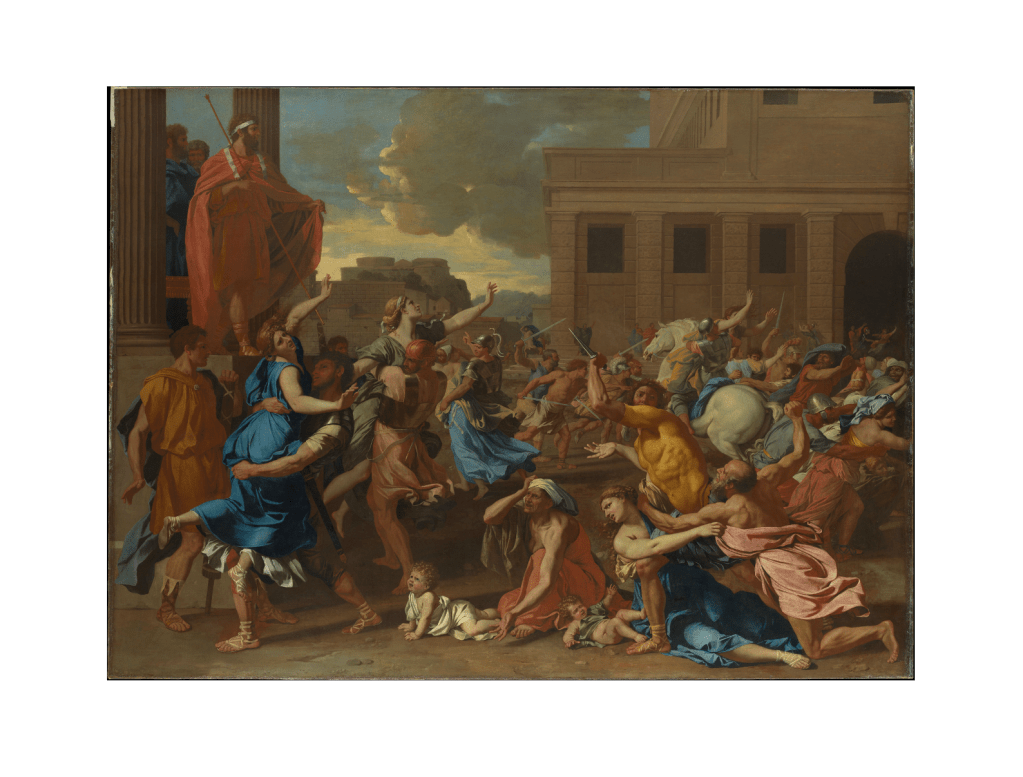
Pictorial dislocation wants to claim distance and separation the non-totalizable while being there. Let us take a painting like Nicolas Poussin’s The Abduction of the Sabine Women (1633-1634): here we have a complex composition ordered around rhythms and modes of figures and distances; the possibilities of communication between forms and the expressivity of the figures hold everything as if in a state of grace. What is striking in the picture is the subtle mounting of activities and gestures without ever falling into the sublimation of the concept. There are no guidelines, and yet we feel that everything communicates. Or to put it in Poussin’s pictorial terminology: “what follows is unlearnable” [7]. I do not think that the painter tried to posit a negative foundation of knowledge for an even higher learning; rather the unlearnable is a practical activity (a gesture, a word, a contact) that is both unique and indispensable; impossible to let itself be arranged into a set of alienated function for a task. Poussin reminds us of the unknowability of rhythms taking place: an uncompressed experience outside the force of systematization. We need thought to incorporate something like this exercise in rhythm.

It does not come as a surprise that a conservative scholar during the first months of the October revolt hypostatized the event as a “gnostic program” claiming that: “Plato’s philosophy offered a simple solution to the gnostic problem: instead of adapting the world to our desire, the task is to adapt the soul of the world…we now know that public order is the our most urgent occupation” [8]. Needless to say, and as Díaz Letelier noted at the time, this was a political Platonism devoid of chōra as a nonsite of our sensible imagination that allows the renewal of the creative experience with the world [9]. There is no ‘common sense’ as the pragmatists of realism assert with conviction; there is only the sensorial passage allowed by the chōra. This is what constitutionalism needs to pacify and incorporate: the battle over the status of the soul at a moment in which material goods and its economic arrangement (and in the Chilean case, its negative subsidiarity principle) becomes insufficient for the psychic production of a rectilinear subject (a masculine subject, Alejandra Castillo would claim) [10]. The postliberal constitutionalism as it stands (and it is postliberal because it cannot longer said to appeal to an internal principle of positive norm nor to a source of ‘Higher Law’, but to the executive command of the principle); a world legal revolution of governmental administration of anomia, amounts to a systematic offensive that exceeds mere material appropriation or personal liquidation. And this is so, because its ultimate mission is the “soul murder” (seleenmord) that currently stands as the basic unit of the ensemble to govern over socialization [11]. Constitutionalism now appears as the last avatar of Americanism. Perhaps there is no higher and modest task at hand than affirming the medium of the chōra that preexists the submission of life into the polis, and which retains, like the pictorial gesture, the unlearnable and the unadaptive. Only this could slowly render another possible sense in the relationship between liberty and law.

.

.

Notes

* This text was in preparation for the conversation panel on the current legal and political cycle in contemporary Chile with Alejandra Castillo, Rodrigo Karmy, and Philip Wohlstetter that took place in May 31, 2023 at the Red May Seattle Forum. The conversation is now archived here.

1. Rodrigo Karmy. “Ademia portaliana: algunos puntos para el “nulo” debate”, La Voz de los que sobran, May 5, 2023: https://lavozdelosquesobran.cl/opinion/ademia-portaliana-algunos-puntos-para-el-nulo-debate/05052023 

2. Martin Loughlin. Against Constitutionalism (Harvard University Press, 2022), 11-12.

3. Ibid., 161.

4. Pablo de Lora. “Constitucionalismo mágico”, The Objective, May 2022: https://theobjective.com/elsubjetivo/opinion/2022-05-07/constitucionalismo-magico/ 

5. Max Horkheimer. “Montaigne and the Function of Skepticism”, in Between Philosophy and Social Science: Selected Early Writings (MIT Press, 1993), 265-313. 

6. Rodrigo Karmy. “The Anarchy of Beginnings: notes on the rhythmicity of revolt”, Ill Will, May 2020: https://illwill.com/the-anarchy-of-beginnings

7. Avigdor Arikha. “On Nicolas Poussin’s Rape of Sabines and Later Work”, in On Depiction (Eris | Benakis Museum, 2019), 112.

8. Manfred Svensson. “Una revolución gnóstica”, The Clinic, November 2019: https://www.theclinic.cl/2019/11/25/columna-de-manfred-svensson-una-revolucion-gnostica/ 

9. Gonzalo Díaz Letelier. “Un platonismo sin khorâ”, Ficcion de la razón, December 2023: ​​https://ficciondelarazon.org/2019/12/04/gonzalo-diaz-letelier-un-platonismo-sin-khora/ 

10. Carlos Frontaura. “Algunas notas sobre el pensamiento de Jaime Guzmán y la subsidiariedad”, in Subsidiariedad en Chile: Justicia y Libertad (Fundación Jaime Guzmán, 2016), 123.

11. Ernst Jünger. The Forest Passage (Telos Press, 2003), 93.