Those wonderful clouds. On Victoria Cirlot’s Imágenes Negativas (2026). by Gerardo Muñoz

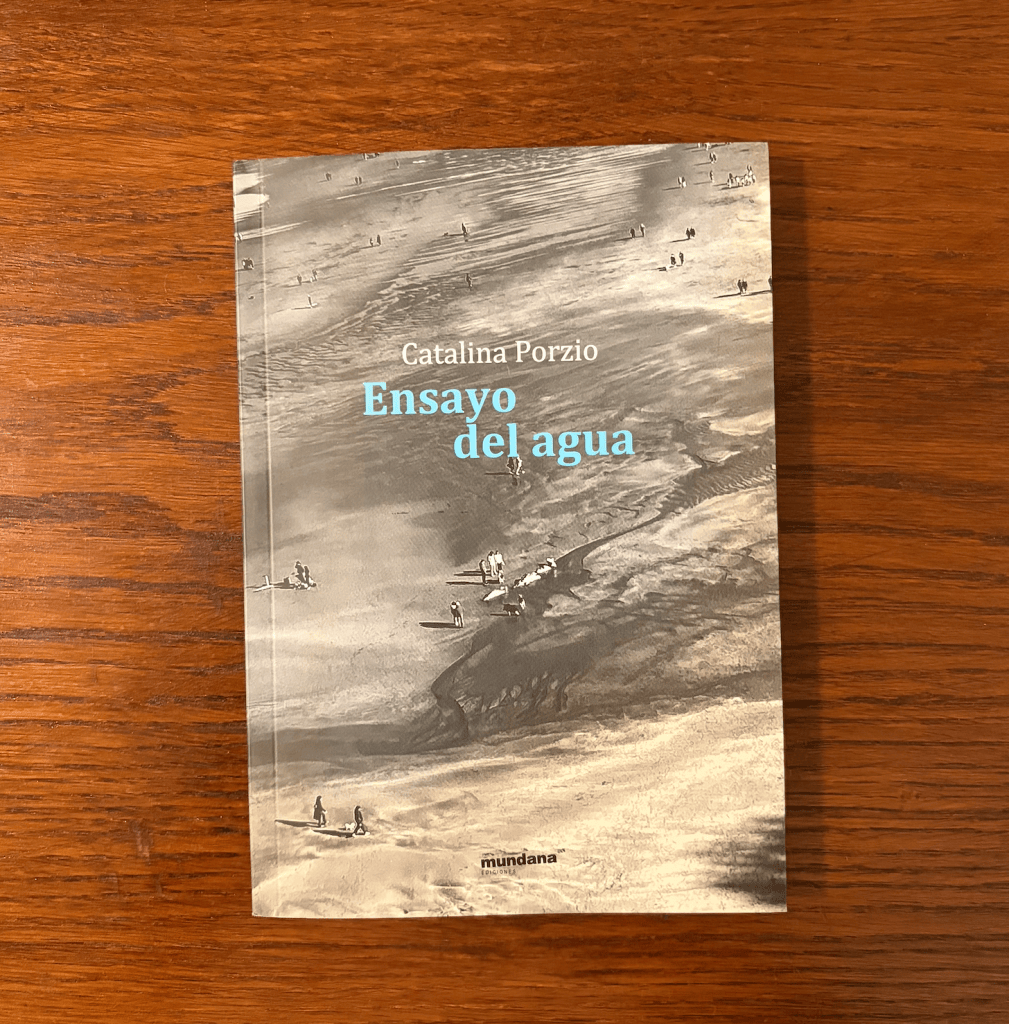
First published in the Chilean publishing house Mundana back in 2016 and long out of print, Victoria Cirlot’s Imágenes Negativas: las nubes en la tradición mística y en la modernidad (2026) finally appears in a new and upgraded edition from Siruela Ediciones. This short essay, initially a conference delivered at the Universidad Católica de Valparaíso, is another contribution to Cirlot’s important work on European mystical tradition of European early modernity, but like other of Circlot’s book its value also resides in its prudential contribution to contemporary thought. In this sense, Cirlot’s visual exploration of the cloud allows us to raise the question without much hesitation: what is a cloud in a field of vision, anyways? In Kurt Badt’s John Constable’s Clouds (1950), a book that is curiously missing from Cirlot’s commentary and bibliography, the cloud is merely a modern phenomenon in painting; a specular effect of the rise of meteorology in post-Enlightenment England that paved the way for a new construction of the modern landscape painting.

If Cirlot does not need to follow Badt’s insights, it is due to the fact that she wants to take a step back, even if her point of departure is Von Dillis’ drawings from the nineteenth century that she encountered in the Alte Pinakothek in Munich. These are relatively small works, and more profusely unfinished than Constable’s cloud exercises in oil painting. I seriously wonder if Cirlot’s would have taken another direction in her analysis if she had confronted another series of cloud paintings of the modern tradition. Perhaps not. Following Gombrich’s dictum that clouds are accidental forms reserved in the mind and extended to the pictorial space, Cirlot immediately goes on to document the long mystical tradition where the cloud stands for theos gnophos, or the incandescent light that descend from the divinity right into the human’s heart (Cirlot 18). In the mystical tradition the cloud of the story of Moses, later deployed as a trope by Pseudo-Dionysus and Gregory of Nyssa, the cloud refuses to be an accident of substance; it is rather the image of substance itself: the impossibility of knowing and having access to the divine, and thus the need for the recollection of the light of ignorance. 

If mysticism and painting go hand in hand it is because what the divine cannot be said in language, but it be disclosed through the spectacular persuasion of an image that is carved in the veil of theology. In this way, the cloud is a bit like a dress in a painting, both conceptually and figuratively: Cirlot does not fail to note that in Medieval representations one can grasp the figure of God swerving in a cloud before a horned Moses, but it is also the turbulence in the depth of the picture that allows for the ascension of the gaze that fails to establish a horizon and the linear perspective. Although Cirlot does not put it in this way – she is obviously more refined and attentive to her historical sources – one could easily find an opposition between clouds (and perhaps clouding of the background of a picture, an activity) and horizon of pictorial representation. It is in this sense that Cirlot defines the “via negativa” that clouds appeal to the impossible knowledge of God (in my translation): “The images of ascension and clouds are modes of making visible the negative way of the proximity with God…the fact that the experience of god takes place through the mode of negative images is something that persist from Pseudo-Dionysus to Mechthild of Magdeburg, and San Juan de la Cruz” (Cirlot 23-25).

In other words, the cloud is the non-human figure of a mode of cohabitation in God – Cirlot goes as far as quoting that it is the medium, “el entre”, the incommensurable distance between the sensible being and god (Cirlot 27). This is why the cloud, in virtue of what it discloses in its non-disclosure, is a bit like a hole in the picture, and we fail to account for its potency to stabilize its mystery through the categories of the autonomy of the work of art. This is why it is very fruitful when Cirlot tells the reader that the cloud defies vision in its very appearance, since through its clearing and light, it can only “sense through the inner soul” (Cirlot 30). This was also present, at least residually in Badt’s Constable Clouds, when referring to the externalization of the clouds as the spiritual organ of the living. But it is precisely this exteriority that defies the epistemological grounds of meteorological knowledge that would facilitate the technical ability to condense the cloud into force and energy, whose ultimate expression is crowned in a work such as Hans Haacke’s Condensation Cube (1963). A fallen cloud from the sky that can only be experienced in the abstraction degrees and measurements of its objective “data”. 

There is an intimate and communicate vessel between painting and clouds that can be derived from Imágenes Negativas (2026), and that can be sound in the state of imperturbable contemplation where life and thought convergence without the energy of struggle that would define modern artistic creation and its fall into autonomization (Cirlot 33). If painting is to release and live as a mode folded in God; the modern sensibility would require the energy of creation in order to open the passage between worlds. Following Puech’s important work on Gnosticism, Cirlot sees that the nebular trope of the cloud persists in modernity well beyond San Juan de la Cruz: one can sense in the attempts to “escape this world” – from Piranesi’s ladders to Thomas De Quincety’s prose, and of course, Charles Bauderlaire – a hymnal longing for the clouds that depends on the energy of the reversibility of the modern seen as a form of confinement (and from the pictorial space, I would argue also as the triumph of flatness in modern painting) (Cirlot 44). The cloud becomes a window for gnostic imagination, although this could very well be a sort of self-serving pleonasm, given that the “possible” of the gnostic remnant in the work of art only appears as momentary reversibility; a temporality that necessarily subsists without transforming the plane of sensibility. These are wonderful experiments in poetry, painting, photography; and yet, the negative, I take it, cannot be refused its place in the historical wealth of  historical capture of exteriority. Both Hölderlin and Baudealire’s clouding of poetry is already the document of the impossible attempt to live the serene life in god. Thus, any attempt at a full-fleshed exodus via negativa, runs into catastrophe and possibly madness in the wake of disenchantment. 

In her final and short essay of the volume, titled “La estrella y la nube”, Cirlot speaks of the return of the cloud in modern photography, concrete the work of André Kertész, as ‘laceration in the sky” (“agujerear el cielo”), or a tear in the heavens (Cirlot 60). The passage here appeals to an inverse tonality, where lamentation becomes an inexorable dimension of affection in the world now organized through massification and urbanization of all spaces. Disenchantment is ultimately spatial enclosure. But this tear in the sky is a remnant of a memory of the divine, as well as the absence of the divine in the world; the failure of establishing a transcendence with the unknown and the inapparent. But it is thanks to Victoria Cirlot’s pictorial explorations that we can raise these questions, which are also more than mere questions pertinent to theology and art.  

At the threshold. By Gerardo Muñoz

Just a few days ago there was an esoteric exchange between Giorgio Agamben and Alberto Moreiras on the difficulty of the ‘other beginning’ and the ‘via di uscita’, a propos of a recent meeting on desecularization and theology that took place in Granada, Spain. The notion has been in the air for some time now, since two years ago this was the central problem in a 2024 meeting in Berlin. That the exchange was esoteric is not in question, since it presupposes undertaking the conditions of the conversation and papers of the meeting as well as multiple books from both Moreiras and Agamben, and I do not think that the nuances have been taken into consideration. But it must be noted that there is an exoteric dimension to the contention as well: Giorgio Agamben has favored the ‘via di usicita’ in different figures (mainly Pulcinella, Pinocchio, Hölderlin; and we know that Agamben’s overbeckian urgeschichte is a clear cut rejection of an epochal beginning); and, from his end, Alberto Moreiras has also thematized the other beginning of thought and aleotropic excess in his most recent Tiempo Roto (2025), which cuts through Heidegger’s thought, and thus not limited to what is understood as heideggerianism. I want to reject the idea that these two notions – ‘via di uscita and other beginning – are just two forking paths in postheideggerianism, as complicated as it is to go beyond Heidegger’s end of Western metaphysics. And I think – and in fact I am convinced- that both Agamben and Moreiras are soliciting something that radically escapes Heidegger’s thought even when it emanates from it; a bit like what Derrida says that the chôra escapes the categorial order of Plato even though it emerges from the Timeus.

There is no doubt that at stake is a breakthrough in thought. Of course, stating this puts a finger into something fundamental; but, alas, the devil is always in the details. I am in no position to unravel the implications of the two options – new beginning and via of exodus – and to that extent I am still taken by Moreiras’ interpellation in the first day of the meeting about my own position regarding the new beginning, which I am in no way ready to respond. Of course, Nicolas Poussin comes to mind (I cite from memory his epistolary words to Chantelou): “I am in the profession of mute things”. A claim of silence that in no way refrains from language and writing. Yes, I am no painter, although I am interested in painting and what painting can offer and donate to thought and philosophy. And we live in an epoch at the end of painting, and yet painting outlives everything as in a metaphysical remnant, as Kurt Badt reminds us in his great work on Cézanne.

Giorgio Agamben notes in his little Il tempo del pensiero (2023) how Heideger declared his Le Thor seminared that he always thought that Cézanne was the other figure of the tradition that resembled his own path. It is a curious analogy to a painter and the painterly praxis in the age of technological subsumption. Or perhaps I am reading too much into it, since I am working on a small book on the communication between painting and thought, and I want to understand what painting has to offer.

As a preliminary response to the difficulty that emerged in the ‘new beginning’, I am left wondering if the threshold is an intermediary space to arrest the jump beyond nihilism, which is ultimately what is at stake. This has been my way- I am all for changing that – of reading Agamben’s work: to remain at the threshold in order not to force the overcoming of nihilism, even if that anti-nihilism takes the force of antiphilosophy or thought of the unthinkable (Moreiras). Can thought breathe from the rest and imperturable dwelling in the threshold, if understood as mediated by the hand and the eye at a distance? This is for me the problem of painting as the last activity at the end of metaphysics – a theological remnant that intercepts the reduction of a historical cosmos. A duration that escapes the regime of the ontic but that does not dare to point to transcendence nor does it accept the inevitability of anthropological struggle. Yet, duration is the condition of breathing in a landscape: if we face it, is there even the need to begin or retreat? 

Vermeer’s weightless scales. by Gerardo Muñoz

Vermeer’s “Woman Holding a Balance” (1663) has been read as an allegory of the Final Judgement for very obvious reasons. The painting within the painting on the foreground embodies a traditional representation of the Last Judgement for the saved and the damned. But how are we to mediate between the painting in the painting and the activity that is taking place in the mute and contemplative woman that is holding a balance with her right hand? Advancing an interpretation that departs from the coins placed on the table, Herbert Rudlolph’s important thesis suggests that exchange and equilibrium is taken place at once; a movement that allows him to favor the narrative of vanitas that would have been immediately diaphanous to the spectators of his time, especially the growing Catholic community of Vermeer’s Netherlands [1]. 

The picture shines with religious piety and depth, and yet it is a work of interiority that Vermeer has notably chosen to deprive of an explicit iconographical assertion in its main figure. Could it just be a visual representation of Loyola’s  Exciertia spiritualia (1548) that recommended to be “like the equivalent scales of a balance ready to follow the course which is more for the glory and profuse of God, our Lord, and the salvation of the soul”? [2]. What are the instances of balance in the picture that would justify such a singlehanded transposition into the picture? If painting is anything, it is precisely what carries an excess to narrative and iconology. And this is what we should be interested when looking attentively to the picture. The vortex of depiction is the event that falls outside the concept through which we are attempting to arrest the meaning of a picture in its manifolds historical subtleties. 

If taken prima facie “Woman Holding a Balance” (1663) is representing a combination of the embodiment of justice and judgment, what remains an enigma is precisely the fact that the balances are empty, as is evacuating the act of weighting the unequal units of weight. In the graceful hands that hold up the weightless balance, Vermeer has given us something like an image of the suspension of judgement, and in this way, communicating esoterically with the Last Judgement that looms heavily on the foreground. Whereas the allegorical representation of the last judgement is reminiscent of Van Eyck’s “Last Judgement Diptych” (1430), the female figure appears to us in an experiential graceness restrained from any transcendence; as if only sub specie aeternitatis time had come to a halt at the very contemplative motion of her inexpressible being.  Her presence recalls Kafka’s assertion about the temporal fixation of judgment: “It is only our conception of time that makes us call the Last Judgement by its name; it is a kind of martial law” [3]. 

The nullification or void in the balance inscribes this ex tempore suspension in the sequence of historical time of salvation that subordinates faith to history oblivious to the fact that life without judgment is also an instant of faith. As Felix Weltsch, a theologian that was very close to Kafka, thought in an important work: faith is a process that overcomes itself by creation; it is not a force of judgement and belief, but the the subsumption of existence into what which already is [4]. Or, in the words of Kafka, closely following the steps of Weltsch: “faith means emancipating oneself: being indestructible or better: being”. Faith has been transfigured as a transmission of what now is the emergence of appearance as the event of life. Fleeting and yet irrevocably unbending, what appears is both incommensurable and sensuous.

After this detour, if one goes back to Vermeer’s picture, what does one see? Definitely, not an instance of allegorical portrayal towards the transcendental expectation; rather, this is an image where theos has become a presence because it is enacting the faith of being in the withdrawal of God. This invisible, and yet sliding retreat is rendered visible by the emptying of a balance that is no longer posited as judgement of post-Edenic life towards salvation; it is the opening of space that upholds life because it no longer surrenders to the martial court enabled by time. When judgement unfolds into the indestructible and visible ‘lunatic strength of faith’, to use Kafka’s singular expression, then we are entering a living grace that is only attuned to the eternity of its appearance. And is not this another way to define the emergence of painting, after all?

Against what contemporary jurists’ formulations about pondering and weighting of rights as the ideal of the rule of law; the figure of thought that emerges in the picture is that justice is neither scalable nor measurable, but rather a motionless state of grace that can only be contemplated in the mystery of life. The emancipated life staged in Vermeer’s “Woman Holding a Balance” (1663) holds an inconspicuous eloquence that knows neither waiting nor judging, because its imperturbable state is beyond all consolation. 

Notes 

1. Herbert Rudolph. “Vanitas: Die Bedeutung mittelalterlicher und humanistischer Bildinhalte in der niederländischen Malerei des 17”, in Wilhelm Pinder (Seemann, 1938), 410.

2. Gregor Weber. Johannes Vermeer: Faith, Light, and Reflection (Rijksmuseum, 2022), 127.

3. Franz Kafka. The Aphorisms (Princeton University Press, 2022), 82. 

4. Felix Weltsch. Freiheit und Gnade (Kurt Wolff, 1920), 10.

Plastic spirit and depth. by Gerardo Muñoz

In an issue of The Listener in 1935, the renowned British art historian Kenneth Clark penned a short article titled “The Future of Painting” that can be read as an early eulogy to the tradition of the pictorial craft. As a provocation – this was still the high tide of Modernist art – the ‘future’ of painting for Clark was undeniably reaching a point of irreversible exhaustion, at least in the Western tradition. In a phenomenological reduction of two major strands of modern painting – what he called “pure painting” that included Impressionism and Post-Impressionism; and, on the other, “super-realism” as the artistic consciousness that bypassed  “spiritual salvation”, such as that of Surrealism and other visual experiments – Clark’s indictment deployed an indictment on what he sought as the end of the “plastic spirit”: “We must keep in mind the possibility that in the western world the plastic spirit is really exhausted and that art will be lost for many decades” [1]. 

For Clark, it was not that art ceased to exist as an autonomous practice of sensorial activity; it was rather that its imaginative and spiritual endeavors had a future only if mediated and “linked up” (sic) with the evolution of a “new social economic system” driven by the standards of productivity and mass spectatorship. Unlike Clement Greenberg’s reflexive plea of modernist painting as the triumph of the dialectical inversion of flatness over depth, for Clark the convergence of pictorial relation with social objectivity resulted, in the tradition of a post-Cezanne world, in draining the inherent sensible communication of painting and myth. This meant that modernist painting tout court was devoid of any mythical relation. In fact, one could very well claim that the outwardly material support (the flat canvas) of the picture became its most dramatic corroboration. Modernist painting was the triumph of social symbolization insofar as it served as a reminder of the objective space that could only be taken as unserious gratification of its own objectivity.

It does not take too many readings of Greenberg’s large claim on modernist painting to see that behind “flatness”, its very surface, lurks variations of the aura of subjectivity, expressed in “success of self-criticism”, “resistance to the sculptural”, and the drive towards systematic consistency viewed in the mirror of the “convergence of spirit with science; their concern does show the degree which Modernist art belongs to the same historical and cultural tendency as modern science” [2]. Or so writes Greenberg in his landmark text. If Greenberg goes out of his way to invite modern science into the field of aesthetics it is precisely because Modernist art has been able to spell out the potential for representation into an autonomous surface that has given up depth to the conscious effort of its material limitations as its primary concern (imagination, the divine, the liturgical theatrical aura are all secondary). It is perhaps against this backdrop that one can understand what Clark means by the exhaustion of the “plastic spirit” that underpins his prophetic understanding of the decline of painting. 

But what is, ultimately, the “plastic spirit”? It is not referring to sacred representation nor artistic inspiration of the artist, but rather the receptive affinity of the pictorial gesture with nature without ever being reducible to its material support (flatness). If painting exists, it is because its lovely being “is neither sensuous nor spirit, but rather the ungraspable, diffusing over the figure…this being is ungraspable yet perceptible to everyone is what the Greek language called [kharis] and we call grace” [3]. What the ‘plastic spirit’ discloses in its suspension of judgement through very disclosure of appearance is the imperturbable space, and by extension ungraspable, where figuration arrest an instance of eternity. In this sense, it always resists any assertion towards the future, because it dwells in the opening of a space “there” that fails to coincide with the material extension and limitation of the canvas.

This is what perhaps Walter Benjamin had in mind in an early fragment where he reflected on painting as an art of paradise or a state other-than-being grounded in visual contours: “Painting, too, generates space spiritually; its generation of form is likewise grounded originally in space, but it generates space in an­ other form. Not the dimension but the infinity of space is constructed in painting. This happens through the surface, in that, here, things develop not their dimensionality, their extension in space, but their being toward space. The depth yields infinite space. In this way, the form of concentration is given, but this now requires for its fulfillment, for the allaying of its tension, a presentation of the infinite in itself and no longer as dimensional and extended” [4]. Was not this the ungraspable caesura between depiction and nature already pointed out by Schelling?

Painting is depth, or at least it is about a certain way to accout for depth. And depth, fundus, before it takes the form of a flat spatial region in ‘thereness’, it is eminently the display of the figure that emerges from it. This “space otherwise” – that is not just a different spatial arrangement or geometrical calculation – is something of the infinite that makes both flatness and the diachronic arrow of time collapse in its unattainable rigor brought to bear in the affection through figures and colors. Every painting shows therenesss, but that is only possible through the depth of interiority that remains invisible. This can illuminate what Osip Mandelstam said of the plastic spirit when writing that “painting is also much more a matter of internal secretion than of apperception, that is, of external perceiving. To appreciate a picture you must go through a process making of restoring it” [5]. It is in this renewal that the imperturbable depth of painting fulfills before the abdication of the future. And from the “depths of nature” into the blossoming manifestation of appearance, painting recalls, beyond words, what in the sequence of time is understood, and yet often neglected, as the ungraspable. 

Notes 

1. Kenneth Clark. “The Future of Painting”, The Listener, October 2, 1935, 578.

2. Clement Greenberg. “Modernist Painting” (1960), in The Collected Essays and Criticism (University of Chicago Press, 1993), 91.

3. F.W.J. Schelling. “On the relationship of the plastic arts to Nature” (1807), Kabiri: The Official Journal of the North American Schelling Society, Vol. 3, 2021, 146.

4. Walter Benjamin. “The Rainbow, or the Art of Paradise”, in Early Writings 1910-1917 (Harvard University Press, 2011), 225.

5. Osip Mandelstam. Journey to Armenia & Conversation about Dante (Notting Hill Editions, 2011), 79.

Painting and Paradise. by Gerardo Muñoz

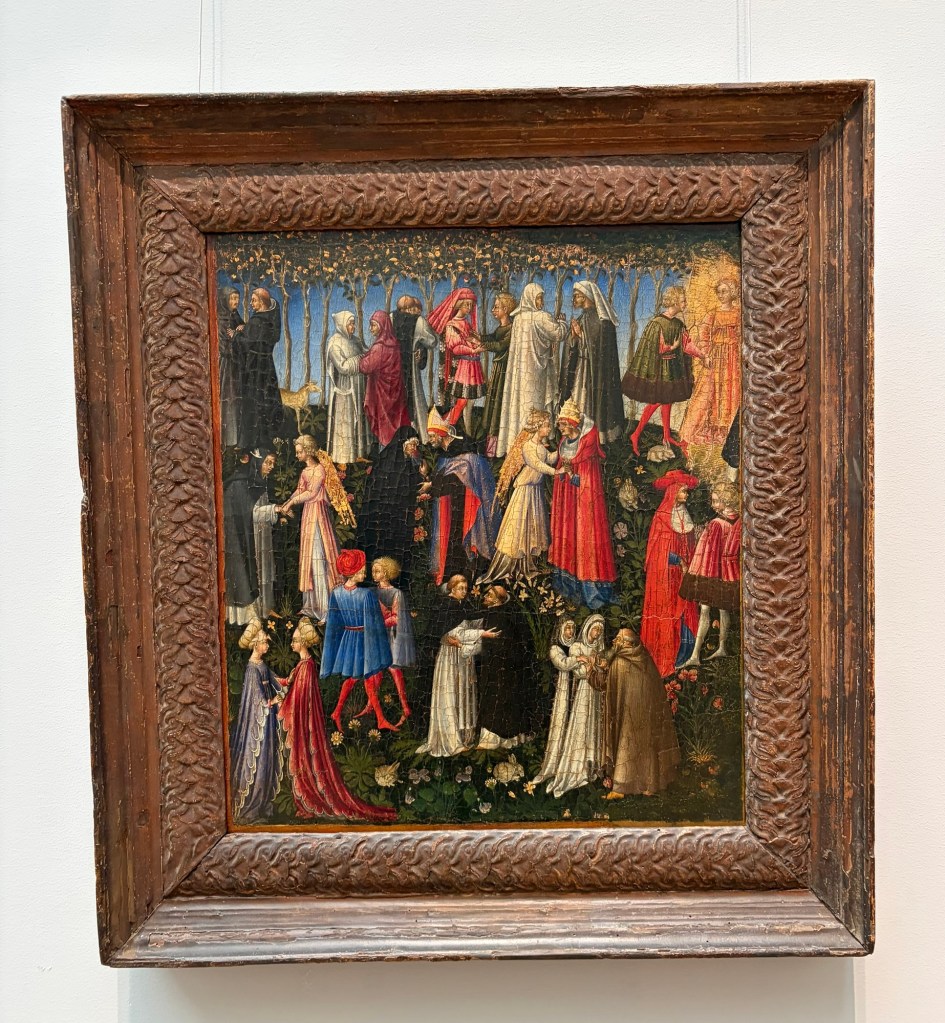
Giovanni di Paolo’s “Paradise” (1445) is a small scene once featured as a predella of an altarpiece from Siena’s San Dominica cathedral. Albeit its miniature proportions it is a striking image of Paradise that puts us in front of a choreography of encounters of the dead, as if the heaven was not a superior and separate stage of life in the cycle of salvation, but rather a continuous stretched territory that takes off where “this life” had left. In its rather simple and rhythmic composition, surrounded by citrus and vegetation, Di Paolo offers the viewer a state of paradise that is not about absolute bliss or bathed in irresistible enchantments, but rather something that in poverty reveals itself in proximity, literally face to face, with an other, perhaps a friend or lover. If we zigzag across the figures it is almost as if the picture would confirm Roberto Antelme’s intuition that “the only transcendence is the relation between beings”. And nothing else is the painterly texture of paradise beyond life. In this way, one can define the earthly paradise as a space where transcendence is dispensed because it primarily welcomes and senses otherness.

One of the striking details of the picture is precisely the positioning of the hands of each couple. Just take a second to gaze around them. These are hands that gesture towards a supreme affection; it is the hand that reciprocates and welcomes. It has been noted – for instance, in Berenson’s A Sienese Painter of the Franciscan Legend (1910), that Sienese painting of the fifteenth century introduced a new pictorial attention that manifested the coming to life of the spiritual. In Giovanni di Paolo’s Paradise the flickering hands, moving around the bodies, are perhaps signifying the initial touch of renewal between heaven and earth. In fact, it is almost as if the sliding of hands was the vehicle for the nongranular transition into the arrival of heaven. In a way of synthesis, one could say that paradise is always at the distance of the hand; which is why painting and happiness remain in an intimate dialogue regardless of themes or historical epochs.  

And one can ponder whether the absence of paradise from imagination in the wake of the absolute intrusion of hell in reality, is not precisely a world where the incommensurability between hand, nature, and language become indistinguishable; the transparency of sameness in an expansive totality well beyond reach. To be in nearness is not just an ethical transcendence between beings, but ultimately allowing a divine region to flourish for possible encounters. This is why Angelus Silesius says that “nothing exists except you and I, without both of us then god would not be god, and the heavens will cease to exist” [1]. Paradise is, as Di Paolo’s painting reveals, not the utopia to come in another time, but the  inconceivable place never fully detached from the experiences in this earth. As Karl Barth once wrote: “As the place of God in heaven is, of course, a place which is inconceivable to us. It cannot be compared with any other real or imaginary place. It is inaccessible. It cannot be explored or described or even indicated. All that can be affirmed concerning it is that it is a created place like earth itself and the accessible reality of earth which we can explore and describe or at least indicate; and that it is the place of God” [2].

This inconceivable place of God is the apocatastasis of what sorrounds us, of what has touched us, and of what we have touched; and this includes above all, the nexus of the living and the dead in a strenuous thought that gathers itself in what has loved. This space outlives the world of the living in order to express the divine that is, precisely, the unmediated appearance of each encounter. This means that painting paradise does not commission what a new life should look like as a way to overcome a previous existence of deficiencies and missed opportunities inscribed in felix culpa; what is recollected, and thus the only true apocatastasis, is a path to presence that knows neither end nor name that is self-contained in the ur-space of depiction. 

Notes 

1. Angelus Silesius. El peregrino querúbico (Ediciones Siruela, 2005), 2005.

2. Karl Barth. Church Dogmatics: The Doctrine of Creation, III (T&T Clark, 2010), 149.

*image. Giovanni di Paolo’s “Paradise” (1445), part of the Metropolitan Museum Collection.

A painting that knows no evil. by Gerardo Muñoz

In several places of his Lectures of Aesthetics, Hegel refers to Dutch painting as a way to thematize the concept of completion that fulfills being in the world. For a moment his commentary brings to bear a state of the mundane while avoiding the vulgarity of the overachieving surface that would define the general tendency of modern painting. True, Hegel’s indictment of Dutch painting does not negate the modern sensibility either, insofar as the portraits of the Flemish tradition fail to disrupt that is always held incredibly visible in the frame of pictorial representation. The artistic triumph of Dutch painting depends on a specific oscillation between the inner and outer experience of the subject visible range of depiction. This is not an exclusive one-directional movement towards the immanence of life; which Carlo Levi will denounce as the estrangement from the world, but rather a synthesis that gracefully falls on the sensuous activity of painting just at the moment that appearance dispenses in the world. 

Thus, the emergence of Dutch painting was only possible in a specific form of life that was resolutely experiential in nature and spiritual rich. As Hegel writes in a first moment in the Lectures: “the Dutch in their taverns, at weddings and dances, at feasting and drinking, everything goes on merrily and jovieall, even if matters come to quarrels and blows; wives and girls join in and a feeling of freedom and gaiety animates one and all…this spiritual cheerfulness in a justified pleasure, constitutes the higher soul of pictures of this kind” [1]. And this spiritual freedom, sublated from the necessities and constraints of external things in the world, validates a concept of the ‘ideal of life’ that is transcendent only to its sense of living. Hegel notes that Protestantism facilitated the Dutch a materiality for this sense of worldly transcendence, of communitarian deificatio, allowing them to have, in his words, “some footing in the prose of life” [2]. So, Dutch painting is predominantly concerned with depth; and this depth is not concerned with the absorption of the spectator, but quite literally, almost in a physical way, enmeshed in the inner tonality of everyday figures. This is their inner being made visibly manifest. The manifested and gathered presence of this inner and outer movement of the infinite is precisely what retains the imperturbable trace of the divine beyond time; indeed; an eternal Sunday of life, as Hegel says in another important moment: 

“This painting has developed unsurpassably, on the one hand, through and through living characterization in the greatest truth of which art is capable…For this reason we have before us no vulgar feelings and passions but peasant life and the down-to-earth life. lower classes which is cheerful, roguish, and comic. In this very heedless boisterousness there lies the ideal feature: it is the Sunday of life which equalizes everything and removes all evil; people who are so whole-heartedly cheerful cannot be altogether evil and base”. [3] 

It is well known that in the art historical discipline, the moment of Dutch painting has been understood within the framework of the scientific and optical revolution of that century; a new “faith in the eyes”, to follow Francis Bacon’s terms, capable of generating a concrete and rational knowledge of the “common world” of a new, more geometrico, regime of light [4]. But nothing could be further from how Hegel’s synthesis approached the sensibility of Dutch painting; mainly, as fundamentally a site of the overcoming of evil because it was not alien to the comic downfall of human experience. In Dutch painting, Hegel reminds us, it is not that evil or wrongdoing is removed from the factical life; rather, it means that the comic is a nested experience that can grasp and transfigure the miseries or the disasters beyond taxative transactions of the social world and preparing the conditions for a kallipolis

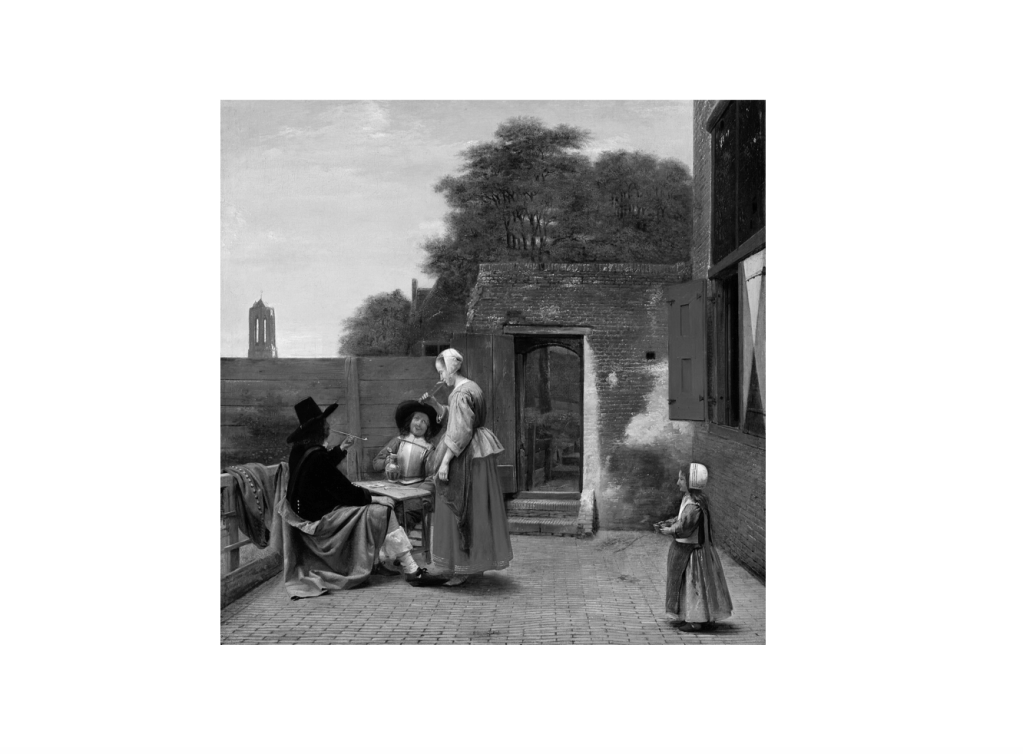
Although it is not clear who are the Dutch painters that Hegel had in mind when writing about a painting that enters into the “Sunday of life”, certainly the pictures of Pieter de Hooch – “A Dutch Courtyard” (1660) comes to mind – where distant and miniscule figures smile at each other in the open encounter of a place. The erasure of evil from painting is achieved not from stating the dogma through which the world could transcend and reverse the fall from nature, that is something like a new “faith in the visible”; it is more the event that accounts for the surrounding as it becomes oblivious to the very artifice of depiction. In this sense, the imperturbable state of Dutch painting is achieved as a life that dwells in the folds of the world as it retreats from the force of anticipation. And, if according to Chrysippus, evil is nothing but losing the capacity of affection or mediation of our inner sensibility; what the Dutch pictorial order brings to bear is that the ‘good’, rather than being a substantive function of the will and contingency, it can only be accessed in a form of life that is indistinct from the inconspicuous and breathable space through which it dwells.

And what is the sensibility of the comic if not what remains ungraspable in each and every in a painterly expression in a world in consonance, a place without remainder? In other words, if there is a painting that has abdicated from evil, it is because its has attuned the soul to an exteriority that is no longer dependent on the weight of the sign. It is still the business of the mute things (Poussin) in order of the beautiful. This is the state the state of grace that Schelling thought the plastic arts could bestow human sensuous experience after the irredeemable apotheosis of nature: “In painting a lovely being that is neither  sensuous nor spiritual, but rather ungraspable, diffuses itself over the figure and nestle into all the figures and to each oscillation of the extremities. This being, which as we said, is ungraspable yet perceptible to everyone, is what the Greek language calls kháris and we call grace (Anmut) [5]. And the movement of grace in painting is what initiates the transfiguration of death – the muted voices of the dead – into a divine whose sole task is the disclosure of presence. 

Notes 

1.  G.W. F. Hegel. Aesthetics. Volume I (Oxford University Press, 1975), 169-170.

2.  Ibid., 597-98.

3. G.W. F. Hegel. Aesthetics. Volume II (Oxford University Press, 1975), 886-887.

4. Svetlana Alpers. The Art of Describing: Dutch Art in the Seventeenth Century (University of Chicago Press, 1983), 91. 

5. F.W. J. Schelling. “On the relationship of the plastic arts to Nature” (1807), Kabiri : The Official Journal of the North American Schelling Society, 2021, Vol. 3, 146.

Quod natis exitus. by Gerardo Muñoz

In Book V of his Latin Language, and immediately after commenting the duality of Earth and Sky, Varro writes an enduring and yet enigmatic gloss of worldly life. In Roland Kent’s translation from 1938 we read: “Inasmuch as the separation of life and body is the exitus, ‘way out’ for all creates born, from that comes exitium, ‘destruction’, just as when they ineunt ‘go into’ unity, it is their initia, ‘beginnings’ [1]. It is probable that Kent had to leave the latinized terms next to familiar reiteration of modern English in order to allow the text to breath in all of its complexity, for what is Varro ultimately attempting to tell us can very depending what we want to stress, and how we read in the scope of his discussion starting in section 58. Is it that life is always marked by the wound of separation with the natural world? Or that destruction and caducity (exitium) is a necessary condition for all new beginnings, as if life understood as an enclosed organism or entity is always insufficient, because of the order of excess at the very moment that it recognizes its propriety? This excess is what cannot be contained in neither life nor in social form or political mediation; it is the initia of thought in its relation to phenomena of the world but without ever being reduced in them. In this sense, there can only be a beginning in the passion that thought grants to the separation from the world. 

This is perhaps what Pindar had in mind when writing in Isthmian 8 – in clear tone of his disenchantment before political strife – of a need to return to a shared language among friends (a language that cannot be that of the rhetorical antinomies of the polis): “It is always best to look at each thing right at our feet / for treacherous time hangs over men and twist awry the path of life. But even those things may be healed by men if freedom is with them; and a man should give care to [that] noble hope” [2]. In his commentary on these lines C.M. Bowra notes that the awry and treacherous time of life that Pindar refers is not just a personal account, but rather a state of the world of his own generation and friends [3]. Politics brings to ruin; it brings fear, but more importantly it brings oblivion to the nearness of each and every thing that stamps irreducibility. But what Bowra does not thematize is the central stress of these lines; mainly, that the Ancient poet makes a plea to the examination of proximity and nearness “look at each thing right at our feet”. The plea to take care of a true life harmonized is preoccupied with this lying out before our feet is so inapparent that it provides texture and rhythm to every appearance; it is so invisible that it can disclose the very possibility of the beginning or end of a visible world. 

It seems that Pindar’s solicitation of proximity speaks to Varro’s initia; but not because there is something like a true origin or original position (a category that modern political thought later elevate to the physics of social stratification and positional distribution), but rather because another idea of “freedom” can be rethought from the excess of what appears spatially in the world; an absolute instance of appropriation beyond life. This is perhaps beautifully expressed in one of Cézanne’s most acute images of his creative process: “I breathe the virginity of the world…a sharp sense of nuances works on me. At that moment I am as one with my paintings” [4]. Before painting and creation there is a sensuous region in which the separation of objects and subjects do not longer sustain totality except as catastrophe or force.

This means that to disclose regions of life in the world is not just about the claim of autonomy and normativity of a place; on the contrary, it is the very inapparent, almost imperceptible, possibility that lies in the wrinkled proximity when we withdraw from things ad they seem. Quod natis exitus – because we are always exiled from each and every place, it is through the thinking of the inconspicuous of each and every being that revisitation of an ethical life calls on us from the outside. Ultimately, the ethical life is nothing but the imperative of «lech lechà» in a separation that unites when overcoming the deceit of time. 

Notes 

1. Varro. On the Latin Language, Books 5-7 (Loeb Classical Library, 1951), 59. 

2. Pindar. “Isthmian 8”, in Pindar (Loeb Library, 1997), 211.

3. C.M. Bowra. Pindar (Oxford University Press, 1964), 114. 

4. Joachim Gasquet. Cézanne: A memoir with conversations (Thames&Hudson, 1991), 45.

Casa Bayona’s pensive slave. by Gerardo Muñoz

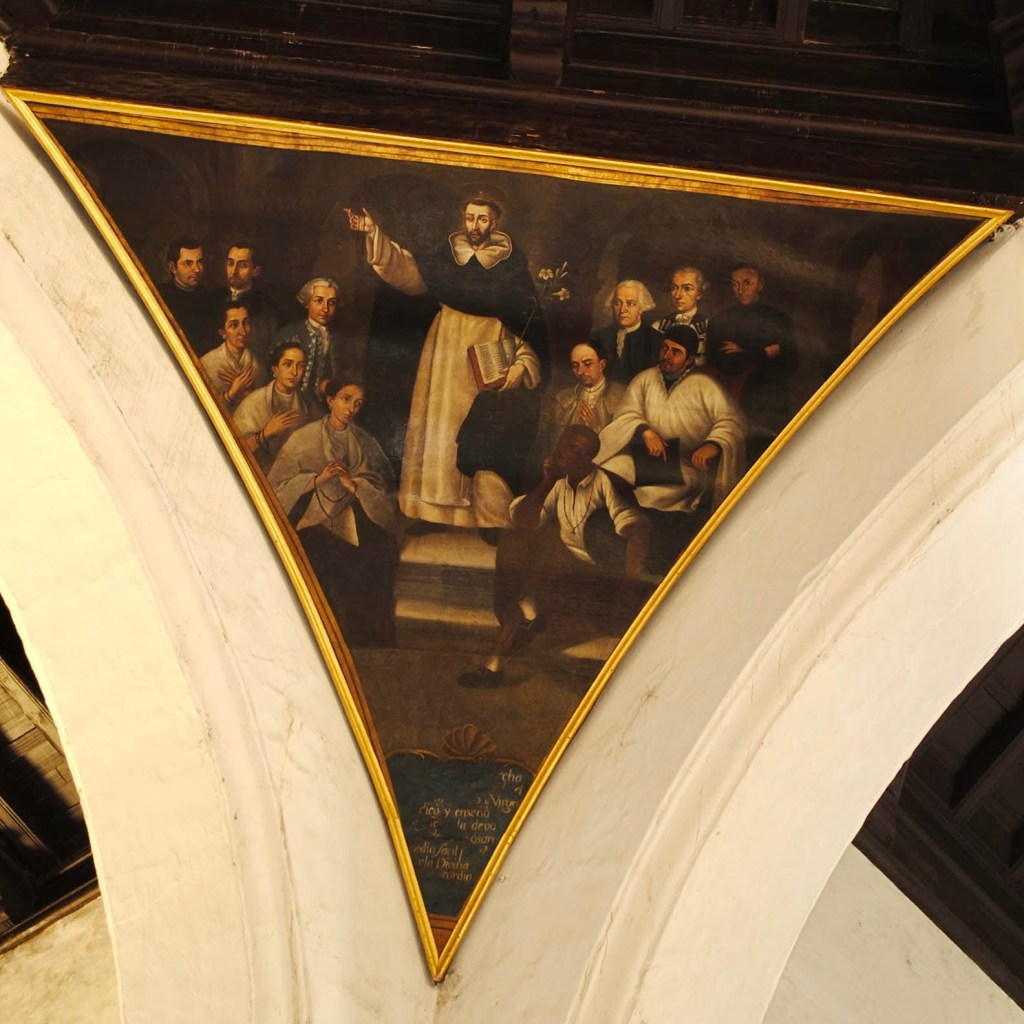
In the Church Santa María del Rosario of Havana there is a pendentive cycle completed in the 1770s painted by the baroque artist José Nicolás de Escalera – whom according to Guy Pérez Cisneros, was truly the first professional Cuban painter of the tradition – that includes a black slave in a pensive pose seating on a lower step, just below a Dominican priest who figures prominently in the middle of the picture holding a Bible and raising his right arm forward [1]. It has been noted that the figure of the black slave is also the first portrait of a slave in the New World, and its meaning has been highly disputed. The enigmatic slave or liberto portrait shows the man in a thinking pose, with a folded long white shirt, and what seems to be a wooden rosary hanging in plain sight. It is hard to make the details of his facial expressions, but it is obvious that his gaze is neither upwards nor directed at the viewer, but rather suspended, as if were, in a moment of attention and rest (and also listening?). The context here is fundamental, since Santa María del Rosario Church was commissioned by the Count of Bayona, a wealthy member of the sacarocracia (sugar plantation owner) after a previous church was burned to the ground by a slave revolt that took place in 1727 in an act of complete defiance to Christian indoctrination. 

The event that only has come down to us in just a handful of mentions and erasures of the colonial archive is featured prominently, as we know, in Manuel Moreno Fraginals’ El Ingenio when the historian documents the spiritual schism of the eighteenth century colonial plantations of the island. According to Fraginals’ historical account, the slave insurrection in the plantation took place in the wake of a theatrical enactment proposed by the Count of Casa Bayona in an act of repentance and humility aiming to mimic a well known moment of the Christian story: one day the Count washed the feet of twelve slaves, and when he finished he made them sat with him for dinner. Later that afternoon the slaves revolted and burnt down the whole sugar mill, including the chapel, to the ground. The episode ended with a plantation mayoral officer hunting down the runaway slaves, who was ordered to place the heads of the dead slaves high in spikes for the Count and everyone to see them [2]. It is an early staging of visibility and bodily dominion that the modern epoch will take to its final conclusion. 

The portrayal of human suffering was a symptom of the impossible hegemony of christianization of body and soul that the missionary Nicolás Duque de Estrada decades later will try to deploy in his pedagogical treatise Explicación de la doctirna cristiana acomoada a la capacidad de los negros bozales (1823), which argued that obedience of slaves could be achieved by implating “guilt” and work ethic in the affective interiority, in the forum internum of their souls. But even Estrada was of the fact that after sixteen hour workdays the Christian ascesis was imperceptible and little more than convoluted chatter to the ears of the slave. It is almost as if the slave, separated from the politico-theological inscription of salvation, was already outside the subjective domination of productive bondage and political freedom.

When Escalera was commissioned to do the cycle of frescos at Santa María del Rosario he was asked to combine a twofold narrative: the history of Christian salvation and the story of the Casa Bayona. At the center of the altar piece is the world as a common house or oikos, that carries history and its bodily sovereignty forward. One possible reading of the pensive slave shown in Santa María del Rosario’s pendentive is to assume that this figure is completely outside the eschatological vision embodying a sense of freedom that only painting could have documented in its unique and mute language. This raises the question about the relation between painting and freedom in which the figural emerges unmistakably fixed beyond historical narration. Although writing about Cézanne’s late work, Kurt Badt once suggested that there is no such a thing as the representation of freedom, but rather “painting generates a concept of freedom as two-faced: negatively, it is liberation from isolation and resistance, positively to the serious gentleness of freedom….expression in freedom to the scene from nature, which declares the world to be existing together, a mutual self-supporting and carrying of things” [3]. The pensive slave portrayed in the pendentive does not embody freedom understood as the spiritual accumulation of rights and duties known to the order of historical transformation; rather is an absolute pictorial appearance of freedom because it embodies, in its non-separation of life and thought, a static moment of a being that contemplates the liberty of his potency.

What is striking about the collective portrait where Escalera inserted the former slave is what we can call, following Bernard Berenson, a dimension of the ineloquent that appears just as “mute, with no urgent communication to make, and no thought of rousing us with look and gesture. If they express anything it is the character, essence rather than momentary feeling or purpose. They manifest potentiality rather than activity. It is enough that they exist in themselves” [4]. In the pensive gesture of his pose, the slave is the untouched existence and the revolt that rips the escathological narrative that ordains the interiors of Santa María del Rosario. Malraux once noted that the age of the divine disdained the realistic portrait of an ordinary person, because he was too distant and mundane from the stone conclave of the gaze of the gods. The slave’s inexpressive ‘naturalness’ refrains from partaking into a mood compensated by the semantic compulsion of the colonial painter, because his naturalness discloses the indestructible soul that has transfigured the realm of the divine. 

The unfathomable mystery of the pensive slave or liberto is the obscure and yet luminous portrait of a life in thought that is, at the same time, the thought of a life that is forever inexpressive, and as such the highest state of imperturbable freedom in the aftermath of worldly destruction. The ‘gentleness of freedom’ that Badt locates at the heart of painting is the imperative of the stream that carries, and yet restrains, thought and appearance into the figure of life. The freedom that anchors painting – because such freedom is never realized in painting except as vulgarity – becomes a tacit secret for which ultimately there is no image.  

Notes 

1.Guy Pérez Cisneros. Características de la evolución de la pintura en Cuba (Ministerio de Educación, 1959).

2. Manuel Moreno Fraginals. El Ingenio (Crítica, 2001), 99.

3. Kurt Badt. The Art of Cézanne (Faber & Faber, 1965), 314.

4. Bernard Berenson. Piero Della Francesca: The Ineloquent in Art (Chapman & Hall 1954), 7.

The love of painting. by Gerardo Muñoz

There might very well be an internal affinity between painting and love that at some point it becomes indistinguishable. A painterly picture can become love unquenched for that which remains persistently fixed and unrealizable. In one of the short essay books of his Big Sur period, Henry Miller asked this very question of painting. For him panting had a wondering origin that crosses the hand, undoing what we can easily enact. The erotic dimension of painting, thus, has nothing to do with the image or figure of the beloved, but rather with a specular limitation staged in the ability to allow the unseen to be incorporated in the visible scheme of the world. Only if we are able to see – and by the same token, only if there we are facing an event of painting – can something like use can be liberated from the constraints of mimetic compulsion. Miller writes in To Paint is to Love Again (1960): 

“To paint is to love again. It is only when we look with eyes of love that we see as the painter sees. His is a love, moreover, which is free of possessiveness. What the painter sees he is duty bound to share. Usually he makes us see and feel what ordinarily we ignore or are immune to a certain manner of approaching the world tells us, in effect, that nothing is vile or hideous, nothing is stale, flat or unpalatable unless it is our power of vision. To see is not merely to look. One must look-see .See into and around. Or, as John Marin, once put it – “art must show what goes on in the world” [1]. 

The place of painting for Miller is an imperturbable state that refuses to be fixated on objects, but in the invisible region (as in the figure of the chora) that allows for the thing in the world to be used. This is why Miller considered Japanese watercolor and prints an absolute primer of the pictorial: it taught him the appearance of worlds within the world, regionalizing the surroundings never logically stated unto itself, which in modernity it became the catastrophic horizon of autonomy towards its posterior liquidation. This is why Miller, very much like Carlo Levi, understood that the crisis of painting in the Western tradition ultimately signaled a general sense of social terror as a new phase of human desperation attenuated by the circulation of social fictions. 

At the height of the the closure of civilization, painting reemerged, if Kurt Badt’s axiom is correct, as the last metaphysical activity of human praxis. A metaphysical activity that holds on to the experience of belief in suspended appearance of originary anthropogenesis. For Miller, in painting as much as in love “one must be a true believer” [2]. And this assertion must be understood in the backdrop of Miller’s experiential retreat in the landscape of Big Sur: an experience away from the closure of American city life in research of a “feeling of aloness as spiritual achievement”, as a relation of oneself towards disclosure [3]. In this sense, the painter is a counter-social figure that, refusing to make stir in the world, turns to serenity, silence, and to the pressing contours of the unfathomable beyond any prefiguration. The believer in painting – who is a figure of belief in the desert, after the flight of the gods in the nocturnal vigil of history – is the thrust to the experience of things without barristers or shortcuts to what is revealed.

The age of automation in mid-century transformation of American industrial production serves as the historical backdrop of Miller’s indictment regarding the poverty and eventual disappearance of painting due to the autonomization of human praxis and the gigantic scale in spatial organization. Following Georges Duhamel’s prognosis in America: the menace (1931), he shared the intuition that the crisis of dexterity meant the impossibility of realizing painting, now situated beyond the grasp of human absorption [4]. A land without landscape that, as Adorno noted, bears no traces of the human hand. And this was seen already in the 1950s when the rise of abstract expressionism in North American announced not just the end of easel painting, but the funeral of the whole pictorial tradition. The barbarism of gigantic and unlimited Americanism would run counter to painting as a sensorial activity that embraced the vital limitations of its region. 

Miller’s insistence on painting was an eulogy to a life as experience – painting is indistinguishable from the hands and souls of the painters that he encountered and shared his life – and the value of poverty as absolute necessity for a life that regionalizes our contact with the world. It was through the love of painting that humanity could only restore its divine presence without rest.

Notes 

1. Henry Miller. To Paint is to Love Again (Cambria Books, 1960), 17. 

2. Ibid., 39

3. Henry Miller. Big Sur and the Oranges of Hieronymus Bosch (New Directions, 1957), 34.

4. Georges Duhamel. America: the menace (Houghton Mifflin, 1931), 85.

God behind painting. by Gerardo Muñoz

In one of the glosses in Marginalia on theology, Erik Peterson provides a remarkable pictorial image of thought of death and resurrection through the activity of washing a bowl. Peterson writes: “When washing a dirty dish, our thoughts may turn to the dead, to the dead as a genus, as an inferior genus that perhaps unconsciously influences our actions, as angels and demons do in another way. This probably happens because the dead have something in common with dirty, unclean dishes. Imagine this cleanliness however you like: perhaps we can say that death as such is an act of purification. To think of death in this way, endowed among things – like a bowl – gleam just like the voice of god in the bush” [1]. It is a fragment where Peterson comes closest to the specific nature of painting: what is painting if not the transference of muteness to the gleaming of the visible that opens before our very eyes? And like the divine voice in the bush in Exodus, what does it take to grasp and see the divine between or behind a dirty bowl as it lays on our hands? If washing a dirty dish entails receiving the dead in our thought, the passive act of painting seems always to lay a claim about the mystery of presence outside language. 

If I elevate Peterson’s remarks to a terrain that the one that he intended, is connected to two Vermeer’s pictures exhibited these days at the Frick Collection gathered around the theme of “letter writing”. In both pictures there is a lady seating at a table drafting a letter – one of them has already concluded it fully attentive to the visitor on her right side; the other a maid gazes at an open window  – but what is always unnerving in Vermeer’s work is the sense of the ineffable and impenetrable in the disclosure of the picture (an exposure that that is usually aided by a side curtain that welcomes us in). What is this impenetrable divinity that lurks in Vermeer picture in pure presence? Although we do not have a name for it, it is like the god that dwells in the dirty bowls or in the nocturnal bushes of Peterson’s gloss.

The painting does not speak in revealing, it only bear witness of the absolute fall of language as it becomes imperturbable in the picture. Contesting the vulgar interpretations on Vermeer’s Catholic conversion in Delft, Daniel Arasse notes that the vortex of his pictorial theology is bounded to the threshold in which images become alive (in the tradition of au vif) outside itself: “Vermeer’s painting are constructed such a way as tho render this life equally present inaccessible, near and impenetrable. What is seen is not a crete of nature observed, but a mystery within the painting itself” [2]. In Vermeer’s pictures, presence and the invisible collapse not through the inception of a metaphor of nature, but rather through the painting’s light when it casts a shadow beyond any instance of closure.

This is why in Vermeer’s paintings surfaces mandate an order of theatrical presence, while simultaneously making room for a perturbance that is forever barred from the conceptual. Unlike Giorgione’s “Three Philosophers”, Vermeer’s pictures are not endowed by the mysterious force of an alienated nature that man can measure and master; rather, the mystery resides in the whispering of the invisible that cosigns the amoris causa of the appearance of painting. If for Peterson what gleams in the dirty bowl is the cleansing of resurrection; what befalls Vermeer’s pictures can only be understood as the faith in the painterly emergence of appearance dependent on the path opened by its light.

The question of god as appearance is always posited as a challenge to the meaning of reality as totality no longer as what emerges in the open, but as what which retracts lagging behind. And we know that only appearance is seductive enough to stand for faith well beyond the fact of being visible [3]. Hence, a way to supreme subtlety of painting (picturae summa subtilitas): no longer a matter of perspective and contour, but of the mysterious indiscernibility that mounts depth between vision and the divinity of presence.

Notes 

1. Erik Peterson. “Fragmentos”, in Tratados Teológicos (Ediciones Cristiandad, 1966), 251-252.

2. Daniel Arasse. Vermeer: Faith in Painting (Princeton University Press, 1994), 75.

3. Consider Heidegger’s response to a question in the Zurich Seminar, 1951: “If I were yet to write a theology then the word ‘being’ would not be allowed to occur in it. Faith has no need of the thinking of being. If faith has recourse to it, it is already not faith. I believe that being can never be thought as the ground of God”. Séminare de Zurich (Paris, 1980), 60-61.