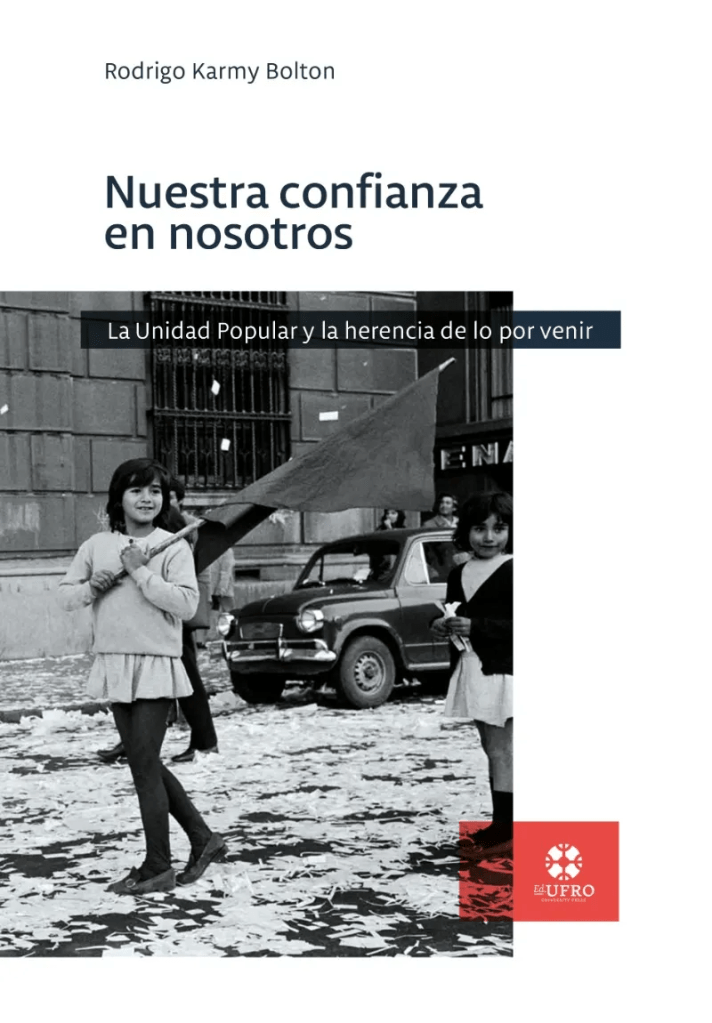
Three notes on Rodrigo Karmy’s Nuestra confianza en nosotros (2023). by Gerardo Muñoz

Transfiguration. Towards the end of Nuestra confianza en nosotros: la Unidad Popular y la herencia del por venir (Ufro, 2023), Rodrigo Karmy suggests that the experiential texture of Salvador Allende’s political years amounted to a sort of corporeal transfiguration of historical time, but also of the political subject within modern architectonics of the inter-state sovereign system. The death-martyrdom brought a new world into order, radically transforming the sense of historical assumptions and its immanent refutations and accelerations. For those of all that know Karmy’s philosophical investigations working through this intuition, it is impossible not to see that ‘transfiguration’ does not entail ‘sacrifice’, but rather it implies the figure of the martyr [1]. And we also know from Erik Peterson that martyrs are absolute witness to truth of an irrevocable event; in other words, those that transcend the core materiality of the mere opinions and matter-of-factness as to remain faithful to the unfathomable to a world brought to abrupt change (and at times, this means also despair). Karmy writes: 

“Se produce así una transfiguración radical de Allende que trastoca enteramente el juego de la teología política, tal como ha sido planteada bajo los avatares del fantasma portaliano: si en esta última, el cuerpo físico termina desmaterializado en un cuerpo institucional, tal como ocurrió con el devenir del general Pinochet,  en Allende termina desmaterializado en una potencia por venir (no en cuerpo institucional), aquello que Walter Benjamin llamaba lo «nunca sido»: «Siempre estaré junto a ustedes», dice el presidente usurpado por el golpismo esa triste mañana de septiembre” [2]. 

The truth of transfiguration – and in a sense every event of truth is always carried by the energy what is transfigured – marks the incommensurable distance between the eternal persistence of the word and the historical movement guided by the precepts of civilization. Whereas the political grammar organizes itself through an indiscriminate institutional corpus and a set of moral binding obligations upon its citizens; the truth of transfiguration is the keeper of the night of the soul that, like the myth of Er, signals the passage between the world of the living and the kingdom of the dead. When transfigured, the dead can become even more lively than those allegedly “alive”; where those alive become embodied and rigid statues or mummies. As such, the energy of transfiguration remains outside the cloisters of history and its memory sites, since its realization takes place whenever there is a drift outside and beyond the suturing of the world as mere stated and enclosed fact.

Voice.  The “we” (Nosotros) in Karmy’s thesis does not signal the constituent political unity of the People nor a partisan form that can exert force towards the inversion of the sedimented historical order. In his archeological endeavor, the ‘nosotros’ indexes a non-numerical instance through the vocative raises its own question to the past. This does not imply that there is a “collective voice” that must enact its point of annunciation through representation and mediated forms; the voice emerges as an exception to the grammaticalization of the constitutional order and its statuary production as expression of legislative will. The voice is the exteriority to every scheme of reproduction. But, what is a “voice”? Following Emilio Recabarren, Karmy connects the voice to the very act of creation: in other words, a voice to the truth implies the vocative of what has truly never been there before. Like the chorā, the voice is both at the reemergence of its origin and medium rather than substance; and this is why the voice, unlike the written language, cannot be subsumed to the reification of mimesis and generative substance [3]. The voice is what every time remains irreducible to the order of discourse difference, historiographical narrativity, and the original letter and spirit of the law. And even in traditions without “Constitutions”, law cannot escape its written and grammatical framework; this is why in Common Law, the Constitutional authority is supplanted by the historical absorption of habits, manners, and tradition into the force of legal codes and binding statutes. It is a high merit of Karmy’s Nuestra confianza (2023) to reminds us that the happiest moments (and perhaps the only moment worth saving, that infinitely returns against the grain of historical progress) of the revolutionary experiences of the twentieth century are to be found in the evocation of the voice and its popular music (something that can also be said of the Cuban Revolution, for instance). This esoteric orphic thread evidences the disjointed relation between the polis and the mythic transfiguration when facilitated by the prophetic overtones of the musical nomos in the genesis of the West [4]. Hence, whenever there is a voice, the suture of politics to the theology cannot amount to the continuous transaction upon the survival and agony of the living.

Freedom from revolution. Unlike the reverential or formalist accounts written for the fiftieth anniversary of the Chilean Unidad Popular, Karmy’s essay invites us to dwell about a political experience after its epochal exhaustion: the collapse of the horizon of the philosophy of history implies the internal implosion of the modern revolution’s infrastructure (constituent power, moral justice, militant subjectivity, sacrificial energy). For Karmy to arrive at a certain nearness to the well lighted tradition of the UP is to abandon once and for all the civilizational eon of sedentary political hegemony (“a revolution in world history” bringing about the age of the nomads to an end, claimed historian Edward Gibbon) that has now paved the way for the unlimited forms of planetary government exerted through the rationality of the management of population and the distribution of the economy [5].

The farewell to the revolution and its reverse – it is well known that De Maistre claimed in the wake of the French Revolution that the opposite of the revolution is not a counter-revolution, but what is all together contrarian to it – means to put a halt to the paradigm of force (positive and immanent hostility) that has oriented actions, expectations, passions, and even dreams taxed at the fictive illusions of an abstract Humanity devoid of any possibility of happiness in the world. It is only after we can leave behind the revolutionary metaphysical mimesis that a new sense of freedom could emerge away from the dominion of the land-surveyors of the Earth. Abandoning any clamors oriented towards the future, it is now for us to attune to the everlasting traditions that are unrelinquished to the endless rubble of time. 

Notes 

1. Rodrigo Karmy. “The Absolute Gift: Martyrdom as Destituent Power”, SAQ, 122, 2023, 157-170.

2. Rodrigo Karmy. Nuestra confianza en nosotros (Ufro, 2023), 183.

3. Ibid., 102.

4. Gianni Carchia. Orfismo e tragedia: Il mito trasfigurato (Quodlibet, 2019).

Glosses on Idris Robinson on Enzo Melandri’s logic of analogy. by Gerardo Muñoz

This is the final entry on the mini-series of interventions within the framework of the course that I am teaching at 17 instituto on contemporary Italian political thought. In this last fourth installment we had a very rich and productive conversation with Idris Robinson (University of New Mexico) on the philosophy of work of logic developed by the Italian thinker Enzo Melandri. Melandri’s work remains largely unknown, aside from the recent new editions of his major works at Quodlibet, and the recent monograph Le Forme Dell’Analogia: Studi Sulla Filosofia Di Enzo Melandri (2014) by Angelo Bonfanti. Idris’ doctoral dissertation (hopefully a book in the near future) will be a major contribution in a rising interest on Melandri’s work on logic, politics, and history, and its dialogues with the work of Wittgenstein, Foucault, and Agamben. As Idris Robinson recalled, the work of Melandri would have been entirely unknown if it weren’t for Agamben’s book on method, Signatura rerum, which uses Melandri’s work on analogy and paradigms as conditions for his own archeological method. This whole terrain remains to be explored, as Philippe Theophanidis suggested, given that it has been for the most part ignored in all the main works on the Agamben’s thought (including Villacañas’ otherwise excellent essay on method, history, and archaeology in the recent collective volume that I edited). But to the extent that Enzo Melandri’s work remains to be translated into English, Idris’ lecture serves as an important introduction to some of the key elements of his work, even if there is a lot to fill in and discuss from now on. All of the questions regarding Agamben’s method should emerge from this terrain, rather than the exhausted and ambiguous mantra of “critical theory”.

1. First, Idris Robinson suggested that Melandri’s central contribution departed from the distinction of two major path of Western logic: linear logic, which comes full circle in symbolic logic and formalization at the turn of the twentieth century (Russell, Frege, Wittgenstein); and analogical logic, which remains suppressed, but subterranean latency for problems of bivalence and the excluded middle against all preconditions of the identity-difference polarity. Like Agamben would later do with his rereading of energeia/dunamis opposition in Aristotle, Melandri was also a strong reader of Aristotle’s logic and the categories in order to advance a series of logical alternatives (not by any means the only ones, and not necessarily distributed equally): a) a different conception of the principle of identity (p / -p), b) gradations of contradictions (p / -p), c) inclusion of a middle or third as failure of bivalence, d) continuity and gradation, and e) the equivocity of meaning. All of these should not be taken at face value or even as complete abandonment of linear logic. Needless to say, these elements supply analogic logic an exit from linear reductions of formal logic and its presuppositions on the grounds of identity and negation to secure general ends and goods. By working within the paradigm of analogy, Melandri is said to account for indetermination and modality, which do not divide form and matter as opposites as in the linear model of the Aristotelian canons of medieval philosophy (Aquinas as its foremost representative) to the more analytical models of twentieth century logic.

2. The work of analogical logic allows Idris Robison to take up the question of form (he referred to it as morphology) as a problem of experience and specular observation of the world. Essentially this is the difference between Goethe and Newton in their explorations of colors, whereas the paradigmatic assumptions of Goethe aligned him with the logic of analogy by favoring deviations, gradation, and middle terms when thinking about the sensible problem of colors as an immanent series in nature (a method continued in Benjamin’s constellation images in his study of nineteenth century, but one could also think of Aby Warburg’s pathosformel as index of Western Art). Whereas Newton made an experiment and deduced the range of colors from a prism; Goethe was able to engage in observation (Idris alluded to his descriptions in his Italian diaries entries) in changing phenomena and organize it as such.

3. As a methodological question, what is important is how the paradigm becomes the unity for regulating (perhaps not the happiest of words) and constructing the indeterminate zone between thinking and the world, and in this way avoiding the abyss of pure relativism (or the arbitrary, I would also add). In this sense, the Goethe example stands for the problem of paradigm, but it does not necessarily entail – at least in my view – that his work is in itself free-standing for analogical transformation of life and thought. At the end of the day, Goethe is also famous for claiming that “All theory is gray, forever green is the tree of life”, which could explain why Giorgio Agamben in his most recent book on Holderlin’s final year juxtaposes the chronicle of Hölderlin modal and dwelling life (the parataxis is analogic poetics with respect to language) with the diplomatic and successful life of Goethe (the linear logic here could also be transposed with the ideal of destiny becoming ‘political’, as it is appears in his meeting with Napoleon). In any case, the logic of analogy and the reduction of paradigms becomes crucial to account for two distinct problems (at least this is my first reading, and I am in no way speaking on behalf of Idris Robinson’s thesis): to hold on to a stratification of history (open to configuration of mediums – images); and, on the other, a ground for logic, but only insofar as they are neither at the level of historical necessity and negation (philosophy of history), nor about linear logic that dispenses moral ends according to some “natural law”. From this premises, it should be interesting to explore Agamben’s archeology and ethics as a third path that diverges from both rationalization and the moral standing of understanding the just or the good.

4. Finally, I think two major problems emerge from a first preliminary confrontation with Melandri’s work, which we are only beginning to see how they “operate” in Agamben work, although at some point one should also confront the work on its own merits: on the one hand, the logic of analogy provides us with a truly historical method that is sensible to forms and stratification of the imagination that does not depend on conceptual history (in the manner of R. Koselleck), and even less on teleological historical progression. At the level of content, the analogical paradigm is consistent with trumping (suggested by Philippe Theophanidis) the hylomorphic conjunction of Western metaphysics, and thus contributing to a logical infrastructure for the form of life that abandons the primacy of ends and realization. What could this design entail for the transformation of our political categories? Does this necessarily imply that analogical legislating is always about political ontology! Does it require interpretation or a qualification of truth-validity? Or rather, does analogy favors the event instead of formal principles that have subsumed the grammar of politics and its negations (yes, also revolutionary politics, a problem also present in Della Sala’s paper)? Sure, extrapolating these questions to the field of politics is perhaps too hasty to fully repeal deontological concerns. Perhaps analogical analysis requires, precisely, a distance from the subsumption of political ontology at the center of thought. But to be able to answer these questions we need to further explore the work of Melandri. Idris Robinson’s lecture has provided us an excellent starting point§.

.

Notes

§ Idris Robinson’s intervention on Melandri and the discussion should be available in the next days at the 17/instituto YouTube channel.