The ascent of the Shadow Docket. by Gerardo Muñoz

In recent years there has been a steady but increasing practice in the American legal system that has passed unnoticed outside the corridors of law professors and practitioners of litigation, including the federal state that has summoned to its practical use: the emergency relief, or ‘shadow docket’ that puts the burden on the Supreme Court to decide on concrete questions without a formal hearing, fact finding, or without proper argumentative opinions of visible authorship (the judge who pens the opinion tends to deface his authorship). Since the outbreak of the Covid-19 pandemic, the Supreme Court of the United States has increasingly expanded its so-called ‘shadow-docket’ in parallel with the merits docket to such an extent that, as some legal theorists have noted, the blurring of the borders between the first and the second have become so tenuous and intertwined that it would seem that the merits docket depends on the prior selection mustered in the shadow docket. As constitutional scholar Stephen Vladeck has registered in his The Shadow Docket (2023), a practice that historically was strictly tied to emergency relief for capital punishment executions, it has now become a normal vehicle to decide on the emergency contingencies, while at the same time exercise discretionary judgement regarding the merits, or actual dispute, of case pending future review that might never be considered at all [1]. 

It must be said that the selective practice of cases by the court through the notion of “certiorari” on merits cases was in itself a decision on the exclusivity of relief based on the criteria of major legal questions of interest to the court. But precisely the differentiation between certiorari and the shadow dockets grants sharp focus on their differences. On the one hand, the shadow docket fails to decide on “legal questions” – in fact, it avoids tailoring the boundaries between the other branches of government and itself, as some have noted – and, by the same token, its non-decision produces a precedent lacuna that further entrenches the ascension of the shadow docket, inviting an evermore practice of emergency relief to increase chances of ‘cert’. Contrary to expert opinion, this is a juridical situation that does not create the conditions for the normalization of the “state of exception”, since there is really no authoritative decision to stabilize a concrete order, which was the purpose of Carl Schmitt’s well known formulation about sovereign arcana in political theology. In a certain sense, we have already crossed this threshold. Rather, the shadow-docket as a juridical practice in the American legal order is an institutional symptom in which decision has been evacuated or rendered inoperative, so that emergent social needs enforce any specific arrangements and political vectors through an enacted order. 

Furthermore, the shadow-docket as a regularized legal practice at the highest court confirms the historical shift within American legal system from the empire of the courts to administrative departmentalized commands, which ultimately means that the formal tendency towards “delegation” should not be solely circumscribed in allocated powers of the different branches’ oversight and control, but rather is a product of a holistic tendency towards the emergence of a new form of social indeterminacy in which authority resides in the shadows. As Supreme Court Jackson writes in the “Per Curiam” dissent in Trump v. JGG  (April 7, 2025): “With more and more of our most significant rulings taking place in the shadows of our emergency docket, today’s Court leaves less and less of a trace. But make no mistake: we are just as wrong now has we have been in the past, with similar devastating consequences”. It is an astonishing statement from the Judge not only because of what it states, but also what it silences; mainly, that by leaving no trace at all of their argumentative reasons there is no precedent, and for that matter no process and thus no case. And what is a rule of law devoid of a case and precedent? The historical schism with respect to the tradition of Common Law that gives birth to its formal constrains should be utterly obvious. Ultimately, this evidences the uttermost decline of the legal positivist horizon of the modern law rooted in legitimate authority (authoritas, non veritas, facit legem), in which arbitrary decisionism, legal motorization, and appeals to external values align themselves in order to render absolute determinacy between social life and legal execution without any preclusion in the form of a social trial without end. In this sense, it would be foolish to assume that the crisis of authority with the dissolution of auctoritas in the social spheres compartmentalized in functions of the “political community”; on the contrary, in the shadow docket scenario, authority “becomes more and more abstract, more and more inhuman and inexorable; more and more demanding” [2]. The orientation of executive commands is met with proportional digression of adjudicated moral pondering, and each time the force of legalization is vigorously expanded.

The decline of the juridical decision, one would be tempted to say, paves the way for the infinite demands at the expense of the arbitrary values formation of social gigantism. In the opinion about college admissions and racial discrimination of the 2023 merits docket cycle (Students for Fair Admissions v. Harvard College), Justice Roberts wrote that “What cannot be done directly cannot be done indirectly. The constitution deals with substance, not shadows”. An ironic statement, indeed, given the preeminence of the shadow-docket in the adjudicative practice of the Supreme Court itself. While the administration of justice becomes a practice in the shadows, one cannot but be reminded of Plato’s protofigure of the Guardian of Constitution, the Nocturnal Council, as elaborated in the last pages of The Laws. And for Plato “if a state lacks such constituent [a Nocturnal Council], no one will be surprise to see it staggering from one irrational and senseless expedient to another in its affairs…that body must posses virtue in all of its completeness which amens that it will not take erratic aim at one target after another but keep its eye on single target and shoot all its arrow at that” [3]. On the tail opposite end of the platonic Nocturnal Council, the United States’ highest court’s gliding abdication seems to erratically aim at repeated targets that emerge blasting flickering lights from within the ever present shadow docket – indeed, a momentary luminosity, full of ‘technical terms’ and deferrals, that aim to showcase that the rule of law still endures in the House of Justice.

Notes

1. Stephen Vladeck. The Shadow Docket: How the Supreme Court uses stealth rulings to amass power and undermine the republic (Basic Books, 2023), 19.

2. Theodor W. Adorno. “On the Problem of the Family” (1955), Endnotes, 2022: https://endnotes.org.uk/posts/theodor-adorno-on-the-problem-of-the-family-1955 

3. Plato. The Laws (Penguin Books, 1975), 520.
Due Process and justification. by Gerardo Muñoz

Even if it is appalling to witness the brute amount of executive force in the current American political system, it is nonetheless “business as usual” if understood within the internal development of its own legal order. In other words, what is emerging is not a drastic rupture or abdication due to external pressure against “legal liberalism”, broadly understood as a package of normative rights to solve social conflicts in a political community, but rather the consequential effect of the decline of the legitimating force of positive law, the modern legislative state, and the principles such as the right to due process – which includes but it is not limited to a public hearing, a defense, the right to a defense, cross-examination of witnesses, or an impartial jury. The slow erosion of constitutional due process has not only resulted in an unprecedented upsurge of civil cases resulting in “guilty pleas” devoid of legal process (about 95% of cases according to Supreme Court Judge Neil Gorsuch), but also in the collapse of remedies from government even if a federal court decides against the state. As Aziz Huq shows in The Collapse of Constitutional Remedies (2021), the demise of legal remedies means that the federal courts at large can only “interpret the constitution” but remains silent and inoperative in terms of the practical solutions to amend injuries, seizures, or plain violence enacted.

Any attentive student of the history of law does not second guess that many centuries before the ratification of the Constitution of 1789, the principles of modern criminal procedure, such as due process, fair trial and reasonable doubt, were already sedimented to such an extent that the Medieval canonist Guillaume Durand in Speculum iudiciale (1291) claimed that the right to defend himself should not be denied even to the devil if he were summoned to the court. In this sense, the so-called “Due Process Clause” of the Fifth Amendment of the U.S. Constitution that claims that “No person shall be deprived of life, liberty, or property, without due process of law” is a latecomer to the internal development of Common Law’s theological secularization. And it should not go unnoticed that the clause explicits states “person”, instead of the narrow privilege to the “citizen” or the “legal resident”, which is why during the Founding Era even foreign pirates accused of illegal activities were still subjects of the Due Process clause under the international and domestic legal order. As crude as it may sound, in the current moment one could very well say that the “concept of piracy” had more footing in a juridical concrete order than in the current legal stasis operative in a post-positive scenario. 

Even those constitutional scholars that in the wake of the “War on Terror” defended the Sedition Act of 1798 in order to defend a “process reduction” during an instance of political emergency, also warned of governmental overreach could very well upset political opposition and public support or loyalty (Vermuele & Posner, 2007, 235). Today we are in muddier waters (although fully “rational”) in which the punitive juridical order increasingly acts without a “process”, and the Federal Courts are incapable of offering clear cut remedies. This begs the question: what comes after the classical paradigm of due process inherited from the historical dispensation of Common Law? In other words, if the rule of law can now fully prescind, under ordinary times (there is no “emergency declaration”), of the right to due process and to the guarantee of remedies, what is the source of its legal authority? 

This is an ambitious question that we cannot even attempt to answer here, but there is at least one possible working hypothesis: mainly, that post-positive rule of law adjudicates from the production of its own justification. It goes without saying that legal justification has always been an internal mechanism of legal authority; but only now is the force of justification taking over formal procedures, normative guarantees, and written and unenumerated rights. Justification makes its way as a rhetorical subsumption of any sphere of social reality. This is why, for the Federal Judge James Ho, “migration” can be understood as hostile forces if properly justified as an “invasion”. As a further task to be explored, one should bear in mind as a symptom that the most influential and enduring legal philosophy to have emerged within the crumbling edifice of modern legal positivism was precisely a concept of law defined by two guiding criteria: “fit and justification”. This means that law’s empire is no longer ordered through the “process” but through what becomes “justified”.

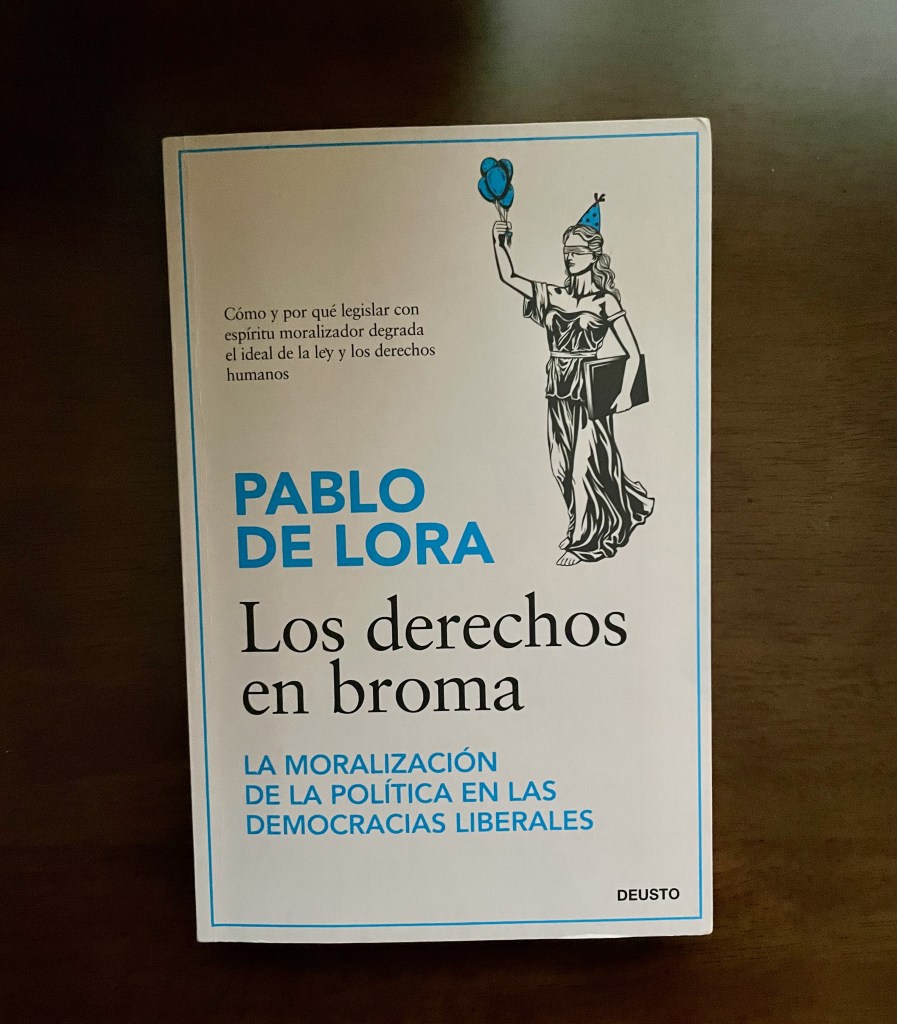
The nursery social state. On Pablo de Lora’s Los derechos en broma (2023). by Gerardo Muñoz

The crisis of the liberal legislative state is almost as old as the very project of the modern liberal state itself. And if we are to believe Carl Schmitt, the rise of the supreme values of the French revolution and ‘human rights’ (with its corollary of universal recognition within its normative system) also meant walking the fine line from the political theology of generative reform to the nihilism of ius revolutionis commanded by new discharges of individual will, political and technical movements, and immanent forces bringing the collapse of the separation between state and civil society. We are still living under its protracted shadow, albeit with a different intensity and intent. In his new book Los derechos en broma: la moralización de la política en las democracias liberales (Deusto, 2023), Pablo De Lora co-shares this point of departure, while daring to suggest a new sequence after the collapse of modern political form and legal order: we are currently living under a particular epochal transformation that is anti-legalist (sic) in nature – precisely because of its surplus of legal motorization – that erects a “nursery state” for the totality of the political community’s reasons and justification for action (De Lora 23). 

Although De Lora case studies shown are almost entirely derived from the Spanish and Latin American contemporary social contexts, I do think that his sharp diagnosis could be extended to the epoch itself without blurring the important nuances. This is an epoch of a reigning “emphatic constitutionalism” (Laporta) or the total Constitution (Loughlin), at the same time that it no longer takes too much effort to imagine a political community devoid of a legislative body, as one eminent constitutional scholar has said repeatedly [1]. We are already here. In other words, whether by excess or deficit, the overall purpose of moral driven legislation announces the internal transformation of modern politics as we know it, extending itself to a civilizational regression from the ideals and norms of the Enlightenment rooted in the fiction of the citizen, the binding of the social contract, and the invention of the principle of sovereign authority.

De Lora does not quite says it in this way, but I think I am not diverting too much of his cartography when extracting some of the central consequences of these internal moral substitutions that are palpable everywhere across the West: ecological legislation that increases social conductivity and expansion of natural destruction; ‘feminist’ anti-sexual aggression that leads to lowering of sentences for convicted sexual predators; the inflationary instrumental use of “Human Rights” for persons and things, but only defined narrowly by those that, under the thick haze of institutional hegemony, can deprive their political adversaries and enemies of the most basic legal guarantees of due process transforming them into non-persons. These ‘moral substitutions’ is part of the “ironic” and “futile” consequence of the sacralization of morality whose end is the management of the “social model” at all costs. According to Pablo De Lora, within the limits of confronting a social dilemma such as disability, the specificity of the “case” is turned on its head; what matters is the overall structural design of the social order and its infinite adaptive changes (De Lora 71-72).

This mutation generates all sorts of unintended consequences when the rhetoric of “social benefit” takes the lead. As De Lora writes: “No hay apoyo anticipado a la discapacidad mental sin reconocimiento de que el discapacitado mental no puede ejercer su autonomía en el futuro. Dicho de otro modo, la institución de las voluntades anticipada de la lógica desideratum de modelo “médico” de la discapacidad mental que se rehuye en beneficio del modelo social” (De Lora 85). And in spite of normative incoherence within an institutional system, the deflection to the “social model” requires ever-expanding commands, rules, principles, and hyper-amendments to guide the adverse proliferation of reasons for action within the social state (in the United States this is soften by the police powers of inter-agency statutes of the administrative state through cost&benefit balancing of discretionary principles under the supervision of the executive branch). This transformation entails the collapse of the internal mediation between the validity of norms and its foundation in social facts as in the classical construction. Thus, the expansion of value-driven legislation that also requires of specific adjudicative constitutional theories, such as legal interpretation and the theory of balancing of principles advocated by Robert Alexy, the sponsors of social neo-constitutionalism, but also the embedded dialogic ideological positions of constitutional scholars such as Roberto Gargarella (or in the United States context, the work of Mark Tushnet and the so-called anti-originalist ‘living constitutionalists’).

All things considered, the fundamental problem for De Lora is that this specific transformation enacts what he calls a “Estado parvulario” or ‘nursery state’ that he defines as: “El que denominado “Estado parvulario” da pábulo a que el poder público, en sus diversos instancias y encarnaciones, escamotee las realidades y consecuencias que conllevan algunas discapacidad per oa que lo haga de manera internamente inconsistente: tratando a los menores como adultos, pero sólo simbólicamente, y, en cambio, de manera efectiva, a todos los ciudada como menores, congénitamente desvalidos, incapaces de encarar la realidad” (De Lora 87). In the framework of the nursery state within its specific moral legislative apparatus, children become adults and the mature civil society regresses to an infantile stage. And like in a nursery setting, the democratic virtues pave the way for new dramatic effects where the function of rhetorical annunciation – so central for the any credentials of moral hegemony – forecloses the void between morality and politics in the wake of the unification that the social model requires to begin with (De Lora 89). 

This slippery slope can only lead straight to a sacralization of the political system that runs co-extensively with the infinite expansion of social rights; which, in turn, leads to an ever increasing conflict over the assumptions regarding its social facts (De Lora 151). In this narrow form, De Lora is audacious when citing Martin Loughlin’s recent indictment from his Against Constitutionalism (2022): “En la era de la Constitución total, el gobierno bajo el imperio de la ley ya no significa el gobierno sujeto a reglas formales independientemente pulgadas. Significa gobierno de acuerdo con principios abstractos de legalidad que adquieren significado sólo cuando son insuflados con valores…” (De Lora 188). And we know perhaps too well that values cannot be reasoned, but only weighted; values are commanded and taxed on the permanent devalorization of other values. This is why the rise of the value fabric of constitutionalism coincides with the ‘weighting’ proportionality of principles of law’s ideal social efficacy, to paraphrase Robert Alexy’s influential position as claim for “anti positivist legal justice” [2]. The nursery social state cannot be corrected merely from the position of the legislator; it can also be tracked as a triumph of moral jurisprudential theories of law that seek to overcome (and provide answers) to the overall crisis of institutional authority that characterized the so-called ordered liberty of the moderns. 

Is there anything to be done beyond a description? It is quite clear that Pablo De Lora’s ambition is not so much the proposition of a new political or legal philosophy as much as the sketch of the current epochal predicament in its current practice. This is already enough to welcome a robust analytical discussion of our predicament in Los derechos en broma (2023). However, there is a cobweb of affinities in De Lora’s own position towards the end of the book that, even if not fully developed, must be registered as a mode of conclusion. First, there is an affinity with John Hart Ely’s deferential conception of judicial power that aims at overseeing the procedural mechanism for the democratic deliberation and legislation over a hot-button issues. In this vein, De Lora shares Akhil Amar’s position regarding the overturning of Roe in the Dobbs’ decision; a conception that fully embodies judicial deference to diverse legislative majorities [3]. Secondly, De Lora favors a judicial minimalism associated with the doctrinal theory sponsored by James Bradley Thayer over the practice of judicial review of the Court (De Lora 233). And last, but not least, De Lora sees transformative potential in John Rawls’ assertion in his late Political Liberalism (1993) that the use of public reason is a comprehensive doctrine to deal with our fundamental disagreements and contentions over shared political values (De Lora 241).

I am not sure how deep or for how long does De Lora wants to go with Rawls; however, it is important to remember – and specially given the treatment of the ‘social model’ in the morality presented in Los derechos en broma (2023) – that insofar as social paternalism is concerned, Rawls’ late liberal political philosophy at the heart of the crisis of the secular liberal state amounts to a political conception that, as Eric Nelson has brilliantly shown, abandons the commitment of individual non-cooperation or refusal to cooperate with unjust moral legislative burdens, and thus making everyone stuck in the same ship [4]. This ship is the management and balancing of the totalization of the values being trafficked in the Social as ‘egalitarian’, although they are fully endowed as a seterological scheme of “election” (and who is elected) balanced by secondary compensations.

On a larger canvas, if the current political structure is defined as a nursery state of social rights, then this means that appealing to ideal positions of justified reasons, “diaphanous” deliberation, and well crafted citizen arguments belong to the age of maturity of the Enlightenment, but not to the stage of social infantile disorder. And demanding political qualifications to the contemporary citizen today is not only naif, but at odds with what what institutional thinking requires. In other words, the concrete transformation of the post-liberal state is one of permanent optimization of conflict, which is why John Gray has lucidly defined the (contemporary) ‘new Leviathans’ are “engineers of the soul” with broad and sweeping capacities to govern over every inch of the social space [5]. In the wake of these institutional mutations, the call endorse a “moral critique” might be taken as a post-enlightened lullaby that among the blasting and striding cries of infants of the nursery will most likely just pass unheard.

Notas 

1. Adrian Vermuele. “Imagine there is no Congress”, Washington Post, 2016: https://www.washingtonpost.com/news/in-theory/wp/2016/01/11/imagine-theres-no-congress/ 

2. Robert Alexy. “The Rationality of Balancing”, in Law’s Ideal Dimension (Oxford U Press, 2021), 122.

3. Akhil Reed Amar. “The end of Roe v. Wade”, The Wall Street Journal, 2022: https://www.wsj.com/articles/the-end-of-roe-v-wade-11652453609 

4. Eric Nelson. The Theology of Liberalism: Political Philosophy and the Justice of God (Harvard U Press, 2019), 164.

5. John Gray. The New Leviathans: Thoughts After Liberalism (Farrar, Straus, and Giroux, 2023), 5. 

Tacitus’ arcana and political wisdom. by Gerardo Muñoz

During the flourishing of Renaissance civic humanism, the tradition of Tacitism, as well as the work of Tacitus, was broadly understood as advisory to the problem of tyranny within the cycles of political power’s rise and decline, unmasking imperial rule’s debasement and cruel domination [1]. It is in Edward Gibbon’s erudite project where Tacitus’ political wisdom receives an integral treatment about the institutional dimension of power and its cohesive structure based on both facts and theoretical presuppositions. For Gibbon, the wisdom of Tacitus is not merely anchored in theoretical speculation; rather, the rhetorical construction takes its energy from the convergence between historical facts and the physics of a concrete political order. Tacitus’ wisdom is practical but also flexible, and this entails that political realism is not about the opportunist dimension of power (although this most certainly occurs in every political community), but about the deployment of analytical understanding regarding faults, fissures, and disequilibrium of institutions. Tacitus’ thought is about vision, and this means looking at the cracks, identifying the asymmetrical correspondences, and teasing out the nuances of a particular reality.

This presupposes that Tacitus’ enduring notion of the arcanum imperii, far from posing a ‘mystery of the state’ (its legitimacy, rule, and mystical reserve), allows for a strong narrative about the latent crisis internal to every political community. Tacitism is, insofar as it confronts the crisis and ruin of a political order, draws a negative reflection on the ongoing force of civil war as a historical and existential condition of domination. In other words, no politics can exist without the concrete legibility of the faults of conflict, which ultimately entails that civil war and political power are constantly in proximity. The arcana delimits the problem of civil war as the internal contradiction of every imperfect institutional design that cannot transcendent its own crisis through conceptual reordering.

At the center of Tacitus’ arcana in Rome is the death of Nero as well as the fault lines of civil war: “The was revealed that arcanum of state, the discovery that emperors might be made elsewhere than Rome” [2]. Of course, Rome as the glorious center of power was fundamental and indivisible; but for Tacitus the argument condensed in the arcana is precisely that the corruption of politics takes place when political representatives (power delegated at the provinces) and that of the center ceased being in coordination, losing the grip of institutional mediations. Thus, the ruin of politics is best expressed by the disjointment of formal procedures between authority and delegation, the vesting of the emperor and territorial monopoly, legitimate rule and predatory corruption. When this happens the arcana is transformed into a permanent revolution that dissolves checked political rule into the willful triumph of the uncontained and proliferated fragmentation (this is why Tacitus looked back with nostalgia to the unlived era of Roman republicanism).

For Gibbon to hold on to the Tacitan tradition of the arcana imperii meant, above all, to underscore the esoteric relationship between history and revolution as part of the desire to understand political energy, which he posed as a methodological concern: “In our larger experience of history the imagination is assisted by a perpetual series of causes and effects , to unite the most distant revolutions” [3]. The arcana is political wisdom of a secondary source; that is, it’s not a normatively established political premise or category, but an excess to description of political order. Hence, it is not that the arcana imperii is a monocausal and ultimate foundation of instability – and in this sense he was still faithful to his conception of plurality of causation in defense of the study of literature and the imagination – the emphasis is placed, on the contrary, in the way in which grasping the archeological and heterogeneous field of tension that will reveal, in turn, the historical specificity of the arcana [4].

In other words, the arcana grants access to the fundamental features of the epiphenomenon of civil strife without a recourse to abstraction and the closure of the concept. In this way, it could be said that the arcana (in part in the reading that Gibbon undertakes of Tacitus) is continuously operating in three distinct registers: a) it is a comprehensive analytic of the plurality of causation that impact political conflict and civil war, b) it reports to the center of authority, probing its direct and indirect meditations on the ground; its forms of delegation and adjudication, and its production of legality and dominium and implementation; c) it demands to design a description and a narrative of the political situation in order to properly respond to the paradox of tyranny and corruption within a specific polity.

Having sketched out the operational effect of the arcana, we can say that the notion is far from being reducible to a Renaissance “ragion di stato” scenario assisting in the consolidation of power in the hands of the price; the arcana seeks to elucidate the contours and limits of the intensification of war and its risks; a problem that becomes central to Hobbes notion of the state [5]. To claim that this political wisdom is something that merely emerges technically-placed in the Renaissance “great men”, and systematically blurred in modern liberalism is a thesis that will need further elaboration about the resources of the state and the underpinning of modern legitimacy through civil society and its late-modern mutation into planetary imperial spaces. In a certain sense “Tacitism” opens the possibility of sketching the political crisis of in each distinct epoch. It is perhaps in this sense that Carl Schmitt invites us to think the issue in an entry of his Glossarium:

“The beginning of Tacitus’ Histories has moved me. Is it just rhetoric, like Ortega told me?’ Isn’t it about the identity of the situation, that is, existential participation, participation in one and the same nuclear and ancestral situation of our eon? Every word of that chapter of Tacitus is absolutely current: «Magna ingenia cessere; opus adgredior optimum casibus, atrox proeliis, discors seditionibus, ipsa etiam pace saevum. Of course, “ipsa etiam pace sacvum, bella civilia et exterior plerumque permixta.” The relationship between international war and civil war, that is not rhetoric but the horrible reality recognized and expressed, the non-distinction between war and peace.” [6] 

The arcana never truly coincides with a philosophy of history or a rhetorical veneer of civil existence (social contract). The subversiveness of Tacitus plays out in thinking through the elaboration of a specific governmental organization [7]. And what is the “ancestral situation of the eon” if not the polar relationship between political order and stasis, the duality between civil war and the principle of authority, the nihilism of the will and the limits of a public rule of law, however ordered? Tacitus’ classical wisdom, invested in plotting legible facts with a singular narrative, far from raising itself to a “science of politics” or a set of “fundamental principles of order”, responds to potential fluctuations devoid of a universal grammar. In this way, politics remains closer to a physical experiment: an active self-evolving canvas in which the arcana is irremediably drawing upon the instituting and destituting of interconnected forces at play.

Notes 

1. Arnaldo Momigliano. “Tacitus and the Tacitist Tradition”, in The Classical Foundations of Modern Historiography (University of California Press, 1990), 120.

2. J. G. A. Pocock. Barbarism and Religion: The First Decline and Fall, Vol.III (Cambridge University Press, 2003), 25.

3. Ibid., 58. 

4. G.W. Bowersock. “Gibbon on Civil War and Rebellion in the Decline of the Roman Empire”, Daedalus, Summer, 1976.

5. Richard Tuck. “Hobbes and Tacitus”, in Hobbes and History (2000), eds. G. A. J. Rogers and Tom Sorell, 99–111.

6. Carl Schmitt. Glossarium: Anotaciones desde 1947 hasta 1958 (El Paseo, 2019), 7.

7. Ronald Syme. “Who was Tacitus?”, Harvard Library Bulletin XI, Spring 195, 185.

Production as a total religion of man: Notes on Gramsci’s Prison Writings (VII). by Gerardo Muñoz

In an important moment of Notebook 7, Antonio Gramsci writes that production in the age of industrialization amounts to a “new religion of the common man”. This thesis conditions many aspects of Gramsci’s thought and fully exposes his thinking as determined by the epoch of industrialization. If so, this means that his thinking is fundamentally insufficient for our historical present as defined by stagnation and the end of growth. First of all, the condition of industrialization allows for the famous “war of position”, which is exerted as a moralization of politics (hegemony). It is important to note that the concept of hegemony is introduced only “after” the historical reduction to industrial productivity is rendered as the unity of all historical time. In an explicit Hegelian fashion, Gramsci argues that: “The process of historical development is a unity in time, which is why the present contains the whole of the past and what is “essential” of the past realizes itself in the present, without any “unknowable” residue that would constitute its real “essence”. Whatever is lost….it pertained to chronicle not History, a superficial episode and, in the final analysis, negligible” (175). This is at the core of Gramsci’s thinking, not at the margins.

So, the Hegelian absolute movement of the philosophy of history as coterminous with the flattening of the “rational is the real” is the metaphysical ground in which Gramsci not only operates but the venue through which he offers us a “new religion of the common man”. A few sections later (§. 35), Gramsci confesses that “hegemony was also a great “metaphysical event”. Of course, one could suppose that Gramsci was delivering a new God within the gigantomachy of the age of production. The irony is, of course, that this strict “political theology” is only justified by the industrial regime that it seeks to overturn. Therefore, the question that the so-called contemporary Gramscians (or anyone taking up Gramsci today, say from the 1970s to the present) should respond is: how can the analytical conditions of Gramsci’s thought illuminate post-Fordism in the wake of the exhaustion of growth? 

If according to Jason E. Smith’s important new book Smart Machines and Service Work (2020) since the 1980s we are witnessing an ever-expanding service sector (in the US and the UK drifting well above the 80% of the GDP) as a compensatory for growth stagnation in the age of technological innovation, how could the Gramscian “new religion” on industry mobilize a horizon of emancipation, or even minimal transformation from said regime of exploitation? On the contrary, it seems (as I tried to argue recently here) that if we take Gramsci’s insight about the material conditions of “production” in any given epoch, the work of hegemony today can only open to a demand for exploitation as subjected to servant domination in the stagnant regime. In other words, if we accept Gramsci’s own analytical conditions (industrial production), this necessarily entails that we must move beyond hegemonic domination. To think otherwise – say, believing that a “temporal form of dictatorship” or “populist takeover”, now in ruins – amounts to a solution oblivious to the historical conditions, which can only blindly accept the “command” of a hegemonic principle. It is not a surprise that only the new nationalist right in the United States today can be properly labeled “Gramscian”, since they want to recoil political form to industrialization, organic community flourishing, and national “delinking” from globalization decomposition of the regime of total equivalence. But this is only a “storytelling” (a bad one, indeed) in times of stagnation.

More broadly, this speaks to the divergence between Gramsci’s faith in industrialization and Protestantism, as he defends it in section 47 of the Notebook. While glossing Max Weber’s Protestant Ethic, Gramsci notes that only the “spirt of the Reform” can produce reciprocal positions vis-à-vis grace and “good works”; whereas in Catholicism, activity and human action is not bounded by labor form, but by corporativism. On the surface this links Gramsci’s thesis with that of Max Weber’s; however, given the conditions explained above, it also shows that Gramsci’s thinking is really at odds with a commitment to thinking reform within the concrete conditions of a historical epoch. In other words, the political categories of Gramscianism (war of position, hegemony, production) are undeniably more on the side of reaction rather than in the production of new reforms. Of course, his position is not even a Catholic reaction; since, as Carl Schmitt observed in Roman Catholicism and Political Form (1923), at least the Church offered formal institutionality as a response to the total electrification of the world, whether in the hands of the Soviets or the American financial elite. But, as we know, the theory of hegemony is also oblivious to the problem of institution and the concrete order. 

Politics as substantive morality: Notes on Gramsci’s Prison Writings (VI). by Gerardo Muñoz

In section 79 of Gramsci’s Notebook 6 we are offered a strong definition of “politics” that I think illuminates the core of the Gramscian program fundamentally as a substantive morality. Gramsci writes the following against the “particularism” of normal associations (say the aristocracy, the elite, or the vanguard): “[an universal] association does not set itself up as a definite and rigid entity but as a something that aims to extend itself to a whole social grouping that is itself conceived as aiming to unify all humanity. All these relationships give a universal character to the group ethic that must be considered capable of becoming a norm of conduct for humanity as a whole. Politics is conceived a process that will culminate in a morality; in other words, politics is seen as leading towards a form of sociality in which politics and hence morality as well are both superseded.” (30). It is an astonishing definition, given the precise way it mobilizes the content of this new politics. Of course, there is the explicit the Hegelianism of the ‘universalist’ translation through the dialectical conflation between state and civil society, which just a few sections prior to 79, Gramsci deploys in order to posit the ultimate goal of communist society. 

But in this section he goes further, since it becomes clear that the state and civil society, as they march towards an ‘integral state’, dissolves politics into pure morality. But Gramsci immediately clarifies that it is not just a “morality” of a new dominant class (which could still be contested vis-a-vis other values), but rather a “morality that is superseded”. This is an absolute morality beyond value disputes. In other words, it is an absolute morality that needs to be so because state and civil society have become a unified whole. Concretely, this means the dissolution of politics and of any concrete order of the republican tradition, which recognizes that, precisely because civil war is the latent in the social, no morality can be granted hegemonic status. At bottom, this is the reason why we need politics and institutions to mitigate conflict. The Gramscian moral universe frames a world in which the conflict not only disappears, but rather it becomes pure morality towards a “substantive common good” in which every person is obliged to participate. Indeed, one could claim that the theory of hegemony as morality has never appeared as strongly as in this fragment. I think it is fair to say that the telos of hegemony is, in every case, a drive towards the consolidation of this uncontested morality. 

Needless to say, this is a frontal assault on positive law, which aimed, from Hobbes to H. L. Hart, to clearly differentiate between politics, institutions, and morals. In a surprising but direct way, Gramsci’s definition of politics as substantive morality is closer to the tradition of “Thomism” in at least three compartments of Aquinas’ thinking. First, because it posits a substantive morality as a unified conception of aims, which negates any competing positions between values. Secondly, the substantive morality of politics informs the Gramscian theory of the state, which, very much like the Thomist subsidiary structure, understands institutions not as a concrete order of conflict (stasis), but rather as a depository for the reproduction of civil society (that is why Gramsci also in notebook 6 will speak about the “state without a state”) in the image of the state. However, if we are to be fair to the natural law tradition, I think we can claim that Gramsci is really an archaic and not a “modern” (or revolutionary) Thomist, since even John Finnis in his Natural Law and Natural Rights (Oxford, 1980), in an attempt to square natural law with modern liberalism, countered Hart’s objection of unified moral aims in this way: “…there are basic aspects of human existence that are good leaving aside all the predicaments and implications…all questions of whether and how one is to devote oneself to these goods” (30). Finnis distinguishes between general principles and personal elaborations of aims. However, Gramsci is not interested in establishing generic “principles” for plural aims, but rather he seeks the actualization of a morality that is substantive because it is understood as “superseded as morality” as such. The kingdom of the Gramscian integral state is only realized if the heterogeneity of the social is captured by the hegemony of a supreme morality of Humanity. 

The distance between Gramscian moral politics and the modern natural law foundation (Fuller, Finnis) is driven home when later in section 88 of notebook 6 he claims that: “…one should not think of a “new liberalism” even if the beginning of an era of organic freedom were at hand” (76). This confirms that Gramsci is interested in crafting a morality tied to the efficacy of immanent individual ends and desires, and not at the level of generic principles of a common order. If one takes this moral politics seriously, then it becomes difficult (impossible, in my opinion), to square the primacy of this morality with positive law and the republican tradition at large. At its “best light”, the Gramscian absolute morality can only yield a faith in “Humanity”, which feeds from the production of enmity (turning dissent into ‘inhumanity’) in a civil war, as it cannot be otherwise.