Monia Ferrando’s archeological reconstruction of Arcadia as a “political paradigm” that retreats from the nomos of force and usurpation has as its fundamental condition poetry and the voice of the poets. Given the tripartite nomoi of Arcadia (as law of the heart, song, and meadows), which exceeds the autonomy of the polis in Athens, poetic voice functions as the mediation for the effective transmission of the mythopoetic figure that would guarantee another relation, a non-productive and authentic proximity with the world. Throughout the book, whenever Ferrando wants to take a distance from the polis as derivative from the polis she goes to the poets and poetry. Consider for instance, this moment (all the translations are mine from the Spanish edition) in the last chapter on the political paradigm of Virgil: “Poetry, then, is called upon, from its own painful present, to venture like a new Orpheus, but as a memore veggente [a memorious seer], into the darkness of the past, to give new form to love without being content with its mere image. To traverse the stratification of human experience that has shaped the world in order to reshape, in turn, a love reduced to a bloodless and deceptive phantom” [1]. The ‘pre-political’ site of Arcadia is in the poetic voice, whose fundamental task is to transform the ideal of triumph and victory to that of erotic enchantment and fascination that refuses the autonomization of the erotic image [2].
If one considers the totality of Il Regno Errante it is not all too difficult to discern that the transmission and ambivalent origin of irruption in the tradition – which Ferrando thinks with Overbeck’s urgeschichte – is only possible through both a poetization of politics, and the substitution of the hēgemon by the poet when thinking about the afterlife of Arcadia in the genesis of the West, in the very passage from Antiquity to the modern epoch. In this way, poetics is not subsumed to political practice, guided by the classical figure of the ‘Dichter als fuhrer’ described by Max Kommerell, but a state of the via contemplativa in its distancing with the world. In a very elucidating moment Ferrando thematizes this as follows: “Eros is not a political practice in which thought is neatly concealed, but a poetics that culminates in the disinterested contemplation of beauty, in pure theoria. Here, poetry will be philosophical, and philosophy, poetic, without any distinction” [3]. But it is also here that poetry is acting as the supreme activity that can retrieve and connect existence in the world, which is the proper to the classical antiquity, which solicits the question: could this still hold for the philosophical predicament of the poem in modernity? Can the poet stand and mediate to the prophecy at the moment of the decline of the logos, positing the dichtung as an operative substitute? It seems to me that this presents us with an unavoidable difficulty about the transmission of the memory of Arcadia. And we should do well to articulate it.
In her recent biography of Paul Celan, Anna Arno mentions in passing and without no theoretical pretensions, that the young Jewish poet, still under the influence of his mentor Alfred Sperber, wrote a poem that while taking place in the meadows of Arcadia, there is a loose arrow that hinders and hunts the possibility and and shadow of death. The last verses of the poem titled “The arrow of Artemis” introduce something like an oblique and unfathomable shadow in the landscape of Arcadia, which Arno describes in this way:
“The ‘born again’ poet dedicated “The arrow of Artemis” to his mentor. Celan rendered the Arcadian landscape, but in the final stanza he expressed his fear: “How should he who, above sky-blue pebbles…not ponder that Artemis’ arrow, still lurks in the forest and in the end will strike him?”. Introducing a sense of peril, the poem struck up a polemic: mythical lands provided no shelter against the shockwaves of historic barbarism. Celan was declaring a new path, unlike what Sperber could have chosen for him”. [4].
While on the surface there is a superficial way of reading this commentary in the manner of the typical proximity-distance of the “anxiety of influence”, I want to read this moment as emblematic and hyperbolic of the condition of the crisis of the age of the poets in modernity where the transmission of the Arcadian bliss is impossible in the wake of historical barbarism, which also shatters the structure of poematicity as it runs through the intricate work of Celan. How do we understand Celan’s ‘new path’ that seems absolutely heterogeneous to the divinization of the musical voice required to disclose the Arcadian myth? Perhaps modern poetry, and modern poets at large, cannot initiate the restitution of Arcadia because they can only recognize its own autonomy in a postmythic world after the fleeing of the gods and the absence of God (as verbalized in Hölderlin’s fragment on Oedipus).
This is what Giorgio Agamben has seen in his text on San Juan de la Cruz when discussing poetry to mystical theology: “Indeed, San Juan’s mystical theology still presupposes the existence of a positive theology and of a Holy Scripture, from which it derives its own legitimacy and guarantee. Modern poetry, instead, does not recognize any other holy scripture but itself. For this reason, modern poetry—insofar as it is its own, sole guarantor—has been fatally led to question its own limits and its own adequacy and to search in its own incessant, ironic sacrificial self-negation for the only valid guarantee of its own authenticity” [5]. And more recently, this thesis has also been validated explicitly in Il corpo della (2026), where he recalls that all major poetic gestures of Western poetry in the twentieth century – from Pound’s Cantos to Eliot’s The Wasteland, from Mandelstam’s Fourth Prose to Celan’s own destructive poetry of the German language – only manages to preserve the ruins and fragments of the tradition. The poet can only register those fragments, but he is incapable of building another world in the accumulated site of its ruins.
In its possibility of bearing witness in language, experience might open up the trace of the voice in the non-place of death as the sole destiny of between beings, as Carchia suggests in his early essay on Celan’s “The Meridian” [6]. But poetry transfigured in this way entails that the figure of Arcadia can only be taken as the possibility that emerges from the event of language at the border of nihilism and madness. As emblems of this poetic experience without revelation, both Hölderlin’s madness and Celan’s suicide are perhaps instances of this ‘seeking’ in the shadow of Arcadia’s disinterested via contemplativa of beauty, where the nocturnal black that casts a shadow into the clear and sunny landscape of the memory of Arcadia. This shadow does not eclipse the myth of Arcadia; far from it; in its theistic passage disclosed by light of the eros daimon, the voice seems to be prolonged and eternal at the very end of the experience of modern poetry.
.
.
Notes
1. Monica Ferrando. El reino errante: la Arcadia como paradigma político (Adriana Hidalgo, 2024), 638.
2. Ibid., 595.
3. Ibid., 538.
4. Anna Arno, Paul Celan: A Life (Harvard Press, 2026), 60-61.
5. Giorgio Agamben. “La notte oscura di Juan de la Cruz”, in Poesie: Juan de la Cruz (Einaudi, 1974), xii.
6. Gianni Carchia. “Il Meridiano di Celan”, Rivista di Estetica, XVIII, May-August 1973, 196.
At least since Ernst Böckenförde declared the end of secularization and the exhaustion of the liberal state form in the late sixties, the distinction between theology and politics has experienced a profound schism across Western social life, which once served as the ground and mediation to the homogeneity of “ethical life” (Sittlinchkeit) of civil society. It is still useful to recall Böckenförde’s theorem as a refresher: “What does the state live on, and where does it find the force that sustains it and guarantees its homogeneity, after the binding force emanating from religion is no longer, and can no longer be, essential for it? Until the 20th century, in a world that was first interpreted in a sacred way and then as a religious world, religion had been the most profound force involved in the political order and in the life of the state. But is it possible to find and preserve life in a completely earthly and secular way? […] Therefore, the question of binding forces is raised again, and now at its true core: the secularized liberal state lives on prerequisites that it can no longer guarantee” [1].
Indeed, one could say that in our era, clearly marked by the collapse of political mediations and categorial order, the schism between theology and political forms inherited from the Judeo-Christian eon has increasingly become full fledged and patently visible at a global scale. In a certain sense, and leaving behind all nuances, the operating horizon of thought today implies from and through the energy of this schism. If this meeting attempts anything however modest, is precisely the intuition that in the wake of the schism of political theology, the “theos”, following the trumpeting of the death of God proclaimed by Nietzsche or the flight of the gods as orphanage from the divine declared by Hölderlin, presents with an opportunity to think a non-rarefied style on the reverse of historical collapse. In recent years, a certain theological latency has been present in many contemporary theoretical projects, insisting on approaches related to mysticism and life, the gods of language and nominalism; the insistence on the communication between souls, the messianic and presence, to name just a few figures of thought without pretending to be exhaustive.
As machination and the spiritualization of technology subsumes the totality of social life in the West, existence enters a region of thoughtful and cunning marranismo, which could be taken as a form of life in the desert and a keeper of its depth of the ethos. How does one make sense in this moment of delirium and relentless decline, which include although it is not limited to, the defeat of the cycle of global uprisings and the solicitation of positions of exodus and desertion? In other words, we are trying to think of a language that we speak across distant places, and come to terms with the tonality of pain and despair. Is there a non-nihilistic way out of a civilizational project governed by the cybernetic dominium, continuous predatory extraction and lethal destruction of worlds? “Desecularization” is not naming a historical moment after “secularization” – something that has taken place in its own historical dispensation – just like posthegemony is not naming a temporal sequence to principial hegemonic politics. And of course, “desecularization” is not a program of any sort, although it is interesting in positing the possibility of “a new beginning” in the wake of the ruin of political theology as the orienting strategy of division and orderability, which fundamentally colored capitalist civilization on the abstraction of work and the work of abstraction proper to the historical modulation of Christian metaphysics and its theological rubrics. And if “desecularization” is neither a concept nor a program, I still would like to retain at least its resonance to other positions that have I have called for lack of a better term, the quadrant of positions of refusal [2].
Can theology, a confrontation with theology, drag us out of the via negativa towards something else? It is easier said than done. And it is never sane to get caught up in the spinning wheel of a term, whether it is “desecularization” or “desistence”, or “destitution”; a sort of rhetorical enchantment of the “-des”. Ultimately words say very little at the level of the concept, and they tend to offer a cell in which the process of amnesia and ratification can take place – the task of refusal, then, I take it, is also watching over, what the Cappadocian Fathers called the nepsis – what thought cannot elevate to the luminosity that emerges from the term. We are interested in theology and theos, but only insofar it opens itself to thought and the place of language, as well as the irreducibility of existence and death, to the imagination and the endurance of an ethics that undeniably invites makes itself present whenever we hold on the incommensurable distance between language and world. And if we have invited both Monica Ferrando and Alberto Moreiras to open up this seminar with us, it is because their styles of thinking are clearly devoted to pursue this question to the end. Of course, this means something consequential: they both affirm a path wherever it might take them (one can even visualize this in Monica’s extraordinary nocturnal paths in painting, such as the series “Paessaggio Perduto”, or “Lost Paths”). And it is a commonplace to say that both of them have been grappling with the problem of theology from almost opposite directions of the meridian distance awakened to the horrific abyss of our present, which means that perhaps the marrano and Pan do meet as fugitives in the forest passage both lost and found.
One word must be said about the term that is meeting is trafficking with – and perhaps “trafficking” is, alas, a good verb since none of us (perhaps with the exception of one person, and even he might feel stranger with that label) are professional theologians, nor do we have access to revelation, but perhaps this is too much on the side of intimate matters that one should refrain from commenting upon. Of course, the trafficked word is “desecularization”, which alludes to a certain rupture with the very essence of the saeculum, or the political institutional authority and its institutional arrangements in this world. When Schmitt says that all political concepts of modernity are secularized theological concepts, he is also assuming the irreversibility of secularization as internal to the historical matrix of Christianized West. In fact, according to theologian Robert A. Markus, desecularization has already become operative within the early Christian epoch of Saint Augustine. In his Christianity and the Secular (2006), Markus writes the following: “[in dialogue with Peter Berger] We may leave sorting out the complexity of that relation to the sociologists. All we need to note for our purpose is that the reverse, what some have called ‘desecularization’ has become a more recent preoccupation of sociologists of religion – and not only of sociologists. “This is just what came into being in the course of the emergence of Western Christendom from Roman Late Antiquity – a ‘deseculariation’ which is the reverse of what happened in the Wars of Religion. If the notion of the secular were to apply in such a society, it would have to be defined in more problematic terms: as what does not form part of a religious discourse … .The core of my argument in this book can be briefly summarized. Its substance is that Christian tradition has a legitimate place for the autonomy of the secular, even though for many centuries this was eclipsed in its awareness, and despite the perpetual undertow of what we have become costumed to call ‘triumphalism’ in Christian political and cultural attitudes” [3].
Of course, as Märten Bjork has recently shown, in Markus’ theological understanding of the saeculeum, the government of the Earthly city grounded in principial politics must also be relativized by the eschatology of the Kingdom – facing the event of death and the dogma of resurrection of life – that can take step back (or beyond) the libido domininandi, that generates the solipsistic desire for government and administration necessary for the circulation of a “libidinal economy” [4]. We can thus call the Markus’ position as the architheological position that dissolves the polarity of secularization and desecularization as an enterprise of Western philosophy of history and its homogeneous temporality of survival and reproduction. Secondly, it is also important to note that the notion of ‘desecularization’ made an important entry in the famous Capri conference of 1994 organized by Gianni Vattimo and Jacques Derrida, where the French philosopher mobilized Plato’s chôra to avoid relapsing into religious faith, and thus uprooting revelation as the ur-site of Christianity. Thus, for Derrida, ‘desecularization’ is a figure of thought that seeks a third space of the a priori of the nonsecularizable. In the brief dossier “Christianity and secularization” later published in Il Pensiero: Revista Di Filosofia in 1998, Deridda sheds light unto this path of his thinking, which he never fully develops:
“….. The desert, the figure of the desert, which we discussed extensively in Capri, is clearly charged with biblical memory; and it’s not enough to say desert, or even “the desert grows,” to achieve or, conversely, abandon secularization. The desert within the desert is a radically heterogeneous desert. The motif of the chôra serves me, in general, as a guiding thread for thinking about a place, and chôra means place, to take place; and of the event, it is said that it takes place, and chôra means place or spacing, interval. This is a place that is, to use Plato’s terms, neither sensible nor intelligible, and which is spoken of in a bastardized discourse, in that it gives rise to neither a metaphorical nor a proper language, and in Plato’s text itself, it escapes all Platonic concepts and even Plato’s self-interpretation. This place is neither divine nor human… The chôra is the place where the demiurge, gazing heavenward, contemplating eternal ideas or models, inscribes the sensible copies for the formation of the world. Therefore, it is neither sensible nor intelligible, neither human nor divine; it is absolutely impassive, totally neutral with respect to all conceptual or dialectical oppositions; it is therefore the place that resists any reappropriation or reduction within the poles of anthropotheology. Chôra is that which cannot be reached even by a discourse of negative theology” [5].
The nonsite of the chôra is also what is heterogenous to the polis, and so for us the absolute differentiation between chôra and polis is precisely as important, and parallel to Monica Ferrando’s distinction between the musical nomos of the mythic topos of Arcadia, and the modern allocation of the nomoi of spatial dominium as appropriation, concrete order, and reproduction; the three pillars for the constitution of the ideological revolution of survival. Of course, the chôra can be said manifolds, but it allows us the temptation of political subsumption, of an inversion of a new “theological political” (as it is already taking place in many circles in the United States, with the unfortunate but expected in Leo XIV as equidistant, alas, the new self-delegated commissar of an “Anti-Cybernetics” point de capiton. Alas, once again hegemony knocks at the door, this time with theological garments). This reservation speaks, if not directly, at least tangentially to Alberto Moreiras’ recent affirmation against the ‘retheologization of the world’, which would entail the hegemonization of the total space of social reproduction [6]. Here we might find room for fruitful dispute and elaboration. Indeed, because it is never about re-theologization of the world, but perhaps in the old formulation of Guy Landreau and Christian Jambet’s L’Ange: Ontologie de la révolution (1976) that any gesture of true refusal or revolt requires at least the partition of two worlds, if we are to avoid the eternal dialectic of desire between Master and Rebel that nourishes the ideological projection sustained through the amnesia of any ethical elaboration.
Perhaps by ‘desecularization’ we are pointing to an exit through the liquidation of this world, in the same way that the task of thinking is a schism against calculative representation and the eccentric plane of objectivity. As Landreau and Jambet claim in El Ángel (1979): “There are two kinds of thought, just as there are two worlds: one kind of thought that belongs to God, and one kind of thought that belongs to the world; one kind of thought entirely devoted to salvation, and another kind of thought animated only by an abject desire for knowledge—a searching thought, vain curiosity: precisely what we, intellectuals, philosophers, call Thought. Gregory of Nazianzus famously asserted that one can philosophize safely about the world, about good and evil beings. The monks, on the other hand, responded to him with the words of Sirach: ‘Do not seek what is too difficult for you, do not scrutinize what is beyond your strength. The simpler the symbol, the better” [7]. In other words, against the absolute immanence of an infernal materialism and its frozen fictions of the immaterial – where all that exists subsists as equivalent – there is a reality of the soul, the abolition of sexual difference, and by that matter the libidinal bond that generates the autonomy of the revolt of the Rebel perfectly comfortable under the shadow of the Master [8]. In this sense, if another parallelism is allowed here, the chôra is the collusion of the outside world to the polis in order to start anew from scratch from the site of the sensibility of our existence.
If this position has been repeatedly called “gnostic” or maniquean by the executioners of modern irreversibility, so be it [9]. And perhaps these critics are right, and we can grant them that much: already Susan Taubes noted with scholarly precision that there are even Gnostic elements in Heidegger’s thought, even when his polemic with the architectonics of metaphysics becomes explicit against the reduction and adequatio of the medieval Aristotelian metaphysics, opening himself to a secret and clandestine tradition, in which the last god has his recollection in the excess or abyss of all vital experience (erlebnis); in what is outside of life at the entrance of another world [10]. The overcoming and taming of the gnostic manicheism has been precisely the infrastructure through the rarification of Christian theology took place – in Landreau and Jambet’s terms – which transforms the conditions of the cultural revolution (existence) into an autonomous and spectral ideological productivity, which is the limit in which theological contemplation narrativizes itself into Christian community of salvation once necessity and deficiency bind you to political dominion – it is here where the Master and the Rebel coincide in their projected goals: that there is nothing other than political struggle. But the gnostic culture of existence never disappeared as readers of modern poetry know well, even though that might not be the site for the emergence of the angelic life of beatitude today either.
As Pacome Thiellement says towards the end of his beautiful The victory of those without kings: gnostic revolution (2025): “In the absolute embrace of those without Kings, the fading of the initial eroticism is transmitted in every instant of life. It creates neither anger nor remorse, but rather gratitude and a multiplication of protected powers. It appears at the moment when solitude is profound, not from the absence of love, but as a consequence of the pleromatic state inscribed in the man with memory: the overflowing of unitive eroticism into all the possibilities that life offers, whether in this world or others” [11]. It is this theology of the infraworld – not so much of heaven, but of a memory of the worlds and the humus of the dead that becomes one with the mirror of the heavens – allows the metaphysical gnosis to breathe out in thought, allowing for the pending encounter with the metaphysics of the schism of n-1 worlds to emerge [12]. It seems to me that this subtractive movement brings back, in interesting new ways, a metaphysics of purity and inoperativity; an imperturbable existence no longer seduced nor corrupted by the images of this world.
.
.
Notes
1. Ernst Böckenförde. El surgimiento del estado como proceso de secularización (Editorial Trotta, 2024), 45,57.
2. Gerardo Muñoz. “Quatre positions du refus”, in Entêtement: Tenir une sensibilité (Pli, 2024), 20-26.
3. Robert A. Markus. Christianity and the Secular (Notre Dame Press, 2006), 8-9.
4. Märten Bjork. “Deliver me from my necessities: R. A. Markus and Erik Peterson on the End of Law”, Political Theology, Junio 2026, 13-14.
5. Vincenzo Vitiello. “Cristianesimo e secolarizzazione”, in Il Pensiero: Rivista Di Filosofia, XXXVII, 1998, 155-157 .
6. Alberto Moreiras. “Gnosis marrana”. Paper read in Universidad Complutense, October 2025. Unpublished.
7. Guy Lardreau & Christian Jambet. El Ángel: ontología de la revolución (Ucrania, 1979), 128.
8. Ibid., 105-106.
9. See, José Luis Villacañas. Tierra o Ser. La gran decisión de la filosofía contemporánea (Akal 2026), specifically the section “Gnosis y excentricidad”, 416-419. His recent column against Heidegger’s philosophical legacies and afterlives also deals with the gnosis, see “Heidegger, a la distancia de medio siglo siglo”, Levante, May 25, 2026: https://www.levante-emv.com/postdata/2026/05/23/heidegger-distancia-medio-siglo-130551106.html
10. Susan Taubes. “The Gnostic Foundations of Heidegger’s Nihilism”, The Journal of Religion, XXXIV, Julio 1954, 160-162.
11. Pacome Thiellement. La victoria de los Sin Rey: Revolución gnóstica (Granica, 2025), 159.
12. It is notable that Derrida in the exchange with Vitiello, Vattimo, and Ferraris already cited, he goes out of his way to claim that he never had anything against metaphysics per se. Could the same thing be said of Heidegger if one posits the differentiation between metaphysics and the holy, and onto-theology and the adequatio of Medieval Aristotelian metaphysics? Along this line, Laurence Hemmings has suggested a fertile dialogue between Heidegger and the sacred in his Heidegger’s Atheism: The Refusal of a Theological Voice (University of Notre Dame Press, 2002).
There is a wonderful poem titled “Midston House”, where the now forgotten American poet David Schubert defines the poetic task as the possibility of freeing a path through conversation capable of transposing both experience and language. The verses, also quoted in John Ashbery’s lectures on “minor poetic traditions”,taking the form of the imperative read as follow: “What is needed is a technique of conversation / but not the limited vocabulary of our experience, the surface irritations which pile up, accumulate a city, – but the expression, metamorphosed, of what they are the metaphor of– and their conversion into light” [1]. This technique of conversation and the living words should not be understood as a mere transposition or vehicle for the grounding of meaning that makes exchange possible; rather it is first and foremost an ethical mode rooted in experience that can enact the clearing, between sense and silence in order for something to appear. What emerges from the cloud of the phenomena is not the blinding light of truth; what is true can only be taken as the effortless coming in what has been cleared. This is why for Schubert the task of poetic speech is concerned with coming into “light” not as an exclusive effect of language, but as the distance between language and sensation that sparks the soul momentarily, to use an eckhartian figure.
Conversation allows for the simplification between things through a detachment in a path where the possible supersedes that of the deficiencies and needs. This fleeting state of serenity is confirmed in further verses when Schubert endorses the possibility of the eternal place of concordia: “To a place where life is simple and decent, not too demanding …That man, whose handshake was happiness” [2]. This is not a sublimated state of bliss in a subject, but the crossing over, an event, which is usually at hand distance and yet ungraspable. In this way, it becomes pertinent to assume that what Shubert mysteriously solicits as a “technique of conversation” nourished in experience but always as excess to it, never comes to fulfill the autonomy of poetry and life, corrupted by the exclusionary modalities of rhetorical dispensation.
But the technique of conversation is the coming of the poetic at the end of its tradition; a poeticity completely aligned with Osip Mandelstam’s revocation of the value of “poetic work” in order to recover, as the only possibility of presence, the tension that the voice lends to the contemplation of thought. In his short poetological statement, Schubert seemed to have grasped this problem when writing that “this rather unimportant novelty [poetry] is sometimes a play of possibility and sometimes a genuinely new insight” [3]. The poetic task of conversation both proceeds and exceeds life, appearingas a formof nepsis, a workable vigilance of interiority, that run through every ethical intensity. And if the poetic conversation takes the form of light, it is because its verbal illumination is far from announcing a new world; it is merely the witness to the sensation in thought that has cleared a site for cohabitation.
If the task is to measure up to a techne conversationis of language it is because the poetic tradition guarded by the age of the poet is no longer viable, since it has run astray without any possibility of legitimate restitution. In her new biography of Paul Celan, Anna Arno comments that in the early years, in a poem titled “The Arrows of Artemis”, the poet considered the Arcadian topos with great skepticism in the wake of catastrophe and historical barbarism: “….not ponder that Artemis’ arrow still lurks in the forest and in the end will strike him?” [For Celan] mythical lands provided no shelter against the shockwaves of history. Celan was declaring a new path” [4]. What is the essence of this new path? Of course, it is the path of the meridian, which in its asymptotic drift towards conversation and alterity shatters the illusion of the self-sufficient and embellished order of discourse, whether as inflationary rhetoric or as absolute muteness atrophied by delegated systems of communication. The poetic word, on the contrary, is the moment when persuasion looks at the face of the homelessness for those “who speaks truly, who speaks the shade” [5]. It is in this capitulated assortment of clearing and shadows where one can locate what Schubert called the ‘fragment of life’.
.
.
Notes
1. David Schubert. Works and Days (Quarterly Review of Literature, 1984), 56.
2. Ibid., 57.
3. Ibid., “A Short Essay on Poetry”, 2.
4. Anna Arno. Paul Celan: A Life (Harvard University Press, 2026), 61.
In a recent lecture about the different strands of political liberalism in the American tradition – a lecture that in its own way was presented as a synthesis of his lifelong teaching now collected in the book titled The Rise and Fall of Rational Control (Harvard U Press, 2026) – the political theorist Harvey Mansfield made a claim that was left unquestioned by the audience, but that has some strong pungent resonances in our present: “You cannot conceive of a political [liberal] regime without some kind of abuse”. These words were not meant as a way to prevent the intrusion of this protuberance in a political order, but rather as a way to indicate that liberal politics is always, to some degree and arraignment, the administration of abuse. In Manfiesld’s own conception, the classical legal order of the American founding now chattered into “a thousand particles” (his words), dispersed in bureaucratic commands and executive arrangements, dispense a direct form of abuse. It is noteworthy that although Liberalism has always been thought in relation to fear (from the conception of auctoritas in Hobbes to the minimalist form of government of Skhlar), it is important to dwell on the initiate relation between liberal politics and abuse; or rather, about its kernel of truth in the notion of abuse.
That liberalism’s ultimate objective can be understood as the regulation of abuse can easily be inferred, at least implicitly, in Mansfield’s own normative assumptions laid out towards the concluding pages of The Rise and Fall of Rational Control (Harvard U Press, 2026). Towards the end of the book, and commenting on Nietzsche’s declaration on nihilism and erosion of rational control for the efficacy of political order, Mansfield notes that when politics takes the form of an unconstrained form of subjectivity oriented towards survival, it must be supplemented by a new virtue of nobility and sacrifice: “Modern rational control, we have seen, does not work through an effort of reason by its citizens; its government is indirect, using irrational moves to gain a rational result. It does not appeal to human pride, as would a liberalism attuned to the virtue of citizens in the exercise of their rights. That liberalism would return from an unnaturally constrained self, interested only in survival, to a reliance on the soul, which contains a concern for nobility and sacrifice as well as survival” [1]. In this framework of late liberalism, that in recent years in the American context has been called “post-liberalism”, can properly be understood as liberalism of abuse where force and executive power takes priority over legitimacy and social hegemony. The liberalism of abuse is not interested in the renewal of the social contract and the juridical capacity for rights and obligations; rather, it deploys a prerogative decision making over the souls of the living. Those that have recently claimed that the sphere of the soul is the new theater of operations have unlocked an important door of our epoch.
To govern in this framework means to allow abuse to flourish in the social bond not just as a tributary of penal codification and retribution of punishment, but as a transference of hostilities through the grammar of values and willful possession. The old form of patrimonial form of legitimation, as some have recently emphasized it, does not just pertain to the transformation of political elites, it is also coextensive to the totality of civil society and its mediations [2]. And the normalization of patrimonial abuse casts the long shadow of the Roman Law’s notion of ius abutendi that transformed the concept of abuti into property destruction through the sovereignty of the subject of ownership. As the nineteenth legal scholar Ferdinando Piccinelli showed in his important study on this notion of Roman Law, the ius abutendi passed from being the the capacity of “using to the end” or the “consummation” of a thing as registered in Ulpian’s writings, into a plena in re potestas denoting the sovereign power of a subject over objects and things in the world [3]. This means that the notion of “abuse” in late political liberalism, at the threshold of the modern social contract and rational control, is structurally the way in which the destruction of our use of the world is legitimized and fostered. In this sense, the operativity of ius abuntendi is not exclusive to punitive practices, punishment and public police powers of the administrative state; more importantly, it should be understood as the ossification of subjects and objects that permanently enacts the unlimited destruction of the relations with exteriority, that is, with the world. When we use we are not decreeing modes of organized distribution, rather we are enabling the freedom of transit between things, the territories, and the proportional transmission of techniques.
The deployment of abuse as technology of dominance is proportionally inverse to the obliteration of our capacity to use that defines the human experience. It is in this light that we can understand Hölderlin’s well known dictum in a letter to his friend Casimir Bohlendorff that “the free use of the proper is the most difficult thing”, as a refusal to disengage life from the political constrain of ius abutendi. It is only when use is thought, or brought into thought, beyond and outside political rational control that we can make room to inhabit the world beyond the perversions of abuse and judgment over the human species. In our historical conjuncture, we can say hyperbolically that all political thought is indirectly infused with ius abutendi, since it is incapable of seeing that the use of life never fully coincides with the circular polarity of domination and servitude; because there is a third figure beyond these two that allows use to unsettle the ground of force. If American political liberalism has entered a phase of self-infliciting abuse as the essence of political rule, destruction, and lethality of social forms, it is precisely because what it is desperately trying to conceal in the deep waters of Lethe is the pathway of a worldly use. After control, we are left with an expansive regime of socialized abuse even when it purports to speak on behalf of the preservation of the living community: “Because that is truly tragic among us, that we quietly leave the realm of the living inside some ordinary box, and not that, ravaged by flames, we pay for the fire we failed to control” [4].
.
.
Notes
1. Harvey Mansfield. The Rise and Fall of Rational Control (Harvard University Press, 2026), 305.
3. Ferdinando Piccinelli. Studi e ricerche interno a lla definizione ‘Dominium est ius utendi et abutendi res sua, quatenus iurius ratio patitur’ (Firenze Presso L’Autore, 1886), 101-103.
4. Fredrich Hölderlin. Cartas filosóficas de Hölderlin (La Oficina, 2020), 191.
In the section of the unclassified “pensées”, Pascal’s meditation on the notion of “opinion” is so incandescent that it is hard to imagine that this was, in fact, written in age of deep religious conflict, an epoch increasingly transformed by the fascination of bodies in space (this is the substance of the counter-reformation and the Newtonian thematization of the limit afterall). In particular gloss 554 strikes a tenor for our current epoch: “Power rules the world, not opinion, but it is opinion that exploits power. It is power that makes an opinion. To be easygoing can be a fine thing according to our opinion. Why? Because anyone who wants to dance the tightrope will be alone, and I can get together a stronger body of people to say that there is nothing fine about it” [1]. In the world after the fall, the intramundane system of felix culpa, is already one of dual power.
In many respects, this image is stronger than that of nihilism as the oblivion of walking upwards gazing at the abyss, because it connects the social pressure of “opinion” to that of the common ground that makes out of blindness the legitimacy of vacuous enlightenment. In the very void that truth will carve out for authority, Pascal seems to imply that the imperium of opinion will reign as a dual power of administration and mediation with the world. This is why for Pascal, force without opinion is indocile; but opinion without force amounts to the persuasion of solitude of the last man in the earth. At the heart of the groundlessness of modern legitimacy there is the necessary organization of opinion or doxa that will regulate the community of the living and the dead because ultimately its end is to master the mystery of language in its inability to name.
Of course, Pascal thought that language could overcome the fictive empire of opinion, which in its modern avatar of propaganda is meant to design apocalyptic tendencies towards self-destruction in the course of historical development. As a “properly speaking wholly animal”, the human can only dwell in a poetic region “entre-deux”, that is, between the abhorrent light and the infinite depth of darkness, where language endures through the symbol well beyond the experience of the fallen corruption of nature. As Lezama Lima reminds us in a short essay on the French thinker, the poetic region in Pascal is ultimately the experience of language as a mystery of creation that refuses to accept the post-mythic condition of nature and human boredom that will euthanize the use of linguistic creation [2]. Now it can be said that the intrusion of the infinite chatter of opinion takes place precisely in the logged forest of speech, which consolidates its rhetorical autonomy of language away from the possibility of distance and self-constrain of the sayable. The statecraft of rhetoric is the infrastructure of the reign of opinion, because here the draining of the depth of being is supplanted by alienated voluntary participation at the very ground of nothingness. Nihilism takes a decisive step forward when language can become any differential sign to communicate what has become impossible to be said outside the cubicle of the enthymeme.
Paraphrasing the ancient wisdom of Pindar’s famous opening verse in Fragment 169 (“Law, νόμος, the king of all”), Pascal assures us of the fragility of this imperium: “An empire based on opinion and imagination resigns for a time, and such an empire is mild and voluntary. That force reigns for ever. Thus opinion is like the queen of the world, but force is its tyrant” [3]. Is it possible to separate, nevertheless, the reign of opinion from that of force; and, secondly, the circulation of force as grounded in a fabric of language that has already descended into the empire of opinion without any trace? In a way, there is no modern politics without the presupposition of the autonomy of a field of opinion integrated into “rational control”, to use the expression of American political theorist Harvey Mansfield. And even if Carl Schmitt could state in his Constitutional Theory (1928) that no democratic secular state could effectively exist out without opinion as a diffused and disorganised form of acclamation, it is now completely obvious to us that the post-liberal state configuration, persists in a constant state of the fluctuation, compartmentalization, and archic steering of opinions. What survives the utter collapse of the category of political modernity is the flattening of language into “opinion” that provides standing to the epochal anomia.
Following classical philologists we are tempted not to ignore that in the word anomia entails not just the suspension of legislated norms and positive commands, but also the decline of the distance between existence and the divine that in antiquity, in the age of Pindar, subsisted under the notion of eunomia as harmonious attunement of the very lived experience. In other words, the consolidation of opinion is a long historical effect of the erosion of distance and perspective that restricts the capacity to “ascertain a spiritual excitement…and if worth anything, a language, a witness to reality” [4]. To bear witness in language is a poetic enactment that, at heart of its solitude, refuses the glacial ripples of the force of opinion vested in reality.
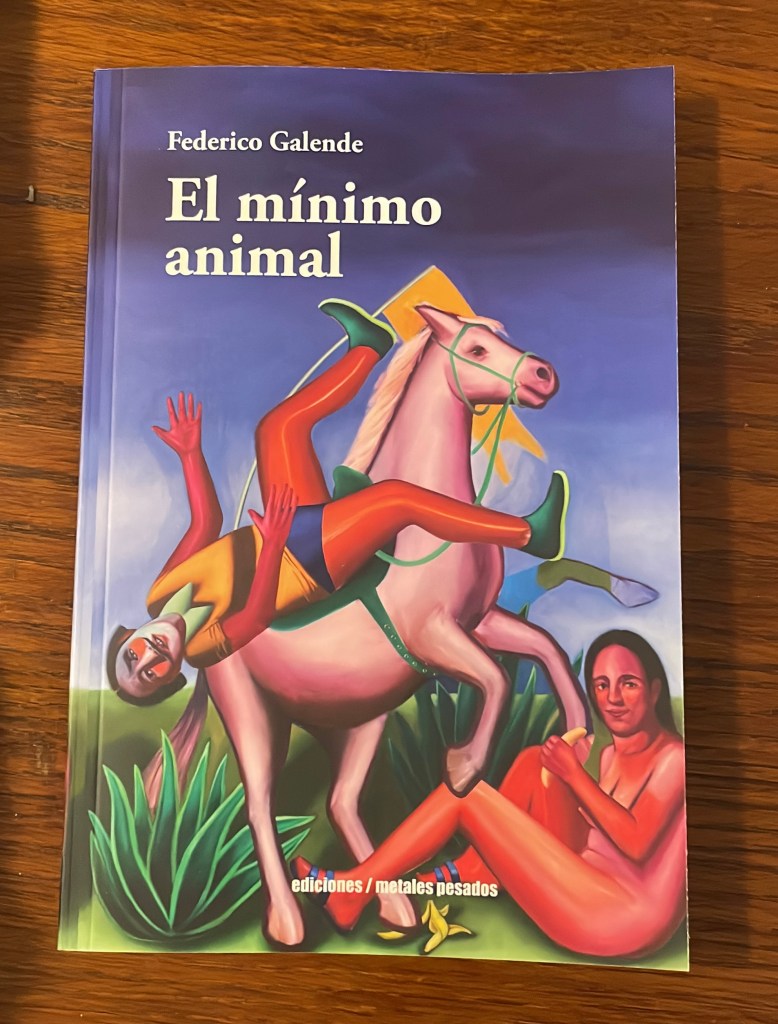
Federico Galende’s most recent essay El mínimo animal (ediciones metales pesados, 2025) is freestyle mediation on the singular animal that is the horse. When we say ‘horse’ we immediately dispense a bulky package: it is Pech Merle cave paintings and Franz Marc; it is Kafka’s parable of the racing red Indian, the agonizing horse in Picasso’s Guernica, as well as Juan José Saer’s mutilated horses in Nadie Nada Nunca (1980). Galende’s tiny mare, however, is first and foremost a memory of his childhood in the green grasslands of Córdoda that, we are told, had a big white spot in her muzzle. The first pages are spectacularly bucolic in a sedative language that retrieves a descriptive pollination of events and figures. But immediately the book gains depth and surprising detours. Galende notes that the relationship between humans and the horse differents slightly from that of pets, not as a question of scale, but primarily as complicity in language that shares the solitude between species: “…porque la del animal es una compania ofrecido a la soledad de lo humano en cuanto especie” (Galende 23). Avoiding the humanist temptation that makes the animal into a fantasy of the human, Galende’s situates the horse an experience beyond language. Is not this common solitude – that a few pages before Galende refers just in passing as ‘nocturnal communism’, in an esoteric allusion to his book on the cinema of Akis Kaurimakis – what has been usurped by the total domestication of species in a world that walks towards extinction? Galende’s El mínimo animal (2025) is an exercise in retrieving this innocence abode of man and animal in their reciprocal, and yet intransigent, mutation between worlds.
As a painterly writer, Galende is in full awareness that he must first interrupt the heraldic density of this animal. Because we know that the horse is an emblem of St. Paul’s way Damascus as much as it is one of modernity’s energy and mobilization. Galende is quite aware of it: the notion of “horse power” registers the unity of measurement of potential power for engines and motors. And just like the steamboat and gaslight, the horse stands a figure that unleashed a civilization defined by development and domestication of the world. The horse entered history through the main door of modern spiritualization (Galende does not elaborate on Napoleon’s famous horseback riding entrance in Germany, avoiding an image that is perhaps too obvious, already “manoseada”), allowing for social stabilization and homogenous time; the arrow of progress that underpins subjective historical consciousness. Galende writes, for instance: “De ser una masa abstracta que rodea la tierra, el espacio se convertía en una línea delgada, con la historia estirando un hilo la materia cósmica de la simultaneidad. Ahora, gracias al caballo, se tenía acceso a los lugares más retirados, solo que a causa de la velocidad de se los pasaba por alto de modo que lo que hasta allí había reinado de la imaginación comenzó a ser parte de lo accesorio, de lo circunstancial” (Galende 82).
The unification of the planet under the nomoi of depredation would not have been possible without the domestication of the horse to coerce the acceleration of time as the index over space. As a cypher of time, the horse started to pop up everywhere progress made a violent incursion. This is perhaps why Galende, in a poetic style that seeks no conceptual scaffolding for self-assertion, claims that in its mystery the horse is not embedded in an ideal of freedom – which will be the freedom already fallen prey to the tribulations of civilization and the political world – as being in the world as such, without the pretensions of overcoming it; remaining a witness to permanent discontent in the open distance of some meadows (Galende 61). Can a notion of freedom be rethought from the figure of the horse at the end of history? Galende does not provide an answer, and his muteness is an attempt to resist transforming the horse into an apodictic symbolon of human anthropology transpiring meaning where there is none. The horse – and perhaps all animals are – stands for muteness and companionship without the burden of proof.
Perhaps the ultimate meaning in El mínimo animal (2025) can only be grasped in those silences, in what remains unthought and unsaid, which is another way of saying that Galende has provided the essay not only of form but of a soul. All things considered, the mystery of horse is a passing memory of the modern: speed, total mobilization, energy dispensation, the unity of a compact and legible world. What remains of the horse after the watershed of modern times; literally its exhaustion? Ultimately, the horse as species recalls the “specio”, which means to see, and to have the visibility for discernment; to be able to see with a sensible eye that blushes at the world before it crumbles into despair and conflagration at the threshold of the Anthropocene. And in many ways we are already there. Galende’s musings speak to an abundance trimmed by a trotting horse that only reappears in a poetizing that is capable of thinking and loving what has passed, like the epoch of horses. For Galende the horse is thus always sub specie aeternitatis. Towards the end of the book, and condensing Gottfried Benn’s argument on style as ranking higher than truth, Galende makes an open apology for appearance, that is rigorously eternal because it is concrete and unforgettable (Galende 91).
Of course, the same can be said of Galende’s serpentine, courteous light prose – like a horse, that is, “una elegancia contenida” – that refuses the monumental and sterile retrievals of sedimented and dusty knowledge on the horse or any other animal (Galende 43). In this sense, Galende’s horse differs fundamentally from Blumenberg’s lion in its refusal to make of the species an anthropological metaphor, that is, a mere creed for the human bonum commune to stabilize social reality. Departing from the offerings of a meandering memory, Galende’s tiny animal is a vanishing horse that interrogates what it means to inhabit the space of non-relation that opens up when the modern scheme based on production, progress, and energy comes a halt. It is this “nothingness” what the vanishing horse reveals beyond itself, as Galende writes:
“Retirándose, el caballo le estaba advirtiendo a todo el siglo XX que la historia de retira con ellos y el mundo también, y todo lo que siguio 4 después de que por inercia ese siglo hiciera desfilar frente a sus narices las profecías más disparatadas…Pero no esperar nada no significa estar consciente de no esperar; puede ser al revés, que la nada sea una intersección invisible entre un sinfín de velocidades insustanciales. La aceleración de la vida – para decir lo con una expresión manoseada -…sirve para compensar este vacío que dura…” (Galende 87).
In the stretched historicity of boredom and nothingness, memory awaits and assaults like an incoming galloping horse. And when Galende speaks of the “nothingness” that mediates between the temporalities of human action he is indexing the fabric of life; since authentic life only happens, as Don Delillo claims at the opening lines of Point Omega (2011) not when words have been spoken or inventions patented, but in the self-awareness of microscopic fragments of facticity. It is at this moment, when history unravels as a farcical script of putative norms of human action, and imagination can begin to gather species outside itself; in this way, perhaps once and for all, leaving behind the atrophies of nihilism already deposited in a language of strange instruments and recyclable data.
Just like Marguerite Duras’ Little Horses of Tarquinia (1953), where the Etruscan sculpture of a winged horse fails to enter the plot of a community of friends at a beach-town; Galende’s horse also disappears in the concluding pages of the book. In fact, there are two disappearances: first, the equestrian statue of Baquedano in Plaza Italia after the October social revolt of 2019; and, more importantly, that of his childhood mare in the hills of Córdoba. The vanishing horse at the limit of prose recalls the reality of the living for which there is no tropology: “…nunca conocí a ese ser, así como no es possible – nunca jamás – conocer a los seres ni tampoco el fin de ninguna historia” (Galende 110). As the horse makes his exit, we can only be sure that life has taken place elsewhere. Only because it has been transfigured in thought, Galende is able to seize a glimpse of it; a glimpse that is imperceptible and diluted before vanishing forever.
As a theme for his 1949 Aquinas Lecture at Marquette University, an American scholar, Robert Hutchins, decided to titled his conference “St. Thomas and the World State”. It is obvious that Hutchins had fresh in his mind the fact that the long European Civil War of the twentieth century, which included two World Wars, was a direct consequence of warring nationalisms and militarized nations that in our times it is once again has lavishly returned with even higher lethal consequences. There is a major historical difference, however; and that is the fact that whereas the nationalisms of the twentieth century were distinct territorial struggles in the wake of crumbling empires, the emergence of the new nationalisms are concerted, nourished, and aligned to the global commanding American imperialism. The techno-political ideal of an influential figure on American elites such as Peter Thiel takes the form of warring nations and firms against the possibility of a global world state to secure peace, interdependence, and free movement of populations across borders and communities [1]. It is fair to say that contemporary technopolitical dominance is a combination of imperial and national forces through the perpetual administration of anomia or lawlessness.
What is striking about Hutchins’ 1949 lecture is that although Aquinas’ philosophy of law has been traditionally understood as the most important source of natural law, in his proposal Thomas’ actuality is able to fulfill positive law against the instrumental morality of nationalist empires (the United States and the Soviet Union then) that “in the absence of positive law; they may be expected to break the peace” [2]. For anyone that knows the emergence of the European state as coterminous with the secular authority of legal positivism will find this emphasis contradictory at best. The very notion of positive law requires principles of sovereign authority and normative internal recognition of its command coordination in order to consolidate a stable political form over time. This is a contradiction that Hutchins was aware of throughout his lecture. Consider, as an example, when he claims that: “The origin and meaning of the saying that a state has the natural right to sovereignty therefore, is that one state may not forcibly impose its will upon another. It means that Catholicism should oppose the foundations of a world state by force” (36).
Or, when glossing over the obvious tension between the right of national sovereignty and a potential international federal state in the views of popes and Catholic thinkers: “I think they know that the national state is no longer the perfect community and that positive law is required to make the world community an effective political organization. I believe that they are making two points that are of the utmost importance: first, they are saying that any world government must be a federal government; and second, they see that world must come into existence by consent and not by conquest” (34). However, any student of modern political thought knows that consent and coercion are two internal modalities of governance for legitimate rule. Hutchins’ notion of “consent”, along with positive law, remains not only unthematized, but dependent on a circular of definition of law; that is, the “common good”, which is not a political concept, but a theological and moral notion extracted from the philosophy of history of Christian salvation.
Towards the end of the lecture, Hutchins goes beyond strict positive law as if searching for some substantive ground: “…the West should not only survive, but also revive and rescue a deeper conception of human civilization than the one recently current, which enters around a religion of progress by resourceful greed and technological mastery of non-human nature” (42). But Hutchins’ plea for the retrieval of a past memory of the West runs astray when it relocates Church and State into a dual predicament of a new world state for peace on the conditions of the same structure of political theology that are no longer operative, but that actually make up the very ground of the modern collapse into nihilism – nihilism that political form does not remain immune to, quite the contrary. In fact, it is the most salient symptom of civilizational collapse. In the same way that Ernst Jünger immediately after the war called for the subsidiary spiritual assistance of the churches in the face of technological power- “the true conquest of nihilism and attainment of peace will be possible only with the help of the churches” – Hutchins will also repeat that only the conjointment of Church and State “must now work together for world peace founded on university charity…and universal democracy” (44) [3]. And the same thesis has found a clear expression in Pope Francis’ Apostolic Letter Candor Lucis Aetenae (2021): “To restore order and salvation, faith and reason, Beatrice and Virgil…Church and Empire are called to operate in harmony” [4]. This speaks directly to what we have recently called the plasticity inherent in the historical adaptations of thomism in social life [5].
This plasticity amounts to the administration of desperate souls from the structures of the state and Churches, without ever transforming the mere survival of life on Earth. This leaves us with the notion of kingdom, which Hutchins introduces in opposition to the political community of city life (polis), but only to reabsorb it into the order of political theology. And it is at this threshold, that we can claim that the kingdom is not a political theological category, but an experiential allowance in which life, the dead and languages occur beyond and before political determinations. It is no surprise, then, that Ivan Illich called the kingdom primarily a mystical experience: “I will dare to formulate a hypothesis: the kingdom is what constitutes the authentic mystical experience, if the mystic knows what experience is really constituted by. The mystical experience of the believer is the conscious experience of the kingdom before the parousia. The mystical experience is the fruit of love, and, therefore, it is also accessible to every lover. The awareness about its meaning is the fruit of faith…” [6].
We tend to forget that both national units and the contemporary empires of world building and destruction have been first and foremost enemies of spoken living languages and idioms. On the one hand, the historical grammars to build the unity of people’s official language, and in our days the rise of Artificial Intelligence has clearly become the last stage through which power abandons languages to computational and rhetorical obsolescence. This opening towards awareness is not an article of faith through consent nor a moral predicament that can be adequate prima facie into a political register; it is fundamentally a linguistic experience that allows for the delicate cultivation of peaceful coexistence taking place not in a world, but between them: “To learn a language in a human and mature way way is to accept the responsibility for its silences and sounds. The gift a people gives us in their language is more a gift of the rhythm, the mode, and the subtleties of its system of silences than its system of sounds…The greater the distance between two worlds, the more this silence of interest is a sign of love” [7].
6. Ivan Illich. “Concertning Aesthetic and Religious Experience”, in The Powerless Church and other selected writings, 1955-1985 (University of Penn State Press, 2018), 86.
7. Ivan Illich. “Missionary Silence”, in The Church, Change, and Development (Urban Center Training Press, 1970), 121.
The notion of “zoning” in American public law refers to the compartmentalization of land use (residential, governmental, industrial, among others), as well as the “zones” of the administrative framework that dispenses its delegated power. It is a common fact that the Fifth Amendment of the United States Constitution, which includes the “Taking Clause”, states that taking territory must always be equitable compensated. The Fourteenth Amendment included during Reconstruction implements a non-discriminatory standard into zoning as division of space for political representation, and what is usually referred as “redistricting” in any given state. This means that the operative semantic and legal field of “zoning” refers simultaneously to both land as property, and territory as a spatial index of political representation. Of course, modern revolutions, whether in 1776 or in 1789, were stealth transformations of space into these two tier units of alienated property and representation, as we know from the territorial census in the aftermath of the French Revolution.
Likewise, the framework of Americanism as a political civilization is that of landsurveying, which ultimately means not just to make coterminous sovereign authority to territorial limitations, but to make transactions between world forms (territory and its inhabitants). If “zoning” has become a fundamental point of contention in all spheres of American life – from housing to development, from political representation to governmental “taking”, from wildlife sites to the circulation of good and services of the metropolis – is because the essence of Calvinism was fundamentally a settler cosmos that reduced life to usurpation of territory. In this sense, Bruno Maçaes is right that in the age of planetary Americanism the predominant form of domination is world-building and world-destroying. The perpetual social war over “zoning” is precisely the movement of building and destroying life-worlds through the linguistic justification of the administrative legal apparatus.
In his forgotten book Nomos and Physis: Origin and Meaning of One (1945) on the severability of the two notion of “order” in Ancient Greece, Felix Heinimann notes that the triumph of nomos over physis implied a separation from the world of “reality” and “deeds” from that of rhetorical language that came to dominate it (nomos). In the present, the separation between nomoi and physis is the void that is perpetually governed by the attenuation of zoning: the creation of artificial worlds, but, at the same time, the composition of artificial languages. But the paradox is the following: the world of nomoi ceases to have any contact with that of physis; and physis, the natural world, becomes an artificial life world only responsive to irreflexive and undetermined practices of social exchange. This means that zoning is the vector of force that constantly separates human beings from both the world and language, and ultimately stripped its “humanity” from the species-being.
As the zoning process plunges extensively into all spheres of practical and intellectual relations of human beings, an increasingly grouping of unalienable life emerges in a polar night. Here solitude in language brings forth the warmth of the unalienable. Perhaps it is in this night, where a trivial amor mundi will be cultivated for other generations, as beautifully suggested by Tim Ingold. A vita nota that will only commence on the lines that are invisible and opaque to the shining surfaces of zoning.
Immediately after the end of the Second World War, the historian Emilio Roig de Leuchsenring published a thin book in Havana with the title Weyler en Cuba: un precursor de la barbarie fascista (Páginas, 1947), which made a direct connection between twentieth century political movement fascism and the lurking shadow of the Spanish general Valeriano Weyler, who commanded the intense colonial pacification against pro-independence insurrection at the end of the nineteenth century in Cuba. It is to Roig’s credit how he managed, toward the end of the book, to capture the actuality of what he called “weylerism” of full-fledged totalitarian and imperial wars against populations that did not come to an end in spite of international law and the several peace agreements of the Second War victors. For Roig the structural positionality of politics even in the years 1945-1947 was still maximalist, all encompassing the total conditions of living of populations, and thus a direct instrument of capitalist rent through war making. What he termed “weylerism” or the new fascist barbarism was a new qualitative leap in terms of conducting war, which now realized itself in terms of population control and the veneer of “order”: “Todo lo que Weyler representó y practicó está vigente en la posguerra” [1].
The idea of “peace” (the United Nations was settled in the fall of 1945 with the active participation of Cuba, something that Roig would not have ignored) could only signal the continuation of an extreme form of extermination and the dispensation of cruelty. In fact, the Weyler model (weylerism), was very much an administrative form of pacification of population through encampment and survival. In his memoirs, Weyler himself justifies “reconcentraciones” of the population as a martial solution to answer insurrectional arson activity, in the form of an exclusionary space within the territory even if this meant mass starvation [2]. As Roig does not cease repeating in his postwar essay, the actuality of Weylerian command is not an image of the past, but something that is already an essential part of the world of today and surely of tomorrow.
Today we are living Roig’s historical future, and we can say that his Weyler en Cuba: un precursor de la barbarie fascista (Páginas, 1947) has become as current as ever before. Just a few days ago we heard the Secretary of Homeland Security of the United States claim that Immigration Detenter Center in Florida’s Everglades could become a model for detention centers across the nation thanks to its spatial efficiency near airport runways that facilitate deportation flights and extraditions without due process. As observed by Stephen Bonsal as early as 1897, the Spanish reconcentraciones in the island of Cuba enacted by Weyler’s military command were all deployed near key military strategic sites of the colonial army [3].
It comes to no surprise that in the current public discussion about Immigration Detention camps in the United States, the discussion always pivots towards health and sanitary management of the centers, and not in the “dislocating localizations” of these evolving zones d’attentes that now are propping up near airports, shipping ports, and hinterlands of American metropolises [4]. If the camp, or reconcentraciones, is the sharp image of ongoing domestication of human beings, as a great twentieth century writer observed, it might very well be that the current metamorphosis of Weylerinism has become victorious because it has been rendered acceptable by an increasingly indolent and dormant Society.
.
.
Notes
1. Emilio Roig de Leuchsenring. Weyler en Cuba: un precursor de la barbarie fascista (Páginas, 1947), 216.
2. Valeriano Weyler. Memorias de un general (Ediciones Destino, 2004), 257.
3. Stephen Bonsal. The real condition of Cuba today (Harper & Brothers Publishers, 1897), 112.
4. Giorgio Agamben. Homo sacer (Stanford University Press, 1995). 175.
A good place to start on Tetsuro Watsuji’s Climate (1935) is by considering how the very notion of the Japanese fudo as it appears defined in the first pages of the text, as a “structural element of human existence”. Augustin Berque has proposed a slightly different translation: the “structural moment” that speaks semantically to the prefix *-med, that also recalls mediality, metaxy, and also the French ‘milieu’. In any case, “fudo” discloses an expressive instance of existence, but it is not overtly determined cultural or historical teleologies; rather fudo like Heidegger’s fourfold (das Geviert), brings into gathering wind and earth in which existence can only appear to exist in between as exteriority. Watsuji writes: “The structure of “ex-sistence” is, thus, something rather than to exist in the reality of the cold; it is rather to exist within other persons. To designate this reality we prefer the technical relation of intentional reality, used by phenomenologists, the Japanese expression term aidagara (interpersonal)” (†27).
Unless we know the language, we can only take Watsuji at his word when it comes to the Japanese, but all things considered it is at least obvious to say that fudo is not strictly a descriptive objective reality, but a relation of Being. Watsuji calls it a few pages later a “movement of negativity”: “…this is a ‘movement of negativity’. This is how the spatial-temporal structure of human existence comes to being like that of the climate and that of historicity” (33). The notion of existential transcendence that Watsuji wants to hold on to dwells between reality and existence, generating kimochi, or tonality / stimmung (38). The first question here is what to make of Watsuji’s typology of regional climate setting if these are not to be taken geographically or culturally as expressing locational structures for specific kimochi?
There are three types of climate regions for Watsuji: monsoon, desert, and meadow. One could imagine that these three ideal types as environmental arrangements in the disclosure of kimochi. Each region has its surroundings. For instance, the monsoon is defined by its humidity (47). For Watsuji each of the climatic regions will fundamentally generate different forms of social organization, and it is from this perspective that he interprets the civilizational rise of the West beginning in Ancient Greece. The emergence of the polis is understood as a direct relation with harvesting and later to a social bond determined by production and struggle (war). In the most clear elaboration of his interpretation of the polis, Watsuji writes: “With a slave system as through-point as this, the small number of people who comprised the polis were freed from the labours of the herdsman-farmer. […]. With the building of the polis one may begin to use the word ‘Greece’. If this be correct, Greece began with the conversion of the farmer-herdsman gained freedom from the restraints of nature” (82, 113). This restraint of nature is not just productive in the practical sense (attachment to agricultural life), but it is also of the order of the sensible: this is why Watsuji claims that the Greek classical culture possessed a commitment to a visuality of clearing that is ingrained in their architecture and temples in the open (115). And being in the cleared visual spaces demands the question of technique: “The life of the polis has at its center the artificial-technique in order to dominate the Mediterranean. The emergence of this form of life was the powerful instance that determined the destiny of the “West” (116). In this line, modern science is nothing but a consequential reduction of technique for the Greeks (117).
There is definitely some ambiguity here, since later on and following Komei, Watsuji claims that the emergence of machines in the West was only possible as a retreat from cold weather in the North, and thus a product of interiority (130). Could this mean that the all-clearing established in classical Greece – with its vantage point and all too visible sculptures without oblique point of view – contributed to the later historical production of reserved interiority? Watsuji seems to contrast the clearing in classical Greece with the opaque and gloomy clime of the Germanic lands. In fact, Watsuji says later that only in the shrouds of Germany could pure music be created, where light is not so keenly embodied (141, 111). Returning to the question of existential tonality, or the kimochi, I wonder if Watsuji’s subtle yet recurrent positioning of Western destiny has to do with an originary ethical deficit that is maintained from the depths of fudo as within and outside the clearing of nature. There might be a clue about this in “America’s National Character” (1943): “The true hidden reserves are in ethical strength and not in the power of quantity” [‡]. Is living proportionally in the fudo the ability to master this ethical orientation?
Session 2 (continued)
Having laid out his climate interpretation of the West, I think it is fairly easy to grasp the orientation in Watsuji’s monsoon specificity as a sharp contrast to the condition of its “structural moments”. In particular, the political contrast is implicitly established – and I say implicit because Watsuji never confronts it as the guiding principle of differentiation, although it bends that way. It caught my attention that, following the scholar Kateke Fumio, Watsuji will note at the outset that Chinese (Asian) subjectivity refuses any positing of the legitimacy of the state, and especially the fiscal state (we know from Schumpeter that the modern European state is the fiscal state), and they can only flee from such submission, although they are submissive in other ways, to force (shoguns, for instance) (157). The monsoon structure, hence, has primacy over the political sphere projecting a sort of permanent stagnation for historical development. The notion of akirame or “no bearing, nothing we can do”, a sense of overwhelming resignation, becomes the social tonality of the monsoon surrounding, which ultimately (Watsuji does not say it like this, but perhaps we can push the text in this direct) entails enduring stagnation. This perhaps highlights, quite convincingly, of a certain caducity in Watsuji’s monsoon type in our present epoch.
In the order of the political register, one could read Watsuji’s emphasis on the Japanese home in this direction; that is, the monsoon resignation leads to permanent homecoming. The monsoon region is the region where the oikos triumphed over the polis (180-181). If in the Greek world, legibility and the transparency of the grasping logos made the domestic space an exception to the social life, for Watsuji the Japanese dwelling space is not just a space of familiar gathering, it is also a cosmology and an ecology: “The Japanese consciousness took shape in the totality of the home” (184). (As a side note, I cannot but read this in light of Xi Jinping’s notion of the ‘ecological civilization’ as the master key for the planetary relevance of the CCP). Elevated to the rank of cosmology, the monsoon retreat into the home, does not become an all too easy path towards natural domestication?
In the Japanese home there is no separation – there are no locks and keys – says Watsuji, which introduces as a paradigm for a different form of sociality that differs from Western individuality around appropriation, assignation, and separability (201). This is true to some extent if we think about a spatial figure of Western civilization and enclosure, such as the castle. This is fundamentally different from the tokonama. For Watsuji, the structural moments of ambiance and surrounding generates specific mentis types, and thus concrete organizations of said space. I derive from Watsuji’s second part of the book that Western civilization revolved around the movement of total legibility and clearing (Greeks) that unfolded to separation and thus control over nature, resulting in a machine utopia as Adolf Caspary rightly called it. What about the monsoon specificity? There is retreat and resignation over the surrounding, which allows another mediation or in-betweenness with the natural world and exteriority, although this will entail stagnation in world historical terms.
The contrast between the West and China was already well established during the Enlightenment in the writings of Montesquieu, Voltaire, and other luminaires according to Federico Chabod. In fact, Chabod claims that the civilizational divide between the West and China is crucial to understanding both [‡ ‡ ‡ ]. Asking why an ancient civilization like the Chinese had made such little progress in two centuries (XVII-XVIII), Montesquieu for instance claims that an explanation is to be found in the sacred respect of this civilizational mentis for the transmission of its tradition. It is easily inferred from Watsuji that the monsoon ambient allows for a civilization of “Wisdom” in the deep sense that it “thanks” all the elements of the tradition that it receives. This is also a form of “resignation” proper to mezuru, a form of wonder and surprise that adds nothing new. When Kojeve referred to the end of history in the form of American animality and Japanese snobbism, I think he was crediting this inner Wisdom in the wake of stagnation and released resignation. Of course, we also wonder what Watsuji will say about the “ecological civilization” driven by China’s modernizing planetary project that, if we are to believe Adam Tooze, possesses the master key for world transformation in the notion of “development”. If true, this can only entail the triumph of Western machination through the labor of its others.
.
.
Notes
† All pages are referring to the Spanish edition, Tetsuro Watsuji, Antropología del paisaje: climas, culturas, y religiones (Ediciones Sígueme, 2016). All English translations rendered are mine.