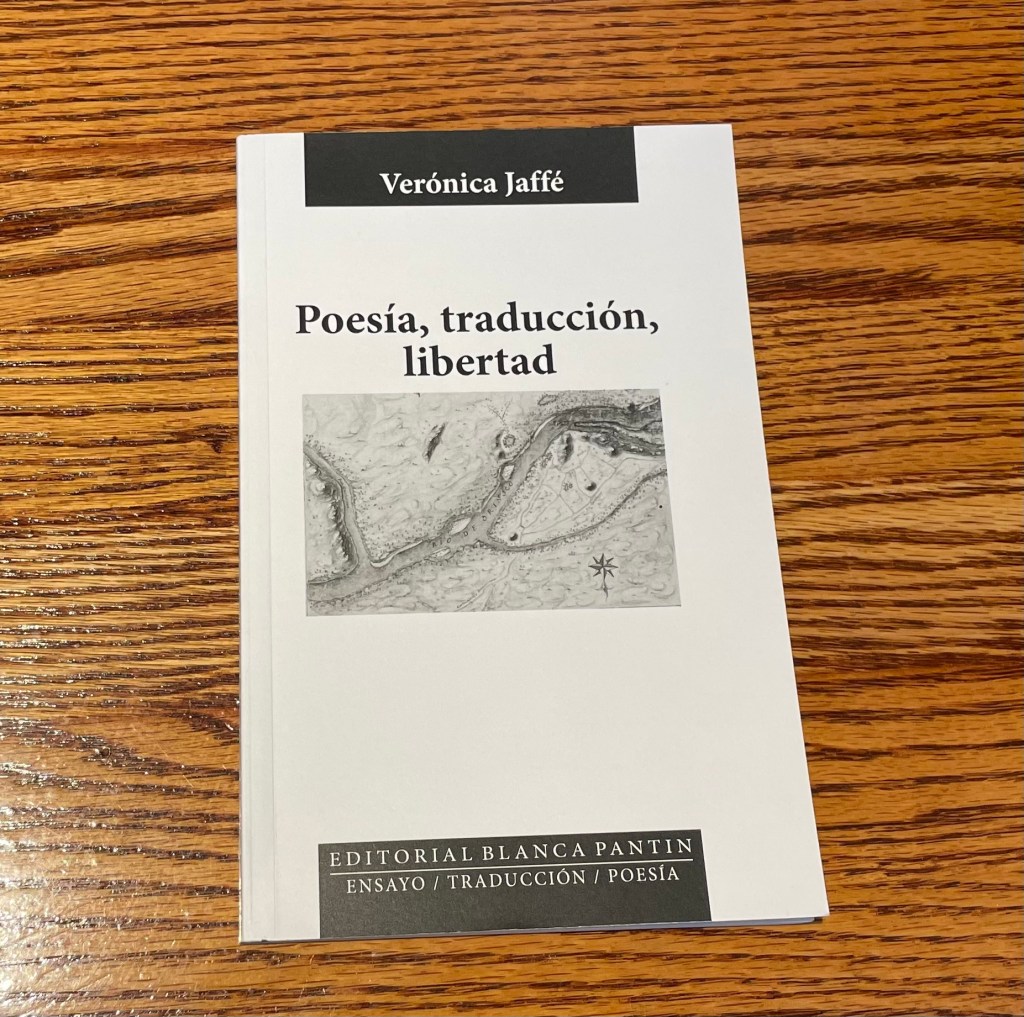
Verónica Jaffé’s most recent Poesía, traduccion, libertad (2024), which gathers some of the translations already contained in Fredrich Hölderlin: Cantos Hespéricos (La Laguna de Campona, 2016), features an introductory essay where she reflects on translating Hölderlin’s poetry from the German into her own creative visual renderings of Spanish. Reflecting on the difficult task, if not utterly impossible, of translating “Andenken” (in Spanish she opts for “Recuerdo” and not “Memoria”), Jaffé departs from an important observation that we must take into account here: the fact that this late hymn has been catalogued as a proemial composition. What does it mean that “Andenken” is to be read as a proem? As we know from the Ancient sources, the proem is an oratory prelude to the topic deployed in a text; in other words, it is the persuasive caesura of language before any argumentative exposition. Hence, the composition of the proem is something like the pure mirroring of language. This could explain why Hölderlin’s “Andenken” while prima facie about memory and thinking does not have a guiding thread to restrain it; it unfolds the enactment of its own recollection through the sayable.
If “Andenken” is a long proem – the space where the poem and proem absolutely coincide – then this means any translation must keep the poetic possibilities of oration in preamble, in path of preparation. Jaffé offers two distinct trans-creations of the famous poem’s last lines. The first reads thus: “Un mar que guarda los recuerdos / que da amores, que los toma / para que solo queden después / como tesoros / en quienes recuerden y en quienes escriban” [1]. In the second version, even more elaborate and idiosyncratic, Jaffé writes: “de pensar con todos / mis amores, es decir / pensar fijando / papel y lápiz / sobre tela / en memoria de todos mis muertos” [2]. It is noteworthy that the famous literal last lines of the “Andenken”, suspended in an enjambment, appeals to a canvas that is splattered with the memory of the dead. It seems of all the dead of the human race. What does it mean that the act of remembrance is the recollection of all the dead? Poetic imagination, if a testamentary document, appeals to the archaic where the living and the dead inhabit the world through image [3]. For Jaffé – but this also an intuition that Hölderlin shared in his pindaric translations – the beginning is not a previous stage, but in media res of the event of language.
The recollection of language within proem attests to the exilic dimension of language; the site where no one truly ever belongs to: “…la lengua en mi país que no me pertenece”, writes Jaffé [4]. This means that the authentic remembrance of language is not a national language, but always ex patria lingua, or a language outside the telluric fabric of the national community. Because we are always walking strangers in our own language, the contact with the dead repeatedly reemerges in the memorial grain of the voice.
As C.M. Bowra has noted, Pindar’s allusion to Memory takes place in the context of the Muses: “[the poet] invokes Memory because she embodies the accumulated wisdom of the past, and the Muses because they pass on this wisdom to him. What he asks from them is the ability to deal properly with what they give….men are blind if they do not pursue wisdom with the help of the Muses” [5]. If the “Andenken” should be read as a proem, this is because recollection is always fixed in the irreducible experience of our voice that recalls language from its beyond.
.
Notes
1. Verónica Jaffé. Poesía, traducción, libertad (Editorial Blanca Pantin, 2024), 38.
2. Ibid., 40.
3. Ibid., 40.
4. Ibid., 51.
5. C.M. Bowra, Pindar (Oxford, 1964), 33.
 Infrapolitical Reflections