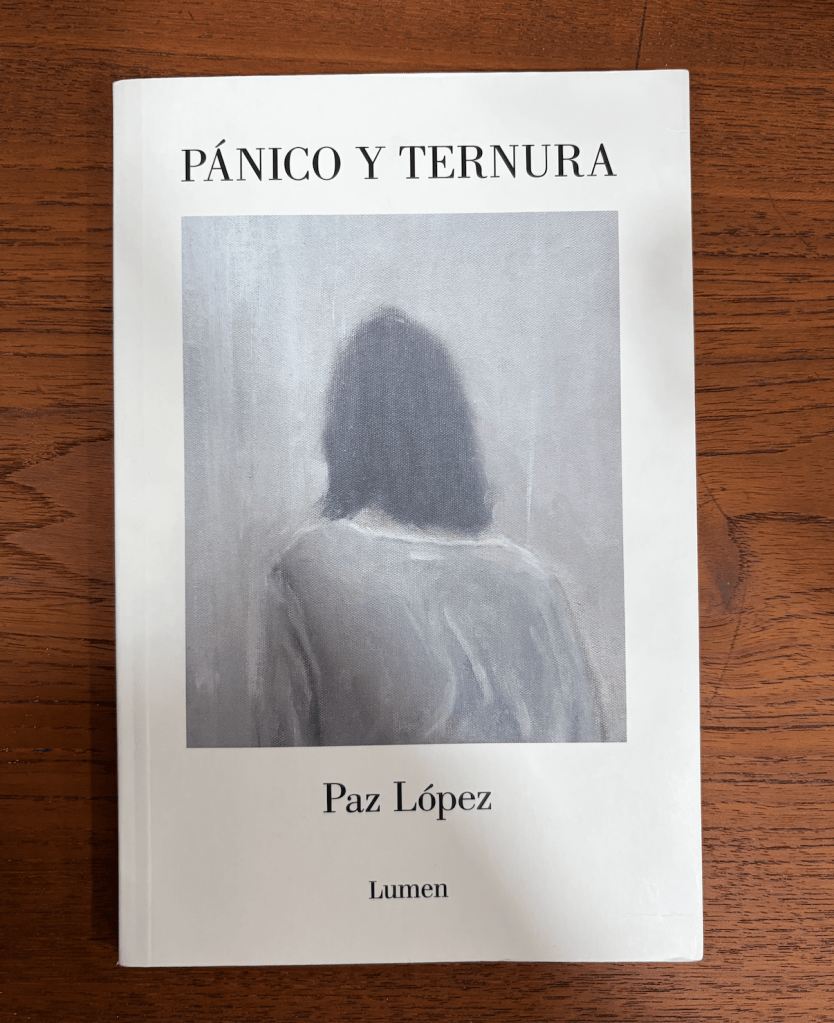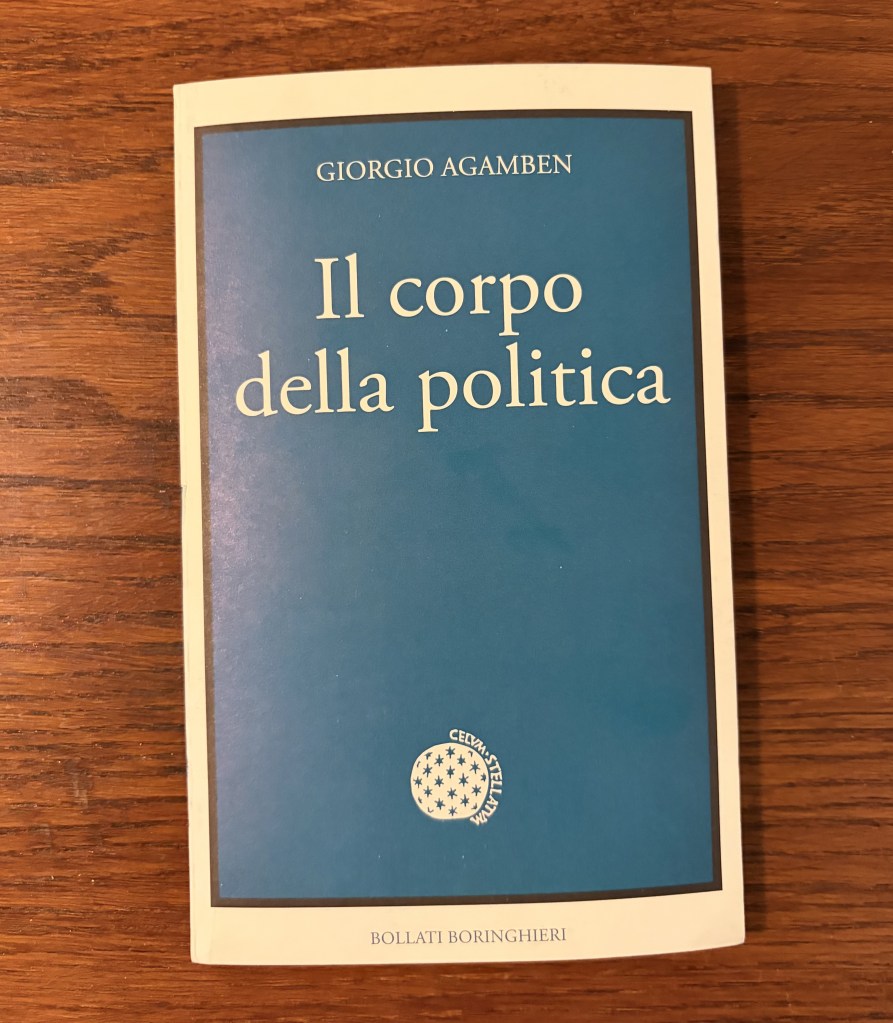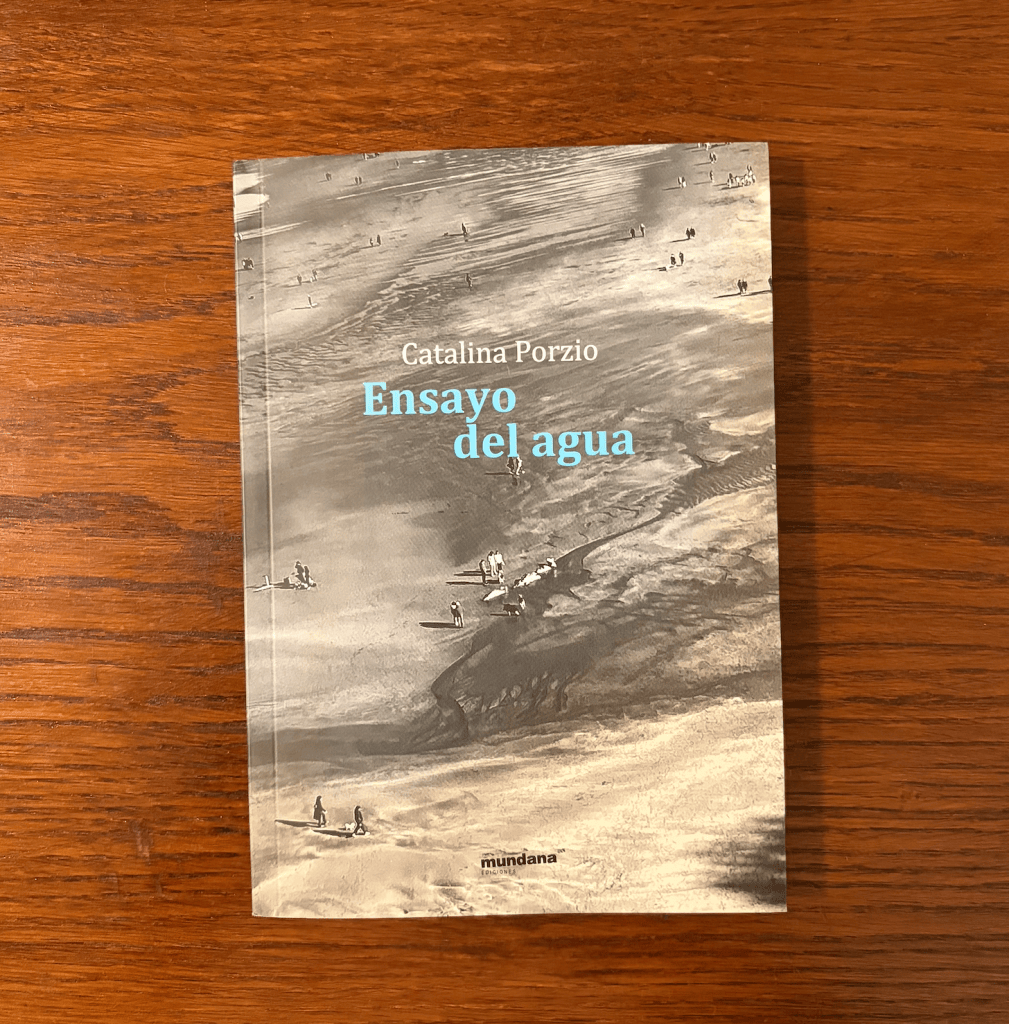
Assimilation in exile. On Giorgio Agamben’s Il corpo della politica (2026). by Gerardo Muñoz

One of the decisive lessons of Giorgio Agamben’s archeological examination of Western politics is that the imperative to confront the closure of representation, sooner or later it must also come to terms with the notion of the body (corpo) as a central metapolitical condition in the genesis of modernity. If L’uso dei corpi (Neri Pozza, 2014) brought to its final stage the philosophical exploration of Western ontology of politics defined by efficacy and realization; in most recent opuscules, Agamben has shown how the fixation and regulation of the body is also embedded in the regions of language and sensation of human life as well.  In this sense, it is impossible not to read Il corpo della politica (Bollati Boringhieri, 2026) along with Il corpo della lingua (Einaudi, 2024), as two parallel commentaries on the defining stature of political representation. If a new beginning is one of the decisive questions of our times, then one of the pending tasks is precisely to think the body (corpo) against the ontotheological assumptions of calculative reason.

Similar to Il corpo della lingua (2024), Il corpo della politica (2026) starts with the treatment of the Copernican revolution of bodies in Hobbes and Newton, which in the face of the cosmological infinity inscribed a notion of two bodies in order to allow for representation within spatial coordinates. In other words, Hobbes’ artificial sovereign represented by the mortal god Leviathan (state normative authority) will have an autonomous colorary in the autonomy of the subject that will become “political” as long as it becomes coterminous with the civic body of the “People”. Thus, to speak of “bodies” is not just to rationalize physicality in space – although it is also this from a technical viewpoint that state legibility will soon demand of the incipient civil society – but more importantly, it entails the administration of energy and movement (in Agamben’s well known lexicon, the domestication of potency to the realization of purposeful ends). For Agamben, Spinoza’s conatus, which appears in the Baroque period in critical dialogue with Hobbesian and Newtonian frameworks should be read precisely a way to think past the body as substance, following the steps of the tradition of ancient Stoicism in which beings are corporeal insofar as they are in tension with the world, allowing the tonos or acoustics to animate being in its movement towards preservation and exposure (Agamben 20-21). 

If all beings are traversed by a tonos – a tension that crosses as its medium in virtue of its contact with the world – this means that they are no longer defined by a substance, but as intensity within a field of forces once thrown in the world. As Agamben writes in passing with explicit confrontation with Heidegger’s Being and Time: “…con la tesi perentoria ‘l’essenza dell’esserci giace (liegt) nell’esistenza’. L’esserci è stato “gettato” nel mondo, ma si direbbe che, una volta gettato, non cade in piedi, ma giace (liegen significa innanzitutto essere sdraiato). E questa concezione sub-stanziale dell’essere che il conatus mette radicalmente in questione” (Agamben 23). In an archeological gesture that is already signatura of his work, Agamben reminds us that Hobbes’ substantive and artificial division of the “two bodies” that anchors modern politics can be traced to the corpus mysticum and the theological debates concerning transubstantiation that will later be recasted in the intersecting works of both Ernst Kantorowicz and Carl Schmitt, in which the impolitical dimension of the multitude becomes political through the artifice of decision and representation of a unified and indivisible body (Agamben 25-26).

The catastrophe of modern politics takes place when the body, once reduced to a substance and computable object in space, ceases to be understood as an inteusum or intensity of an irreducible multitude that expressed a generic and universal human species, as it was for Dante: “La politico – il finis totius humanae civilitatis che Dante intende definirie nel suo trattato – è ancora una volta un campo di tensioni interne allo stesso genere umano e questa intensità ha la foram di una moltitudine” (Agamben 39). In other words, for Agamben following the implicit tonus present in Dante’s Monarchia, the political is neither action nor mediation, but what names the very site of the possible. Agamben calls the hypothesis of an “anarchic politics” (politica anarchica), which no longer defines itself in relation to a formal mediation of government and state, but rather as the intensity of the multitude through the generic being (Marx) or the universal humanity (Dante) that takes the form of sensible Empire devoid of principial politics mediated by constituent power (Agamben 47). 

Where does the multitude dwell outside the constituted representation of a community of belonging or the social mediation of the state? Already in 1990s Agamben had written a gloss on the politics of exile collected in Mezzi senza fine (1996), and the last part of Il corpo della politica (2026) he returns to philosophical and theological notion of the exile vis-a-vis the historical experience of the Jewish tradition as an errant or stateless people, as Erich Unger called it in 1922, whose existence has been defined by exile or galut (Agamben 48). It is a bit of a misnomer to call the exilic experience a “politics”, since for Agamben the authentic tradition of exile does not entail the right or duty fixed to a community of belonging; rather, what outlives the law is the only path capable of deposing it (in the manner of Paul, that is, as katargeo). In this way, justice is now understood not as a procedure in a normative system, but as a written tradition that can only be studied and reflected upon and ultimately experienced as a state of passivity.

Hence, the exilic experience is the caesura between language and world, in which we touch the exteriority with a renewed intimacy that unfolds the uncommunicative solitude that keeps the mystery of our use of language. Following the neoplatonic formulation “phygé monou pros monon” – understood by Erik Peterson as an expressive mystical relation of a “fuga di un solo presso un solo” – there is intimacy and authentic belonging whenever there is sensible separation in being (Agamben 55). Following Plutarch and Plato, for Agamben the exilic dimension is the very home of philosophy and thought, which confirms, against Crito’s suggestions at the end of Socrates’ life, that there life outside of the polis and the conglomerate of the demos, because life is outside itself once it is assimilated in the virtuality of a divine that nourishes its own potency.  In what stands as one of the most precise formulations of the pheugein (exile) condition as a figure of existence, Agamben writes of its precise ascesis: 

“La celebre definizione ascetica della fuga dal mondo come assimilazione a Dio andrà resa, pertanto, restituendo tutta la sua forza alla metafora politica: “l’assimilazione a Dio virtualmente un esilio” (kata ton dynaton significa qui, secondo il sense più proprio del termine dynatos, “virtualmente, secondo la potenza). L’affermazione e tanto piu significativa in quanto, con queste parole, Platone rompe con l’insegnamento socratico del Critone, secondo cui la possibilità di phygé offerta al condannato non potrà che essere rifiutata, perché non vi è vita possibile fuora dalla polis” (Agamben 57).

This region that precedes and exceeds politics – in the language of Sophocles, the well known ypsipolis apolis – is akin to the tone that runs to the forgetting of any substantive ontology of politics that seeks to subsumes life into the confinement of external forces. It is in this paradoxical situation of assimilation in exile, and a permanent exile that assimilates itself in God as shared thought that politics can be transfigured as an apodemia that refuses the closure of life into principles of government and dominium, and away from the community form of propriety and rooted belonging. Agamben recalls that in the history of Christianity, it is the time of the parish (paroikias) what allows the soul to live in earth as foreigner and exile, in proximity of the medium of the kingdom, and that only later with Saint Augustine it was transformed into a territorial institution for the communio and communal salvation (Agamben 60-61). In the paroikias, Agamben returns to the kingdom not as a retheologization of the politics, but as a figural parable in which a poetic dwelling is enacted in the measureless passivity of a form of life, a project consistent with the formulation of the singular whatever being articulated in La comunita che viene (1990).

The assimilation in the exile of the divine, which recalls the forgetting of oneself and the god announced by Hölderlin in“Note on the Oedipus”, is refined in the last essay of the book entitled “Il corpo dell’Europa”, which reproduces a lecture delivered in Venice in May 2024 about idea of Europe. As a sort of concluding reflection or apostilla, we are now able to say that for Agamben the only possibility of dwelling in the vestiges of the European tradition and memory is to rescue, from the wreckage of its history, the sediments of a texture of the phygén: to be exiled is not just a vitalist affirmation of this life, but more importantly, it also implies disclosing the possibilities buried in the past with the dead, that is, in contact not only with Gaia, but also in the downward movement to the domus of the infraworld (a figure that receives a novel treatment Agamben’s recent book La lingua che resta). Agamben exemplifies this exile with the dead with three poetic moments of high european modernism: Ezra Pound’ Cantos, T.S. Eliot’s The Wasteland, and Eric Auerbach’s masterpiece Mimesis written from his exile in Turkey – and of course, we could also think here of Kafka’s parables and Joseph Roth’s narratives of Jewish errancy; as well as Alexandre Lerrnet Holenia’s phantasmatic crumbling of Empire in The Standard and Osip Mandelstam’s “The Fourth Prose”, where the end of the work leads to the human voice as the supreme poetic task in the face of nihilism and political totalitarianism. 

It should be clear, however, that the problem is not found a temporary refuge or a last stand in the fortress of modern literature, but of coming to terms with the phygé as a fundamental problem of language that, in virtue of its unique and irreplaceable experience, delivers a world nested in the affection of remembrance. As Agamben asks towards the end of the lecture: “Is there a sensibility and a form of life that we can call European?” (Agamben 82). This question can only be answered when we dwell and assimilate into the exile of thought that harbors the residues, figures, and voices that speak to us from the dead in a tradition because it is no longer transmitted, we can only access it poetically. In the only moment that the word anima (soul) appears in the text, in the very last sentences, it becomes clear that it is only in the intensity of thought that life accounts for the inseparability of the body and the soul that historical abstraction has rendered oblivious and alien from the tonos of presence. We are not yet ready to declare a return to the appearance between being and world, and for that very reason even the presence of the divine, as Agamben says following Isaac Luria, is itself exiled from the creation of the world until the advent of the tiqqun in the night of restitution. The exilic dwelling of life outside itself is marked by this sort of secret unfaithfulness in the absence of the god. In the meantime, the task of an ethical life is to passively reside in an exile where the reality of the soul returns what is possible and breathable to the appearance of the real.

Andenken and Pythian 3. by Gerardo Muñoz

Many interpretations of Hölderlin’s “Andenken” (“Remembrance”) have taken for granted that the hymn’s last verse might have been a paraphrasis and creative translation of Pindar’s ode Pythian 3. In the philological scholarship of the poem, it was Günter Zuntz who took notice of the analogical semblance to shed light on “Andenken” final verse as something more than mere imitation: “Never, however – unlike Pindar who does so frequently – does Hölderlin begins a hymn with a praise of the Muse, which would be an imitation, but not an analogy…the “Andeken” conclusion, “Yet what remains, the poets found” – corresponds almost verbatim to Pindar’s Pythian 3 final verse…” [1]. If we reread Pindar’s Pythian 3 from Race translation (Loeb, 1997, 263), we encounter the following verse: “Excellence endures in glorious songs for a long time. But few can win them easily”. If on Hölderlin’s side we encounter the “remnant” of the sayable in language, in Pindar’s ode we are presented with the endurance of a “glorious song” of the festivity that is carried out in struggle and forward in time. 

Ignoring the common place interpretation that assumes that Hölderlin’s concluding verse is a distortion of the translation from the Greek, Zuntz goes to note that the pindaric remnant in Hölderlin’s hymn effectively “constitutes in essence an analogy – not an imitation; it rises from the affinity of spirit not from an act of self-effacement” [2]. This analogical relation with the past, and thus the memory of Antiquity speaks directly to the modality of the improper that is common to the hermeneutical debate on the poem. All things considered, and following Zuntz’s hermeneutics, we could say that the pindaric intrusion in the concluding verse is a way in which the poet is enacting the harmonious poetic creation as it finds external resonance in tradition. As Hölderlin notes in his difficult note “On the mode  of proceeding of the poetic spirit” (“Die Verfahrungsweise des poetischen Geistes”): “Put yourself through free choice in harmonious opposition with an outer sphere, just as you in yourself are in harmonious opposition, by nature, but unrecognizably, as long you remain in yourself” [3]. The solicitation of the irreducible distance from the creation is always the preparatory transitional space of poetic cohabitation that rejects a notion of life consolidated in modern representation. 

In this sense, the poetic spirit in Höderlin is a keeper of the analogia of the incurable separation between the language and gods; this means that remembrance is only possible because there is an abyss cured by the song. And here the maximum proximity between the German poet with Pindar comes to the forefront, as the distance that separates him from the inaccessible world of the Greek means that one cannot longer proceed from myth, but rather from the “remnant” of the festivity of the song that seeks the harmonious through expropriation with nonbeing. What “remains”, via analogia, is the flowing of the song as “capacity for the solitary school for the world” in postmythic historical time [4]. The poet does not “remember” what the substantive essence of the song as if the past is a reservoir of retrievable expenses; rather, what remains is the possibility of what must be said “amid the many things that remain to be borne in the long time and to be said in song” [5].  The song is a prelogical meandering that overflows reality because it is persistently remembered. 

And yet, this is a song without ideal form, because after the tragic age of the titans “we lack song that loosens the mind” as Hölderlin notes [6]. This poetic tension conquers and frees itself from the world at the risk of absolute loss. The analogia musicae retains the highest of the divine in suspended disbelief, which according to Hölderlin occurs “at a moment when man forgets both himself and the God, and in a sacred manner, turns himself around like a traitor” [7]. Here we are already at a distance from Pindar’s verbal testimony for Hieron and glorious fame, since what “remains” is the pure event of the song that transfigures presence so that “the memory of the heavenly ones does not die out” [8]. 

Notes 

1. Günther Zuntz. Über Hölderlins Pindar-Übersetzung (Thiele & Schwarz, 1928), 75.

2. Ibid., 76.

3. Friedrich Höderlin. “When the poet is once in command of the spirit…”, Essays and Letters (Penguin Books, 2009), 290.

4. Ibid., “Pindar Fragments”, 334. 

5. Martin Heidegger. Hölderlin’s Hymn “Remembrance” (Indiana University Press, 2018), 165. 

6. Friedrich Höderlin. “The Titans”, in Selected Poems and Fragments (Penguin Books, 1998), 283. 

7. Friedrich Höderlin. “Notes on the Oedipus”, in Essays and Letters (Penguin Books, 2009), 324.

8. Ibid., 324.

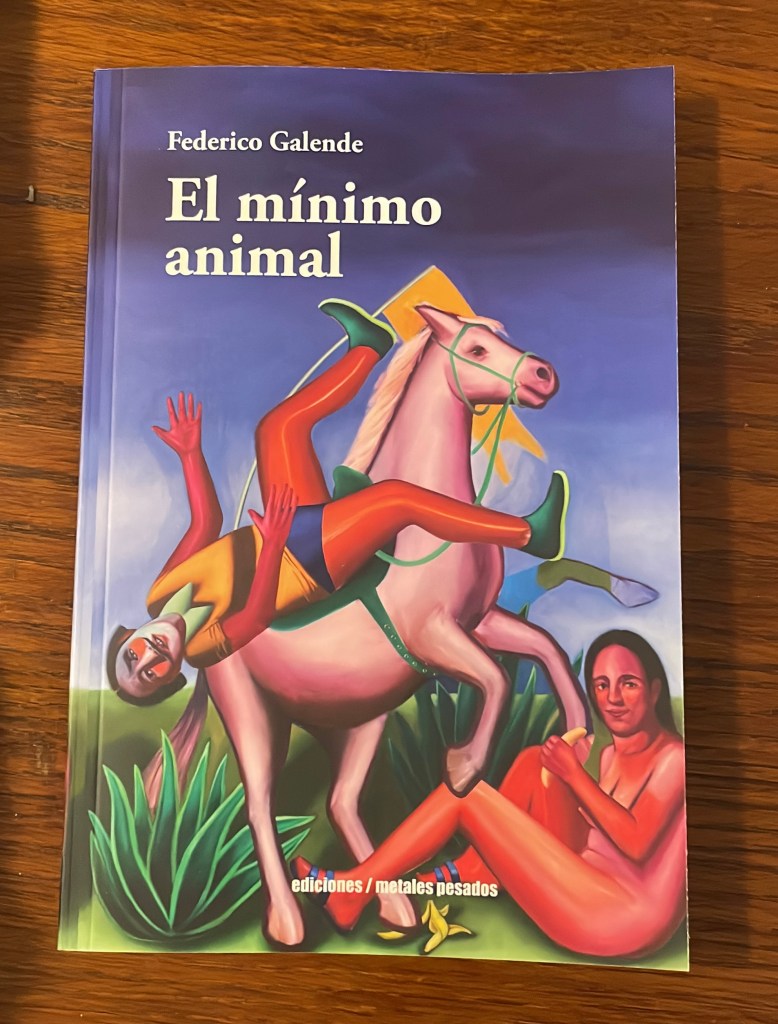
The vanishing horse. On Federico Galende’s El mínimo animal (2025). by Gerardo Muñoz

Federico Galende’s most recent essay El mínimo animal (ediciones metales pesados, 2025) is freestyle mediation on the singular animal that is the horse. When we say ‘horse’ we immediately dispense a bulky package: it is Pech Merle cave paintings and Franz Marc; it is Kafka’s parable of the racing red Indian, the agonizing horse in Picasso’s Guernica, as well as Juan José Saer’s mutilated horses in Nadie Nada Nunca (1980). Galende’s tiny mare, however, is first and foremost a memory of his childhood in the green grasslands of Córdoda that, we are told, had a big white spot in her muzzle. The first pages are spectacularly bucolic in a sedative language that retrieves a descriptive pollination of events and figures. But immediately the book gains depth and surprising detours. Galende notes that the relationship between humans and the horse differents slightly from that of pets, not as a question of scale, but primarily as complicity in language that shares the solitude between species: “…porque la del animal es una compania ofrecido a la soledad de lo humano en cuanto especie” (Galende 23). Avoiding the humanist temptation that makes the animal into a fantasy of the human, Galende’s situates the horse an experience beyond language. Is not this common solitude – that a few pages before Galende refers just in passing as ‘nocturnal communism’, in an esoteric allusion to his book on the cinema of Akis Kaurimakis – what has been usurped by the total domestication of species in a world that walks towards extinction? Galende’s El mínimo animal (2025) is an exercise in retrieving this innocence abode of man and animal in their reciprocal, and yet intransigent, mutation between worlds.

As a painterly writer, Galende is in full awareness that he must first interrupt the heraldic density of this animal. Because we know that the horse is an emblem of St. Paul’s way Damascus as much as it is one of modernity’s energy and mobilization. Galende is quite aware of it: the notion of “horse power” registers the unity of measurement of potential power for engines and motors. And just like the steamboat and gaslight, the horse stands a figure that unleashed a civilization defined by development and domestication of the world. The horse entered history through the main door of modern spiritualization (Galende does not elaborate on Napoleon’s famous horseback riding entrance in Germany, avoiding an image that is perhaps too obvious, already “manoseada”), allowing for social stabilization and homogenous time; the arrow of progress that underpins subjective historical consciousness. Galende writes, for instance: “De ser una masa abstracta que rodea la tierra, el espacio se convertía en una línea delgada, con la historia estirando un hilo la materia cósmica de la simultaneidad. Ahora, gracias al caballo, se tenía acceso a los lugares más retirados, solo que a causa de la velocidad de se los pasaba por alto de modo que lo que hasta allí había reinado de la imaginación comenzó a ser parte de lo accesorio, de lo circunstancial” (Galende 82). 

The unification of the planet under the nomoi of depredation would not have been possible without the domestication of the horse to coerce the acceleration of time as the index over space. As a cypher of time, the horse started to pop up everywhere progress made a violent incursion. This is perhaps why Galende, in a poetic style that seeks no conceptual scaffolding for self-assertion, claims that in its mystery the horse is not embedded in an ideal of freedom – which will be the freedom already fallen prey to the tribulations of civilization and the political world – as being in the world as such, without the pretensions of overcoming it; remaining a witness to permanent discontent in the open distance of some meadows (Galende 61). Can a notion of freedom be rethought from the figure of the horse at the end of history? Galende does not provide an answer, and his muteness is an attempt to resist transforming the horse into an apodictic symbolon of human anthropology transpiring meaning where there is none. The horse – and perhaps all animals are – stands for muteness and companionship without the burden of proof.

Perhaps the ultimate meaning in El mínimo animal (2025) can only be grasped in those silences, in what remains unthought and unsaid, which is another way of saying that Galende has provided the essay not only of form but of a soul. All things considered, the mystery of horse is a passing memory of the modern: speed, total mobilization, energy dispensation, the unity of a compact and legible world. What remains of the horse after the watershed of modern times; literally its exhaustion? Ultimately, the horse as species recalls the “specio”, which means to see, and to have the visibility for discernment; to be able to see with a sensible eye that blushes at the world before it crumbles into despair and conflagration at the threshold of the Anthropocene. And in many ways we are already there. Galende’s musings speak to an abundance trimmed by a trotting horse that only reappears in a poetizing that is capable of thinking and loving what has passed, like the epoch of horses. For Galende the horse is thus always sub specie aeternitatis. Towards the end of the book, and condensing Gottfried Benn’s argument on style as ranking higher than truth, Galende makes an open apology for appearance, that is rigorously eternal because it is concrete and unforgettable (Galende 91). 

Of course, the same can be said of Galende’s serpentine, courteous light prose – like a horse, that is, “una elegancia contenida” – that refuses the monumental and sterile retrievals of sedimented and dusty knowledge on the horse or any other animal (Galende 43). In this sense, Galende’s horse differs fundamentally from Blumenberg’s lion in its refusal to make of the species an anthropological metaphor, that is, a mere creed for the human bonum commune to stabilize social reality. Departing from the offerings of a meandering memory, Galende’s tiny animal is a vanishing horse that interrogates what it means to inhabit the space of non-relation that opens up when the modern scheme based on production, progress, and energy comes a halt. It is this “nothingness” what the vanishing horse reveals beyond itself, as Galende writes:

“Retirándose, el caballo le estaba advirtiendo a todo el siglo XX que la historia de retira con ellos y el mundo también, y todo lo que siguio 4 después de que por inercia ese siglo hiciera desfilar frente a sus narices las profecías más disparatadas…Pero no esperar nada no significa estar consciente de no esperar; puede ser al revés, que la nada sea una intersección invisible entre un sinfín de velocidades insustanciales. La aceleración de la vida – para decir lo con una expresión manoseada -…sirve para compensar este vacío que dura…” (Galende 87). 

In the stretched historicity of boredom and nothingness, memory awaits and assaults like an incoming galloping horse. And when Galende speaks of the “nothingness” that mediates between the temporalities of human action he is indexing the fabric of life; since authentic life only happens, as Don Delillo claims at the opening lines of Point Omega (2011) not when words have been spoken or inventions patented, but in the self-awareness of microscopic fragments of facticity. It is at this moment, when history unravels as a farcical script of putative norms of human action, and imagination can begin to gather species outside itself; in this way, perhaps once and for all, leaving behind the atrophies of nihilism already deposited in a language of strange instruments and recyclable data.

Just like Marguerite Duras’ Little Horses of Tarquinia (1953), where the Etruscan sculpture of a winged horse fails to enter the plot of a community of friends at a beach-town; Galende’s horse also disappears in the concluding pages of the book. In fact, there are two disappearances: first, the equestrian statue of Baquedano in Plaza Italia after the October social revolt of 2019; and, more importantly, that of his childhood mare in the hills of Córdoba. The vanishing horse at the limit of prose recalls the reality of the living for which there is no tropology: “…nunca conocí a ese ser, así como no es possible – nunca jamás – conocer a los seres ni tampoco el fin de ninguna historia” (Galende 110). As the horse makes his exit, we can only be sure that life has taken place elsewhere. Only because it has been transfigured in thought, Galende is able to seize a glimpse of it; a glimpse that is imperceptible and diluted before vanishing forever.

The name Beatriz Viterbo. by Gerardo Muñoz

The central question that “The Aleph” raises is as banal as difficult to answer: who is Beatriz Viterbo? For one, she is dead. Borges’ Leibnizian experiment with the infinite point of the universe is that even assuming that we account for all the possible predicates of this person we still cannot exhaust who lurks behind “Beatriz Viterbo”. In a way, Beatriz remains encrypted in a house soon to be demolished, remaining unattainable and mysterious in the passing of the world. As we know, there have been critics that have taken up the detective task to understand the significance of the name Beatriz Viterbo by probing the story’s dedication to Estela Canto, who later became the rightful owner of the original manuscript, and that connects to Dante’s Divine Comedy in terms of its cantiche structure as well as the figure of Beatrice [1]. However, as Giorgio Agamben once said regarding the Italian poet, it is utterly senseless to attempt to identify a subject behind Beatrice, since what is at stake in Dante’s poetics, perhaps of all poetics, is the experiment of language as an experience of love [2]. What the name Beatriz Viterbo enacts is no different. 

Indeed, in Borges’ Beatriz Viterbo this experience of love is one that fundamentally lacks images and predicates of this world; which means that love, if to be held as an intensity of the living, in the name harbors the region between life and death, between memory and forgetting. These distinctions are not oppositional, but rather an angular index that defines erotic intensity; and, as we know, the name is the supreme vehicle of the impropriety of oneself because it precedes it. As Borges writes in “The theologians” also included in The Aleph: “There are some that look for love in a woman in order to forget her; in order to cease thinking about her” [3]. The fundamental formlessness of love does not depend on neither images nor acts, but on the enduring vocative or song (canto) that shines forth in the open secret of the name. 

This is why the portrait of the deceased is insufficient for the narrator of the story. In a moment that is the clearest parallelism to the concatenation of “things seen” in the aleph, the name appears four times in repetition: “Beaitriz, Beatriz Elena Viterbo, Beatriz querida, Beatriz perdida para siempre…” [4]. If Osip Mandelstam once remarked that the “eye is an instrument of thought”, one could say that the the voice of the name is the instance where language and thought coincide without remainder; a convergence of Heaven and Earth, of the dead and the living in the grain of the voice. There are no static images of Viterbo because her mysterious life, the unlived life with the narrator, is precisely the missing image guarded by the name. In the basement, facing upwards to peek into the aleph, we are told that he, Borges, will be able to “establish a dialogue with all the images of Beatriz” (“podrás entablar un diálogo con todas la imágenes de Beatriz”). But what the aleph cannot yield is the missing image that is only the event of his irreducible linguistic contact proper to his memory. Once again Maldelstam: “The word, the name, is a psyche…does not signify an object, but freely chooses, as though for a dwelling place, some beloved body. And around the thing the word hovers freely, like a soul around a body that has been abandoned but not forgotten” [5]. But what is not forgotten is not that quality or that image of a person, but the enduring rustling of a name that recalls the oldest human experience: the mystery of the voice.

It might also be for this reason that Beatriz Viterbo recalls not just Dante’s divine and eternal Muse, but the world of the dead; the vetus in ‘Viterbo’, that is, the oldest or ‘most ancient’ life that dwells in the underworld, because its direct provenance is the archaic Etruscan civilization [6]. If Beatrice, as the trope of transcendence beyond the Earth has been a repeated object of literary interpretation, Viterbo as the vetus burial has rarely generated any interest (if the house of Viterbo is being demolished, this also means that in her proper name is the burial site at the end of remembrance). 

In the cadence of the name “Beatriz Viterbo” we can hear the transit between the living and the dead, the invisible and the present, the possible predications as well as the defaced; a work of oblivion in virtue of its own caducity. “Me trabajó otra vez el olvido”, writes Borges towards the end evoking the erosion of forgetting in the void of nonpresence: the working of eros pushes to the end, towards absolute oblivion through the very accruing of remembrance. Life is this immemorial that is encrypted, as if were, in a handful of names. 

Notes 

1. Emir Rodríguez Monegal. Jorge Luis Borges : A Literary Biography (Paragon House, 1988), 414.

2. Giorgio Agamben. “No amanece el cantor”, in En torno a la obra de José Ángel Valente (Alianza Editorial, 1996), 49.

3. Jorge Luis Borges. “Los teólogos”, in El Aleph (Alianza Editorial, 1999), 50.

4. Jorge Luis Borges. “El Aleph”, in El Aleph (Alianza Editorial, 1999), 189. 

5. Osip Mandelstam. “The Word and Culture” (1921), Arion: A Journal of Humanities and the Classics, Vol. 2, No. 4, 1975, 531.

6. Adolfo Zavaroni. Etymological Dictionary of Etruscan Words (2024), 310.

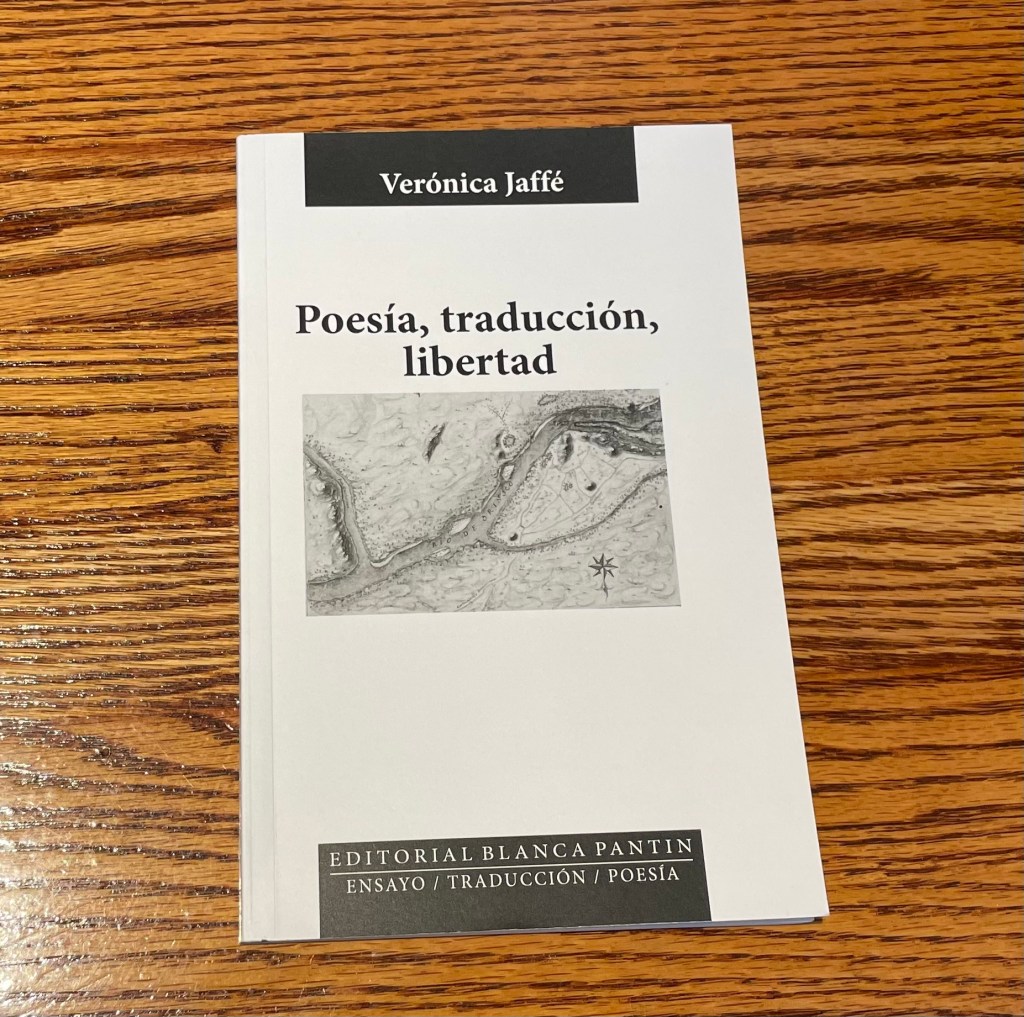
Verónica Jaffé’s translation of the “Andenken”. by Gerardo Muñoz

Verónica Jaffé’s most recent Poesía, traduccion, libertad (2024), which gathers some of the translations already contained in Fredrich Hölderlin: Cantos Hespéricos (La Laguna de Campona, 2016), features an introductory essay where she reflects on translating Hölderlin’s poetry from the German into her own creative visual renderings of Spanish. Reflecting on the difficult task, if not utterly impossible, of translating “Andenken” (in Spanish she opts for “Recuerdo” and not “Memoria”), Jaffé departs from an important observation that we must take into account here: the fact that this late hymn has been catalogued as a proemial composition. What does it mean that “Andenken” is to be read as a proem? As we know from the Ancient sources, the proem is an oratory prelude to the topic deployed in a text; in other words, it is the persuasive caesura of language before any argumentative exposition. Hence, the composition of the proem is something like the pure mirroring of language. This could explain why Hölderlin’s “Andenken” while prima facie about memory and thinking does not have a guiding thread to restrain it; it unfolds the enactment of its own recollection through the sayable.

If “Andenken” is a long proem – the space where the poem and proem absolutely coincide – then this means any translation must keep the poetic possibilities of oration in preamble, in path of preparation. Jaffé offers two distinct trans-creations of the famous poem’s last lines. The first reads thus: “Un mar que guarda los recuerdos / que da amores, que los toma / para que solo queden después / como tesoros / en quienes recuerden y en quienes escriban” [1]. In the second version, even more elaborate and idiosyncratic, Jaffé writes: “de pensar con todos / mis amores, es decir / pensar fijando / papel y lápiz / sobre tela / en memoria de todos mis muertos” [2]. It is noteworthy that the famous literal last lines of the “Andenken”, suspended in an enjambment, appeals to a canvas that is splattered with the memory of the dead. It seems of all the dead of the human race. What does it mean that the act of remembrance is the recollection of all the dead? Poetic imagination, if a testamentary document, appeals to the archaic where the living and the dead inhabit the world through image [3]. For Jaffé – but this also an intuition that Hölderlin shared in his pindaric translations – the beginning is not a previous stage, but in media res of the event of language. 

The recollection of language within proem attests to the exilic dimension of language; the site where no one truly ever belongs to: “…la lengua en mi país que no me pertenece”, writes Jaffé [4]. This means that the authentic remembrance of language is not a national language, but always ex patria lingua, or a language outside the telluric fabric of the national community. Because we are always walking strangers in our own language, the contact with the dead repeatedly reemerges in the memorial grain of the voice. 

As C.M. Bowra has noted, Pindar’s allusion to Memory takes place in the context of the Muses: “[the poet] invokes Memory because she embodies the accumulated wisdom of the past, and the Muses because they pass on this wisdom to him. What he asks from them is the ability to deal properly with what they give….men are blind if they do not pursue wisdom with the help of the Muses” [5]. If the “Andenken” should be read as a proem, this is because recollection is always fixed in the irreducible experience of our voice that recalls language from its beyond.

Notes 

1. Verónica Jaffé. Poesía, traducción, libertad (Editorial Blanca Pantin, 2024), 38.

2. Ibid., 40. 

3. Ibid., 40.

4. Ibid., 51.

5. C.M. Bowra, Pindar (Oxford, 1964), 33.

Enamoured psyche. On Pablo Oyarzun’s Hölderlin, el recuerdo (2025). by Gerardo Muñoz

The concluding verses of Hölderlin’s “Andenken” (“Rembrance” or “Memoria”), “Yet what remains, the poets found” stands as one of the preeminent testaments of modern poetry, and in Heidegger’s famous characterization, as a declaration of the task of the poet. At least since the time of Stefan George and Max Kommerell, the figure of poet or Dichter, a hyperbolic figure of illumination and guidance caught in the net of poetry and philosophy, was already dependent on Hölderlin’s mysterious words. What remains in what the poet remembers and clears for foundation? What is the relationship between remembrance and what is ‘found’ or ‘established’? “Andenken / Remembrance” is a hymn from the late period, which means that it must be read in consistency with Höderlin’s poetological framework as it reaches its maximum degree of intensity in its declaration and deliverance. Pablo Oyarzun’s most recent Hölderlin, el recuerdo (Mudana ediciones, 2025) is a powerful and subtle contribution to the understanding of this poem that measures up to the task in its attention to lexicon and structure, metaphysical condensation, and the vortex of ‘memory’ that discloses the poem. One of the merits of Oyarzun’s philosophical hermeneutics, if we can call it that, resides in its refusal to incorporate philosophical doctrines to inform the major questions of the hymn; rather, he favors the very unfolding of the poem ramping its internal structure for possibilities (Oyarzun 18-19). Rereading “Remembrance” opens a path between philosophy and poetry in the dawn of the realization of metaphysics, whose price was paid by crushing the possible and the voice of the poem. 

For Oyarzun the poet’s remembrance is that of appropriation of what is proper, and thus inappropriable, and to which the hymn can only ‘thank’ in the way of thinking as figure in the face of the unfathomable. Following Heidegger’s reading to a point, to give thanks is also to welcome and greet that lets humans and things be in their truth; since greeting always assumes otherness as foreign into presence (Oyarzun 29-30). And in presence life acquires texture, depth, singularization, but also conversation; a reminder that will control the rhythm of Hölderlin’s hymn. What is brought to presence, then, is neither a possession nor a legible inheritance, but the non-synthetizable modulation of what is proper in virtue of being absolutely alien (Oyarzun 34). What is recalled in this poem that remembers and thinks the unthinkable? Is it just a stage for Hölderlin to poetically transfigure his well known travels in Bordeaux? Oyarzun tells us that even if that is to be taken into account, the foreigner path is only essential as a way of homecoming, making the site (and song) into the hymn (Oyarzun 42). There is relation to the absolute other, but only as transitory to becoming and divine destiny in the world: “…el espíritu ama, porque precisamente así, ensa autoalienación puede transitar a lo otro que lo otro, es decir, apropiarse de lo propio […] el pensamiento del Ereignis está condicionado estructuralmente poesía ex-propiación, por ese retraimiento, distracción o retiro (Entzug), solo puede el cual se da lo propio (Oyarzun 54-55). Höderlin’s poem sings from the lacuna of its own expropriation of the abode. And that abode is ultimately the unworking of remembrance and memory that is defaced in being absolutely intimate and irreducible.

In order to elucidate the contours of this memory and its oblivion, Oyarzun follows Dieter Heinrich observation that: “este movimiento [of remembrance as transcendence] conocedor de su propio curso y a la vez desviado del mismo, aspirando a un conocimiento en que algo perdurable (lasting), con gratitud, reine aún en la superación – esto es remembranza” (Oyarzun 61). What is remembrance if not what unweaves time? It is not an actual faculty of human psychology, nor a spectral incorporation of a missing object; rather, it is the non-syntheizable partition between language and the wound of existence; a separation that is only redeemed in the way of remembrance that deposes an ideal recollection of missing facts in preparation for recomposition. Oyarzun’s reading will depend on clearing the notion of severability as a condition for remembering and forgetting as it makes an entry into the poem’s final verse about the “fixating eyes of love” (den Blick heften). Helena Cortés Gabaudán translates it as “y el amor también fija aplicadamente los ojos” [1]. “Y también”, “but also”, a conjunction of persistence that Oyarzun reads as an inexorable attachment to memory and separation, and the memory of separation (Oyarzun 68). Because there is no sliding towards remembrance without departure, coming into the presence welcomes the memory that, in that very moment, has transformed our souls. 

Ultimately, for Oyarzun the vortex of Hölderlin’s “Andenken” is love understood as the supreme citation that enacts the place of both thanking and remembering: “Amar es recordar, frecuentar con el recuerdo (el pensamiento), lo amado, incluso allí donde lo amado está presente, porque así lo resguarda de la mera posesión y agradece su presencia. Amar es pensar-en, un modo, tal vez el más entrañable, de Andenken, amor” (Oyarzun 73-74). And this means that what remains and endures, as Adorno observed in his well known essay on parataxis in Hölderlin’s late poetry, is neither of the logical nor of the temporal indexes, but the event of language as originary creation and donation without contestation (Oyarzun 77). This is the instance where Hölderlin’s strange case of the divinization of the word – and this is the particularity of the hymn form, an element that is never teased out by Oyarzun – becomes absolute and intransigent. It is Höderlin’s absolute proximity with the classical world, but also its radical separation in the post-mythical world of dissenchantment. It can be said that that what endures ‘thanks’ the love of remembrance in its persistence of the word that does not allow history and the crisis of tradition: “en nombre de la cosa que queda, en la fragilidad de su tiempo, que es ese mismo quedar” (Oyarzun 79). 

The poem becomes the verbal and sayable site where the poetizing resides, as well as the greeting and farewell of departure, just like the spectral sailors of the poem. What endures intimately can be called love as a form of the immemorial (Oyarzun 80). And that is because in inscribing, or holding on to the irreducible origin, poetics becomes the supreme form of love – the love in separation – of an expropriated language that welcomes us home in conversation with friends. This attests to the spirit of Hölderlin’s well known letter to his friend Böhlendorff in 1802: “A los artistas les hace falta la psyche entre amigos, el nacimiento del pensamiento en la conversación y la carta. De lo contrario, no gozamos de nada de esto para nosotros mismos” [2]. And this intoxicated love in language that departs from separation situates Hölderlin as radically different from the Chirstian agape and its bond of perfect unity for securing salvation (Colossians 3:14). A salvation that Hölderlin overcame in the drama of Empedocles, enacting the impossible incorporation of the aorgic physis through the writing of the tragic myth. 

Now we are also able to understand why Hölderlin transited to the hymn as the supreme form of the poem; not because because it is the origin or its last stage, but a suspension of language retrieved is gathered in the two moments of salutation and farewell, celebration and lamentation [3]. The hymnal dimension of the poem becomes language as such, which Oyarzun calls the immemorial without ever alluding to the notion of hymn. Indeed, the love of remembrance only becomes possible as a disjointed factum of experience anchored in its abyssal noncorrespondence  (Oyarzun 84). Thus, to remember is to love the caducity of life – “este ya no es la signatura indeleble del amor”, as beautifully expressed by Oyarzun – in a world in which the testament of language awaits no resurrection. 

Notes 

1. Friedrich Hölderlin. Poesía esencial (La Oficina, 2017), Trad. Helena Cortés, 129. 

2. Friedrich Hölderlin. Correspondencia completa (Ediciones Hiperión, 1990), trads. Helena Cortés & Arturo Leyte, 554. 

3. Nicoletta Di Vita, Il nome e la voce: Per una filosofia dell’inno (Neri Pozza, 2022), 246-247.