
During the flourishing of Renaissance civic humanism, the tradition of Tacitism, as well as the work of Tacitus, was broadly understood as advisory to the problem of tyranny within the cycles of political power’s rise and decline, unmasking imperial rule’s debasement and cruel domination [1]. It is in Edward Gibbon’s erudite project where Tacitus’ political wisdom receives an integral treatment about the institutional dimension of power and its cohesive structure based on both facts and theoretical presuppositions. For Gibbon, the wisdom of Tacitus is not merely anchored in theoretical speculation; rather, the rhetorical construction takes its energy from the convergence between historical facts and the physics of a concrete political order. Tacitus’ wisdom is practical but also flexible, and this entails that political realism is not about the opportunist dimension of power (although this most certainly occurs in every political community), but about the deployment of analytical understanding regarding faults, fissures, and disequilibrium of institutions. Tacitus’ thought is about vision, and this means looking at the cracks, identifying the asymmetrical correspondences, and teasing out the nuances of a particular reality.
This presupposes that Tacitus’ enduring notion of the arcanum imperii, far from posing a ‘mystery of the state’ (its legitimacy, rule, and mystical reserve), allows for a strong narrative about the latent crisis internal to every political community. Tacitism is, insofar as it confronts the crisis and ruin of a political order, draws a negative reflection on the ongoing force of civil war as a historical and existential condition of domination. In other words, no politics can exist without the concrete legibility of the faults of conflict, which ultimately entails that civil war and political power are constantly in proximity. The arcana delimits the problem of civil war as the internal contradiction of every imperfect institutional design that cannot transcendent its own crisis through conceptual reordering.
At the center of Tacitus’ arcana in Rome is the death of Nero as well as the fault lines of civil war: “The was revealed that arcanum of state, the discovery that emperors might be made elsewhere than Rome” [2]. Of course, Rome as the glorious center of power was fundamental and indivisible; but for Tacitus the argument condensed in the arcana is precisely that the corruption of politics takes place when political representatives (power delegated at the provinces) and that of the center ceased being in coordination, losing the grip of institutional mediations. Thus, the ruin of politics is best expressed by the disjointment of formal procedures between authority and delegation, the vesting of the emperor and territorial monopoly, legitimate rule and predatory corruption. When this happens the arcana is transformed into a permanent revolution that dissolves checked political rule into the willful triumph of the uncontained and proliferated fragmentation (this is why Tacitus looked back with nostalgia to the unlived era of Roman republicanism).
For Gibbon to hold on to the Tacitan tradition of the arcana imperii meant, above all, to underscore the esoteric relationship between history and revolution as part of the desire to understand political energy, which he posed as a methodological concern: “In our larger experience of history the imagination is assisted by a perpetual series of causes and effects , to unite the most distant revolutions” [3]. The arcana is political wisdom of a secondary source; that is, it’s not a normatively established political premise or category, but an excess to description of political order. Hence, it is not that the arcana imperii is a monocausal and ultimate foundation of instability – and in this sense he was still faithful to his conception of plurality of causation in defense of the study of literature and the imagination – the emphasis is placed, on the contrary, in the way in which grasping the archeological and heterogeneous field of tension that will reveal, in turn, the historical specificity of the arcana [4].
In other words, the arcana grants access to the fundamental features of the epiphenomenon of civil strife without a recourse to abstraction and the closure of the concept. In this way, it could be said that the arcana (in part in the reading that Gibbon undertakes of Tacitus) is continuously operating in three distinct registers: a) it is a comprehensive analytic of the plurality of causation that impact political conflict and civil war, b) it reports to the center of authority, probing its direct and indirect meditations on the ground; its forms of delegation and adjudication, and its production of legality and dominium and implementation; c) it demands to design a description and a narrative of the political situation in order to properly respond to the paradox of tyranny and corruption within a specific polity.
Having sketched out the operational effect of the arcana, we can say that the notion is far from being reducible to a Renaissance “ragion di stato” scenario assisting in the consolidation of power in the hands of the price; the arcana seeks to elucidate the contours and limits of the intensification of war and its risks; a problem that becomes central to Hobbes notion of the state [5]. To claim that this political wisdom is something that merely emerges technically-placed in the Renaissance “great men”, and systematically blurred in modern liberalism is a thesis that will need further elaboration about the resources of the state and the underpinning of modern legitimacy through civil society and its late-modern mutation into planetary imperial spaces. In a certain sense “Tacitism” opens the possibility of sketching the political crisis of in each distinct epoch. It is perhaps in this sense that Carl Schmitt invites us to think the issue in an entry of his Glossarium:
“The beginning of Tacitus’ Histories has moved me. Is it just rhetoric, like Ortega told me?’ Isn’t it about the identity of the situation, that is, existential participation, participation in one and the same nuclear and ancestral situation of our eon? Every word of that chapter of Tacitus is absolutely current: «Magna ingenia cessere; opus adgredior optimum casibus, atrox proeliis, discors seditionibus, ipsa etiam pace saevum. Of course, “ipsa etiam pace sacvum, bella civilia et exterior plerumque permixta.” The relationship between international war and civil war, that is not rhetoric but the horrible reality recognized and expressed, the non-distinction between war and peace.” [6]
The arcana never truly coincides with a philosophy of history or a rhetorical veneer of civil existence (social contract). The subversiveness of Tacitus plays out in thinking through the elaboration of a specific governmental organization [7]. And what is the “ancestral situation of the eon” if not the polar relationship between political order and stasis, the duality between civil war and the principle of authority, the nihilism of the will and the limits of a public rule of law, however ordered? Tacitus’ classical wisdom, invested in plotting legible facts with a singular narrative, far from raising itself to a “science of politics” or a set of “fundamental principles of order”, responds to potential fluctuations devoid of a universal grammar. In this way, politics remains closer to a physical experiment: an active self-evolving canvas in which the arcana is irremediably drawing upon the instituting and destituting of interconnected forces at play.
.
.
Notes
1. Arnaldo Momigliano. “Tacitus and the Tacitist Tradition”, in The Classical Foundations of Modern Historiography (University of California Press, 1990), 120.
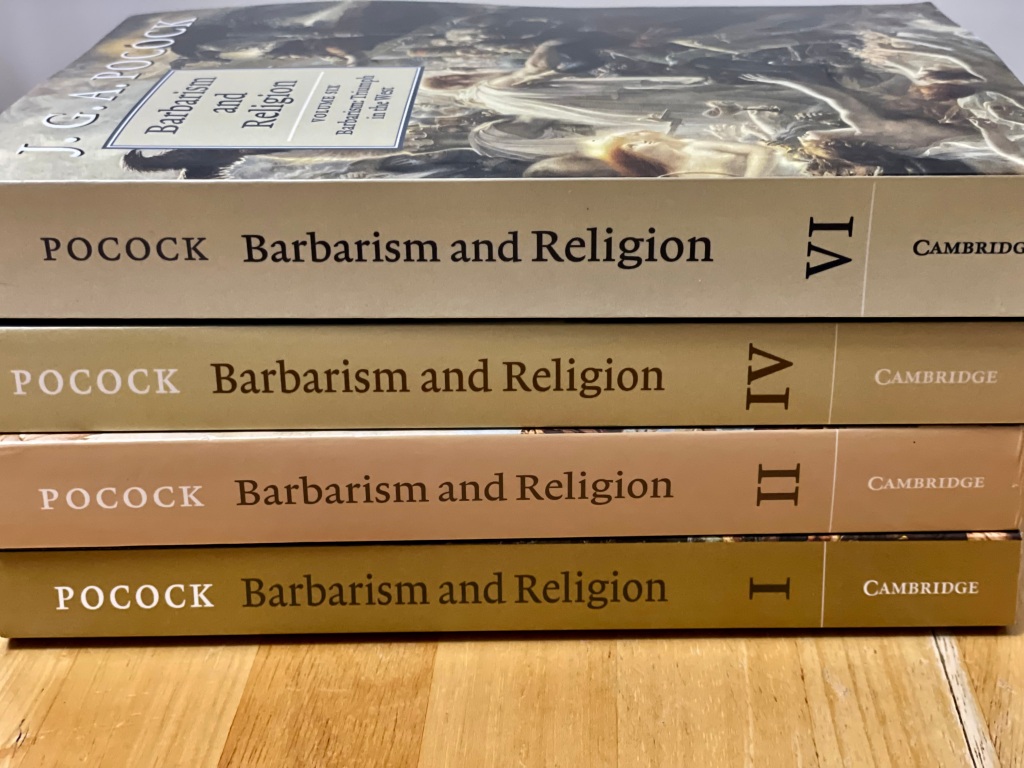
2. J. G. A. Pocock. Barbarism and Religion: The First Decline and Fall, Vol.III (Cambridge University Press, 2003), 25.
3. Ibid., 58.
4. G.W. Bowersock. “Gibbon on Civil War and Rebellion in the Decline of the Roman Empire”, Daedalus, Summer, 1976.
5. Richard Tuck. “Hobbes and Tacitus”, in Hobbes and History (2000), eds. G. A. J. Rogers and Tom Sorell, 99–111.
6. Carl Schmitt. Glossarium: Anotaciones desde 1947 hasta 1958 (El Paseo, 2019), 7.
7. Ronald Syme. “Who was Tacitus?”, Harvard Library Bulletin XI, Spring 195, 185.
 Infrapolitical Reflections