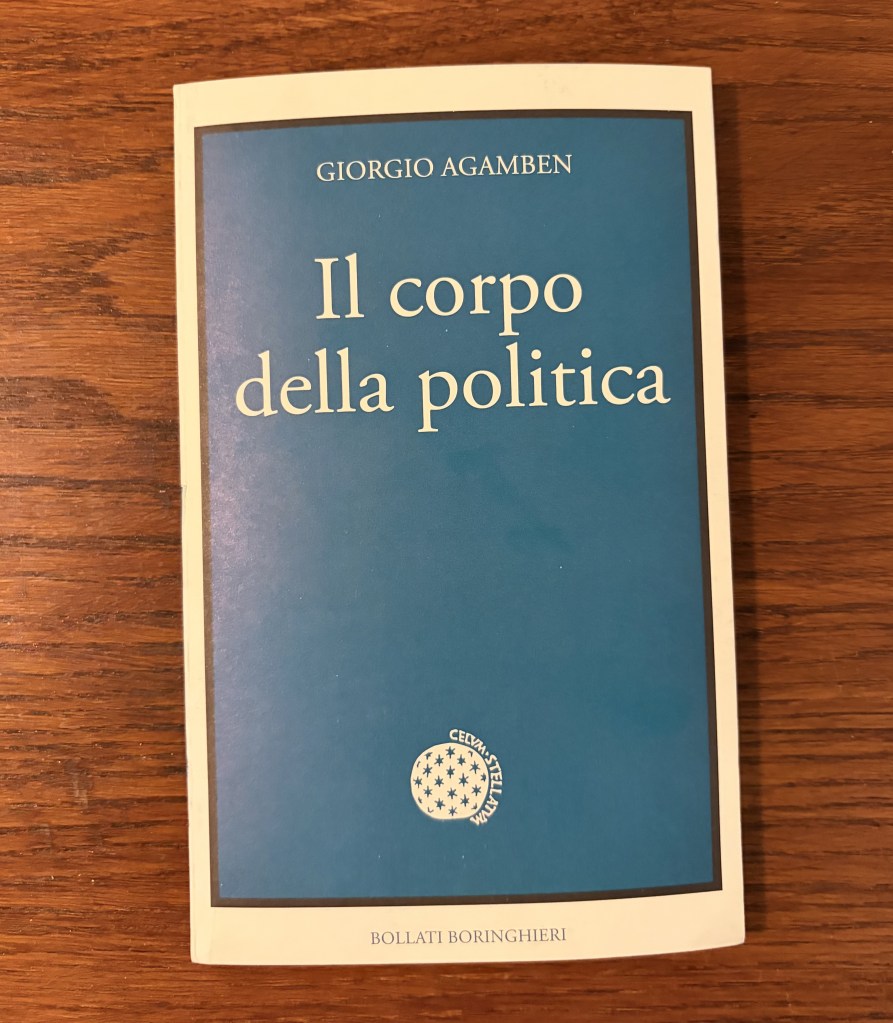
Assimilation in exile. On Giorgio Agamben’s Il corpo della politica (2026). by Gerardo Muñoz

One of the decisive lessons of Giorgio Agamben’s archeological examination of Western politics is that the imperative to confront the closure of representation, sooner or later it must also come to terms with the notion of the body (corpo) as a central metapolitical condition in the genesis of modernity. If L’uso dei corpi (Neri Pozza, 2014) brought to its final stage the philosophical exploration of Western ontology of politics defined by efficacy and realization; in most recent opuscules, Agamben has shown how the fixation and regulation of the body is also embedded in the regions of language and sensation of human life as well.  In this sense, it is impossible not to read Il corpo della politica (Bollati Boringhieri, 2026) along with Il corpo della lingua (Einaudi, 2024), as two parallel commentaries on the defining stature of political representation. If a new beginning is one of the decisive questions of our times, then one of the pending tasks is precisely to think the body (corpo) against the ontotheological assumptions of calculative reason.

Similar to Il corpo della lingua (2024), Il corpo della politica (2026) starts with the treatment of the Copernican revolution of bodies in Hobbes and Newton, which in the face of the cosmological infinity inscribed a notion of two bodies in order to allow for representation within spatial coordinates. In other words, Hobbes’ artificial sovereign represented by the mortal god Leviathan (state normative authority) will have an autonomous colorary in the autonomy of the subject that will become “political” as long as it becomes coterminous with the civic body of the “People”. Thus, to speak of “bodies” is not just to rationalize physicality in space – although it is also this from a technical viewpoint that state legibility will soon demand of the incipient civil society – but more importantly, it entails the administration of energy and movement (in Agamben’s well known lexicon, the domestication of potency to the realization of purposeful ends). For Agamben, Spinoza’s conatus, which appears in the Baroque period in critical dialogue with Hobbesian and Newtonian frameworks should be read precisely a way to think past the body as substance, following the steps of the tradition of ancient Stoicism in which beings are corporeal insofar as they are in tension with the world, allowing the tonos or acoustics to animate being in its movement towards preservation and exposure (Agamben 20-21). 

If all beings are traversed by a tonos – a tension that crosses as its medium in virtue of its contact with the world – this means that they are no longer defined by a substance, but as intensity within a field of forces once thrown in the world. As Agamben writes in passing with explicit confrontation with Heidegger’s Being and Time: “…con la tesi perentoria ‘l’essenza dell’esserci giace (liegt) nell’esistenza’. L’esserci è stato “gettato” nel mondo, ma si direbbe che, una volta gettato, non cade in piedi, ma giace (liegen significa innanzitutto essere sdraiato). E questa concezione sub-stanziale dell’essere che il conatus mette radicalmente in questione” (Agamben 23). In an archeological gesture that is already signatura of his work, Agamben reminds us that Hobbes’ substantive and artificial division of the “two bodies” that anchors modern politics can be traced to the corpus mysticum and the theological debates concerning transubstantiation that will later be recasted in the intersecting works of both Ernst Kantorowicz and Carl Schmitt, in which the impolitical dimension of the multitude becomes political through the artifice of decision and representation of a unified and indivisible body (Agamben 25-26).

The catastrophe of modern politics takes place when the body, once reduced to a substance and computable object in space, ceases to be understood as an inteusum or intensity of an irreducible multitude that expressed a generic and universal human species, as it was for Dante: “La politico – il finis totius humanae civilitatis che Dante intende definirie nel suo trattato – è ancora una volta un campo di tensioni interne allo stesso genere umano e questa intensità ha la foram di una moltitudine” (Agamben 39). In other words, for Agamben following the implicit tonus present in Dante’s Monarchia, the political is neither action nor mediation, but what names the very site of the possible. Agamben calls the hypothesis of an “anarchic politics” (politica anarchica), which no longer defines itself in relation to a formal mediation of government and state, but rather as the intensity of the multitude through the generic being (Marx) or the universal humanity (Dante) that takes the form of sensible Empire devoid of principial politics mediated by constituent power (Agamben 47). 

Where does the multitude dwell outside the constituted representation of a community of belonging or the social mediation of the state? Already in 1990s Agamben had written a gloss on the politics of exile collected in Mezzi senza fine (1996), and the last part of Il corpo della politica (2026) he returns to philosophical and theological notion of the exile vis-a-vis the historical experience of the Jewish tradition as an errant or stateless people, as Erich Unger called it in 1922, whose existence has been defined by exile or galut (Agamben 48). It is a bit of a misnomer to call the exilic experience a “politics”, since for Agamben the authentic tradition of exile does not entail the right or duty fixed to a community of belonging; rather, what outlives the law is the only path capable of deposing it (in the manner of Paul, that is, as katargeo). In this way, justice is now understood not as a procedure in a normative system, but as a written tradition that can only be studied and reflected upon and ultimately experienced as a state of passivity.

Hence, the exilic experience is the caesura between language and world, in which we touch the exteriority with a renewed intimacy that unfolds the uncommunicative solitude that keeps the mystery of our use of language. Following the neoplatonic formulation “phygé monou pros monon” – understood by Erik Peterson as an expressive mystical relation of a “fuga di un solo presso un solo” – there is intimacy and authentic belonging whenever there is sensible separation in being (Agamben 55). Following Plutarch and Plato, for Agamben the exilic dimension is the very home of philosophy and thought, which confirms, against Crito’s suggestions at the end of Socrates’ life, that there life outside of the polis and the conglomerate of the demos, because life is outside itself once it is assimilated in the virtuality of a divine that nourishes its own potency.  In what stands as one of the most precise formulations of the pheugein (exile) condition as a figure of existence, Agamben writes of its precise ascesis: 

“La celebre definizione ascetica della fuga dal mondo come assimilazione a Dio andrà resa, pertanto, restituendo tutta la sua forza alla metafora politica: “l’assimilazione a Dio virtualmente un esilio” (kata ton dynaton significa qui, secondo il sense più proprio del termine dynatos, “virtualmente, secondo la potenza). L’affermazione e tanto piu significativa in quanto, con queste parole, Platone rompe con l’insegnamento socratico del Critone, secondo cui la possibilità di phygé offerta al condannato non potrà che essere rifiutata, perché non vi è vita possibile fuora dalla polis” (Agamben 57).

This region that precedes and exceeds politics – in the language of Sophocles, the well known ypsipolis apolis – is akin to the tone that runs to the forgetting of any substantive ontology of politics that seeks to subsumes life into the confinement of external forces. It is in this paradoxical situation of assimilation in exile, and a permanent exile that assimilates itself in God as shared thought that politics can be transfigured as an apodemia that refuses the closure of life into principles of government and dominium, and away from the community form of propriety and rooted belonging. Agamben recalls that in the history of Christianity, it is the time of the parish (paroikias) what allows the soul to live in earth as foreigner and exile, in proximity of the medium of the kingdom, and that only later with Saint Augustine it was transformed into a territorial institution for the communio and communal salvation (Agamben 60-61). In the paroikias, Agamben returns to the kingdom not as a retheologization of the politics, but as a figural parable in which a poetic dwelling is enacted in the measureless passivity of a form of life, a project consistent with the formulation of the singular whatever being articulated in La comunita che viene (1990).

The assimilation in the exile of the divine, which recalls the forgetting of oneself and the god announced by Hölderlin in“Note on the Oedipus”, is refined in the last essay of the book entitled “Il corpo dell’Europa”, which reproduces a lecture delivered in Venice in May 2024 about idea of Europe. As a sort of concluding reflection or apostilla, we are now able to say that for Agamben the only possibility of dwelling in the vestiges of the European tradition and memory is to rescue, from the wreckage of its history, the sediments of a texture of the phygén: to be exiled is not just a vitalist affirmation of this life, but more importantly, it also implies disclosing the possibilities buried in the past with the dead, that is, in contact not only with Gaia, but also in the downward movement to the domus of the infraworld (a figure that receives a novel treatment Agamben’s recent book La lingua che resta). Agamben exemplifies this exile with the dead with three poetic moments of high european modernism: Ezra Pound’ Cantos, T.S. Eliot’s The Wasteland, and Eric Auerbach’s masterpiece Mimesis written from his exile in Turkey – and of course, we could also think here of Kafka’s parables and Joseph Roth’s narratives of Jewish errancy; as well as Alexandre Lerrnet Holenia’s phantasmatic crumbling of Empire in The Standard and Osip Mandelstam’s “The Fourth Prose”, where the end of the work leads to the human voice as the supreme poetic task in the face of nihilism and political totalitarianism. 

It should be clear, however, that the problem is not found a temporary refuge or a last stand in the fortress of modern literature, but of coming to terms with the phygé as a fundamental problem of language that, in virtue of its unique and irreplaceable experience, delivers a world nested in the affection of remembrance. As Agamben asks towards the end of the lecture: “Is there a sensibility and a form of life that we can call European?” (Agamben 82). This question can only be answered when we dwell and assimilate into the exile of thought that harbors the residues, figures, and voices that speak to us from the dead in a tradition because it is no longer transmitted, we can only access it poetically. In the only moment that the word anima (soul) appears in the text, in the very last sentences, it becomes clear that it is only in the intensity of thought that life accounts for the inseparability of the body and the soul that historical abstraction has rendered oblivious and alien from the tonos of presence. We are not yet ready to declare a return to the appearance between being and world, and for that very reason even the presence of the divine, as Agamben says following Isaac Luria, is itself exiled from the creation of the world until the advent of the tiqqun in the night of restitution. The exilic dwelling of life outside itself is marked by this sort of secret unfaithfulness in the absence of the god. In the meantime, the task of an ethical life is to passively reside in an exile where the reality of the soul returns what is possible and breathable to the appearance of the real.

Reformation and administration. by Gerardo Muñoz

The dispute concerning the legitimacy of modernity also implies the question of the reformation, which transferred the power away from the hands of priests into a new priesthood of everyman’s consciousness. This was the Lutheran self-affirmation of economic theology (it has been laid out by Monica Ferrando’s recent work). The new priesthood implied a consolidation of the power over interpretation, since the biblical sources were now opened to battle over meaning itself. The interests over the Hebrew sources were not new, as a contemporary scholar has shown, but it was of central interest to the hermeneutics of sola scriptura over the scrutiny of the canons [1]. If this is the case, how come Thomas Hobbes account of the religious sources point to a different dimension of revelation? As we know, Hobbes was not alien to the ancient Hebrew sources, but his treatment and conclusions were entirely misplaced. Here I want to briefly account for this divergence.

In reality, it was Carl Schmitt who best confronted this problem in a late essay form 1964, published in “Der Staat, “Die Vollendete Reformation” by asserting that Hobbes’ place in the constellation of the modern political theology of the reform was rooted in the invention of the autonomy of the political. Schmitt works his way through Hobbes’ second bibliography in a subtle way, reminding us that the theorem “Jesus is the Christ” meant the artificial creation of a political technique over the battle over “meaning and truth” that fueled the European wars of religion. Hobbes, contrary to the theologians, became the founder of a counter-power: the confrontation between Leviathan and Behemoth. Indeed, for Hobbes the “reformed theologian” stands as the Behemoth, but it has yet to come to terms with the question posed by Leviathan as who will decide. This is for Schmitt the kerygmatic theme of the New Testament, which will only be decided at the end of times, but meanwhile the decision through authority is the only way in which the problem of “civil war could be neutralized. As a commentator of his time, Schmitt was directing a direct arrow to Rudolf Sohm’s idea of reform, which ultimately coincided with an economic theology bypassing the fact that the era of concrete political theology had its ultimate principle in authority of the sovereign’s decision [2]. 

Although never registered directly, the lesson of Hobbes for Schmitt resided in circumventing the rationality of the scientist and the technocrat, going as far as to mention Simone Weil’s critique of the codependency of the total state with the essence of technology [3]. The question of decision was Hobbes’ metaphysical solution to an “intra-evangelical war”, which introduced the immanentization of indirect powers unto the flatten space of civil society. In other words, for Schmitt, the true father of the “spirit and letter” of the Reformation was neither Luther nor Calvinism, but Hobbes’ Leviathan insofar as it was able to offer a third option against the secularization of a universal priesthood of the autonomous economic theology. But this is only the beginning of the problems, since we know that Hobbes’ political philosophy was dependent on “civil society” preparing the conditions for the liquidation of anti-normative decisionism. Schmitt himself was aware of this towards the end of his monograph on Hobbes as a farewell to state form. Hence, the epoch of political theology was brought to an end not through reformation, but through the ever-expansion of the operative sphere of the concept of the civil. The triumphant economic theology that has only intensified well into our days adequates to the fullest extent to the infrastructure of Hobbes’s project. 

If this is the case, the differentiation that Schmitt establishes in Political Theology II between ius reformandi and ius revolutionis collapses, given that the solicitation of the autonomy of the social requires an ever-expanding outsourcing of administrative apparatus that will turn legality into the bin of administrative application (Verwaltungsrechts einzufügen unwissenschaftlich) [4]. And in the face of administration political theology loses its grip, and economic theology silently takes hold. The subsequent internal triumph of the verwaltungsrechts einzufügen will bring to an end the epoch of political theology. The ideal of the Reform took this challenge and brought it to the very anthropological core of humanity.

.

.

Notes 

1. Eric Nelson. The Hebrew Republic (Harvard University Press, 2010), 8.

2. Carl Schmitt. “Die vollendete Reformation: Bemerkungen und Hinweise zu neuen Leviathan-Interpretationen”, Der Staat, Vol.4, 1965, 51-69.

3. Ibid., 66. 

4. Ibid., 67.

Barbarism and Religion: Rome and the civil concept. Introduction for a seminar. by Gerardo Muñoz

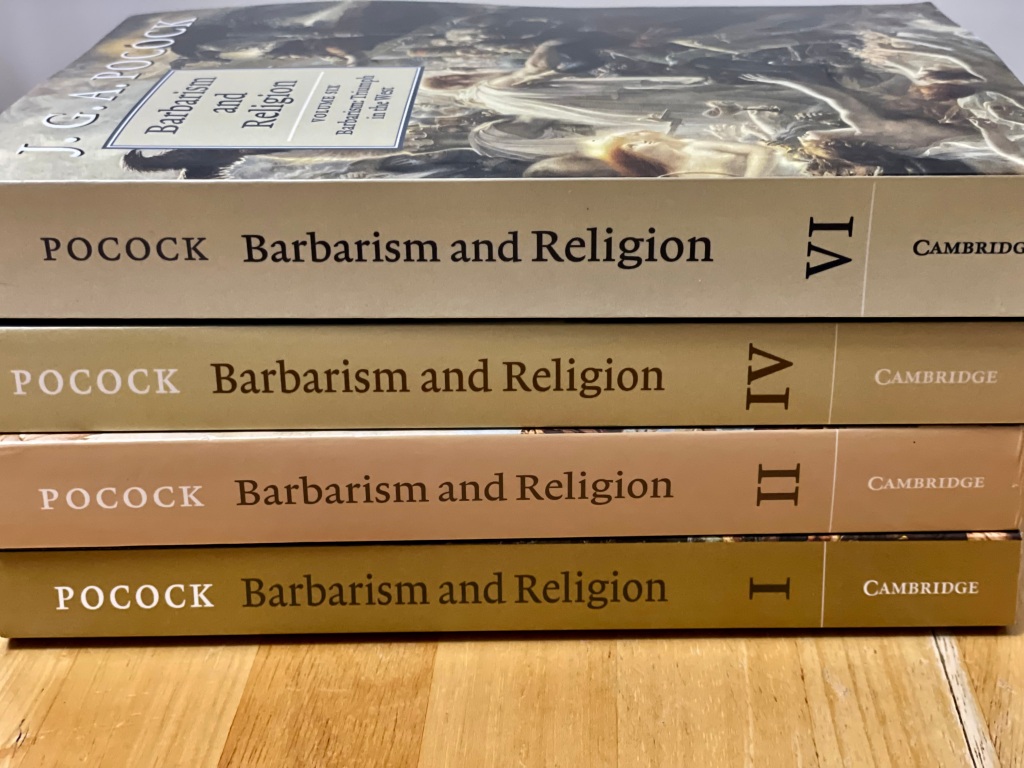
Thomas Hobbes famously wrote towards the end of Leviathan that “Papacy is no other than the Ghost of the deceased Roman Empire, sitting crowned upon the grave thereof” (Hobbes 1985). The long shadow casted by the Roman political tradition, however, is still peripheral to the current debates on secularization and political theology, and even in the most sophisticated analysis of the emergence of the fragmented public powers of the twelve century (Bisson 2015). In this seminar (one in a series of three) we will study the relation between Rome and the emergence of political modernity by attending to the multi-volume series Barbarism and Religion (1999-2015) authored by the Cambridge School historian J.G.A. Pocock, who has arguably undertaken the most serious attempt to provide an answer (however incomplete) regarding the passage between Rome and our modern political foundations.

Through a mannerist and highly idiosyncratic reconstruction of Edward Gibbon’s magnum opus, Pocock draws a large canvas of the Roman metapolitics, shedding light on the ongoing process of economic constitution and mutation. In this first seminar we will attend to the first two volumes of the series attending to the “civil” concept as an operative mediation of public order. Our wager is that the civil is at the crossroads in the ongoing crisis of authority and global civil war. Indeed, we tend to forget that the civil is operative in the notion of “civil war” used to describe the exhaustion of institutional and political forms.

Secondly, although we will consider the historiographical and conceptual constructions in Barbarism and Religion, the main focus of the seminar is to furnish an original understanding of the civil dimension from Rome to the modern legitimization of the political. In this sense we ask: to what extent does the concept of the civil discloses a specific genealogy from the decline of Rome and into the modern state? If so, how can one understand the polarity between barbarism and imperium (politics) as the two vectors of modern imagination about public order and the rule of law? And more ambitiously: can one mobilize (departing from Pocock’s historiographical project) the concept of the civil as a historical a priori – as the historical excess to every concept (Cooper 2022) – situated in the intersections of public law, modern commerce, and the rise of the state? What accounts for the event of the civil?

Getting ahead of ourselves, Pocock writes in the last volume of his series: “…so long powerful at the meeting point of imperium and barbaricum, who after defeat became the semi-autonomous subjects of the new kingdom. This is a moment in world history” (Pocock 2015). All things considered, this seminar looks to understand “this moment” in a present in which the civil has resurfaced as the principle of a total encompassing barbarism in the wake of the flaring up of Western civilization. If after concluding the six volume series we are capable of saying something to this end, we would have found ourselves lucky.

Böckenförde sobre la unidad de Carl Schmitt. por Gerardo Muñoz 

Ernst Böckenförde, quien fuera juez de la Corte Suprema de Alemania, tal vez haya sido uno de los responsables en la restitución del pensamiento de Carl Schmitt en la postguerra distanciándose de la polémica sobre los ‘años negros’ del nacionalsocialismo así como de la instrumentalización propiamente ideológica de la nueva derecha. De hecho, lo que vuelve singular la proximidad de Böckenförde con Carl Schmitt es que ofrece lo que él mismo denominaba un uso “liberal” de quien supuestamente fuese uno de los críticos más duros de las categorías de legitimización del liberalismo moderno, como la representación, la democracia, el subjetivismo, por no hablar del economicismo, o de las teorías del valor en la jurisprudencia iusnaturalista.

¿Cómo es posible que un defensor del liberalismo político como Böckenförde haya tomado el pensamiento de Schmitt como lámpara para encarar la relación entre derecho y política, como le confiesa al biógrafo Reinhard Menhring [1]? En manos de Böckenförde la leyenda iliberal sobre el pensamiento de Schmitt colapsa, e incluso va más allá: si el liberalismo puede seguir teniendo chance en la organización política del estado debe atender a las recomendaciones de Schmitt. Böckenförde sugiere que el desplazamiento de Schmitt ocurre en dos niveles compartamentalizados donde se ubicaría toda discusión sobre el alcance, los límites, y la dimensión deficitaria del concepto de lo político.

Primer nivel: contra las teorías de “ocasionalismo” de la decisión política (que lanza Löwith pero que genera una proliferación relevante en la teoría contemporánea), para Böckenförde el concepto de lo político no remite a la decisión, sino a la unidad política subsumida a la autoridad del estado de derecho. Como bien argumentaba Böckenförde en un ensayo de 1988 sobre El concepto de lo político, la noción de lo político tiende a una “homogeneidad relativa” que solo cobra sentido en el marco de la constitución que organiza la forma de estado. Esto se deja ver con el “Guardián de la constitución”: un poder neutral que asiste a la unidad política en última instancia independientemente de los diseños constitucionales vigentes de segundo orden. ¿No es esto lo mismo que pedía Platón, aunque ignorando el constitucionalismo moderno, con la figura del Consejo Nocturno hacia el final de Las Leyes? [2].

En cualquier caso, el concepto de lo político no buscar definir un enemigo ad hoc (mucho menos producirlo), sino que existe cuando la producción de normatividad falla y la sociedad civil muestra su debilidad estructural (con respecto al estado). Este había sido el problema de la autonomía de lo civil en la teoría del estado de Hobbes, como dice el propio Schmitt en su monografía de 1938. Lo político tampoco depende de una ubicación específica de la auctoritas, aunque sí de una noción de temporalidad, por lo que se le suele involucrar al ejecutivo. Pero para Schmitt habría una diferencia entre el constitucionalismo en el polo de la legalidad, y la definición de lo político que mantiene, a pesar de todo, lo que Böckenförde llama una “homogeneidad relativa” de la autonomía de los poderes.

El segundo nivel se deriva no tanto de Böckenförde como del propio Schmitt: ¿qué pasa con el concepto de lo político una vez que la neutralización del estado entra en su eclipse filtrando todo tipo de potestas indirecta? Esto pudiera verse de dos formas. Por un lado, el concepto de lo político se elabora como respuesta a la insuficiencia de lo “civil” en la teoría más fuerte del estado (Hobbes), y que que recorre buena parte de la experiencia “liberal” del siglo veinte relativo a los presupuestos prácticos del positivismo. Schmitt responde con un concepto de lo político contra una dimensión civil que asumiendo razones del actuar es incapaz de responder a la crisis de autoridad. Pero hay una segunda respuesta que, sin negar la primera, ofrece Böckenförde en un ensayo tardío de 1997, a propósito de la obra de Schmitt. Y es allí donde Böckenförde pareciera trasladar el concepto de lo político del estado al fondo de la teología política:

“Me parece – y esta es mi opinión – que la “cifra” de la teología politica es la llave maestra de Schmitt. Aunque formulada teológicamente, aquí damos con la divisa katejóntica para responder a la lucha contra las fuerzas del reino del Anticristo. Pero formulado en su versión secularizada, esto puede tomarse como una clara hostilidad al liberalismo occidental en sus propias bases políticas e intelectuales. ¿Quiere esto decir que el enemigo es la incorporación de la propia pregunta de Carl Schmitt?” [3].

El mismo Böckenförde no logra responder a la paradoja que ha formulado: por un lado el concepto de lo político se nutre de la leyenda de la teología política convirtuendo al liberalismo en el enemigo; por otro, el liberalismo también es el resultado secularizado del saeculum transitorio de los regímenes temporales, en la que la persistencia del enemigo es irreductible a la política si es que no quiere sucumbir a la tentación donatista de una escatología teológica. Aquí se confirma la raíz agustiniana de Schmitt, que hace del concepto de lo político un principio auxiliario del saeculum contra todas las derivas indirectas (pueden ser técnicas o morales) que hacen del desacuerdo un “enemigo de la Humanidad”. Entiéndase: un enemigo expugnable de la Tierra misma: mititte me in mare si propter me est orta illa tempestas! [4]. Concepto de lo político: tierra y tiempo.

.

.

Notas 

1. Ernst Böckenförde. Constitutional and Political Theory (Oxford University Press, 2017), n.20.

2. Ibíd., “The Concept of the Political: A Key to Understanding Carl Schmitt’s Constitutional Theory”. 83. 

3. Ernst Böckenförde. “Carl Schmitt Revisted”, Telos, n.109, 1996, 86.

4. Carl Schmitt. Glossarium (El Paseo Editorial, 2021), entrada 28.4.48, 176.

Hobbes y la génesis hebrea. por Gerardo Muñoz 

El antihobbesianismo postliberal consta de muchas gradaciones y matices, pero de fondo yace una paradoja conceptual relativa a la leyenda de la secularización: por un lado Thomas Hobbes aparece como aquel pensador que adoptó el registro aristotélico y agustiniano, pero solo para llevarlo a fines materialistas que anunciaría la crisis moderna de la potestas indirecta de la Iglesia; por otro, Hobbes es un pensador que reconstruye y adapta una teología política específica que debe evacuarse o permanecer desapercibida. En efecto, cuando Hobbes habla al final del Leviatán de que la Iglesia existe sobre las ruinas del fantasma del imperio romano, lo que él busca es expugnar esa fantasmagoría y no desarrollar una ciencia de estratos de aquellos escombros para la invención de una “nueva ciencia política”. Sin embargo, la dificultad en torno a Hobbes, en la medida en que supone la secularización, también remite a la fuente teológica de Hobbes que se nutre del pacto entre el pueblo judío y Dios, y que Eric Nelson relaciona al paradigma de la Republica Hebraeorum que circuló en el siglo XVII, pero que en Hobbes encuentra la síntesis de la asociación civil.

Esto quiere decir que la creación del concepto de la autoridad civil no es simplemente una secularización de conceptos cristianos, sino también una politización moderna de la teología en toda la complejidad que esto supone (la apelación a un ur-texto es bastante clara). Y como ha visto Nelson, la Republica Hebraeorum no es simplemente un paradigma estático sino una aspiración que hace posible imaginar una nueva estructura de autoridad por fuera del absolutismo de una potestas indirecta deficiente en la tarea de frenar la guerra civil [1]. Para encarar lo que Hobbes domina “the Fire of a Civil Warre”, se necesitaba una concreción de fuerza autoritativa capaz de escapar una escatología inmanente arraigada en la parálisis del “después de esta vida”. Así, el principio de lo civil es antes que todo, una forma de un representante temporal y mortal, cuya forma vinculante era un contrato con aquellos a quienes solicitaba su obediencia. La secularización hobbesiana pasa, por lo tanto, a través de un proceso genético cuya regresión es la fuente de la república judía como condición de posibilidad de lo civil.

El concepto de lo civil, sin embargo, y antes que una matriz de reconocimiento y fuente de derechos individuales se definía como una separación de poderes y potestades. Ahora la teología carecía de la última palabra sobre la política, porque su operador era la profecía. En este punto el historiador David Nirenberg tiene razón: una vez que la profecía es separada del orden de la revelación, es que se torna viable un contrato entre el profeta y el pueblo. Esta nueva dinámica daría lugar a una forma política desentendida de los subrrogados substaciales o de las intromisión nominalista del reino superior [2]. Si Moisés fue el profeta del pueblo hebreo, es porque puedo establecer un pacto como peculium de cunctis populis (un pueblo específico ante mi). No se trata de un principio de Humanidad ni de los atributos de Dios que para Hobbes son siempre insondables, sino de una función pública que garantiza el principio de autoridad que es reconocido internamente. La profecía y la función del profeta es el quizás el instrumento central en Hobbes para despejar la potestas indirecta del providencialismo de los teólogos, introduciendo no solo la división, sino más importante aún, el principio impersonal de delegación.

Según J.G.A. Pocock en su conocido estudio sobre Hobbes: “De Moisés a Samuel, de manera intermitente pero siempre recurrente, los profetas aparecen como prolocutores – hombres a los que Dios les habla y sobre quienes delega su palabra hacia el pueblo, y a través de los cuales los altos sacerdotes de Dios pueden ejercer un reino civil” [3]. Así, la fuerza de la profecía devenía neutralización contra toda sacralización de la historia y la inmanencia de salvación hacia una forma del poder civil. Por eso también es notable que los sacerdotes para Hobbes estaban conferidos a un poder civil cuya fuente era la constitución de un pacto positivo, y no meramente la apelación a una fuente superior como en el ius romano de Ulpiano [4]. El formalismo civil, la delegación, y el principio de autoridad en Hobbes fueron llaves hebreas de lo que diseñaría el aparato moderno del estado sobre la arquitectónica del principio de soberanía como liquidación de todo velo de teólogos y de recargas virtuosas de la política homogénea de la antigüedad. La fuente hebrea podía suministrar una política de la separación que la política teológica de la Iglesia no podía ofrecer al suturar la creencia de la revelación hacia la forma providencial de un imperio cristiano. No era menor que la res publica heredada de los hebreos era la condición de una teología política desde una articulación temporal para alterar el dominio de los poderes públicos y sus diseños institucionales.

Aunque la oposición a Hobbes desde el tradicionalismo católico o el naturalismo dogmático prefiere ignorar la fuente genética de la república hebrea, tal vez este sea el síntoma que recorre la interpretación del Leviatán en la conocida monografía de Carl Schmitt de 1938. Puesto que para Schmitt, la creación del Leviatán durante los siglos fue liquidada desde adentro, arruinada por el espíritu de la técnica, y finalmente “pescada” como gran ballena en el banquete del cumplimiento de la historia como mito originario. Dada la dependencia en el mito del Leviatán, para Schmitt Hobbes habría buscado divisa de una forma de “activismo filosófico” de la acción que no podía agotar la condición de un verdadero “pensamiento político” [5]. O mejor dicho, desde la propia gramática schmittiana, Hobbes no contaba con un verdadero concepto de lo político. El Leviatán en tanto que mito absoluto culminó en una desmitologización soterrada: alojar a los pescadores – falsos usurpadores del Christós, donde se patentiza el antijudaísmo de Schmitt – en la barriga de la enorme ballena. Y aquí la máxima proximidad como máxima distancia entre Schmitt y Hobbes: el concepto de lo civil estaba entregado ya a la totalización de una debilidad del mito, cuya dependencia en la (razón) acción del cive no podía garantizar una forma política en verdaderos momentos de crisis o amenaza.

De este diagnóstico se puede derivar que solo el concepto de lo político – y que Hobbes no pudo pensar como primera instancia al interior de la unidad del estado – debe prevalecer sobre la debilidad del concepto de lo civil. Aquí es interesante el contraste con Marx, ya que para el autor de “Sobre la cuestión judía” la emancipación judía guarda una relación intima con lo civil. Salvo que para Marx es el principio de la economía política lo que debería refundar la totalización social (es por esta razón que Schmitt escribía que, si Marx había encontrado la plusvalía económica, él había dado con la plusvalía de lo político). ¿Pero qué podía ofrecer el concepto de lo político sino una apuesta en última instancia desde la crisis de la separación de la teología política hebrea? ¿No era la separación de toda política la condición de posibilidad del concepto de lo civil? Tal vez el silencio sobre la génesis hobessiana de lo civil, su liquidación a través de la mitificación escatológica (Peterson y el rechazo a la conversión) y posteriormente su superación desde un conceptualismo substantivo pone en evidencia la incomprensión de la teología política, ya sea para establecer la base del estado moderno como en Thomas Hobbes, para afirmar el pueblo errante como en Erich Unger [6], o bien en las formas que pudieran anunciarse en el agotamiento de la filosofía de la historia cristiana, pero que ineludiblemente siguen contorsionando el nudo de Occidente.

.

.

Notas 

1. Eric Nelson. The Hebrew Republic (Harvard University Press, 2010). 129.

2. David Nirenberg. Anti-Judaism: The Western Tradition. 317. 

3. J.G.A Pocock. “Time, History, Escathology in the Thought of Thomas Hobbes”, en Politics, Language, and Time: Essays on Political Thought and History (University of Chicago Press, 1989). 148-201.

4. Thomas Hobbes. Leviathan (Penguin Books, 1985), 707.

5. Carl Schmitt. The Leviathan in the State Theory of Thomas Hobbes (Greenwood Press, 1996). 85.

6. Erich Unger. Die Staatslose Bildung eines Judischen Volkes (Verlag David, 1922)

¿Por qué el iusnaturalismo no se alinea al bien común constitucionalista? por Gerardo Muñoz

En una reciente reseña crítica sobre Common Good Constitutionalism (Polity, 2022) de Adrian Vermeule, el historiador James Chappel admite en un momento que “uno de los puntos más importantes del libro de Vermeule es el hecho de que todo sistema de derecho siempre expresa algún tipo de postura moral” [1]. Es un comentario de brocha gorda, pero qué nos permite indagar un poco más en el problema en torno a la relación más acotada entre moral y derecho. Pues, en realidad, lo que afirma Chappel (y que asume como “sentido común”) cobra fuerza solo en la medida en que entendamos que por décadas la crisis del positivismo como fuente de autoridad del derecho ha abdicado a lo que el profesor Juan Antonio García Amado ha llamado iusmoralismo, una forma de amplificación “interpretavista” que se “ajusta” y “justifica” principios generales desde una integridad moral. El auge del interpretativismo ha hecho que la moral y el derecho converjan, lo cual legitima lo que Chappel reconoce como el punto “persuasivo” de la apuesta teórica de Vermeule. En realidad, diríamos que es todo lo contrario: es decir, lo que no parece persuasivo de la teoría del bien común constitucional es que es eminentemente una teoría interpretativista y no necesariamente una teoría iusnaturalista. Veamos un poco mejor este diferendo.

La divergencia entre el “constitucionalismo del bien” y el iusnuralismo explicaría – al menos de momento hasta donde tengo noticias – porqué filósofos del derecho natural como John Finnis o Robert P. George – no se han alineado con esta forma de revolución constitucional. ¿Por qué? En primer lugar, porque el bien común desarrollado por Vermeule favorece la instancia interpretativista por encima de la iusnaturalista, que el trabajo clásico de Finnis intentó aproximar la tradición iusnaturalista con la noción autoritativa del positivismo moderno. En segundo lugar, porque la cuestión de la “moral” en el derecho no es simplemente un enunciado abstracto más, sino que depende de cómo lo “ajustemos” en el diseño de una filosofía jurídica. Esto lo podemos comprobar con claridad en la reseña ensayo que el propio Finnis hiciera de Law’s Empire de Ronald Dworkin cuando aparecía el libro por primera vez [2]. Repasemos brevemente lo que Finnis dice en ella.

Hay al menos tres elementos que son atendibles en el contexto del diferendo entre iusnaturalismo e interpretación: el problema de la interpretación “creativa”, el riesgo de una yuxtaposición entre derecho y ley (ius y lex), y la minimización autoritativa por parte del imperio del derecho. En primer lugar, Finnis cuestiona el hecho de que el principio de interpretación creativa se postule como poesis y factio, en lugar de como guía y praxis, tal y como funciona en el pensamiento de Aristóteles y del mismo Santo Tomas de Aquino. En segundo término, Finnis advierte que Dworkin hace coincidir las normas de la ley con una concepción de principios del derecho, algo que “tanto el positivismo como el derecho natural mantuvieron separadas para poder identificar la ley en manos de jueces y abogados en una comunidad concreta” [3]. Y, en tercer lugar, el cierre de la “conmensurabilidad” entre ius y lex, entre derecho y ley, termina por debilitar gravemente la concepción de la autoridad del derecho para el interpretrativismo. El principialismo genérico del interpretativismo, entonces, termina por desempeñar una función “neutral” con respecto a la autoridad vigente de un sistema concreto de derecho. Finnis define el pensamiento de Dworkin como el de un “liberalismo de justificación política”, y que por lo tanto termina por entregarle “municiones” (weapons) a un relativismo jurídico [4]. Podemos decir que quizás Dworkin podía permitirse un relativismo interpretativista, ¿pero acaso lo puede hacer Vermeule sin traicionar las “lealtades” teológicas de su pensamiento? Esta sigue siendo la contradicción central de la apuesta de un constitucionalismo del bien común, que es más heredero (dada su aceptación realista) de cierta irreversibilidad interpretativa de valores que de una teoría institucional iusnaturalista.

De manera que a diferencia de lo que expresa Chappel en su reseña, Vermeule no tiene mucho que ver con Carl Schmitt – Chappel dice, otra vez con brocha gorda, “que se trata de un jurista de derechos que redefine sus ideas para justificar un régimen autoritario” – puesto que, como sabemos, el autor de Teología Política era más bien crítico de toda conflation entre moral y derecho como principio de justificación, además de que veía en Thomas Hobbes al creador del positivismo moderno que dio fin a la guerra civil. El bien común no podía llevarse al plano de una “justificación” de “integridad” para neutralizar la guerra civil, ya que la fragilidad de su reglamento autoritativo era el único camino que podía promover aquello que se quiere eliminar. Y al final, el problema del constitucionalismo del bien común no es que introduzca la moral en la discusión del derecho (esto es algo contemplado por todas las teorías jurídicas), sino que instrumentalice cierta idealidad iusnaturalista de fondo para fines claramente interpretativos. Esta anfibología entre una apelación de fondo al ius y una “motorización del lex” (Vermeule dixit) no crea forma política ni da espacio para una necesaria inconmensurabilidad.

.

.

Notas 

1. James Chappel. “Inside the Postliberal Mind: A Review of Adrian Vermeule’s Common Good Constitutionalism”, The Bias Magazine, abril de 2022: https://christiansocialism.com/adrian-vermeule-common-good-constitutionalism-postliberalism-authoritarianism-christianity-left-politics/

2. John Finnis. “On Reason and Authority in Law’s Empire, Law and Legal Philosophy, 6, 1987, 357-380.

3. Ibíd., 368.

4. Ibíd., 366.