“Desecularization: theology and thought”. Introduction to the seminar in Granada, Spain, July 2026. by Gerardo Muñoz

At least since Ernst Böckenförde declared the end of secularization and the exhaustion of the liberal state form in the late sixties, the distinction between theology and politics has experienced a profound schism across Western social life, which once served as the ground and mediation to the homogeneity of “ethical life” (Sittlinchkeit) of civil society. It is still useful to recall Böckenförde’s theorem as a refresher: “What does the state live on, and where does it find the force that sustains it and guarantees its homogeneity, after the binding force emanating from religion is no longer, and can no longer be, essential for it? Until the 20th century, in a world that was first interpreted in a sacred way and then as a religious world, religion had been the most profound force involved in the political order and in the life of the state. But is it possible to find and preserve life in a completely earthly and secular way? […] Therefore, the question of binding forces is raised again, and now at its true core: the secularized liberal state lives on prerequisites that it can no longer guarantee” [1].

Indeed, one could say that in our era, clearly marked by the collapse of political mediations and categorial order, the schism between theology and political forms inherited from the Judeo-Christian eon has increasingly become full fledged and patently visible at a global scale. In a certain sense, and leaving behind all nuances, the operating horizon of thought today implies from and through the energy of this schism. If this meeting attempts anything however modest, is precisely the intuition that in the wake of the schism of political theology, the “theos”, following the trumpeting of the death of God proclaimed by Nietzsche or the flight of the gods as orphanage from the divine declared by Hölderlin, presents with an opportunity to think a non-rarefied style on the reverse of historical collapse. In recent years, a certain theological latency has been present in many contemporary theoretical projects, insisting on approaches related to mysticism and life, the gods of language and nominalism; the insistence on the communication between souls, the messianic and presence, to name just a few figures of thought without pretending to be exhaustive.

As machination and the spiritualization of technology subsumes the totality of social life in the West, existence enters a region of thoughtful and cunning marranismo, which could be taken as a form of life in the desert and a keeper of its depth of the ethos. How does one make sense in this moment of delirium and relentless decline, which include although it is not limited to, the defeat of the cycle of global uprisings  and the solicitation of positions of exodus and desertion? In other words, we are trying to think of a language that we speak across distant places,  and come to terms with the tonality of pain and despair. Is there a non-nihilistic way out of a civilizational project governed by the cybernetic dominium, continuous predatory extraction and lethal destruction of worlds? “Desecularization” is not naming a historical moment after “secularization” – something that has taken place in its own historical dispensation – just like posthegemony is not naming a temporal sequence to principial hegemonic politics. And of course, “desecularization” is not a program of any sort, although it is interesting in positing the possibility of “a new beginning” in the wake of the ruin of political theology as the orienting strategy of division and orderability, which fundamentally colored capitalist civilization on the abstraction of work and the work of abstraction proper to the historical modulation of Christian metaphysics and its theological rubrics. And if “desecularization” is neither a concept nor a program, I still would like to retain at least its resonance to other positions that have I have called for lack of a better term, the quadrant of positions of refusal [2].

Can theology, a confrontation with theology, drag us out of the via negativa towards something else? It is easier said than done. And it is never sane to get caught up in the spinning wheel of a term, whether it is “desecularization” or “desistence”, or “destitution”; a sort of rhetorical enchantment of the “-des”. Ultimately words say very little at the level of the concept, and they tend to offer a cell in which the process of amnesia and ratification can take place – the task of refusal, then, I take it, is also watching over, what the Cappadocian Fathers called the nepsis – what thought cannot elevate to the luminosity that emerges from the term. We are interested in theology and theos, but only insofar it opens itself to thought and the place of language, as well as the irreducibility of existence and death, to the imagination and the endurance of an ethics that undeniably invites makes itself present whenever we hold on the incommensurable distance between language and world. And if we have invited both Monica Ferrando and Alberto Moreiras to open up this seminar with us, it is because their styles of thinking are clearly devoted to pursue this question to the end. Of course, this means something consequential: they both affirm a path wherever it might take them (one can even visualize this in Monica’s extraordinary nocturnal paths in painting, such as the series “Paessaggio Perduto”, or “Lost Paths”). And it is a commonplace to say that both of them have been grappling with the problem of theology from almost opposite directions of the meridian distance awakened to the horrific abyss of our present, which means that perhaps the marrano and Pan do meet as fugitives in the forest passage both lost and found.

One word must be said about the term that is meeting is trafficking with – and perhaps “trafficking” is, alas, a good verb since none of us (perhaps with the exception of one person, and even he might feel stranger with that label) are professional theologians, nor do we have access to revelation, but perhaps this is too much on the side of intimate matters that one should refrain from commenting upon. Of course, the trafficked word is “desecularization”, which alludes to a certain rupture with the very essence of the saeculum, or the political institutional authority and its institutional arrangements in this world. When Schmitt says that all political concepts of modernity are secularized theological concepts, he is also assuming the irreversibility of secularization as internal to the historical matrix of Christianized West. In fact, according to theologian Robert A. Markus, desecularization has already become operative within the early Christian epoch of Saint Augustine. In his Christianity and the Secular (2006), Markus writes the following:  “[in dialogue with Peter Berger] We may leave sorting out the complexity of that relation to the sociologists. All we need to note for our purpose is that the reverse, what some have called ‘desecularization’ has become a more recent preoccupation of sociologists of religion – and not only of sociologists. “This is just what came into being in the course of the emergence of Western Christendom from Roman Late Antiquity – a ‘deseculariation’ which is the reverse of what happened in the Wars of Religion. If the notion of the secular were to apply in such a society, it would have to be defined in more problematic terms: as what does not form part of a religious discourse … .The core of my argument in this book can be briefly summarized. Its substance is that Christian tradition has a legitimate place for the autonomy of the secular, even though for many centuries this was eclipsed in its awareness, and despite the perpetual undertow of what we have become costumed to call ‘triumphalism’ in Christian political and cultural attitudes” [3]. 

Of course, as Märten Bjork has recently shown, in Markus’ theological understanding of the saeculeum, the government of the Earthly city grounded in principial politics must also be relativized by the eschatology of the Kingdom – facing the event of death and the dogma of resurrection of life – that can take step back (or beyond) the libido domininandi, that generates the solipsistic desire for government and administration necessary for the circulation of a “libidinal economy” [4]. We can thus call the Markus’ position as the architheological position that dissolves the polarity of secularization and desecularization as an enterprise of Western philosophy of history and its homogeneous temporality of survival and reproduction. Secondly, it is also important to note that the notion of ‘desecularization’ made an important entry in the famous Capri conference of 1994 organized by Gianni Vattimo and Jacques Derrida, where the French philosopher mobilized Plato’s chôra to avoid relapsing into religious faith, and thus uprooting revelation as the ur-site of Christianity.  Thus, for Derrida, ‘desecularization’ is a figure of thought that seeks a third space of the a priori of the nonsecularizable. In the brief dossier “Christianity and secularization” later published in Il Pensiero: Revista Di Filosofia in 1998, Deridda sheds light unto this path of his thinking, which he never fully develops: 

“….. The desert, the figure of the desert, which we discussed extensively in Capri, is clearly charged with biblical memory; and it’s not enough to say desert, or even “the desert grows,” to achieve or, conversely, abandon secularization. The desert within the desert is a radically heterogeneous desert. The motif of the chôra serves me, in general, as a guiding thread for thinking about a place, and chôra means place, to take place; and of the event, it is said that it takes place, and chôra means place or spacing, interval. This is a place that is, to use Plato’s terms, neither sensible nor intelligible, and which is spoken of in a bastardized discourse, in that it gives rise to neither a metaphorical nor a proper language, and in Plato’s text itself, it escapes all Platonic concepts and even Plato’s self-interpretation. This place is neither divine nor human… The chôra is the place where the demiurge, gazing heavenward, contemplating eternal ideas or models, inscribes the sensible copies for the formation of the world. Therefore, it is neither sensible nor intelligible, neither human nor divine; it is absolutely impassive, totally neutral with respect to all conceptual or dialectical oppositions; it is therefore the place that resists any reappropriation or reduction within the poles of anthropotheology. Chôra is that which cannot be reached even by a discourse of negative theology” [5]. 

The nonsite of the chôra is also what is heterogenous to the polis, and so for us the absolute differentiation between chôra and polis is precisely as important, and parallel to Monica Ferrando’s distinction between the musical nomos of the mythic topos of Arcadia, and the modern allocation of the nomoi of spatial dominium as appropriation, concrete order, and reproduction; the three pillars for the constitution of the ideological revolution of survival. Of course, the chôra can be said manifolds, but it allows us the temptation of political subsumption, of an inversion of a new “theological political” (as it is already taking place in many circles in the United States, with the unfortunate but expected in Leo XIV as equidistant, alas, the new self-delegated commissar of an “Anti-Cybernetics” point de capiton. Alas, once again hegemony knocks at the door, this time with theological garments).  This reservation speaks, if not directly, at least tangentially to Alberto Moreiras’ recent affirmation against the ‘retheologization of the world’, which would entail the hegemonization of the total space of social reproduction [6]. Here we might find room for fruitful dispute and elaboration. Indeed, because it is never about re-theologization of the world, but perhaps in the old formulation of Guy Landreau and Christian Jambet’s L’Ange: Ontologie de la révolution (1976) that any gesture of true refusal or revolt requires at least the partition of two worlds, if we are to avoid the eternal dialectic of desire between Master and Rebel that nourishes the ideological projection sustained through the amnesia of any ethical elaboration.

Perhaps by ‘desecularization’ we are pointing to an exit through the liquidation of this world, in the same way that the task of thinking is a schism against calculative representation and the eccentric plane of objectivity. As Landreau and Jambet claim in El Ángel (1979): “There are two kinds of thought, just as there are two worlds: one kind of thought that belongs to God, and one kind of thought that belongs to the world; one kind of thought entirely devoted to salvation, and another kind of thought animated only by an abject desire for knowledge—a searching thought, vain curiosity: precisely what we, intellectuals, philosophers, call Thought. Gregory of Nazianzus famously asserted that one can philosophize safely about the world, about good and evil beings. The monks, on the other hand, responded to him with the words of Sirach: ‘Do not seek what is too difficult for you, do not scrutinize what is beyond your strength. The simpler the symbol, the better” [7]. In other words, against the absolute immanence of an infernal materialism and its frozen fictions of the immaterial – where all that exists subsists as equivalent – there is a reality of the soul, the abolition of sexual difference, and by that matter the libidinal bond that generates the autonomy of the revolt of the Rebel perfectly comfortable under the shadow of the Master [8]. In this sense, if another parallelism is allowed here, the chôra is the collusion of the outside world to the polis in order to start anew from scratch from the site of the sensibility of our existence. 

If this position has been repeatedly called “gnostic” or maniquean by the executioners of modern irreversibility, so be it [9]. And perhaps these critics are right, and we can grant them that much: already Susan Taubes noted with scholarly precision that there are even Gnostic elements in Heidegger’s thought, even when his polemic with the architectonics of metaphysics becomes explicit against the reduction and adequatio of the medieval Aristotelian metaphysics, opening himself to a secret and clandestine tradition, in which the last god has his recollection in the excess or abyss of all vital experience (erlebnis); in what is outside of life at the entrance of another world [10]. The overcoming and taming of the gnostic manicheism has been precisely the infrastructure through the rarification of Christian theology took place – in Landreau and Jambet’s terms – which transforms the conditions of the cultural revolution (existence) into an autonomous and spectral ideological productivity, which is the limit in which theological contemplation narrativizes itself into Christian community of salvation once necessity and deficiency bind you to political dominion – it is here where the Master and the Rebel coincide in their projected goals: that there is nothing other than political struggle. But the gnostic culture of existence never disappeared as readers of modern poetry know well, even though that might not be the site for the emergence of the angelic life of beatitude today either. 

As Pacome Thiellement says towards the end of his beautiful The victory of those without kings: gnostic revolution (2025): “In the absolute embrace of those without Kings, the fading of the initial eroticism is transmitted in every instant of life. It creates neither anger nor remorse, but rather gratitude and a multiplication of protected powers. It appears at the moment when solitude is profound, not from the absence of love, but as a consequence of the pleromatic state inscribed in the man with memory: the overflowing of unitive eroticism into all the possibilities that life offers, whether in this world or others” [11]. It is this theology of the infraworld – not so much of heaven, but of a memory of the worlds and the humus of the dead that becomes one with the mirror of the heavens – allows the metaphysical gnosis to breathe out in thought, allowing for the pending encounter with the metaphysics of the schism of n-1 worlds to emerge [12]. It seems to me that this subtractive movement brings back, in interesting new ways, a metaphysics of purity and inoperativity; an imperturbable existence no longer seduced nor corrupted by the images of this world. 

Notes 

 1. Ernst Böckenförde. El surgimiento del estado como proceso de secularización (Editorial Trotta, 2024), 45,57. 

2. Gerardo Muñoz. “Quatre positions du refus”, in Entêtement: Tenir une sensibilité (Pli, 2024), 20-26. 

3. Robert A. Markus. Christianity and the Secular (Notre Dame Press, 2006), 8-9.  

4. Märten Bjork. “Deliver me from my necessities: R. A. Markus and Erik Peterson on the End of Law”, Political Theology, Junio 2026, 13-14. 

5. Vincenzo Vitiello. “Cristianesimo e secolarizzazione”, in Il Pensiero: Rivista Di Filosofia, XXXVII, 1998, 155-157 . 

6. Alberto Moreiras. “Gnosis marrana”.  Paper read in Universidad Complutense, October 2025. Unpublished. 

7. Guy Lardreau & Christian Jambet. El Ángel: ontología de la revolución (Ucrania, 1979), 128.  

8. Ibid., 105-106.

9. See, José Luis Villacañas. Tierra o Ser. La gran decisión de la filosofía contemporánea (Akal 2026), specifically the section “Gnosis y excentricidad”, 416-419. His recent column against Heidegger’s philosophical legacies and afterlives also deals with the gnosis, see “Heidegger, a la distancia de medio siglo siglo”, Levante, May 25, 2026: https://www.levante-emv.com/postdata/2026/05/23/heidegger-distancia-medio-siglo-130551106.html

10. Susan Taubes. “The Gnostic Foundations of Heidegger’s Nihilism”, The Journal of Religion, XXXIV, Julio 1954, 160-162.

11. Pacome Thiellement.  La victoria de los Sin Rey: Revolución gnóstica (Granica, 2025), 159.

12. It is notable that Derrida in the exchange with Vitiello, Vattimo, and Ferraris already cited, he goes out of his way to claim that he never had anything against metaphysics per se. Could the same thing be said of Heidegger if one posits the differentiation between metaphysics and the holy, and onto-theology and the adequatio of Medieval Aristotelian metaphysics? Along this line, Laurence Hemmings has suggested a fertile dialogue between Heidegger and the sacred in his Heidegger’s Atheism: The Refusal of a Theological Voice (University of Notre Dame Press, 2002).

Lezama Lima and the Etruscan way. by Gerardo Muñoz

Towards the end of his life, poet José Lezama Lima will mysteriously begin to sign the letters to his friends and family as “the Trocadero Etruscan”, a “member of the Etruscan religiosity”, and even the “man who lives in the Etruscan village” [1]. Why call himself an “Etruscan” in this particular moment of his life, and what could it possibly mean? The question about the meaning of the Etruscan authorial mask has been so thoroughly ignored by the literary critics that commentators at their best have noted that “being Etruscan” merely stands for his “cosmopolitanism” and “well-learned Europeanism”. Of course, this explains little to nothing. A sophisticated poet such as Lezama Lima, who ruminate over every single word he would write, could not have ignored that the Etruscans, unlike the civilized Romans and the Latin authorities, was a remnant to the very civilizational enterprise; a prehistoric people poor in written culture, achieved expressivity by the whole outlook of their form of life. And as in the case of Hölderlin’s adoption of different nom de plume (Scardanelli, Killalusimeno, Scaliger Rosa, etc), Lezama’s becoming Etruscan points to something so fundamental that if underscored we would fail to grasp the endgame of his vital poetic experience. The transfiguration of the name does not merely stand as a metaphor; rather it points to a distant figure that will finally dissolve him so that his immortal voice could continue to live on.

Indeed, the self-identification as an Etruscan for Lezama became a subterfuge to flee a political reality – his political reality, entirely structured by the revolutionary gigantic productivism and subjectivism – through a poetic refraction that would free an ethos from the overpowering of alienated autonomous space of the linguistic reproduction of social life. If at first glance it seems like a paradox that Lezama will adopt the Etruscan figure for his antisocial ethos – a civilization lacking written records or high literary achievements, a religious community known for its necropolis – this strangeness will ultimately prove that behind the Etruscan name there was no poetic exclusivity of the poet’s genius, but rather, as he claims in “A partir de la poesía”, the possibility for a divinization of reality to retreat from the historical epoch. In fact, Etruscan culture for Lezama was not a mere archeological ornament, but one of the “imaginary eras” of the West; that is, a stage of condensed and unnumbered imaginative possibilities resistant to griping subsumption and totalization of values. The Etruscan was the mythic remnant through the pantheistic divinization between language and the world. As Lezama writes glossing, in passing, Vico:

“Vico cree que las palabras sagradas, las sacerdotales, eran las que se transmitían entre los etruscos. Pero para nosotros el pueblo etrusco era esencialmente teocrático. Fue el más evidente caso de un pueblo surge en el misterio de las primeras inauguraciones del dios, el monarca, el sacerdote, y el pueblo unidos en forma indiferenciada … .les prestaba a cada una de sus experiencias o de sus gestos, la participación en un mundo sagrado. […] Pues en aquel pueblo, el nombre y la reminiscencia, animista de cada palabra, cobran un relieve de un solo perfil” [2]. 

The divinization of the Etruscans stubbornly insisted on the wonder of things. The human participation in divinity is no longer about founding a new theocracy or a “theocratic politics” in the hands of a ‘mystic accountant’ that would finally put the nation back in track (into the res publica), as Lezama would solicit out of desperation in the 1950s diaries [3]. On the contrary, for Etruscan people the fundamental tonality was the divine music of experience. Of course, we know that D.H. Lawrence captured this when claiming in his Etruscan Places (1932) that “the Etruscans are not a theory or a thesis. If they are anything, they are an experience. An experience that is always spoilt” [4]. And this experience (like every true experience) needs to be necessarily spoiled, which ultimately means that it cannot be mimetically rendered, arbitrarily modified, or subsumed into the order of idealization. But all of this is merely redundant, since the Etruscan inscription is what accounts for the limit to civilization, becoming the impossibility of the destruction of myth in the arrival of modern aesthetic autonomy. Thus, for Lezama the Etruscan way had something of a persistent cure against the ongoing civilizational disenchantment, even if it does not cease to appear in the modern attitude. In fact, Lezama writes that: “Rimbaud is the best reader of the Etruscan liver” (“hígrado etrusco”) to describe the dislocated position of the poet in the modern world of technology [5]. In the Etruscan cosmology, the liver was a symbolon of the vision of the cosmos registering the divisions of the spheres in the sky through the divine naming of the gods; it is the figure by which the poet guards the desecularizing remnant of the prehistoric inception of myth [6]. But this does not mean that Lezama will look at himself in the mirror of Rimbaud’s symbolist alchemy.

Rimbaud as an Etruscan is the poet who descends into hell because his lyricism can bear the pain in the disruption of language after the archaic peitho. Does the possibility mean a travel back in historical time? Not the least, as Lezama knew how to let go of storytelling and historical necessity. This is why Etruscans stand for an image or a sort of handwoven picture (the hand will make a comeback, as we will see) to gain vision. And this is one case on point: the Etruscan stands paradigmatically to the “sufficient enchantment” (“la cantidad hechizada”) , which discloses a higher knowledge of the soul (psychê) in the taking place of poetic errancy: “Sabemos que muchas veces el alma, al escaparse de su morada, tripulaba un caballo inquieto, afanoso de penetrar en las regiones solares” [7]. To wrestle against the historical reduction of autonomy of the modern age means to find this enchanted sufficiency necessarily for myth remnant to elevate itself against the aesthetic mediation that, in the words of Gianni Carchia, had become a consoling surrogate of the emptied historical time [8]. An entirely other conception of freedom is firmly implicated the Etruscan way: the gathering of the enchanted poetic dwelling to dissolve a reality that had become too thick in the business of brute force purporting to call ‘what’s out there’. The Etruscan reintroduces a divine nominalism of pure exteriority.

However, the Etruscan way does not commute with things of the world; rather, his soul unbinds the empirical limit of death to overcome death, and learn to live as if it were already dead. The trespassing of death through the poetic enchantment – which Lezama will also call an ‘potens etrusca’, or the Etruscan potentiality- will multiply the invisible possibilities against the rhetorical closure of reality legitimation. By accepting the thick of the dead as an illuminated presence, the Etruscans draw out the most important consequence: learning to live among the dead as the ultimate form of a dignified life. This is why D.H. Lawrence reminds us that the underworld of the Etruscans – their refusal of reality, the embrace of their dead, the augurium – was after all “a gay place…For the life on earth was so good, the life below could but be a continuation of it. This profound belief in life, acceptance of life, seems characteristic of the Etruscans. It is still vivid in the painted tombs. They are by no means downtrodden menials, let later Romans say what they will” [9].

If civilization is a construction that takes place at the crust of the Earth as some have claimed; the way of the Etruscan is a downward declination away from the architectural reduction of world sensing [10]. For Lezama the Etruscan dreams of a civilization submerged in the depths that only an acoustic totality that bear witness to its sensorial gradation: “Esas civilizaciones errantes por debajo del mar, sumergidas por el manteo de las arenas o por las extensivas exigencias…reaparecen, a veces, en los sueños de los campesinos” [11]. Hence, the fundamental dignity of poetry resides in the mythical homecoming that guards the possibility for what remains inexistent: “this is why the poet lives in the Etruscan world of the birth of fire” [12]. And although the Etruscan stands as one of the worlds in possession of an imaginary epoch (the other two for Lezama being the Catholic world and the feudal feudal Carolingian Empire), it is only in the Etruscan where the resurrection had taken the transubstantiation in the name itself; even if the price was its own liquidation as a historical people that refused to be incorporated into the doxa of postmythical order [13].  

The fiery force of the mythic peitho outlives and predates the political epoch of the nomos of fixation organized as “One People, One State, One Language” [14]. As Lezama explains in “La dignidad de la poesía”: “…el odio en la polis contra el daimon socrático, hizo que la nueva doxa no logra sustituir a cabalidad el período mítico….Si por lo mitos, los dioses se irritable con la felicidad de los de los mortales, pero al menos, se interesaban por sus destinos; en la nueva doxa, la poesis se extinguía – el daimon individual reemplazando al destino individual liberado de la polis” [15]. The primacy of myth as orientation to happiness should make clear that for Lezama the poetics of naming follows the overflow of its permanent modalization [16]. The Etruscan way marks the path for the irrevocable retreat from the space of the polis where civilization will be erected on the grounds of deliating ethos and daimon, polis and poesis, and ultimately life and death as a rubric of a new science of separation. The fact that the civilization of social reproduction has been erected on the basis of the destruction of the chthonic underworld speaks to the systematic erasure from the dead as a vital extension of life [17]. The poetic natality of the Etruscans will only be cultivated, as Aby Warburg suggests, from the assumption of deep superstition in the face of the placement of political autonomy, which allows for the persistence of the image as inseparable from the needs and uses of the living [18]. And only persistence could prepare the final triumph over death.

19
[19]

Towards the later phase of his work, the poet seems to never want to abandon the Etruscan inframundo. Lezama returns to the Etruscan scene towards the end and unfinished novel, Oppiano Licario (1977), in which the central character Fronesis describes at length the mutation of reality following the footsteps at a distance of Ynaca Licario slowly merging into the Tarquinia necropolis painted wall, which is accompanied by a visual reproduction of the Etruscan tomb:

“El sacerdote, en el lateral izquierdo, hace gestos de ensalmo en torno a una espiga de triga. Un pájaro que se acerca queda detenido sin poder posarse en el ámbito hechizado de la hoja. En el lateral derecho, el sacerdote repite idéntico rito, pero ahora de la raíz colorida hace saltar la liebre que cavaba en las profundidades. El aire cubría como unas redes de secreta protección en torno de la mutabilidad de las hojas y de la inmovil jactancia de los troncos. Una indetenible pero resguardada evaporación alcanza aquella llanura con los muertos …La conversación subterránea era el símbolo del vencimiento de la muerte. [20]

The ongoing conversation (the shared word koina ta philōn) in a mysterious divine language had triumphed over death because it had overcome death and the sight of death. It is no longer the transposition of a historical sublime that must protect experience from the fixity of the human corpse, since the soul can escape the limit of form. In passing through and embracing death, the Etruscan validated their passions for mirrors and the palm, which according to Lezama is the true keep of the appearance of the uttermost revealing of the face in its own irreducible ethos. The possibility (potens etrusca) of defeating death while in life finds in the Etruscan appearance Lezama’s most intimate poetic arcana: the persistence of the anima renounces symbolic legibility as too innocuous and ornamental; where the flags of victories now resembled an accumulation of well settled defeats nurtured in the name of the muteness over “life”.

The Etruscan distance mysterium validated myth as the affirmation of the cosmos as based on the potentiality of contemplative imagination [21]. Lezama will call this distance the “eros de la lejanía” (Eros of distance) in the experience of the inframundo that will break through by affirming the possibilities of divine naming as a correlative causation in the world [22]. As Lezama tells his sister in a letter from 1966, he had already assumed to have crossed the bridge between the dead and the living: “Para mi ya ha sucedido todo lo que podía tocarme….Pues creo ya haber alcanzado en mi vida esa unidad entre los vivientes y los que esperan la voz de la resurrección que es la supresa contemplación” [23]. Or yet again: “El que está muerto en la muerte, vive, pero el que está muerto en la vida, es la única forma para mi conocida de la vida en su turbión, en su escala musical, en su fuego cortado” [24]. To scale up life to the higher music is the final trope of happiness as already dead. The Etruscan dirita vía of descension – “a weight going down” of stepping into the Earth, as Ruskin would have it – achieves the arrest of the divine contact between the voice and the dead [25]. It is for us to raise this mirror before our impoverished and fictive unswerving reality.

.

.  

Notes 

1. José Lezama Lima. Cartas a Eloísa y otra correspondencia (1939-1976) (Verbum, 1998), 230.

2.  José Lezama Lima. “A partir de la poesía”, in Obras Completas, Tomo II (Aguilar, 1977), 831.

3.  José Lezama Lima. Diario (Verbum, 2014), 87.

4. D. H. Lawrence. Etruscan Places (The Viking Press, 1957),  90.

5. José Lezama Lima. “La pintura y la poesía en Cuba”, in Obras Completas, Tomo II (Aguilar, 1977), 968 

6. Gustav Herbig. “Etruscan Religion”, in Encyclopedia of Religion and Ethics, Volume V (Dravidians-Fichte, 1912), 533.

7. José Lezama Lima. “Introducción a los vasos órficos”, Obras Completas, Tomo II (Aguilar, 1977), 861. 

8. Gianni Carchia. Orfismo e tragedia (Quodlibet, 2019), 81.

9. D.H. Lawrence. Etruscan Places (The Viking Press, 1957), 31.

10. Amadeo Bordiga. “Specie umana e crosta terrestre”, in Drammi gialli e sinistre della moderna decadenza sociale (Iskra, 1978). 

11. José Lezama Lima. “Estatuas y sueños”, in Obras Completas, Tomo II (Aguilar, 1977), 449.

12.  José Lezama Lima. “La dignidad de la poesía”, in Obras Completas, Tomo II (Aguilar, 1977), 774. 

13. Ibid., 776.

14. Erich Unger. Die staatslose Bildung eines jüdischen Volkes (Verlag David, 1922).

15.  José Lezama Lima. “La dignidad de la poesía”, in Obras Completas, Tomo II (Aguilar, 1977), 777.

16. Monica Ferrando. “Presentazione”, in Hermann Usener, Triade: saggio di numerologia mitologica (Guida Editori, 1993).

1176.  Giorgio Agamben. “Gaia e Ctonia”, Quodlibet, 2020 https://www.quodlibet.it/giorgio-agamben-gaia-e-ctonia 

18. Aby Warburg. The Renewal of Pagan Antiquity (Getty, 1999), 189.

19. Image included in Chapter VII of Oppiano Licario (Cátedra, 1989), 375. 

20. José Lezama Lima. Oppiano Licario (Cátadra, 1989), 374.

21. Aby Warburg’s treatment of the symbolic mediation between myth and distance appears at the center of his essay on Pueblo Indians. See, Aby Warburg, El ritual de la serpiente (Sexto Piso, 2022), 66.  And also, Franz Boll, Vita Contemplativa (Heidelberg, 1920), who connects contemplari to the augur’s spatiality of the templum.

22. José Lezama Lima. Cartas a Eloísa y otra correspondencia (1939-1976) (Verbum, 1998), 411.

23. Ibid., 109.

24. Ibid., 266. 

25. John Ruskin. The Letters of John Ruskin (George Allen, 1909), 133.

Barbarism and Religion: Rome and the civil concept. Introduction for a seminar. by Gerardo Muñoz

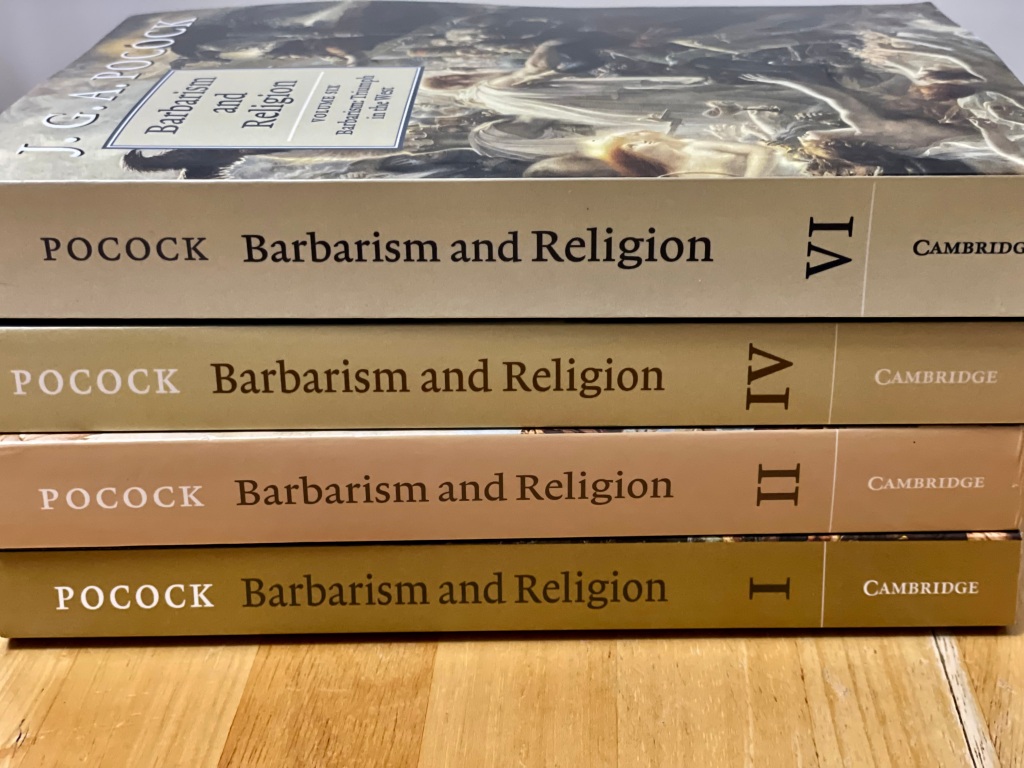
Thomas Hobbes famously wrote towards the end of Leviathan that “Papacy is no other than the Ghost of the deceased Roman Empire, sitting crowned upon the grave thereof” (Hobbes 1985). The long shadow casted by the Roman political tradition, however, is still peripheral to the current debates on secularization and political theology, and even in the most sophisticated analysis of the emergence of the fragmented public powers of the twelve century (Bisson 2015). In this seminar (one in a series of three) we will study the relation between Rome and the emergence of political modernity by attending to the multi-volume series Barbarism and Religion (1999-2015) authored by the Cambridge School historian J.G.A. Pocock, who has arguably undertaken the most serious attempt to provide an answer (however incomplete) regarding the passage between Rome and our modern political foundations.

Through a mannerist and highly idiosyncratic reconstruction of Edward Gibbon’s magnum opus, Pocock draws a large canvas of the Roman metapolitics, shedding light on the ongoing process of economic constitution and mutation. In this first seminar we will attend to the first two volumes of the series attending to the “civil” concept as an operative mediation of public order. Our wager is that the civil is at the crossroads in the ongoing crisis of authority and global civil war. Indeed, we tend to forget that the civil is operative in the notion of “civil war” used to describe the exhaustion of institutional and political forms.

Secondly, although we will consider the historiographical and conceptual constructions in Barbarism and Religion, the main focus of the seminar is to furnish an original understanding of the civil dimension from Rome to the modern legitimization of the political. In this sense we ask: to what extent does the concept of the civil discloses a specific genealogy from the decline of Rome and into the modern state? If so, how can one understand the polarity between barbarism and imperium (politics) as the two vectors of modern imagination about public order and the rule of law? And more ambitiously: can one mobilize (departing from Pocock’s historiographical project) the concept of the civil as a historical a priori – as the historical excess to every concept (Cooper 2022) – situated in the intersections of public law, modern commerce, and the rise of the state? What accounts for the event of the civil?

Getting ahead of ourselves, Pocock writes in the last volume of his series: “…so long powerful at the meeting point of imperium and barbaricum, who after defeat became the semi-autonomous subjects of the new kingdom. This is a moment in world history” (Pocock 2015). All things considered, this seminar looks to understand “this moment” in a present in which the civil has resurfaced as the principle of a total encompassing barbarism in the wake of the flaring up of Western civilization. If after concluding the six volume series we are capable of saying something to this end, we would have found ourselves lucky.