Cuaderno de apuntes sobre la obra de Rafael Sánchez Ferlosio. Quinta Parte. Por Gerardo Muñoz

Mientras vamos adentrándonos en la selva ensayística de Sánchez Ferlosio en preparación para el curso, se asoma una pregunta que tarde o temprano terminaría imponiéndose: ¿cómo pensar una legibilidad entre el movimiento analítico de Ferlosio y un despeje infrapolítico? ¿Existe un horizonte propositivo en la escritura de Sánchez Ferlosio, o, por el contrario, ese movimiento es algo que tenemos que ofrecer nosotros como lectores extemporáneos de su obra? Pienso en Ernst Jünger, quien ante la consumación de la técnica y el agotamiento de la imaginación introdujo toda una serie de figuras: el Waldgänger, la tijera, el Anarca, la interioridad espiritual, o el mito como energía contra el desvalor del sujeto. ¿Hay otro gesto en Ferlosio? Las notas que siguen es un merodeo inicial sobre esta cuestión en diálogo con el pensador Jorge Álvarez Yágüez.

Yágüez: Me parece que la relación de Ferlosio con la infrapolítica pasa por el wittgensteniano “aire de familia”: intempestivo, fuera de lugar respecto a los cánones, desconfianza respecto de los grandes relatos, de la historia o del poder, sospecha sobre toda legitimación del sufrimiento, rechazo implacable de toda lógica identitaria, escritura insobornable, sin concesiones, desconfianza respecto de la razón, sensibilidad agudizada hacia el lado oscuro, hacia la violencia innocua, malestar en la cultura, descrédito del yo, del individuo, saber que el modo en que se vive el tiempo es lo determinante…

Muñoz: Estoy de acuerdo, aunque se me hace difícil ver un paso propositivo de parte de Ferlosio; esto es, una salida, una fuga, una alteración. No lo digo sólo como límite interno, sino para dar cuenta de otra cosa: tal vez para Ferlosio una interrupción de la proyección de la historia sacrificial no pasa por la efectividad de un concepto. Es como si entre la palabra y el concepto se arrojara una sombra. Lo interesante es la sombra misma, el agujero. Un concepto sería otro dispositivo para sostener el dominio desde la filosofía que siempre aparece en el último acto. Alain Badiou dice algo interesante en el seminario sobre Lacan (Sesión 4, 1995, p.112): una vez que una hegemonía impone su discurso, la filosofía (el concepto) aparece para redimir su legitimidad. Badiou luego remata: a eso le llamamos política, el intento de taponear la brecha entre el discurso y lo real. Lo que me ha llamado la intención de este momento del seminario de Badiou es que aparece la misma figura que utiliza Ferlosio en los pecios: la política como una especie de pegamento . En “Alma y Vergüenza”, Ferlosio afirma que ese tapón es lo que “crea jurisprudencia” [cursivas suyas] como fuerza de constricción entre sujeto y sus actos (p.117). Un paso atrás nos situaría en lo que pudiéramos designar por infrapolítica.

Yágüez: Con respecto al derecho se mantiene en la idea benjaminiana de la violencia originaria generadora de valor. Con respecto a infrapolítica la idea de autenticidad, en efecto puede mantenerse desde la idea de que infrapolítica sea una especie de reivindicación de la existencia frente a su supuesta perversión en lo político donde este ha quedado vaciado de todo sentido republicano, pero en Ferlosio esa repulsa a lo afectado va mucho más allá que su referencia a la política, es mucho más general y afecta a todo, a lo que diríamos es algo así como la forma moderna de vida. Desde otro punto de vista, que no es el de existencia versus política, sino algo metódico, como alguna vez he intentado defender, tendría más que ver con el concepto de “furor de dominación”, su clave explicativa de la historia, la génesis de su violencia, eso sería lo previo, lo que subyace a toda instancia política, lo infrapolítico.

Cuando digo auténtico no hacía proyección filosófica alguna sobre el término, tan solo lo usaba como el antónimo de fingido que puede consultarse en cualquier diccionario. Desde el momento en que la autenticidad se volviera una especie de proyecto de vida acabada o algo semejante entraría en el campo de su opuesto. Esto es lo que tanto Ferlosio como García Calvo, tan convergentes en tantos puntos, siempre han sostenido. La referencia de todo ello a la política no es central, como apuntaba, es más bien dirigida a toda una forma de sociedad y de cultura, que incluye obviamente a lo político mismo, cuya consideración en clave republicana Ferlosio nunca llega a contemplar, no es algo que le haya interesado, en gran parte porque piensa que el meollo está en otra parte fuera de la instancia política, de la que por lo demás nunca ha creído que pudiera esperarse gran cosa.

Muñoz: Claro, creo que Ferlosio ve en el derecho una máquina productora de fictio, como tan bien lo estudió Yan Thomas en el derecho romano. Pero eso último que dices me parece extremadamente importante. O sea, a Ferlosio pareciera no interesarle fetichizar el problema de la dominación en la Política, porque lo político es ya un sobrevenido de una escena arcaica. En este sentido que me gusta la conjetura que nos da en QWERTYUIOP: ” la gratuita imaginación me ha hecho asociar a las pinturas rupestres a él “vítor” como el bautismo de sangre del montero se dejan relacionar con uno de los asuntos más antiguos y extendidos que se contempla en la antropología: los ritos de iniciación” (p.483-484).

La política sutura una escena arcaica, por eso siempre es ratio compensatorio. La polis es ya siempre tráfico de bienes o actividad de piratas (como ha argumentado recientemente Julien Coupat) cuyo fin es la construcción de un nomoi. En el léxico ferlosiano: la constricción institucional es la hegemonía fantasmal de lo Social. La política para Ferlosio es siempre un fantasma secundario. De ahí que la crítica efectiva de la política ya no sea un registro primario. Lo importante es retener la mirada sobre los principios de descivilización que la sustenta (los dioses Impersonales o las distensión del derecho de la persona al cualquiera). En este sentido, la política es siempre equivalencia en tanto que forma legislativa de lo Social.

Yágüez: Sí, creo que lo formulas bien. Para Ferlosio lo político es meramente derivativo, un escenario del que, no obstante, a veces se ha ocupado (especialmente en la época de Felipe González, incluso llegando a cubrir para alguna revista un congreso del PSOE, observando siempre las imposturas a las que conduce el poder), pero su foco, el de sus problemas siempre se ha situado en otra parte, yo diría primordialmente en dos espacios: el de lo que podría denominarse de crítica de las ideologías en (en el sentido de los francfortianos)  que tanto le han acompañado, (deporte, industria del ocio, Disney y Collodi, filosofía de la historia, etc.) esos elementos que configuran conductas y formas de vida; y el registro de los arcana imperii, o de ciertas instancias últimas: dominación, el laberinto de la identidad, o genealogía de la moral.

Primera parte, Segunda parte,Tercera parte, Cuarta parte

Nota sobre el “centrismo” de Carlo Galli. Por Gerardo Muñoz

Varios amigos que estimo han reaccionado con algo que dice Carlo Galli en el intercambio. El momento en cuestión es el siguiente: “Una democracia carente de un centro político y de la capacidad de analizar sus dinámicas y de poder responder a ellas, se encuentra a la merced de cada crisis y de cada amenaza.”

Es cierto que es una sentencia que no escatima su buena dosis de schmittianismo. Pero en ningún caso es reducible a “filosofía política ni al “acuerdo consensualista”. Al contrario, es  todo lo que le antecede: la energía misma de la política. En otras palabras, es la mirada realista en torno al poder. La filosofía política tradicionalmente ha sido un deber-ser y una teoría de la jurisprudencia (como dice J.G.A. Pocock); mientras que la teoría del consenso se ha expresado como parlamentarismo de lo neutro. (En Estados Unidos, por citar una de las “democracias residuales de Occidente”, no es difícil imaginar cómo sería la política si no existiera el Congreso).

¿Qué es el centro? Obviamente, el centro nada tiene que ver con lo que hoy entendemos por “centrismo”, esa forma más o menos grotesca de apoliticismo. No quiero hablar por Galli, pero mi impresión es que un centro político es la capacidad de actuar en el momento en el que somos arrojado al espacio volátil de lo político. Yo no pondría el acento en “crisis” ni en “centro”, sino en amenaza o riesgo. Dicho en otras palabras, la política siempre se da en función de la naturaleza del riesgo que, por su parte, abre el conflicto.

Esto es lo que yo llamo la postura madura. Y ese es el an-arcano de todo centro. La asignación de una habilidad debe tener presente que el riesgo se genera no sólo en el contenido de las precauciones, sino también en el diseño que se elevan para contenerlas. Ya si Carl Schmitt representa la postura madura o una decisión decidida de antemano (‘el mandato es lo primero, luego vienen los hombres’, como dice en el temprano Aurora Boreal) es otro tema.

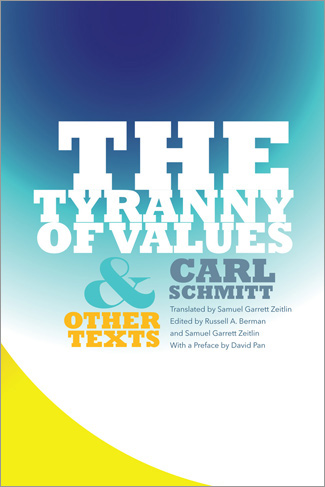
The End of the Constitution of the Earth. A review of Samuel Zeitlin’s edition of Tyranny of Values & Other Texts (Telos 2018), by Carl Schmitt. By Gerardo Muñoz.

Samuel Zeitlin’s edition of Tyranny of Values and Other Texts (Telos Press, 2018) fills an important gap in the English publication of Carl Schmitt’s work, in particular, as it relates to his lesser known essays written during the interwar period. This edition is still meant as an introduction to Schmitt’s political thought and it does not pretend to exhaust all the topics that preoccupied the Catholic jurist, such as the geopolitical transformations of the European legal order, the rise of economicism at a planetary scale, or the ruminations over the early modern theories of sovereignty and its defenders. Indeed, these essays sheds light on the complexity of a thinker as he was coming to terms with the weakening of the ius publicum europeum as the framework of European legality and legitimacy, and of which Schmitt understood himself to be the last concrete representative, as he repeatedly claims in Ex captivate salus.

As David Pan correctly observes in the Preface, the Schmitt that we encounter here is one that is confronting the transformations of political enmity in light of a gloomy and dangerous takeover of a global civil war. In fact, one could most definitely argue that the Schmitt thinking within the Cold War epochality is one that is painstakingly searching for a “Katechon”, that restraining force inherited from Christian theology in order to give form to the ruination of modern legal and political order. The global civil war, cloaked under a sense of acknowledged Humanism, now aimed at the destruction of the enemy social’s order and form of life. This thematizes the existential dilemma of a jurist who was conscious of the dark shadow floating over the efficacy of Western jurisprudence. In other words, the post-war Schmitt is one marked by a profound hamletian condition in the face of the technical neutralization of every effective political theology. This condition puts Schmitt on the defensive, rather than on the offensive, as his later replies to Erik Peterson, Hans Blumenberg, or Jacob Taubes render visible.

The essays in the collection can be divided in three different categories: those on particular political thinkers, some that reflect on political enmity and the concept of war, and two major pieces that deal directly with the crisis of nihilism in the wake of the Cold War (those two essays are “The Tyranny of Values” and “The Order of the World after the Second World War”). Zeitlin includes an early essay on Machiavelli (1927), a brief piece on Hobbes’ three hundred years anniversary (1951), a reflection on his own book Hamlet and Hecuba (1957), and a succinct note on J.J. Rousseau (1962). These are all not necessarily celebratory of each of these figures. Indeed, while in the piece on Hobbes Schmitt celebrates the author of Leviathan as a true political analyst of the English Civil War against Lockean contractualism; the piece on Machiavelli is a clear exposition of his loathe for the Florentine statesman. In fact, to the contemporary student of intellectual history these words might sound unjust: “[Machiavelli] was neither a great statesman nor a great theorist” (Schmitt 46). If politics is understood as the art of reserving an arcanum, as mystery of power against all forces of moral relativism and technical procedures, then, machiavellism’s endgame amounts to a mystified anti-machiavellinism that favors individual pathos over political decisionism. Machiavelli might have said “too much” about politics; and for Schmitt, this excess, points to the flawed human anthropology at the heart of his incapacity for thinking political unity (Schmitt 50).

If juxtaposed with the essay on Hobbes, it becomes clear that Schmitt’s anxiety against Machiavelli is also the result of the impossibility of extracting a Christian philosophy of history, which only the Leviathan was able to guarantee in the wake of a post-confessional world. Whereas Hobbes provided a political theology based on auctoritas, non veritas, facit legem, Machiavellism stood for an impolitical structure devoid of a concrete political kernel. In such light, the essay on Rousseau is astonishingly curious. For one thing, Schmitt paints a portrait of Rousseau that does not adequately fits the contours of a political theologian of Jacobinism. On the reverse side of this, Schmitt also avoids making the case for The Social Contract as a precursor of totalitarianism. Rather, following Julien Freund, Schmitt polishes a Rousseau that stands for limited freedom and equality; a sort of intra-katechon within Liberalism, and in this sense a mirror image of every potential Hegelianism for the unfolding of world history (Schmitt 173). Finally, the piece “What Have I done?”, a response to a critic of his Hamlet and Hecuba, is aimed not so much at the making of a “political Shakespeare”, but rather at shaking up both the “monopoly of dialectical materialist history of art” as well as the “well-rehearsed division of labor” of the university” (Schmitt 139-41). This is critique has not lost any of its relevance in our present.

Whereas the pieces on political thinkers is an exercise in reactroactive gazing on the tradition, the essays on political enmity and war are direct confrontations on the erosion of the European ius publicum europeum in the wake of the Cold War, dominated by the rise of international political entities (NATO, UN), and anticolonial movements of a new global order. It is in this context that Schmitt’s interest in the figure of the partisan begins to take shape as a way to come to terms with the new forms of mobility, irregularity, and changes in its territorial placement of the enemy. In “Dialogue on the Partisan”, Schmitt revises some of his major claims in Theory of the Partisan, while reminding that “the great error of the pacifists…was to claim that one need simply abolish warfare, then there would be peace” (Schmitt 182).The destitution of the ius publicum europeum, that oriented war making vis-a-vis the recognition of political enmity has, in fact, opened up for a de-contained partisanship in which the destiny of populations now was at the center. This new stage of political conflict intensifies the nihilism where potentially anyone is an enemy to be destroyed (Schmitt 194).

As Schmitt claims in the short piece “On the TV-Democracy”, the question becomes who will hold political power and to what extent, as techno-economical machination becomes the force that directly expresses the Goethean myth of nemo eontra deum nisi dens ipse. With the only difference that the mythic in the essence of technology has no political force, but mere force of mobilization of abstract identities and what Heidegger called “standing reserve”. In this new epoch, the human ceases to have a place on earth, not merely because his political persona cannot be defined, but rather because he can no longer identify himself as human (Schmitt 205). Schmitt’s sibylline maxim from poet Theodor Daubler, “The enemy is our question as Gestalt”, thus loses its capacity for orientation. Already in the 1940s, Schmitt is contemplating a crisis that he does not entirely resolve.

This is one way in which the important essay “The Forming of the French Spirit via the Legists”, from 1941, must be understood. This text on the one hand it is a remarkable sketch of French jurisprudence, grounded on “mesura”, “order”, “rationalism”, and sovereignty. It is no doubt an essay directed against royalist French intellectuals (Henri Massis and Charles Maurras are implicitly alluded to); but also at the concept of state sovereignty. Indeed, the most productive way to read this essay is next to The Leviathan in the State Theory of Thomas Hobbes (1938) written a couple of years prior. The impossibility of crafting a theory of the political in the wake of the exhaustion of the sovereign state form will eminently leave the doors wide open for a global civil war, as he argues in the post-war essay “Amnesty or the Force of Forgetting”. Schmitt’s defense of the a formation of the Reich in the 1940s will be translated in his general theory of a ‘new nomos of the earth’ immediately after the war.

The two most important pieces included in The Tyranny of Values and Other Texts (2018) are “The Tyranny of Values” (1960), and “The Order of the World after the Second World War”. The “actuality” of Schmitt’s political thought has a felicitous grounds on these essays, although by no account should we claim that they adjust themselves to the intensification of nihilism in our current moment. There is much to be said about the weight that Schmitt puts on the “economic question”, a certain pull that comes from the emphasis of the much debated question then concerning “development-underdevelopment”, which does not really capture the metastasis of value in the global form of the general principle of equivalence today. Schmitt also deserves credit in having captured in “The Tyranny of Values”, the ascent of the supremacy of “value” in relation to the philosophies of life (Schmitt 12). Schmitt quotes Heidegger’s analysis, for whom “value and the valuable become the positivistic ersatz for the metaphysical” (Schmitt 29), which we can have only intensified in the twenty-first century. Perhaps with the only difference that “value” is no longer articulated explicitly. But who can deny that identitarian discourse is a mere transposition of the tyranny of values? Who can negate that the cost-benefit analysis, “silent revolution of our times” as one of the most important constitutionalists has called it, now stands as the hegemonic form of contemporary technical rationality? [2].

At one point in the “Tyranny” essay, while commenting on Scheler’s philosophy, Schmitt says something that it has clearly not lost any of its legibility in our times: “Max Scheler, the great master of objective value theory has: the negation of a negation value is a positive value. That is mathematically clear, as a negative times a negative yields a positive. One can see from this that the binding of the thinking of value to its old value-free opposition is not so lightly to be dissolved. This sentence of Max Scheler’s allows evil to be requited with evil and in this way, to transform our earth into a hell, the hell however to be transform into a paradise of values” (Schmitt 38). It is a remarkable conclusion, and one in which the “mystery of evil” (the Pauline mysterium iniquitatis) becomes the primary function of the art of government in our times. It is here where we most clearly see the essence of the techno-political as the last reserve of legal liberalism. Schmitt would have been surprised (or perhaps not) to see that the disappearance of the rhetoric of values also coincides with a new regulation of disorder, whether it takes the name of “security”, “cost and benefits”, or “identity and diversification”. Indeed, now politics even has its own place in the consummation of the race for the “highest values”, since anything can be masked a “political” at the request of the latest demand.

In his 1962 conference “The Order of the World after the Second World War”, delivered in Madrid by invitation of his friend Manuel Fraga, Schmitt still is convinced that he can see through the interregnum. Let me quote him one last time: “I used the word nomos as a characteristic denomination for the concrete division and distribution of the earth. If you now ask me, in this sense of the term nomos, what is, today, the nomos of the earth, I can answer clearly : it is the division of the earth into industrially developed regions or less developed regions, joined with the immediate question of who accepts development f aidrom whom…This distribution is today the true constitution of the earth” (Schmitt 163). It is a sweeping claim, one that seeks to illuminate a specific opaque moment in history.

But I am not convinced that we can say the same thing today. Here I am in agreement with Galli and Williams, who have noted that the disappearance of a Zentralgebiet no longer solicits the force of the Katechon [3]. And it is the Katechon that guarantees an effective philosophy of history for the Christian eon. The Katechon provides for a juridical sense of order against a mere transposition of the theological. Indeed, it is never a matter of theological reduction, which is why Schmitt had to evoke Gentilis’ outcry: Silenti theologi, in munere alieno!  I guess the question really amounts to the following: can a constitution of the earth, even if holding potestas spiritualis, regulate the triumph of anomia and the unlimited? Do the bureaucrat and the technician have the last world over the legitimacy of the world? Here the gaze of the jurist turns blank and emits no answer. One only wonders where Schmitt would have looked for new strengths in seeking the revival of a constitution of the earth; or if this entails, once and for all, the closure of the political as we know it.


Notes

  1. Carl Schmitt. The Tyranny of Values and Other Texts, Translated by Samuel Garrett Zeitlit. New York: Telos Publishing Press, 2018.
  2. Cass Sunstein. The Cost Benefit Revolution. Massachusetts: MIT Press 2018.
  3. See Carlo Galli, “Schmitt and the Global Era”, in Janus’s Gaze: Essays on Carl Schmitt. Durham: Duke University Press, 2015, p.129. Also, Gareth Williams, “Decontainment: The Collapse of the Katechon and the End of Hegemony”, in The Anomie of the Earth (Duke University Press 2015), p.159-173.

Some Notes Regarding Hölderlin’s “Search for the Free Use of One’s Own”. By Gerardo Muñoz.

In what follows, I want to comment on Martin Heidegger’s reading of Hölderlin’s well-known dictum from his 1801 letter to his friend Casimir Bohlendorff, “the free use of the proper is the most difficult thing”. Heidegger devotes a whole section to this enigmatic phrase in the recently translated 1941-42 Hölderlin’s Hymn “Remembrance” (2018) seminar, which dates to the years in which he was confronting Nietzsche’s work, and also more explicitly and for obvious reasons, the issue of German nationalism [1]. In the wake of recent conversations about nationalism and patriotism in political rhetoric, it seems like a fitting time to return to Heidegger’s comments on Hölderlin’s work. This also marks a turn in Heidegger’s thinking of the poetic in the strong sense of the term, which has been analyzed widely in the literature.

Heidegger begins by claiming that the “free use of one’s ownmost” requires a direct confrontation with “the foreign” but that at the same time, it is the easiest thing to miss (Heidegger 105). What is difficult is that which is already one’s own and nearest, and because it is intuitive, it is easy to overlook it. What is difficult is not due to some kind of epistemological overcapacity that today we would associate with the complexity of technical density, but rather, it is an immediate inhabitation, a mood of our belonging that is grasped beyond consciousness and propriety. Hence, it is easy to discard it in a gesture of dismissal due to its familiarity. It happened even to the Greeks.

Heidegger quotes Hölderlin’s verses referencing the loss of the ‘fatherland’: “Of the fatherland and pitifully did / Greece, the most beautiful, perish” (Heidegger 105). Following an obscure Pindar fragment on the “shadow’s dream”, Heidegger shows that the absence is the most important element to illuminate the unreal as it transitions to the real. And this is what the poet does. Indeed, the poet can establish a “footbridge”, or rather it came bring it forth, to initiate a transition towards “what is historically one’s own” (Heidegger 109). If anything, what Greece and Germania point to in Hölderlin’s poetry is this otherwise of historical presencing, which Heidegger admits has nothing to do with historiographical accumulation or cultural metaphorcity (Heidegger 109). At times it is all too easy to dismiss what is at stake here. In the beginning of the twentieth century, for instance, E.M. Butler wrote a book titled The Tyranny of Greece over Germany (1935), which studied the “classical influence” of all things Greek since Winckelmann and German Idealism. Many do not cease to repeat the cliché that Heidegger’s thinking – even Schmitt in Glossarium laments the fascination with Hölderlin over Daubler, which is also the controversy between the critique of logos and a Christological conception of History – is a flight back to Greek ruminations for a new German beginning.

Obviously, this is not Heidegger’s interest in reading the holderlinian use of one’s own. There is no cultural equivalence between the German and the Greek sense of belonging; rather it seems that what Heidegger is after is another way of thinking the historicity of the people, which is fundamentally a problem with the relation with time: “A humankind’s freedom in relation to itself consists in funding, appropriating, and being able to use of what is one’s own. It is in this that the historicality of a people resides” (Heidegger 111). The poet is the figure that, by asking the question about the most difficult thing (one’s use of the proper), can discover this task. Only he can take over the business of founding it (Heidegger 112). The task of the poet is always this “seeking”, which is already in Hölderlin’s first fragment in his novel Hyperion: “We are nothing: what we seek is everything” (Heidegger 113). The task of seeking opens itself to what is the highest and the most holy, which for Hölderlin is the “fatherland’. It is “holy” precisely because it is forbidden and the most difficult to retain.

We are far away here from the sacrificial structure of Hölderlin’s “Der Tod Furs Vaterland” (“To Die for the Homeland”), which Helena Cortés Gabaudan has read in light of the archaic Horacian trope of ‘dulce et decorum est pro patria mori’; a staging of the heroic ethos against the backdrop of the aporetic conceit between thinking and action, the sword and the pen, the poet and the warrior in the early stages of the artist fallen into the age of revolutions [2]. Something else is going on in “Remembrance” use of one’s own at the level of the very transformative nature of historical time, in so much as that which is most holy is nothing that resembles a past principle (a work of art stored in a museum, or the poem as an artistic medium), but rather an atheology, which is never negation or lack; it is always nearness to one’s own as the encounter with what’s “holy” (Heidegger 117).

This atheology suspends any given theistic structure in the act of poetizing. (Is it even correct to refer it as an “act”?). And this poetizing is the task as passage is the inscription of the impossible relation with one’s use here and now. But where does the “political” fit in this picture, one could ask? Is Hölderlin’s turn towards the “use of the national” (Vaterland) entirely a question driven by a political vocation of some sort? This is a poet, one must remember, frustrated by the belated condition of nationhood that sealed Germany’s destiny in the wake of the French Revolution. Hölderlin is first and foremost a poet of political disenchantment and a witness to how politics cannot escape this tragic fate. Indeed, only the poet can actually look straight at this predicament, unlike the political thinker who fantasies with a programmed “assault on the heavens”. In an important moment of the analysis, Heidegger touches this problem:

“What is more obvious than to interpret the turn to the fatherland along the lines of a turn to the “political”? However, what Hölderlin names the fatherland is not enchanted by the political, no matter how broadly one may conceive the latter…The turn to the fatherland is not the turn to the political either, however“. (Heidegger 120).

Undoubtedly, this is a Parthian arrow directed at the political essence of the national understood as a gigantism of state, culture, and history as it was conjuring up in the European interwar period. It is also takes a distance from any given “standpoint” of the national becoming. In this sense, I am in agreement with poet Andrés Ajens’ suggestion that, against the dialectics of locational “alternative histories”, the problem of the national is that of an infinite task of the “desnacional” (this is Ajens’s own term) under erasure, in relation to the “foreign”, in preparation for the “passage of learning to appreciate one’s own” (Heidegger 120) [3]. What we cannot grasp in the national is precisely what bears the trace of the task of ‘denationalization’ as the homecoming of “the clarity of presentation” in its discrete singularity (Heidegger 122). This last line is also from the letter to Bohlendorff.

It is interesting that every time that the form of denationalization has been referred to in strictly political terms, it entails the overcoming of politics by an exogenous force that liquidates the capacities for its own limits. This is, indeed, the realm of the political in the strong sense of the term, in line with the emergence of sovereignty that Hölderlin’s poetic thought wants to curve toward an otherwise of the national. This use of the national wouldn’t let itself be incubated by the supremacy of the political. Let us call this an infrapolitical kernel of patriotism.

This is why at the very end of this session Heidegger mentions that Hölderlin, unlike Nietzsche, must be understood as a “harbinger of the overcoming of all metaphysics” (Heidegger 122). We wonder whether the emphasis on the “People”, however fractured or originary, does not carry a residue of metaphysical rouse. Nevertheless, it is undoubtedly true that Hölderlin aims at something higher. Perhaps he aims at an “inebriation that is different from the “intoxication of enthusiasm” (Heidegger 125); that is, a distance from Kant who elevated the perception of the French Revolution as an anthropological affection.

The step back of the singularity is driven by the “soul” – which Heidegger connects to the polysemic usage of the word Gemüt (at times translated as disposition or gathering) – as other than politics, since it sees through the offering of the dark light and keeps thinking in the human. Transposing it to our discussion, we can say that a politics is irreducible to Gemüt, and that only Gemüt is the excess in every politics. The use of one’s own, vis-a-vis the national (or the process of denationalization), is a resource to attune oneself with this “disposition”. No human can bear to be human without it. Hölderlin seeks to reserve this poverty as the primary task of the poet as a radical neutralization of all techno-political missteps. Or, in the last words in the session: “…it is the while of the equalization of destiny” (Heidegger 131).


Notes

  1. Martin Heidegger. Hölderlin’s Hymn “Remembrance”. Bloomington: Indiana University Press, 2018.
  2. Friedrich Hölderlin. Poesía esencial, ed. Helena Cortés Gabaudan. Madrid: Oficina de Arte y Ediciones, 2018.
  3. From a personal exchange with Andrés Ajens.

Hegemony, Legitimacy, and the Mature Position: on Chantal Mouffe’s For A Left Populism. By Gerardo Muñoz.

Chantal Mouffe’s For A Left Populism (Verso, 2018) is deliberately written for the ‘populist moment’. It resembles the patriotic pamphlets, which according to historian Bernard Bailyn fueled passions months prior to the American Revolution. For Mouffe, the crisis of democracy will continue to grow if populism is not taken seriously both politically and theoretically, and her book is an excellent guide in that direction. For A Left Populism does not pretend to tease out new arguments. Rather, it seeks to revise and render accessible some of the main tenants of the radical democracy project that she elaborated, along with her late partner Ernesto Laclau, in books dating back to Hegemony and Socialist Strategy (1985). Mouffe reminds us that their task was to propose a theoretical horizon in the wake of the crisis of Eurocommunism, and against the ‘third-way’ of liberal democracies that dismantled the Welfare State. The populist agenda is ambitious: it proposes a move beyond Marxist liberationism, but in doing so it takes distance from market liberalism of Western democracies.

But what does “left populism” has to offer? For Mouffe the answer is short: a politics for the People, “in the name of the People”, capable of organizing an equivalency of social demands through the construction of a political frontier against a common adversary (the elite). Mouffe is right about the diagnosis: both Liberalism and Communism were attempts to deface the People. Whereas Communism promised a new man in a society outside capital, Liberalism offered the guarantee of happiness for the individual citizen. These two attempts were ways to neutralize social contingency between civil society and state relations. Contrary to the citizen and the subject, populism assumes heterogeneous social actors that vis-à-vis their equivalent demands are capable of radicalizing democracy. This process of radicalization entails that a social dynamic attentive to material needs could avoid the pitfalls of the Marxist historical subject as well as the sedimentary flow of institutions. The strategy that catalyzes such radicalization is the theory of hegemony (Mouffe 24).

Now, the logic of hegemony introduces an array of important elements for the radicalization thesis. First, hegemony, according to Mouffe, is what effectively disputes the “consolidation of neoliberal hegemony in Western Europe” (Mouffe 33). In a way, hegemony here takes the form of an avatar of the existing order of domination; a political transposition of capitalist reproduction. In fact, what hegemony shares with capitalism is the formalization of equivalence. Secondly, hegemony is understood as the missing tool in liberalism, which shrinks democratic life (Mouffe 38). Finally, hegemony emerges as an alternative to communism’s eschatology by accepting the current institutional designs in pursuit of ‘passion for equality’ (Mouffe 43). Common to all of these arguments is the main claim that only hegemony can rescue democracy from its post-political gloom. Hence, the theory of hegemony posses two important edges: one is descriptive and the other one is prescriptive. On the one hand, neoliberal postpolitics is already hegemonic. In other words, it does not allow an outside to what is provided by the general equivalent. On the other hand, hegemony appears, following Antonio Gramsci’s lessons, as a central political force that can transform the real-existing order.

But as political philosopher Jorge Yágüez has noted, Gramsci considered hegemony as a passive development that cannot be merely reduced to a political technique of state domination [1]. Mouffe would reply that she is not interested in gramscian textualism, but rather in the practical uses well beyond his original intentions. That is fair, but at the same time there is no reason to think that Gramsci’s theoretical horizon was more complacent under the sign of radical revolution than in the republican separation of powers or popular sovereignty. In fact, there is something to be said about Mouffe’s efforts in trying to move the discussion about populism outside the sociological determinations. Mouffe is aware that rendering the notion of hegemony effective within liberal-democratic order requires attending to the problem of legitimacy. Indeed, in one of the cardinal moments of For A Left Populism, Mouffe writes:

“A liberal-democratic society supposes the existence of an institutional order informed by the ethico-political principles that constitute its principles of legitimacy. What is at stake in a hegemonic transformation is the constitution of a new historical bloc based on a different articulation between constitutive political principles of the liberal-democratic regime and the socioeconomic practices in which they institutionalized. In the case of a transformation from on hegemonic order to another, those political principles remain in force, but they are interpreted and institutionalized in a different way” (Mouffe 45).

By disposing the idea of a drastic rupture in institutional life, hegemony accepts the liberal-democratic framework in exchange for coming to terms with the principle of legitimacy. But if we are in an epoch that has gone through an absolute decline of founding principles, is a “different way” of management enough? In studying the administrative state, for instance, I have argued that legitimation, once centered on charisma, has ceased its domain to administration. This means that legitimacy becomes synonymous with technique, and the political leader becomes synonymous with the bureaucrat.

How does hegemony stand in relation to legitimacy? Hegemony can stand as a superstructural element above it, but it can also become the principle of legitimacy itself to renew democracy. Mouffe is not explicit about this, except when she considers the Gramscian notion of the ‘integral state’ as significant to remake the contract between state and society (Mouffe 47). It is curious that this formulation coincides with José Luis Villacañas’ recent preface to Gramsci’s prison notebooks [2]. Let me briefly turn to Villacañas’ text.

For Villacañas, hegemony does entail a substitute of the legitimacy principle, now in crisis, which can open a transformative epoch beyond the domination of economy. Villacañas and Mouffe converge on this point: the essence of hegemony juxtaposes the political region against the economic region. But where as for Mouffe hegemony operates to defend and radicalize the principles of democracy, for Villacañas, hegemony is a “civilizational principle” that secures an ethical state in the form of a passive revolution (Mouffe 49, Villacañas 19). But, can legitimacy be resurrected from a political will unified under hegemony? There are two possibilities here. If we say that hegemonic populism is a struggle to politize a post-political scenario, then hegemony is merely a temporal stand-in to the current legitimacy. On the other hand, if we say that hegemony is a principle of legitimacy, what can guarantee its force is the cathexis between the political leadership (“clase dirigente”, says Villacañas) and the People. In reality, neither of the two options have the capacity to offer a social contract to reform democracy.

Mouffe claims that hegemony stands for identification via “different forms of subjectivities” (Mouffe 76-77). In other words, hegemony is a form of subjection. This means that in order to partake in hegemony you must necessarily be subjected to it. The civilizational drive of hegemony repeats the same step that led to the crisis of democratic politics in the first place, since it reduces democracy to a legislation of demands for recognition. It is not surprising that the minimal unit of equivalency is the demand. Thus, hegemony is first and foremost the demand to be a subject of hegemony. This is why leftist democratic politics based on hegemony is a self-defeating mechanism: it promises conflict but it reduces it through an empty signifier; it promises to displace the historical subject but it relocates it through equivalent subjective agglutination; it cares for legitimacy but it offers management not very different from the liberal paradigm. In this way, hegemony reintroduces politics as administration cloaked under political cordiality [3]. But we know that no effective politics were ever created on the basis of love or good intentions or unity.

If neoliberalism upgrades the “totalitarian” aspiration onto its economic indexation of life, as Argentine psychoanalyst Nora Merlin has argued, then the concept of hegemony runs the risk of absolutizing political domination as its substitute principle [4]. By reminding faithful to principle of unity and equivalence, the logic of hegemony tends to reproduce the results that it attempts to avoid. In other words, hegemony merely displaces the technique of the economy to a technique of the political. Is there a different position without discarding populism and moving back to liberal technicity? It is interesting that Mouffe mentions in passing posthegemony, which she reduces to an “affective turn” that ignores the lessons of psychoanalysis (Mouffe 74).

I would like to argue, on the contrary, that posthegemonic populism is the mature position that avoids the closure of conflict internal to hegemonic rationality. In fact, if psychoanalysis were to be taken seriously, hegemony would amount to yet another master discourse that aims at administering singular desire through a two step procedure: vertical cathexis and horizontal agglutination. The hegemonic recentralization of conflict leads necessarily to the closure of other potential conflicts and risks. Posthegemony, on the other hand, names the political position that aims at liberating the conflictive nature of politics within any democracy. It comes as no surprise that at the very end of her essay, Mouffe comes full circle to posit faith in “certain forms of consensus” once hegemony has been accepted as the logic of the political (Mouffe 93). By insisting on the optimization of conflicts, rather than in its verticalization, posthegemonic populism would allow turbulence in politics beyond the dead end of consensus.

A hegemonic alternative to legitimacy not only fails to renew democratic life, but it taxes life on behalf of the political. In this sense, by becoming a technique of dominance hegemony is incapable of transcending the antinomies of state and civil society, politics and economics at the root of the crisis. In broader terms, we know that the disintegration of the modern state form is neither an economic nor a political problem, but one of a deeper symbolization as a result of the primacy of legality over legitimacy, something that Carl Schmitt noted in his later works [5]. Hegemony can only offer a political legislation out of the crisis, but not much more.

Legitimacy is vital for democracy. But hegemony cannot do the work, except as faith. Democratic politics, however, is precisely what is incommensurable to beliefs. By positing hegemony as integration from within, Mouffe leaves us with an alternative political theology. This political theology works solely on behalf of its believers. The posthegemonic position concedes Mouffe & Laclau’s formula a winner for democratic politics, but it prefers to recognize conflicts at face value; that is, not as a question of principles, but rather of optimization beyond the intended precautions. It seems that this is the mature position for populism if it wants to be successful today.

Notes

  1. Jorge Álvarez Yágüez. “Retorno a Gramsci” (2017). https://dialnet.unirioja.es/servlet/articulo?codigo=6135405
  2. José Luis Villacañas. Pasado y presente: Cuadernos de la cárcel. Prefacio de J. L. Villacañas Berlanga. Barcelona: Gedisa, 2018. See also, the debate between Villacañas and Moireras on hegemony & posthegemony: https://infrapolitica.com/2018/06/23/respuesta-de-jose-luis-villacanas-a-precision-sobre-posthegemonia/
  3. Antoni Puigverd, “Hegemonía de la cordialidad” (2018): https://www.lavanguardia.com/opinion/20180709/45776820190/pedro-sanchez-parlament-torra-cordialidad.html
  4. Nora Merlin, “Neoliberalismo, el retorno del totalitarismo por otros medios” (2018): https://www.eldestapeweb.com/neoliberalismo-el-retorno-del-totalitarismo-otros-medios-n46759
  5. For Carl Schmitt’s critique of values and a self-critique of his concept of sovereignty, see The Tyranny of Values (1996) and Glossarium (2015).

El Santo y el Político. Por Gerardo Muñoz.


El ascenso del ‘servidor público’ nos sitúa ante la pregunta sobre el agotamiento de la figura del político de vocación. Se trataría de algo más que un mero desplazamiento de Weber a Kant, aún cuando estas categorías hayan sido heredadas de las gramáticas del pensamiento moderno. Hoy estamos en condiciones de preguntar: ¿podemos hoy seguir hablando de liderazgos políticos? ¿O es acaso todo líder reducible a la figura del gestor de las buenas intenciones? Esta sigue siendo una conversación pendiente entre quienes nos interesa pensar las mutaciones de las élites políticas.

La cuestión del liderazgo ha estado a flor de piel en los últimos días en la coyuntura española. Y no solo por la salida de Rajoy de la Moncloa, sino también por la discusión que se abre en torno a sus relevos. El periodista Pedro Vallín subrayó el liderazgo de Pablo Iglesias (Unidos Podemos) en la moción de censura. Y por su parte Iglesias le recomendó a Sánchez aparentar “presidenciable” y no un mero “mal menor”.

Liderazgos para política de alta presión y mirada larga. La imagen misma de Iglesias como político-santo (del bien común) tiene entre sus múltiples propósitos liberarse de los subusleos de un modelo financiero inscrustado en los lazos sociales. Esto lleva el nombre “corrupción”, aunque tampoco es reducible a lo que normalmente entendemos por esto.

Se abre un hondísimo problema para pensar el nudo entre política y moral. El caso del chalet de Iglesias-Montero, por ejemplo, permite un manejo gradualista bajo el presupuesto de que es un asunto ‘privado’. Pero la moción de censura anticorrupción hegemoniza aquello que constituye ‘lo público’ (el fisco) desde las más diversas alianzas (PSOE, UP, PNV, las fuerzas independentistas catalanas, etc.). La hegemonía en política hoy coincide con el político como gran gestor. Y el tema viene al caso dada la incidencia ganadora de la teoría de Laclau en la hipótesis Podemos. Es el mayor dilema de toda propuesta política contemporánea sin obviar sus riesgos de neutralización.

El carisma de santo de Iglesias – como bien lo ha notado Enric Juliana – es franciscano. La mirada del Fatricelli encaja con el pastoreo de Francisco (Papa Peronista, no lo olvidemos) y entona con el ethos sacrificial que ha naturalizado la crisis. El líder franciscano descarga el peso ominoso de los líderes jesuíticos. Piénsese en Fidel Castro, quien provenía de esas filas. Pero el franciscanismo trae las malas noticias en tanto que práctica ajena al goce, es incapaz de producir el corte de una emancipación efectiva. Aunque como también ha visto Jorge Alemán en su lectura lacaniana En la frontera: sujeto y capitalismo (2014), aquí también puede producirse un singular desvío al interior del discurso capitalista y de la política consumada en Técnica. El franciscano se mide en ajustes y contenciones, hábitos y reglas. Puesto que experimenta el sinthome desde otro lado.

Vale la pena volver a ver Francisco, Juglar de Dios (1950) de Roberto Rossellini sobre la habítica comunidad del Fatricelli. O sea, de su relación mínima con la propiedad. Una delicada trama, puesto que ante el goce ilimitado que todos buscan hoy en día, el gestor franciscano pareciera desatender la tesis de que es el consumo el que libera y no al revés.

*Una versión de esta columna se escribió para Tecla Eñe Revista.

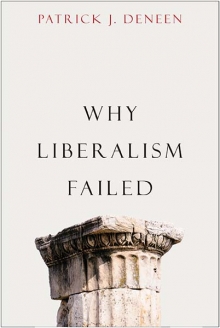
The triumph of res idiotica and communitarianism: on Patrick Deneen’s Why Liberalism Failed. By Gerardo Muñoz.

Patrick Deneen’s much-awaited book Why Liberalism Failed (Yale University Press, 2017) is a timely contribution that, in the wake of the Trump presidency, vehemently confirms the epochal crisis of political liberalism, the last standing modern ideology after the demise of state communism and short-lived fascist mass movements of the twentieth century. It is difficult to distinguish whether liberalism is still a viable horizon capable of giving shape to citizenship or if on the contrary, it endures as a residual form deprived of democratic legitimacy and popular sovereignty [1]. In fact, contemporary liberalism seems incapable of attending to social demands that would allow for self-renewal. In a slow course of self-abdication, which Carl Schmitt predicted during the Weimar Republic, liberalism has triumphed along the lines of a logical administration of identity and difference through depolitization that has mutated as a global war in the name of ‘Humanity’ [2]. The catastrophic prospect of liberalism is far from being a schmittian alimony of political exceptionalism. In fact, Mark Lilla in his recent The Once and Future Liberal (2017) claims, quite surprisingly, that the “liberal pedagogy of our time is actually a depolitizing force” [3]. What is at stake at the threshold of liberal politics is the irreducible gap between idealia and realia that stages a moment where old principles wane, no longer accounting for the material needs in our contemporary societies [4].

Deneen confronts the foundation of its idealia. Deneen’s hypothesis on the failure of liberalism does not follow either the track of betrayal or the path of abdication. Rather, Deneen claims that liberalism has failed precisely because it has remained “true to itself” (Deneen 30). In other words, liberalism has triumphed in its own failure, crusading towards liberation as a philosophy of history, while administrating and containing every exception as integral to its own governmentality. If modern liberalism throughout the nineteenth century (an expression of the Enlightenment revolutionary ethos) provided a political referent for self-government, the grounds for the rule of law, and the exercise of liberty against divine absolute powers (the medieval theology of the potentia absoluta dei); contemporary liberalism has found consolidation as a planetary homogeneous state that reintroduces a new absolutism that interrupts modern man’s self-affirmation against divine contingencies [5]. Since its genesis, liberalism was held by two main anthropological assumptions: individualism as the kernel for the foundation of negative liberty and the radical separation of the human from nature, both by way of an economic-political machine that liberates the individual at the same time that it expands the limits of the state. The rise of the securitarian state is the effective execution of this logic, by which politics centers on governing over the effects in a perpetual reproduction of its causes. These ontological premises are the underlying infrastructures of a two-headed apparatus that ensembles the state and the market in the name of the unrestrained conception of liberty. As Deneen argues: “…liberalism establishes a deep and profound connection; its ideal of liberty can be realized only through a powerful state. If the expansion of freedom is secured by law, then the opposite also holds true in practice: increasing freedom requires the expansion of law” (Deneen 49).

But the same holds true for the unlimited market forces that today we tend to associate with late-modern neo-liberal laissez-faire that presupposes the expansion of functional units of state planning as well as the conversion of the citizen as consumer. The duopoly of state-market in liberalism’s planetary triumph spreads the values of individual autonomy, even if this necessarily entails the expansion of surveillance techniques and the ever-increasing pattern of economic inequality within an infinite process of flexible accumulation and charity that maintain mere life. In this sense, globalization becomes less a form of cosmopolitan integration, and more the form of planetarization driven by the general principle of equivalence that metaphorizes events, things, and actions into an abstract process of calculability [6]. This new nomic spatialization, which for Deneen discloses the erosion of local communitarian forms of life as well as the capacity for national destiny, is the epochē of sovereignty as the kernel principle of liberalism. In other words, Liberalism’s sovereigntist traction was always-already exceptio through which the governance of the nomos is only possible as the effective proliferation and rule over its anomic excess.

The substantial difference with early forms of liberalism is that only in the wake of contemporary globalization and the post-industrial reorganization of labor, this exceptionalism  no longer functions as a supplement to the normative system, since it is what marks the subsumption of all spheres of action without reminder. In this scenario, liberalism is no longer a political ideology nor is it a horizon that orients a modern movement towards progress; its sole task is to control the imports of identity and difference within the social. One could say that liberalism is a technique for containing, in the way of a thwarted katechon, a society without limits. Paradoxically, liberalism, which once opposed sovereign dictatorship, now endorses a universality that cannot be transmitted, and a principle of democracy that has no people (populus).

In the subsequent chapters of Why Liberalism Failed, Deneen turns to liberalism’s imperial mission in four distinct social paradigms: culture, technology, the Liberal Arts in the university, and the rise of a new aristocracy. The commonality in each of these topoi is that in each and every one of these social forms, liberalism has produced the opposite of what it had intended. Of course, it did so, not by abandoning its core principles, but precisely by remaining faithful to them, while temporalizing the hegemony of the same as eternal. First, in the sphere of culture, Deneen argues that liberalism’s inclination towards an anticultural sentiment is consistent with multiculturalism as the “eviscerated and reduction of actual cultural variety to liberal homogeneity loosely dressed in easily discarded native garb” (Deneen 89). The culturalism promoted by liberalism is a process of deletion that knows only a fictive transmutation within the logic of ‘diversity’ and ‘inclusion’ that seeks to exhaust the cosmos of the singular. The price to be paid for policed inclusion of cultural differences into liberal anticultural norms, aside from leaving the economic accumulation untouched, is that it forces a form of consent that tailors the radically irreducible worldviews to standardized and procedural form of subjective recognition. Although Deneen does not articulate it in these terms, one could say that culturalism – which Deneen prefers to call liberalism anticulturalism-, amounts, in every instance, to a capture that supplies the maintenance of its hegemonic thrust.

Nowhere is this perceived with more force today than in liberal arts colleges and universities across the country, where from both ideological extremes, the Liberal Arts as a commitment to thinking and transmission of institutional knowledge is “now mostly dead on most campuses” (Deneen 113). From the side of the political conservative right, the way to confront the ongoing nihilism in the university, has been to completely abandon the liberal arts, pledging alliance to the regime of calculative valorization (the so called “STEMS” courses) on the basis of their attractive market demand. But the progressive left does not offer any better option, insisting by advancing the abstract “critical thinking” and one-sided ideological politization, it forgets that critique is always-already what feeds nihilism through the negative, which does little to confront the crisis in a democratic manner. The demise of the liberal arts in the contemporary university, depleted by the colonization of the dominance by principle of general equivalence, reduces the positionality of Liberal Arts to two forms of negations (critique and market) for hegemonic appropriation [7]. In one of the great moments of Why Liberalism Failed, Deneen declares that we are in fact moving slowly into the constitution of a res idiotica:

“The classical understanding of liberal arts as aimed at educating the free human being ids displaced by emphasis upon the arts of the private person. An education fitting for a res publica is replaced with an education suited for a res idiotica – in the Greek, a “private” and isolated person. The purported difference between left and right disappears as both concur that the sole legitimate end of education is the advance of power through the displacement of the liberal arts” (Deneen 112).

Liberalism idiotism is invariable, even when our conduct is within the frame of public exposition. One must understand this transformation not merely as a consequence of the external economic privation of the public university (although this adds to the decline of whatever legitimacy remains of the Liberal Arts), but more importantly as a privatization of the modes of the general intellect into a dogmatic and technical instrumentality that “can only show their worth by destroying the thing they studied” (Deneen 121). The movement of liberalization of higher education, both in terms of its economic indexes and flexible epistemic standardization, dispenses the increasing erosion of institutions, whose limits have now become indeterminate within the general mechanics of valorization. The res idiotica is the very exhaustion of the res publica within liberal technicality, where any form of impersonal commonality is replaced by the unlimited expansion of expressive subjectivism. In a total reversal of its own conditions of possibility, the outplay of the res idiotica is satisfied in detriment of any use of public reason and freedom, if by the latter we understand a commitment to the polis as a space in which the bios theoretikos was never something to be administered, but constructed every time [8]. The emergence of res idiotica coincides with the decline of politics as a force of democratization in the public use of reason.

In the economic sphere, the assault of the res publica entails the emergence of a new aristocracy, which as Deneen argues, was already latent in liberalism’s great ideologues’ (Locke, Mill, and Hayek) commitment to a ruling class formation and arbitrary economic distribution. For Deneen, one did not have to wait for Hayek’s experiments in active market liberalism to grasp that what J.S.Mill called “experiments of the living” as the promise of liberation from the social shackles, but only to consecrate an even more stealth system of domination between expert minorities rule and ordinary people. What remains of Liberalism in its material deployment is not much: a res idiotica that fails at constituting a public and civil society devoid of cives, and a state that expands the limits of administration in pursuit of freedom only to perpetuate an aristocratic class. In broad strokes, Deneen’s narrative about liberalism could be well said to be a story about how a “living body” (the People) became an absolute in absentia that only leave us with a practice of idolatry to a supreme and uncontested principle [9].

The idolatrous character of liberal principles is rendered optimal in recent theoretical claims against democracy, where the latter is seen as an obstacle for government rather than as the premise for the legitimacy of popular sovereignty. Hence, democracy is turned into a mechanical arrangement that includes whatever supports liberal assumptions and beliefs, and excludes all forms of life that it sees as a threat to its enterprise. In this way, liberalism today is a standing reserve that administers the proliferation of any expressive differential identities, while scaffolding an internal apparatus for self-reproduction. In one of the most eloquent passages of the book, Deneen evokes the anti-democratic shift of liberalism in the contemporary reflection:

“…the true genius of liberalism was subtly but persistently to shape and educate the citizens to equate “democracy” with the ideal of self-made and self-making individuals – expressive individualism – while accepting the patina of political democracy shrouding a power and distance government whose deeper legitimacy arises from enlarging the opportunity and experience of expressive individualism. As long as liberal democracy expands “the empire of liberty”, mainly in the form of expansive rights, power, and wealth, the actual absence of active democratic self-rule is not only an acceptable but a desired end”. Thus liberalism abandons the pervasive challenge of democracy as a regime requiring the cultivation of disciplined self-rule in favor of viewing the government as a separate if beneficent entity that supports limitless provision of material goods and untrammeled expansion of private identity” (Deneen 155-156).

The triumph of the res idiotica works in tandem with the expansion of the administrative state at the level of institutional reserve, and through the presidentialist charismatic populism in covering the void of an absent demos. These two cathetic instances of hegemonic closure maintain the democratic deficit that organizes the polis against any attempt at active dissent against the unlimited forms of commence and war that, according to Deneen, “have increasingly come to define the nation” (Deneen 172). At the very core of its innermost material practices, liberalism amounts to a technical-war machine that, in the name of a homogenous and uprooted ‘humanity’, liquidates the commitment to the res publica as the only political system that can uphold any form of consistent and durable endurance against the imbalanced domination of an unruly and anarchic power. If the political as a modern invention it is said to be a flight from the condition of servitude and slavish subordination, as Quentin Skinner has observed, we are in a position to claim that contemporary liberalism is as much a movement forward in unlimited freedom that articulates a regression to the form of dependence of the slave [10]. Once the singular is dependent on a power that he interiorizes as fully spectral and all encompassing, freedom amounts to a slave restraint over the potentiality of desiring and retreating. In the planetary stage governed by equivalence as the administration of cultural identity formation, the singular comes to occupy the position of the slave that, although is free to exercise his self-command in an unlimited region for self-recognition, any transgression of the normative regime is always-already anticipated by the securitarian apparatus. Politics, as we know it, has come to a close in the liberal paradigm.

Why Liberalism Failed does not shy away from offering a way out, a ‘what is to be done’ to the liberal dominium that puts in crisis the relations between thinking and action, imagination and political ideologies. For some contemporary thinkers (in particular, the post-Heideggerian tradition opened by the work of Reiner Schürmann and Giorgio Agamben) have endorsed a positivization of an-archy as a way for clearing the path beyond the saturation of apolitical liberalism [11]. But if we grant this speculative move, we forget that liberalism is an economy that governs the very excess of foundation that is already well within the anarchy principle. In other words, failure is not an exception or achievement or telos of liberal rationality; it is rather something like its irreducible latent force that gives semblance to the ‘actuality’ of the idolatrous principle. However, if liberalism is only semblance without material substance (barren from popular sovereignty), then it is no longer a constituted principle or archē. Anarchy is thus a false option, although it is not the option that Deneen subscribes. The question remains: what is to be done at the end of liberal politics that have brought to ruin the triad of action, freedom, and even citizenship?

Deneen’s wager is not an endorsement of a new and better theoretical articulation, but the affirmation of a community form that he associates with Tocquevillian ‘schoolhouse of democracy’ as well as with Wendell Berry’s practical communitarianism as a “rich and varied set of personal relations, a complex of practices and traditions drawn from a store of common memory and tradition, and a set go bonds forged between people and place that is not portable, mobile, fungible, or transferable” (Deneen 78). It is at this critical point in the conjuncture, where I see Deneen’s proposal as insufficient on grounds of both his own intellectual premises in his critique of liberalism, as well in relation to what the community form if understood as a locational and identitarian structure.

First, it is not very clear that community as understood here can do the work to retreat from liberal machination. The community form, assumed as a foreclosed and identitarian contained social form, can offer only a thetic instance of what liberalism promotes in its rule through management. The community as a countercultural reaction to liberalism’s promotion of identities leaves intact its own identitarian closure reduced to propriety and consensus [12]. Could one reconcile democracy with a communitarian horizon for a singular that opts for dissent against the communitarian majority? Probably not, because the horizon of communitarization, like that of liberalism, rests on the production of exclusion for anyone that chooses to retreat from the community. The fact that these questions are left unanswered by Deneen’s proposal is a sign the community form does not offer any substantial alternative to atomized identity. Rather, the community form only call to legitimacy is a set of metaphysical niceties such as ‘inheritance’, ‘location’, and ‘practicality’.

By subscribing to organic communitarianism, Deneen postulates a theoretical archē of the community that thrives on what it excludes in order to properly define and constrain itself. In other words, as conceived under the banner of “practical” (not ‘theoretical’) forms of life, the community form becomes an active self-reproductive logic that bars dissent before any threat from the outside. However, there is a second consideration when thinking about community form. Essentially, that it is not convincing that Deneen’s affirmation of the community can claim to be an exception to liberalism’s empire. By retorting that liberalism amounts to a “demolition that comes at the expense of these communities’ settled forms of life”, Deneen immunizes the community as an impolitical form that can be extracted from the logic of real subsumption (Deneen 143). In an ironic endgame, Deneen’s practical communitarianism as a ‘personalized and settled form of life’ recasts contemporary Marxist and current vice-president of Bolivia Alvaro Garcia Linera’s thinking of the community form as organic entelechy that accelerates use value against global transnational capitalism [12]. But whereas for the Bolivian thinker, the task amounts to an actualization of the community form in order to radically transform the state, in the case of Deneen’s proposal, the return to the communitarian patchwork amounts to the fantasy of a radical detachment from the administrative state and national popular structures. These two positions, although from opposing extremes of the ideological spectrum, do not provide an exit from the crisis of politics, but rather the full realization of politics as ongoing nihilism against the negative labor of liberalism. It would seem that the best that either the Left or the Right can offer today is a form of communitarianism.

If community form is always one of theological salvation – as a set of practices that would include care, humility, and modesty at the level of local communities (Deneen 191-192) – then this entails that communitarism works through a theological foundation of faith as the dissuasion of any possible instance of the profane interruption. As Elettra Stimilli has observed, the Christian community of salvation is always already consigns an unknown dimension of freedom, which reintroduces the dependence model of servitude [13]. The factical life of Christian community of faith can only be maintained as an ascetic practice for those that already within the parameters of its beliefs. In short, community form does not only leave unperturbed the functioning of the liberalism’s empire of liberty, and unfortunately can only provide the same broken idealia that fails to confront the interregnum that today names the fracture between theory and practice of the political.

Could it be, rather counter intuitively, that Patrick Deneen’s Why Liberalism Failed is actually an esoteric defense of liberalism? I would like to read the consequences of the book in that direction, by slightly displacing the question of liberalism to that of the anthropological genesis of modernity. This speaks to the book’s admirable tension between the triumphs of liberalism as a failure (or as always failing), while at the same time liberalism’s appeal to realize the admirable ideals that liberalism often only promised (Deneen 184). What if these aporias could allow us to rethink the Enlightenment as a project ‘to come’ that can guarantee open universal conditions for reform and in pursuit of modern man’s self-affirmative counter-communitarian, and institutional durability? What if the Enlightenment could desist on being a triumphalist account of humanist withdrawal, and instead be rendered as a project of radical deficiency, of the crisis of modern science, and the scope of singularity that can never amount to a metaphorization of the idea of liberty, but one that allows for the disturbance of myth (as well the theology) against transcendental action? [14]

The failed triumphalism of liberalism, and here I must agree with Deneen, was confined on its reducibility on subjectivation and subjectivity as an absolute anthropologism. This metaphysical anthropology, in fact, made the psychic life of the singular into identity reproduction between duty and guilt as the dual symptomology of becoming ‘subject’. Liberalism has been a compulsive and failed politics, not because of what it has not achieved by remaining all too faithful to its promises, but because it has substantially realized subjectivity as the uncontested hegemonic principle of the political. Against the servitude of liberalism’s imperial drive, and the communitarian countercultural obligations, the task remains to think the emergence of a universal, marrano, and non-subjective democratic enlightenment that could reinstate the res publica from within the ruins of the res idiotica, only if it is not already too late.

Notes

  1. The retraction of legitimacy in all political systems of the West has been argued by Giorgio Agamben in The Mystery of Evil: Benedict XVI and the End of Days (2017). Slightly in a different register, what I am arguing here is that the exhaustion of popular sovereignty in liberal hegemony, in part, is due to liberalism’s extreme distance, and at times even explicit rejection, from any transaction with the ‘popular’. At the same time, one could also claim that the emergence of populism in contemporary societies is a latent expression that seeks to ground popular mobilization to readdress the democratic deficit in technocratic governance.
  2. See La Guerra Globale (2002), by Carlo Galli.
  3. Mark Lilla. The Once and Future Liberal: After Identity Politics (2017). 137-138.
  4. The epigraph of Barbara Tuchman’s A Distant Mirror: The Calamitous 14th Century, we read: “When the gap between ideal and the real becomes too wide, the system breaks down. Legend and story have always reflected this in the Arthurian romances the Round Table is shattered from within. The sword is returned to the lake; the effort beings anew. Violent, destructive, greedy, fallible as he may be, man retains his vision or order and resumes his search”. The question is whether in the current interregnum the capacity for ‘myth’ can still provide a source to cope with the fissure between a desirable political horizon and a theoretical set of concepts capable of giving form to a new order.
  5. This is the argument for the legitimacy of modernity beyond the theological-political underpinnings in the wake of secularization advanced by Hans Blumenberg in The Legitimacy of the Modern Age (1985).
  6. Although the term general equivalent spans from Marx to Jean Luc Nancy to account for the logic of exchange, for an assessment of the question of equivalence as the logic of nihilistic measurement at a planetary scale, see “Infrapolitical Action The Truth of Democracy at the End of General Equivalence” (2016), by Alberto Moreiras at: https://quod.lib.umich.edu/p/pc/12322227.0009.004?view=text;rgn=main
  7. The insufficiency of hegemonic politics today has nothing to do with a partisan, theoretical, or ideological inclination. If we say that the theory of hegemony is no longer viable today, it is because it can only work as a collectivization of identity proliferation, whether in the form of the equivalent demand or in through the closure of the community form, failing to provide in either case for a demotic impersonal region. For the crisis of the modern university and the insufficiency of critique, see La crisis no moderna de la universidad moderna (1996), by Willy Thayer.
  8. As Arendt writes in her essay “What is Freedom?”: “The way of life chosen by the philosopher was understood in opposition to the bios theoretikos, the political way of life. Freedom, therefore, the very center of politics as the Greeks understood it, was an idea which almost by definition could not enter the framework of Greek philosophy”.
  9. I am thinking here of Adrian Vermeule’s important critique of the idolatrous conception of the separation of powers by legal liberalism in his most recent Law’s abnegation: from Law’s Empire to the administrative state (2017).
  10. Quentin Skinner. “A Genealogy of Liberty”, unpublished lecture read at Stanford University, October 2016.
  11. See, “On Constituting Oneself an Anarchistic Subject” (1986), by Reiner Schürmann.
  12. For an important assessment of the limits of the communitarian model, see “Consensus, Sensus Communis, Community” (2016), by Maddalena Cerrato, at https://quod.lib.umich.edu/p/pc/12322227.0010.005?view=text;rgn=main
  13. Elettra Stimilli. The Debt of the Living: Ascesis and Capitalism (2017). 9-10.
  14. This is the moment where Hans Blumenberg, who labeled himself as a disillusioned child of the Enlightenment, took maximum distance from the Kantian unlimited freedom as a necessary presupposition of reason: “However, the danger of using an absolute metaphorics for the idea of freedom can be discerned in Kant himself, and its grave, necessarily misleading consequences can be seen in the introduction of the conception of transcendental action. This makes it natural to regard as freedom anything that can be represented as a transcendental action of understanding”, in Shipwreck with spectator (1997), 101.

Democracy without arcanum: philosophical anthropology and metaphorics after The Question of Being & History 1964 seminar. (Draft for “Transformative Thinking Workshop”, University of Michigan, September 2017). By Gerardo Muñoz


Jacques Derrida’s important early 1964 seminar on Martin Heidegger, The Question of Being and History (2016), is more than a mere exegetical reading of Being and Time. I think it is also wrong to think of the seminar as an attempt to promote a “Heideggerian paideia” of a philosophical master. From the first session, it becomes clear that Derrida is not interested in producing anything that could resemble what we think of as “critical theory”. Indeed, theories today could be thought-provoking novels and melodramas, and every time that one hears of ‘good theories in America’ it is most certainty because they are good novels. No stories, no masters. It should come to no surprise that Derrida says that the Heideggerian ‘destruction’ could never entail a refutation. The craft of refuting belongs to the sophistry of meaning made possible through exchange and measurement. It is not coincidence that the sophists were performers of rhetorical persuasion, a pragmatic practice that unified substitution, linguistics, and temporality in semblance of philosophical deployment [1].

This game of refutation is always potentiality hegemonic, since its capability for truth never leans towards a singular ex-position. It is rather in the metaphorics of discourse that the singular runs astray as truth of being. As a preliminary condition of his seminar, Derrida makes himself unsophistically clear: there will be no anti-philosophical sophistry, no refutation, and no university productive surplus. In fact, one of the challenges that reading this seminar poses today –especially as professors or students having some relation to the contemporary university world – is to be found in an unbounded desire to extract essential lessons for the ‘present’. But one must reject the journalistic temptation in the teacher’s lesson. Furthermore, today this difficulty cannot be entirely solved by favoring écriture, but rather by confronting the task of thinking outside the dispensation of the order of ‘philosophy’, ‘literature’, or ‘politics’ [2]. The seminar is an invitation to accept the integrity of thinking with no derivative systematic and telic program.

If this is true, then one must take Derrida very seriously when he contends that: “there are no Heideggerianism and no Heideggerian” (Derrida 223). This affirmation is not rebutting the construction of a philosophical school under the label ‘Heideggerianism’. Rather, it is preparing, in its place and deferral, another entrance that neutralizes the metaphorical dissimulation that subordinates the tragic dimension covered up by narrative production of originary sense. Throughout the sessions, Derrida stages the possibility of rendering visible the ways in which the metaphysical tradition has never ceased to sleepwalk over its principles in language. This condition of sleepwalking is not the story that metaphysics has produced in its ipseity; it is rather a secondary plot that keeps buried the conditions under which stories are told, transmitted, redrawn, and acknowledged in a process that binds ontology and history.

Hence, the texture of the onto-theological ground of the philosophical tradition is novelesque. Derrida tells us: “Telling stories,” in philosophy, is for Heidegger something much more profound that cannot be so easily denounced as doxography. The Novelesque from which we must awaken is philosophy itself as metaphysics and as onto-theology” (Derrida 26) Telling stories has been the pacifier for the infant misrecognition of metaphysics as the teleological movement of history. But there is no formal uniformity to the philosophical tradition. From Aristotle’s organon and Hegel’s philosophy of history, from Husserl’s empiricism and Descartes’ skeptical logos and Bergson’s duration, telling stories has produced what Derrida calls a state of immaturity, a permanent infantile stage of storytelling. This does not mean that adults are immune to storytelling, quite the contrary. One could argue that the Enlightenment’s call to an exit from immaturity was yet another variation of a sleepwalking night under the self-possession of logos in the name of an ultimate indivisible sovereignty. Let’s recall Kant’s “What is Enlightenment?”. If one submits to the courage to ‘use of one’s own reason’ then one must admit that no failure is possible, except as cowardice. This is why every fracture of the Kantian bodybuilder of reason needs to compensate with subjective guilty (‘only you are to blame for this failure’). Here we also are thrown into a story of modern capitalist subjectivity that necessarily needs to sublimate finitude as either economic guilt or political treason. Since there is no unifying form of infantile storytelling, a metaphoric combustion supplements the transaction of every epochal failure to radically confront the problem of history. The power of the metaphor works to alleviate and postpone the inquiry of the existential.

If metaphorics is the core problem in The Question of Being and History, it comes to a surprise that Derrida wouldn’t openly confront the strategic defense of storytelling pursued by the post-Heideggerian school of philosophical anthropology. Even more so, because Heidegger himself had seen in Max Scheler – who at times is seen as one of the “founding fathers” of philosophical anthropology –the strongest force of German philosophy during the first decades of the twentieth century [3]. But perhaps there is no mystery involved, and Heidegger’s ontological difference is nothing but a direct engagement to a philosophical anthropology’s recasting of a metaphysical and rhetorical humanism in the wake of biology and Weberian sociology of the separation of powers. Although this is not the place to reconstruct the strands of philosophical anthropology, I want to recap at least three movements to situate its program. First, one must recall its starting point in Max Scheler’s The Human Place in the Cosmos (1928), where a metaphysical humanity was thought as a dual substance between an external process of spiritualization and internal biological drive. Scheler’s hypothesis of the deficiency and excessive posture of the human will later become premises for Helmuth Plessner and Hans Blumenberg’s speculative projects of modern man’s self-affirmation against the risks of absolute contingency.

The driving force behind philosophical anthropology hinges on the idea that every singular human necessitates concealment from himself in so far he is deficient. For Plessner, speculative anthropology does not presuppose a subject, since man is first and foremost a homo absconditus that “never discovers himself complete in his actions [and] only has his shadow which precedes him and remains behind him” [4]. This deficient edge entails that man can only interact with reality through a partial and metaphorical mediation that fails to actualize an absolute inner-worldly history of salvation. As a non-absolute and fissured being, man can only relate through metaphors. Metaphorics for philosophical anthropology is thus a nonconceptual discharge of existence against the absolute or literalness of the objectivity of phenomena.

In fact, while Derrida was working on the 1964 seminar, another exponent of philosophical anthropology, Hans Blumenberg, had just written Paradigms for a metaphorology (1960), a collection of essays that attempted to rework the relation between history, metaphorics, and existence. Like Derrida, Blumenberg also departed from the crisis of phenomenology and metaphysical tradition in the wake of Heidegger’s radicalization of thinking beyond history and ontology in Being and Time. However, for Blumenberg, the question of being in philosophical reflection amounted to a dysfunctional mode of representation, since the essence of care would render impossible any form of delegation and incommensurable exchangeability [5]. If the question of Being presupposes an indeterminate structure of existence, then this could only mean that an absolute conceptualization could place philosophy as an index of poetics. The impossibility of substitution and delegation of singulars meant that it was philosophical anthropology’s task to explain man’s deficiency once immersed in reality as “always indirect, circumstantial, delayed, selective, and above all metaphorical” [6].  Because we cannot endure the absolutism of reality, man can affirm its existence only through rhetorical and symbolic forms that exceed empiricism and measurement into potential expectations. Metaphorics interrupts the absolute reality, while opening the singular vis-à-vis stories to the historical density of the concept.

Philosophical anthropology’s reaction to Being as care, is perhaps best explained in Blumenberg’s sardonic treatment of being as a “MacGuffin”, in which he refers to a dialogue that Hitchcock had made up between two men on a train [7]. So the story goes: one man asks about what is inside a package in the baggage rack, and the other answers, “Oh, that’s a McGuffin, it’s an apparatus for trapping lions in the Scottish Highlands”. But if there are no lions in the Scottish Highlands, what is exactly a McGuffin? The mystery of the McGuffin begins as soon as one reveals his name, keeping silence of its logic or procedure. The McGuffin must remain a mystery. For Blumenberg, Dasein shares a similar structure that enacts curiosity in order to avoid boredom. The enigma of the McGuffin resides in the suspension of storytelling or rhetorical mediation involved. This is quite the opposite way in which Derrida refers to the source of the enigmatic and enigmaticity in the constitutive of privilege of the present at the heart of every metaphysical epoch. In an important passage of the seventh sessions, Derrida writes:

“Enigmatic, then, is the discourse — and the enigma is always, as its name indicates in Greek, ainos, a discourse and even a story — on history at the moment that it really must speak about the past. Enigmatic is the discourse on the past, enigmatic is the past as origin of discourse, enigmatic is historicity as discursively. The time of the past in discourse and the past of time in ek-sistence are the enigma itself. They are not enigmas among others but the enigma of enigma, the enigmatic source of the enigma in general, enigmaticity” (Derrida 174).

This passage brings forth several difficulties. To the extent that we are to understand the destruction of temporality of presence as a fundamental point of inflection of the destruction of metaphysics in the seminar, enigmaticity points to an aporetic limit in which the past of tradition, the generality of inheritance and transmission become one with the origin of the present. This relation is fundamentally enigmatic because the temporality of presence appears as one of dissimulation. In other words, the enigma signals the movement of metaphysics’ sonambulism. Here one is able to see the preliminary movements of Derrida’s subsequent deconstruction of the presence of metaphysics from the structure of the trace. Derrida seems to suggest the enigma recalls the fact that we take for granted the temporality of the present as presence. In this crucial injunction we can approach the irreducible distinction between Blumenberg and the project of existential temporality of Being.

Whereas Blumenberg understood the enigmatic formalization of presence as a danger of the absolutism of reality that solicited the human engagement through compensatory metaphorics for self-affirmation; for Derrida the destruction of presence entails a factical suspension of all metaphors conferring to a temporality always already that lets existence be. This letting be, however, cannot be re-metaphorized, as Giorgio Agamben has recently undertaken in Use of Bodies (2014), to make it coincide with an ontological primacy of the political [8]. Derrida’s early seminar is an attempt to make the case that for this im-possible inherence of the philosophical tradition without first privileging philosophy (ontology) as arcana for thought. Here destruction of metaphysical ontology essentially encompasses a transformation for thinking politics as excess to every foundation that works against singular existence. In an important passage of the seminar, Derrida warns of the impossibility of derivative originary politics:

“Heidegger does not provide, and does not have to provide, an ethics or a politics. Insofar as he is analyzing the essence of the decision in the situation — the decisionality and being of the structure in general — he does not have to tell stories and say what must be done, in fact, here or there, in this or that situation” (Derrida 187).

So, within a general economy of de-metaphorization, there are no derivative politics or ethics from the destruction of philosophical storytelling. For Derrida, more importantly, this also means that one must be vigilant of the force of the negative: every destruction of principial (archē) temporality cannot deliver us with an an-archia as a reversal towards an ethics of a non-political essence.  This gesture would belong to what one could call the nomic and temporal acceleration of a historicist philosophy of salvation. This is also why Karl Lowith found gratification when Heidegger told him that he “agreed without reservation that his concept of ‘historicity’ was the basis of his political ‘engagement’” [9]. In this framing, “Heideggerian” historicity yields a non-political dismissal of ethics. But we are not going to subscribe anecdotal veracity in a game of refutation. In fact, in the opening of existential historicity a relation between politics and thought is the infrapolitical designation that marks the passage from historical ontic storytelling to existential de-narrativization. Infrapolitics could depart from the Heideggerian suggestion that ‘essence of the polis is non-political’, but it avoids interpretations of this stepback as a flight from politics [10].

I think that what Derrida already quite forcefully discloses in the 1964 seminar is an infrapolitical historicity that is necessarily followed by an affirmation of a quasi-concept of democracy. I emphasize “–quasi” since democracy cannot constitute either a thetic or hegemonic ground. Infrapolitics would come to trace the non-metaphoricity in the metaphorics between thought and politics as a retreat from the anxiety of an arcanum. The destruction of the enigma of the temporality of present as privilege of presence necessarily demands a suspension of every political arcanum. Carl Schmitt defines the arcanum as the political secret of the modern state sovereignty’s technology, as the phantasmatic essence of politicity [11]. Thus for Schmitt “every great politics belongs to an arcanum”, which secures order and communal subordination, providing legitimacy of a mythical drama that unfolds a theological shadow containing liberal endless dialogue. The enigma of the arcanum coincides with a notion of history as a mystery, since it is also a political theology of communal salvation. The well-known Pauline notion of katechon in Schmitt’s thought is a way to concretely dispense every political decision to an existential temporalization that must decide in the face of disintegration. Indeed, in schmittian terms, the drama of history stages the katechon against anarchos, in an effort to tame the prevalent liberal ethical anarchy dispensed by the technical structuration of modern nihilism. This is why Schmitt represents a hyperpolitical thinker that guards and protects the arcana of an originary authority. But infrapolitics cannot amount to a negation of the arcanum in the direction of anarchy. This is the second option that existential infrapolitics denies.

Derrida was very attentive to this second slip in his early essay on Levinas’ “Violence and Metaphysics” distinguishing between being and commandment: “Being itself commands nothing or no one. As Being is not the lord of the existent, its priority (ontic metaphor) is not an archia. The latter are therefore “politics” which can escape ethical violence only by economy: by battling violently against the violences of an-archy whose possibility in history, is still accomplice of archaism” [12]. In his commentary on this important negation of the anarchy principle, Moreiras objects to the eschatology of messianic peace that every an-archy proxies for political arcana. Thus, the negation of archaic politics as an an-archy of ontology is still supported by the archē. In this sense, infrapolitics is the term that seeks to reorient a radical detachment of anarchy as a secondary declination that displaces the co-belonging of politics and ethics, to the irreducible distance between politics and thought. In fact, what we see in those gestures that have paradoxically posited anarchy as first principle – from Reiner Schürmann to Miguel Abensour to most recently Agamben’s an-archical modal subject within an archeological history – is that are still subjected (hypokeimenon) and subject to the deployment and clousure of the command [13].

In place of an arcanum that subordinates existence to politics and an a-historical anarchy as form of an ethics, Derrida’s elaboration of historicity in the 1964 seminar yields an infrapolitics as a third turn that is neither an anti-politics nor an ethics of the singular encounter with the other. Infrapolitics could thus be thought as a third moment that thinks with and beyond Heidegger the notion of democracy as always deficient, always to come, and quasi-concept that is never fully political, nor entirely given to closure. Many years later, Derrida would link democracy and historicity in Rogues in that: “…the language of democracy has an essential historicity of democracy, of the concept and the lexicon of democracy (the only name of a regime, or quasi regime, open to its own historical transformation, to taking up its intrinsic plasticity and its interminable self-critical, one might even say its interminable analysis)” [14]. The fact that Derrida denotes an “essential historicity” to democracy is fundamental. Unlike the political arcanum or the eschatological somnambulism of conducted by an-archy, democracy watches over the historical absolutism lacking in the horizon of politics as last instance of thought.

Infrapolitics names a transformative thinking that cannot be integrated under the arcana of the One, and that consigns a democratic indifference. The fact that democracy can provide a non-anarchic relation with the coming of nihilism, announces that only “in principle it assumes the right to criticize everything publically, including the idea of democracy, its concept, its history, and its name” [15]. Underneath, the historicity of being puts to work a deficient relation of every singular with politics. This form of democratic reinvention of ‘essential historicity’ at a near distance, poses another challenge for thinking freedom as a permanent examination of the fictio legis inherited from the legal institutions. Democracy presupposes the promises to think historicity (Geschehen) as an undoing of the present into present as past of a future. This is the final displacement of historicity of the origin where no arcanum is subsumed within existential temporality. Derrida comes close to explicitly naming a democracy of unequal singulars, which Jean Luc Nancy has called the democratic truth beyond the categories of onto-theology storytelling:

“…one should not even say inequality but anequality, inequality presupposing a defect or a shortcoming with respect to a measure or a telos, to a common entelechy, to a measure of all things. The concept of anequality is the only one able to respect this originality, and the radicality of the difference of which Heidegger was always primarily concerned to remind us, an originary difference: that is, one not thinkable within the horizon of a simple and initial or final unity. So, an irreducible multiplicity of historicities.” (Derrida 208).

The assertion of a historial democracy unlocks every process of singularization where politics is irreducible neither to “heroic individuals nor communitarian resolution” (Derrida 198).  The end of political ontology destroys the operative process of dissimulation produced in every hegemonic phantasy.  Thus, a-metaphorical thinking is the infrapolitical turbulence within the theory of politics and the ontological void of the political. But can we truly say that this amounts to a rejection of ‘philosophical anthropology”? Philosophical anthropology cannot provide us with a politics as the telic organization of existence to sustain community or history. It cannot depart from an-archic metaphorics. So it must come to terms with the finitude that is prior to the deployment of deficiency and delegation.

This is the supplementation that any philosophical anthropology should address in every (im)possible metaphorics. I take this to be one of the possible guiding marks in Derrida’s only mention of ‘philosophical anthropology’ in the seminar: “Philosophical anthropology, necessary though it is, must lean on this analytic of Dasein and come after it if it wants to rest on a satisfactory philosophical base” (Derrida 56). This tracing out of the metaphor borders an existential temporality that can only announce a movement to an infrapolitical reflection at work in the majestic (presbeia) and insufficient composure of democracy.


Notes

  1. Boris Groys, The Communist Postscript. London: Verso, 2010.
  2. Alberto Moreiras has made an important distinction between first and second wave of deconstruction in order to distinguish deconstruction as a reflective practice from the history of its reception. More importantly, this distinction helps to differentiate between a residual textuality and a turn towards thinking politics as infrapolitics. For a discussion of this, see Marranismo e inscripción (Escolar y Mayo, 2016).
  3. Martin Heidegger. “In Memory of Max Scheler” (1928). Heidegger: The Man and the Thinker (ed. Thomas Sheehan). New York: Transaction Publishers, 2010.
  4. Helmuth Plessner. “De Homine Abscondito”. Social Research, Vol.36, No.4, 1969.
  5. Hans Blumenberg. “Prospects for a Theory of Nonconceptuality”. Shipwreck with Spectator: Paradigm of a Metaphor for Existence. Massachusetts: MIT, 1997. p.107
  6. Hans Blumenberg. “An anthropological approach to rhetoric”. After Philosophy: End or Transformation, MIT Press, 1987. p.439.
  7. Hans Blumenberg. “Being – A MacGuffin: how to preserve the desire to think”. Salmagundi, No.90-91, 1991, p.191-193.
  8. At the end of Use of Bodies (2016), for instance, Agamben writes: “And if being is only the being “under the ban” – which is to say, abandoned to iself of beings, then categories like “letting be”, by which Heidegger sought to escape from the ontological difference, also remain within the relation of the ban”. p.268.
  9. Karl Lowith. “My Last Meeting with Heidegger in Rome, 1936”. New German Critique, No.45, 1988. p.115-116.
  10. Barbara Cassin. “Greek and Romans: Paradigms of the Past in Arendt and Heidegger”, Sophistical Practice, 164-188.
  11. Carl Schmitt. Dictatorship. New York: Polity, 2013. p.16-20.
  12. Quoted in Alberto Moreiras’ “Infrapolitical Derrida”, forthcoming, 2017. p.141.
  13. The contradiction of the an-archic position in contemporary thought has also been treated by François Loiret in his “L’épuisement des archéologies.”. https://www.francoisloiret.com/single-post/2015/05/25/Lépuisement-des-archéologies “.
  14. Jacques Derrida. Rogues: Two essays on reason. Stanford University Press, 2005. p.25.
  15. Ibid., p.28.


“La legitimidad administrativa y la liquidación de la teoría política”. Presentación en el marco del Seminario Crítico-Político Transnacional IV “Los arcanos de la política”, Universidad Complutense, Madrid 2017. Por Gerardo Muñoz.

Lo que voy leer es una versión simplificada de un trabajo en curso sobre la legitimidad del estado administrativo. Esto forma parte de un proyecto mucho amplio sobre poshegemonía y constitucionalismo. Para atenerme al límite de tiempo acordado de las intervenciones, he intentado resumir mi intervención en siete elementos muy precisos. Así que por razones de tiempo no podré reconstruir varios contextos históricos y elaborar casos jurídicos, pero estoy dispuesto a aclarar cualquier duda durante el tiempo de la discusión.

I. El sombrero de Molotov. Permítanme comenzar con una imagen. En realidad, ésta proviene de la correspondencia entre Carl Schmitt y Alexandre Kojeve en 1955. En una carta fechada en Noviembre, este último le hace una confesion al gran jurista alemán: “Yo soy optimista en el futuro, y para probarlo tengo el símbolo del sombrero de cowboy de Molotov”. Como sabemos, en este intercambio Schmitt y Kojeve polemizaban sobre el futuro del orden mundial y el fin de la forma estado después de la segunda guerra mundial. Schmitt le confiesa a Kojeve no estar de acuerdo en abosluto con el pronóstico hegeliano. Era obvio que con esa imagen de Molotov con sombrero se cowboy en Wyoming, Kojeve aludía al fin de la historia, tras la cual solo quedaría la administración planetaria. Un mundo entregado al domingo feliz de la técnica en manos de los expertos. Desde luego, esto es una pesadilla para Schmitt, quien incluso en su obra tardía, como ha mostrado José Luis Villacañas en recientemente (ver su “Schmitt, Epimeteo Cristiano”), nunca dejó de exigir la figura del enemigo como acceso mismo al derecho en el ius publicum europeum. Leído desde la actualidad, ¿quién tuvo la razón? Mi hipotesis es que si partimos de la premisa del estado administrativo, ha sido Kojeve quien más se acerca a nuestros tiempos, aunque paradojicamente, desde las premisas de Schmitt. Dicho de otra manera, si bien nunca se reconfiguró un espacio geopolítico bajo el signo de un “Imperio Latino” capaz de contener la stasis o la guerra civil, si hemos experimentado la permanencia del derecho en la administración. Aunque hay otra dimension paradójica: esto ocurrió no desde la supremacía del derecho como aventura del genio (así define Schmitt la vocación del jurista en Ex captivate salus), sino desde el nuevo principado del estado administrativo.

II. Liberalismo contra administración . Es curioso el silencio que guardan los juristas y pensadores liberales sobre el ascenso del estado administrativo y su fuerza en el derecho público. Aquí puedo formular otras de las premisas que animan este trabajo. Y es que solo confrontando el estado administrativo hoy, podemos realmente escapar el impasse que caracteriza el estado residual del liberalismo. Me gustaría anotar al menos tres elementos que son síntomas compensatorios de ese silencio sobre el estado administrativo: 1. La tiranofobia, o el miedo excesivo sobre un supuesto presidencialismo imperial. Los constitucionalistas Eric Posner y Adrian Vermuele han notado la manera en que para asumir la autonomía del tirano hay que pasar por alto las constricciones del poder ejecutivo en cuanto exceso burocrático que dado su expansión, se autoimpone límites a su capacidad unitaria. 2. La melancolía por el centralismo jurídico es otra forma en que el liberalismo lamenta la pérdida de autoridad de las cortes como motor de cambio social, ya sea de conservacion o de cambio. 3. También, diría que el populismo ambivalente del trumpismo sintomatiza este impasse liberal en la forma misma de gobernar. ¿Cuáles son las dos fuerzas irreducibles a la unidad en este momento presidencial? Son dos las ambiciones encontradas: por un lado el ímpetu de deconstruir el estado administrativo y por otro lado la convicción por ejecutar políticas proteccionistas a las tarifas con el propósito de equilibrar las fuerzas del comercio transnacional. 

III.  ¿Arcano burocrático? A veces se equipara el estado administrativo con algunas de esus funciones, como la estructura regulatoria, la burocracia de estado, o sus mandarines intelectuales, como les llama Antonio Valdecantos. Pero el estado administrativo es mucho más que la burocracia de estado o la regulación. Al fin de cuentas, el estado administrativo puede deregular en algún determinado momento de su gestión. La unidad central del estado administrativo es la agencia. Y una agencia se define en función de una nueva comprensión de la división de poderes. Otra manera de definirlo es mostrando su evolución histórica que desplaza el “reino del derecho” hacia su abnegación. Este ha sido un proceso voluntario de renuncia de la autoridad jurídica a la funcionalidad de la agencia. En otras palabras, el estado administrativo responde a un desarrollo interno de la common law en la tradición anglosajona. Esto causa alarmismos y pulsión de traición, ya que si recardamos el elogio que Tocqueville hacia de los Estados Unidos en su clásico Democracia en América, este radicaba en la ausencia del “despotismo burocrático “. Fue lo mismo que celebró otro gran observador europeo, James Bryce, en The American Commonwealth (1885). Pero a veces ni los mejores pensadores políticos están en condiciones de imaginar las trampas del futuro. Desde entonces, solo hemos visto la expansión ilimitada de la autoridad administrativa. En 1938, James Landis, decano de la Harvard Law School, registraba unas 12 agencias federales. Hoy se registran entre 250 y 456. La historia de la abnegación recorre las tres funciones del poder: pensemos en la creación de la Comisión Interestatal del Comercio que delegó la rama del poder regulatorio; o la opinion Crownwell vs. Benson (1937) que delegó el poder legislativo; o más recientemente la opinión Chevron (1984) que delegó el poder interpretativo y judicial sobre la ambiguedad estatuaria. El hecho mismo de que hablemos de un proceso histórico que recorre todo un siglo, evidencia que el proceso del estado administrativo es también su historia.

IV. Ataque a la legitimidad. ¿Pero es legítimo el estado administrativo? Esa es la gran pregunta, puesto que la creación de agencias federales ha significado la transformación de la división de poderes y la continua desintegración de las tres ramas del poder. En el último año se ha vuelto famosa, al punto de convertirse en headline, la sentencia de Steve Bannon “deconstruir el estado administrativo”. Pero eso solo implica el deseo neoliberal de ‘deregular’. Hay otros enemigos del estado admnistrativo intelectualmente mucho más  coherentes, pues cuestionan la legitimidad misma del derecho administrativo. Para dar cuenta de este giro en el debate constitucional norteamericano, quisiera pasar ahora al constitucionalista Philip Hamburger, profesor de la escuela de derecho de Columbia University, quien ha escrito un libro titulado Is administrative law unlawful? (2016). Más recientemente, ha publicado otro titulado The Administrative threat (2017). Lo importante de Hamburger es que ya no cuestiona el estado administrativo a partir de su eficiencia o ineficiencia macroeconómica, sino que cuestiona la raiz misma de su legitimidad. He desarrollado esto en otro ensayo, de modo que aquí solo puedo tan solo resumir las tres premisas de Hamburger contra el estado administrativo. a. El estado administrativo supone un nuevo abolustimo monárquico, ya que el poder ejecutivo de las agencias asciende al unitarismo. La función de delegación por adjudicación judicial consolida su voluntad. Para Hamburger esto es un calco de la monarquía de James I, quien empleó toda una serie de perrogativas para impulsar sus decisiones ejecutivas a través de súbditos. Aunque ahora es peor, ya que ni existen jueces como Edward Cooke para detener la expansión delegativa. b. El absolutismo atenta contra la división de poderes, ya que a lo largo de la evolución del estado administrativo, la agencia ha cobrado más y más autonomía en las tres ramas. El caso central es Chevron (1984), cuya opinión de la Corte Suprema generó el principio de auto-interpretación de la ambigüedad estatuaria. Este es llamado el principio de deferencia. En otras palabras, ahora las agencias están en condiciones de juzgar normativamente interpretaciones en la medida en que 1. el Congreso no tenga una opinión normativa sobre el propósito concreto, y 2. haya cualquier elemento ambiguo en el estatuto. Así, las agencias ahora pueden ejecutar, legislar, e interpretar. c. Finalmente, para Hamburger habría una disputa histórica entre el estado adminstrativo y los derechos civiles. La premisa es que la agencia siempre habla en función del derecho público por encima de derechos individuales. Hamburger demuestra el desencuentro entre las burocracias (al menos desde la presidencia de Woodrow Wilson) con las luchas de los movimientos sociales. 

V. Legitimidad y abnegación. Pero, ¿habría que aceptar las premisas libertarias de Hamburger? No. No puedo desplayarme sobre la importancia del libro reciente Law’s abnegation (2016), de Adrian Vermuele, quien ha disputado los argumentos de Hamburger a la misma vez que ha desarrollado una nueva forma de pensar la legitimidad de la administración. Habría que decir que no hay absolutismo, porque no hay principio de delegación subdelegada, en supuesta violación de la delegata potestas non potest delegari. Tampoco hay violación  de la división de poderes, ya que hay equilibrios y finalidades pluralistas en las agencias. Solo si tenemos una concepcion idólatra u originalista de la división de poderes se podría concluir esto. Pero la división de poderes no tiene porque regirse en un arcano originario. José se Luis Villacañas ha llevado esto a umbrales muy relevantes en su Teología Política Imperial (2016). Contra ese fetiche arcaico de la division de poderes, James Landis en The Administrative Process (1938), criticaba con cierta vehemencia lo que él llamaba el fetichismo con el número tres. Y esto indicaba la crisis del pensamiento político como arcano.

Sobre la última premisa de Hamburger: ¿existe realmente un desencuentro entre burocracia y derechos civiles? Esto implica una disputa desde los debates historiográficos. Pero al margen de esto, lo más  importante es que no parece ser muy razonable pensar que incluso cuando pudieramos mágicamente revertir el estado administraitvo, estaríamos en camino a una necesaria expansión de los derechos. El problema es otro. Y esto es algo que reconoce tanto Hamburger (desde la derecha libertaria) como Bruce Ackerman (de la izquierda progresita): estamos ante el ocaso del centralismo de las cortes como motor de cambios de régimenes constitucionales. Por eso me parece que hay cierto cinismo por parte del liberalismo actual que actúa como si nada pasara, silenciando la incomodidad que prudece el estado administrativo. El paradigma de Ronald Dworkin que insiste en el imperio del derecho desde las cortes, y que tiene al juez como principe, es hoy una quimera sin fundamento en la realidad. El imperio ha dado lugar a la universalidad de la administración. Aunque en cuanto proceso de abnegación integral, los jueces han cedido su poder hacia formas plurales de racionalizacion. Quizás como los antiguos dioses que en algún momento se escondieron y le dejaron al hombre la potencia de la técnica, el derecho ya no esta en manos de la autoridad de los jueces. El estado administrativo cumple con la integridad del derecho. Esto es, este no ha surgido de un golpe de estado, o de una imposición   externa. Por eso el estado administrativo norteamericano no puede entenderse como análogo al droit administratif francés que se intentó a comienzos de siglo en EEUU por Freund. Esta es la historia de un fracaso. Ni tampoco tiene nada que ver con el estado burocrático estamental que criticaba Weber para la nacion tardía alemana.

VI. Post-katechon y nuevas compensaciones. ¿Es el cambio del estado de derecho madisoniano o liberal dworkiniamo un nuevo absolutismo imperial? Mi hipotesis es que no. Y no lo es a partir de dos criterios: la anticipación y la delegación. Para Hans Blumenberg en Trabajo sobre el mito, estas dos categorias operan para encontrar una mediación posible con la realidad de lo absoluto. Entonces, quizás sea Hamburger el absolutista, quién en el momento postkatechontico actual busca deshacerse de la anticipación y la delegación enraizada en el derecho adminsitrativo. Por eso Villacañas tiene razón en un trabajo reciente cuando dice que la caída del katechon como forma estatal supone que pensemos una nueva división de poderes sobre las premisas de la compensación. Y esto es lo que legitima el estado administrativo, que es algo que no se entiende desde premisas schmittianas (aquí me distancio del trabajo de Vermeule y Posner). Nos queda pensar la relación entre administración y republicanismo.

VII. Liquidación de la teoría política. En cierta medida este trabajo en curso sobre el estado administrativo responde a una posición crítica a mía ante las metapolíticas del pensamiento crítico contemporáneo. No solo los libertarios rechazan la legitimidad de la administración, también la teoría crítica que hoy no es más que politización de la vida y sobre la vida. De ahí la necesidad de la infrapolítica. Los ejemplos abundan: pensemos en el desprecio a la legitimidad terrenal de Giorgio Agamben  en su libro sobre el misterio escatológico de la Iglesia, o en las mimesis teológicas-políticas de Esposito en torno al ius imperii, o incluso Arendt quien se muestra horrorizada en Judgement & Responsability sobre el ascenso de la administración. La metapolítica o impolítica contemporánea es probablemente la compensación que emerge a partir de la liquidación de la teoría política estatal. Por eso no me interesa desarrollar una teoría política de la administración, sino pensar la administración en registro infrapolítico: esto es, más alla de los arcanos y los viejos principios que ya no puede responder eficicientemente a un mundo postautoritario. 

Lo que me gustaria llamar la liquidación de la teoría política toma distancia de toda metapolítica y teología política substituta. Por eso el estado administrativo no es horizonte normativo, ni puede traducirse a una metapolítica desde un reclamo contra su neutralización de lo político. La democracia necesita confrontacion realista ante la cuestión del derecho, sin que tenga que verse forzada a aceptar la indeterminación  del estado de excepción cuya mimesis imperial se desdibuja ante la adjudicación administrativa. Hay que estar a la altura: la reinvención de la democracia en nuestros tiempos (que es la del populismo, y la de una nueva división de poderes, o la del constitucionalismo), tiene como tarea pendiente asumir el reto del estado administrativo. No queda otra. Por eso, pensar su legitimidad aparece como urgencia para seguir avanzando con nuevos pasos sin el peso regresivo del arcano.

A Constitutional Absolutism? On Philip Hamburger’s The Administrative Threat. By Gerardo Muñoz.

AdministrativeThreatPhilip Hamburger’s most recent book, The Administrative Threat (Encounter Books, 2017), is a legal pamphlet as well as constitutional call to arms of sorts. Deliberately written for the general public with the intention of popularizing the central tenets of his otherwise more technical work Is Administrative Law Unlawful? (U Chicago Press, 2015), Hamburger fuses a warning with a call to question the increasing danger posed by the expansion of the administrative state in American public law. In his view, no other force and legal development is undermining the core and purpose of civil liberties as much as administrative law, which today extends to all spheres of social life. This bureaucratic power is not only an existential threat to personal freedoms, but also a betrayal to the original intent of the Constitution.

The idea harboring this perception is that decision-making is only possible on purely market or commercial grounds, which administration continuously obstructs under the guise of regulation. The book cuts sharply through a martial tone: “For better understanding of the administrative threat one must turn to law…for although much administrative state power is economically inefficient, all of it is unconstitutional” (Hamburger 2). But how did the development of legality and American public law reached such a boiling point? This a question that Hamburger must sidestep, and at times reduce to a barely credible narrative regarding a handful of American scholars that studied German administrative law at the turn of the last century. Hamburger accurately notes that in the last century (roughly from 1917 to 2017), there has only been ‘rise and rise’ of administrative delegation. This is undeniable. James M. Landis records in The Administrative Process (1938) about 12-14 federal agencies in 1933. Today there are between 240-456 federal agencies, including sub-agencies, quasi-agencies, and departments. And as if more alarm is needed, each landmark opinion through the century by the Supreme Court has incrementally extended agency statutory powers for execution and judicial interpretation.

In what follows, I want to critically comment the three premises that support Hamburger’s attack on the legitimacy of administrative state: 1. a historical comparison with the King James monarchy in order to make the case that we are returning to a regime of legal absolutism; 2. that we are witnessing the corruption of the separation of powers, which has expounded extralegal boundaries; 3. and the libertarian assumption that civil liberties are prey to the tyrannical might of the administrative state. Hence, as Hamburger says verbatim, the administrative state is fundamentally disloyal to at least two tiers of governmental authority: on the one hand, to an arcana, and on the other, the more real ground of civil liberties and negative freedom (Hamburger 23). While the first lies in that of the level of principle, the second forms that of integrity. It is important to note that, as Hamburger does at the outset of the book, his critique is at the level of legitimacy. Hence, he is not necessarily interested in putting forth a critique of political economy or regulatory reform, which would entail an acceptance of the administrative state one way or another.

Let us take the first premise, which assumes that the administrative state brings about a new absolutism. Hamburger establishes a comparison with King James’s absolute monarchy, which represented a model of constant prerogatives and forms of adjudication to agency discretion, in permanent conflict with legislative decision-making, and interpretative authority of judges. For Hamburger this all takes place in the present, but the situation is much worse, since the administrative state seems to have achieved King James’ absolutist intention. For instance, Hamburger writes: “the lawmaking interpretation that James desired for his prerogative bodies has become a reality for American administrative agencies. Federal judges’ show varying degrees of deference to agency interpretations, and the agencies therefore can use their interpretation to create law” (Hamburger 9). Ultimately, this means that administrative agencies have come to inhabit a sort of juridical monad that can interpret, execute, and legislate its statutory norms and facts in clear violation of the principle of the separation of powers.

Hamburger observes the watershed 1984 decision Chevron vs. National Resources Defense Council, in which Burger Court decided that every time there are statutory ambiguities, judges must defer to agency for clear interpretations, with horror. This does not mean that an agency will rule every time on the agency’s behalf, but it has come to establish what is known as the principle of ‘deference’ in a two-step model. Mainly, that if Congress does not express direct intent on the statute, the agency can uphold the interpretative prerogative for clarification of any ambiguous component. The deference principle to agencies not only violates the principle against subdelegation (the common law axiom delegata potestas non potest delegari), but more importantly for Hamburger it confuses the spheres of interpretation and execution in the hands administrative quasi-judges. The prefix hints at the fact that experts and technicians of different epistemological spheres now have entirely displaced the imperial pretensions of the independent judicial branch. At the same time, we know that there are no judges freed from inter-dependence, and that the very legal process is always politically binding [1]. This transformation does entail that the judiciary is noww marginalized to a thin discretionary position to arbiter reasonable goals.

Furthermore, it is not the case that the way deference is understood in American administrative law hinges on a principle of sub-delegated power. Adrian Vermeule has convincingly argued how the specification of statutes is conceived within the executive branch [2]. Hamburger insists, however, in that “administrative power resembles old absolutism” (Hamburger 14). Absolutism is defined as extra-legality, and as a fundamental and consistent evasion of law (sic). Curiously, Hamburger fails to explain in which way the expansion of the administrative state legality has moved the boundaries unto an extra-legal domain over time. The administrative state cannot amount to a new monarchism for the simple reason that there is no monarch who is deemed as the sovereign mediator capable of dispensing his potentia absoluta without retrains.

The administrative state is a process of self-rationalization towards judicial abdication to experts, abandoning the empire of courts towards reasonable decision-making. It is an enterprise to limit incongruousness and contingency. As we know, this is one of the trademarks of the modern legitimacy. In other words, the administrative state follows integrity, and not the arcanum of political theory. This is something Landis already had in mind in the 1930s [3]. If absolutism is grounded in a principle of contingency and theological nominalism, modern rationality and administration bends towards rationalization of law’s integrity [4]. In doing so, the administrative state is a highly sophisticated machine to regulate all possible risks. Here the question of a constitutionalism of risk within the expansion of the administrative delegation becomes relevant.

Hamburger, in a sense, seeks to revive the specter of Elizabethan judge Edward Coke, while ignoring that the becoming of the administrative state has pluralist aims, at odds with vertical decision protocols vested in the absolute sovereign [5]. The administrative state is a modern legal development, and any comparison to the English monarchy is a serious bend. From a historiographical standpoint, Hamburger’s premise is also ambiguous when he writes: “Early Americans, however, were familiar with English constitutional history, and they therefore were well aware of the danger from the absolute power and its extralegal paths” (Hamburger 19). It is not the case that there is a firm consensus about the patriot political beliefs about presidentialism or the British Monarchy. Eric Nelson in his landmark The Royalist Revolution (2014) has studied how republican patriots were comfortable with ideas of strong centralized executive power in fear of the British parliamentary form regarding commerce and taxation. And here one should ask to what extent the imperial presidency could also be justified on “originalist” grounds. But this is beside the point, since the legal development of administrative law is one thing, and the Atlantic political theory is another.

This takes us the second point regarding the separation of powers. The main problem with Hamburger’s account is that it fails to engage with Adrian Vermeule’s sound critique in Law’s abnegation (2016) of a certain political attachment to an idolatrous understanding of the separation of powers. Vermeule terms ‘idolatry of the separation of powers, in reference to a mechanic execution of the three branches (legislative, executive, and judicial). In this framework, anything that is excess to it is part of a narrative of betrayal. But it should not be so. This is what Landis called rather humorously the “attachment to the number three”:

“To condemn the administrative process simply because it is a fourth branch of government is not to consider what a branch implies. Four, five, and six branches of government may, of course, coexist without violating Montesquieu’s maxim, for the ultimate source and the ultimate division of power remains the same. It is the relations of the administrative state’s three departments of government that are important”  [6]

Needless to say, a mechanistic fixation to the tripartite separation of powers fails to account for the ways in which the administrative state is already an expression of specifically allocated knowledge, decisions, and state-national-agency conflicts over a long period of time.  The question that should be asked is not in which way the administrative state profanes a sacrosanct Madisonian separation of powers structure, but rather whether there are powers in separation that are legitimate within the classic design of contemporary government, which is what Vermeule brings to bear in his important book [7]. The fact that Hamburger is silent about the different arguments made on behalf of the administrative state’s legitimacy (Landis, Kagan, or Mashaw ), speaks about his originalist obliviousness to historical and legal evolutionary nature of the separation of powers. As a process of self-rationalization, the legitimacy of the administrative state is rooted in its immanent force against any transcendental arcanum. Hence, the way to test the status of legitimacy is not by probing on the grounds of the separated powers in 1789 or the seventeenth century, or in terms of what Madison or Montesquieu thought of them, but rather on how well those powers today can withhold actions within a frame of reasonable judgment regarding the material need of the res publica. The administrative state does not stand for a vicarious being, since its delegated powers are not ideal immovable concepts, but rational conditions for risk management of human action.

This leads me to the third and final premise of The Administrative Threat. Hamburger does have something to say about the current condition of citizenship, and it comes by way of the libertarian defense of civil rights. The idea here is that the administrative state trumps individual rights in the name of “public” rights, which Hamburger calls a “disgraceful assault on the Bill of Rights and the due process” (Hamburger 35). This argument is supplanted with a meditation on the historical valance between voting rights and the administrative state. Going as far as to the Wilson presidency, Hamburger shows that throughout the twentieth century, bureaucracies were at odds with the voting rights of disfranchised minorities. Of course, the implicit assertion here befalls on a defense of the courts, primarily the judicial activism of the Warren Court, which Bruce Ackerman, on the opposite side of the political spectrum has called the last legal revolution in American constitutional development [8]. This is even truer today in light of the Shelby County decision, and the rise of Kris Kobach or Jeff Sessions to national public office, both intellectually committed to voting suppression [9]. One could say that both Hamburger and Ackerman, albeit in very different ways, lament the dawn of the traditional judicial authority. But even if there were a one-direction movement between the expansion of rights and the rise of the administrative state, it seems illogical to defend a return of a court-centric model on the basis of past historical experiences.

If we are, indeed, at the end of the court-centric legal revolution model, are we to assume that the dismantling of the administrative state will restore its capacities? I am doubtful of the eschatological weight of such a proposal. And if voting rights is a concern for Philip Hamburger, why isn’t electoral reform an optimal option for democratic expansion? Of course, this would necessary entail something like a Federal Voting Commission, which would in turn require more of the administrative state. But we are in no position to think that if we were to imagine the end of the administrative state (even as a thought experiment), a new type of liberty would be distributed across the board.

Since today we are facing the end of the state form, any historical analogies with the past tremble on very weak grounds. Furthermore, we know that beyond the moment of casting a vote a ballot, a civil equality protection really amounts, as Anatole France used to say, to whether we chose to sleep in a park bench or under bridges. While might be true is that the administrative state is a neutralizer of political dynamics, to use the language of Carl Schmitt; it is in no way reasonable seek its destruction in the name of a libertarian ideal of freedom within an unequal social space. It is defeatist to turn to political theory in exchange for the integrity of administrative legality, as Hamburger seems to do here.

It is rather strange for a libertarian to end a book on a legitimacy crisis quoting Lenin. But there is another implicit paradox here on Hamburger’s part; mainly, that while Lenin offered a theory of state, we cannot say the same for Hamburger. The modern state was able to implement and model itself with commerce, but much harder is to image a state emerging from contemporary anarchic markets. Hamburger writes in a section sarcastically subtitled what is to be done?: “Lenin asked his fellow Russians, “What is to be done?”. Fortunately for Americans, the answer is not revolution but a traditional American defense of civil liberties. To this end, Americans will have to work through all three branches of government. Of course, none of the branches have thus far revealed much capacity to limit administrative power” (Hamburger 61). This is a self-defeating argument, since as Vermeule has argued quite convincingly, even if one could ‘magically’ undue the administrative state and return to the original institutional design of 1789, it will evolve into the administrative state. This is an argument centered on the integrity of the American legal development that Hamburger needs to ignore in order to render somewhat possible the return to the  idolatrous originalism of the separation of powers and principled judicial review. The other part of the ‘what is to be done’ plan resonates with a populist overtone: “Ultimately the defeat of administrative power will have to come from the people. Only their spirit of liberty moves Congress, inspires the president, and braces the judges…” (Hamburger 64).

But who are the People? Is We The People the progressive mobilizing force within a constitutional regime? Is the People here a spirit or idea for the return to the courts? It is difficult to say, mainly, because Hamburger himself has no idea either. I take this to be the impasse of libertarian and liberal thought facing the irreversibility of the administrative state. This explains why libertarians, at times, equate deregulation with lessening the administrative power. This impasse is, in effect, the same currently stamping Trump’s strange brand of populism, which has, on one end, the mission to ‘destroy the administrative state’, and on the other, the nationalist protectionist banner to cushion transnational market forces. For better or worse, neither of these two goals seems plausible together. At best, they represent a double-bind of the liberal impasse. Only in this sense, the administrative state is a temporary katechon [10].

The trumpist complexio oppositorum in the form of a schizophrenic symptom is showing, paradoxically, that the administrative state will only be reinforced through new checks and balances emerging from executive administrative inefficiency. We are now in conditions to reach a somewhat different conclusion from that of Hamburger’s: we are far from an absolutist monarchic regime, since the human cannot endure the absolutism of reality devoid of a sense of anticipation [11]. The principles of delegation and anticipation seem to be two components of the administrative state that have their legitimacy in modern self-rationalization. In the end, it might be Hamburger who, in validating an ostensible and yet dissolute world beyond administration, promises the humanity an archaic absolutism of an unbearable nature. However, no man can live in the absolute. But even if we are to image an alleged triumph of an original law under the supervision of a New Coke, this would require in the form of an eternal recurrence, the invention of the administrative state.


Notes

  1. See Braden, George D., “The Search for Objectivity in Constitutional Law”, Faculty Scholarship Series. 4031, 1948. However, for a contending non-political moral stand of the judicial process, see Alexander Bickel. “Constitutionalism and the Political Process”, in The Morality of Consent. New Haven: Yale University Press, 1975.
  2. See Vermeule’s argument on the lawfulness of administrative law on the principle of delegation through executive power in Law’s Abnegation (2016), 50-54 pp.
  3. Landis will write in The Administrative Process (1938): “A similar development with reference to the administrative seems more a matter of time than of political theory, of demonstration by the administrative that intervention of this character is futile and tends more to prejudice than to further a client’s cause”. 102-103 pp.
  4. Hans Blumenberg. Legitimacy of the Modern Age. MIT, 1985. 125-205 pp.
  5. Sunstein, Cass & Vermeule, Adrian. “The New Coke: On the Plural Aims of Administrative Law”. The Supreme Court Review, Number 1, Volume 2015.
  6. Landis, James M. The Administrative Process (1938). 88 pp.
  7. Vermeule Adrian, Law’s Abnegation: from law’s empire to the administrative state (Harvard U Press, 2016). 56-87 pp.
  8. Ackerman, Bruce. We The People III: The Civil Rights Revolution. Cambridge: Harvard University Press, 2014.
  9. Berman, Ari. “The Man Behind Trump’s Voter-Fraud Obsession”. New York Times, June 13, 2017. https://www.nytimes.com/2017/06/13/magazine/the-man-behind-trumps-voter-fraud-obsession.html
  10. On the administrative state as a counter-schmittian katechon, see my “The administrative state as a second Leviathan: a response to Giacommo Marramao”. Although I do not mean by any means that the administrative state is a universal katechon in the way that the Church and the early modern state were, but this I will try to develop somewhere. https://infrapolitica.wordpress.com/2017/05/25/the-administrative-state-as-second-leviathan-a-response-to-giacomo-marramao-by-gerardo-munoz/
  11. On the absolutism of reality and the anthropogenesis of anticipation as an intrinsic separation of powers, see Hans Blumenberg’s Work on Myth (MIT, 1985). 2-40 pp.