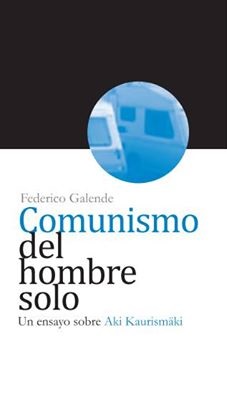
Into the common blue: on Federico Galende’s Comunismo del hombre solo (2016). by Gerardo Muñoz

Galende Comunismo hombre solo

Federico Galende’s new book Comunismo del hombre solo (Catálogo, 2016) cannot be read as just an essay, but rather as a gesture that point to a common hue of humanity. This hue is the intensity of blue – instead of the zealous red, the morning yellow, or the weary white – the intensity that withdraws to an ethereal plane of the common. In a recent book on Picasso, T.J. Clark reminds us that the palate blue of the Spanish artist’s early period paved the way for the entry into the temporality of the modern, while demolishing the bourgeois interior and its delicate intimacy of lives that thereafter became possessed by work and display [1].

Galende’s blue dwells on an angular bend of a color without signification. He is not interested in re-signifying blue as topologically reducible to the new oikos of being. Rather, it is the blue of Aki Kaurismäki’s films what inscribes a distance or metaxy of what is improperly common to a humanity thrown into a world beyond measure (11-12). For Galende, Kaurismäki’s work is an excuse for thought, in the same way that the paintings of Yves Klein or Andrew Wyeth would have been been deployed to un-veil a distant sky that opened to the world of the living in a radically different temporality that is neither that of progress or work, nor that of alienation and consumption.

Blue communism, or rather a communism of blues brings forth unity where there is separation, because ‘class’ far from constituting an identity, is a praxis that “les brinda a ser habitantes inocentes de una actividad que se despliegue bajo un mismo cielo” (36). Hence, there is no ‘idea of communism’, but only an unfulfilled image of potentiality (this is what at stake in Kaurismäki’s cinema, but also in Bresson and Bela Tarr, briefly sketched out in the essay by Galende) of a “tiempo inútil” or an inoperative time. It is a time of life against empty homogenous time of historical appropriation or abandonment. This is also the time that exceeds the threshold between life and work, cinema and the worker’s ailment, the solitary proletarian and the lumpen as always immanent to the capitalist conditions of labor. This inoperative time is what gives form (gestalt) to a negative community of the senses that re-attaches, as in multiple patchwork, what is real and what must remain fiction (78).

Galende sees implicitly this inscription of the inoperative time in Marx’s figure of the lumpenproletariat, and more subtlety, in bits and pieces of Marx’s own life as is autographically reconstructed from the days when the “18th Brumaire of Louis Bonaparte” (1852) was written. It is only in Blanqui and later Benjamin, where communism is imagined as the improper existence of singulars under a common sky. Galende’s injunction for communism is an astro-communism that is neither regulated by subjectivity or will, political parties or the language of the transcendental nor is it a historical benchmark for hegemony and order. Against every regimen of subjective onto-theology, astro-communism is an experimental and impersonal practice of being exposed in the other, with the other. In a crucial moment of his essay, Galende writes:

“Introducir la práctica de los otros no es sin embargo una facultad exclusive del arte. Es la manera que tienen cualquiera de deshacer la identidad a la que ha sido confinado por el otro…Esto significa que no hay nada que interpretar ni nada que comprender, como diría Deleuze, ningún imperativo que asimilar: lo que la experimentación destruye es el transcendental que el catastrofista o el adelantado inyectan en el movimiento de la experiencia con el único fin de inmovilizarla. Ahora estamos al tato de que ese trascendental no era más que la máscara que cubra la vida vacía del sacerdote que frustra las potencias que se actualizan en su despliegue. […] Probar ser otro: la experimentación es una extensión en lo impropio” (81-83).

Astro-communism is conditioned by a metaxy that exceeds every anthropological remainder and its restitution. This explains why in the later part of the essay, Galende turns his attention to the animalia of both Kaurismäki and Bresson’s films: stray dogs, Balthassar the donkey, talking monkeys, rats or giant insects in Kafka. Curiously enough there is no mention of wolves in the essay (the wolf being the only animal that resists the circus or domestication, that is, that resists theory proper). Under the sway of animality, what Galende captures is not a substance or an intensity of the animal as to delimit the caesura between man and animal, but an openness that retain metaxy of every singular animal with the world.

For Galende, the animal’s sight abolishes any ‘central organization of perception’, which is condition for the appearance and consequently for being-singular in common (103-104). The metaxy of animal-world is (intentionally?) underdeveloped in Comunismo del hombre solo, but one could well speculate that this imagistic tactic here is to cross over the ontological difference into a region what the event of the human proper loses its privilege into an unearthly landscape where things and animals are assumed as a form devoid of epochal destiny. Astro-communism renders inoperative all epochality, since it conceives itself as lacking a ‘center, axis, or an organization of the visible that are merely instantiated in the quotidian [2].

This improper communism of the singular man delivers no political program. Of course, Galende makes no effort in restituting a politics in the time of the ruins of the political; at a moment when critique as such has been subsumed into a universitarian operation (125-126). Galende’s point of departure (not of arrival) is thus infrapolitical. His gesture in this sense cannot be said to produce a critical register aim at “re-orienting the present struggles” and re-integrate lumpen-living into the “stable working class”. This second option is already to abandon the promise of astro-communism in the name of an anthro-productivism that feeds off from the fictive arrangement of mechanical and labor arrangement against the singular experience.

Comunismo del hombre solo imagines and thinks what is always-already in the excess of production, that is, on the side of the lumpen, which is the form of life of astro-temporality of being. The blue man of communism can’t never be subsumed by work, since he is first a style of existence that is closer to the work of art. This is why the experience of communism, as Groys understands it, was a destructive plenary where social space became an all-encompassing museum. But that experiment failed, and only comes back to us as spectral trace. This is the promise in Kaurismäki’s oeuvre. What returns is what is un-common of the inoperative man – for instance, the particle ‘mu’ of communism [3] – not only as what makes possible and concrete every existence of life, but as a natural flux of a reverie that carries the fractured back of a laboring humanity.

Notes.

  1. T. J. Clark. Picasso and Truth: From Cubism to Guernica. New Jersey: Princeton University Press, 2013.
  2. Federico Galende writes: “…en este comunismo no hay centro, no hay eje, no hay una organización de lo visible ni a partir del contracampo del protagonista en el que el paisaje se condensa ni a partir de una mirada dirigida….fuera de toda imposición, en formas de co-existencia que asoman solo cuando se las requiere para solucionar un traspié inmediato o cotidiano”. 117-118
  3. Wu Ming. “The Mu particle in communism”. Make Everything New: a project on communism. London: Book Works, 2006.

Is communitarianism a substitute for State-University discourse? by Gerardo Muñoz.

As we witness the exhaustion of the Latin American progressive cycle, it is obvious that new demands emerge for thought. What began more than ten years ago in Venezuela, Ecuador, and a little later in Argentina and Bolivia, has now come to a full close. Concretely, this signifies a halt in the processes of democratization in the region. It also entails the need to think new categories, demand imagination to other possible configurations, and abandon principles that have been subsumed into the ‘duopoly’ of market-State formulation [1].

If the last decade was characterized by democratization through consumption, this could well mean that the Latin American plebs will now consume less, will party only part-time under surveillance, and will have to reimagine themselves otherwise (even if it is around a Coca-Cola late at night in the villa). The runfla lives (the lives of the marginalized, of the popular sectors, the villeros, etc.) will have to regain the time of life, which is the time of the commons in consumption.

Out of the many concepts that circulated in the ‘Universidad Posible’ Conference (generously organized by Willy Thayer & Raul Rodriguez Freire) that took place in Santiago (April 18-21) it was that of ‘the commons’ which had intellectual political purchase to ‘invert’ and transform the waning of progressive political structuration, now in the hands of right-wing administrative governmentality. But the idea or concept of ‘commons’ was in itself ambivalent: on one hand, the ‘idea of the commons’  (it is always an idealistic affirmation) thrives on the general horizon of resistance from below, but on the other, it necessarily feeds off the crystallization of the crisis of hegemonic articulation.

This resonated in the phrase that Eduardo Rinesi repeated throughout the four days of the conference: ‘let us not forget that something has happened all these years in Latin America’ (“recordemos que algo ha venido pasando en América Latina”). On one hand, this introduced the experience of someone implicated in a progressive State apparatus, but on the other, this was also an implicit response to those who called for radical suspension of university epochality [2].

But what is that that has happened (in Latin America)? In any case, what happened must remained silenced, and merely evoked. The event cannot be given its proper weight, its semantic density, and its full hermeneutic dis-closure. Perhaps, because what has happened is democratization, but also (now) the crisis of democratization. In other words: in the time of the ruin of hegemony proper, there is a decline and trans-formation into its other, the shadow of post-hegemony as translated and incorporated against the time of democracy. Hegemony flows back as time past to avoid its spectral present.

More importantly, that ‘that which has happened’ provides for political verisimilitude that guarantees specificity of location, which is also a guarantee of the political. But in its closure, it also unveils a temporality of the past. A past that cannot assume the present, and when it tries to do so, it renders a telic result of what has already taken place. In this variation of university discourse, thought is incorporated into the prison of consequential necessity of time. It has happened, but it must remain outside of the now. If according to a maxim of the Russian poet Joseph Brodsky, the prison is maximum time with minimum space; university discourse is maximum past with minimum present. In the carceral reflection on the university in time of crisis, thought itself enters prison with no possibility for parol.

It is at this point where the communitarian option emerges from below as co-substantial with the crisis of democracy. In fact, its demand appears as its supplement that affirms time present of horizontal an-institutionalization with the ‘something has happened’ of partial (interrupted) democratic life. Communitarism becomes a safety-vowel to recast hegemony form from below in the crisis of hegemony form. Thus, communitarianism is a necessary supplement of hegemony to keep its ground intact.

It is in this double movement – between hegemony of the effectual past and the localization of the movement in the present – where something like a crisis of university discourse could be located in the Latin American intellectual reflection when confronted with the inevitable sinking progressive cycle in the region. This movement is full stasis in a double sense: it provides balance and form to principal (intellectual) reflection, and it also guards the conflict between fracture of institutional hegemony and immanentization of hegemony translated into community.

Can the Latin American crisis assume the form of a political plebeization to save itself? What is the time for a plebeization of the university? This was the question posed by Oscar A. Cabezas against reflexive modalities of political closure or the substantialization of the political (as stasis) into thinking the present [2]. Plebeization becomes a possible horizon when it demands the integration of the unity of conflict. But the turn to a communitarian unity of intellect must first posit political struggle as a primary antagonism of the friend-enemy divide, as Luis Tapia forcefully argues [3]. In fact, this is the argumentative core in Tapia’s Universidad y Pluriverso (2014), an inverse but affirmative schmittianism.

Plebeization (a term that interestingly Tapia himself does not deploy) organizes the time of the ‘future’ as a way to govern the present, in the name of forgetting the singular. Or is plebeiazation an invisible remainder of what is always taking place? Or is it a dirty eschatology for post-katechontic times? In both cases, the ‘something has happened’ and the ‘immanentization of the ultimate struggle’ amount to a dual machine of a particular historical fabric that, in the face of the fissures the political, is unable to see the open.

Notes

  1. The duopoly of State and market was thematized by Gareth Williams following Brett Levinson’s Market and Thought: Meditations on the Political and Biopolitical (Fordham, 2004).
  2. Moreiras referred the a-positional ‘ex-universitatis’, Villalobos-Ruminott a suspension of the principle of equivalence, whereas I called for a ‘postunivesity form beyond community’. Rodrigo Karmy’s averroism against ‘epistemic personhood’ was also consistent with these positions. These were all rehearsals for an infra-university, as Williams called it.
  3. Oscar A. Cabezas. “Los intelectuales y la universidad norteamericana”. Paper read at Universidad Posible Conference, 2016.
  4. Luis Tapia’s Universidad y Pluriverso (2014). The reference to Schmitt’s concept of the political is thematized explicitly in Tapia’s essay.

A note on ‘class’. By Gerardo Muñoz.

I think that a discussion on class and exploitation brings important points for a fundamental disagreement. In so far as thought solicits perpetual interlocution, this exchange seems necessary and timely. Since I alluded in passing to Daniel Zamora’s article on exploitation in a previous note, I would like to recall the way in which he brings to bear the analytical stakes in pursuing the question of ‘exploitation’ against that of ‘inequality’. (Let’s leave for a moment the oppositional form of the debate, that is, between inequality and/or exploitation, which I do not think exhausts the discussion of work in any sense). Zamora writes at the very end of his article:

“Today, more than ever, the success or failure of the struggles to come depend on the capacity of political and class organization (e.g: unions) to draw attention to the socioeconomic stakes represented by the “surplus population”, and to convince the so-called “stable” working class that their fates are intertwined. Indeed, at the very dawn of the industrial era, Marx had already posited that a decisive stage in the development of the class struggle would be the moment when workers “discover that the degree of intensity of the competition among themselves depends wholly on the pressure of the relative surplus population” and thus on their being able to “organize a regular co-peration between employed and unemployed in order to destroy or to weaken the ruinous effects of this natural law of capitalist production on their class” [1].

I do not intend to gloss Zamora’s article, rather I want to use it to introduce at least two intertwined elements of analysis. First, I would agree with Zamora that exploitation has not disappeared from our contemporary world. On the contrary, everything is labour and everyone is exploited insofar as we are in the post-epochal stage dominated by the principle of general equivalence. What disappears is the semblance and unity of the very category of class as articulated in Marx’s thought. In the 1990s, this aporia underlying the “theory of the working class” was posed with immense clarity by the Chilean philosopher Willy Thayer as follows:

“Escasa la teoria porque esta ha caido en el territorio de la fenomenolidad. Lo que equivale a decir que el conflicto o la divison del trabajo entre teoria y fenomenolidad ya no rigen estrictamente mas. La efectividad ha subsumido esa posibilidad” [2].

So, the end of work does not mean the end of exploitation as such, but a turbulence between the categorial sphere and the phenomenal sphere. As Willy Thayer observed, the totalization of real subsumption of capital leaves only capitalism and gets rid off the potential for revolution (Thayer 139). So, if we only account for labor in the way that Zamora (or even Hatfield at the end of his book) seems to do, then, how can the role of finance, derivative models, the phenomenon of debt, and the pure means of speculative capital where nothing is produced except value itself be thought? It is general knowledge that for Marxism the model solicits a necessary mediation between money, commodity, and surplus value. However, in the ‘financial turn’, as Joseph Vogl discusses at length in his Specter of capital (Stanford 2013), work is reduced to mere re-production of value for value’s sake. For Vogl this is linked to bad faith and guilt. Today, it seems that the attractiveness of the category of class in the new the sociological revival of Marxism is solely discursive, since it cannot say anything about these transformations.

More important is the fact that, by retaining the category of class, the sociological critic secures his place as a vanguard of his time, leaving untouched the constitutive productionism at the heart of Marxian critique of capitalist labour. This is, after all, the philosophy of history working both against existence (wanting to “convince” specific subjects, whether in motley or unified social determination), while voicing a messianic promise for an emancipation to come. Of course, this does not mean that the idea of class could not be reworked as to grasp something else beyond Marx, as Andrea Cavalletti has demonstrated [3]. But the positive horizon that posits class against inequality does not do the work as an analytical tool to understand the global predicament. In fact, it seems to restitute as a sort of violence implicit in political drives.

When Zamora speaks of the “intention to convince the stable working class”, he reveals an old desire of the Left. (And it should not come as surprise that his book on Foucault and Neoliberalism comes endorsed by the Marxist sociologist Vivek Chibber). However, this is a legitimate political position, which actually exited last century under the name of guerrilla warfare. What is the guerrilla if not a process of subjectivization that pushes to link or “convince” the unemployed or the lumpen (whoever inhabits the outside of the “stable working class”) with class, or vice versa (those outside with the stable proletariat)?

It is very interesting that those who stand for full fleshed theory of such a strict political action do not push (at least explicitly) for guerrilla warfare. But it is the guerrilla form what seems to haunt the very horizon of thought that demands revolutionary alliance. Guerrilla is the unsaid of ‘obligatory’ class as a sort of universal military conscription or duty. Against voluntarism or this kind of brute force, the task is to imagine other ways of thinking labor as an exigency for our times. Infrapolitical exodus – exemplified by the sabbath (see Kelso 2016) – seems to me a space beyond this productionism and the recurring promise of emancipation of life through work.

.
Notes

1, Daniel Zamora. “When inequality replaces exploitation: the condition of surplus-populition under neoliberalism “. Non-site, Issue 10, September 2013.

2, Willy Thayer. “Tercer Espacio e ilimitacion capitalista” (1999). But also see his “Fin del trabajo intelectual”, in Fragmento repetido (ediciones/metales pesados, 2006)

3, Andrea Cavalletti. Clase: el despertar de la multitud. Buenos Aires: Adriana Hidalgo, 2013.

A reply to Steve Buttes on infrapolitics. by Gerardo Muñoz

Steve Buttes’ “Some questions for infrapolitics” is an intelligent and generous effort that engages with several key problems at the heart of the ongoing collective project of ‘Infrapolitical Deconstruction’. Although, it begs to say that Moreiras’ works – from the early Interpretación y Diferencia (1991) to Línea de sombra (2006), have been central to thinking de-narrativization and the critique of metaphoricity, bringing these problems into new light from different registers (the literary, the cultural, and the political), I think it would be incorrect to frame the particular project of infrapolitics as a culmination of Moreiras’ own thought and itinerary. In this light, what I find of importance in Buttes’ intervention is the fact that he does not just hinge on a particular problem, but is able to juggle and render visible a series of common elements of the project that merge with his own research (1).

Indeed, it was unfortunate to have missed Prof. Buttes at the last formal meeting during the Harvard ACLA 2016 conference, but we could only hope that there will be another timely encounter for discussion. For what it is worth, I want to lay down a few commentaries on some issues raised by Buttes. My aim is not to correct or even less defend a programmatic way of infrapolitics, but perhaps to think about his recent inquiry as parallel with some of the problems that have been pertinent to my own intellectual reflection over the last two or so years. I hope this will serve as a reparatory outline for future discussions to come.

In a precise moment of his commentary, Buttes writes: “That which escapes regulation, visibilization through the metaphors chosen to organize the world—the unthought thought, that which “what was never [on the] radar” (“Some comments”), freedoms that remain beyond writing (Williams, The Mexican Exception), the unfinished manuscript (Cometa, “Non-finito”), averroist intellect (Muñoz “Esse extraneum”) and so on—always remains invisible, and as a consequence always emerges as something that looks like the thing it is: real life beyond calculation, beyond visibilization, beyond metaphoric capture. In other words, it is the image, as Dove has called it. This image, of course, is characterized by its invisibility, by its ability to be sensed but not seen, experienced but not known, used but not valued”.

I am entirely in disagreement that infrapolitics could be thought as invisibility in opposition to visibility, since that opposition itself remains caught in calculation that renders the operation of unconcealment and the existential analytic obsolete. The very idea of the averroist intellectual has nothing to do specifically with the image as such, but with metaxy (or metaxu as rendered by Weil’s anti-personalist Platonism). This is why life as pure means constitutes itself impersonally from the outside. Hence, to reduce the question of the image to a division of the senses (sight) or to the disciplinary arrangement made possible by modern art historical discourse (Fried et al) is interesting, but not relevant, at least not for averroism. It is true, however, that averroism is crucial for infrapolitics. To some extent averroism, like the existential analytic or marranismo, is an important referent for infrapolitical existence and posthegemonic democracy.

אIn her important research on the saturated image, Camila Moreiras Vilaros has emphasized the transformative nature of images from a regime of the society of control to one of saturation and exposure. If the first still has a mode of coercion over bodies and subjects, the second one is hyperbolically without subject, substance, and extension. Exposure coincides fully with the image of the world in positionality. In this sense, infrapolitics fundamentally thinks not the invisible, but the invisible as already fully visible. To be marrano in the open means to dwell in the event of total exposure.

Weil, Esposito, Coccia, Agamben, or Moreiras are thinkers of this outside as metaxy, although do not particularly wish to install an “invisible iconology”, or “an icon of potentiality over actuality”. I am convinced that the question of iconology features centrally in Prof. Buttes’ research, but from my own understanding, infrapolitics cannot be separated from an actuality granted by a form of life or the second division of existence that renders inoperative the very distinction of actuality and potentiality. In fact, in recent months some of us have understood the importance of undertaking Heidegger’s influential seminar Aristotle Metaphysics 1-3: the actuality over force, as to cautiously rethink the difficulty of the Aristotelian category (actuality) that is at stake here. In terms of the icon, in my own research project I have thought of another relation with pictorial space that is not possessed by iconicity, which allows possible oikonomical arrangement and sacrament institution [2]. I would say that, indeed, landscape is important for infrapolitics, but far from rendering a dichotomy between the visible and the invisible, the expropriated and the appropriated, it seeks to think distance and dwelling.

א It was something like this that was at stake for Heidegger in one of his rare essays written as a general reflection on art, but specifically meant as a commentary on a Spanish sculptor that he very much admired: Eduardo Chillida. In Die Kunst und der Raum (1969), Heidegger writes: “Solange wir das Eigentümliche des Raumes nicht erfahren, bleibt auch die Rede von einem kunst-lyrischen raum dunkel. Die weise, wie der Raum das Kunstwerk durchwaltet, hangt vorerst im Un-bestimmten.” Before the pictorial space there is the question of space. How to account for the peculiarity of space? That was Heidegger’s question, since spacing meant to ‘erbringt’ (don) freedom and the life (wohnen) for da-sein.

The word “value” appears in different ways about seven or eight times in Buttes’ piece. I am not sure I can take up the different ways in which it appears, at times in opposition to use. However, it is clear that infrapolitics does not seek to value any ontic or ontological position, since it departs necessarily from a critique of the principle of general equivalence as the contemporary determination of nihilism (an argument made forcefully, I think, by Moreiras, Villalobos-Ruminott, & J. L. Nancy). Thus, it is inconsistent with infrapolitics to argue that “infrapolitics, creates […] a fetish—“a form of thinking the political that fetishizes the undoing of power as a value in itself”. Undoing power arrives at the non-subject or post-hegemony as democratic condition for social existence. But how is this “value” or instrumentalized for “value itself”? In some cases, Buttes seems to take value for ‘preference’. Infrapolitics does not make that decision for preference’s sake, but for understanding the non-correspondence between life and politics in thought.

א The question of value tied to the problem of ‘poverty’ and ‘exploitation’ is a register that infrapolitics does not take for granted. However, I am convinced that the pursuit of a new jargon of exploitation today is always in detriment of the possibility of understanding the existence of man otherwise. It is a very strange turn that some today on the Left– take Daniel Zamora, who fundamentally misinterprets Foucault’s work – keep insisting on the question about the necessity to reintroduce proletarian identity as determinate subject against diversity. It makes no sense to do this in a time like ours, where work and labor have completely disappeared. I prefer to discuss inclusive consumption (Valeriano) and uneven pattern of accumulation (Williams), not labor and exploitation.

In one of his footnotes, Buttes claims that “infrapolitics spans writers from Javier Marías, to Borges, to Lezama Lima to Cormac McCarthy to, as I note below, Ben Lener, and also, plausibly, Sergio Chejfec or Alberto Fuguet, then infrapolitics is the canon, it is the archive itself”. It is a surprising remark, but I understand that I might not fully understand its implications. Does it entail that infrapolitics is an archive of a particular style, or that it coincides merely with a work-for-the-archive? I agree with Moreiras that infrapolitics is a type of relation with the archive, and in fact, at the moment the collective is currently thinking through the archive in relation to the general historiography of the imperial Hispanist tradition [3]. Does this mean that infrapolitics is merely a relation with Hispanism and the Spanish letters? I am not convinced. I do think that there is intricate relation between writing and infrapolitics, but it could be extended and explored in other forms of art (painting, music, cinema, or even dance). Most of us work on writers such as Roa Bastos or Raul Ruiz, Lezama Lima or Oscar Martinez, Juan Rulfo or Roberto Bolaño; but these proper names are far from constituting an infrapolitical archive. There can never be an archival infrapolitics.

א In a recent intervention on the subject of infrapolitics, Michele Cometa suggested that infrapolitics was indeed the place to use literature as a thing for thought [4]. The modern invention of university disciplines and faculties, archives and practices such as “literary criticism” is a perversion of an an-archic space of unity where there is no differentiation between literature and thought, the image and life. One has to break away from the modernist fantasy that there is a ‘proper location’ for an object of studies. There are only relations of force constituted by tradition. This is why Dante at the dawn of Modernity, and later Leopardi during the bourgeoisie revolution, could see themselves as poets, thinkers, political theorists, and lovers. There was no separation.

Notes

1. Buttes, Steve. “Some questions for infrapolitics”. https://infrapolitica.wordpress.com/2016/04/10/some-questions-for-infrapolitics-by-stephen-buttes/

2. Mondzain’s research is fundamental here, since her work on early Byzantine Church’s articulation of hegemony is intimately tied to the operation of iconology. See, Image, Icon, Economy: The Byzantine Origins of the Contemporary Imaginary. Stanford University Press, 2004.

3. Alberto Moreiras. “A response to Steve Buttes”. https://infrapolitica.wordpress.com/2016/04/11/a-response-to-steve-buttes-by-alberto-moreiras/

4. https://www.youtube.com/watch?v=U6ddjE_sL5w

Esse extraneum: on Emanuele Coccia’s Sensible life: a micro-ontology of the image. by Gerardo Muñoz

coccia sensible lifeLa vita sensibile (2011) is Emanuele Coccia’s first book to be translated into English. Rendered as Sensible Life: a micro-ontology of the image (Fordham U Press, 2016), it comes with an insightful prologue by Kevin Attell, and it belongs to the excellent “Commonalities” series edited by Timothy Campbell. We hope that this is not the last of the translations of what already is Coccia’s prominent production that includes, although it is not limited to La trasparenza delle immagini: Averroè e l’averroismo (Mondadori, 2005), Angeli: ebraismo, cristianesitimo, Islam (co-ed with G. Agamben, 2011), and most recently Il bene nelle cose: la pubblicità come discorso morale (2014). One should take note that in Latin America – particularly in Chile and Argentina – Coccia’s books have been translated for quite a while, and have been part of a lively debate on contemporary thought. We hope that a similar fate is destined in the United States. For some of some of us working within the confines of the Latinamericanist reflection, an encounter with Coccia has grown out of our continuous exchange with friends like Rodrigo Karmy, Gonzalo Diaz Letelier, and Manuel Moyano. It would be superfluous to say that Coccia’s work is nested in the so called contemporary ‘Italian Philosophy’ (pensiero vivente, in Roberto Esposito’s jargon), although one would be committing a certain violence to reduce it to another ‘theory wave’ so rapidly instrumentalized in the so called ‘critical management’ within the North American university.

Coccia’s tropology (not entirely a set of fixed “categories” or “concepts” for a philosophical program), such as imagination, the sensible, and the averroist intellect are signatory relays for a potential history of thought against the grain of grand conventional histories and historiographies of Western philosophy, or even more so, against the reaffirmation of a principle of philosophy of history in the wake of nihilism and biopolitics. It is most certainty true that Coccia’s investigations share a horizon that we can call the “form of life” – some of us also call it “infrapolitical existence”, which for Coccia himself has translated as the vita sensibile – although both his approach and condensation of thought always presuppose an efficient interrogation of the singular indifferent to “influences” or “schools of thought” (even when Coccia moves deep into scholastic and medieval philosophy). Perhaps no less important of a metacritical index is the unreserved service for a reconsideration of the philosophical tradition – and more importantly, the transmission and disposition of a thinking that remains unwritten – beyond the history of metaphysics and political theology.

Sensible Life is not a book about the ontology of the image in the pictorial or phenomenological sense, but an investigation into the metaxy of existence and being in the world. As Coccia argues early on in the book, ‘the sensible life is a world given to us, and only as sensible life are we in the world’ (2). Against biopolitical or vitalist (neo-positivist) remnants of understanding as fated in the subject (or the persona), Coccia prepares the ground for a physics of the sensible that affects, without really transforming, the human as subject, although it does seek to exhaust itself in subjectivity. Coccia argues, as if implicitly taking up Simone Weil’s suggestion, that the form of sensation is always a modal relation with the outside, an improper distance (metaxu) of the ‘in between’, necessary for any schematization of concrete existence [1]. Hence, perception or sensing is only possible because there is metaxy, and not because there is a subject as the producer and commander of capacities and substances. Against distributive ontologies that design complex arrangement and division of ‘life’, Coccia’s sensibly maps out a region that has always already been there, and that turns to another relation with ontology and language.

In a large part, Sensible Life is vastly informed by his prior study on Averroes and the averroist tradition Averroè e l’averroismo (Mondadori, 2005), where Coccia studied the ways in which conventional Christian history of philosophy convicted the twelve century Iberian philosopher for the madness of positing a common and universal unity of the intellect. What Coccia thematizes in that study, but also in Sensible life with greater speculative freedom, is the extent to which reason depends on the potentiality of the intellect understood as the capacity for imagination. What is common and at the same time ‘improper’ to all beings is the potentiality of imagination that remains outside of life, never constituting a principle of sufficient reason nor the ground for dogmatic belief. The ‘scandal of averroism’, as Rodrigo Karmy has called it, was followed by the Scholastic ban on teaching averroism and removing averroists from the university. It is no surprise that this coincided with the development of the category of the person as a secondary reserve of Christian political theology and Roman Catholic ratio [2].

This is what lays bare in Coccia’s explicit condemnation of the Cartesian cogito, and his affirmation of the sensible as a de-metaphorized image without proper location, since it only dwells ‘where one no longer lives and where one no longer thinks’ (17). This impersonal drift of the sensible is what allows for an extreme de-localization in multiplicity of reproduction of images that serve to dislocate the very inside and outside of the constitution of the subject, but also of any constitution of life itself (31-32). Indeed, the first part of the book is said to write a physics of the impersonal and immaterial ‘third space’ (sic) – what in Aristotle’s vocabulary is the relation with the ‘externals’ [tōn exōthen], and in medieval scholasticism is the esse extraneum – that like marrano existence, it dwells on a dual exteriority. In a key moment of the development of Sensible life, Coccia writes:

“How, then, can we define an image? In his work on perspective John Peckham held that an image is “merely the appearance of an object outside its place (extra locum suum) because the being appears not only in its own place but also outside its own place”…Our image is nothing but the existence of our form beyond what makes up, the substance that permits this form to exist in an entirely extraneous matter to that in which one exists and mixes with. Every form is born from this separation of the form of a thing from the place of its existence: where the form is out of place, an image will have a place [ha luogo]. […] Thus, an image is defined by a dual exteriority: the exteriority from bodies and the exteriority from souls – because images exist prior to meeting the eye of the subject who observes a mirror” (19).

The reproductive machine of the sensible image does not ground itself unto the subject or the purely sensorial; a movement which would have produced yet another schism between mind and body, senses and reason, the visible and the invisible. Against the categorial arrangement of the persona (and its attributes, genus, and divisions), Coccia pushes forth a general theory of productions of forms that could account for the natural life of images (31). What is really at stake here is a medial process (provided by the medieval intentio) of multiplicity beyond being and substance, property and the proper of ontological assertion. Instead, Coccia affirms a cosmological understanding of the One. In fact, one could stress this a little bit further and argue that the averroist potential intellect is a singularization of the henological neo-platonic substance into one of pure externality beyond metaphysical structuration. But the question of henology and the overcoming of metaphysics is one that we cannot raise in the space of this commentary.

For Coccia the medial extension of the image (and the imagination) leads to a metaxy of coming together (simpatizzano, which is Italian ‘third person’ indicative for sharing, is the word he choses) that conspire to form a sort of clinamen effect of singularities. Not long ago Fabián Ludueña thematized this negative community in his important La comunidad de los espectros (Miño & Dávila, 2010) as a ghostly disfiguration that, vis-à-vis the nature of mediality, enters into relation with what is always unhomely and foreign (extraneum). That is the only possible form of the communitas in the sensible life.

The second part of the book made up of seventeen scholion unveil the way in which the sensible immaterial metaxy also provide for the man’s body that accounts for a mundane relation that exceeds and subceeds the psychological and the culturalist materialisms. By reassessing vita activa and mediality, dreams and the ‘intra-body’ (Ortega y Gasset), clothing and cosmetics, Coccia situates the sensible incarnation on the very surface of the body as momentary dwelling (52). As a general anthropology of the sensible, Coccia recoils back to the ‘subject’ and even ‘identity’, but only insofar as one recognizes in this an intention that he calls an ‘ontological indifference’ that allows for an outside projection of an “infra- or hypersychic consistency – a consistency that is almost hyperobjective. Here, “the intentional sphere does not coincide with the sphere of the mind even it includes the mind; it is, rather, the state of existence of all forms when they keep themselves beyond objects and on this side of subjects, or vice versa” (55). This “infra-subjective” solicits a concrete intentional relation of dwelling in the world.

Although the space of the political is not elaborated explicitly – and perhaps for Coccia there is no need for embarking on such a task – one could say that this region is consistent with the infrapolitical relation of the non-subject vis-à-vis the ontological difference. In fact, the marrano whose existence is necessarily infrapolitical in nature is consistent with the multiplied imposture that clothes every identity and every oikos an un-homely as being-in-the-world (91). In fact, Coccia is correct in taking this cue to the limit: “only those can make up and disguise themselves can truly say “I” (86). Marrano life is also the life of the outside, a borrowed life. It is in fashion understood as a tropological site of existence, where according to Coccia a style of the multiple is given its proper place, precisely because it lack costumes, essence, or meaning. On the contrary, fashion brings to bear that only modal relations can constitute forms of life (habits). Fashion has freed life to the sensible, through a suspension of all meditation with the metaphor as its end. Indeed, it is style and not metaphorization what provides for the sensible life.

The dwelling of the sensible is also incarnated multiplicity: it is the improper relation between man and animal, between living and dying. The sensible life as pure immersion, as Coccia has argued in another place, is a flow where movement and detention, action and contemplation become inseparable [3]. It comes as no surprise that Sensible life closes with a meditation on images for life and with a general economy of natality. Here perhaps one could raise the question about averroism as philosophical transmission, but also regarding its staging of ‘living with images’. Coccia argues that life is, above all, ‘what can be transmitted, the very being of tradition” (98). But to transmit is to re-enact a style that never took place: it is a becoming of singularity. In this sense, continues Coccia, ‘Life never stops producing and reproducing, and multiplying’. However, can there be ‘inheritance’ or even ‘legacy’ of that which lacks proper place, and that is always alocational? Is not the becoming of the reproduction of the sensible the very end of transmission, the very form of dis-inheritance from any nomic determination?

It is in this aporia where Coccia’s account of the sensible life (perhaps as a flight from the form of life) touches on the question of natality as a central problem for thought, which is fundamentally a question for the history of thinking. This is also the problem that Reiner Schürmann contemplated in his posthumous Des hégémonies brisées (1996) without really unrevealing its major consequences (except in the problem of finitude posed by the tragic denial). Coccia’s invitation is for us to reimagine imagination (la vita sensibile) outside of its proactive and transcendental saturation into a region that co-belongs with thought. To this end, the vita sensible cannot amount to another anthropology, since its taskless work is to render a life that is no longer one for labor and action, but affected by the immanence of what can be imagined.


Notes

  1. Simone Weil. “Metaxu”. Grace and Gravity. New York: Rutledge, 1999.
  1. Rodrigo Karmy. “La potencia de Averroes: para una genealogía del pensamiento de lo común en la Modernidad”. Revista Plèyade, N.12, 2013.
  1. Emanuele Coccia. “Speaking Breathing”. New Observation, N.130, 2015.

Línea de sombra ten years after: introductory remarks at ACLA 2016 Harvard University. by Gerardo Muñoz & Sergio Villalobos-Ruminott

linea de sombra

Ten years have passed since the publication of Línea de sombra: el no-sujeto de lo político (Palinodia, 2006). It seems that this seminar received neither the most appropriate of titles, nor the most desirable one. At the end of the day, others are the ones that live by anniversaries, ephemerides, and revivals. In a way, to commemorate is a convoluted and dangerous move that recaps the jacobinist principle ‘down with the King, long live the principle!’

Something radically other is at stake here, or so we wish to propose. To the extent that something is ‘actual’ is so because it allows conditions for thinking and thought; that is, conditions of doing in thought. Then, of course, there are activities and activities. As Lyotard observed, there are some activities that do not really transform anything, since ‘to do’ is no a simple operation (Lyotard 111). So much is needed for this encounter to happen – and the purpose of this encounter with many friends here is Línea de sombra ten years after. This was Alberto’s fourth major book – after Interpretacion y diferencia (1992), Tercer espacio (1999), and The Exhaustion of Difference (2001), and that is without counting his early La escritura política de José Hierro (1987). Línea, we should not forget it, was published in Chile in 2006, under turbulent circumstances. We are referring here of course to Alberto’s exodus to Aberdeen, and in a way his “exile” from the enterprise of Latinamericanism. The drift to suspend the categorial structure of the Latinamericanist reflection was already underway in Tercer espacio and Exhaustion, books that radically altered the total sum of reflections on and about Latin America, in the literary and the cultural levels, and whose consequences were felt, though we are not too sure that they have been fully pursued and taken to its outermost transgressive limits. As Alberto has repeated often, the issues on the end of the 1990s and the beginning of the 2000s are still among us, but we have yet been able to deal with them radically, which means, to deal with them without just reproducing the constitutive limited structures and categorical systems that have informed Latinamericanism and Hispanism at large through the twentieth-century.

In this sense, Línea de sombra is an unfinished intervention. In part because it did not produce many interlocutors and readers when published, or perhaps because it was taken (and it is understood as such still today) as a book that transgressed the ‘Latinamericanist reason’, opening itself to a region of thought that was in itself undisciplined, savage, and for the same reason, considered an outlaw intervention (and we should keep in mind this tension between thinking and law). It does not matter. But what really does matter is that we consider the silences around Alberto’s intervention not as a personal affair, but as a particular effect of a certain disposition of hierarchies and prestige within the contemporary university. As if Línea (and the other books) were dammed from the beginning due to the constitutive limitation of Hispanism and due to the lack of interest in theoretical approaches coming form Latinamericanism, a field that was usually identified with the exoticism of political conundrums and the curiosities coming out of Third World countries.

Of course, the reverse side of this underprivileged condition of Spanish language for intellectual reflection is that it (re)produces reactive effects. For example, the decolonial option demands a constant revision of the privilege that Spanish has had in the process of representing Latin American realities. However, the paradox arises when this decolonial turn limits itself to the glorification of native languages as if they carry with them a more authentic access to the real, without questioning the self-limitation that both, Latinoamericanist criollo scholars and decolonial ones, show in restricting themselves to the same ethnographic task, avoiding not an explicit politics of identification, but avoiding the most urgent and radical politics of thinking. This politics of thinking doesn’t belong to disciplines and doesn’t follow University structruration. This is what we call infrapolitics.

In fact, we recently called this self-imposed limitation in Latinamericanism ‘late criollismo’ in relation to the last manifestations (political practices and historical forms of imagination) of a particular tradition of thought that, reactively, is confronting the dark side of modernity and globalization with a dubious re-territorialization of affects, practices and politics: from neo-indigenism to neo-communitarianism to literary New Rights, from neo-progressism to neo-developmentalism and neo-extractivism.

On the other hand, we should not forget it, Spanish was an imperial language, and the current (rhetoric of) privilege for ‘Spanish’ is also at the heart of the neoliberal university. In fact, it is what allows the expansion of the language programs, and by consequence, the expansion of ‘adjunct professors’ and ‘part-time post-PhD students’ that carry departmental duties. An exponential process of subalternization that professors that defend far-away subalterns always seem to forget. One might say, the psychotic decolonial affect is possible by the foreclosure of a minimal distance in favor of the maximization of their subjective drive, in a process of identification that is also a process of libidinal investment and insemination.

Línea de sombra appeared in this context, but we do not think it wants to take part on either the side of defending the underdog or assuming a counter-hegemonic capitulation of Spanish as the master language or even the variations of Spanish as a sort of a new pluralism against Iberian hegemony. Línea renounces what Derrida calls in an essay of Rogues the ‘presbeia kai dunamei’, which is roughly translated as ‘majesty and power’, but it also renounces to the privilege of the predecessor or forbear, the one that commands, the archē (Derrida 138). Alberto’s text is a call for releasement of such a demand as principle of reason into a different relation with thought – now we think it is fair to say that that relation is always an infrapolitical relation – positing the archē of the political parallel to the category of the subject. In the introduction Alberto lays the question:

“El subjetivismo en política es siempre excluyente, siempre particularista, incluso allí donde el sujeto se postula como sujeto comunitario, e incluso ahí donde el sujeto se autopostula como representante de lo universal…el límite de la universalidad en política es siempre lo inhumano. ¿Y el no sujeto? ¿Es inhumano? Pero el no-sujeto no amenaza: solo está, y no excepcionalmente, sino siempre y por todas partes, no como el inconsciente sino como sombra del inconsciente, como, por lo tanto, lo más cercano, y por ello, en cuanto que más cercano, al mismo tiempo como lo ineludible y como lo que más elude” (Moreiras 12-13).

So, el no sujeto is an excess of the political subject, an incalculable and unmanageable rest, since the non-subject of the political just is, without a why. Just like the counter-communitarianism cannot constitute a principial determination, the non-subject does not wish to do so either. Indeed, Línea de sombra unfolds a complex instantiation against every nomic determination that guarantees the truth of the idea or the concept. But the non-subject haunts its violence, its transgression. Following our recent encounter with Schürmann’s work, we can say it confronts the latent forgetting of the tragic condition of being.

Indeed, the political has rarely been thought against the grain of its nomic and decionist principles, and Línea de sombra was (and still is) an invitation to do so. Our impression is that it is a book that does not want to teach or master anything, but thematizes something that has always been already there, even if some prefer to sublimate it into the principle of satisfaction. The price to be paid for that is quite high. Hence the desire to move thought elsewhere: indifferent to legacy, proper name, inheritance, masters, and subjects.

We propose, then, to think collectively these days around the promise, the offer, and the gift of this book, but not necessarily to place it in a central canonical position. Rather we intend to open its questions to interrogate our own historical occasion.

Notes

Alberto Moreiras. Línea de sombra: el no-sujeto de lo político. Santiago de Chile: Palinodia, 2006.

Jacques Derrida. Rogues: two essays on reason. Stanford University Press, 2005.

Jean François Lyotard. Why Philosophize? Polity, 2013.

*Image by Camila Moreiras, 2016.

Movement and Sacrifice. On Samuel Steinberg’s Photopoetics at Tlatelolco, Afterimages of Mexico 1968 (2016). by Gerardo Muñoz.

Photopoetics SamSamuel Steinberg’s Photopoetics at Tlatelolco, Afterimages of Mexico 68 (U Texas Press, 2016) is a timely contribution to the field of Mexican Studies. It posits itself as a sort of culmination of that field, and we would not exaggerate to say by saying that it is an archive of an archive that thrives to undo ‘Mexicanist ideology’ towards a different opening. Steinberg powerfully states at the end Photopoetics: “Mexicanism, in turn, is the name of the ideology that regulated the dutiful carrying-out of the relation between art and the people that the Mexican state organized until Tlatelolco…According to this procedure, one can constantly make art speak the name of Mexico as its truth, as the discontinuous thought, the spirit that haunts and must be revealed by thought” (182). This is a strong and devastating assertion that should also be strategically posited in whatever remains of ‘area studies’ structuration as institutional inertia as well as against its dominance over knowledge production of Latin America within the contemporary university. Photopoetics’ boldness lays precisely in this intersection within archive and reflection, between cultural inscription and disciplinary containment in the wake of the Tlatelolco massacre during the Mexican 68. This ‘event’ is symptomatic of the hegemonic haunting of principial Mexicanist reflection and of its multivalance inscription that continuously translates and archives itself as ‘defeat’ (37).

But Photopoetics is more than a book about the co-belonging between photography and literature, the image and life. Rather this very relation, and the limits thereof, is what is tested and taken to the edge in the different folding case studies that make up the book – from Monsivais to Poniawtoska, from Paz and Volpi to contemporary artist Francis Alÿs. The name of that operation depends largely on ‘photography’ as a medium but is not entirely reducible to it. Indeed, photopoetics is the term that establishes a transversal relation with the archival 68 without necessarily being a master trope that seeks to subordinate the archive to “photographic studies” or the “visual culture” discipline (in the W.J. T. Mitchell line or otherwise). The ‘photopoetic’ is not even a concept, but rather a dispositif that varies according to the object in question, allowing for a phenomenology of the onto-photographic effect on the Real and process of encrypting the event as event, as well as the indexical repetition of the archive (25-28).  

This has potent consequences for an analytical comprehension of the political, which fundamentally entails the displacement of hegemonic structuration (not only for ‘Mexicanism’ or the ‘global 68’). Indeed, for Steinberg, hegemony is the consignation of an archive, if by the latter we understand the reduction and principial limitation of the political to calculation (27). It is thus not surprisingly that Steinberg situates his own reflection within a post-hegemonic horizon primarily defined as the destruction of the differend between theory and practice (and throughout the book there is critical engagement with Moreiras, Williams, Yúdice, and Beasley-Murray) (8). This is the unsaid ‘althusserianist’ wager in Steinberg’s book, which is, at the same time, consistent with a politics beyond the subject and a defiant a-principial thought. There are two major and unexpected figures that support this general horizon: José Revueltas and Francis Alÿs. In fact, the book opens with Revueltas and closes with Alÿs; a double movement that although not fully developed, is preparatory for an atopic ground in relation to a post-Mexicanist horizon of reflection, a new form of thought, and a democratic (and communist?) promise.

The first two chapters – “Archive and Event” and “Postponed Images” – situate the general economy of the book, that is, the relation between archive and event and archive as the hegemonic force proper to the 68. The hegemonic phantasm is that of situating the 68 as a sacrificial horizon of history against what should be read as the contingent and democratic student movement that remains encrypted or translated into a reiterated and diversified figures of closure (victims, heroes, the people, or melodrama). Understood in a rancierean key, Steinberg’s post-hegemonic articulation rests principally on the contingent heteronomy of the movement:

“…What we call 1968: “an unforeseeable coming of the other, of a heteronomy; “the event of what or who comes” as incalculable exposure to that other and to the event that is other. […]. No: it is “the event of what or who comes”, that change encounter in which ‘students are confused with workers”, and in which the peasants are also present – absent from where they properly should be. Unconditionally”. (44).

It is not just that the archival event orders them into a grammar of visibility, but also the fact that it translates it (them: the students, or what is to come) into a principle. This is what in “Postponed images” Steinberg sees in Monsivais’ popular melodrama and “national unity” that reinserts “mexicanidad” within the general analytical economy. In a similar way, although folded, this is what is analyzed in the chapter on testimonio (“Testimonio and the future without excision”) taking Elena Poniatowska’s famous La noche de Tlatelolco as interchangeably positing the sacrificial structuration of history vis-à-vis civil society. La noche de Tlatelolco tames the democratic dis-order of the movement into one of the “People” within a broad ‘collective memory’ of the nation (112). We are not too far here from a ‘fictive ethnicity’ grounded in testimonio and its politics of truth. Again, an indexical photopoeticology is what guarantees – in Monsivais’ melodrama as well in Poniatowska’s civil society deposition – the encryption of 68 and its ‘afterlife’.

“Exorcinema” and “Literary restorations” are secondary moments of the 68 archival fantasies and unusual atopics for carrying out the lasting effect of this event. “Exorcinema” takes up films, such as Fons’ Rojo Amanecer and Raygadas’ Silent Light as resurrections of the photopoetic act, but it also has strong declinations that spill over Chris Marker monumental Grim without a cat (1967-77), as well as other figures of Mexican cinema. In “Literary Restoration”, the transition is folded from the ‘spirit of revolutionary sixties’ to the ‘neoliberal age of restoration’. Restoration here is not deployed lightly. Following Badiou, the staging of restoration announces an impasse in the face of historical nihilism, but also makes evident the fascination with the ‘past’ as melancholic repetition and restitution. In this sense, the work of Jorge Volpi centrally figures itself as the symptom of neoliberal restoration, and more specifically his pedagogic novel El fin de la locura (Seix Barral, 2003) sketches something like a narratological aleph of the sixties, revolving around “French theory”, Fidel Castro, psychoanalysis, the “Padilla Case”, and revolutionary ethos. This is an ‘after the fact’ historical novel that condenses – meant for a middlebrow public – major events of the leftist politization and heroic drives. Against Volpi’s own authorial intentions, however, Steinberg concludes that Volpi’s narrative halts at complete politization (hegemony) making possible an infrapolitical register. This is not to say that Volpi is an infrapolitical writer himself. There is no doubt that Volpi’s literary program – the Crack Manifesto, his novels, also his journalism – amount to literary nihilism in the wake of Mexico’s turn towards neoliberalism after NAFTA trilateral economic adjustments. Steinberg pushes for what I would call an infrapolitical interruption in Volpi as a secondary effect of what hegemony and counter-hegemonic literary depolitization cannot hold itself up to.

The last chapter, “An-archaeologies of 1968”, is the fleeing territory from the Mexican archive, and it does so with the help of contemporary artist Francis Alÿs. In this chapter, there are at least two major problems at stake for Steinberg: on one hand is the question of the de-territorialization of the Mexicanist disciplinary (and disciplined) boundaries of knowledge formation, and on the other, the possibility of rendering inoperative any ideal of emancipation (and resistance) based on history, subject, and work (192-93). The relational aesthetics piece “When faith moves mountains” is taken as a precarious negative community that exceeds national borders, as well as any possibility of subjectivation for the Mexican being. Alÿs is resistant to the resistance of Mexicanism. While this is true, perhaps some readers are left desiring further confrontation but this time not against the Mexican archive, but on the grounds of what I would call the transnational circuit of global contemporary art. Bourriaud and Claire Bishop’s theories on relational aesthetics make an entry into the discussion, but I am tempted to say that both of these critics, in different ways, are fully committed to hegemony theory, or at least to hegemony for contemporary art relations to the political, whether in consensual or antagonistic terms [1].

I am not arguing here that Steinberg endorses either Bourriaud’s or Bishop’s assessments or “contemporary art”, but that the an-archeology releasement opens to a critical assessment of the very machinistic operation of contemporary art in its very economical precocity, autonomous circulation, and so called “democratic inclusion” of extended practices and subjects. In this sense the problem of “faith” (189-91), is also about “the faith” of contemporary art: the “pistis” (credit) that in the aura of participation and immateriality ends up repeatedly bounded within a logic of exchange value through the practice of documentation.

Photopoetics at Tlatelolco inaugurates a post-sacrificial reflection on Mexican culture and its conditions of possibility. Making no concessions to ideological or locational authorities, Steinberg calls for a post-hegemonic desire that affirms the real movement of thought that is the concrete potentiality of politics beyond principles and idle chatter.


Notes

  1. I am thinking here of Nicolas Bourriaud’s Relational Aesthetics (Les Presses du Réel, 1998) on the side of consensual political practice, and the article “Antagonism and Relational Aesthetics “ (October, Fall 2004), by Claire Bishop on the side of antagonism.

Five hypotheses on Reiner Schürmann’s anarchy. (Gerardo Muñoz)

It was pitch black at Bryan’s Revolution Café and Bar, a smoky fire behind us, when Sergio Villalobos claimed that more vital than becoming “experts”, what really mattered was to produce an encounter that permitted us to leave our “skins behind”. In a similar vein, I added, that lizards too lose their skin in the desert. Lizards in the desert: that seems to be the right image to describe what was indeed a productive and worthwhile, and much needed conference on Reiner Schürmann’s oeuvre.

The purpose of the workshop, if any at all, was far from wanting to establish a consensual theoretical frame on “Schürmann” as yet another proper name within the marketplace of ideas. Rather, it seems to me that at the center of our debates, to paraphrase Schürmann himself, was a “nocturnal knowledge” of sorts, a constellation that produced moments of encounter and releasement; a thinking on the basis of the epochal structuration of the history of being and the exhaustion of principial thought.

What remains of interest in Schürmann’s thought is the potential to make thinkable the relation between hegemonic phantasmatic maximization, principial articulation, and the question of finitude (what he calls the tragic denial in his monumental and posthumous Broken Hegemonies). If anything, Schürmann contributes, as noted by Alberto Moreiras’ introductory remarks, to the archive of infrapolitical thought in a line of reflection folded within the contemporary university discourse and the consummated politicity of globalized machination [1]. To be sure, to “become lizards” is very different from “becoming Schürmanians”. The first thrives for releasement of tragic denial, and posit in the singularization to come in what it can no longer be reduced to the will, which is also the predicament at stake in thinking by and through principles. The second is the professional philosopher committed to the accumulation of knowledge, and by consequence, to the denial of the singular in the name of the duties of imposed on life. There is no normative judgment in making this distinction, but rather it is a matter of a tonality, and of establishing differences. One needs not “sacrifice” the epistemological grounds that demand the first in appropriative gestures of the second.

“Nocturnal knowledge” signals a drift of thought that is not longer bounded by the location drawn by heritage, proper name, archive, expertise, or even ethical relation. Yet all of these remain of importance, even if not exhausting the possibility of thinking otherwise beyond the masters and the articulation of “being in debt” as a structural position or intellectual commitment. It is futile to reconstruct a debate whose consequences and “effects” are always beyond our reach. What I would like to do in the remainder of this note, is to sketch out a hasty catalogue of “five hypothesis” – by no means the only hypotheses discussed during the rich two days of discussions at Texas A&M – that will inscribe, at least for me, a path of further investigation and writing to come in line with the project of infrapolitics.

  1. The “epochal” hypothesis. Schürmann’s breakthrough philosophical project is without question the monumental Broken Hegemonies. Surpassing a telic drive of Heidegger: Being and acting, BH installs the topology of the history of being as a heterochronic montage that, as powerfully argued by Stefano Franchi, “rewinds” or unwrites to a certain extent Hegel’s Phenomenology of Spirit. Deremption against the synthetic offers parameters to think the differend of naturality and mortality in a strictly non-dialectical movement, but still a politically significant one. For my purposes, what is at stake here, besides the ruin of any philosophy of history, is the translation of the legitimacy-legality differend that opens another way of thinking the legal and legitimate grounding of the categories of modern political thought. Epochality and epochs establish a reversal of the metaphoricity of history, contributing to the historicity of being that radically retreats from the “poem” of development. The nexus between epochality and the end of principial thought (or anarchy in the face of globalization) is a daunting question that remained open in much of our own reflection on Schürmann. Villalobos-Ruminott picked up the subtle but open Schürmann critique of the “deconstructive text” at the beginning of BH as to go into the “thicket of the text” (BH, 15). But if this is a crucial task, is not the task of deconstruction precisely the drifting beyond the “hegemonic maximization” towards those spaces that remain contaminated by the labor of minimization and transgression? The very legislative differend Derrida-Schürmann remains a fertile space for problematization. In other words: how can we think the postulate of the post-hegemonic ultimate from BH last pages with the deconstructive differànce?
  1. The Democracy hypothesis. It is not obvious in any case how Schürmann himself situates the problem of “Democracy” at the intersection between the end of principial thought and the maximization of legislative-transgressive norms. If infrapolitical reflection is also a question about the potential of democracy, then it remains to be thought how Schürmann’s work contribute to this task beyond the limitations of the political that structure Arendt’s work (which seems to be the modern thinker that best informs Schürmann’s thought on democracy). Guillermo Ureña’s transversal take on Schürmann and Marzoa’s Concepto de lo civil, indicates a point of departure in light of singularization to come as it faces its tragic destiny. The question of democracy gains space of its own if it could radically differentiate itself from the maximization of community, which binds the maximum phantasm of hegemonic politics in light of natality and the denial of the tragic. If we take Arendt to be a thinker that establishes an antinomy between the oikos and the polis, it is easy to sidestep the question of stasis or civil war as always already fantasmatic constitutive of any demos articulated between these two poles, as well as any promise of “democracy” regulated by the category of the citizen [2]. In light of our current “global war”, however we understand it, is difficult to affirm democracy without taking into consideration the facticity of neoliberalism. This was the relevant point made by both Charles Hatfield and Patrick Dove on the “life without why” as replicating or even coinciding with the nihilist condition of transnational accumulation at the “end of history” ideologies.
  1. The “life” hypothesis. Alberto Moreiras and Stefano Franchi’s noted in contrasting ways how BH necessarily opened to the question of “life”. The radical opening towards the tragic denial recoils back to this problem where another relation of experience (passion) must be thought. If for Franchi the tragic opens back to natality and even to the comic; in Moreiras’ grammar it is a matter of affirming the existential analytic where something like an “infrapolitical breakthrough” could possibly take place [3]. Let’s call this instance infrapolitical dwelling or breakthrough. In terms of the “possible”, and what is meant by the possibility of that which remains impossible, Ronald Mendoza reminded us that it is a task to be pursued on the threshold of Heidegger’s rendition of possibility in Being and Time. This is no mere exegetical task, since what is at stake here is nothing other than the confrontation with the economies of reading and thinking through Aristotle’s Metaphysics, reconsidering the relation between dunamis and energeia. It is in this direction or turning towards the possibility where something other than a biopolitical closure. Releasement towards the tragic destiny is only evoked to reopen the question of life beyond the antinomies that organized logics of causation and distributive ontologies that, in the words of Agamben in Lo aperto, have only fueled the anthropological machine of the West that divides the animal and the human.
  1. The “text” hypothesis. It would be unfair to treat Schürmann’s architectonics of the topology of being as sidestepping the question of narrativity and the literary text in general. What are myths if not a textual machine, as understood by Jesi, which plays on the organization as well as excesses of each economic phantasm? Nevertheless, much work needs to be done to wrench Schürmann’s topological arrangement of the history of being in relation to the function of literature. It is at this intersection where Dorfsman’s meditation on the poetics dwelled, as well as perhaps the figure of the marrano strategically analyzed by Humberto Nuñez. Literature has all to do with a textual economy that is the excess of hegemonic maximization, and that for this reason is difficult to locate on a single plane of ordering and commandment of language. But what becomes clear is that through Schürmann a tropology opens with fundamental consequences for grapping with “life”: this is the “fool” as suggested by Franchi, Don Quixote’s wandering joy through La Mancha alluded by Teresa Vilarós, or Moreiras’ pícaro. I would also suggest Dante’s Divina Comedia, where mundane life seem to mark the passage from the hegemonic Latin phantasm of natura to the sovereignty of the modern passive epochality [2].
  1. The Luther hypothesis. It seems to me that the only major figure that throws off a shadow at the grand epochs of the topology of being is that of Martin Luther. It is a risk that Schürmann takes, but that allows him to read the modern tradition of the subject against the grain of Descartes’ cogito, Kant’s autonomous subject, or Spinoza’s Deus sive natura. Luther stands out in BH as an outsider that fundamentally returns to inflict the totality of the modern structuration. It is through Luther that we are confronted negatively with a possibility of the de-basement of the subject, emptying the signifier of “God” that connects with the releasement and play in his analysis of Eckhart’s sermons. Jaime Rodriguez Matos rightfully noted that the arguments on the existence of God, far from being the central problem, function as a pretext for an underlying problem consistent with the ruination of the subject. And what has been modern politicity if not hyperbolic to the condition of subjectivity? The figure of Luther for Schürmann signals passive transcendentalism and the opening towards heteronomy, which must be understood in light of the subject of command through duty and debt. It is here where Sam Steinberg’s reflection on the Mexican modern politicity as a history of debt resonates with the modernizing paradigm in Luther. The militant figure of Worms offers another paradigm to understand the epochality of secularization, and reassess Schmitt’s well-known “occasional decisionism” (Löwith) in differential positioning with the passivity of the vocation. It is also through Luther that Hegelianism becomes an epochal possibility (impossible?) for the narrativization of the history of the West. Luther also signals the problem of returns not only in the modern epoch, but also as Jose Valero argued in his own terms, in relation to the arche of metaphysics and repetition. How does tradition gets transmitted and repeated? In slightly different terms, Michela Russo’s problematization of heritage also speaks beyond the metanarrative task imposed by Schürmann’s “archive”, situating the archive as command and origin of a form of doing history of philosophy; even if it is aprincipial history that questions the very antinomy of progression / containment.

As Hispanists or Latinamericanists working in the contemporary university, one must renounce the burden that implies carrying forth or reproducing Schürmann’s legacy as a question of fidelity, preservation, or even detachment. The history of the topology of being, argued Moreiras, seems at moments even more complex than the one offered by Heidegger himself. This much is needed. Metaphysics will neither be abolished nor put to a standstill with Schürmann’s injunction in the theoretical scene. For my purposes, a possible turning would always be a-locational, and for that very same nature, incalculable. In lesser words, this would imply the suspension of the very ground that feeds into our beliefs.


Notes

  1. Alberto Moreiras. “Preliminary remarks on Infrapolitical anarchy: the work of Reiner Schürmann. https://infrapolitica.wordpress.com/2016/01/05/preliminary-remarks-for-no-peace-beyond-the-line-on-infrapolitical-an-archy-the-work-of-reiner-schurmann-a-workshop-january-11-12-2016-texas-am-by-alberto-moreiras/
  1. Giorgio Agamben. Stasis: civil war as a political paradigm. Stanford University Press, 2015.
  1. Eric Auerbach. Dante: poet of the secular world. University of Chicago Press, 1961.

Infrapolítica: de otro modo que política en Beta Local, San Juan 2015. por Gerardo Muñoz & Maddalena Cerrato.

[Los apuntes a continuación recogen algunos de tópicos y figuras del encuentro “ De otro modo que político: Infrapolítica y Deconstrucción” que tuvo lugar en el espacio Beta Local (San Juan, Puerto Rico) durante el mes de Mayo de este año. Aunque estas breves acotaciones no pretenden en modo alguno ser exhaustivas del productivo y largo intercambio que tuvo lugar aquella noche entre amigos de la escena puertorriqueña y norteamericana, esperamos que están notas sean leídas como una incompleta inscripción testamentaria del proyecto en curso que aun gravita bajo el nombre de infrapolítica. Fue una jornada muy intensa, y quizás unos de los primeros espacios en donde expusimos ante un público externo a nuestro grupo, un cúmulo heterogéneo de ideas y tramas de lo que se ha venido pensando en el último año y medio. Le agradecemos en especial a Ronald Mendoza de Jesús por haber organizado el organizado el encuentro en Beta Local, así como a los hospitalarios amigos de dicho espacio en el corazón del Viejo San Juan].

Gerardo Muñoz

Infrapolítica es un nombre impropio de un proyecto común en curso. Su ritmo va marcando instancias y oscilaciones, pliegues al interior de una zona apenas indecible y registrada. Se trataría, en cualquier caso, de una multiplicidad de formas de habitar el pensamiento. Hay pasiones y nombres propios (al igual que tradiciones y experiencias universitarias disímiles), pero más que todo lo que hay son estilos. Como cuando en Monsieur Teste leemos: “Solo buscamos formas de pasar, sin que ninguna idea lo exprese. Ninguno de los sentidos puede mostrarlo. Solo se dice y eso es todo”. Teste es, justamente, un pensador infrapolítico en la medida en que destituye toda funcionalidad del “yo” deshaciendo el encuentro entre conciencia y lenguaje. Teste es un pensador del afuera, y por lo tanto un pensamiento ausente, constituido sin sujeto.

Y es en este sentido que infrapolítica es irreducible a la luminosidad traducible del concepto o de los grandes relatos comunicacionales de la historia de la filosofía y la teoría universitaria. Puesto que infrapolítica se retrae y abandona una práctica que entiende solo sobre el umbral del agotamiento (una palabra que gravita en el corpus Moreiras). Y si bien su desistencia le imposibilita subscribir otra lógica maestra de la Historia, rehúye también de la ética como sustitución de la fragilidad orgánica que ha distinguido a la política desde Shakespeare hasta el Peronismo (es ilustrativo aquí, sin dudas, las reflexiones sobre el abismo carismático del filósofo argentino Eduardo Rinesi como reverso de la articulación hegemónica de Ernesto Laclau).

Entre la ética y la política, entre la imagen y el signo, entre una vida cuyo espesor no es traducible a experiencia de la intimidad burguesa, infrapolítica aparece como un delicado nombre preliminar de un pensamiento otro que político (y siempre ajeno a la policía o lo “inquisitorial”). Una reflexión con la política que solo puede ser coyuntural y aprincipial. Puesto que no se trata de desalinear una práctica o un programa (mucho menos una vanguardia en línea con el “qué hacer”). Infrapolítica se mueve en el interior de las categorías para suspender su crisis y su crítica, a saber, todo decisionismo intelectual que ha caracterizado toda teología política así como todo apoliticismo en sus diversas diagramaciones modernistas. Pero infrapolítica excede a la impolítica en la medida en que nunca es reducible a ninguna matriz comunitaria (tampoco a la matriz de la comunidad de la muerte, en el sentido que le otorga Roberto Esposito en Categorías de lo impolítico, aunque el encuentro crítico entre infrapolítica e impolítica de la Italian theory es aun tarea pendiente).

El debate que tuvo lugar recientemente en Beta-Local (Viejo San Juan) dio muestra no solo de un proyecto en curso, sino del pliegue lateral que lo conforma y lo tensa en torno a lenguas y problematizaciones diversas. De la crítica a la Marea Rosada (Russo) al abandono de la historicidad trágica (Rodriguez-Matos), de la suspensión de la crisis categorial universitaria (Villalobos-Ruminott) a la deconstrucción de la metafísica (Mendoza de Jesús) – por aludir algunos de los ejes de las intervenciones – lo que se dibuja no es un “manifiesto”, sino un mapa. Y se trata de un mapa en fuga tanto de la Universidad contemporánea como del suelo identitario y culturalista del latinoamericanismo.

Al margen de las tensiones y disputas, hubo consenso en que vivimos en la consumación del nihilismo epocal, y es así que la infrapolítica abandona ese seguir actuando como si nada ocurriese en cuanto a la política. La política ha quedado arruinada en su interior, y no hay forma de abastecerla que no sea nihilistamente, esto es, a partir del fatuo ejercicio del “marco” como nuevo mythos. Esa sería la labor común del “remero chino” – como nos dice Willy Thayer en Tecnologías de la crítica, libro discutido sobre estos días también – aquel que remando de espaldas cada vez se aleja más del precipicio que quiere cruzar. O bien, al decir de Cacciari en su ensayo “Nietzsche y lo impolítico”: más politización es la mantra que abastece esos espacios allí donde el Estado parecería estar ausente.

            Ante la ruina de la política: el éxodo por una parte, y el habitar mundo por otra. Ninguna de estas dos formas, sin embargo, supone la negación de la acción, sino su retirada. Una retirada que tematiza un afuera universitario o los límites de la condición universitaria en cuanto a producción de saber. El éxodo es aquello con lo cual experimentamos con nuestros cuerpos, pero también con nuestros intelectos (pensamiento de lo impersonal), así como con nuestra disposición en el espacio común e impropio del pensar. El éxodo supone una ocupación sin resistencia, y de este modo sin la pulsión de goce que ha operado en toda militancia desde las guerras civiles de religiones de la época de Lutero y el Protestantismo. Infrapolítica no es el regreso a un protestantismo tenue, ni un katechon católico que sueña con el regreso de lo mismo (en este caso el Welfare State).

Infrapolítica es una modalidad de reflexión que renuncia al poder en la era de la stasis global (“la anomia del decontainment”, según Gareth Williams), y de la compensación mundial de la soberanía del capital en sus múltiples metamorfosis sobre las finanzas, el trabajo precario, las inscripciones sobre los cuerpos, y la violencia excedente del fin del Estado integral. Por habitar mundo, infrapolítica no busca traducir una nueva ciencia o un concepto maestro (“una red”, un “sistema”, una gestell del pensar) relativo a la crisis contemporánea en su fase de expansión imperial hacia todas fases de la vida.

Infrapolítica habita mundo, porque no puede afirmar un poder alternativo (ni tampoco un changue the world without taking power) como cambio en nombre de una nueva transcendencia inscrita en la filosofía de la historia y su tiempo del desarrollo. Si el mundo hoy se ha estructurado a condición de un modelo securitario a nivel planetario – de miles y miles de soberanías clandestinas, tal y como lo afirmaba Giorgio Agamben – habitar el mundo requiere pensamiento que se debe más allá de la tarea de la subjetivizacion que ha cateterizado a lo política desde el origen de la Modernidad. Se busca afirmar la suspensión de un cuidado por la vida, donde ésta ya aparece domesticable su fin, a un telos del productivismo y de una obra cuya reserva es solo posible desactivando los parámetros de la an-arquía del capital en la era de las finanzas transnacionales y “sus efectos soberanos” (Joseph Vogl).

La financializacion del mundo, al igual que el fin del trabajo intelectual, borró los límites internos-externos de la acumulación del valor. Pero la especificidad de las finanzas radica en que su cómputo ya no solo tiene condición en modos productivos de la mercancía, sino en la universalización de la disposición sobre los cuerpos, y por consecuencia en la asimétrica relación entre deseo y su función extractiva de valor qua valor. En esa expansión valorativa del mundo, ya no podemos hablar de política o economía-política, sino de un exceso en donde se inscribe una zona infrapolítica atrapada en los efectos soberanos de las finanzas en su extrema hegemonía planetaria. Infrapolítica solo puede marcar ese umbral entre lo que las finanzas hacen sobre los cuerpos, y los cuerpos en tanto lugar de una potencia irreducible al espectro del principio general de la equivalencia y sus diversos procesos de la ‘acumulación continua’, para decirlo en términos de John Kraniauskas. Infrapolítica no calcula sus movimientos ni anuncia un nuevo horizonte nihilista de (re)politización. Sabe que allí donde no hay lengua para expresar una crisis, ya está dicho nominalmente el lugar donde podemos habitar. Y quizás solo desde ahí sea posible imaginar una vida.

Maddalena Cerrato

Quiero simplemente retomar muy por encima algunos puntos que he intentado plantear en el artículo para el monográfico de Transmodernity, para intentar explicar un poco mi forma de pensar la duplicidad de la infrapolítica en cuanto practica de pensamiento y en cuanto dimensión de la experiencia. Primero, se trata de entender la infrapolítica como manera de relacionarse con la clausura de la metafísica y de la ontoteología en cuanto forma y matriz de la filosofía occidental, y también de relacionarse con las reflexiones de los que han anunciado y pensado esa clausura, (y en este sentido me refiero especialmente a Heidegger y Derrida, pero también a los que con ellos han pensado como Schürmann y Malabou). Esa clausura tiene que entenderse como pasaje de la metafísica a su otro, como pasaje desde lugar la ontoteología a otro sitio del pensamiento que no tiene nombre, ni puede tenerlo. Se trata de un pasaje que es una transformación y un desplazamiento del pensamiento mismo. Este pasaje es el lugar al cual nuestro momento filosófico pertenece y asimismo el enigma con el cual hay que enfrentarse.

En este sentido, la infrapolítica (como desde luego la deconstrucción) es una manera particular de habitar este pasaje, de demorar en el pasaje. Habitar el pasaje significa tener que cuestionar el lugar de que se viene, es decir la metafísica, pero también la posibilidad misma de ir hacia un nuevo “lugar” de pensamiento, es decir la posibilidad misma de un nuevo inicio. Se trata de enfrentarse con la condición de desarraigo en que se encuentra la “filosofía”, y con la proliferación de fantasmas que la acosan, los espectros de los principios a los cuales ha renunciado. Podríamos entonces decir que la infrapolítica es una manera de enfrentarse con esa proliferación de fantasmas que sigue desde la perdida de los principios universales que ha organizado el horizonte histórico y el marco normativo de la acción. Ahora, la cuestión que surge, y que intenté plantear, es aquella en torno a la especificidad de la manera infrapolítica de cómo habitar este pasaje, de relacionarse a lo que podemos llamar “el enigma del pasaje” y de apuntar a una transformación del pensamiento.

De hecho diría que el verdadero desafío que la infrapolítica tiene que afrontar, es intentar operar en el pasaje mismo, una incisión…es decir hacerse cargo de un desplazamiento ulterior, de un desplazamiento también respecto a los pensadores con los cuales está dialogando. La infrapolítica es una práctica teórica deconstructiva que mira introducir un cambio en el pensamiento del fin de la ontoteología. Ese cambio consiste en el buscar acceso a un pensamiento afirmativo y emancipatorio a través de una nueva historicidad como eventualidad /acontecimientalidad que no sea ni un programa onto-teo-teleo-escatologico, ni tampoco una promesa mesiánica, sino la perspectiva de un “ya-siempre-allí.”

El verdadero desplazamiento de la infrapolítica consistiría en el desplazamiento de lo post-histórico anunciado por Alexandre Kojève entre las posibilidades de la existencia que ya-siempre han estado allí. La infrapolítica entiende la nueva historicidad de la existencia después de la clausura de la metafísica no como una promesa de un nuevo inicio sino como una dimensión de la experiencia misma que ha ya-siempre estado allí, pero olvidada y encubierta por el pensamiento y el lenguaje metafísico, o sea dimensión infrapolítica de la experiencia. Así podríamos decir que la práctica de pensamiento infrapolítica es como un vértigo en el pensamiento del pasaje que ocurre como irrupción de una nueva dimensión de la experiencia y de la acción, la dimensión infrapolítica, como dimensión que ya siempre excede los límites de la subjetividad ético-política y desde la cual entonces ofrece la posibilidad de desafiar la subjetivación en cuanto condición de la dialéctica histórica de explotación/dominación.

En última instancia la duplicidad de la infrapolítica se recompone como afirmación de la posibilidad de sustracción de las distintas dinámicas de explotación/dominación como posibilidad que han estado ya-siempre estado allí en cuanto dimensión de la experiencia ignorada por el marco dicotómico de la comprensión ética-política.

Potencia y deconstrucción. (Gerardo Muñoz)

Attell Agamben 2014Sobre Kevin Attell. Giorgio Agamben, beyond the threshold of deconstruction. New York: Fordham, 2014.

Kevin Attell, quien es también traductor al inglés de varios libros de Giorgio Agamben (The Open 2004, State of Exception 2005, The Signature of all things 2010), ha realizado un gran esfuerzo en su reciente Giorgio Agamben: Beyond the Threshold of Deconstruction (Fordham, 2014) por pensar la obra del italiano a la mano de la llamada “deconstrucción”. De hecho, en las primeras páginas del libro Attell lanza una premisa que articula y organiza el argumento: a saber, que desde su comienzo en la década del sesenta, Agamben no ha hecho otra cosa que medirse en relación con el trabajo de Derrida [1]. Esto pudiera ser más o menos obvio para los trabajan con la obra del italiano, aunque menos obvia es la forma en que Attell desplegará un vínculo – casi pudiéramos llamarlo un “dossier esotérico”, que atraviesa toda la obra filosófica antes y después de Homo Sacer – y muy sensible al desarrollo analítico de la deconstrucción, en donde está en juego no solo la disputa por el nombre de “Heidegger”, sino también una querella por terrenos comunes como la semiología, el judaísmo, o el marxismo.

Pero Attell no se detiene en un movimiento unilateral, sino que lo combina con la operación en reverso, mostrando cómo una vez que la obra de Agamben va generando una relevancia central en su intervención, Derrida va tomando en cuenta preguntas en torno a la biopolitica, la animalidad, o la soberanía como se hace manifiesto en los últimos seminarios sobre la bestia o la pena de muerte. De ahí que donde mayor “efectividad” concentra el plan analítico de Attell, es también el lugar donde encontramos su límite. En la medida en que el pensamiento de Agamben queda atravesado por una “polémica esotérica” con la deconstrucción, esta operación se ve obligada a reducir la analítica a una continua oposición de ambos lados; un pliegue dual de tópicos y conceptos fundamentales del pensamiento de Agamben que quizás no encuentran ensalzarse con “efectividad” en la querella de la deconstrucción (es así que Attell descuida por completo Il regno e la gloria, así como la pregunta por el método tan central en Agamben desde la publicación de Estancias).

Pero sobre estos límites y otros, volveremos hacia la última parte de nuestro comentario. Basta con decir, de entrada, que el libro de Attell, muy a diferencia de otras introducciones tales como Giorgio Agamben: A Critical Introduction (de la Durantaye, 2009), o Agamben and politics: a critical Introduction (Prozorov, 2014), es mucho más que una repaso introductorio a un aparato de pensamiento. Ni tampoco se asume como una “reconstrucción de un debate intelectual”, a la manera de la escuela de la historia de las ideas, sino que muestra los núcleos centrales de la que quizás siga siendo la disputa más importante en los últimos años, y cuya consecuencia para el campo de la política y el pensamiento no son menores.

Los dos primeros capítulos “Agamben and Derrida Read Saussure” y “The Human Voice” trazan el desacuerdo entre ambas parte por el estatuto del logos y la naturaleza general de la significación como presencia y principio general de la metafísica occidental. Hay varios elementos en juego, de los cuales no nos podríamos ocupar en el espacio de esta reflexión y que Attell reconstruye en una minuciosa lectura de Saussure de ambos pensadores. Lo central se ubica en torno a la significación general y su aporia en el interior del proyecto de la deconstrucción relativo a desmontar la jerarquía entre escritura y palabra que modula la matriz metafísica de la presencia. Citando varios momentos del temprano Estancias y del tardío Il tempo che resta, Attell explicita la coherencia de la crítica de Agamben en cuanto a la deconstrucción: al intentar “destruir” o “deconstruir” la metafísica epocal, Derrida mantiene una postura de defferal indefinido que si bien ha logrado explicitar el problema central, es incapaz de traspasar ese impasse.

A partir de una relectura de los cuadernos de Saussure- y aquí estaría en juego también la pregunta por la “filología” que Agamben eleva a un nivel de exigencia filosófica – el autor de Estado de excepción argumenta que la deconstrucción asume la saturación irreducible del signo (o del texto), ignorando la propia inestabilidad al interior de la armadura conceptual del lingüista. Por otro lado, para Agamben tampoco se trata de una cuestión meramente filológica en cuanto a los cuadernos últimos de Saussure (que meramente apuntaría a una ignorancia vulgar por parte de Derrida), sino más bien de una asimilación más profunda en cuanto al problema de la significación. Mientras que el modelo lingüístico de la deconstrucción asume una “codificación edipal del lenguaje”, Agamben se posiciona en la fractura del propio “experimento del lenguaje” en tanto problema topológico más allá de la división dicotómica entre significado y significante. Como explica Attell:

“For Agamben, the disjuncture between “S” and “s” is not itself the nonorgionary origin, or the “producer” of signification, but the index of that originary “topological” problem of signification , which remains to be thought – and thought precisely on terrain other than of the semiotic logic of the signifier and the trace….Thus, in response to Derrida deconstruction of the metaphysical logic of the sign, Agamben claims that “To isolate the notion of the sign, understood as positive unity of signans and signatum, form the original and problem Saussurian position on the linguistic fact as a ‘plexus of eternally negative different’ is to push the science of signs back into metaphysics” [3].

Aquí se enuncian varios problemas centrales, que luego derivan en la morfología topológica de la inclusión-exclusión propia de la categoría de excepción soberana, pero también la posibilidad de pensar la metafísica como un problema que excede la matriz semiológica para la cual la deconstrucción sería insuficiente. De ahí, entonces la recopilación de figuras como el “gesto” o la “infancia”, el “silencio” o el “poema”, como lugares que sitúan catacreticamente una archi-escritura en la dicotomía estructural de la presencia, y abriéndose hacia una laguna o caída del lenguaje en el hombre y del hombre en la lengua. Dicho de otra forma más acotada: mientras que la deconstrucción entiende el problema del Ser como presencia que se asume obliterando la condición de ausencia, para Agamben el problema principial de la metafísica es la falta constitutiva signada en la Voz en el devenir de lo humano.

Como sugiere Attell, aquí la discrepancia entre ambos filósofos no podría ser mayor, puesto que si para Derrida la metafísica es reducible a la presencia (“fonocentrismo”) para Agamben es la negatividad entendida como Voz; sitio donde la metafísica estructura no solo su antropología (el pasaje de la animalitas a la humanitas), sino la producción del lenguaje como aparato de subjetivización y división de “vida” en tanto negatividad. En un momento clave Attell resume la aporia que la deconstrucción no pudo asumir al situarse en la gramma como oposición al phone:

“To identify the horizon of metaphysics simply in that supremacy of the phone and then to believe in one’s power to overcome this horizon through the gramma, is to connive of metaphysics without its coexistent negativity. Metaphysics is already grammatology and this is fundamentology in the sense that the gramma (or the Voice) functions as the negative ontological foundation]…In this passage Agamben recasts the Derridean critique of phonocentraism by reading the phone of metaphysics….The Voice thus emerge not as a presence, but precisely as the original negative foundation of metaphysics. It is not the negative breach within the hegemonic metaphysics of presence, but rather the very ground of the hegemonic metaphysics of negativity” [4].

El trabajo posterior de Agamben desarrolla una respuesta al problema de la negatividad como fundamentación ontológica de la metafísica. En este sentido, el concepto de potencia (dunamis / adunamis) pasa a ser central en todo el desenvolvimiento del pensamiento de que descoloca la oposición phone / gramma del territorio de la semiología, y devuelve la saturación metafísica hacia un problema primario de la filosofía desde Aristóteles hasta Heidegger. De esta manera, Agamben construye lo que Attell se aventura a llamar una “potenciologia“, donde la cuestión obviamente no es dicotomizar una vez más dunamis vs. energeia, sino mostrar como en el libro Theta de la Metafísica de Aristóteles encontramos algo así como una valencia en donde la dunamis (potencia) no solo no conlleva a la energeia (la realización o actualización), sino que escapa la negatividad al inscribirse como modalidad de “impotencia” (potencia). Este segundo registro es realmente lo que signa el “gesto” fundamental de Agamben, puesto que de esta manera pareciera afirmarse una forma que no opera a partir de la negatividad (dunamis no es energeia, pero la adunamia es dunamis sin realización, esto es, como puro acto que acontece). En uno de los momentos de mayor claridad expositiva del capítulo 3, Attell nos dice:

“At stake in Agamben’s impotential reading is his broader critique of the primacy of actuality in the philosophical tradition, which we already saw an element of his more or less heideggerian affirmation of potentiality over actuality….for Agamben, in energeia, it is not only potentiality but also and above all impotentiality that as such passes wholly over into act, and if this the case, then actuality must be seen not as the condition of impotential and the fulfillment of potentiality, but rather as the precipitate of the self-suspension of impotentiality, which produces he act in the far more obscure mode of privation or steresis. It produces the at not in the fusion of a positive or negative ground, but in a paradoxical structure of privation that is not negation” [5].

La adunamis como impotencia no es una mera negación de la potencia, sino algo así como su devenir en donde forma y acto coinciden sin la negación de una estructura principial (en el sentido en que Reiner Schurmann discute arche y telos en función del cálculo y la exploración de la causalidad y la praxis desde Aristóteles) [6]. La [im]potencia es, como lo ejemplifica el ensayo sobre “el contemporáneo”, la im-potencia-de-no-ver en la oscuridad, donde no es que estemos no viendo (privados de la luz), sino que vemos al ver la oscuridad [7].

Esta apuesta que pareciera meramente filológica en lo que respecta a la obra de Aristóteles, le permite a Agamben hacer varios movimientos a la vez, de los cuales podríamos enumerar sin querer ser exhaustivos al menos cuatro:

  1. encontrar una salida de la “máquina semiológica” mostrando que la “represión cuasi-originaria” de la metafísica no es la supresión de la gramma, sino de la potencia que es también des-obra inoperante de la ontología. Este espacio es determinado por una lectura de Aristóteles a contrapelo de la deconstrucción, y volviendo al Heidegger de la dunamis y la pregunta por lo “animal”. Aquí pudiéramos decir que Agamben insemina la filosofía desde dentro (y no desde la lengua o la literatura, aunque como bien señala Attell esto desde ya genera la pregunta por el “apego filosófico” de Agamben. Este debate en torno a la “anti-filosofía” requeriría muchísima más atención).
  1. Al ampliar el campo general de referencia de la crítica de la metafísica (de un modo análogo como lo hizo con la “Voz”) ahora sitúa la gramma en subordinación a la potencia. Es aquí que cobra sentido la frase que Agamben recoge de Cassiodorus, quien nos dice: “Aristóteles mojó su pluma en el pensamiento”. El acontecer de la (im)potencia como intelecto es condición de inscribir de la gramma. De modo que el gesto de Agamben es ampliar el marco de problematización, y ver que el problema de la escritura en Derrida no es negado, sino recogido al interior del espacio de la potencia.
  1. Agamben de esta manea sitúa la imaginación al centro de un debate por “salvar la razón” (pregunta que también es central para el último Derrida). De ahí la importancia del averroísmo, así como cierto interés en la teoría de la imagen que recorre la virtualidad y el montaje en los libros de cine de Deleuze, centrales para el desarrollo de la teoría del mesianismo de Agamben en el libro de San Pablo.
  1. Pudiéramos decir que la potencia es lo clave en virtud de que abre una zona topológica para comprender el movimiento inclusivo-exclusivo de la soberanía, dejando atrás la dicotomía “poder constituido / poder constituyente” de Negri que, vista de esta forma, no sería más que la reificación onto-teologica que reproduce la metafísica de una nueva soberanía política.

Los próximos dos capítulos en torno a la lógica de la soberanía y la animalidad, Attell recorre el intercambio y desencuentro entre ambos pensadores. Por un lado, la pobre distinción que Derrida atiende entre zoe y bios en el pensamiento de Agamben, pero también el poco cuidado que Agamben le otorga la espectralidad como forma potencial de la naturaleza policial de una democracia arruinada por la estructura principial de autoridad. Asimismo, es sumamente productivo notar una serie de matices que introduce Attell para comenzar a pensar la crucial división del homo sacer en Agamben: primero que la zoe no está plegada a una “zona natural” de la vida “animal”, sino que conforma un duplo, junto a la bios, de una misma máquina biopolitica. Segundo, que no hay anfibología alguna entre biopolitica y política, sino toda una biopolitica estructural que recorre las épocas de la historia de la metafísica desde Aristóteles como arcanum de la consumación nihilista de la política. Y finalmente, la inserción de la “máquina antropológica” en cuanto a la división taxonómica de la vida animal y la vida humana que explicitan, quizás mejor que cualquier otro aparato de la metafísica, la estructura del aban-donamiento continuo de la vida ante un cierto principio aleatorio epocal.

Todo esto complica y problematiza la propia noción de “potencia”, ya que podemos ver de esta manera que el funcionamiento de la soberanía no es, en modo alguna, el poder de decisión a la manera del soberano schmittiano, sino más bien el lugar en donde se explota la negatividad (o la potencia) que ha sido asumida desde siempre en función de la actualización, o sea como realización de un orden establecido fáctico de la esfera del derecho. El pasaje se establece de la soberanía política estatal de Hobbes a la indecisión barroca de Shakespeare y el teatro barroco alemán que estudiase Walter Benjamin.

Aunque varios son los ejemplos que podrían aclarar la diferencia entre Agamben y Derrida en cuanto a la naturaleza del derecho, el ejemplo de la alegoría de “Ante la ley” de Kafka es quizás central, ya que si para el autor de Gramatología, estar ante la ley demuestra la asimetría diferida que explicita el no-origen o el juego de la différance de la ley, para el autor de Estado de excepción, la parábola de Kafka es el ejemplo de la estructura misma del “abandono” (ban, siguiendo el término de Jean Luc Nancy que Attell señala) en su función topológica de exclusión-inclusiva. Esa es la forma en que la potencia de la soberanía ejecuta su decisión, aun cuando sea en modalidad pasiva, aunque regulada dentro del aparato de la jurisdicción. Es así que, como bien señala Attell, mientras que para la deconstrucción se trata de mostrar una serie de aporías de un mecanismo “ilegitimo” de la Ley en su continua contaminación; para Agamben quien sigue muy de cerca la lección de Schmitt, todo principio rector de legitimidad tiene como estructura una forma de exacerbada división interna. Pero es quizás en la lectura sobre Walter Benjamin y su “Crítica de la violencia”, donde Attell mejor inscribe el desacuerdo de Agamben y Derrida en cuanto a la naturaleza dual de la soberanía. Ya que el método de Derrida es mostrar la promiscuidad entre violencia “fundadora de derecho” y violencia “conservadora de derecho”, y la noción de “violencia pura” o “divina” como una violencia sin fin capaz de desarticular la operación fáctica de la esfera del derecho (a la que interpreta bajo el signo de “origen”). Para Agamben la violencia pura de Benjamin es una zona que asegura una salida entre las dicotomías de poder constituyente y constituido, entre legalidad y legitimidad, entre energeia y dunamis. La “violencia divina” es aquí otro nombre para la impotencia (adunamis).

La tensión en el diferendo “potencia / deconstrucción” encuentra su grado de mayor tensión en el último capítulo sobre el mesianismo, donde Attell muestra cómo para Agamben el proyecto de Derrida no solo ha quedado límite en sus autolimitaciones metafísicas ya aludidas, sino que también encarna un falso mesías que apenas ha sustituido la noción schmittiana de katechon por différance. La lógica es la siguiente: si el katechon para Schmitt es aquello que frena y difiere el tiempo del fin; la différance en su postergación a venir no es posibilidad “mesiánica” real (del tiempo del ahora, ya ocurriendo, para decirlo en términos de la modalidad del tiempo operacional), sino un “falso profeta” en la culminación de la metafísica. En uno de los pasajes más duros de Agamben contra Derrida, Attell escribe:

“Agamben’s virtual charge here is the harshest that can be leveled: that Derrida, or rather deconstruction (there is nothing personal in any of this), is the false Messiah. The “elsewhere” to which Thurschwell refers here is the 1992 essay “The Messiah and the Sovereign: The Problem of Law in Walter Benjamin,” where Agamben characterizes deconstruction as a “petrified or paralyzed messianism that, like all messianism, nullifies the law, but then maintains it as the Nothing of Revelation in a perpetual and interminable state of exception, ‘the “state of exception” in which we live…[…] Schmitt’s katechonitic time is a thwarted messianism: but is thwarted messianism shows itself to be the theological paradigm of the time in which we live, the structure of which is none other than the Derridean différance. Christian eschatology had introduced sense and a direction in time: katechon and différance, suspension delaying this sense, render it undecidable” [8].

Aunque injustamente agresiva, queda claro que la movida conceptual de Agamben es mostrar como tanto Schmitt como Derrida no superan la negatividad de la anomie, puesto que han quedado ajenos a la adunamia, y por lo tanto capturados en una movimiento de desplazamiento cohabitados por la zona de indeterminación de la indexación del acto traducible al movimiento mismo de dunamis y energeia [9]. Desde luego, los pasos que Agamben se toma para desarrollar esta proximidad entre Schmitt y Derrida son inmensos, y pasan justamente por toda una lectura minuciosa a varios niveles del “mesianismo apostólico” de Pablo contra las interpretaciones vulgares del mesianismo como futurología (para Agamben basadas en una sustitución de apóstol por profeta), o la homologación con la escatología que apuntan a una crítica implícita, aunque sin nombrarlos, a Jacob Taubes y a toda la tradición marxista atrapada en una homogeneidad del tiempo vulgar del desarrollo.

Si el mesianismo sin Mesías de Derrida solo acontece en una postulación diferida de momentos en el tiempo de interrupción; para Agamben no se trata de un tiempo futuro ni del fin del tiempo, sino de un tiempo de fin que marca el ya constituido devenir entre lo que podemos concebir ese tiempo basado en nuestra concepción de la representación de esa temporalidad final. La concepción del mesianismo como “temporalidad operacional” del ahora-aconteciendo se distancia de manera fundamental de posiciones como la John Caputo (Paul and the philosophers), Michael Theodore Jennings Jr. (Reading Derrida / Thinking Paul), o Harold Coward (Derrida and Negative Theology), quienes en su momento intentaron homologar la lógica de la democracia a venir con el “tiempo mesiánico” de Pablo de Tarso.

Las diferencias son ahora muy claras: si Derrida ofrece la “trace” como catacresis de un origen, Agamben insiste que esa posición asume una concepción semiológica de la metafísica, y que ahora se inscribe en el suspenso de la negatividad (que ahora se ha insertado en la modernidad bajo la aufhebung hegeliana), pero sin posibilidad de pleroma [9]. La trace es escatológica, al igual que en su reverso el katechon, en la medida en que apunta a una anomie de primer grado – llamémosle una excepción 1 – que no logra suspender la lógica inclusiva-exclusiva del mismo movimiento de la excepcionalidad. Aunque nunca dicho en estos términos, Agamben para Attell sería quien hace posible una excepción 2 (una excepción a la excepción de la anomia via la dunamis), en donde se hace posible no una postergación del tiempo cronológico, sino una katargesis (des-obra, inoperancia) haciendo posible un vínculo existencial de representación del tiempo “operacional” mesiánico como algo que ocurrirá o que ha ocurrido , sino como algo que va ocurriendo. La noción de tiempo “operacional”, como el énfasis en los deícticos como índice del lenguaje-que-tiene-lugar, es retomado por Agamben de la escuela de Benveniste, y en este caso especifico de Gustave Guillaume para pensar la temporalidad no como chronos, sino como duración que antecede a la significación y que marca el tiempo de la formacion de una imagen-en-el-tiempo [10]. Esta maniobra le permite a Agamben seguir tomando distancia del signo y moverse hacia una significación general escapando el paradigma de la semiología y de la lengua como división residual que ahora ocurre a partir de imágenes via Aby Warburg, W. Benjamin, o Gilles Deleuze [11].

La katargesis es también la desvinculación radical en nombre de un mesianismo sin ergon, en disposición del fin de la ‘actividad como trabajo’, esto es, dada a la plenitud de la adunamia. Escribe Attell en lo que podríamos llamar una tematización de la “suspensión de la excepción 1” en cuanto a derecho:

“For Agamben, who has his critique of the Derridean katechon very much in mind here, the point of Kafka (and Benjamin) imagery of a defunct, idling, operative law is not a matter of a “transitional phase that sever archives its end, nor of a process of infinite deconstruction that, in maintaining the law in a spectral life, can no longer get to the the bottom of it. The decisive point here that the law – no longer practiced, but studied – is not justice, only the gate that leads to it…another use of the law” [12].

La diferencia sustancial entre la excepción 1 y la 2 es que mientras la 1 mantiene una “negociación perpetua” con la Ley, la 2 imagina una posibilidad del fin de excepcionalidad soberana del derecho sin remitirá al nihilismo, es decir, a su suspensión fáctica absoluta. La noción de “uso” como “juego” que introduce a Attell en su “Coda” queda limitada a desentenderse del más reciente L’uso dei corpi (Neri Pozza, 2014), donde la cuestión del uso ya no queda cifrada en una práctica ni a un dispositivo tal cual, sino más bien a una forma aleatoria de existencia – el “ritmo” o la “rima” serían incluso mejores figuras para describirla – que tematizan la irreducible distancia entre la vida y el derecho, o entre la forma-de-vida y el fin de la soberanía. Todo esto pareciera ser sospechoso, y hasta cierto punto de vista una resolución clarividente. Pero Agamben es consciente que la superación de la soberanía o del arche es una tarea en curso, y no implica que llegue a su culminación en su pensamiento. Lo que parece ocurrir es un abandono de la matriz de significación de la crítica-onto-teologica (la deconstrucción) hacia una “modalidad” que, sin vitalismo ni humanismo alguno, busca pensar la porosidad de la vida como forma an-arquica en vía de una distinta concepción de la política.

Pero habría que notar que el pensamiento de Agamben no comienza ni termina en el mesianismo, como lo demuestra ahora el reciente L’uso dei corpi, donde Agamben pareciera repetir la misma modulación de su argumento filológico sobre San Pablo, pero esta vez a través de un conjunto de “ejemplos” que incluyen la pregunta por el estilo, la ontología modal, el paisaje, el mito de Er, el concepto de virtud, o el poder destituyente en Walter Benjamin. En cualquier caso, una futura investigación crítica sobre el corpus Agamben tendría que reparar no solo en la tematización del mesianismo como un “punto de culminación de un pensamiento”, sino más bien pensar lo que yo me aventuraría a llamar la indiferenciación modular del estatuto de la glosa o del ejemplum [13]. En la forma de la glosa, así como en el ejemplo, donde pudiéramos a comenzar a pensar el desplazamiento que estructura la misma “forma de vida” en cuanto propuesta conceptual de obra que compartimentaría via ‘ejemplos singulares’ (como en La comunidad que viene) sin inscribirlos en una teoría general de pensamiento o mucho menos “teoría”. Este registro es completamente ignorado por Attell.

En efecto, una de las tensiones que solapan el libro de Attell es la poca problematización sobre el orden de la “política” o lo “político” a partir de la katargesis o de la potencia. ¿Por qué sostener una “política que viene” sin más? ¿No es eso, acaso, una forma de falso mesianismo katechontico? Es cierto que Attell alude en varios momentos a la “estructuración metafísica” de la política moderna, pero su libro, y quizás el pensamiento mismo de Agamben, nos deja una tarea para lo que aquí llamamos infrapolítica, y que de manera similar podemos pensar como una fractura de la politización con la vida más allá de una temporalidad vulgar asumida de la filosofía de la historia del capital (Villalobos-Ruminott), o como proceso continuo de metaforización (Moreiras) [14]. Es ahí donde el libro de Attell, más allá del diferendo deconstrucción-potencia, puede ser productivo para seguir pensando tras la ruina categorial de la política moderna. Tal y como dice Agamben en Homo Sacer, y que Attell es incapaz de tematizar sus consecuencias estrictamente políticas: “Politics therefore appears as the truly fundamental structure of Western metaphysics insofar as it occupies the threshold on which the relation between the living being and the logos is realized” [15].

La política es inescapable a la labor de la negatividad de la actualización nihilista. Por lo que la pregunta central en torno al uso que coloca Agamben como tarea a sus contemporáneos es, en buena medida, también la pregunta por los usos que le demos a Agamben. Usos que, más allá de estar marcados por conceptos o el circunloquio viciosos de una exigencia retórica, pregunta por la creación de una multiplicación de estilos, una capacidad de habitar sin regla ni condición al interior del intersticio entre la imaginación y el lenguaje.


Notas

  1. Kevin Attell. Giorgio Agamben: beyond the threshold of deconstruction. New York: Fordham University Press, 2014. p.3
  1. Refiero aquí “Persecución y el arte de la escritura” de Leo Strauss. Habría que pensar en que medida muchos libros de reconstrucción intelectual o “pensamiento” plantean un esquema similar asumiendo de esta manera la “crisis del pensamiento”.
  1. Kevin Attell. p.37
  1. Ibid. p.82
  1. Attell. p.97
  1. Ver la discussion sobre el arche de Reiner Schurmann en Heidegger: on being and acting: from principles to anarchy (Indiana, 1990). p.97-105.
  1. Giorgio Agamben. “What is the contemporary?”. What is an apparatus and other essays. Stanford University Press, 2009.
  1. Kevin Attell. p.215.
  1. Quizás esto ahora hace legible lo que parecía un insulto infantil en Introduction to civil war de Tiqqun: “57. The only thought compatible with Empire—when it is not sanctioned as its official thought—is deconstruction“.
  1. Si tomamos la metafísica más allá del problema del Ser, ¿no se abre otra historia que ya no pasa por el anclaje epocal que sugiere la tradición de la destrucción de la metafísica? ¿No es el “averroísmo”, una tradición de pensamiento que, al ser sepultada, queda fuera de los límites de la máquina onto-teologica de la metafísica? Para una excelente reconstrucción del averroísmo y su actualidad, ver “La Potencia de Averroes: Para una Genealogía del Pensamiento de lo Común en la Modernidad”, Revista Pleyade, N.12, 2013, de Rodrigo Karmy.
  1. Como en el capítulo sobre la “ontología modal” en L’uso dei corpi, habría que detenerse en un futuro en el nexo entre la noción de “tiempo operacional” a partir de imágenes que constituye el “tiempo del fin” en San Pablo via Guillaume, y lo que Deleuze llamó “la imagen-tiempo“. En efecto, Deleuze reconocería la centralidad de Guillaume en Time-Image: “…habría en las imágenes otro contenido, de otra naturaleza. Esto sería lo que Hjelmslev llama lo non-lingüístico…o bien, lo primero signado, anterior al sentido (significante), que Gustave Guillaume lo doto de condición de la lingüística” (262).
  1. Kevin Attell. p.253.
  1. Para pensar la noción de “ejemplo” como modalidad del método en Agamben, ver La comunidad que viene. Habría que pensar hasta que punto la oposición ejemplo y paradigma, establecen una singularización del método que no se restituya a una teoría general de lo político. Esto estaría también muy cercano de la “hacceity” que Gilles Deleuze adopta de John Duns Scotus. Le agradezco a Sergio Villalobos-Ruminott un breve intercambio sobre este tema.
  1. Ver Soberanías en suspenso: imaginación y violencia en América Latina (La Cebra, 2013), de Sergio Villalobos-Ruminott. Sobre des-metaforizacion, véase los apuntes de Moreiras al seminario de Derrida de 1964 en http://www.infrapolitica.wordpress.com.
  1. Giorgio Agamben. Homo Sacer: Sovereign Power and Bare Life. Stanford University Press, 1998. p.7-8.