Cuaderno de apuntes sobre la obra de Rafael Sánchez Ferlosio. Primera Parte. Por Gerardo Muñoz

La serie a continuación son solamente notas de lectura en preparación para el curso que daremos en unos meses titulado “Rafael Sánchez Ferlosio y la infrapolítica“. La lectura va dirigida en función de dos hipótesis de trabajo: a. Primero, tener una idea integral de la operación “destructiva” de Ferlosio; operación que abriría, según ha dicho el propio escritor, una entrada a “la esencia de la lengua pertenece al ser profana” (Pecios, p.12). Ferlosio pertenece – junto a una serie de escritores, como Simone Weil, Cristina Campo, Yan Thomas, Giorgio Agamben, o María Zambrano – a una modalidad que busca cuestionar el suelo sagrado (sacer) de los dispositivos del humanismo. b. Segundo, me interesa ver lo que Sánchez Ferlosio tiene que decir sobre la optimización del conflicto contra el paradigma de la guerra. Estas dos líneas de lectura buscan explorar lo que pudiéramos llamar el arcano de la obra Sánchez Ferlosio. Para llevar a cabo estas interrogaciones, utilizaremos solo dos fuentes bibliográficas: los ensayos reunidos en cuatro volúmenes (ed. Ignacio Echevarria, Debolsillo, 2018), y la biografía El incognito Rafael Sánchez Ferlosio: apuntes para una biografía (Ardora Ediciones, 2017), de J. Benito Fernández. Una de las metas de esta investigación es poder llegar a decir algo sistemático sobre la crítica de los fundamentos teológicos-políticos de Sánchez Ferlosio. Sólo así pudiéramos despejar en él la órbita infrapolítica.

En esta primera parte quiero detenerme en el ensayo de 1996-1999 titulado “El Castellano y Constitución” (p.397-443). Interesa por al menos dos razones: como comentario a la escritura de las constituciones, y como análisis del aparato lingüístico. El punto de partida, para Ferlosio, es una máxima constitucional: “El castellano es la lengua española oficial del Estado. Todos los españoles tienen el deber de conocerla y el derecho a usarla“.

Es curioso que Ferlosio no diga nada de los dos polos que cierran la máxima, y cuyo peso conceptual no se le escapa a nadie: deber y uso. Veremos si en textos posteriores Ferlosio pondrá atención en la noción kantiana de “deber” que tanta influencia ha ejercido en el derecho moderno y en la subjetividad hispánica (Opus Dei). Ferlosio prefiere aislar estos términos para enfocarse en la esencia “modal” de la expresión, y de la estructura del presente indicativo (p.399). Las constituciones tiene mucho de presente del indicativo, pero también de la forma modal. Esto hace que se establezca una especie de “efecto de noticia”, que la vuelve siempre actual (p.400).

Dice Ferlosio: “Así pues, el que informa a otro del contenido de una ley usa el presente, porque da noticia de algo que, por decirlo con la lúgubre formula inmemorialmente acunad para el destino, ya “esta escrito”. Con esta misma fórmula “está escrito”, se remitían los judíos a la Torá, a la Ley, cuyos libros no, ciertamente, por casualidad tomaron precisamente el nombre de Escrituras” (p.400-401).

Ferlosio detecta uno de los misterios del derecho en Occidente: la ley tiene que estar escrita. No hay derecho sin escritura. La escritura misma en la constitución es “escritura escribiente” (p.401). (Nikolas Bowie tiene un artículo muy interesante sobre este problema como la arcana del constitucionalismo norteamericano: “Why the Constitution Was Written Down”, Stan.L.Rev, 2019). Pensar aquí en Yan Thomas: la escritura funciona como uno de las operaciones de la artificialidad del derecho. Esta es una de las herencias fuertes de la romanitas. Lo importante, nos dice Ferlosio, es que el presente indicativo de la escritura constitucional no es un “valor veritativo”, sino imperativo: “La ley es un mandato obligante; su enunciado no puede ser más verdadero o falso de cuanto puede serlo una frase en el modo llamado “imperativo” (p.401).

¿Qué es un mandato? Es la pregunta que sobresale en estas páginas de Ferlosio. El mandato traspasa el límite de lo verídico, y puede prescindir de ella, puesto que su interés es producir una orden que a su vez ordene. Esta es la esencia del sacramento (p.402). El mandato es principio y orden, pero más importante, dice Ferlosio, es que produce un sentido de “futuro”, ya que la afirmación del sujeto y predicado ya esta dada. Piénsese en este mandato: “Pondrás la mesa todos los días” (p.406). La futuridad no es una cosa de mera temporalidad abstracta, sino de la construcción de hábitos y normas efectivas. El derecho es la coherencia de la normalización.

Dice Ferlosio: “La noción de norma, no acepta en modo alguno cubrir una orden ocasional como la que se dan “imperativo”, de tal manera que puede servir como piedra de toque para distinguir entre las funciones del modo “imperativo” y las del “futuro” (p.407). Lo decisivo aquí: el indicativo de la ley produce “vigencia” (p.408). O también pudiéramos decir, eficacia. Por eso, la ley no puede ser más que el futuro, nunca el presente (p.409). En realidad esto es importante, puesto que si pensamos en las discusiones sobre el “originalismo” en el constitucionalismo norteamericano, el debate pareciera ser una operación de fidelidad en el origen, pero no es tal. La verdadera operación es instrumentalizar el principio para tener acceso directo al futuro y atrapar al destino. Ferlosio cita una frase de Benjamin que va directo al problema: “El juez puede ver el destino donde quiere; en cada pena debe infligir ciegamente el destino” (p.410). Pero como decía Carl Schmitt (Hamlet o Hecuba): ningún destino inventado es un destino. Y este es el problema.

Este también es el problema de la lengua. El castellano se ha vuelto ley escrita y por lo tanto un dispositivo de la hegemonía imperial, perdiendo radicalmente su destino material y profano. Termino con este momento al final del ensayo. Escribe Ferlosio sobre el “castellano”: “…España no significa la unidad e integridad  – o “de destino” – sino sencillamente la amistad entre sus reinos o, en lenguaje de la Iglesia, la “paz y concordia entre los príncipes cristianos” (p.437). La operación moderna por la cual la guerra civil es suprimida y desplazada, a cambio del miedo (Hobbes) y la auctoritas tiene un secreto importante en la operación de la lengua como forma del imperativo. Un imperativo que está ya siempre caído al imperii del futuro.

La sinousia de Platón. Por Gerardo Muñoz.

En el intercambio que acabo de terminar con Giorgio Agamben (de próxima aparición en el número monográfico sobre su obra editado en la revista Papel Máquina), el filósofo italiano vuelve a insistir, luego de una pregunta mía sobre L’uso dei corpi (2014), sobre la necesidad de pensar una “institucionalización de la potencia destituyente”. Esta operación es completamente contradictoria, dice Agamben, ya que el poder destituyente es, en cada caso, lo que permanece irreducible al derecho y lo que se desprende de cualquier cuadratura jurídica. Agamben cita el término platónico synousia, que no es fácil de traducir, pues consta de varios sentidos técnicos en los diálogos socráticos. Sinousia puede significar “estar-juntos”, pero también “estar-con” o “juntarse” (recogimiento de más de una persona), y a veces “vivir juntos” o “aprender juntos”.

Al final de L’uso dei corpi (2014), Agamben lo emplea en la designación que aparece en Leyes de Platón (y no en la “Carta VII”, que es el otro lugar con el que se le suele asociar): metà synousia pollen. Pudiera traducirse como “perdurar estando-juntos”. Parecería una definición más o menos convencional de la institución política entendida como la descarga de pruebas para “aliviar” los hábitos de los hombres ante la realidad.

Pero Agamben pasa a recordarnos que la sinousia de Platón no es una institución política, ni puede pensarse en función de la esfera del derecho, ni tampoco como instrumento jurídico. Esto tiene sentido en la obra del filósofo italiano, para quien la concepción de institución política en Occidente es ya una figura caída a la dinámica del gobierno (oikonomia) en cuanto administración del mal, tal y como ha sido expuesto en su ensayo sobre Benedicto XVI (hace algún tiempo reseñamos ese libro aquí). Por lo tanto, la sinousia platónica es de otro orden.

Este orden Agamben lo relacionada con la harmonía musical. Una metáfora que implícitamente alude a la concepción de la kallipolis, o de la belleza de la ciudad griega que integra la singularidad como exceso de la politización. La sinousia produce belleza en la polis, pero esa belleza no es ni puede ser una belleza política. Claro, una práctica sinousyal produciría mayor rango de Justicia, que es, al fin y al cabo, la posibilidad de rebajar la dominación del hombre por el hombre. Pero la kallipolis no es un agregado de ‘diferencias culturales’, ni se vincula a la metaforización de identidades en equivalencia. Se prepara una kallipolis desde la sinousia.

En cualquier caso, la sinousia nos remite a un singular en relación que, sorprendentemente, tiene un parecido a lo que Jorge Alemán ha llamado una soledad-común. La soledad del singular evita dormirse ante el anhelo de una totalidad sin fisuras. Es llamativo, por ejemplo, que en varios de los diálogos platónicos (Teages, Teeteto, Epístola VII, o Apología), Sócrates emplee la sinousia para referirse a dos cosas opuestas: al trabajo de una partera que acoge al recién nacido, y al maestro (Sócrates) en relación con sus discípulos.

Una primera intuición nos haría pensar que la sinousia es una vía para “formar personas” o dar “entrada al sujeto”. Sin embargo, sabemos muy bien que Sócrates es un filósofo que no sabe nada. Por eso es válida la distinción entre Sócrates y el platonismo, así como entre Jesucristo y el Cristianismo. En el diálogo Teages, por ejemplo, el discípulo Arístides le confiesa que él no ha aprendido absolutamente nada. La sinousia es una renuncia a la relación de subordinación al discurso maestro, y solo así está en condiciones de inscribir un quiebre en el saber que ha dejado de cumplir las tareas de “epistemizar” contenidos y producir formas.

La única manera en que la sinousia innova es cuando deja madurar al daimonion. Estamos ante el trabajo de un filósofo-analista que descree de las ingenuidades de la conciencia y rechaza administrar el goce del otro en nombre de una comunidad nómina. Por eso la sinousia platónica apunta a algo más allá de la subordinación a la ley del maestro o de una ‘voluntad colectiva’. Me atrevería a decir que la institucionalización que estaría pensando Agamben, aunque él no la hace explícita, es la de un anarco-institucionalismo, contra la supremacía de los teólogos (punto ambiguo en Leyes), que cuida de un proceso transformativo del singular más allá de lo propiamente político o antipolítico. La sinousia es índice de la separación en toda relación de co-existencia.

Es llamativo que Foucault en el curso de 1982-83, oponga la sinousia a la mathemata. Mientras la segunda da “forma” y vuelve “formulaicos” los contenidos del saber, la sinousia es destello de luz y “secreto lubricante del alma” en la absorción generativa de la filosofía. O en palabras de Sánchez Ferlosio, el “fondo de un punto ciego por el que entra la noche. Ese nadir es la aporía de una Razón completa”.

A Merciful Reason: on David Soto Carrasco’s España: Historia y Revelación, un ensayo sobre el pensamiento político de María Zambrano. By Gerardo Muñoz.

In the new book España: Historia y Revelación, un ensayo sobre el pensamiento político de María Zambrano (Círculo Rojo, 2018), David Soto Carrasco has given us a systematic treatment of Zambrano’s philosophical project in a double interpretative frame (in the sense that he considers both the philosophy-political implications of her work for Spain and European modernity simultaneously) of her oeuvre. According to Soto Carrasco, Zambrano’s originality resides in a highly unique modality of thought that goes well beyond the confines of Philosophy (the metaphysical tradition), which produced a speculative critique of European history as it descended into political nihilism. In fact, Zambrano, very much like Simone Weil or Judith Shklar, writes from the abysmal non-place of the ruin of the political, and the rise of new tempting fears and pieties. Her confrontation with liberalism and democracy, at least since her vocational years as a student of Jose Ortega y Gasset, expands thinking to the turbulence of those historically defeated. Indeed, Zambrano never stopped reflecting upon what she perceived as the sacrificial structure of history and the need to open up to a non-imperial relation to politics in the name of democracy.

España: Historia y Revelación fills an important gap in contemporary thinking about the origins of the political, which remains unsteady if not failing in confronting the complex philosophical inheritance of the great thinker from Malaga [1]. Quite to our surprise, and very early on in his book, Soto Carrasco advances a downy version of his thesis, in which he calls for Zambrano’s thinking as that which bends towards an infrapolitical relation to sovereignty against the liberal foundation of politics. Carrasco states:

“…[Zambrano] pretenderá abandonar todo intento de política soberana, esto es, de establecer lo político sobre la base de un concepto infrapolítico de soberanía. De este modo, nuestro ensayo plantea que hay un mesianismo impolítico que recorre toda la obra de Zambrano. Desde esta perspectiva, la historia consistirá en que haya siempre victimas e ídolos” (Soto Carrasco 19).

Taking distance from the Schmittian critique of liberal neutralization from the friend-enemy divide integral to unity of political theology, Soto Carrasco identifies that Zambrano’s “infrapolitics” (which he only mentions once without specifications of a narrow sense of the term) announces a solicitation of democratic community against a thwarting of sacrificial history and the subject of sacrifice. This is fair enough. Soto Carrasco has in mind Zambrano’s categories of “el claro”, “la vida sin textura”, and “razón poética”, which prepare the path for an athological gnosis and arranges the conditions for what the philosopher termed the “person of democracy” [2]. Zambrano’s project for the interwar and postwar period was undoubtedly an extraordinary meditation for the Liberal interregnum and its modern political ideologies. In what follows, I would like to assess the limits and reaches of Zambrano’s project in Soto Carrasco’s reading, which in our times, due to the conditions of global and the effective disintegration of inter-state sovereignty, could allow us to think beyond some of the impasses of the valence of reason and poetics, which are still latent in contemporary thought.

Zambrano’s thinking took off in the 1930s in books such as Horizonte del liberalismo (1930) and Hacia un saber del alma (1934). This is a period of a strong readjustment of European politics and parliamentary democracy. It was a period that went through the rise of fascism, totalitarianism from the right and the left, but also of instances of restoration (conservatism), revolution (left-wing communism), and welfare containment (United States). As Carrasco reminds us, Zambrano not only wanted to make these epochal shifts legible. She also wanted to assume an “insalvable distancia”, or an “irreducible distance” from a politics that had “shipwrecked into scientism and the most mediocre form of positivism” as the justification of dictatorship and ius imperi. This is a position that Zambrano shares with the Heidegger of the Parmenides, who understood the imperial inheritance of the hegemonic domination under the sign of the Roman falsum. Zambrano was highly aware of the calculative operation of the politics that we now associate with the principle of general equivalence as the ontology of modern civil society. In this sense, fascism and communism were two ends of the continuation of absolutism.

But so was liberalism, which in Zambrano’s view, failed due not just to its foundation on a “moral economy”, but because it eluded to the sentimental dimension of man, making him a human, but not a person. The modern foundationalism of the political ran in tandem with a process of the absolutization of the logos. This meant that reason was opposed to myth, a component that had always helped the psychic balance to battle the different external absolutisms of reality. In this way, Zambrano’s definition of conservatism – “it wants to not just have reason, but absolute reason” – could well apply across the ideological spectrum to identify the nihilism of politics. This dead end leads to a philosophy of history, whose horizon of sacrifice undermines the res publica as well as the separation of powers of democracy. The notion of person, in a complete reversal of Simone Weil’s impersonal characterization of the sacred, was the condition for democracy as a livable experience in Zambrano’s own propositional horizon in light of the crisis of liberalism.

Against a politics of domination and sacrifice, one would expect Zambrano to turn to philosophy or tradition. But it is here, as Soto Carrasco argues, that we find a poetological turn in her work as a retreat from the imperial-theological drift of modernity. Carrasco asserts: “La poesía se reivindicará como género para evadir la sistemática razón moderna y rememorar un orden sagrado perdido. La poesía será su más clara revelación” (Soto Carrasco 51). It is at conjuncture where Zambrano’s Spanish context should be taken into account, says Carrasco, since due to the insufficiency or absence of a philosophical tradition in the Iberian Peninsula, there was no concept to find refuge in, but rather, the Spanish ethos was to be found in poetry or the novel. In authors like Machado, Bergamín, Unamuno, or Galdós, Zambrano will clear a path for what she calls an “intuition of a world and a concept of life” (Soto Carrasco 55). In this turn, we arrive at a substitution of Philosophy for the Poem with the promise that it will grant a “verdadera vida” or a true life, at least at the level of intra-national Spanish topoi. This strategy is more or less repeated for the European space in the essays published between 1943 and 1945, such as La agonía de Europa or La confesión, género literarios y método, which for Soto Carrasco complements her critique of logos in the tradition of the West that runs from Plato to Heidegger (Soto Carrasco 73). It is difficult to accept Heidegger as a thinker of logos; a task that became the central operation for the destruction of Western onto-theology and the new beginning of philosophy for an authentic life. Soto Carrasco never fleshes out this complex discussion, and I suspect whether Zambrano herself engaged in a thorough way with Heidegger’s work after the 1930s. But there is an important distinction that Carrasco makes in the last part of his book in relation to Heidegger. When commenting on Zambrano’s notion of “claro”, he writes:

“Por ello, el claro [de Zambrano] no es un Lichtung. Si para Heidegger la “apertura” va a actuar como sorge, como una luz que ilumina la verdad la acción desde la capacidad interrogante, para Zambrano, el “claro” es luz opaca, donde la Palabra surge a las “entrañas” porque en ellas se padece con pasividad. De ahí que el filósofo se oponga al bienaventurado” (Soto Carrasco 125).

The differences are set straight here: Heidegger, in Carrasco’s reading of Cacciari’s reading Zambrano, remains tied too deep into “philosophy”, where Zambrano opens a clear path for a poem that instantiates itself in the divine and recognizes the blessed in ‘thy neighbor’. Zambrano will be on the side of the poem of salvation, but also on the side of ethics. Whereas Heidegger is situated in the threshold of a philosophical project that demands the question of being to be asked; Zambrano’s poematic offering opens an inter-subject mode of care. Again, Soto Carrasco thematizes the differences: “Si para Heidegger pensar el olvido del ser era pensar una posibilidad no-imperial de lo político, para Zambrano, toda posibilidad de lo política fuera de una historia sacrificial solo puede pensar desde el olvido de lo divino, de la relación abismada entre el hombre y Dios, que el bueno de Molinos definió” (Soto Carrasco 83). Zambrano’s “new beginning” is not properly existential, nor can we say after this description that it is one of an infrapolitics of existence, but rather that of an ethics for a human history based on errancy and exile. But it is also an exile that finds is meaning in opposition to the loss of country.

It is in this aporetic limit of Zambrano’s project that I would like to derive a few consequences from Soto Carrasco’s intelligent and important reading. Just a couple of pages before this allusion to Heidegger, Soto Carrasco quotes from La agonía de Europa that reads “in the Roman imperial dominion, existence is lived like a nightmare” (Soto Carrasco 77). If existence is liberated from imperial politics, but substituted to the ethical determination of the poem, isn’t there a risk of assuming that the endgame of the “poetical reason”, based on “misericordia” and “un saber de salvación y sufrimiento” is only capable of being moved by the delirium of the suffering of the world, but not properly achieving a transformative freeing of existence against the transparency of the concept (“la claridad de la idea”)? And does not the inverted messianic and redemptive time posited by a gnosis arrangement against political gigantism, give us yet another chapter in the history of salvation of the onto-theological tradition and its historical productivity? If, as Soto Carrasco does not fail to remind us vis-à-vis Nietzsche, we need History but “History otherwise”, what follows is that any messianic poematic history has unfulfilled this promise as it remains tied to an account of subjection to salvation in detriment to existence, and hence within the walls of imperi and its economy of “novelerías” (Soto Carrasco 105) [3].

It makes sense that the occlusion of existence paves the way for an explicit affirmation on “life”, which Carrasco systematically teases out in the last chapters of the book. He quotes Zambrano affirming that “la vida resulta ser, por lo pronto…un género literarios”; or in relation to Galdos’ characters “una vida habiendo conocido la extrema necesidad acaba libre de ella” (Soto Carrasco 107-08). It is not difficult to find in this concept of life the texture of the Franciscan form of life that, while shredding off the goods of commerce, it still carries the vestiges of an ethical rule of an ontology of the totality of the living (in fact Zambrano in a moment writes “una totalidad desconocida que nos mueve”). This becomes even more present in Soto Carrasco’s defining moment of “razón poética” for Zambrano as based on “love”:

“Es la razón poética hecha razón misericordiosa o piadosa. Amor que solo puede emerger de la revelación, desde un nuevo nacimiento. Es fundar una “comunidad de corazones”. Ante las Palabras de Juliana, se nuestro este eros…”. Yéndose de sí misma seguía sirviendo a la Piedad sin ser devorada por ella, en la verdad de su vida” (Soto Carrasco 113).

Poetical reason offers a communitarian symbolization for a more “ethical Christianity” against the dark night of imperial politics in the name of a new salvation. Zambrano’s mysticism sought in the Spanish tradition of symbols that could mobilize a détente against the force of philosophy and politics, and the hegemony of reason spiraling downwards. The question is whether Zambrano’s poetical and merciful reason can provide us with an authentic exodus from onto-theology and alternative foundations. Or, if on the contrary, the articulation of a substitute ethical condition to the sacrificial horizon of history is really an exception that is already contained within the dual machine of modern historical development that hampers singularization from community and as well as from the negative structure of the political. That is why it remains puzzling why Soto Carrasco states at the very end of the book that Zambrano’s thinking is also a “political philosophy” that is tied to history (Soto Carrasco 134). If Zambrano’s poem produces a reification of political philosophy, then there is no question that the ius imperi is still haunting a counterhegemonic practice even when it wants to speak in the music of democracy. No political philosophy can open a path for infrapolitics, and no infrapolitics can amount to the closure of a political philosophy.

But then again, much could be said about ethics and Zambrano, but also about the ethical traction in contemporary thinking today as politics enters an irreversible crisis for conceptual renovation. In his recent book Karman (2018), Giorgio Agamben interestingly makes the claim that Alain Badiou’s recourse to the “event” amounts to a substitution for the general crisis of modern Kantian ethics, upholding an ethical determination while repeating the antinomies of being and acting proper to the fractured political foundation [4]. I suspect that the same duality can be registered about ethics and politics, or the poem and the logos. There seems to be no other pressing problem today in contemporary thought than to move, for once and for all, beyond the ethico-political axis without any reservations to messianic and poetological substitutes. What is at stake, as Soto Carrasco reminds us, is an originary sense of being. But this would require us to move beyond the mercies of lovable life and the reassurances and prospects of a glorious subject too comfortable in the pieties and mercies that cloak modern ethics. The astuteness and intensity of Soto Carrasco’s brief essay on Zambrano’s thinking asserts the need for us today to push beyond the community and the political into a region that draws out an infrapolitical fissure unbinding the temporalities of singularization in the outlook of a politics that never coincides with life.


Notes

  1. Roberto Esposito has juxtaposed two different ontologies of the political by contrasting Arendt and Weil’s projects in relation to imperial and totalitarian politics. See The Origin of the Political: Hannah Arendt or Simone Weil? (Trans. Gareth Williams, 2017).
  2. See Alberto Moreiras, “Last God: María Zambrano’s Life without Texture”. A Leftist Ontology: Beyond Relativism and Identity Politics (2009). 170-184.
  3. For a dual critique of the modern Hegelian philosophy of history and its messianic reversal, see Writing of the Formless: Jose Lezama Lima and the End of Time (2016), by Jaime Rodriguez Matos.
  4. See Giorgio Agamben, Karman: A Brief Treatise on Action, Guilt, and Gesture (2018). 42.

Beyond rigorisms: notes on Martin Heidegger’s “What is Metaphysics?” (1929). By Gerardo Muñoz.

A preliminary note: it is important to have in mind that Heidegger understood metaphysics as onto-theology. This means that metaphysics was not anevent among others in history, but rather the event that allows the dispensation of the history of the forgetting of being as such. This is why it is always insufficient to take up the mission of founding an “alternative metaphysics” or an immanentization of the metaphysical horizon, which is, at the end of the day, the high price that Averroism has to pay for reenacting absolute aristotelianism against Christian dogmatics. Already in the opening line of “What is Metaphysics?” (1929), (“The question awakens expectations of a discussion about metaphysics…” 82), we encounter the gesture of awakening from the sleepwalking that is the essence of metaphysics as constituted by figures of the supreme (those “idols” that Gareth Williams already brought up to our attention in his commentary) on the one hand; and by the logic reconstruction of identity and difference of historical time on the other.

The engagement against all metaphysical rigorisms must open to a region of factical existence that clears a distinctive path that does not coincide with the demand for “exactness” in the wake of modern scientific development and the legitimacy of the ‘spiritualization of technology’. This spiritualization grounds the objectivity of scientific knowledge as its self-legitimation: “Today the only technological organization of universities and faculties consolidates this multiplicity of dispersed disciplines; the practice establishment of goals by each discipline provides the only meaning source of unity. Nonetheless, the rootedness of the science in their essential ground has atrophied” (82-83). Thus, the question of Da-Sein must necessarily move away, in a counter-universitarian fold, from the demand of exactness of mathematics and the rigorisms of inquiry that is only capable of establishing grounds. The techno-universitarian machination vis-à-vis exactness and rigor ascertains legitimacy through being understood as unveiled will-to-power and reserve for transformation, production, and distribution-organization.

But how? Of course, Heidegger not once speaks of legitimacy in this essay, and I would leave it open to whether the ontological difference and existence is a path that could be thought as an otherwise point of entry into the inquiry for legitimacy in the modern age. (A long parenthesis: this question seems pertinent, in my view, in order to bypass the recurring indictment of Heideggerianism as a “mystical step back” to the antiquity of the Greeks, to the inhumane hypsipolis apolis of the city, or turn to dichtung as the stamp of the German genialismus destroyer of the Enlightenment. I would bracket this question here for future investigation. I must clarify, however, that I pose this question not in the order of intellectual history, but as someone interested in the problem of the genesis of modernity. Also at stake here is the crucial debate with Ernst Jünger regarding the “crossing over the line” as the condition of nihilism, as well the unexplored relation between Lacan’s psychoanalysis, anthropological deficiency, and the ontological difference). In “What is Metaphysics”, Heidegger suggests that any real confrontation must be done through the nothing. The question of nothing for science and the techno-spiritual constellation is “an outrage and a phantasm”, a sort of suppository for transparent rationality (84). Indeed, Heidegger writes: “Science wants to know nothing about the nothing.” (84). But the nothing is never sutured, and that is why it takes a spectral figure; it returns whenever science fails to bring to unity of its own ground.

The question regarding nothing must be cleared from the logic operation of ‘negation’, which for Heidegger is “a doctrine of logic and a specific act of the intellect” (85). Here, Heidegger not only wants to break away from all forms of the Hegelo-Marxist dialectical philosophy of history, but with a deeper anthropological assumption that resides in the insistence of the condition of anticipation (86). (Note for future elaboration: a central kernel of philosophical anthropology – from Helmuth Plessner to Arnold Gehlen, from Hans Blumenberg to Odo Marquard – has been the story of finding ways to institute conditions of anticipation to discharge the absolutism of phenomena and organizing symbolic reality through compensatory and manageable partitions of spheres and actions). But I agree with Gareth Williams that what is at stake in the non-grasping of the question of the nothing is sustaining thinking as nihiliation to an “unconcealed strangeness” that opens up the condition of finitude. Originary attunement is what “makes manifest the nothing” (88), for Heidegger, the possibility of the closest proximity and near true distance. The unwelt of attunement (which never constitutes the idealism of a weltanschauung) is said to be found in boredom or anxiety that rips a hole in language, since “anxiety robs us of speech” (89). Boredom puts us in relation to the animal.

Now, this ur-stimmung knows no hypokeimenon (the pure “that is” of the subject, what subjects the pre-supposition), and that is why it is an instance where the “nothing is manifest” as the clearing of being as a sort of black sun in the open of nothing. “Nihiliation will not submit to calculation in terms of annihilation and negation. The nothing itself nihiliates” (90). This original attunement is what allows for freedom completely disintegrate “logic itself in the turbulence of a more originary questioning” (92). The digression on freedom is important. That is, the freedom that is evoked here is necessarily detached from the freedom of the subject of dialectical thought, the two conceptions of freedom in classical Liberalism (positive and negative), and freedom understood as a conatus of experience engrained in the subjective fabric of affects and habits in the tradition of immanence and philosophies of vitalism, etc. Let’s bracket it in a schematic form: freedom against liberty (liberalism):: attunement against affect (life). A question at this point: is the emergence of the freedom in this early text as a vortex of the attunement of anxiety and boredom, later displaced in Heidegger’s insistence on the Galassenheit as the fundamental mood of a suspended topology? Or is the Galassenheit an adjoined mood as the attunement with the nothing? The question of freedom emerges again at the end in an important passage:

“We are so finite that we cannot even bring ourselves originally before the nothing through our own decision and will. So abyssally does the process of finitude entrench itself in Dasein that our most proper and deepest finitude refuses to yield to our freedom” (93).

The question of freedom as posited here runs all absolute rigorisms amok, whether ethical or political, which ultimately makes their propositions fall within the regime of the “legitimacy of the dominion of “logic” in metaphysics” (95). I would like to call the freedom that opens up in this region where philosophizing takes place infrapolitical freedom. But philosophy here is trans-formed; this is thought. The dismissal of the nothing “with a lordly wave of the hand” as science does, or through an accumulation of facts as it is done in historiography, cannot guarantee freedom in the originary sense that is housed in existence.

As Heidegger says at the very end: “no amount of scientific rigor attends to the seriousness of metaphysics. Philosophy can never be measured by the standard of the idea of science” (96). Not fully abandoning Husserl (or at least that is my wager here, briefly crossing to a late essay on the question of “Earth” beyond science), the philosozing occurs in the measureless earth, an earth that does not move, and beyond any conception as a ready-made idea of measurement. The moment that philosophy raises the question of our existence, it embarks in a decisive removal of all rigorisms of truth (be it ethical, logical, political, anthropological, or historical –hegemonikai or guiding faculties) as well as the absolute trepidations of the negative. Only when positing being at the proximity of the fissured ark, there is the possibility of a bringing the questioning of the nothing. It is here where all rigorisms collapse and good theories end.

Bibliography

Edmund Husserl. “Foundational Investigations of the Phenomenological Origin of the Spatiality of Nature: The Original Ark, the Earth, does not move”. Shorter Works (University of Notre Dame, 1981). 222-233.

Gareth Williams. “First Take on “What is Metaphysics” by Martin Heidegger”. https://infrapolitica.com/2018/02/18/first-take-on-what-is-metaphysics-by-martin-heidegger-by-gareth-williams/

Martin Heidegger. “What is Metaphysics” (1929), Pathmarks (University of Cambridge Press, 1998). 82-97

Stories or fiction? A footnote to Derrida’s The Question of Being and History. By Gerardo Muñoz.

Arguably, one of central problems in Heidegger: The Question of Being and History (2016) is the radical destruction of storytelling proper to onto-theological history. For instance, if we are to take the question of historicity seriously, Giorgio Agamben’s recent efforts on a ‘modal ontology’ provides yet another form of storytelling principled on henological absolutism. A similar gesture appears in Reiner Schürmann’s late work on the possibility of an outside of metaphysics vis-à-vis Plotinus’s hypostases of a “One” prior to all differences and intellect [1]. Although Schürmann points to Derrida’s suggestions on Neo-Platonism as an exception to onto-theology, one should bare in mind that any effective destruction of storytelling would also bring to ruin the henological difference under the critique of the trace. This is the crucial passage delivered very early in the seminar:

“The writing that tells stories is easy, narration is easy and philosophy, in spite of appearances, has never deprived itself of it. The point is to break with the philosophical novel, and to break with it radically and not so as to give rise to some new novel. The philosophical novel, philosophical narration, is of course, but is not only, the history of philosophy as doxography that recounts, reports, gathers and lays out the series of philosophical systems. “Telling stories,” in philosophy, is for Heidegger something much more profound and that cannot be so easily denounced as doxography. The Novelesque from which we must awaken is philosophy itself as metaphysics and as onto-theology“. [2]

As it becomes usual throughout the seminar, telling stories is not just an intellectual operation of the history of philosophy and the philosophy of history. The gesture of going beyond storytelling entails an affirmation of the ontological difference. This leap is not to be understood as a way of entry into a higher kingdom of speculation. Rather, it implies an invitation to radically confront history without exceptions or absolutes. In a way, this is the opposite end of philosophical anthropology’s task, which for Blumenberg amounts to a nonconceptual metaphorics capable of man’s self-affirmation against the absolutism of reality.

But I wonder if one could make the case that the deconstructive operation already in the 1964 seminar vis-à-vis the destruction of storytelling opens to a new conception of fiction. It is telling that ‘fiction’ as such is never brought in the seminar. This displacement, however complex and aporetic, should point to a minimal difference between Heideggerian destruction and Derridean deconstruction when it comes to dismantling every effective onto-theological operation. Should one, then, distinguish between storytelling and fiction? For one, if storytelling belongs the realm of the sleepwalking of philosophy and ontology, then it would be productive to think whether the shift after destruction takes place between thinking and fiction. I am still unable to grasp (if it is indeed possible and consistent) if fiction could effectively be understood as an excess of storytelling. It is not a question of form or even truth.  Should fiction point to the distance between politics and infrapolitics in thought? Could we say that infrapolitics is the dissemination of singular fictions announced after the destruction of onto-theological storytelling? Fiction: a non-metaphorical essence over existence after the end of metaphoric translation.

A negation of fiction puts us in a position of anomy. Here the fiction of law is a productive site for thought, because it is a discipline in which we find that fiction (fictio) is an operation that organizes and brings about a nebulous domain. According to Yan Thomas, who is arguably the central scholar on the fictive nature of Roman law: “The fictio is, from the point of view of Western history, without precedent. It only arrives as an operation of law to fix and keep within its boundaries the limits of reality, and the possible distances that it could trace with the fictive Nature” [3]. Roman law’s artificiality is a second-degree fiction that can no longer represent the state of things, but only the ‘as if’ of every probable manifestation. Fiction is always double, aware and checking its own artificiality. Agamben has appropriated Yan Thomas’ hermeneutical notion of ‘operations of law’ in an opportunity to ‘render inoperative’ the ‘politico-theological machine’ of Western governance. But this non-contained negation of principles speaks to Agamben’s anarchy, which differs from Derrida’s democracy to come. Later on in his life Derrida will establish a coterminous relation between fiction and justice as hyperbolic conditions of democracy.

I think an important moment appears in Rogues, where Derrida endorses a notion of democracy in possession of an “essential historicity” [sic] well beyond the subject and natural rights. Derrida also seems to be grappling with an evolving and transformative notion of democracy that cannot be subsumed either as vulgar historical as principle (arche) nor as reversed impolitical an-archy. One cannot evade history, but can one evade the fiction of democracy?

Back to the seminar. At the very end of the last session, Derrida reasserts that “it is not a matter of substituting one metaphor for another, which is the very movement of language and history, but of thinking this movement as such, thinking metaphor in metaphorizing as such, thinking the essence of metaphor (this is all Heidegger wants to do). There is thinking every time that this gesture occurs, in what is called science, poetry, metaphysics, and so on.” (Derrida 190).

So fiction cannot amount to a mere substitution for storytelling. Fiction should name the process of uncontained de-metaphorization within an evolving economy of democracy that has no political arche. The end of philosophical storytelling will open to a contamination of the turbulence of fiction by which the legal operation is always insufficient, but never deposed. The shift from the absolutist negation of the Roman fictio (the political as roman ratio according to the Parmenides lecture) to democracy as an essential historicity, retreats politics in the shadow of fiction. Couldn’t we say, assuming all the risks involved, that infrapolitics is also a reflection on the nature of fiction as a condition for democratic reinvention?


Notes

  1. Reiner Schürmann. “The One: Substance or Function”. Neoplatonism and Nature (ed. Michael F. Wagner). State University of New York Press, 2002.
  2. Jacques Derrida. Heidegger: The Question of Being and History. University of Chicago Press, 2016.
  3. Yan Thomas. “Fictio legis. L’empire de la fiction romaine et ses limites médiévales”, Droits, no 21, 1995.

An explanation for ‘deconstructing the administrative state’. By Gerardo Muñoz.

A few weeks ago at CPAC (Conservative Political Action Conference), when Steve Bannon, Donald J. Trump’s White House chief strategist, laid out the principle of “the deconstruction of the administrative state” as one of the immediate objectives of the Trump administration, there followed a storm of commentaries. For academics in the humanities, it was a perfect setting to mock ‘deconstruction’, and assert the un-political character of this so called “theoretical trend” in the academia, easily linking Derrida with Bannon’s strategic plan.

Just to cite one of many examples, French writer Alain Mabanckou twitted: “Steve Bannon, le mentor de Trump parle de “deconstruction” du povuir de Washington. Deconstrution? Srait-il un lecteur de Derrida?”. Many more followed on social media and in academic groups. These witty remarks were, of course, written under the sign of irony, which is certainly a central stimmung of our time. But irony is also one of the most serious genres to discuss a serious affair, of which I would like to briefly contemplate. Of course, my intention is not to defend Derrida, or even worse, to prove that Bannon has not read Derrida. I am sure that Bannon has not read Derrida, and even if he has heard of him, or someone told him a few things about deconstruction as a critical strategy of contemporary thought, this is irrelevant.

Bannon’s usage of deconstruction of the administrative state is correct, although in another sense. For one thing, deconstructing the administrate state is a technical term used in sociology and political science analysis as it relates to the fiscal state. In his new book Democracy against Domination (2017), Sebeel Rahman discusses the deconstructive force of computative fiscal logic over institutional structures and governmental regulatory bureaucracy [1]. In a good portion of the literature, whenever the notion of deconstruction of the administrative state is used, it refers directly to the dismantling of the fiscal regulatory apparatus (see Norris 2000). Whereas it might, at first sight, seem that Bannon is misinformed or just downright clownish, he is deeply versed in the specific discipline that he wants to target; mainly, political science of the welfare state as it has been discussed from the New Deal onwards.

One could press this point even further: the idea that Bannon wants to ‘deconstruct the administrative state’ does not merely amount to ‘more neoliberalism’ as cultural critics seem to reduce the problem. This is part of the truth, but not the whole truth. The attempt to attack the administrative state entails a serious assault on the rule of law, since as the most intelligent constitutionalists have recently noted, the administrative state is today the legal structure that has supplanted legitimacy over the deficit of presidentialism of the executive branch. Adrian Vermuele (2016) makes it clear that the administrative state is the law’s greatest triumph after the weakening of the separation of powers. This ultimately entails, that perhaps Bannon is well aware that it is not enough to destroy a democratic society from the standpoint of a sovereign executive, since it must be done from the very place where the rule of law resides, and this is where the administrative state plays a fundamental role. Bannon’s deconstructive gesture goes to the heart of the rule of law, which we have already started seeing as a check mechanism to Trump’s rampant executive unilateralism. Hence, the rumor that says that Bannon is a Leninst should be taken very seriously: Leninism seeks the destruction of the state and rule of law in order to create a dictatorship of the proletariat, which is Bannon’s civilizational response to globalization [2]. Bannon is a full-fleshed anti-institutionalist who admires not only Lenin, but also the decade of the thirties that he has called “exciting”.

At this point, it is perhaps almost unnecessary to say that Derrida’s deconstruction has little do with Bannon’s loaded attack on institutions of the welfare state. However, what is important is to note that Bannon’s articulation of deconstruction is inequivalent to Derrida, and a comparison becomes only possible if one subscribes to a transparent conceptual reservoir of the linguistic turn in order to abuse it. Thus, whenever a linguistic component is emphasized as hyperbolic of intellectual thought, the latter is suspended to favor an easy advantage in tandem with anti-politics.

Derrida emphasized that deconstruction was a condition of democracy, and that democracy could not take place without deconstruction. Democracy is really not a political concept in Derrida’s thought. It is not reducible to a tradition of “intellectual history”, and not even to the primal causation of life as predicated in the political. Such was, for Derrida, the exemplary nature of Mandela [3]. But to the extent that it solicits unconditional hospitality, it alters the alterity of the singular that is never reducible to political finality. This coming of friendship or non-enmity is another way of thinking through an infrapolitical existence. It is this demotic existence beyond the political what Bannon wants to destroy and obstruct in a move that is both fully ultra-political and non-political.

Notes

  1. K. Sebeel Rahman. Democracy against Domination. Manhattan: Oxford University Press, 2016.
  2. “Steve Bannon, Trump’s top guy, told me he was ‘A Leninst’ who wants to ‘destroy the State’. http://www.thedailybeast.com/articles/2016/08/22/steve-bannon-trump-s-top-guy-told-me-he-was-a-leninist.html
  3. Jacques Derrida. The Politics of Friendship. London: Verso, 2005. P.102-106. “Admiration of Nelson Mandela, or The Laws of Reflection”, Law & Literature, Vol.26, 2014.

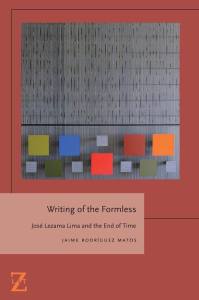
Infrareligion in the abyss: on Jaime Rodriguez Matos’ Writing of the Formless: José Lezama Lima and the End of Time. By Gerardo Muñoz.

writing-of-the-formless_2017Jaime Rodriguez Matos’ Writing of the Formless: José Lezama Lima and the End of Time (Fordham U Press, 2016) is an ambitious and truly mesmerizing mediation on the Cuban poet José Lezama Lima in light of contemporary theoretical debates concerning the status of the political in the wake of Modernity’s decline into nihilism. Rodriguez Matos’ sophisticated intervention attempts to accomplish several objectives at once, and in this sense, the book does not pretend to be an exegetical or philological contribution to scholarly debates on the poet. Rather, in the book, Lezama is taken as a poet-thinker of the informe, whose main import into Western history of writing and thought is that of a ‘writing of the formless’ (Rodriguez Matos 171). In its totality, the whole book is a groundwork for such a claim, and it works through a series of tropologies, figures, and debates that extend from Lezama’s specific cultural Cuban context and its readers, to a set of wider debates pertinent to Left-Heideggerianism, political theology, or the event (although by no means, is the complex set of debates reducible to these three philosophical indexes).

If one were to describe the project in its most far-reaching ends, Writing of the Formless is important yet for another reason: by handling several topologies of Lezama Lima’s oeuvre, we are offered an in-depth analysis of the intricate conceptual wager in infrapolitics, or in infrapolitical-deconstruction, which as Rodriguez Matos suggests, is the provenance of Lezama Lima’s contribution as a critical task. The book is divided in two parts. In the first one, four chapters grid an explication of the problem of time, as well as that of the formless, revolution, and nihilism. In the second, Rodriguez Matos engages in an innovative reading of different zones in Lezama Lima that evidence the destruction of principial politics, and the opening towards an (infra)politics of the void. In this review, I can hardly do justice to a book that I truly consider a masterwork of contemporary thought. In my opinion, this monograph comes as close as it gets to being flawless in establishing conceptual premises and argumentative deployment. In what follows I will map some provocative elements of his exposition, in hope that it will be a starting point for a discussion with those critically engaging Latin America, the political, and the stakes of thought in our time.

The point of departure of Writing of the Formless is the temporal question (in Latin America, although it is not localized here as a site of privilege) of Modernity, which is registered as a Janus face machine: on one end, the linear time of Hegel’s philosophy of history; and on the other, the teleological time of the messianic redemption and reservoir to many salvific political theologies. Early in the book, Rodriguez Matos sets up to establish the conditions that guide the development of his task:

“But it now it seems that in fact modernity, and not any possible redemption or liberation from its political and economic deadlocks, is itself a mixed temporality that is constantly battling between a circular and a linear time – a linear time of alienation and a circulation teleological time of redemption. The two need to be taken together, even in the very (im)possibility of such a synthesis. And this would mean that modernity is no longer the other of the revolutionary interruption of empty chronological time; rather, these are two sides of a single coin” (Rodriguez Matos 33).

By way of this dual apparatus of time, it becomes clear that linear time represents the time of alienation, where the eternal return marks its radical detachment only to become the engine of the theological messianic interruption. The two temporalities that frame Modernity, according to Rodriguez Matos, are a policing force, as well as “a residual effect or the symptom of the emergence of order itself” (Rodriguez Matos 22). And it is this formal legislation that synthesizes a duality that veil, in a variety of effective techniques, the formless of any foundation. Throughout the book the formless has different dispositions, such as the “intemporal”, “time of the absence of time”, or Lezama’s own “muerte del tiempo”. These all play key strategic functions and deconstructive relays. It might be the case, at least implicitly, that Rodriguez Matos knows that the history of metaphysics to cover up the void is, at the same time, the narrative produced by its apparatuses. What is important, however, is that by allocating these two times, Rodriguez Matos is able to set up what was otherwise obstructed: mainly, the time of void, which falls right beneath all principial politics, always in retreat and outside legitimizing messianic and developmental policity of Western modernity that governs both the time of the One and that of the multiple. Lezama is the figure that mobilizes a drift away from these two modalities:

“…beyond the politization of politics, and beyond the image of time as synthetic operation, what remains is the possibility of thinking with the poet beyond the current apparatus of academic-imperial) knowledge and all of its returns” (Rodriguez 25).

One would not exaggerate much in concluding that Lezama Lima as a thinker of the informe becomes the necessary antidote and hospitable dispensary against the philological exercises of the traditional belleletrism, but also of decolonial and neocommunist designs that, although attempting at the surface to break-away with imperial semblances, end up carrying the guise of principial politics as the highest flagpole for self-legitimation.

The reading of the informe allows us to move beyond the temporal dichotomy between revolution and conservation, messianic originalism (such as that of catholic, later convert post-socialist official poet Cintio Vitier), and the multiplicity of historical time (such as that endorsed by Rafael Rojas, Cuba’s most sophisticated neo-republican intellectual historian). It must be noted, however, that many other intellectuals and thinkers are tested on this basis. The common ground shared by diverse thinkers such as Rafael Rojas, Ernesto Laclau, Cintio Vitier, Walter Benjamin, Bruno Bosteels, Alain Badiou, and those that subscribe to post-foundationalism becomes clear: mainly, the assumption that the crisis of nihilism of temporality can be amended by always providing an adjustment for the abyss. In this way, Rodriguez Matos offers a frontal critique of any claim instantiated in hegemonic phantasms: “Our task remains to think time in all its radical complexity – that is, to think time as something other than a solution” (Rodriguez Matos 44). Writing of the Formless stands up to this deliverance.

There are many important elements that come forth in this argumentation, one of them being that the covering of the formless, or the lack of foundation, is usually articulated through a master and masterable political theology. It is not just Rodriguez Matos who arrives at this conclusion, but also Bruno Bosteels by way of observing the inscription of Christianity in many of contemporary thinkers of the Left. In a passage cited by Rodriguez Matos from Marx and Freud in Latin America, we read: “All these thinkers [Badiou, Negri, Zizek], in fact, remain deeply entangled in the political theology of Christianity – unable to illustrate the militant subject except through the figure of the saint” (Rodriguez Matos 44). It is even more perplexing then, that Bosteels’ own solution to this problem ends up being just more political theology by way of Leon Rozitchner’s reading of Saint Augustine, and merely exchanging the category of the saint for that of the militant subject, even though this is already part of the history of alienation of Christianity [1]. But the reason for this might be, as Rodriguez Matos thematizes a few pages later, that any predicament for politization as supreme value today needs to ascertain some sort of militant subject of the event in order to guarantee a consensus on “contemporaneity”, and in this way avoids what the present is or what it actually stands for (Rodriguez Matos 109).

The chapters 2 (“Sovereignties, Poetic, and Otherwise) and three (“The Mixed Times of the Revolution”) attend to how the question of time was conceived within the Cuban Revolution. This framing, one must first note, already dislocates the grounds of the discussion centered on the sovereign or the caudillo, a fetish so dear to both revolutionary and liberal imaginations when confronting the ‘Latinamericanist object’. Hence, in chapter two, Rodriguez Matos advances a demolishing reading of the temporality of foquismo, although not on the grounds that one could have imagined. From a historiographical standpoint, it is common to agree on the fact that that both Guevara and Debray’s formulations have little substance in historical experience, since they are theoretical fictions that develop to master a non-repeatable event (the Cuban Revolution), which was far from being successful solely because of the foco guerrillero in the first place. But this is not Rodriguez Matos’ critique. The argument is set up to make the claim that the Revolution, in order to become flesh and conceive the unity and sameness with the people, theory must be first discarded (Rodriguez Matos 60). Rather mysteriously, in foquismo it is the people that ‘act’, while Guevara becomes its narratological supplement. This is the inversion of the Leninist principle that alleged that in order for a revolution to materialize it needs a good theory beforehand.

Guevara, in Rodriguez Matos, takes the role of the anti-Lenin. In fact, in a strange way, Che appears as a sort of naturalist-philosopher: “…what Guevara is after is the same time that was at issue in Marti: the idealism of the Revolution has to become a force of nature, sprouting in the wind without being cultivated…in all its originary ontological stability, phusis) and the people, without the transubstantiation of the idea into flesh yielding intimate unity, and without this force of nature forging revolutionary ideology…this passage would be nothing but the declaration of one individual from Argentina who has recently landed in a foreign land…” (Rodriguez Matos 60). Guevara is a hopeless romantic, who recaps the Romantic ideal of the fragmented temporality in the pedagogical poem, only that for him the impolitical people are in a “time out of joint”. This is why they must also become a New Man. The catastrophe of foquismo, is thus not merely at the level of a massive historical evidence, but an afterfact of a metaphysics that is already one step away from thinking the void, while formalizing it through a dialectical moment. Rodriguez Matos stages the central problem, just after having glossed Guevara’s revolutionary thought:

“For the metaphysics in question already relies heavily on the form in which it makes multiple small narratives. For the metaphysics in question already relieves heavily on the form in which it makes multiple temporalities appears together. That is, modernity is fundamentally and internally committed to the constant confrontation of disparate forms of time. Instead, I suggest taking a closer look at the time of lost time, the time of the void, and what might happen when it is not filled in but, rather, allowed to resonate in all its formlessness.” (Rodriguez Matos 61).

How should we understand this echo? The turn to Celan and Heidegger’s immersion in noise and the ontological difference validates immediately any vacillation in the answer, since what is at stake is ultimately to think not the “standstill of all time” of the messianic force, but our being in time understood as our most basic and intimate relation that we have with time (Rodriguez Matos 70). It is only this absent time of the formless that will be one of majesty, capable of undoing sovereign authority and its governability over the singular.

The third chapter moves against the belief that Lezama Lima can be grasped in interested disputes regarding his intellectual provenance, political ideology, or assumed Catholicism (origenismo). This is an arduous task, but Rodriguez Matos makes it look easy through a threefold operation. First, Lezama is moved beyond the antinomies of secularization and aesthetics, placed in the proper site of the religion of the formless (we will come back to this). Secondly, Rodriguez Matos confronts Lezama’s own interpretation of the Revolution as parusia or Second Coming, which coincides perfectly with Guevara’s own model of the “ways things are” that folds revolutionary Cuba into globalization due an ingrained total administrate apparatus over life (Rodriguez Matos 93).

This entails that revolutions, if we take the Cuban experience as metonymic of the phenomenon, are always already biopolitical experiences, even though Rodriguez Matos does not frame it in such terms. Third, by understanding the ‘mixed’ temporality of communism and revolutionary politics as convergent with the temporality of capitalism, we come to understand that the second is always on reserve in the backdrop of the state and its institutions (Rodriguez Matos 96-97). In sum, the superposition of revolutionary times with the time of capital is here shown, once again, to be two sides of the same dual narrative of modernity that turns away from the abyss at the heart of politics. This complicates many, if not all, of the assumptions that Cuban transitologists have disputed with very futile outcomes, in my opinion, in the last decade.

Finally, the fourth chapter “Nihilism: Politics as the Highest Value” rightly places the question of nihilism at the center. This is a return to the question of political theologies discussed above. Whereas many of the thinkers on both sides, republicanist and communist alike, take up the question of nihilism, the result, according to Rodriguez Matos, is that it is presented as a fight against those that think the problem of nihilism. Thus, the “banality of nihilism must be dismissed or critiqued” (Rodriguez Matos 104). The operation rests on the fact that the question of being must be avoided at all costs. And this is achieved in at least two main forms: discarding nihilism by proposing a “multiplicity of times” (Rojas), or by proposing a “living philology” (Vitier, Bosteels) that would be able to restitute a truth of a text of the past to give proper political ground (Rodriguez Matos 115). Now the tables are turned, and those that seek to cover the void, as if that were an option, appear as agents of a true nihilistic force.

The second part of the book titled “Writing the Formless,” provides a roaming through Lezama’s conceptualization of the void against politico-theological closure, arriving at the unthought sites of the ontological difference after Heidegger and deconstruction, and moving into infrapolitics. This is an exemplary section in the sense that Rodriguez Matos warns that he is in no position to offer a transhistorical formal theory of Lezama’s writing, and in this way he calmly avoids the universitarian-Master demand for a totalizing expertise of lezamianos. This operation is undertaken not for the sake of confrontation against Lezama specialists, but rather due to a more modest motive: it is not the point that drives Writing of the Formless. Anyone to counter argue on this level is rather to sidestep its most important contribution of this book. Finally, Rodriguez Matos lays out what is at stake, which is tailored as a question that by far exceeds Lezama Lima as a single corpus:

“Ultimately what is at issue whether there is a difference between those texts of the Western tradition that forget the question of being and those whose starting point is the challenge and the difficulty that the question poses, the challenge and the resistance involved in dealing with the ground that is and is not there in its absence. What is at stake is whether or not it is possible to imagine a writing and a thought that do not simply fall silent in order to guarantee the continuity of the narrative of legitimacy and sovereign authority in the poem or in politics – but the link between these two is also at issue here. That is, whether or not it is possible for posthegemonic infrapolitics to be something other than the trace of politics” (Rodriguez Matos 136).

What immediately follows is a series of closely knit constellations of the writing of the formless as absent time in Lezama, which I can only register here without much commentary: Lezama’s own critique of T.S. Eliot’s notion of the difficult, a critique of Garcia Marruz’s reading of the aposiopesis as rhetoric’s hegemonic property, Lezama’s understanding of Aristotelian metaphoricity; Lezama’s philosophy of an atopical One, and finally Rodriguez Matos’ own conceptual position of Lezama as an infrareligious and infrapolitical figure that pushes politico-theological legislation of principles to their very limit into a ‘nonsynthesizable reminder’ [sic] (Rodriguez Matos 154). Further, Lezama’s vitalist response to the Platonist pros hen, unlike the immanentist modern reversal, concludes in a Platonist affirmation instead of an overcoming of Platonism (Rodriguez Matos 139). Rodriguez Matos intelligently resolves this bizarre multiplicity vis-à-vis a parallel reading of Paul Claudel, who rejects aposteriori knowledge in exchange for the cognizant objectification of God before the sovereignty of the Poet. Although I am left thinking about the status of Neo-Platonism as it relates to the discussion of Christian Trinitarian thought [2].

But Rodriguez Matos goes further, and the Lezama that emerges from this destructive multi-level procedure is one that resists alleogrization, taking cue from Alberto Moreiras’ pioneering reading in Tercer Espacio (1999), as well as a privileged and secured position of a profane materialism over the question of form. And it is also in this very instance where Rodriguez Matos opens up to a complicated debate, which although unresolved, is the most striking and illuminating kernel of his book. In short: does ‘the roaming of the formless’ [sic] in Lezama offer something other than a trace of politics? I want to suggest, from my first reading of what is certainly a complex conversation, that this remains unresolved in Writing of the Formless. Let’s consider a key moment at the end of the book:

“For part of what I am calling attention to is the fact the staging of the formless in Lezama involves a thematization and an awareness of what should only be there as trace. This awareness goes beyond a more familiar claim regarding the self-deconstruction of discourses of their own accord – this is, after all, also what the trace is supposed to underscore. I would like to read this excess of awareness as a radicalization of deconstruction” (Rodriguez Matos 176).

This radicalization will entail leaving behind the moment of ecriture, which characterized the first wave of deconstruction in literary fixation and textual playfulness. Infrapolitics will be, programmatically speaking, post-deconstruction, or what Moreiras has recently called a second turn towards instituted deconstruction [3]. But the question remains: is infrapolitics then, a trace of politics? It is an unresolved question, but perhaps the most important one. Rodriguez Matos leaves us a clue at the very end of the book. When discussing the baroque – and let’s not lose sight of the fact of how late the question arrives, which is a merit and not a pitfall – Rodriguez Matos cites a letter of Lezama to Carlos Meneses: “I think that by now the baroque has begun to give off a stench” (Rodriguez Matos 181). The Baroque has come become an exchangeable token for the Boom, the last stage of identitarian transaction. But it is more than this: the baroque can no longer account for the informe at the heart of the image and rhythm.

Let’s probe this further. If the baroque is now exhausted, it is because all politics of the frame are insufficient to cope with the formless. The primacy of the critique of political economy today, for example, remains just one of its last formal avatars. But one could also respond to Rodriguez Matos’ final invitation, and say that while the aesthetic program of the baroque is demolished or turned into ashes, perhaps a trace of it remains in posthegemonic politics. To the extent that we understand the baroque as a political of self-affirmation against Imperium beyond hegemony, the baroque necessarily entails a republicanist politics [4].

In other words, while the infrareligious trace depends on the abyss, posthegemonic politics of republicanism sprouts from the baroque in early modernity against any imperial and counter-imperial conversions. Rodriguez Matos interchangeably speaks of infrapolitics and posthegemony throughout the book, therefore this nuance could be taken as a radicalization of the second term in line with the disclosure regarding the baroque. Post-deconstructive infrapolitics remains open. But if Lezama’s legacy is waged on having confronted the formless abyss of the absent time; perhaps, the author of Dador can also reemerge as a political thinker and existential representative not of Paradise, but of the secret Republic. This will entail a republicanism that, in each and every single time, does not longer participate in the eternal arcanum.


.

.

Notes

  1. This does not mean that St. Augustine cannot be read against the myth of political theology. Such is the task that José Luis Villacañas has accomplished in his Teología Political Imperial: una genealogía de la division de poderes (Trotta, 2016). In my view, Rozitchner’s La Cosa y la Cruz (1997) is a flagrant misreading of Augustinian anti-political-theology in exchange for a superficial materialist affective analysis. Although I do not have space to discuss this at length, I must note that Rodriguez Matos’ discussion of contemporary materialisms is also a timely warning about the easy exists that the so-called “materialisms” offer today as an effective transaction in contemporary thought. For his discussion of materialism see, pgs. 104-108.
  1. The question of Neo-Platonism is a fascinating story by itself, which speaks about the multiple in the One. Pierre Hadot studied its influenced in debates of early Trinitarian thought in his work of Marius Victorinus; recherches sur sa vie et ses œuvres (Paris: Etudes augustiniennes, 1971). Now, it seems that Lezama Lima himself was not foreign to Plotinus and Neoplatonism, which he linked it to the emergence of the modern poem. In fact, while reading Writing of the Formless, I revisited my copy of Lezama Lima’s unpublished notes in La Posibilidad Infinita: Archivo de José Lezama Lima, ed. Iván González Cruz (Verbum Editorial 2000). It was interesting to find that in “Oscura vencida”, a fragment from 1958, Lezama writes: “Si unimos a Guido Cavalcanti, March, Maurice Sceve, John Donne, en lo que puede ser motejados de oscuros, con distintos grados de densidad, precisamos que sus lectores, puede ser los más distinguidos cortesanos, o estudiantes que versifican cuando la hija del tabernero inaugura unos zarbillos…Con una apresurada lectura de la Metafísica de Aristóteles, sobre todo su genial concepto del tiempo que pasa a Hegel (sic) y a Heidegger; con cuatro diálogos platónicos, donde desde luego no faltara el Parménides. Con algunas añadiduras de Plotino sobre la sustancia y el uno…ya está el afanoso de la voluptuosos métrica en placentera potencialidad para saborear una canción medieval, un soneto del renacimiento florentino, o una ingenua aglomeración escolástica que se quiere sensibilizar, o una súmala de saber infantil, regida por un pulso que no se abandonó a la plácida oficiosa…” (252). This does not necessarily dodge Rodriguez Matos’ discussion of Claudel, but complicates it, since the trinity also merges at different points throughout the book. My question is whether any discussion of Trinitarian co-substantialism is still embedded in metaphysical structuration as potentia absoluta, or if Lezama’s informe is a Parthian attack against this influential model of absolute potentiality by turning it into a monstrous infrareligion. At stake here is also the issue of ‘reversibility’ that is obliquely exposed at the end of the book (Rodriguez Matos 189).
  1. See Alberto Moreiras, “Comentario a Glas, de Jacques Derrida”. https://infrapolitica.wordpress.com/2017/01/13/comentario-a-glas-de-jacques-derrida-notas-para-la-presentacion-de-la-nueva-traduccion-espanola-clamor-publicada-en-madrid-la-oficina-2016-y-hecha-por-muchos-autores-con-copyright-de-cristina/
  1. The question of the republicanist politics, Imperium, and the baroque is studied in detailed in Ángel Octavio Álvarez Solis’ La República de la Melancolía: Politica y Subjetividad en el Barroco (La Cebra, 2015).


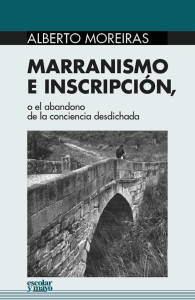
Ascesis universitatis. Sobre Marranismo e Inscripción (2016), de Alberto Moreiras. Por Gerardo Muñoz.

marranismo-inscripcion-moreirasMarranismo e Inscripción, o el abandono de la conciencia desdichada (Escolar & Mayo, 2016), el nuevo libro de Alberto Moreiras, es un compendio reflexivo sobre al estado teórico-político del campo latinoamericanista durante los últimos quince o veinte años. A lo largo de nueve capítulos, más una introducción y un epílogo, Moreiras traza en constelación una cartografía de numerosas posiciones de la teorización latinoamericana, sin dejar de inscribirse a sí mismo como actor dentro de una epocalidad que pudiéramos llamar ‘universitaria’, y cuyo último momento de reflujo fue el ‘subalternismo’. Además de bosquejar un mapa de posiciones académicas (postsubalternistas, neomarxistas, decoloniales, o deconstruccionistas), el libro también alienta una hermenéutica existencial que se hace cargo de lo que le acontece a la vida, y en su especificidad a la “vida académica”. Y los lectores podrán comprobar que lo que acontece no siempre es bueno. Marranismo e Inscripción explicita muy tempranamente en la introducción un tipo de denegación que configura el vórtice de este ejercicio autográfico: “…durante años pensé en mí mismo como alguien comprometido centralmente con el discurso universitario, como la institución universitaria. Hoy debo admitir que ya no – trato de hacer mi trabajo lo mejor posible, claro, pero algo ha cambiado. O seré yo el que cambió. Y entonces, para mí, ser un intelectual ha perdido ya su prestigio, el que una vez tuvo. Habrá quizás otras maneras de serlo en las que el goce que uno quiso buscar pueda todavía darse. Hoy ese goce, en la universidad, solo es ya posible contrauniversitariamente.” (Moreiras 16).

La tesis a la que invita Marranismo es la de abandonar la crítica universitaria (y la conciencia desdichada es un producto de la creencia en el prestigio de la labor crítica) en al menos dos formulaciones principales. Por un lado, la función de la crítica como apéndice tutelar del saber universitario entregado a su tecnicidad reproductiva. Y en segundo término, tal vez menos vulgar aunque no menos importante, el abandono de la crítica como operación efectiva y suplente de la crisis interna de la universidad. El ejercicio autográfico marcaría una modalidad de éxodo de la suma total de la razón universitaria hacia lo que se asume como una estrategia hermenéutica que implica necesariamente la indagación de una situación concreta que da el paso imposible ‘del sujeto al predicado’ [1]. Pero el paso imposible del marrano solo dice su verdad no como persuasión interesada de un sujeto, sino como hermenéutica inscrita en cada situación irreducible al tiempo del saber. En el ejercicio hermenéutico, el marrano deshace íntegramente la incorporación metafórica, sin ofrecer a cambio una paideia ejemplar, un relato alternativo, o recursos para el relevo generacional. Es cierto, hay un llamado a cuidarse ante un peligro que acecha, aunque esto es distinto a decir que el libro está escrito desde una situación de peligro. En realidad, el tono del libro es de serenidad.

En un momento del libro, Moreiras escribe: “…el próximo expatriado potencial que lea esto debe saber a qué atenerse, y protegerse en lo que pueda” (Moreiras 18). La pregunta que surge en el corazón de Marranismo es si acaso la universidad contemporánea está en condiciones de ofrecer un mínimo principio de autoconservación de la vida del pensamiento; o si por el contrario, la universidad es solo posible como pliegue contrauniversitario post-crítico, léase poshegemónico, para seguir pensando en tiempos intempestivos, atravesados por el ascenso de nuevos fascismos, y entregado a la indiferenciación técnica del saber en el seno de la institución. O dicho con Moreiras: ¿habrá posibilidad de ‘mantenerse en pie’ en los próximos años? Y si hay posibilidad de hacerlo, ¿no es una forma de contribuir a mantener en reserva el general intellect en función de una ecuación humanista? (ej.: más saber + más estudiantes = más progreso; pudiera ejemplificar lo que queremos decir). Todo esto en momentos, dicho y aparte, en donde la lingüística aplicada o la pedagogía derrotan en rendimiento a la ya poco digna tarea del pensar. Y si es así, la universidad contemporánea no estaría en condiciones de ofrecer más que humanismo compensatorio, donde el pensador solo puede disfrazarse de civil servant de la acumulación espiritual de la Humanidad. Desde luego que no hay curas ni bálsamos para dar con una salida a lo que Moreiras se refiere como un futuro “incierto e indecible abierto a cualquier coyuntura, incluyendo la de su terminación” (Moreiras 57). Pero tal vez hayan formas más felices que otras de entrar en relación con el nihilismo universitario en sus varias manifestaciones opresivas.

Por eso es que me gustaría invitar a leer Marranismo e Inscripción como una contestación a las formas sofísticas dentro y fuera del campo académico, exacerbadas en el momento actual del agotamiento de la universidad en el interregno. Y como sabemos, el interregno no es más que la imposibilidad de hacer legible el pensamiento en el momento del fundamentalismo económico. Pero es también la diferenciación cultural substituta como se ha demostrado con la hermandad entre multiculturalismo identitario y neoliberalismo. En el interregno el sofismo no solo crece y se alimenta, sino que dada la caída de toda legitimidad, la mentira solo puede asomarse como performance desnudo de la no verdad, puesto que ha agotado su efecto de persuasión posible, su validez efectiva, y cualquier ápice de razón. La tecnificación del pensamiento a través del marco equivalencial de la teoría supone la codificación del sofismo como valorización sin necesidad de apelar a la razón.

Por ejemplo, el éxito universitario de la decolonialidad, ¿no es la victoria de la irracionalidad como valor? A la decolonialidad no le hace falta ni le importa la razón – que para los llamados pensadores decoloniales es ya de antemano contaminación ‘eurocéntrica’ o ‘ego-política colonial’ – sino la afirmación nómica de un absolutismo cultural y propietario. La irracionalidad prometeica de las finanzas en el momento de la subvención real converge con un neomedievalismo crítico, y de este modo las piedades y doxologías retornan como figuras luminosas de un saber que parece haber saldado sus cuentas con la Historia. La anomia de la universidad contemporánea es principalmente una crisis de legitimidad, entendida como fin de su efecto de auto-convencimiento y ejercicio del pensar singular. Y así, no es sorprendente que la irracionalidad brille, triunfe, y cobre un peso irrefutable en las medidas tecnocráticas que regulan las Humanities.

La irracionalidad comparece a la tecnificación donde todo se ventila de antemano. Pensemos, por ejemplo, en la jerigonzas concurridas como ‘¿cuál es tu marco teórico?’ o ‘¿desde donde hablas?’ ‘¿cuál es tu archivo?’. Estas indagaciones solo pueden entenderse como formas de una máquina inquisitorial que la universidad alberga como principio de autoridad ante la caída medular de su legitimidad. Sería coherente pensar, entonces, que si estamos ante una máquina confesional, solo la mentira puede ofrecer salvación o posibilidad de ‘mantenerse en pie’ sin tocar fondo, o sin que le vuelen a uno la cabeza. Justo es esto lo que esgrime en En defensa del populismo (2016) el filósofo español Carlos Fernández Liria, quien sugiere que ante la consumación de la mentira en el campo político contemporáneo, no hay verdad que esté condiciones de legibilidad, ni de escucha, ni de generar efecto alguno ante un macizo ideológico impenetrable. La única posibilidad es expresar una contramentira. ¿Pero es ésta la única forma de contestación? Podemos ‘testear’ esta pregunta en un momento decisivo del libro, y que aparece condensado en la forma de un chiste. Valdría la pena reproducir el pasaje:

“La sospecha de no ser lo suficientemente correctos en política, con todo el misterio terrorífico que esa determinación tiene en la academia norteamericana, pesó siempre sobre nuestras cabezas como una grave espada de Damocles, y todavía pesa, y no importa lo que digamos o hagamos, porque estas cosas, como todo el mundo sabe, se solucionan a nivel de sospecha y rumor y susurro malicioso. O incluso: es una cuestión de olor u honor, como el cristiano nuevo perfectamente devoto que no puede evitar caer en manos de la Cruz Verde porque todo el mundo sabe que su piel no reluce con la grasa prestada de la sobrasada. O, en palabras de algún fiscal federal asistente en la nueva serie de televisión Billions, «Si alguien dice que Charlie se folló a una cabra, aunque la cabra diga que no, Charlie se va a la tumba como Charlie el Follacabras» (225-26).

Lo que he llamado la forma sofística de la retórica contemporánea transforma a todos en Follacabras, en miembros potenciales de algún siniestro grupúsculo de Follacabras, y no importa la verdad que salga de la boca de la cabra (si es que la cabra habla), o del propio Charlie, puesto que una vez que la marca de Caín reluce sobre el pellejo de la frente, ya estamos automáticamente condenados a participar de una exposición que nos arroja al juego de cazadores y cazados. Este ha sido siempre el campo de batalla de la hegemonía, y que hoy se vuelve sistemático desde su inscripción en la equivalencialidad general. Esto es, no hay quien se escape a su lógica. Es más, no hay quien no sea, a la vez, una excepción sacrificable a esta lógica.

Pero habría otra opción: los Follacabras o los condenados pudieran también rechazar el sofismo y sus afligidas metáforas, aceptando la verdad como ascesis, esto es, como ejercicio en éxodo de todo juego hegemónico efectivo. Es lo que parece estar pidiendo Moreiras en Marranismo e Inscripción, y eso es ya bastante, y nos obliga a repensar la cacería como único juego posible. Y es el ascesis donde pensamiento y vida entran en una zona de indeterminación, y desde donde la verdad puede comparecer como alternativa al yoga acrobático que ofrece la universidad contemporánea, ya sea en su forma inquisitiva que obliga a la mentira, o en su produccionismo metabólico desplegado en el consenso, o en la politización, o en las buenas intenciones. Fue Iván Illich quien notó que el ascenso de la crítica académica monástica, y cuya secularización es la sospecha hermenéutica, coincidió con la declinación del ejercicio ascético del singular [2]. Y esto tiene sentido, puesto que la función crítica solo puede apelar a una radicalidad en expansión, siempre y cuando se retraiga de pensar la facticidad que supone la irreversibilidad del capitalismo. No es casual que Moreiras hacia el final del libro, y en réplica a una pregunta de Ángel O. Álvarez Solís, recurra al arcano del ascesis, como abandono del juego hegemónico de las mentira, y que dibujo los contornos de una vida sin principio:

“La palabra «ejercicio» puede servir si la entendemos etimológicamente, desde ex + arcare, desenterrar lo oculto, des-secretar. Digamos entonces, todo lo provisionalmente que quieras, que la infrapolítica es una forma de ejercicio en ese sentido –busca éxodo con respecto de la relación ético-política técnica, busca su destrucción desecretante, para liberar una práctica existencial otra. Yo no tendría inconveniente en usar para esto una expresión que he usado en algún otro lugar, la de «moralismo salvaje». La infrapolítica, en su condición reflexiva, es un ejercicio de moralismo salvaje, anti-político y anti-ético, porque quiere éxodo con respecto de la prisión subjetiva que constituye una relación ético-política impuesta ideológicamente sobre nosotros como consecuencia del humanismo metafísico. Sí, ese paso atrás salvaje con respecto de la relación ético-política es an-árquico, porque no se somete a principio.” (Moreiras 208).

La ascesis dice la verdad en la medida en que siempre atraviesa una hermenéutica existencial, y da un ‘paso atrás’ que renuncia a las determinaciones fundamentales de la subjetividad. El ejercicio tiene como objetivo el cuidado ante previsibilidad del síntoma. Si la ascesis es contrauniversitaria, lo es no en función anti-universitaria, sino por su instancia necesariamente atópica, ejercida como expatriación y desvinculación de todo sentido de propiedad y pertenencia comunitaria. Para el marrano no hay pasos aun por dar, sino solo un paso atrás, que es siempre el paso imposible al interior del tiempo de la morada. Esto supone abandonar el fantasma hegemónico del campo académico como avatar del pensamiento. Se piensa siempre en otro-lado. Es este también el sentido, de otra manera incomprensible, desde el cual podemos entender el intercambio epistolar entre Celan y Bachmann: “No recuerdo haber salido nunca de Egipto, sin embargo celebraré esta fiesta en Inglaterra” [3].

Ese paso atrás es el de la posibilidad imposible para seguir adelante desde un pensamiento que renuncia a la presbeia para ser radicalmente amonoteísta. ¿Podemos acaso imaginar una universidad en Egipto? Solo esta sería una universidad post-deconstructiva. Marranismo e Inscripción invita a este éxodo como única posibilidad de mantenernos en pie, y de echar adelante. Y hoy, ya no perdemos nada con intentarlo.

*Position Paper read at book workshop “Los Malos Pasos” (on Alberto Moreiras’ Marranismo e Inscripción), held at the University of Pennsylvania, January 6, 2017.

Notas

  1. Arturo Leyte. El paso imposible. Mexico D.F: Plaza y Valdés, 2013. p.24-53.
  2. Iván Illich. “Ascesis”. (Manuscript, dated 1989).
  3. Paul Celan & Ingeborg Bachmann. Tiempo del corazón: Correspondencia. Buenos Aires: Fondo de Cultura Economica, 2012.

Interregnum and worldliness: on Sergio Villalobos-Ruminott’s Heterografías de la violencia. by Gerardo Muñoz

Heterografias de la violencia 2016

Sergio Villalobos-Ruminott’s Heterografías de la violencia: historia nihilismo destrucción (La Cebra, 2016) is, at first sight, an assorted compilation of fifteen programmatic essays. Mostly written during the last decade or so, these texts attend to a wide range of theoretical specificities, such as the baroque and performative violence, imperial reason and contemporary literature, sovereign-exception law and flexible capitalist accumulation. It is to Villalobos’ merit that none of these issues are restituted to academic knowledge production or leveled out as a selection of “hot topics” within the neoliberal marketplace. As in his prior Soberanías en suspenso: imaginación y violencia en América Latina (La Cebra, 2013), what is at stake, far from erecting the edifice of a ‘critical theory’ aspiring to fix the limits of reflection – as postulated in “sovereignty” “nihilism” or “destruction” – is the composition of a constellation that circumnavigates the vortex of the general horizon of the philosophy of history and the university machine.

In some way, Heterografías is auxiliary to Soberanías en suspenso, but not in the parasitical sense of amending or filling previous generalities. This new collection pushes thought beyond the specificity of the insular ‘Chilean scene’, providing for the indeterminacy of the logic of sovereignty as the arcanum of both interruption and continuity of the philosophy of the history of capital in Latin America. This is not to say that in Soberanías en suspenso the ‘local Chilean scene’ operated self-referentially as the archive for the reassertion of a cultural investigation. In the prior book, the Chilean scene is understood as a paradigm, in the sense of a singular relation to the singular, which Heterografías converts into a topical ensemble that interrogates the displacements, variations, and narratives of principial Latinamericanist reason from both nomic and anomic spatial formations.

Heterografías resists positing a new metaphorization of history, as well as yet another ‘political theory’ for what Latinamericanists identify as the object of “Latin America”. Although Villalobos does not thematize it as such, his book is full-fleshed post-Latinamericanist, and the reason is not just because it moves and weaves through the Schmitt-Kojeve debate on geopolitics and colonialism to the politics of the baroque and Catholic imperial katechon; from Latin American literature (Borges, Lamborghini, Perlongher) to debates on memory and indexing (Richard, Didi-Huberman, Segato). It is post-latinamericanist because it challenges the university praxis that administers, organizes, and provides for a linguistic transculturation to a post-katechontic ground that is today insufficient except as onto-theology and reproduction of cliché.

On the other hand, one also appreciates Villalobos’ minimal gesture of displacement of Latinamericanism not as a mere abandonment of the Latinamericanist object – which amounts to another exception, another distance with the object of desire, or its mere dis-placement – but as an otherwise relation that is not regulated by what Moreiras has called the ‘pleasure principle’ at the heart of hegemonic investment of the Latinamericanist intellectual [1]. A post-Latinamericanism, thus is necessarily posthegemonic to the extent that:

“…no se trata de elaborar una ‘mejor crítica’ de lo real ni de desenmascarar el carácter ideológico de un programa en competencia, sino de debilitar la misma lógica “fundamental” que estructura el discurso moderno universitario…. desistir del nihilismo en nombre de un pensamiento que no puede ser reducido a un principio hegemónico de producción de verdad y de saber. La post-hegemonía de la que estamos hablando, no es solo una teoría regional destinada a evidenciar los presupuestos de la teoría política contemporánea, sino también la posibilidad de establecer una relación no hegemónica entre pensamiento y realidad. Ubicarnos en esa posibilidad es abandonar el discurso de la crítica de la denuncia y particular de una práctica de pensamiento advertida de las fisuras y trizaduras que arruinan a la hegemonía como principio articulador del sentido y del mundo” (Villalobos 36).

What is offered to radical “destruction” is the principle of sovereignty that, as Villalobos painstakingly labors to display, is always already an-archic and in–determined. If according to Reiner Schürmann, the principle (archē) is what structures and accounts for the ground of presencing in any given epochality; Villalobos bears witness to the an-archic instance of every form of apparatus (literature, geopolitics, the national-popular, ethnicity, war, neoliberalism, etc.) that seeks to ground itself through principial formation, as both origin and commandment. In this way, the ‘history of metaphysics’ is not taken here as a teleo-phenomenological compression reducible to the very hyperbolic presencing of mere principles, but as a folding process that transforms the critique of metaphysics to that of its apparatuses. This has radically consequences, since it is no longer a debate about the university regime of knowledge production, or about the co-belonging between the destruction of metaphysics and the metaphysics of destruction, but rather: “…como concebir el carácter moderna y prosaico de las prácticas históricas, ya no investidas con un secreto transcendental, sino que constituidas como aperiódica radical de de-sujeción” (Villalobos 136).

The gesture does not wish to open a second order of exteriority to thought (whether geopolitically or subject-oriented), but a practice of the “non-subject” within the interregnum that lends itself to the radical historicity beyond the historicism of its apparatuses. The interregnum highlights the radical dislocation between philosophy and history, disinhibiting the categorial determinations that attest to its in-determinacy (Villalobos 145). By putting emphasis on the indeterminate character of violence, Villalobos is also indicating the flexibility and modality of effective law in every specific historical instance [2]. Thus, to amend the anomic status of the interregnum is always already to fall a step forward into nihilism and its epochal structuration of the given conditions. This is the instinct of all hegemonic principial incorporation as a pastoral or geopolitical formation. Heterografías consistently points to the folds that open to a potential constellation of singulars as an otherwise of experience de-contained from the duopoly philosophy-history and the cunning of capital (Kraniauskas).

As such, Heterografías advances the destruction of three transversal lines that feed the apparatuses of the philosophy of the history of capital in the interregnum: sovereignty, war, and accumulation. It is not the case that these lines have their own autonomy, historical foundation, or even ‘substance’. Rather, these folds that act as an assemble that partition and make up what I am willing to call the Latinamericanist exception in its metamorphosized transformations that aggregate knowledge, practices, and discourses. To dwell otherwise on the interregnum entails precisely to ‘free the lines’, as Deleuze & Guattari’s proposed in A Thousand Plateaus, crisscrossing the modalities of war (in times of peace or what Villalobos calls pax Americana); sovereignty (as still rendered in the katechontic determination of the State and fictive ethnicity); and accumulation (as an always ‘ongoing appropriation and expropriation’ from modernization processes to neoliberalist dispossession).

The scene of the interregnum as traversed by the flexible pattern of accumulation (Williams 2002) is a baroque scene. Not so much ‘baroque’ in the literary or even pragmatic sense that seeks to provide agency to subaltern informal workers in the Latin-American peripheries, but as a modal process that counteract the dynamic of sovereignty while re-inseminating a heterogeneous (heterographic) processes of violence at the heart of the common political experience [3]. The baroque also dramatizes the fissure of finitude that could put a halt to the sovereign exception. To this end, the critical gesture during times of interregnum is to abandon first principle of action, whether as purely conservationist katechon, or as immanentization of the eschatology. Villalobos calls for a third option, which is infrapolitical relation with the worldliness and the mundane freed from exclusion-inclusion logic. In an important moment in his essay on Kojeve and the geopolitical philosophy of history, Villalobos writes:

“Faltaría pensar la no-relación entre el ni-amigo-ni-enemigo, lo neutro blanchotiano, que se des-inscribe del horizonte sacrificial de la tradición política occidental, esto es, de una cierta tradición política asociada con el principio de razón, con la comunidad y la amistad, como decía Derrida, o del sujeto, como dice Alberto Moreiras, apuntando a una dimisión no afiliativa ni fraternal, no principial ni fundacional, sino infrapolítica” (Villalobos 92).

Infrapolitical relation is given as a promise that retains freedom of life during the time of the interregnum against all apparatuses of capture and conversion (it is no by accident that the marrano figure appears a few times through the book in decisive ways). How can one participate in conflict without necessarily open to war? How could one instantiate exchange without reproducing the principle of equivalence? How could there be a relation between literature and politics beyond representation and the productionist aesthetic institution and the literary canon? The potential to render thought otherwise, profanes every articulation of the apparatus allowing for a political exigency in the interregnum: an infra-political relation with the political, which brings back democracy to its post-hegemonic site. It is in this sense that Heterografías it is not a book disconnected from the “political practices” or what the althusserians call the material “conjuncture”. On the contrary, the task is achieved through a reflexive gesture that attends to every singular determination of the ‘ongoing accumulation’ that exceed the libidinal and memorialist investments in Marxian locational archives [4].

The purpose is to avoid a calculable relation with the conjuncture as always already shorthanded for hegemony, will to power, ‘movement of movements’, subjection, etc.; as to de-capture the radical historicity no longer ingrained in History’s metaphoricity. This is why Borges, the a-metaphorical thinker, disseminates Heterografías at various key moments juxtaposing politics and imagination and undoing the master-theory for political movements that always speak in the name of ’emancipation’. (The fall of Brodie in Borges’ short-story is the absolute comic negation of the Pauline’s militant conversion at Antioch).

As already specified in Soberanías, the threshold of imagination becomes the task for intra-epochal (interregnum) experience. Imagination, of course, does not point to an anthropological faculty of humanity, the prevalence of a sensible component over reason as in Kant, or a new intellect that as post-universitarian is able to secure a new site for prestige. Imagination is a preparatory relay for a turbulent de-formation of the apparatuses in to a common universality of singulars. Villalobos does not deliver a general theory of imagination, since imagination is already what we do as a form of dwelling, in the course of every form of life. I would like to un-translate Heterografías in these terms not because imagination remains the unsaid in every practice of destitution as what always escapes identity, equivalency, or the friend-enemy relation. But then, is imagination the outside of nihilism?

Imagination accounts for the heterographic processes that are flattened out by the master concepts that capture and dispense principial thought. In this sense, imagination is not reducible to the institution of literature or culture, but inscribes a singular relation with language; the possibility of speaking in the name of that which lacks its proper name [5]. The fact that today everyone speaks in the name of something it is the most visible asymptotic of the fall into technical nihilism. On the contrary, imagination is always the potentiality to speak for a minor people that interfere with the grammar of grand politics. In the last chapter “Crítica de la accumulation”, the site of imagination is the necessary metaxy for an otherwise politics of contemporary Latin America:

“En última instancia, se trata de pensar los límites históricos de la imaginación política latinoamericana, misma que necesita trascender la nostálgica identificación con una política reivindicativa y radicalizar su vocación popular en una suerte de populismo salvaje, que no se orienta heliotrópicamente a la conquista del poder del Estado, para una vez allí, disciplinar a las masas. Un populismo sin Pueblo, pero con muchos pueblos, heterogéneos y contradictorios, con una énfasis insobornable en los antagonismos y no en las alianzas, en las figuraciones catacréticas y disyuntivas…En suma, un populismo post-hegemonico…” (Villalobos 228).

The political mediation insofar as it is post-hegemonic ceases to dominate in the principial totality where life and the social, as based on fictive identity, coincide or collapse unto each other. This post-hegemonic populism cannot be said to be one at odds with institutions, or merely just cultural or charismatic supplement. Villalobos seems to be opening here the question of a distinctive form of law that would require imagination, not heterographic violence; attentiveness to singularity, and not another politics of the subject. How could one think a law that exceeds the citizen and the exception? Is it not isonomy – as the principle of the integral movement towards citizenship – what hinders and captures political life over its heterographic excess? Could one imagine a law that is consistent with democracy as the self-rule of a minor people, of a people without history, a savage people, inhabiting the true state of exception?

The answers to these questions are not to be found in Heterografías de la violencia. Villalobos-Ruminott has made a striking effort to sketch a set of common objectives, tasks, nuances, exigencies, and considerations for the possibility of critical thought (in the deleuzian sense) against the grain of interregnum’s anomie. The task is immense, even when its transparent language is deceiving: to open a fissure of worldliness (mundanidad) in preparation for a savage democracy to come; enabling the conditions for a way of thinking that is not oblivious to the production of violence within the ongoing accumulation that unfolds and whitewashes the present.

Notes

  1. Alberto Moreiras. “Poshegemonía, o más allá del principio del placer“. Poshegemonía: el final de un paradigma de la filosofía política en América Latina. Madrid: Biblioteca Nueva, 2015.
  2. It is in the quasi-concept ‘effective operation of law’, where Villalobos comes nearest  to Yan Thomas’ studies on the juridical flexibility of law. See his Les opérations du droit (EHESS, 2011).
  3. I am thinking here of Veronica Gago’s recent book La razón neoliberal: economías barrocas y pragmatica popular (Tinta Limón, 2015) which seeks to render a micropolitical form of neoliberalism from below deploying the concept of ‘baroque’ to ‘express’ its emancipatory and empowering dynamic in the informal sector. For Villalobos, on the contrary, informal economy is not an exception to the visible form of accumulation, but its flexible difference in the age of an-archic capital. The baroque is not a given instance for “emancipation” or “subjective agency”, but where sovereignty becomes dramatized in its most extreme degree: “Es decir, necesitamos pensar el barroco como una problematización de la filosofia de la historia del capital, con una interrupción que trastoca la especialización del atemporalidad propia de la metafísica moderna y más específicamente, de su correlato, política, la versión liberal-contractualista del orden y del progreso social” (78).
  4. “Diría que hay, al menos, dos formas de confrontar este problema; por un lado, la posibilidad de repensar el marxismo, Marx y sus diversas apropiaciones, según su historia, sus filologías y tradiciones, para determinar la “verdadera” imagen de Marx, hacerle justicia a su corpus, exonerarlo de los excesos de la tradición y traerlo al presente según una nueva actualidad. Por otro lado, sin renunciar a un horizonte materialista y aleatorio, la posibilidad de elaborar una crítica de la acumulación….” (215).
  5. Giorgio Agamben. “In nome di che?” Il fuoco e il racconto. Rome: nottetempo, 2014.

More thoughts on infrapolitics. (Steve Buttes)

I want to respond and reframe some of my initial questions given the ways in which the dialogue has approached them thus far. Moreiras notes that “there is a differend between us at the level of presuppositions, and that it is very difficult to look both for agreements or disagreements if the differend is not recognized as such.” Using the metaphor of the “pine trees” we discussed earlier, he goes on to say that “this is not the same as saying that you, for instance, insist on focusing on the pine trees whereas infrapolitics looks for everything else as well.

Rather, the very perception of the “everything else” already goes through the recognition of the differend. At that level, I would say that “your” pine trees, from this side of the divide, are not the same as the pine trees we can see and deal with.” And then this is compared with “lust [which] has different connotations for different ethical positions: a puritan sees lust where a libertine sees only desire, etc.”

What I understand as at stake here is the difference between translation and belief. In the former, we might think of the possibility of translating libertinism into a puritan language, of acknowledging the presuppositions of puritanism but nevertheless finding room to see from within those terms desire rather than lust. Approaching puritanism and libertinism as different languages, we might find points of conversation. But, then, if you are a puritan and encounter the translation of desire into your language, what do you do with the earlier form of puritanism in which you understood desire as lust? If it’s a good translation, you’d stop using the earlier version, or maybe you’d strategically (or cynically) use one or the other in given circumstances.

If it’s a bad translation, you might say, “nice try, but it makes no sense: I’m not buying it” or “that’s blasphemous.” But what marks the difference between good and bad here is whether or not you find it convincing and adopt it as your own. In other words, it’s not really a translation at all but rather an argument, one that you either believe to be correct or incorrect. The same goes for the pine trees. If I believe every kind of tree is a type of pine tree and you believe that all trees are individual and beyond categorization, we disagree rather than just differ. This takes the argument onto the ground others have already argued: Di Stefano, Sauri, Hatfield, Michaels and others. Indeed, as Michaels notes in The Shape of the Signifier critiquing the conversing “moral vocabularies” that Richard Rorty advocates and explaining the strangeness of the translation model, “Hebrew and German do not contradict each other, and insofar as Saint Paul’s and Freud’s moral vocabularies are like Hebrew and German, they don’t contradict each other either . . . . if Paul says that Jesus is God and Freud says he isn’t, they aren’t disagreeing, they’re just speaking different languages” (46).

While I believe these issues are important to discuss, I believe the scholars I mention can speak to their own arguments if they wish. I don’t want to move in that direction in my own comments because it takes us away from the intention of my initial post, which was not to interrogate the totality of systems of thought (e.g. infrapolitics as a whole) or make claims about entire philosophical traditions that are at odds with each other. Rather, my intervention emerged from my own plodding, piecemeal way of working, which is to mark concrete points of contact between my thinking and interests and those I see in others—in my case the Neobaroque, trompe l’oeil and the punctum—and to ask questions from there.

In this vein, let me reframe the initial reflection above in which I attempted to address the metaphors Moreiras evokes in his previous post. Rather than puritanism and libertinism, I want to imagine the strangeness of this demand for translation over argument in a Latin American context. More specifically, I want to draw attention to an episode from the colonial period that appears in Mariano Picón-Salas’ work and which I encountered in Marco Dorfsman’s recent Heterogeneity of Being (2015). Here Dorfsman discusses the “very Baroque example” (72) of the transliteration of the Pater Noster (Lord’s Prayer) into hieroglyphic Indian writing:

“The text begins with the word pantli (in Nahuatl a banner or flag of sorts) followed by the glyph for nochtli (in Nahuatl the cactus fruit or tuna) and so it continues on in this manner. The idea is that the Indian is supposed to read pantli nochtli phonetically, and not to see the images of the hieroglyph. A proper reading of the pictographic writing would, of course, produce pure gibberish, while the phonetic reading produces a distorted Latin. It is worth recalling that the majority of the Indians, even those who would have been able to ‘read’ and recite the Pantli Nochtli, would have not been able to understand Latin in any case. However, it is precisely the fact that this new hybrid is incomprehensible that gives it both its sacred and poetic power . . . . In the transliteration, Latin is being put to uses that are only ecclesiastical or scholastic on the surface. Within, ‘a beautiful harmony’ (or struggle) rages. What we have here is the true fusion of opposites [the coincidentia oppositorum of the Baroque]: the beginning of a literary production that leads, almost naturally, towards that other Latin American [Lautréamont] who in France joined together an umbrella and a sewing machine upon an operating table” (72-73).

Here, though I’m not certain that this is a main point of his argument, Dorfsman signals the strangeness of the translation model. As Dorfsman frames it, “Tuna Flag” either makes no sense at all (is “pure gibberish”) or is a way of joining the faith community in saying “Our Father” (in a “distorted Latin”). In the tension between these, Dorfsman sees a “poetic power,” but it is a power that emerges, of course, from a pedagogical power. The “Tuna Flag” scene is taken from the section of Picón-Salas’ book entitled “The Pedagogy of Proselyting:” “images and metaphors were sought in the circumscribed world of the native to bring religious ideas nearer to his mentality” (Picón Salas 56). While, as Dorfsman points out, this pedagogy is somewhat pointless in the sense that “a proper reading of the pictographic writing would, of course, produce pure gibberish,” rather than an understanding of the complexities of a belief system, it is possible to find in the gap between the saying (the distorted Pater Noster) and the said (the incomprehensible Pantli Nochtli)—in the failure to produce a successful translation—a proto-surrealist poetic form: the “true fusion of opposites” that is the “beginning of a [Neobaroque?] literary production” (73).

It is here that I see the task of the infrapolitical thinker manifesting itself as Moreiras describes: deciding what kind of object the failure that is the Pantli Nochtli is. Neither the Franciscans who instructed the indigenous artisans to create the images of the Pantli Nochtli nor the indigenous painters themselves would have recognized what Dorfsman does, which is to see what existing modes of calculation could not. In the gap between the utopian pedagogical practice of the Franciscans and the everyday intonation of gibberish in Nahuatl, the infrapolitical thinker sees the emergence of a nascent (Neobaroque?) literary form. But it is for this reason that I claim in my initial post that infrapolitics (in my partial, fragmented approach to it) “remain[s] squarely within Baroque modes of trompe l’oeil thought, requiring . . . unbelieving beholders.” Indeed, here we see a key example of trompe l’oeil literature: out of raw materials (“pure gibberish”) the appearance of the ecclesia emerges (“distorted Latin”).

But the infrapolitical thinker, as what I call a “miner of life’s raw material,” appeals to the potentiality of life itself by seeing the invisible qualities of that “gibberish.” That is, by seeing in the the incongruous encounter a potentiality that is not visible from the two poles mandated by the encounter, in demanding the failure of realizing the utopian promise (which is accompanied by the violent and creative modes Picón-Salas describes), we see the invisible emergence of the possibility of integrating the Pantli Nochtli into an absent whole by seeing it as the first in a series of variations that will produce an alternative tradition: a poetic form that begins with the Franciscans and develops into the incongruous images created by Lautréamont, the surrealists and Octavio Paz.

It matters little here that the Pantli Nochtli is meant as a mnemonic device to enter the ecclesia. What matters instead is the emergence in the everyday intonation of the Pantli Nochtli of the failure of utopia, which the infrapolitical thinker recognizes as poetic form, a form that is invisible to those who made the work. This infrapolitical account of poetic form escapes the belief systems of the colonial encounter, it does not escape a belief system outright but rather produces one of its own that displaces current understandings by integrating the Pantli Nochtli into the avant-garde tradition (if we agree with the reading) or doesn’t (if we disagree). Does the infrapolitical see a role for artistic visibilizations, or must these always be broken down for parts? Is the failed artwork central to infrapolitics? Are the terms “neobaroque” and “infrapolitical” synonyms for each other?

It is from here—in the infrapolitical approach’s ability to see what is not there when reading from existing modes of calculation—that I can return to the question of the punctum. In reading Moreiras’ work on poverty and infrapolitics in Línea de sombra, I saw parallels with his earlier work on Borges and Cortázar in Tercer espacio. I then heard the opening remarks made by Gerardo Muñoz and Sergio Villalobos-Ruminott at the ACLA seminar in which they marked a connection between Línea de sombra and Tercer espacio: “The drift to suspend the categorial structure of the Latinamericanist reflection was already underway in Tercer espacio and [The] Exhaustion [of Difference]” (“A Response”).

It is in this context that I felt justified in asking the question of whether there was continuity between the infrapolitical that motivates Moreiras’ work now (and underscores the work of the Collective) and his earlier claims about the punctum made in Tercer espacio. Moreiras hints at the possibility of this continuity: “The punctum is . . . a crucial concept for me, as precisely the site of desire, redefined by infrapolitics as the crossing of the ontological difference in every case. I should use this precise point in your paper to warn you that when I wrote Tercer espacio, or even Exhaustion of Difference, I was not yet thinking of infrapolitics. So for me the inferences are very interesting, but I am not ready to endorse them without going over them with a very fine comb” (“A Response”). But as he notes in the continuation of our discussion, where he explains that his account of infrapolitics as “always already a response to exploitation,” what is crucial is that the response occurs in “the gap between lives exploited and infrapolitical lives, the punctum in that gap–the site of Borges’ “ancient innocence”” (“More on responding”).

In this line from Borges’ poem “Alguien” [“Someone”], these confluences are clear: a sudden feeling of happiness that emerges not in hope for the future (an eschatology of change) or from the demands of daily life but rather from the pang of an “ancient innocence.” This “ancient innocence” enables one to see in the partial moments (“an unexpected etymology,” “the taste of water”) of a daily life controlled by structures that are not our own the forgotten joys of the past (which could presumably be the joys of the future). The “ancient innocence” that underscores the infrapolitical minor adjustment has a clear connection with the punctum: it cannot be planned but must rather occur “de pronto” [“all of a sudden”].

And this demand leads me to the follow up question of whether the infrapolitical account of the punctum—the hidden minor adjustment that could not come into being were it planned as part of an anti-exploitation or antipoverty project—has something to do with the antitheatrical reading of the punctum produced recently by Michael Fried. As Fried notes, Barthes demands that the punctum not be put there for us, not be part of the photograph’s studium (or mode of calculation), and it is this demand that marks the punctum as part of the antitheatrical tradition and secures for photography its aesthetic form.

If the punctum (what the photographer cannot put there for the viewer) is a radicalized form of absorption (the refusal to perform for the viewer), it is also what secures for Barthes a successful photograph, or at least one that he finds compelling. This creates a tension, then, between the failed translation above and the successful photo here. If every success is a potential failure (mode of exploitation) and every failure a potential success (mode of escape), these are often invisible to existing modes of calculation, that is, remain in the shadows until revealed by the minor adjustment that breaks down (deconstructs?) those modes.

Does the infrapolitical demand a failed (non-unified) work, or does the infrapolitical (with its emphasis on desires that remain in the shadows, on what is not there for us) dialogue with the antitheatrical reading of the punctum developed by Fried and Michaels? I will end for now but will continue to engage in the dialogue as it/if it continues to develop.


Works Cited
Borges, Jorge Luis. “Alguien.” El otro, el mismo. Obras completas. Emecé, 2007.

Di Stefano, Eugenio and Emilio Sauri. “Making it Visible: Latin Americanist Criticism, Literature, and the Question of Exploitation Today.” http://nonsite.org/article/making-it-visible

Dorfsman, Marco Luis. Heterogeneity of Being: On Octavio Paz’s Poetics of Similitude. Lanham, MD: UP America, 2015.

Fried, Michael. Why Photography Matters as Art as Never Before. Yale UP, 2008.
Hatfield, Charles. The Limits of Identity: Politics and Poetics in Latin America. U Texas P, 2015.

Michaels, Walter Benn. The Shape of the Signifier: 1967 to the End of History. Princeton UP, 2004.

___. The Beauty of a Social Problem: Photography, Autonomy, Form. U Chicago P, 2015.

Muñoz, Gerardo and Sergio Villalobos-Ruminott. “Línea de sombra Ten Years Later: Introductory Remarks”. https://infrapolitica.wordpress.com/2016/03/17/linea-de-sombra-ten-years-after-introductory-remarks-acla-2016-harvard-university-gerardo-munoz-sergio-villalobos-ruminott/

Picón-Salas, Mariano. A Cultural History of Spanish America, from Conquest to Independence. Trans. Irving A. Leonard. U California P, 1962.

*Image: Mira Schendel. Untitled. 1973.