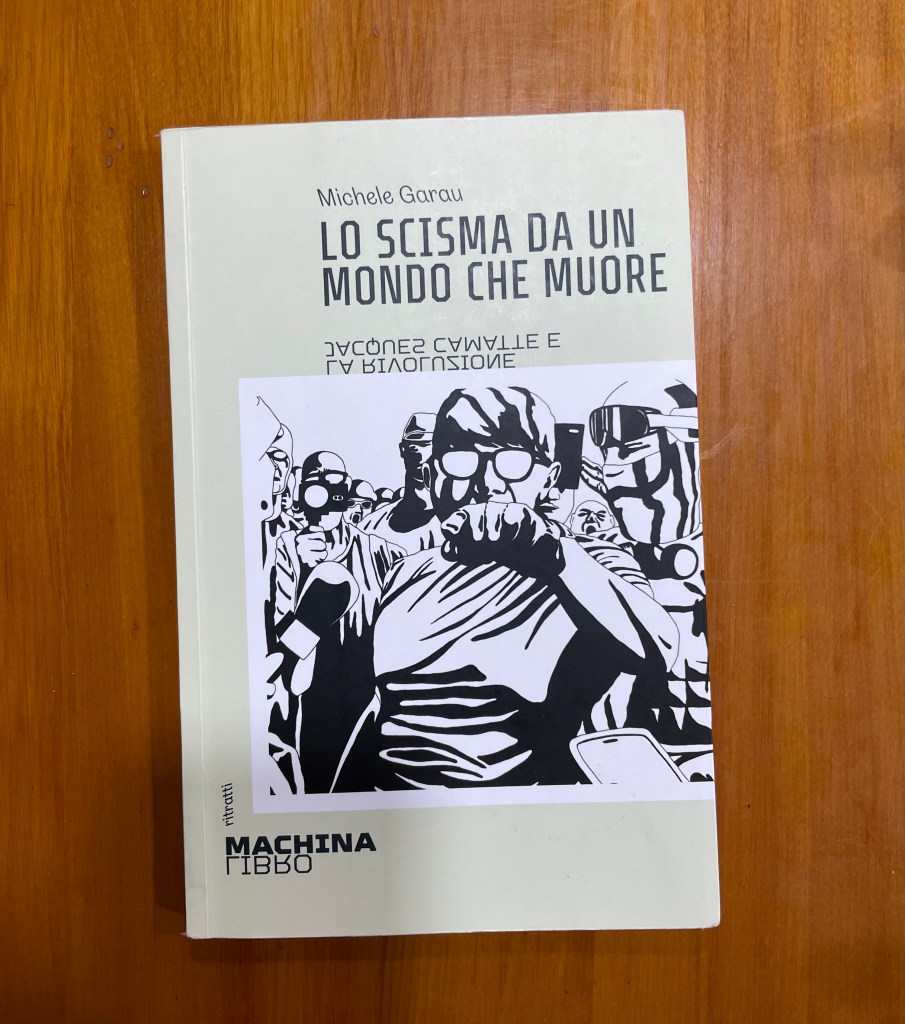
The absorption of the sky of politics. On Michele Garau’s Lo scisma da un mondo che muore: Jacques Camatte e la rivoluzione (2024). by Gerardo Muñoz

We must welcome that Michele Garau has written the first monograph on Jacques Camatte’s thought in any language, although the book, Lo scisma da un mondo che muore: Jacques Camatte e la rivoluzione (DeriveApprodi, 2024) it is also more ambitious than a mere philological reconstruction of the thinker of Invariance. Of course, not that there is anything particularly wrong with philological or archival work; rather, it is also that Lo scisma da un mondo che muore (2024) tries to think with Camatte (and also beyond some of his potential impasses) the historical bifurcation of a watershed moment in the history of humankind through the realization of the “capitalist revolution” as an autonomous colonization of every form of exteriority (Garau 7). If Camatte’s work has been only selectively considered in our ongoing discussions – while completely ignored at large by the so-called contemporary theory, which I guess it is an uplifting symptom – is precisely because he poses a challenge for a possible breakthrough in times of stagnation, while firmly announcing a much needed farewell to the modern revolution. But who would want to jump on that wagon when precisely voluntarism, prosthetic revolutionary cosmetic, and fictive communitarianism are all necessary platitudes to hold on to the illusion of ground right above the abyss? It is a rhetorical question, of course, but also one that Camatte move passed it in the in the decades of sixties and seventies observant to the material transformation of the working class, and the overall lesson of Amadeo Bordiga’s communism of the human species, which has also been rendered opaque and fossil-like by the victorious force of cultural hegemony and the whole grammatical structure of Gramsci’s thought in postwar political thought (and some will say well into our very present in the most recent cycle of failed left-populism). We said ‘farewell’ and this act, for Camatte after Bordiga’s teaching, means that the revolution has already taken place and must be perceived in the perspective of the crisis of negativity and the inception of the real absorption of capitalist development (Garau 14). 

Hence, new challenges lay ahead, which implies the abandonment of the historical and temporal productivity of revolutionary time – and Garau does an excellent mapping of bourgeois revolutionary thinking from Abbe Sieyès to Saint Just to later formulations of the Leninist paradigm of the dictatorship of the proletariat – which in the grand scene of modernity oriented the economy between form and function, but also between thought and action. If the epoch is said to be ‘anarchic’ is mainly because all these mediations and exclusive autonomous spheres have collapsed unto each other, and to favor one over the other is to work within the fiction of ideological reproduction at best. After Bordiga – Garau claims glossing Camatte, although there are nuances that I cannot consider in the space of this short commentary – the temporalization of the ius revolutionis can only bear in mind the crisis of presence (De Martino) as a suspension of exteriority that liberates right unto real subsumption. This means, following the recently polished phrase of Bordiga from his article “Tempo di abiuratori di scismi” (1965), that all revolutions are born and deployed as the affirmation of the schism. “Schism” or “scisma” — and one is reminded or taken back to a theological terrain, and not just as mitigated by the old ecclesiastical memories of the “Great Schism”, but because “schism” is also the “stazion” that fractures the visible-invisible legacy of form of the Church’s Trinitarian doctrine, and which is still the esoteric boiling point of the myth of political theology. This is a detour around Garau-Camatte-Bordiga’s intuition, since none of this is explicitly thematized in the book, nor should it be. It suffices that it opens to this question, given that Camatte’s own grammar of exhaustion – “extinction”, “inversion”, “autopoiesis”, “critique of organization”, “wandering” (erranza) – distill the echoes of an apocalyptic movement proper to the modern anthropological crisis, to put in terms of Ernesto de Martino.

Be as it may, the longue durée of civilizational development of Western revolutions (Edward Gibbon would claim at least since the reconstitution of the Christian Empire) there has been a process of adequation to invariant processes of capitalist accumulation that its substrate (whether permanent, uneven, natural law justified) becomes isomorphic to the structural needs of capitalist autonomization. In a cogent reading of Sieyes with Saint-Just in the framework of the French Revolution, Garau demonstrates how the genesis of modern politics and its categorial scaffolding (localization, constituent power, social unity, subject of rights, and representation) presuppose a thoroughly new vision to make the human community a clean slate for surface legibility (Garau 42). If the civil concept of the ancient polis was measurement and exchange; the crafting of high-modern state politics that took off in the eighteenth century was much thicker and spatially robust dynamics so that the ‘laws of commerce’ and population disciplining could come to fruition with its necessary infrastructural support. The schism was always a perturbation of the “sphere of politics” (and also of politics as a translucent sphere that can be observed, stabilized, and managed), and thus a great scandal.

Hence, the critique of political economy in the history of marxism was never able to untangle this mutual correspondence. For Garau at this point one can locate the difference between Camatte’s thought and Italian operaismo; given that Italian workerism at mid-century was never able to overcome the dialectic between the valence of value form and the theory of the production of capital. Whereas for Mario Tronti the struggle was still to be inscribed in to confrontation between the proletariat qua labor power; for Camatte the “invarianza” is not an permanent stage within the history of class struggle or Marxism, but of the human community and its resistance against the real subsumption of the material community (Garau 48). Decoupling the history of the working class as constitutive of productionism from the human community, allows Camatte, in the wake of Bordiga’s communism, to register the subsumption of capital as it collapses into dialectical negativity. Hence, communism is neither produced nor organized as operaismo always thought (Garau 26-27). And citing a passage from “Against domestication”, Garau argues that for Camatte the history of the proletariat struggle after 1945 is only the struggle to maintain the myth of the proletariat as the subject of a historical breakthrough (Garau 73). This is a staggering affirmation, and one that most definitely produces a theoretical schism. But the schism is also against the fictionalization of a subject of history, which has also been integrated into the emptying of social reality as we have come to know it in the final triumph of the fictive unto itself (Garau 93). 

There is the triumph of the fictive and expansive force of capital despotism, and then there is the struggle for the originary community (Gemeinwesen), which as Gianni Carchia argued in his “Glosa sull’umanismo” (1977) was still enmeshed in the contradiction between humanism and anti-humanism obstructing the vascular movement of non-identical fragments imploding the social. Is this getting at an impasse of Camatte’s own effort of thought to find an exit route? As an intelligent book, Lo scisma da un mondo che muore (2024), refuses to give an essay in the last three pages of the essay, although this difficulty is an object of attention. For instance, Garau writes in one of the clearest elaborations to tackle the problem directly: “La comunità deve allora essere riscoperta in una memoria della specie che finisce per radicarsi, questo è il rischio, esclusivamente in un bagaglio biologico. Nell’esaurimento delle strutture sociali preesistenti, dei linguaggi e degli schemi culturali, delle intelaiature rappresentative e cognitive, nella colonizzazione delle capacità psichiche, affettive, simboliche, è davvero possibile individuare un resto intoccabile dall’antropomorfosi del capitale che non debba essere, invece, creato dal nulla? C’è una «parte irriducibile», come scriveva Bataille, rispetto alle unità di misura del dispotismo economico? Non è semplice rispondere” (Garau 124).

In light of this rumination, Garau also attends to the cycle of contemporary revolts, which might stand as an instance of linguistic and existential struggle against domestication and the crisis of presence (Cesarano), and that might be capable of “absorbing the sky of politics into the most simple and elements components” (Garau 124-125). This is a great image, and one that has pictorial density and durability for thought even if it lacks specific elaboration. To absorb the open sky is to confront the exteriority of the world only as transfigured and brought back as a gathering of experience. The great German critic Kurt Badt comes to mind when writing about Constable: “the sky’s the organ of sentiment”. The embarrassing loss of the world today is fundamentally the destruction of the right attunement to our relation to the opening registered by what gleams above our heads. And perhaps this is a way to measure the capacity for non-movements rather than thinking that movements can disclose the sky. To this end, what could it mean to absorb the sky of politics – which is also a way to refuse the politics of sky, that is, the total planetary grand designs of geopolitical Tianxia? The irreductible may not be reduced to a substance, nor an ontological science nor a vitalist return to an originary community (if only mediated by the restriction of the archaic myth); but precisely that positionality of contact between what is exterior to life itself. To dislodge thought from all political plotting of objectivation and its plastic ligament of social adaptation. A life beyond itself that endures, and perhaps will outlive this dying world.

Humanity’s way out: antinomies of Elio Vittorini’s Uomini e no (1945). by Gerardo Muñoz

In an early review of Elio Vittorini’s Uomini e no (1945), Renato Poggioli noted that one of the important merits of the novel was that in spite of the authort’s political commitment, the narrative was “neither partisan nor ideological. I dare to say it is not political; the author even apologizes for this at the end of the volume” [1]. Poggioli, of course, is referring to Vittorini’s Postscript where he states, favoring a thin notion of the autonomy of art, that the end of art is to “seek in art the trace progress of humanity is altogether different from fighting for it upon the political and social terrain” [2]. This is enough evidence to bring to bear Vittorini’s humanist project grounded in a faith in the “progress of the human species” that he wrestled with throughout his life, and that he never really abandoned according to Franco Fortini [3]. Of course, Vittorini’s ‘progressivism’ is not bounded to ironclad guidelines of political economy and the science of a materialist history, rather his position is the attempt to flee from it, to undertake a different path in which humanity and inhumanity could enter into an improper and inconspicuous relationship towards presence. 

Here we can part ways with Poggioli’s suggestion that Uomini e no (1945) is not “sufficiently political” because the characters do not dare to make political slogans or identify themselves with a concrete political party line (the Communist Party that Vittorini himself identified with in spite of having written a non-political novel) during the underground resistance during the years of fascist domination in Milan during the interwar years. If Uomini e no (1945) drifts aways from engaging in a formal political identification to mobilize the narrative persuasion it is because for Vittorini there is an original struggle for “life” that necessarily precedes subjection and political action: it is the struggle of human species to confront the difficulty of its own inhuman threshold, which becomes necessary to account for in any materialist conception. The whole tension of the novel hinges on the unnerving formal composition of the narrative with the asphyxiating dread and angst of the character that embodies the existential the practice of an incarnated struggle beyond survival. 

However, what is beyond survival? What comes after the desert of a world that soon enough – in the words of Theodor Adorno at the height of the mid century – will turn human life into “mere functions within a monstrous social machine in which “life does not longer lives”…in which what grows is the scope of socialization and its functions. What I want to say is that liberty has become a mere pretext to enhance the ways of domination” [4]. If politics is the religion of modernity (political theology suturing the void with authority), the accumulation of liberty can only be understood as the moment of expansion and reproduction of effective domination. In a way, the metropolitan scenario in Uomini e no (1945) foreshadows the evolving historical epoch of this ‘monstrous socialization’ as a civil war or stasis, in which the mere survival of political struggle is proportional to the dispensation of death of humanity as the last dialectical movement of humanity against itself; that is, towards the concrete extinction of the human. For Vittorini the swerving black sun of fascism and political militancy (in its idealized version invested in the paradigm of sacrificial structure of history) can only amount to the realization of epochal nihilism and the fertilization of the expansive desert in the novel at the expense of sacrificing the erotic mediation with the world, which entails the liquidation of the sensibility external to human: “Love, in those deserts, is at its most squalid; it is not that life is absent from but the life it has is not alive. You are thirsty and have a chance to drink; there is water. You are hungry, you have a chance to eat; there’s bread. There is a spring and alms around, just the one you are looking for. But it  is only a mirage, it is not the thing itself” [5]. The fundamental question posed by Vittorini is never truly resolved by Uomini e no (1945): crossing the desert to achieve something like an erotic distance with the thing itself as ultimately the confirmation of one’s irreductible destiny. No doubt, there are moments where this emerges in strange ways, at the limit of narration and as a linguistic declaration. This is scripted through the exchange with the old lady Selva on happiness: “We work in order that men be happy. Isn’t that what we are working for?…Men need to be happy. Would there be any point to our clandestine newspapers? To our conspiracies?” [6]. 

Is happiness a subterfuge to return to the world, or is happiness, authentic non-compensatory happiness, the stimmung of life as it retreats from the delegated representations of civil society? The suspended dialectical closure at the level of form in Uomini e no (1945) provides a preliminary resolution to the question of happiness amidst wreckage; a collapse that speaks to Vittorini’s impossibility to bring into synthesis political action and existential authenticity. The narrative texture of Uomini e no (1945) is a preparatory exploration – showing the false exists in the meantime – towards the possible liberation of man’s passions, even against the premises of a reconciled ‘Humanity’ capable of leaving behind the antinomies of humanism and antihumanism at the service of the ‘communist way’. And we know that for Vittorini the commitment to ‘Communism’ was inscribed not in the idea or the organizational tactics but in the notion of the “way” (una via), capable of opening possibilities to counter the coercive efficacy of the administrative social apparatuses that turn historical progress into a totalizing desert [7].  How to do so – is there any legible index to the “via comunista”? As a novel Uomini e no is preparatory towards this retreat from the confusion of the inhumanity of the human on the one hand, and the total humanization of the world to deface the possibility of happiness and experience with the world itself. 

In this sense, Fortini is right in describing the lyricism of the novel as attuned to a funeral oration or song (“canto funebre”), which is also a prolonged farewell to the ideals of Vittorini himself as a moral humanist; that is, as someone committed to the ideals and abstraction of redemptive self-sacrificial christology and the self-serving autonomous action of the pardon as man’s last hope to absorb the inhuman kernel into the vita nova of a redeemed universal Humanity. And in fact, these are two “endings”’ of Uomini e no (1945): the self-immolation and sacrifice of the protagonist N2 waiting to confront the Nazi official Cane Nero, and the final sequence of the worker that refuses to murder a German soldier because he looked “sad” even when standing on occupied soil, even when he occupies the role of the protectorate of the nomos of the earth [8]. These are the novel two preparatory distinct actions in the dense fog of the interregnum: the Christological path of sacrifice of N2  – the sacrifice to end all sacrifices, which according to René Girard’s defines the advent of the Christian sacrificial  practice- seeks a last action of resistance holding on to “humanity’s internal weakness”, which carries the elevation of secularized mythic discharge of subjective martyrdom [9]. On the other, the milanese worker offers redemption as a form of secret forgiveness (without a justification and without a why) to the occupier, and in this way integrate the inhuman into the human species as the solution to the repeated rumination over the movement of struggle and resistance: “Why, without being in any way forced to do so, had they entered this duel to the death, and why did they continue to wage it?” [10]. 

In his early reading of Uomini e no (1945) Franco Fortini offered a thesis that I am tempted to call the domestication of the wolf argument; an inversion of Hobbesian anthropology and the Christian felix culpa in which struggle’s optimism will ultimately transfigure the internal wolf unto the human’s heart [11]. But we know that the homo homini lupi depends on a thick notion of anthropology, of the human’s unfathomable deficiency in relation to ‘object reality’ so that any domestication of the wolf within humanity is also an anthropological quest; perhaps the last “route” of negating humanism through substantive acts (sacrificial sacrifice and forgiveness) in the attempt to reconcile the wolf with man. But this is the very enterprise of civilizational techniques of adaptation proper to the tooling of political anthropology – that is, the domestication of the savage wolf entails its conversion to the passive dog. Could there be a way out to the final verdict of dialectical form beyond struggle, and the reconciliation of humanity with its negation? Perhaps this is only registered as the unthought in Vittorini’s Uomini e no (1945); an experience that prepares a return to the world through the conatus essendi, or  the preservation of each thing’s being as their are. This is registered in only instances of the novel in the backdrop of a landscape; indeed, outside the subject of self-reflection, and beyond the premises of radical evil proper to moral platitudes. And the moment reads like this in chapter CXXX: “The long dusty road, the drowsiness, the hay, the stitches where the cicadas were: everything that was, and that, along with everyone who is lost, still wants to be. And the sky filled with kites? The sky that was filled with kites” [12]. The perseverance of the conatus essendi puts to rest what the delegated forms that politics and morality have to offer as temporal substitutes for dragging the historical promise of humanism within epochal nihilism. 

In this suspended imagery of an arid landscape, Vittorini descends to the preservation of things as they open to their manifestation of another sense of freedom – no longer tied to the paradigm of historical liberation nor to the assumption of synthetic anthropological determinations to sooth pain – comes upwards, always silently, through the order of description outside the human. And is not in this description what Gianni Carchia would call “the non-human…a gesture of farewell to the idealist movement; a farewell to the exaltation of the human up to the highpoint of its explosion. The refusal to substitute the dead god for a human that in the depredatory scope of totality crosses every limit, every transcendence, and infinity” [13]? This transposition of this  proximity with this “other-than-humanity” ( what Humanity can no longer hold on to) is the secret to Vittorini’s infrapolitical impasse in Uomini e no (1945) that holds the key to his insistence on a notion of “freedom” against the subject incapable of overcoming itself in the face of the abstraction (morality) or ideological  reassurance (militancy) [14]. One could assume that the worker’s last line in Uomini e no (1945) – which also coincides with Vittorini’s mimetic repetition in his “Postscript” – in the form of a promise (‘I’ll learn better’) registers the final attempt to grasp what remains on the exterior fog of humanity: a notion of freedom that, in seeking ‘a way out’, insists in the possibilities of establishing contact with the world. Thus, the program of historical liberation can only be achieved against historical and civilizational fixation; traversing the polarity of humanity and inhumanity, and thus deposing the sublimated sentiment of pain that social domination can administer as an unending process of degenerated and moribound humanity as mere continuation of the fictive life.

Notes 

1. Renato Poggioli. “Review of Uomini e no by Elio Vittorini”, Books Abroad, Vol.20, N.4, 1946, 393.

2. Elio Vittorini. Men and not men (The Malboro Press, 1985), 199.

3. Franco Fortini. “Ma esisteva Vittorini?”, L’Expresso, 4, 2 febbraio 1986, 86.

4. Theodor Adorno & Max Horkheimer. “El mundo administrado o la crisis del individuo”, Pensamiento al margen: revista digital de ideas políticas, N.19, 2023, 200.

5. Elio Vittorini. Men and not men (The Malboro Press, 1985), 34.

6. Ibid., 13. 

7. Elio Vittorini. “El comunismo como vía”, in Diario en público (Gadir Editorial, 2008), 279.

8.  Elio Vittorini. Men and not men (The Malboro Press, 1985), 50.

9. René Girard. Sacrifice (Michigan State University Press, 2011), 65. 

10. Ibid.,  196.

11. Franco Fortini. “Che cosa può l’uomo: Uomini e no” (1945), in Saggi italiani (1987), 253.

12. Elio Vittorini. Men and not men (The Malboro Press, 1985),190. 

13. Gianni Carchia. “Glosa sull’umanismo”, L’erba voglio, N.29-30, 1977, 9.

15. Elio Vittorini. “La libertad es difícil” (1956), en Diario en público (Gadir Editorial, 2008), 382.