After more than ten years, I have recently reread several works of contemporary novelist Alan Pauls, and only now I have come to understand the precision of his language; a perfect combination of the rhythmic movement of a swimmer combined with a dry stroke of a brush on a canvas. This precision is not holistic, but found in every sentence of his prose. Aside from the content of his intuitions about literature or the almost microscopic development of frozen time of his characters, what Pauls ultimately teaches is that the unit of prose is the sentence, both its cadence and its ability to be severed and be brought to an end. This is precisely the meaning of the “period” (periodos) as the internal unit of the sentence: periodos is afterall, the circular moment of something that has a beginning and an end. The achievement of a good prose is the articulation of periods that can launch and make a sentence retire.
For a novelist who is also a self-reflective essayist, it is puzzling that Pauls has not implicitly thematized the unity of the sentence in the craftsmanship of prose (although he has considered accentuation in an essay) [1]. But it is wholly absent in El factor Borges (2004), and his most recent collection of musings and glosses on reading and writing in a volume titled Trance (2014). It is perhaps too easy to overstate the fact that there cannot ever be a general theory of the sentence, because both tone and periodos are expressions of style. The construction zone of a well crafted prose can only be analyzed in the movement of the sentence. In a fabulous moment of his Arcadian Rhetorike (1588), the sixteenth century grammarian and poet Abrabham Fraunce writes the following regarding the sentence:
“The beginning and the end of a poemt must not be the beginning or ending of prose. For the beginning, a little consideration will suffice, for the middle, less; but in the end the chief care is to be had, for it is most examine, and the longest in memory. It must therefore be sweetly contruied, that it seem not hasty and abrupt: it must also be varied and changed often time…if the same foot should in the end be continualed repeated.” [1].
In his treatise of rhetoric, Fraunce connects the end of the sentence, the coming to the periodos to the work of memory and sweetness. Perhaps because the cadence embedded in the sentence is the instance that allows us to connect past and present without hesitation or interruption; not the moment of suspension and surprise, but of landing in language, so that something, once again, can commence. This is also why a novelist in Spanish like Alan Pauls has not ceased to be fascinated by the idea of the past, especially in El pasado (2003), but also in his historical trilogy about his coming of age in the seventies. In other words, it is not enough to write the past in mere prose; the most important solicitation is to lodge its memory in the nest of the sentence. It is only here where memory arrives at a region called “home”.
.
Notes
1. Alan Pauls. “Elogio del acento”, in Temas lentos (Random House, 2022), 52.
2. Abraham Fraunce. The Arcadian Rhetorike (Oxford University Press, 1950), 34.
First published in the Chilean publishing house Mundana back in 2016 and long out of print, Victoria Cirlot’s Imágenes Negativas: las nubes en la tradición mística y en la modernidad (2026) finally appears in a new and upgraded edition from Siruela Ediciones. This short essay, initially a conference delivered at the Universidad Católica de Valparaíso, is another contribution to Cirlot’s important work on European mystical tradition of European early modernity, but like other of Circlot’s book its value also resides in its prudential contribution to contemporary thought. In this sense, Cirlot’s visual exploration of the cloud allows us to raise the question without much hesitation: what is a cloud in a field of vision, anyways? In Kurt Badt’s John Constable’s Clouds (1950), a book that is curiously missing from Cirlot’s commentary and bibliography, the cloud is merely a modern phenomenon in painting; a specular effect of the rise of meteorology in post-Enlightenment England that paved the way for a new construction of the modern landscape painting.
If Cirlot does not need to follow Badt’s insights, it is due to the fact that she wants to take a step back, even if her point of departure is Von Dillis’ drawings from the nineteenth century that she encountered in the Alte Pinakothek in Munich. These are relatively small works, and more profusely unfinished than Constable’s cloud exercises in oil painting. I seriously wonder if Cirlot’s would have taken another direction in her analysis if she had confronted another series of cloud paintings of the modern tradition. Perhaps not. Following Gombrich’s dictum that clouds are accidental forms reserved in the mind and extended to the pictorial space, Cirlot immediately goes on to document the long mystical tradition where the cloud stands for theosgnophos, or the incandescent light that descend from the divinity right into the human’s heart (Cirlot 18). In the mystical tradition the cloud of the story of Moses, later deployed as a trope by Pseudo-Dionysus and Gregory of Nyssa, the cloud refuses to be an accident of substance; it is rather the image of substance itself: the impossibility of knowing and having access to the divine, and thus the need for the recollection of the light of ignorance.
If mysticism and painting go hand in hand it is because what the divine cannot be said in language, but it be disclosed through the spectacular persuasion of an image that is carved in the veil of theology. In this way, the cloud is a bit like a dress in a painting, both conceptually and figuratively: Cirlot does not fail to note that in Medieval representations one can grasp the figure of God swerving in a cloud before a horned Moses, but it is also the turbulence in the depth of the picture that allows for the ascension of the gaze that fails to establish a horizon and the linear perspective. Although Cirlot does not put it in this way – she is obviously more refined and attentive to her historical sources – one could easily find an opposition between clouds (and perhaps clouding of the background of a picture, an activity) and horizon of pictorial representation. It is in this sense that Cirlot defines the “via negativa” that clouds appeal to the impossible knowledge of God (in my translation): “The images of ascension and clouds are modes of making visible the negative way of the proximity with God…the fact that the experience of god takes place through the mode of negative images is something that persist from Pseudo-Dionysus to Mechthild of Magdeburg, and San Juan de la Cruz” (Cirlot 23-25).
In other words, the cloud is the non-human figure of a mode of cohabitation in God – Cirlot goes as far as quoting that it is the medium, “el entre”, the incommensurable distance between the sensible being and god (Cirlot 27). This is why the cloud, in virtue of what it discloses in its non-disclosure, is a bit like a hole in the picture, and we fail to account for its potency to stabilize its mystery through the categories of the autonomy of the work of art. This is why it is very fruitful when Cirlot tells the reader that the cloud defies vision in its very appearance, since through its clearing and light, it can only “sense through the inner soul” (Cirlot 30). This was also present, at least residually in Badt’s Constable Clouds, when referring to the externalization of the clouds as the spiritual organ of the living. But it is precisely this exteriority that defies the epistemological grounds of meteorological knowledge that would facilitate the technical ability to condense the cloud into force and energy, whose ultimate expression is crowned in a work such as Hans Haacke’s Condensation Cube (1963). A fallen cloud from the sky that can only be experienced in the abstraction degrees and measurements of its objective “data”.
There is an intimate and communicate vessel between painting and clouds that can be derived from Imágenes Negativas (2026), and that can be sound in the state of imperturbable contemplation where life and thought convergence without the energy of struggle that would define modern artistic creation and its fall into autonomization (Cirlot 33). If painting is to release and live as a mode folded in God; the modern sensibility would require the energy of creation in order to open the passage between worlds. Following Puech’s important work on Gnosticism, Cirlot sees that the nebular trope of the cloud persists in modernity well beyond San Juan de la Cruz: one can sense in the attempts to “escape this world” – from Piranesi’s ladders to Thomas De Quincety’s prose, and of course, Charles Bauderlaire – a hymnal longing for the clouds that depends on the energy of the reversibility of the modern seen as a form of confinement (and from the pictorial space, I would argue also as the triumph of flatness in modern painting) (Cirlot 44). The cloud becomes a window for gnostic imagination, although this could very well be a sort of self-serving pleonasm, given that the “possible” of the gnostic remnant in the work of art only appears as momentary reversibility; a temporality that necessarily subsists without transforming the plane of sensibility. These are wonderful experiments in poetry, painting, photography; and yet, the negative, I take it, cannot be refused its place in the historical wealth of historical capture of exteriority. Both Hölderlin and Baudealire’s clouding of poetry is already the document of the impossible attempt to live the serene life in god. Thus, any attempt at a full-fleshed exodus via negativa, runs into catastrophe and possibly madness in the wake of disenchantment.
In her final and short essay of the volume, titled “La estrella y la nube”, Cirlot speaks of the return of the cloud in modern photography, concrete the work of André Kertész, as ‘laceration in the sky” (“agujerear el cielo”), or a tear in the heavens (Cirlot 60). The passage here appeals to an inverse tonality, where lamentation becomes an inexorable dimension of affection in the world now organized through massification and urbanization of all spaces. Disenchantment is ultimately spatial enclosure. But this tear in the sky is a remnant of a memory of the divine, as well as the absence of the divine in the world; the failure of establishing a transcendence with the unknown and the inapparent. But it is thanks to Victoria Cirlot’s pictorial explorations that we can raise these questions, which are also more than mere questions pertinent to theology and art.
Just a few days ago there was an esoteric exchange between Giorgio Agamben and Alberto Moreiras on the difficulty of the ‘other beginning’ and the ‘via di uscita’, a propos of a recent meeting on desecularization and theology that took place in Granada, Spain. The notion has been in the air for some time now, since two years ago this was the central problem in a 2024 meeting in Berlin. That the exchange was esoteric is not in question, since it presupposes undertaking the conditions of the conversation and papers of the meeting as well as multiple books from both Moreiras and Agamben, and I do not think that the nuances have been taken into consideration. But it must be noted that there is an exoteric dimension to the contention as well: Giorgio Agamben has favored the ‘via di usicita’ in different figures (mainly Pulcinella, Pinocchio, Hölderlin; and we know that Agamben’s overbeckian urgeschichte is a clear cut rejection of an epochal beginning); and, from his end, Alberto Moreiras has also thematized the other beginning of thought and aleotropic excess in his most recent Tiempo Roto (2025), which cuts through Heidegger’s thought, and thus not limited to what is understood as heideggerianism. I want to reject the idea that these two notions – ‘via di uscita and other beginning – are just two forking paths in postheideggerianism, as complicated as it is to go beyond Heidegger’s end of Western metaphysics. And I think – and in fact I am convinced- that both Agamben and Moreiras are soliciting something that radically escapes Heidegger’s thought even when it emanates from it; a bit like what Derrida says that the chôra escapes the categorial order of Plato even though it emerges from the Timeus.
There is no doubt that at stake is a breakthrough in thought. Of course, stating this puts a finger into something fundamental; but, alas, the devil is always in the details. I am in no position to unravel the implications of the two options – new beginning and via of exodus – and to that extent I am still taken by Moreiras’ interpellation in the first day of the meeting about my own position regarding the new beginning, which I am in no way ready to respond. Of course, Nicolas Poussin comes to mind (I cite from memory his epistolary words to Chantelou): “I am in the profession of mute things”. A claim of silence that in no way refrains from language and writing. Yes, I am no painter, although I am interested in painting and what painting can offer and donate to thought and philosophy. And we live in an epoch at the end of painting, and yet painting outlives everything as in a metaphysical remnant, as Kurt Badt reminds us in his great work on Cézanne.
Giorgio Agamben notes in his little Il tempo del pensiero (2023) how Heideger declared his Le Thor seminared that he always thought that Cézanne was the other figure of the tradition that resembled his own path. It is a curious analogy to a painter and the painterly praxis in the age of technological subsumption. Or perhaps I am reading too much into it, since I am working on a small book on the communication between painting and thought, and I want to understand what painting has to offer.
As a preliminary response to the difficulty that emerged in the ‘new beginning’, I am left wondering if the threshold is an intermediary space to arrest the jump beyond nihilism, which is ultimately what is at stake. This has been my way- I am all for changing that – of reading Agamben’s work: to remain at the threshold in order not to force the overcoming of nihilism, even if that anti-nihilism takes the force of antiphilosophy or thought of the unthinkable (Moreiras). Can thought breathe from the rest and imperturable dwelling in the threshold, if understood as mediated by the hand and the eye at a distance? This is for me the problem of painting as the last activity at the end of metaphysics – a theological remnant that intercepts the reduction of a historical cosmos. A duration that escapes the regime of the ontic but that does not dare to point to transcendence nor does it accept the inevitability of anthropological struggle. Yet, duration is the condition of breathing in a landscape: if we face it, is there even the need to begin or retreat?
At least since Ernst Böckenförde declared the end of secularization and the exhaustion of the liberal state form in the late sixties, the distinction between theology and politics has experienced a profound schism across Western social life, which once served as the ground and mediation to the homogeneity of “ethical life” (Sittlinchkeit) of civil society. It is still useful to recall Böckenförde’s theorem as a refresher: “What does the state live on, and where does it find the force that sustains it and guarantees its homogeneity, after the binding force emanating from religion is no longer, and can no longer be, essential for it? Until the 20th century, in a world that was first interpreted in a sacred way and then as a religious world, religion had been the most profound force involved in the political order and in the life of the state. But is it possible to find and preserve life in a completely earthly and secular way? […] Therefore, the question of binding forces is raised again, and now at its true core: the secularized liberal state lives on prerequisites that it can no longer guarantee” [1].
Indeed, one could say that in our era, clearly marked by the collapse of political mediations and categorial order, the schism between theology and political forms inherited from the Judeo-Christian eon has increasingly become full fledged and patently visible at a global scale. In a certain sense, and leaving behind all nuances, the operating horizon of thought today implies from and through the energy of this schism. If this meeting attempts anything however modest, is precisely the intuition that in the wake of the schism of political theology, the “theos”, following the trumpeting of the death of God proclaimed by Nietzsche or the flight of the gods as orphanage from the divine declared by Hölderlin, presents with an opportunity to think a non-rarefied style on the reverse of historical collapse. In recent years, a certain theological latency has been present in many contemporary theoretical projects, insisting on approaches related to mysticism and life, the gods of language and nominalism; the insistence on the communication between souls, the messianic and presence, to name just a few figures of thought without pretending to be exhaustive.
As machination and the spiritualization of technology subsumes the totality of social life in the West, existence enters a region of thoughtful and cunning marranismo, which could be taken as a form of life in the desert and a keeper of its depth of the ethos. How does one make sense in this moment of delirium and relentless decline, which include although it is not limited to, the defeat of the cycle of global uprisings and the solicitation of positions of exodus and desertion? In other words, we are trying to think of a language that we speak across distant places, and come to terms with the tonality of pain and despair. Is there a non-nihilistic way out of a civilizational project governed by the cybernetic dominium, continuous predatory extraction and lethal destruction of worlds? “Desecularization” is not naming a historical moment after “secularization” – something that has taken place in its own historical dispensation – just like posthegemony is not naming a temporal sequence to principial hegemonic politics. And of course, “desecularization” is not a program of any sort, although it is interesting in positing the possibility of “a new beginning” in the wake of the ruin of political theology as the orienting strategy of division and orderability, which fundamentally colored capitalist civilization on the abstraction of work and the work of abstraction proper to the historical modulation of Christian metaphysics and its theological rubrics. And if “desecularization” is neither a concept nor a program, I still would like to retain at least its resonance to other positions that have I have called for lack of a better term, the quadrant of positions of refusal [2].
Can theology, a confrontation with theology, drag us out of the via negativa towards something else? It is easier said than done. And it is never sane to get caught up in the spinning wheel of a term, whether it is “desecularization” or “desistence”, or “destitution”; a sort of rhetorical enchantment of the “-des”. Ultimately words say very little at the level of the concept, and they tend to offer a cell in which the process of amnesia and ratification can take place – the task of refusal, then, I take it, is also watching over, what the Cappadocian Fathers called the nepsis – what thought cannot elevate to the luminosity that emerges from the term. We are interested in theology and theos, but only insofar it opens itself to thought and the place of language, as well as the irreducibility of existence and death, to the imagination and the endurance of an ethics that undeniably invites makes itself present whenever we hold on the incommensurable distance between language and world. And if we have invited both Monica Ferrando and Alberto Moreiras to open up this seminar with us, it is because their styles of thinking are clearly devoted to pursue this question to the end. Of course, this means something consequential: they both affirm a path wherever it might take them (one can even visualize this in Monica’s extraordinary nocturnal paths in painting, such as the series “Paessaggio Perduto”, or “Lost Paths”). And it is a commonplace to say that both of them have been grappling with the problem of theology from almost opposite directions of the meridian distance awakened to the horrific abyss of our present, which means that perhaps the marrano and Pan do meet as fugitives in the forest passage both lost and found.
One word must be said about the term that is meeting is trafficking with – and perhaps “trafficking” is, alas, a good verb since none of us (perhaps with the exception of one person, and even he might feel stranger with that label) are professional theologians, nor do we have access to revelation, but perhaps this is too much on the side of intimate matters that one should refrain from commenting upon. Of course, the trafficked word is “desecularization”, which alludes to a certain rupture with the very essence of the saeculum, or the political institutional authority and its institutional arrangements in this world. When Schmitt says that all political concepts of modernity are secularized theological concepts, he is also assuming the irreversibility of secularization as internal to the historical matrix of Christianized West. In fact, according to theologian Robert A. Markus, desecularization has already become operative within the early Christian epoch of Saint Augustine. In his Christianity and the Secular (2006), Markus writes the following: “[in dialogue with Peter Berger] We may leave sorting out the complexity of that relation to the sociologists. All we need to note for our purpose is that the reverse, what some have called ‘desecularization’ has become a more recent preoccupation of sociologists of religion – and not only of sociologists. “This is just what came into being in the course of the emergence of Western Christendom from Roman Late Antiquity – a ‘deseculariation’ which is the reverse of what happened in the Wars of Religion. If the notion of the secular were to apply in such a society, it would have to be defined in more problematic terms: as what does not form part of a religious discourse … .The core of my argument in this book can be briefly summarized. Its substance is that Christian tradition has a legitimate place for the autonomy of the secular, even though for many centuries this was eclipsed in its awareness, and despite the perpetual undertow of what we have become costumed to call ‘triumphalism’ in Christian political and cultural attitudes” [3].
Of course, as Märten Bjork has recently shown, in Markus’ theological understanding of the saeculeum, the government of the Earthly city grounded in principial politics must also be relativized by the eschatology of the Kingdom – facing the event of death and the dogma of resurrection of life – that can take step back (or beyond) the libido domininandi, that generates the solipsistic desire for government and administration necessary for the circulation of a “libidinal economy” [4]. We can thus call the Markus’ position as the architheological position that dissolves the polarity of secularization and desecularization as an enterprise of Western philosophy of history and its homogeneous temporality of survival and reproduction. Secondly, it is also important to note that the notion of ‘desecularization’ made an important entry in the famous Capri conference of 1994 organized by Gianni Vattimo and Jacques Derrida, where the French philosopher mobilized Plato’s chôra to avoid relapsing into religious faith, and thus uprooting revelation as the ur-site of Christianity. Thus, for Derrida, ‘desecularization’ is a figure of thought that seeks a third space of the a priori of the nonsecularizable. In the brief dossier “Christianity and secularization” later published in Il Pensiero: Revista Di Filosofia in 1998, Deridda sheds light unto this path of his thinking, which he never fully develops:
“….. The desert, the figure of the desert, which we discussed extensively in Capri, is clearly charged with biblical memory; and it’s not enough to say desert, or even “the desert grows,” to achieve or, conversely, abandon secularization. The desert within the desert is a radically heterogeneous desert. The motif of the chôra serves me, in general, as a guiding thread for thinking about a place, and chôra means place, to take place; and of the event, it is said that it takes place, and chôra means place or spacing, interval. This is a place that is, to use Plato’s terms, neither sensible nor intelligible, and which is spoken of in a bastardized discourse, in that it gives rise to neither a metaphorical nor a proper language, and in Plato’s text itself, it escapes all Platonic concepts and even Plato’s self-interpretation. This place is neither divine nor human… The chôra is the place where the demiurge, gazing heavenward, contemplating eternal ideas or models, inscribes the sensible copies for the formation of the world. Therefore, it is neither sensible nor intelligible, neither human nor divine; it is absolutely impassive, totally neutral with respect to all conceptual or dialectical oppositions; it is therefore the place that resists any reappropriation or reduction within the poles of anthropotheology. Chôra is that which cannot be reached even by a discourse of negative theology” [5].
The nonsite of the chôra is also what is heterogenous to the polis, and so for us the absolute differentiation between chôra and polis is precisely as important, and parallel to Monica Ferrando’s distinction between the musical nomos of the mythic topos of Arcadia, and the modern allocation of the nomoi of spatial dominium as appropriation, concrete order, and reproduction; the three pillars for the constitution of the ideological revolution of survival. Of course, the chôra can be said manifolds, but it allows us the temptation of political subsumption, of an inversion of a new “theological political” (as it is already taking place in many circles in the United States, with the unfortunate but expected in Leo XIV as equidistant, alas, the new self-delegated commissar of an “Anti-Cybernetics” point de capiton. Alas, once again hegemony knocks at the door, this time with theological garments). This reservation speaks, if not directly, at least tangentially to Alberto Moreiras’ recent affirmation against the ‘retheologization of the world’, which would entail the hegemonization of the total space of social reproduction [6]. Here we might find room for fruitful dispute and elaboration. Indeed, because it is never about re-theologization of the world, but perhaps in the old formulation of Guy Landreau and Christian Jambet’s L’Ange: Ontologie de la révolution (1976) that any gesture of true refusal or revolt requires at least the partition of two worlds, if we are to avoid the eternal dialectic of desire between Master and Rebel that nourishes the ideological projection sustained through the amnesia of any ethical elaboration.
Perhaps by ‘desecularization’ we are pointing to an exit through the liquidation of this world, in the same way that the task of thinking is a schism against calculative representation and the eccentric plane of objectivity. As Landreau and Jambet claim in El Ángel (1979): “There are two kinds of thought, just as there are two worlds: one kind of thought that belongs to God, and one kind of thought that belongs to the world; one kind of thought entirely devoted to salvation, and another kind of thought animated only by an abject desire for knowledge—a searching thought, vain curiosity: precisely what we, intellectuals, philosophers, call Thought. Gregory of Nazianzus famously asserted that one can philosophize safely about the world, about good and evil beings. The monks, on the other hand, responded to him with the words of Sirach: ‘Do not seek what is too difficult for you, do not scrutinize what is beyond your strength. The simpler the symbol, the better” [7]. In other words, against the absolute immanence of an infernal materialism and its frozen fictions of the immaterial – where all that exists subsists as equivalent – there is a reality of the soul, the abolition of sexual difference, and by that matter the libidinal bond that generates the autonomy of the revolt of the Rebel perfectly comfortable under the shadow of the Master [8]. In this sense, if another parallelism is allowed here, the chôra is the collusion of the outside world to the polis in order to start anew from scratch from the site of the sensibility of our existence.
If this position has been repeatedly called “gnostic” or maniquean by the executioners of modern irreversibility, so be it [9]. And perhaps these critics are right, and we can grant them that much: already Susan Taubes noted with scholarly precision that there are even Gnostic elements in Heidegger’s thought, even when his polemic with the architectonics of metaphysics becomes explicit against the reduction and adequatio of the medieval Aristotelian metaphysics, opening himself to a secret and clandestine tradition, in which the last god has his recollection in the excess or abyss of all vital experience (erlebnis); in what is outside of life at the entrance of another world [10]. The overcoming and taming of the gnostic manicheism has been precisely the infrastructure through the rarification of Christian theology took place – in Landreau and Jambet’s terms – which transforms the conditions of the cultural revolution (existence) into an autonomous and spectral ideological productivity, which is the limit in which theological contemplation narrativizes itself into Christian community of salvation once necessity and deficiency bind you to political dominion – it is here where the Master and the Rebel coincide in their projected goals: that there is nothing other than political struggle. But the gnostic culture of existence never disappeared as readers of modern poetry know well, even though that might not be the site for the emergence of the angelic life of beatitude today either.
As Pacome Thiellement says towards the end of his beautiful The victory of those without kings: gnostic revolution (2025): “In the absolute embrace of those without Kings, the fading of the initial eroticism is transmitted in every instant of life. It creates neither anger nor remorse, but rather gratitude and a multiplication of protected powers. It appears at the moment when solitude is profound, not from the absence of love, but as a consequence of the pleromatic state inscribed in the man with memory: the overflowing of unitive eroticism into all the possibilities that life offers, whether in this world or others” [11]. It is this theology of the infraworld – not so much of heaven, but of a memory of the worlds and the humus of the dead that becomes one with the mirror of the heavens – allows the metaphysical gnosis to breathe out in thought, allowing for the pending encounter with the metaphysics of the schism of n-1 worlds to emerge [12]. It seems to me that this subtractive movement brings back, in interesting new ways, a metaphysics of purity and inoperativity; an imperturbable existence no longer seduced nor corrupted by the images of this world.
.
.
Notes
1. Ernst Böckenförde. El surgimiento del estado como proceso de secularización (Editorial Trotta, 2024), 45,57.
2. Gerardo Muñoz. “Quatre positions du refus”, in Entêtement: Tenir une sensibilité (Pli, 2024), 20-26.
3. Robert A. Markus. Christianity and the Secular (Notre Dame Press, 2006), 8-9.
4. Märten Bjork. “Deliver me from my necessities: R. A. Markus and Erik Peterson on the End of Law”, Political Theology, Junio 2026, 13-14.
5. Vincenzo Vitiello. “Cristianesimo e secolarizzazione”, in Il Pensiero: Rivista Di Filosofia, XXXVII, 1998, 155-157 .
6. Alberto Moreiras. “Gnosis marrana”. Paper read in Universidad Complutense, October 2025. Unpublished.
7. Guy Lardreau & Christian Jambet. El Ángel: ontología de la revolución (Ucrania, 1979), 128.
8. Ibid., 105-106.
9. See, José Luis Villacañas. Tierra o Ser. La gran decisión de la filosofía contemporánea (Akal 2026), specifically the section “Gnosis y excentricidad”, 416-419. His recent column against Heidegger’s philosophical legacies and afterlives also deals with the gnosis, see “Heidegger, a la distancia de medio siglo siglo”, Levante, May 25, 2026: https://www.levante-emv.com/postdata/2026/05/23/heidegger-distancia-medio-siglo-130551106.html
10. Susan Taubes. “The Gnostic Foundations of Heidegger’s Nihilism”, The Journal of Religion, XXXIV, Julio 1954, 160-162.
11. Pacome Thiellement. La victoria de los Sin Rey: Revolución gnóstica (Granica, 2025), 159.
12. It is notable that Derrida in the exchange with Vitiello, Vattimo, and Ferraris already cited, he goes out of his way to claim that he never had anything against metaphysics per se. Could the same thing be said of Heidegger if one posits the differentiation between metaphysics and the holy, and onto-theology and the adequatio of Medieval Aristotelian metaphysics? Along this line, Laurence Hemmings has suggested a fertile dialogue between Heidegger and the sacred in his Heidegger’s Atheism: The Refusal of a Theological Voice (University of Notre Dame Press, 2002).
There is a wonderful poem titled “Midston House”, where the now forgotten American poet David Schubert defines the poetic task as the possibility of freeing a path through conversation capable of transposing both experience and language. The verses, also quoted in John Ashbery’s lectures on “minor poetic traditions”,taking the form of the imperative read as follow: “What is needed is a technique of conversation / but not the limited vocabulary of our experience, the surface irritations which pile up, accumulate a city, – but the expression, metamorphosed, of what they are the metaphor of– and their conversion into light” [1]. This technique of conversation and the living words should not be understood as a mere transposition or vehicle for the grounding of meaning that makes exchange possible; rather it is first and foremost an ethical mode rooted in experience that can enact the clearing, between sense and silence in order for something to appear. What emerges from the cloud of the phenomena is not the blinding light of truth; what is true can only be taken as the effortless coming in what has been cleared. This is why for Schubert the task of poetic speech is concerned with coming into “light” not as an exclusive effect of language, but as the distance between language and sensation that sparks the soul momentarily, to use an eckhartian figure.
Conversation allows for the simplification between things through a detachment in a path where the possible supersedes that of the deficiencies and needs. This fleeting state of serenity is confirmed in further verses when Schubert endorses the possibility of the eternal place of concordia: “To a place where life is simple and decent, not too demanding …That man, whose handshake was happiness” [2]. This is not a sublimated state of bliss in a subject, but the crossing over, an event, which is usually at hand distance and yet ungraspable. In this way, it becomes pertinent to assume that what Shubert mysteriously solicits as a “technique of conversation” nourished in experience but always as excess to it, never comes to fulfill the autonomy of poetry and life, corrupted by the exclusionary modalities of rhetorical dispensation.
But the technique of conversation is the coming of the poetic at the end of its tradition; a poeticity completely aligned with Osip Mandelstam’s revocation of the value of “poetic work” in order to recover, as the only possibility of presence, the tension that the voice lends to the contemplation of thought. In his short poetological statement, Schubert seemed to have grasped this problem when writing that “this rather unimportant novelty [poetry] is sometimes a play of possibility and sometimes a genuinely new insight” [3]. The poetic task of conversation both proceeds and exceeds life, appearingas a formof nepsis, a workable vigilance of interiority, that run through every ethical intensity. And if the poetic conversation takes the form of light, it is because its verbal illumination is far from announcing a new world; it is merely the witness to the sensation in thought that has cleared a site for cohabitation.
If the task is to measure up to a techne conversationis of language it is because the poetic tradition guarded by the age of the poet is no longer viable, since it has run astray without any possibility of legitimate restitution. In her new biography of Paul Celan, Anna Arno comments that in the early years, in a poem titled “The Arrows of Artemis”, the poet considered the Arcadian topos with great skepticism in the wake of catastrophe and historical barbarism: “….not ponder that Artemis’ arrow still lurks in the forest and in the end will strike him?” [For Celan] mythical lands provided no shelter against the shockwaves of history. Celan was declaring a new path” [4]. What is the essence of this new path? Of course, it is the path of the meridian, which in its asymptotic drift towards conversation and alterity shatters the illusion of the self-sufficient and embellished order of discourse, whether as inflationary rhetoric or as absolute muteness atrophied by delegated systems of communication. The poetic word, on the contrary, is the moment when persuasion looks at the face of the homelessness for those “who speaks truly, who speaks the shade” [5]. It is in this capitulated assortment of clearing and shadows where one can locate what Schubert called the ‘fragment of life’.
.
.
Notes
1. David Schubert. Works and Days (Quarterly Review of Literature, 1984), 56.
2. Ibid., 57.
3. Ibid., “A Short Essay on Poetry”, 2.
4. Anna Arno. Paul Celan: A Life (Harvard University Press, 2026), 61.
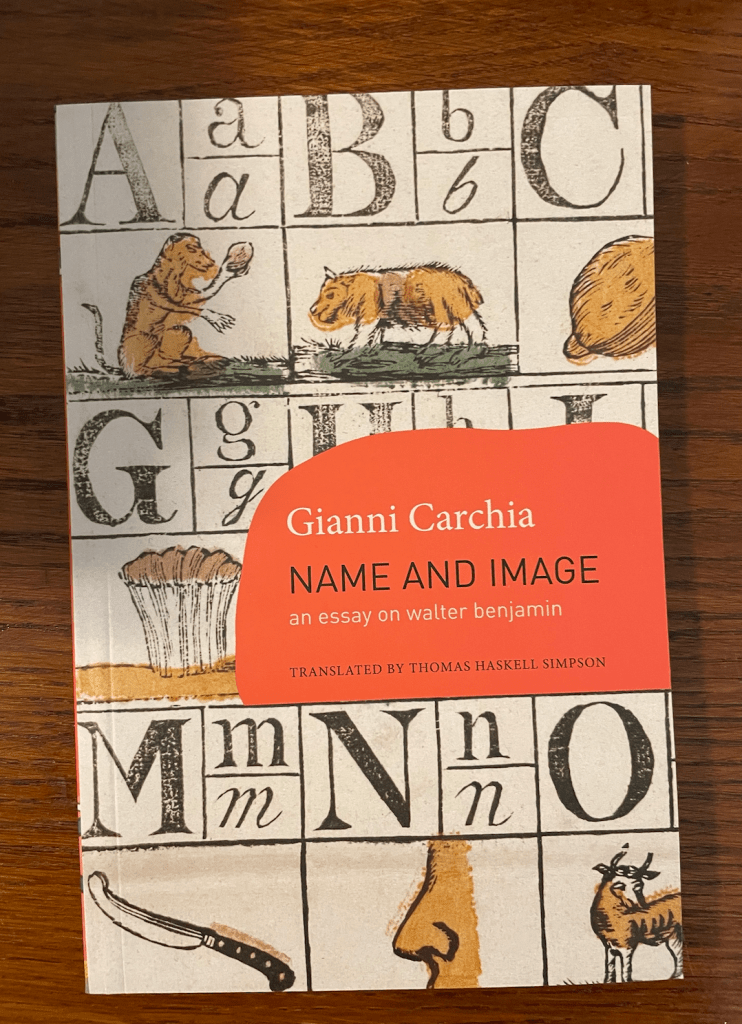
At long last readers in the English speaking world will be able to read Gianni Carchia’s work in translation thanks to the publication of Name and image: an essay on Walter Benjamin (Seagull Books, 2025), which was the Italian philosopher very last book published posthumously in 2008. This is not a work of late style as such, since these four essays on Walter Benjamin serve as an oblique and angular entry point to the thinking form of Carchia’s own philosophical concerns on sensibility, the survival of the myth through aesthetic mediation, and the post-kantian elaboration of the appearance as the condition for experiencing the world. This is a project without systematic architecture that dates back to his first books of the late seventies such as Orfismo e tragedia (1979) and Estetica ed erotica (1981), both published in the Milanese publisher Celuc Libri. It must be noted that although this is a marvelous introduction to Carchia’s philosophical idiosyncrasies and recurring themes, it is perhaps not the best introduction to Walter Benjamin, who in these four essays is read against the grain of dominant hermeneutical frameworks; that is, beyond Frankfurt Critical Theory and dialectics of the image, and on the other hand, the theologico-political concerned with messianic temporality as a transformative philosophy of history.
It does not mean that Carchia is oblivious to these constitutive elements in the corpus of the German thinker; but it does mean that the profile constructed is one that favors a critical project that has disinhibited affinity with the Platonist project of beauty as condition of the critical endeavor committed to truth. For Carchia it is at this vortex where one should locate the “brilliant degree of illumination” that awakens philosophy from its slumber, overturning the texture of thinking to an erotics of the lost detail and the enduring fragment. Citing the correspondences to Florens Rang and The Origin of the German Tragic Drama, we know that for Benjamin “without at least an intuitive grasp of the life of the detail in the structure all love of beauty is no more than empty daydreaming” (Carchia 33). The task of the critic is one capable of arresting the inexpressible, only because beauty lives in the world as a state of silence and expressed revelation (Carchia 38). And it must be said that platonism in Carchia never manages to crystallize into a doctrine of being, pivoting to persuasion as the route to an idea without form.
Carchia shows that for Benjamin the reinvention of the critical method cannot aspire to the totalization of origins and principles – or even that of the status of the visible (Schau), as he brought to bear in his comment to Max Kommerell’s Der Dichter als Führer in der deutschen Klassik (1928) – underpinning the emergence of the idea where the seeds of truth germinate to unfold the interstices of historical sedimentation (Carchia 62). Unapologetically, Carchia suggests that Benjamin’s critical method, if there is such a thing, must be read as a “philosophy of the infinitesimal aim to shatter the prejudice that attributes to totality predominance over phenomena…at the price of their insignificance” (Carchia 61-62). In turn, this means that “the smallest cell of visualized reality outweighs the rest of the world” (Carchia 63). The infinite cuts through the world as a remnant that must be redeemed precisely because of its incongruence in the face of the triumph of immanence and the distribution of forms. And this is yet another sign that Carchia’s Benjamin must read as a thinker of a platonism of the immanence that by folding forms it is able to escape modernity’s temporalization of the sensible reality and its lethargic material objectivity [1]. This hits a hight note about Benjamin’s philosophical thought as anointed in the ancient currents of Stocism, since as Pohlenz taught us, the material forms of this world are the hurdles that neutralize the inception of the divine in a reality governed by the necessity of kakia.
Hence the confrontation with language occupies the center of every critico-historical reflection, which means how to live the immemorial language that is neither an instrument nor the “medium of prophecy or domination” (Carchia 85). Carchia reminds us that for Benjamin Karl Kraus’ language is platonische sprachliebe, or platonic love of language, which means a voice that overcomes the separations of signification and symbol, object and subject, and the consolidation of exchange through the voice of gratitude and use: “thanking and dedication – for to thank is to put feelings under a name” (Carchia 85). The word as apophantic revelation places judgement under erasure, enacting not a return to Edenic pristine nature of divinization or virtuality that attests to the figure and repetition of appearances and the medium of the “spiritual verbalization that animates reality” (Carchia 92). The abdication of an original language survives as the mythic memory of a voice porously open to translation: “All higher language is a translation of lower one, until the ultimate clarity the word of God unfolds, which is the unity of this movement made up of language” (Carchia 92). If for Benjamin the problem of translation is coterminous with that of the mystery of language, it is because it reveals the fragments of a vessel that removes the ground of rhetoric through “variation and discontinuity” (Carchia 96).
In fact, reading Carchia one can infer that rhetoric is to language what the destiny is to human existence in its becoming. Thus, the destitution of language, its internal rhetorical and objective liquidation, appeals to the possibility of the event of happiness and bliss that is the only well illuminated path for redemption, that is, for the flourishing of the “nexus of truth and beauty” of the liberty of the soul. We are painfully aware that modernity is many contradictory elements at once, but Carchia tells us following Simmel, it is ultimately the historical project of Entseelung or loss of soul of the world, and thus “the faculty of memory as particular gift of the soul” (Carchia 121). The historical time of progress, its formal assumption and increasing autonomization, means a ritual situation that “seizes control in exteriority – as as continuum of temporal unfolding – of that entertainment, flashing, discontinuous awareness of the irrevocability of the past held firm by the image-memory” (Carchia 121). Hence, the exercise of thought and memory through the redemption of appearance is the necessary struggle against the usurpation of caducity, and thus the only promise of salvation through the dead, the defeated, and the forgotten. There are clear echoes of Hölderlin’s “Andenken” here that Carchia formulates as the necessity of memory in the repeated dispensation for the clearing of appearance. As he writes in one of the most formidable moments of the book when discussing the self-offering of the memory that guards the catacombs of the dead:
“…for Benjamin, aesthetic temporality, as temporality of the soul absorbed in the contemplation of the nexus of truth and beauty, is the very origin of temporality’s self-offering, of temporality tour court as the space of memory. The salvation of appearance and the dimension of memory are all one: here is rooted the connection between temporality and the aesthetic dimension. The appearance constitutive of the space of redemption, and the beauty whose sacrifice would sacrifice the space of truth itself, are nothing other than memory continuously rescuing them from the space of historical time. It is precisely this connection, between the sphere of appearance as the sphere of the irremediable caducity, and the counter-movement of memory in the involuntary image, that forms the nexus that some of the most subtle passages struggle to delineate as the world of the soul, or rather the world of the past” (Carchia 120).
Thinking the fragment becomes indistinguishable from retaining the sensible participation of the soul. It is this arresting breath (Hauch) of the soul that clears a path on which appearance is saved from the crushing weight of historical self-sufficiency. This confirms, if anything, that Benjamin’s sensibility for Carchia does not end in the confines of postromantic critique, nor in the utopia of totality and abstraction imposed by the metaphysics realized in money form over the living and the dead. As Carchia asserts: “utopia is the end of the constructive and generative ideal of knowledge” at the base of human anthropology and material conditions of social existence, but a whole “redirection underpinning what we have called thinking the informal” (Carchia 127, 135).
What does it mean to think the informal, and what accounts a thought of the informal where Carchia posits Benjamin’s most enduring and clandestine signature? Avoiding all false exists in neopaganism of worldly immanence, Carchia connects the formless dispensation of thought with a nirvana state of para-rūpa (a hypostasis of God that does not presuppose a form, but that it is transformational), the instance of imagination without an image and place that speaks of a chôra as the last refuge of the living. A refuge that, like the platonic cave, does not entail the accumulation or wealth of signification, but that retreats from the perils of insignificance and unhappy consciousness of nihilism. This is one way to understand what Benjamin writes in one of the glosses in “Short Shadows”: “…an image that has already crossed the threshold of the image and property, and knows only the power of the name, from which the lover lives, transforms, ages…and imageless, is refuge of all images”. An existence devoid of a central and authorized image can only prepare for the idea of justice that, because it is experienced it can retreat from the aleatory predication of the world. This enacts a descent into “an anarchy of being in this side of form”, as Carchia would beautifully call it towards the end of book; an inward saturation that is also a reservoir of sensibility because it is able to take a breath. And because it is breathing, it can assent to the external penumbra that restores the appearance of every thinking being in its very image and name.
.
.
Notes
1. On the platonic immanence and the soul, the central reference is Gianni Carchia’s essay “Platonismo dell’immanenza: Fenomenologia e storia in Hans Blumenberg”, Hans Blumenberg: Mito, Metafora, Modernità (il Mulino, 1999), 215-26.
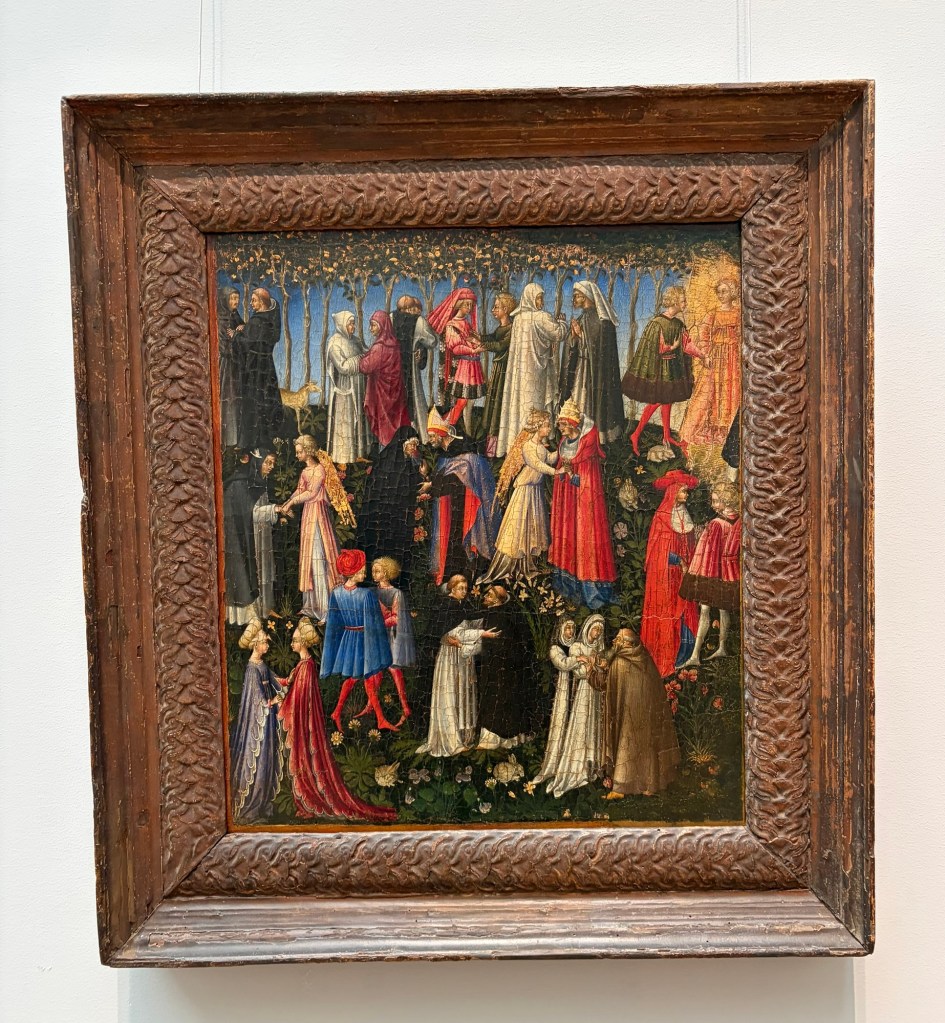
Giovanni di Paolo’s “Paradise” (1445) is a small scene once featured as a predella of an altarpiece from Siena’s San Dominica cathedral. Albeit its miniature proportions it is a striking image of Paradise that puts us in front of a choreography of encounters of the dead, as if the heaven was not a superior and separate stage of life in the cycle of salvation, but rather a continuous stretched territory that takes off where “this life” had left. In its rather simple and rhythmic composition, surrounded by citrus and vegetation, Di Paolo offers the viewer a state of paradise that is not about absolute bliss or bathed in irresistible enchantments, but rather something that in poverty reveals itself in proximity, literally face to face, with an other, perhaps a friend or lover. If we zigzag across the figures it is almost as if the picture would confirm Roberto Antelme’s intuition that “the only transcendence is the relation between beings”. And nothing else is the painterly texture of paradise beyond life. In this way, one can define the earthly paradise as a space where transcendence is dispensed because it primarily welcomes and senses otherness.
One of the striking details of the picture is precisely the positioning of the hands of each couple. Just take a second to gaze around them. These are hands that gesture towards a supreme affection; it is the hand that reciprocates and welcomes. It has been noted – for instance, in Berenson’s A Sienese Painter of the Franciscan Legend (1910), that Sienese painting of the fifteenth century introduced a new pictorial attention that manifested the coming to life of the spiritual. In Giovanni di Paolo’s Paradise the flickering hands, moving around the bodies, are perhaps signifying the initial touch of renewal between heaven and earth. In fact, it is almost as if the sliding of hands was the vehicle for the nongranular transition into the arrival of heaven. In a way of synthesis, one could say that paradise is always at the distance of the hand; which is why painting and happiness remain in an intimate dialogue regardless of themes or historical epochs.
And one can ponder whether the absence of paradise from imagination in the wake of the absolute intrusion of hell in reality, is not precisely a world where the incommensurability between hand, nature, and language become indistinguishable; the transparency of sameness in an expansive totality well beyond reach. To be in nearness is not just an ethical transcendence between beings, but ultimately allowing a divine region to flourish for possible encounters. This is why Angelus Silesius says that “nothing exists except you and I, without both of us then god would not be god, and the heavens will cease to exist” [1]. Paradise is, as Di Paolo’s painting reveals, not the utopia to come in another time, but the inconceivable place never fully detached from the experiences in this earth. As Karl Barth once wrote: “As the place of God in heaven is, of course, a place which is inconceivable to us. It cannot be compared with any other real or imaginary place. It is inaccessible. It cannot be explored or described or even indicated. All that can be affirmed concerning it is that it is a created place like earth itself and the accessible reality of earth which we can explore and describe or at least indicate; and that it is the place of God” [2].
This inconceivable place of God is the apocatastasis of what sorrounds us, of what has touched us, and of what we have touched; and this includes above all, the nexus of the living and the dead in a strenuous thought that gathers itself in what has loved. This space outlives the world of the living in order to express the divine that is, precisely, the unmediated appearance of each encounter. This means that painting paradise does not commission what a new life should look like as a way to overcome a previous existence of deficiencies and missed opportunities inscribed in felix culpa; what is recollected, and thus the only true apocatastasis, is a path to presence that knows neither end nor name that is self-contained in the ur-space of depiction.
.
.
Notes
1. Angelus Silesius. El peregrino querúbico (Ediciones Siruela, 2005), 2005.
2. Karl Barth. Church Dogmatics: The Doctrine of Creation, III (T&T Clark, 2010), 149.
In several places of his Lectures of Aesthetics, Hegel refers to Dutch painting as a way to thematize the concept of completion that fulfills being in the world. For a moment his commentary brings to bear a state of the mundane while avoiding the vulgarity of the overachieving surface that would define the general tendency of modern painting. True, Hegel’s indictment of Dutch painting does not negate the modern sensibility either, insofar as the portraits of the Flemish tradition fail to disrupt that is always held incredibly visible in the frame of pictorial representation. The artistic triumph of Dutch painting depends on a specific oscillation between the inner and outer experience of the subject visible range of depiction. This is not an exclusive one-directional movement towards the immanence of life; which Carlo Levi will denounce as the estrangement from the world, but rather a synthesis that gracefully falls on the sensuous activity of painting just at the moment that appearance dispenses in the world.
Thus, the emergence of Dutch painting was only possible in a specific form of life that was resolutely experiential in nature and spiritual rich. As Hegel writes in a first moment in the Lectures: “the Dutch in their taverns, at weddings and dances, at feasting and drinking, everything goes on merrily and jovieall, even if matters come to quarrels and blows; wives and girls join in and a feeling of freedom and gaiety animates one and all…this spiritual cheerfulness in a justified pleasure, constitutes the higher soul of pictures of this kind” [1]. And this spiritual freedom, sublated from the necessities and constraints of external things in the world, validates a concept of the ‘ideal of life’ that is transcendent only to its sense of living. Hegel notes that Protestantism facilitated the Dutch a materiality for this sense of worldly transcendence, of communitarian deificatio, allowing them to have, in his words, “some footing in the prose of life” [2]. So, Dutch painting is predominantly concerned with depth; and this depth is not concerned with the absorption of the spectator, but quite literally, almost in a physical way, enmeshed in the inner tonality of everyday figures. This is their inner being made visibly manifest. The manifested and gathered presence of this inner and outer movement of the infinite is precisely what retains the imperturbable trace of the divine beyond time; indeed; an eternal Sunday of life, as Hegel says in another important moment:
“This painting has developed unsurpassably, on the one hand, through and through living characterization in the greatest truth of which art is capable…For this reason we have before us no vulgar feelings and passions but peasant life and the down-to-earth life. lower classes which is cheerful, roguish, and comic. In this very heedless boisterousness there lies the ideal feature: it is the Sunday of life which equalizes everything and removes all evil; people who are so whole-heartedly cheerful cannot be altogether evil and base”. [3]
It is well known that in the art historical discipline, the moment of Dutch painting has been understood within the framework of the scientific and optical revolution of that century; a new “faith in the eyes”, to follow Francis Bacon’s terms, capable of generating a concrete and rational knowledge of the “common world” of a new, more geometrico, regime of light [4]. But nothing could be further from how Hegel’s synthesis approached the sensibility of Dutch painting; mainly, as fundamentally a site of the overcoming of evil because it was not alien to the comic downfall of human experience. In Dutch painting, Hegel reminds us, it is not that evil or wrongdoing is removed from the factical life; rather, it means that the comic is a nested experience that can grasp and transfigure the miseries or the disasters beyond taxative transactions of the social world and preparing the conditions for a kallipolis.
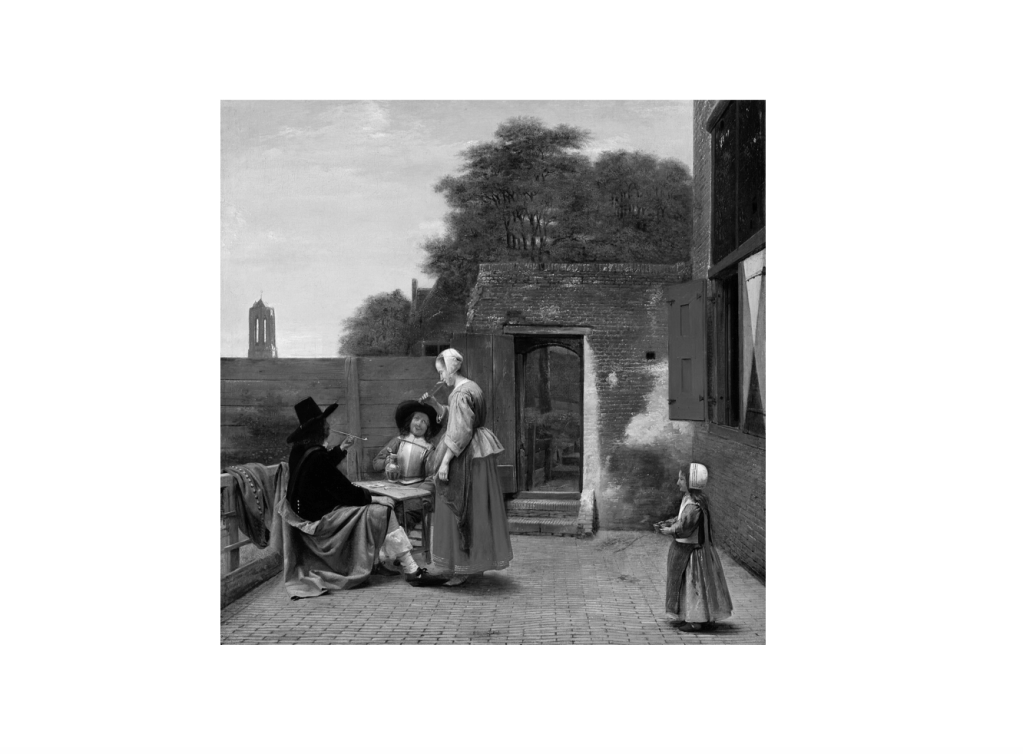
Although it is not clear who are the Dutch painters that Hegel had in mind when writing about a painting that enters into the “Sunday of life”, certainly the pictures of Pieter de Hooch – “A Dutch Courtyard” (1660) comes to mind – where distant and miniscule figures smile at each other in the open encounter of a place. The erasure of evil from painting is achieved not from stating the dogma through which the world could transcend and reverse the fall from nature, that is something like a new “faith in the visible”; it is more the event that accounts for the surrounding as it becomes oblivious to the very artifice of depiction. In this sense, the imperturbable state of Dutch painting is achieved as a life that dwells in the folds of the world as it retreats from the force of anticipation. And, if according to Chrysippus, evil is nothing but losing the capacity of affection or mediation of our inner sensibility; what the Dutch pictorial order brings to bear is that the ‘good’, rather than being a substantive function of the will and contingency, it can only be accessed in a form of life that is indistinct from the inconspicuous and breathable space through which it dwells.
And what is the sensibility of the comic if not what remains ungraspable in each and every in a painterly expression in a world in consonance, a place without remainder? In other words, if there is a painting that has abdicated from evil, it is because its has attuned the soul to an exteriority that is no longer dependent on the weight of the sign. It is still the business of the mute things (Poussin) in order of the beautiful. This is the state the state of grace that Schelling thought the plastic arts could bestow human sensuous experience after the irredeemable apotheosis of nature: “In painting a lovely being that is neither sensuous nor spiritual, but rather ungraspable, diffuses itself over the figure and nestle into all the figures and to each oscillation of the extremities. This being, which as we said, is ungraspable yet perceptible to everyone, is what the Greek language calls kháris and we call grace (Anmut) [5]. And the movement of grace in painting is what initiates the transfiguration of death – the muted voices of the dead – into a divine whose sole task is the disclosure of presence.
.
.
Notes
1. G.W. F. Hegel. Aesthetics. Volume I (Oxford University Press, 1975), 169-170.
2. Ibid., 597-98.
3. G.W. F. Hegel. Aesthetics. Volume II (Oxford University Press, 1975), 886-887.
4. Svetlana Alpers. The Art of Describing: Dutch Art in the Seventeenth Century (University of Chicago Press, 1983), 91.
5. F.W. J. Schelling. “On the relationship of the plastic arts to Nature” (1807), Kabiri : The Official Journal of the North American Schelling Society, 2021, Vol. 3, 146.
How to overcome the consummation of rhetorical force and the privation of language integrated to the transparency of the present? This is a question that weighs heavily on those that remain too attached and mesmerized by a present that ultimately remains unmoved, alien to any epochal breakthrough. Hence, the almost fetichistic fascination of seizing the “new”, even though the price to be paid is always on the side of an overachieving cynicism and hypocrisy mediated by discourses of all kinds. At one moment of his dialogue Eupalinos or the Architect, Paul Valéry claims that whenever deep reflection is pushed by raw force, this unnatural attitude almost always misses truth: “The truth, the discovery of the new is almost always the price of some antinatural attitude. The deep reflection is forced…we must do or suffer violence to see better or differently” [1]. The claim to see clearly beyond the immanent veils of the rhetorical commonplaces is still our question, although rarely posed. If our suspended epoch is that of formless rubble and extinction, one way in which this question could be reformulated today is to ask what does it mean to envision and live in the desert? Is not the desert condition, its suspended and dead temporality that gathers existence in the void, the only authentic event of posthistorical time?
This is the problem that haunts Dino Buzzati’s novel Il deserto dei Tartari, (1940), in which the waiting for an invasion and hoarding armies is conflated to the event of a wait that is infinite and excruciating, very much like the video art of Douglas Gordon at the end of the century. The steppe is a form of deserted land without forestation and depth; it is the very triumph of the symbolization of time stretched into a unified surface that recalls the emptying momentum of every form. It is nothingness as an absolute event, as Buzzati writes: “….the ramparts, the very landscape, breathed an inhospitable sinister air…At this moment Drogo was looking at the northern world – the uninhabited land across which, or so they said, no man had ever come. No enemy had ever out of it; there had been no battles; nothing had ever happened” [2]. How to account, and how to live, beyond mere survival, in a world nothing happens; that is, where the “nothingness” is the very schism between existence and world? When speaking hyperbolically of the Fortress in the steppe where the protagonist Drago is stationed, Buzzati will refer to this mundane condition as a “thankless world”.
It goes without saying that a world beyond “thanking” is a world that is unworldly in its sensible and intelligible mediations, because it no longer appears to grasp the irreductibility of presence; it needs to repress what appears figuratively in its disclosure. This is why in the vast openness of the steppe, in its blinding clearing of legibility, there is only blindness and hallucinations that are always compensatory to the pain endured by the nihilism of a disjointed time. The waiting of the barbarians does not longer hold the concept of prefiguration once held by situated or concrete politics (Turgot’s high-modernist axiom comes to mind: “we always perceive events too late, and politics always needs to foresee, so to speak, the present”); it is rather the impossible, contingent and retroactive narration that fictive communities need to elaborate to endure the ongoing pain at the end of the social bond. This is the price to be paid to survive in the glacial habituation of nihilism.
It might be very well that what can be glimpsed in the temporal wreckage of the steppe is nothing but the mute language of pain that brings presence near without political translation, because it is always an excess to the stabilization of forms. In an interview published in Milan’s Il giorno in 1959, Buzzati referred to the landscape of the steppe as “Nothing better than a fortress at the extreme frontier…it seemed to me, could be found to express precisely this strain of waiting”. But this strain of waiting is the thrownness of existence and its absolute distance from the world. In fact, towards the end of the novel we read a condensation of this inconspicuous tonality: “It was at this period that Drogo realised how far apart men are from their affection for reach, that if you suffer the pain is yours and yours alone, no one else can take upon himself the least part of it; that if you suffer it does not mean that others feel pain even though their love is great: hence, the loneliness of life” [3].
What remains is language not because it can describe or narrate, but because only the voice can measure up to the tonality of pain. In his short prologue on the Spanish edition of the novel, Borges claimed that Buzzati’s desert is both real and symbolic of the void, although the symbol no longer transmits any legible sense of totality; it prefigures a certain exhaustion of symbolization. The truth of language in the absence of form can no longer adequate itself to events or situations; it is now the voice that gathers the turbulence of pain in the waiting of the coming of presence already inhabited. Whenever that voice fails to speak, as René Daumal observed in his unfinished Mount Analogue (1952), life amounts to an empty carcass and a restless cadaver of oblivion. As presence fails to materialize in the world of forms and events, the only realist position is the conjuration of life as a form of expressive self-exile refusing to participate in the hallucinatory social pressure that desperately masks the serenity of a static and inapparent landscape – it is the passive eye that contemplates the plain silence of the steppe while preparing the schism for a possible transfiguration [5]. It is perhaps this passive contemplation what Andrew Wyeth’s faceless Christina laying on the grass has always been yearning for.
.
.
Notes
1. Paul Valéry. “Eupalinos or The Architect”, in Dialogues (Princeton University Press, 1989), 75.
2. Dino Buzzati. The Tartar Steppe (Canongate Books, 2018). 31.
3. Ibid., 220-221.
4. Jorge Luis Borges. “El desierto de los tártaros”, in Biblioteca Personal: Prólogos (Alianza Editorial, 1988), 22.
Lo que sigue a continuación es una síntesis escrita de mi réplica en la presentación de La fisura posthegemónica (Doblea Editores, 2025), en la que intervinieron Mauricio Amar, Ángel Octavio Álvarez, Miguel Ángel Hermosilla, y Lieta Vivaldi el 3 de octubre en Ñuñoa, Santiago de Chile. Esos comentarios aparecerán en el próximo número de la revista Escrituras Americanas.
Agradezco enormemente las intervenciones de mis amigos Ángel, Miguel Ángel, Lieta, Mauricio, porque en última instancia un libro no es nada sin la posibilidad de ser encarado y llevado fuera de sus límites. Mauricio Amar preguntaba por la apuesta general del libro, y quizás pueda decir algo sobre esto. Este libro se inspira en lo que me gustaría llamar la escritura del adiós o del farewell. Siempre me ha llamado la atención que, al comienzo de este siglo, dos pensadores que admiro profundamente escribieron por separado dos libros de farewell: me refiero a Farewell to an Idea (Yale U Press, 1999) de T.J. Clark, y The Exhaustion of Difference (Duke U Press, 2000) de Alberto Moreiras. Respectivamente, adiós al modernismo pictórico, y a la suma metareflexiva sobre América Latina. Al menos para mi La fisura es una forma de decirle adiós a cierta reflexión política contemporánea. Y decir adiós supone atravesar el problema; por eso mismo, el hilo del libro es un problema de hegemonía que ha dominado el horizonte reflexivo y práctico del pensamiento teórico.
Ya aludimos al colapso de las formas de mediación, y se nos suele olvidar que forma es política, y la política es sólo posible mediante una forma. Si queremos pensar contra la dominación, a espaldas del vector retórico de la hegemonía, debemos tomar muy en serio cómo la forma hoy solo cumple la tarea de la dominación sobre la existencia y la palabra. La insistencia compulsiva que las formas ofrecen desembocan en su cierre letal (en la jerga de Alex Karp) sobre cada uno de nosotros. Ángel Octavio veía que el problema se nos presentaba como salida a otra parte. ¿Pero, qué salida?
Toda salida remite a una trascendencia menor: podemos salir al cielo como interioridad espiritualizada; o bien, podemos salir a un espacio demónico nocturno, un hacer noche, como versa el título del nuevo libro de Constanza Michelson. No deja de ser un síntoma de época que algunos hoy insistan en el vector de la espiritualización como vuelta a la tierra, aunque ésta sea el desierto en free fall que produce el declive (stagnation). El último Tronti, con el que tuve la suerte de intercambiar, lo recogía: el único combate hoy pasa por la interioridad (xeniteia). Pero el problema aquí es que el mundo no coincide con la Tierra. Y lo que interesa, entonces, ese justamente esa no-coincidencia, esa fisura, con respecto al mundo del viviente que hoy aparece como búsqueda de región. Y la región está en su acontecer fuera del mundo más que en el fuero interno.
O podríamos decir que está en la apertura del paisaje. No hay salida a un lugar sometido a la viabilidad ecológica. O no puede terminar ahí. Al final de cuentas, como vio un pensador en su momento, la revolución industrial fue la segunda revolución, puesto que la primera había sido la relativa a la agricultura entendida como asentamiento en el terreno. En apertura entronizamos con el cielo; o, en la bellísima definición de Kurt Badt comentando la obra pictórica de Constable: “el cielo es el órgano de los sentimientos”. El cielo aquí no es el espejo mítico que habilita la autoafirmación que conduce al humanismo catastrófico; más bien, es el punto de fuga que no se dirime en las particiones del suelo. Es curioso que la dominación en curso ya está operando como el diseño geoespacial del cielo. Esto es lo que comparte la figura del palantir de la Inteligencia, así como la Tianxia, doctrina “Todo bajo el Cielo” del emergente imperio chino. En apertura mantenemos las intermediaciones entre cielo y suelo en el fin de nuestro tiempo.