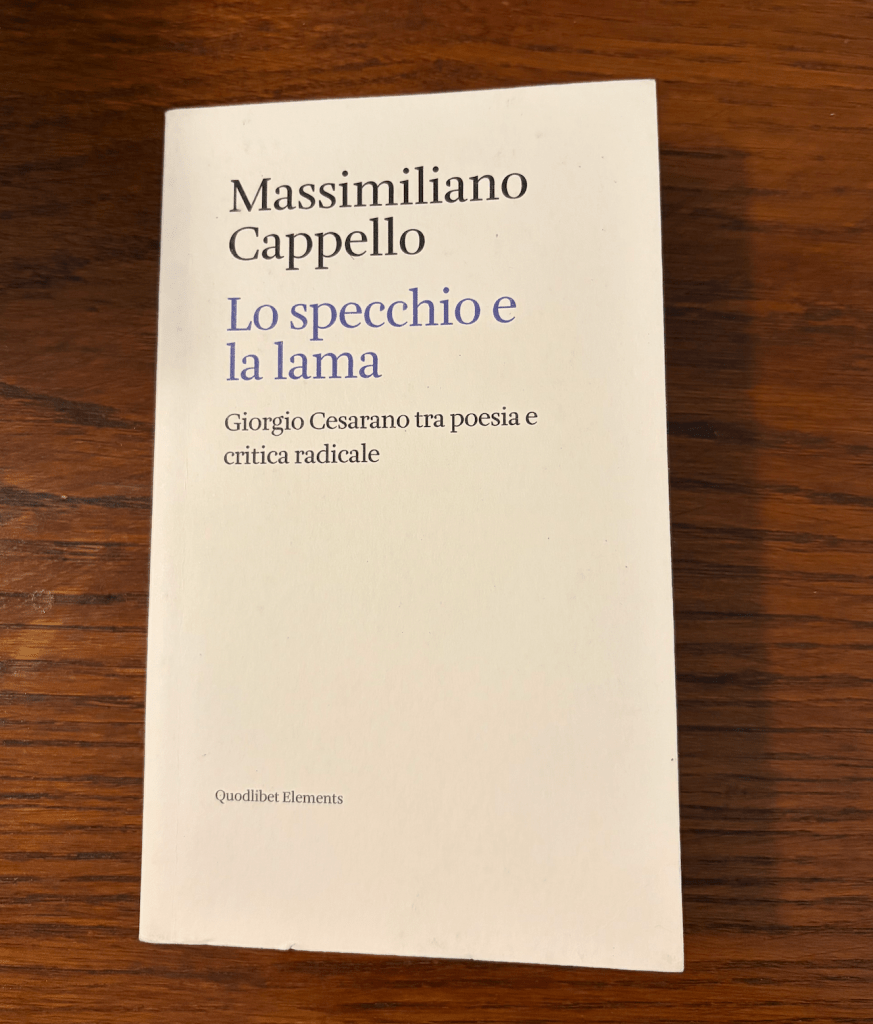
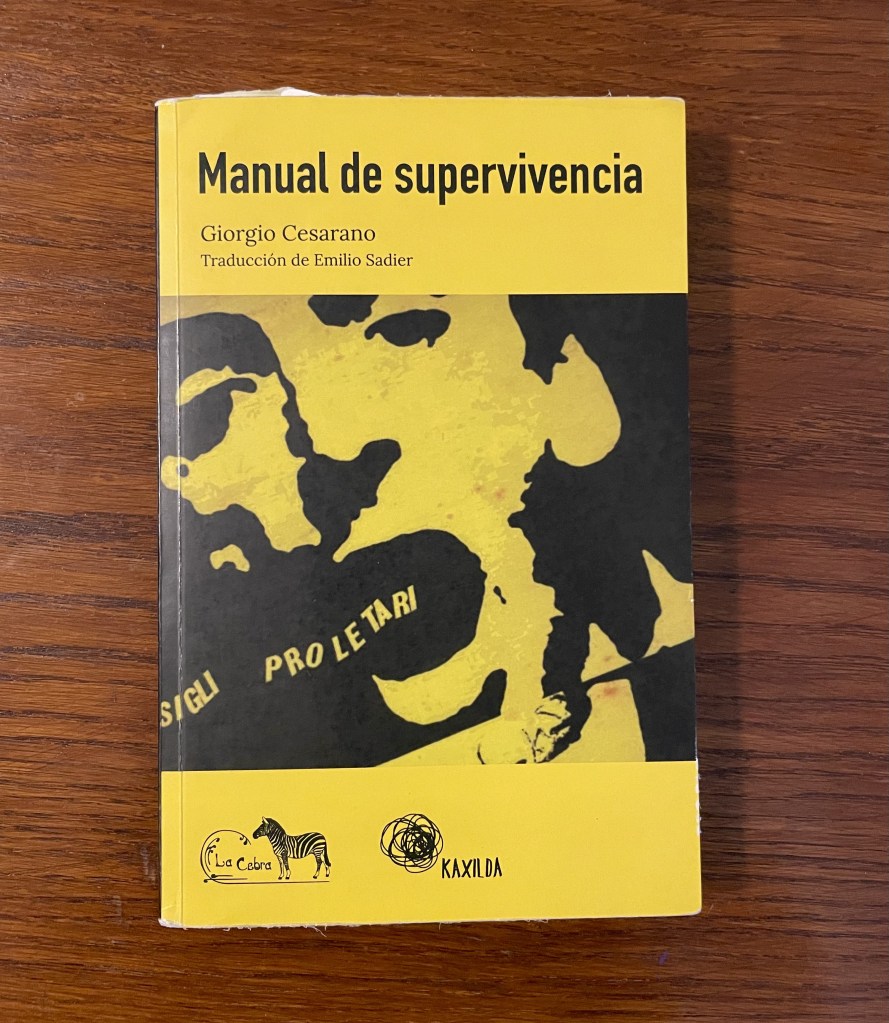
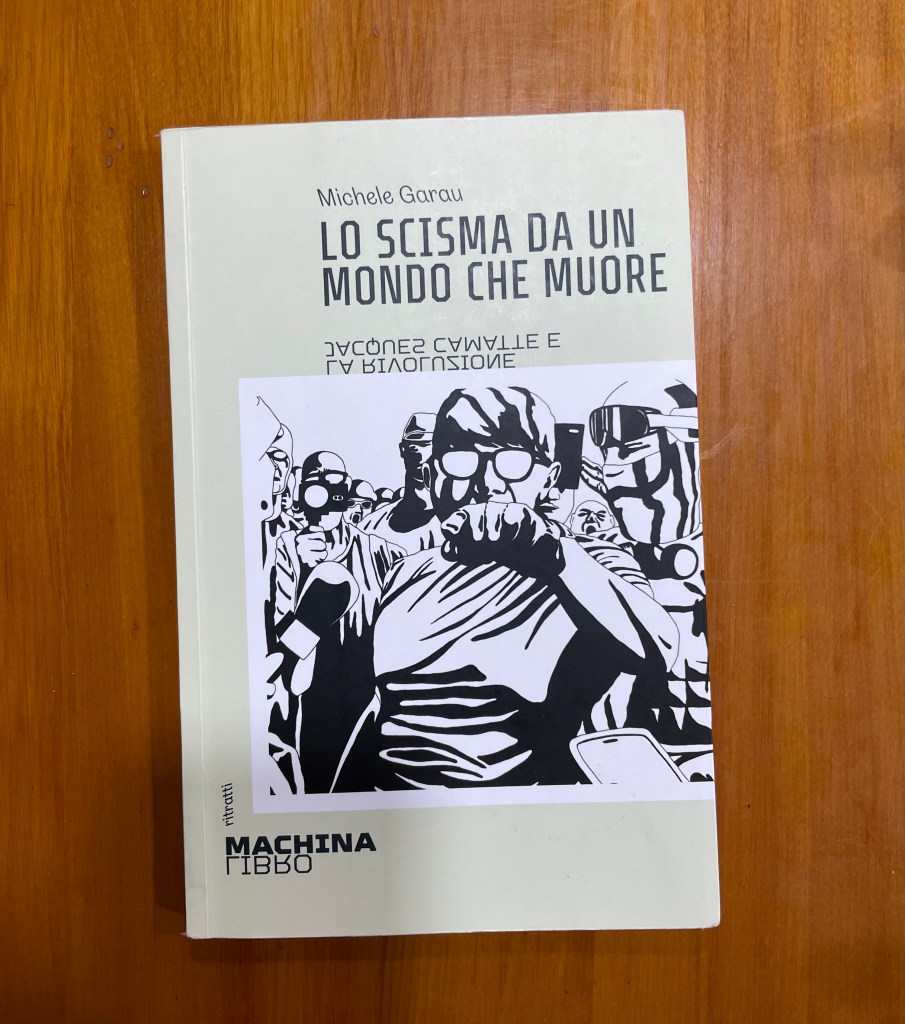
Roughly extending a little over fifteen years (2000-2016), the epistolary exchange between Jacques Guigou and Jacques Camatte is made available in a short book entitled Capital et Devenir Humain: Correspondance avec Jacques Camatte (L’Harmattan, 2026). Truth to be told it is an uneven correspondence at times, where the sustained conversation in time seems to be interrupted around some specific years, and in other moments there is an abundance of certain editorial requests (the publication and translation of books by Giorgio Cesarano primarily) that interfere from a more thorough substantive correspondence. Be as it might, this correspondence does bring to bear the reflexive consistence of the thinker behind Invariance in his last phase of his work, most specifically in the wake of September 11 and the invasion of Iraq, which was already read by Camatte as symptomatic of the internal hostility of the human specifies embedded in the stasis of struggle as the central “engine of development of capital” (Guigou 20).
Both autonomous capital and its regimes of representation (Politics) will only be sustained and driven by internal strife whose apocalyptic destiny has now become all too apparent; even more so than during the years when the Camatte & Guigou exchange was taking place. These historical mediations, however, are a bit of a misnomer, since the correspondence does show that Camatte’s undertaking of Hegel’s cunning of capital as the realization of the effective movement of historical accumulation was already part of the theoretical discoveries of the seventies in Invariance. The “effective end of Capital” seen through the mirror of Hegelianism meant that political reaction and its negation turned the essence of politics reactionary at its core. Later in the correspondence, in fact, we get a glimpse of the essence of “reactionary thinking” when Camatte tells his interlocutor that reaction can be understood as the continuation of a dynamic duality that is expressed in the very movement of autonomous Capital (Guigou 65-66). This is why Camatte’s horizon of reflection differed from the Debord’s situationism; it is not just because of a disbelief in the presumption of a remnant of the autonomy of art in their practices, but rather because their very dyad between art and life, public and private, contingency and necessity, language and the image expressed in many ways the insufficiency of an analytic expressed in the mystification of the commodity form. In other words, all reactionary posture amounts to a relational mode of the commodity form, but no commodity stripping and destruction can guide through a path that can exit the total transcendence of Capital towards life of the Gemeinwesen. We are left with refractory communities of belonging that find their necessary compensation in supplementary forms that allow for a distance to the fundamental question of exodus.
Out of the many sequences of the correspondence the one dealing with the incapacities of poetry is of special interest. In one letter Camatte tells Guigou that he feels that poetry no longer is able to filter a moving tonality in the world, recalling how the end of the age of the poets (not a term expressly deployed by Camatte) has been understood by Amadeo Bordiga in a short text of 1953 that noted that the ancient power could sing in a voice of the community, whereas the modern poet in his solitude only amounts to the author of his work (Guigou 24). The correspondence exemplifies this by recalling Bruce Chatwin’s Songlines, where the poetic is not personal lyricism, but rather a tone that runs through the whole dispensation of the community in its errancy (Guigou 30). And one wonders immediately after reading this moment in the letter, where the very work of late Camatte is not disinhibited of the poetic tonality; or, on the contrary, this poetic tonality insofar as it is a pure voice can only remain opaque and absence from the scene of writing and public reflection. The challenge in this question is to be able to balance the problem beyond judgement, which always hides a form of pathetic condemnation.
In these pages concerning poetry and the philosophical aspiration of the poem, other names are invited into the scene: Giorgio Cesarano, Domenico Ferla, and Andrea Zanzotto. These are three figures where the challenge of poetry was taken only to be radically abandoned (perhaps less so in Zanzotto where the trace of the voice is already embedded in the poetic form, and thus there was not a need to execute the radical gesture of fleeing from poetry). Although one is also surprised that the question of poetry is not extended as a problem of thought and existence, which would allow for the collapse of the very separation of poetic form and the life of the community, perhaps because the voice that is carried in poetry is more originary dwelling of human existence than the human community, because ultimately the human community (Gemeinwesen) is refractory of an irremediable loss that is recasted as original. And Gianni Carchia saw in his “Glossa sull’umanismo” (1977), Camatte’s insistence on the original community and its negation through the anthropomorphosis of Capitalist revolution will necessarily result in an inverted or transfigured humanism; or, at least, a humanism that is always longing for the image of an originary community that can only be posited with an assertive knowledge that we do not know possess except as contaminated subjectivity. But perhaps the solicitation of originary community will always fail because it will be a displacement from abyss of non-belonging that we already inhabit – what Carchia called in the same text as “uscir fuori” – into the site of proper belonging of the human species fails to account for the impropriety that always marks the experience of errancy of life. As Endnotes has noted in their recent essay “Time is an invention of men incapable of love”, Camatte was aware of the Jewish form of life as a concrete experience “seeking a solution outside this world”. But this means that it is not enough to counterpose the community and state form (Jewish form of life precisely is not exhausted in community belonging, or in the memory of a community), but something other than the closure of the community if one wants to go beyond the eternal metabolic stasis of human belonging. Ultimately, as Camatte tells Guigou at the end of the correspondence, only Capital claims immortality in its universalist extension (Guigou 68).
Perhaps this is a task that requires another modality of thought, perhaps a non-philosophical practice beyond community and humanity, but suspicious of the claims to immortality of the capitalist revolution. In a letter from 2016, Camatte citing François Julien, confronts philosophical thinking with a notion of wisdom that retracts from hostility and agonistic dispute, because it retreats into serenity of a peaceful sage (Guigou 65). I take this to mean something akin to Kojeve’s ‘voyou désœuvré’, the sage that in the Sunday of history harbors a passion of life where happiness is received not as a consequence of actions, but as a supreme grace of the unexpected. It does seem that this was also Camatte’s longing in life that although wanting to abandon this world, refused to abandon the interlocution with others; touching as if it were, an unbreachable state of wisdom.