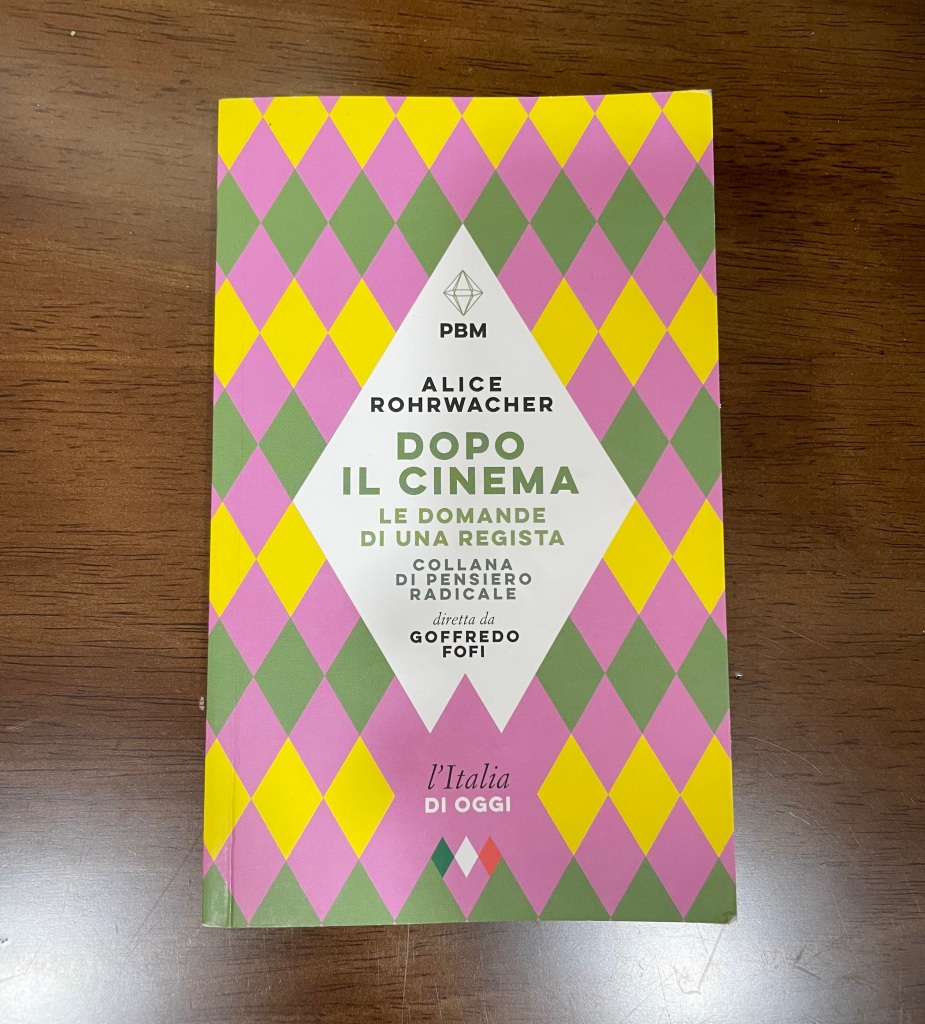
In the the long conversation Dopo il cinema: le domande di una regista (Edizioni e/o, 2023) conducted by Goffredo Fofi, the contemporary Italian filmmaker Alice Rohrwacher offers a series of reflections about the possibilities of artistic creation in the abysmal time of integrated spectacle that has fully brought to bear the erosion of the human capacity for attention and outward experience. Can cinema and film do anything in the wake of such humiliating and crushing reality? At first glance the late modernist critique of the value-driven image seems insufficient and merely rhetorical as the valence of dialectics has been dissolved in the pressure of real subsumption. In a certain sense, Dopo il cinema: le domande di una regista (2023) is a reflection written after the ambivalent commitment of cinema to awaken the spectator from the slumber of the absorption in order regime of standardization where the utopia of self-design realizes the objective abstraction in the acceleration of optimized and contained expressiveness. At no moment does Rohrwacher affirm that we are, indeed, “after cinema”, but throughout the dialogue the tone is that of immediacy in an epoch that seems to be saturated by looping, real-time, and the intensification of life-exposure spectacle. If film is reduced to telling stories, then it falls into vulgarity, while contributing to the gigantic sedative layout that veils the annihilation of social reproduction. In the last decade, Alice Rohrwacher has done a series of important and highly original films (Le meraviglie, Lazzaro felice, or La chimera) that signal a way out from the numbness of sight, relocating the moving image to the mythic dialogue with the invisible, the mysterious, and the old craft of the fable narrative. Rohrwacher’s cinema is only magical to the extent that it subtract itself from the historical overindulgence that the autonomous historical man had to endure in its separation from nature.
Filmmaking is no privilege site of creation, but if Ruíz was right, there are plenty of chamanic energies circumventing the cinematic experience. This is a prehistoric residue that, in her own style, Rohrwacher wants to hold on to. In Dopo il cinema (2023), she admits that any attempt to organize a new “political” cinema is out of question, as it was always grounded in the idealism of ‘consciousness’, which is now realized in the self-narcissistic exposition of the free-floating subject of market equivalence. Political cinema could only be arrogant and superfluous pedagogy at the mercy of the furious chatter of “cultural wars”. Is there a higher poverty? And yet this is what appears as ‘necessary ideological critique’ in some circles. In this sense, cinema is not the leading instrument for the work of imagination and Rohrwacher insistence on ‘creation’ drives the point home. Citing Elsa Morante (and perhaps implicitly Cristina Campo) Rohwacher defends the creation as an ongoing effort of a common intelligence to grasp the invisible and allow the eruption of joy in the life of characters. Similar to Robert Bresson who wanted the characters of his films to have an outlook as if they were castaways from the time of the first Adam in the earthly paradise; for Rohrwacher the thicket of creativity for our times is rooted in a contemplative gaze through which the external elements of the world can hone the one and true destiny of the irreducibility of the human species [1]. Rohrwacher’s assertion that she wants creation to establish proximity with the outside – devoid of attachment to religion, political parties, or moral principles – presupposes a sound critique of all forms of idolatry that have modeled aesthetic production at the service of abstract historical needs (Rohrwacher 33).
As a creator Alice Rohrwacher’s own point departure is thoroughly subtractive. This means leaving behind the subject of consciousness (the internal and self-sufficient producer of images, which today appears with the empty label of content creator), while opening the cinematic possibilities to the luminosity of a collective imagination in which the contemplation touches, albeit for a moment, the thought of the world (‘pensieri del mundo’) (Rohwacher 36). Obviously, this is no longer an artifice of cinema in its industrial and technological capacities; rather, it is the impersonal general intellect that refuses the integral planning that forecloses the wayward route of imagination, discovery, happiness, and the uncharted land in which the characters and spectators are taken by the seduction of the possibility of events (Rohrwacher 39). Whenever film, like a fairy tale, touches the truth of a not-yet administered world (an inapprehensible excess that resembles prophecy), then visual pedagogy ceases to be a task of cinema; rather, the process of film is one of “ex-ducere, cioè portare fuori, educare” (Rohrwacher 52). And as Cristina Campo understood well, the fairy tale (analogous to cinema for Rohrwacher) has at the center of its making the “raw material of existence…this material is the mystery of character…which maintains its traits to the end, and only be transformed by repeating the same errors, suffering the same defeats. The nature of this mystery is sometimes suggested with enchanting ambiguity” [2]. It is this ambiguity what expresses the caesura between existence and world – their strange noncoincidence – that has colored the experiential texture of Rohrwacher’s poetical cinema.
The central characters of Rohrwahcer’s films (Lazzaro felice, La chimera) are symbolic personifications of forms of life that are neither alive nor dead; neither mythic nor mundane; neither fictional nor historical determined (each of her films are also landscapes of specific territorial Italian communes); there are both things at once, and they maintain their musical tonality in their own symbolic protuberance, precisely because they cannot be divided and forced into the civilizational narrative at the expense of the exhaustion of the mystery of form (Rohrwacher 63). In fact, Rohrwacher, so attuned to Joseph Roth’s indictment of the Hollywood’s hollow gestalt announced in the The Antichrist (1933), reminds us that the word “devil” (diaballo) implies cut and division; whereas, the symbol, cultivates and renews the mysterious enchanted dimension of the world in which no reified image (any image that could be potentially any other) can hold the human species as hostage in the cacophonous prison of senselessness. And is not this radical evil – an assumed and distributed morality of the active consumer, who always works “for his own interest” – the most basic unit of the transmission of the image-spectacle from which one has to flee from? The mythic or fairy-tale-like leveling in Rohrwacher is no metaphoric transport; it becomes the cinematic potential to see the world with a clear third eye.
No easy task of course. Deposing the fictitious machine entails exerting a movement of exodus towards the outside, which Rohrwacher assuredly calls the invisible as that which restitutes the soul of things. The symbol is a passage against the seduction of the pleasure principle of self-enjoyment and parodic personal heroisms. And this is perhaps the most powerful and original testament of Rohrwacher aesthetic sensibility in Dopo il cinema (2023): “Ma nel memento in qui quella cose emanano – direi irradiano – un’anima, subito ne abbiamo più cura, e la cura come abbiamo detto è un atto eversivo. Un’azione poetica” (Rohrwacher 64). And poetry remains not only the dwelling place of human beings; but, fundamentally, the lacuna in a world that refuses to come to completion. Perhaps ‘cinema’ – or, rather, ‘cinema after cinema’ – in Rohrwacher’s view only emerges as a gnostic symbol that prepares the birth of a new earth, as if planting a seed for seasonal germination (Rohrwacher 64). In each character, image, symbol, and gesture, Rohrwacher’s filmmaking plunders into the position of redemption against the cruel reduction of the objective madhouse: restituting the soul in things dignifies the inheritance of terrestrial human species as if it is always coming into presence for the very first time. The eros of cinema becoming an enduring task — and is not ultimately what we feel in each of Rohrwacher’s films? The joyous spirit of the saltimbanca: in and outside the world’s reality, the symbol lives and outlives the fixation of this world.
.
.
Notes
1. Robert Bresson. Bresson on Bresson: Interviews 1943-1983 (nyrb, 2013), 277.
2. Cristina Campo. “On Fairy Tales”, in The Unforgivable (nyrb, 2024), 33.

 Infrapolitical Reflections