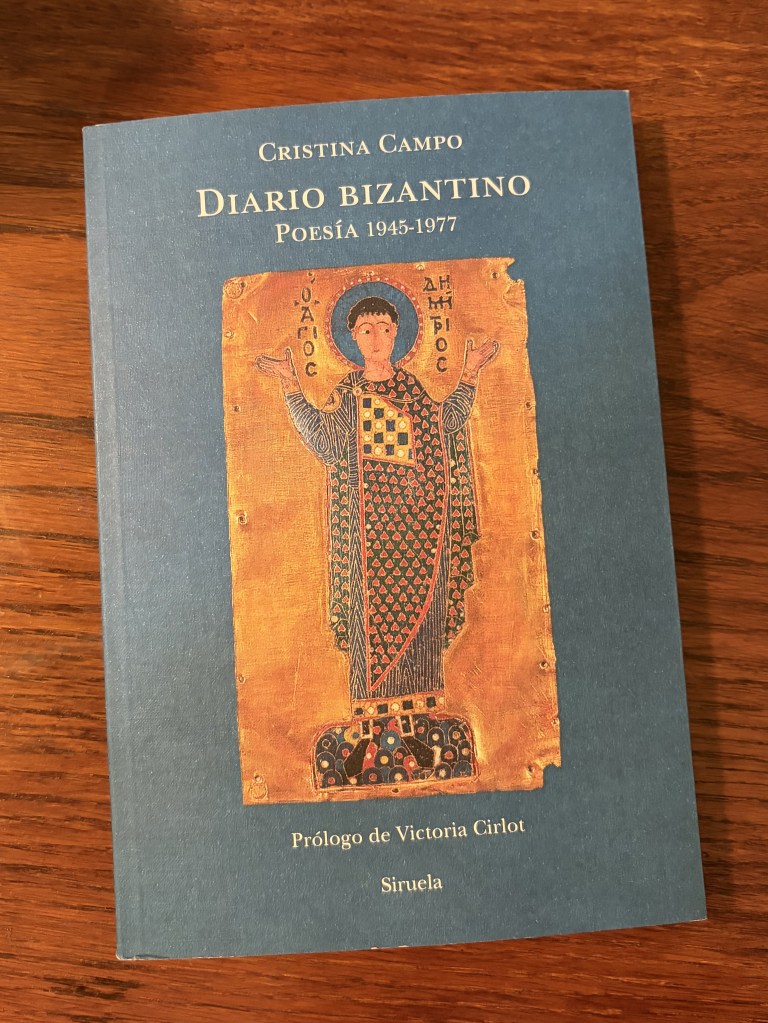
Cristina Campo was a modern mystic who gravitated towards the liturgy of the poetic word. Now thanks to the scholarship of Victoria Cirlot, the Spanish reader is able to read her complete poetry in the bilingual edition Diario Bizantino: Poesía (1945-1977) (Siruela, 2026), which serves the missing companion to the essays collected in Los imperdonables (Siruela 2020). It is difficult not only to differentiate modern genres in Campo’s writing scene, given that both essays and poems (and also her letters, published in multiple volumes by Adelphi, but not yet collected in Spanish) revolve around the same concern around the liturgical depth of the word and the image as indispensable units of raising to the divine transcendence lodged in a treasure chest of secrets. For Campo modernity is the temporal movement that laceration this longing for the mystery, where language insofar it serves the purposes of justification never ceases to participate in the spectacle of imagery and the tradition of the rite that grants access to the experience of the senses. Hence, mutilation does not seem a harsh verb: to slash and separate becomes a misnomer for the closure of “this world”, which is not only the material world of immanence, but one in which the autonomy of imagery – and thus the passive act of imagining – enters into a terminal pauperization elevated by fictitious, at times melodramatic, ornamentation of meaning.
To leave the reduction of meaning implies a sense of the liturgical. As Cirlot notes in her brief, yet lucid introduction to the volume, it is impossible to not read Campo’s poetic word within the coordinates of her understanding of the liturgical praxis as a mode of artistic development. In fact, in her essay “Note on the liturgy” (1966), Campo would claim that liturgy was a celebration of the divine mystery that is instantiated by the charity of language as an “ecstatic mirror of creation” [1]. If liturgy is a mode of an ongoing work of art in the shadow between the living, the dead, and language it is because, as Florensky also noted – another figure revered by the Italian writer – it is the abyss of a sense of freedom raises to the freedom of the senses beyond fixity of mimetic representation through objective spatial groundness. Around the same years that Campo was meditating on the need to alleviate modern poetics from the maladies and the self-inflicted wounds of the Ego, the Catholic poet Octavio Smith, a member of the Orígenes group, would also celebrate the liturgy as the condition of an image that carries forth folded in the vocative, the offices and rites made possible by pure charity [2]. The partition and participation of poetic language is not just an abstract entelechy of the koine for human language; but, more importantly, it is the charitas that saves language because it appeals to the extasis of beauty. Campo will write that the liturgical scene: “…as in poetry is a splendorous charity, more on the side of necessity than of the useful. It is regulated by harmonious forms and rites that, inspired by creation, surpasses itself in extasis” (Campo, 17). It is the excess of language beyond language that finds dwelling space in the abyss that enacts as witness of a comprehensive cosmic reality.
And charity will be less than nothing if it would not carry in its interiority the nexus with the dead and the transmigration of the soul that are now joined with the living. The examples abound: “…se nel mio trachea / contemplarai di un’altra migrazione….nessun vincolo univa questi morti / nella necropoli deserta” (Campo 38). In Campo’s poetry the liturgical charitas is not an event of absolute faith overturning, but what is already occurring, a rhythm, that is both fixed and suspended between actual presence and the non-present, “the destiny between the hand and the flower” (como il destino tra la mano e il fiore)”, that has clear echoes of Coleridge romantic dream (Campo 48). And yet in Campo’s poetic liturgy there is no moment of awakening, but realization that existence is transnatural, never hidden in the order of the natural world, but in the “perfumed cloud of language” (nell’odorosa nube della lingua) (Campo 84). If language participates in the flaming and enduring rite of the living and the dead, it is because it keeps track of the pure absence and the negative of the voice, that is both present and absent in the mouthing of every prayer, and as the symbol that longs to devour language itself: “la Tigre Assenza, ha tutto divorato, di quetso volto rivolto a voi!” (Campo, 92). In the praxis of liturgy, the highest celebration through hymns and chants seem to permanently reveal – and perform its revelation – of the abyss that cross language towards its own rebirth and pulsating elucidation. This passion for absence that devours speech becomes the transport of Campo’s poetic dwelling from beginning to end.
Obviously, the major poem in the collection is “Diario bizatino”, that is structured around four parts and published posthumously in 1977, and whose first verse can easily become the vortex of the poetic exploration: “Due modi – e io vengo dall’altro” (“Two worlds – and I come from the other one”) (Campo 94). The poetic word assumes the reality of the gnosis as a threshold that is no longer between the past and future time of salvation, but the very schism that allows the passage from the living and the dead to resurface. It is a threshold that cuts through the soul itself: “…è il taglio vivente ed efficace / più affilato della duplice lama / che affonda sino alla separazione dell’anima veemente dallo spirto delicato” (Campo 94-96). To come from “other world” and to transit into “this one” is perhaps to be a little bit dead or undead among the living in the whirlwind of the names. As Campo writes in a defining verse of the long poem: “…al centro del Sole là dove il Nome! Rapisce in vortice immoto alla vita del mondo, zampilla nuovi sensi dal mondo della morte” (Campo 96-98). To be with the dead is no theatrical imposture of a void ritual that questions the meaning of “this life” – perhaps the most commonplace Hamletian condition inherited by modernity – but it is the instance that allows the senses of the world of the dead to creep on us as an unexpected ambush.
This is why the mirage of the Byzantine becomes the new Sun in the middle of the darkest Night, and the moon soon gives way to eventual coming of the Sun (Campo 99). The liturgical plane of the senses extends to what language can receive in both giving and receiving through the analogical being that is lacking in sequential time. Here Campo’s East is in sharp contrast with Yeats’ “Sailing to Byzantium”, where all that lives is “caught in that sensual music / all neglect monuments of unageing intellect. An aged man is but a paltry thing” [3]. If for Yeats Byzantium is a site of alchemical rejuvenation and rebirth, Campo’s ageless Byzantinism nourishes the dead in which language finds beauty and pain as the supreme witness. In all accounts of what is invested in a language that cannot speak of the unfathomable revelation, for Campo the poetic word is weighted as a song to “testimonaire, a ferire / a insolibuilmente saldare / a inguaribilmente separate” (Campo 118). The influx is the ultimate liturgy of separation, between language and being, the idea and reality is never completely lost. Or it could very well be lost, but only in what remains merely visible in this world.
This is why Campo never felt the need of the production of writing, not when the liturgy brings closer the excavated eyelids of pavid “gazes ingrained to the memories, to the ground, and to the dying psyche”, as she writes in the last verses of “Ràdonitza” (Campo, 120). In the way of “Burnt Norton” well-known bird – “human kind cannot bear very much reality”, and that is about right when it comes to what can be abandoned from the viewpoint of language. Between this world and its other – the triumph of Manichaeism outlives in the celebration of the fluvial depth of poetry – the divine apokatastasis of what remains unsaid, and yet well kept in the form of a diary.
.
.
Notes
1. Cristina Campo. “Note sopra la liturgia” (1966), in Sotto falso nome (Adelphi, 1998), 129-135
2. Octavio Smith. “Liturgia, Poesía, Mundo”, Islas, N.2, January-August, 1960, 485-492.

