It is a commonplace to think that populations feel ‘lonely’ and ‘alienated’ from society, but perhaps this diagnosis is more of a prefigured talking point than the description of the state of things. In our present, solitude and retreat is a scarce good, as the chatter of automatized languages and images revolve without a moment of pause. In a recent book, the vice-president of a major technological software company, in fact, argues that “mobilization” extends to all aspects of the temporality of social life, which makes his “technological security” system unavoidable for the very motion of living’s one life. This is why in this configuration, the notion of “creation” as poesis has waned, and its institutional inertia is increasingly delegated to machines and market values. Precisely, the promise of “Artificial Intelligence” all things considered is not just productivity growth, it is also grounded in alleviation of a postpoetic social bundle where every form of self-possession – writing and singing, reading and painting, just to name a few – are slowly replaced. And this “replacement” – which is the only true replacement of our epoch – is an absorption of our relation to our own excess of existence.
This is what Kafka understood with outstanding clarity more than a century ago in his well known letter to Felice dated February 1913: “‘Writing means revealing oneself to excess … This is why one can never be alone enough when one writes, why even night is not night enough. I have often thought that the best mode of life for me would be to sit in the innermost room of a spacious locked cellar with my writing things and a lamp. Food would be brought and always put down far away from my room, outside the cellar’s outermost door. The walk to my food, in my dressing gown, through the vaulted cellars, would be my only exercise. I would then return to my table, eat slowly and with deliberation, then start writing again at once” [1].
What does it mean that ‘writing means revealing oneself to excess’? For one, it does not mean to create a well crafted story or essay, but something much harder: to appropriate the relation with exteriority of life that makes the truth of writing to emerge, at least for a moment. This appropriation is what solitude guards and treasures, not as a “good” that can be administered and shared, but as a form of life where language and the idea connect in an instance of time. If the total mobilization of technology succeeds wiping this relationship, we should be reassured that the nocturnal excess of writing will be transformed into a white night of inert knowledge, which is contrary to the very practice of writing. One never writes what one “truly knows”; what attempts to write in order to know that which we did not know that already knew. And only this can be called a relation of excess.
In her beautiful book A horse at night (Dorothy, 2022), the writer Amina Cain similarly says that: “To write, to do any kind of work well, I believe we must at least have a solitude of mind, a solitude of seeing. Of course there are those whole collaborate, but even then there must be moments of retreat. We retreat to read. We retreat to think….There is life that finds each one of us that one else should enter, lest they drive it off” [2]. The closure of the self-sufficient subject of technological mobilization is precisely the one that, by giving up his solitude and retreat that is constitutive of language, has ceased to have the creation and by extension the time of life. What is given up in the name of a faustic “Intelligence” is the most sacred, the access to oneself.
.
.
Notes
1. Franz Kafka. Letters to Felice (Schocken, 1988), 156.
2. Amina Cain. A horse at night: On writing (Dorothy, 2022), 35.
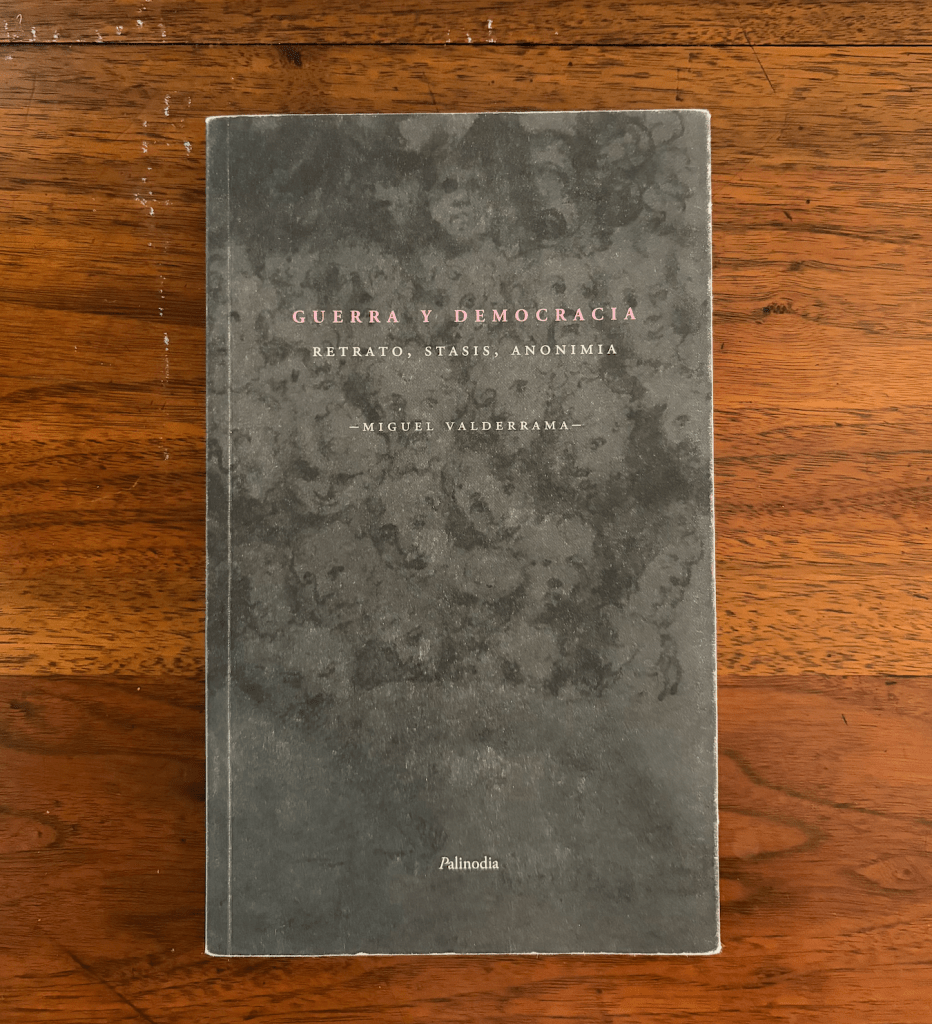
How to think through the stasis as a figure of thought in an epoch of transition and decline? This is the task of the historian – perhaps also of the philosopher and the critic – at the threshold, according to Miguel Valderrama in his book Guerra y Democracia: Retrato, Stasis, Anonimia (Palinodia, 2025), where stasis is extended beyond its categorial inscription in the grammar of political thought in order to capture its oscillatory movement. Dispersion is a word at the heart of Valderrama’s scene of writing; a scattering of sense that radicalizes the enterprise of the historian’s task that cannot remain alien to the problem of language. In fact, it is at the conjunction where Valderrama wants to situate the problem of stasis. As he writes early on in the book: “Pasión en la dispersión, sí, sí con esta frase se nombre en secreto lo que en la errancia del vocablo stasis evoca una escena traumatizante, una herida, una punzada la escenificación de un acontecimiento y el orificio de su representación, la memoria de una stasis y de la anonimia que le es más propia, impropia” (Valderrama 15).
For Valderrama the Greek term – which holds on to definitions of civil war but also conflict and internal stabilization – now welcomed in theoretical discussions, comes to name the errancy and wound of the endurance of war in the modern political project of representation and legibility. As a thinker of the local scene (and its counter-scenes), Valderrama perceives that in recent years the Chilean contemporary critical discussion, especially in the wake of the Chilean revolt of October 2019, has introduced the pulsating grammar of stasis to think this fissure in representation. Valderrama cites the essays by Rodrigo Karmy, and Alejandra Castillo, Juan Pablo Arancibia, Willy Thayer; but also publications like Escrituras Americanas and the now defunct Revista Disenseo, and the novelist Nona Fernández (Valderrama 31). Obviously, the list is not exhaustive. In the Chilean contemporary scene, stasis is removed from its hellenistic origins, in order to name the unmediated irruption of images, inscriptions, and languages as fragments in the interior of history (Valderrama 50). In post-dictatorship Chile these fragments gravitate around the impossible image of La Monada bombed in 1973, which is juxtaposed to the anonymous images of the revolt in Santiago in October 2019, where some are more monumental than others.
One of the novelties in Valderrama’s Guerra y Democracia (2025) is precisely the insistence to think the problem of stasis as radially bound to the regime of visibility and legibility that organize the artifact of political representation. In fact, and following the canonical studies of the Leviathan’s frontispiece and its relation to modern optics, we know that modern political representation has relied consistently on material technologies where representation and the homogeneity of the social body coincide (Valderrama 79). From Thomas Hobbes at the birth of political liberalism to Carl Schmitt’s political theology in Weimar, the visual artefact has been the infrastructure in the making of political authority and the unity of civil society. The repressed containment of stasis at the heart of the modern liberal state is granted only if the regime of public legibility has been constructed. In this sense, all modern politics is necessarily heliotropic, revolving around the sun of sovereignty that will later transform into the electric and atomic form of energy reserves.
By the same token, following Valderrama, we can then say that what stasis names is precisely the breakdown of the helitropic movement in an epoch of absolute exposure and blinding transparency. More than a century ago, in 1913 Malevich could speak of the “Victory over the Sun”, but this can only make sense if such victory can allow for a regime of nocturnal seeing and generic anonymity, which is always on the ‘other side’ of political dominium (be it techno-capitalism or communal administration) where all identifications fails, because there is no longer a common body or a name as energy reserve for social organization. It is because of this rupture that there cannot be a stasis within the social, but also against the closure of the spatial arraignment of the Social understood as the site that requires energy (production) in order to produce a certain degree of comprehensive idealization. Of course, Valderrama is not oblivious to this, as he writes in one of his most programmatic definition of the stasis:
“La revuelta, la stasis, se define contra esta dieta y contra este régimen de luz. Al bertillonismo que define los límites y la lógica del espacio público, la revuelta opone la multiplicación de máscaras, la suspensión del retrato, la proliferación de lo anónimo. El régimen diurno del aparecer opone la noche, las sombras y el humo de los enfrentamientos de cuerpos liberados del rostro y del retrato, de la ficha policial. La revuelta pone en movimiento una anonimia, un juego de máscaras que desata anónimos, pseudónimos, alonomios, sobrenombres, para nombres, antenombres….La anónimo guarda un secreto en la imagen, lo guarda como lagrima y caída de la imagen” (Valderrama 109-110).
But is it just a festive game of defacement and creative destruction that would resemble the spirit of carnival festivities, in which masks evoke, in an exceptional time of inversion, the supernatural powers and the dead as studied by Karl Meuli? Is not the carnival a compensatory act of the logistics of expenditure and realignment for any community of social exchange? If true, then the notion of stasis would need to break from the polarity of social identification and instance of mask, in the same way that already in the classical period the stasis emerged as a zone of indistinction between domestic and public spaces, an unbreachable black hole between the oikos and the polis that is well beyond the exception (Valderrama 119). In other words, stasis needs to be rethought as something other than an interruption in temporality, which is still the negative duration that feeds negatively into the course of temporal order of social domination and its ‘economy of violence’. Valderrama reminds that for the poet Armando Uribe, this economy of violence names the very engine of historical development. And poets tend to be better than political analysts at imagining other worlds.
Towards the end of Guerra y Democracia: Retrato, Stasis, Anonimia (2025), Valderrama briefly glosses Armando Uribe’s 2000 lecture “El fantasma Pinochet” in order to introduce not only the problem of violence, but also language; a language that he calls uncanny, “une inquietante étrangeté” (Valderrama 120). These words are glossing Uribe who is also commenting a speech by former President Eduardo Frei, but that can also be used to thematize the central problem that Guerra y Democracia introduces in its scene: how to traverse a destitution of language if stasis is the capacity to traverse the moribund language that metaphoric and cataphoric politics speaks, without any possibility of saying anything at all? As an initial promise of the book, Valderrama had called for ‘another lexis’ (“otra lexis”) against narrativity and the hallucination of language towards a ‘language as such’, which is the language of naming approaching the coasts of physis. It is tempting to say that the revolt only appears liberating when understood as a problem of inventing and making space for this other language that ceases to be a metaphor of this world.
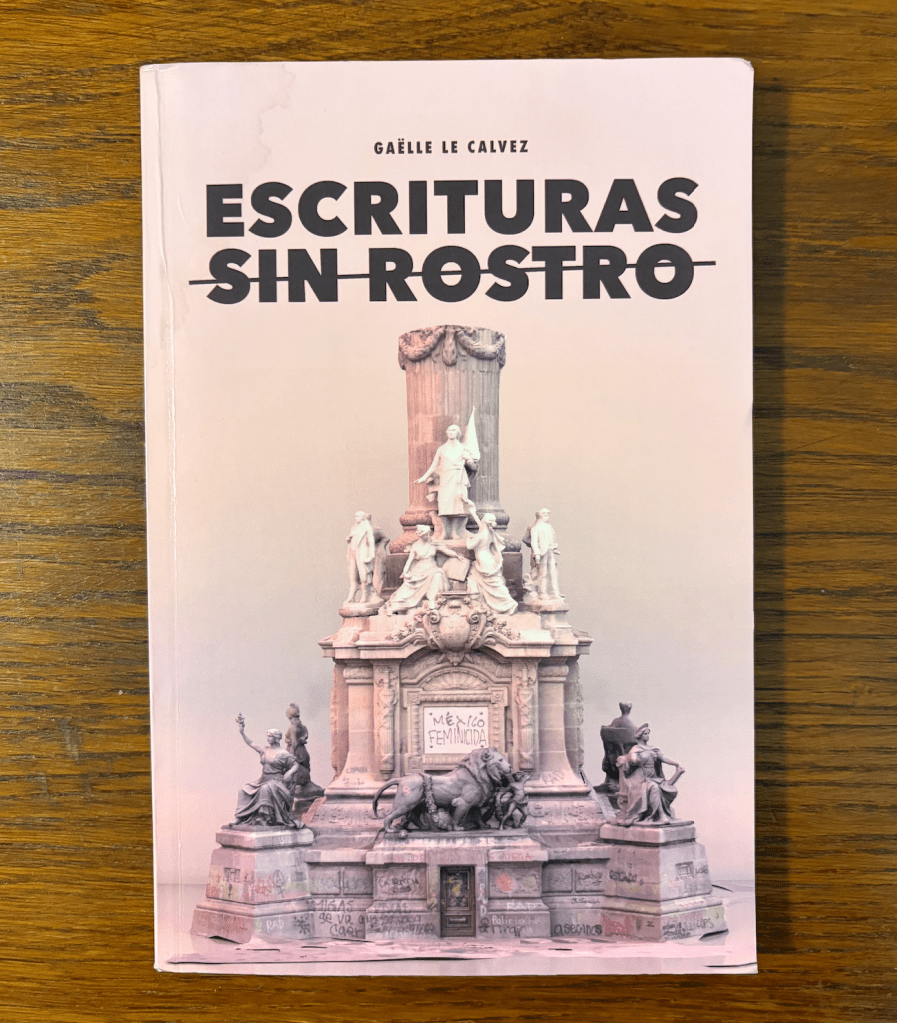
Every book has a history of its own, its subterranean itineraries, and oblique paths that are only disclosed when entering in contact with its future readers. There is no question that Gaëlle Le Calvez’s Escrituras sin rostro (University of North Carolina Press, 2025) has plenty of merits that we cannot begin to elucidate. For one, it is a monograph that should be of interest to students of Latin American studies, but also to any fellow travellers wanting to confront and think through the problem of writing at the wake of the epochal crisis of the state form and the exhaustion of the historical subject. Can thinking overcome the deficiencies proper to cultural studies and populist hegemony to understand the ongoing fragmentation visible everywhere? One can start by saying that Le Calvez’s books points to a positive direction from this impasse, avoiding the shortcomings of sociological epistemology and the auratic reflexes of subaltern subjects as the master oppositional category to State form in the becoming of modernist development and global neoliberalism. In Gaëlle Le Calvez’s Escrituras sin rostro (2025) the object of study is the irruption of EZLN or Zapatismo, and more specifically the scene of writing of the Zapatistas through the genealogy of their declarations, public letters, gestures, and signatures of all kinds that speak to the persistence of a writing of defacement; a scene of writing beyond the social function of the author, and on the margins of the legitimacy of the “lettered city” of the Latin American criollo uneven modernism. In the space of this commentary, I would like to list three levels of Le Calvez’s arguments that hope will further contribute not just to the themes proper to her study, but more fundamentally to a constellation of problems that exceed Latin America as a region of studies.
First, Gaëlle Le Calvez’s Escrituras sin rostro (2025) withdraws itself from understanding Zapatismo as a sociological political phenomenon of the late Mexican State, or a belated product of the shortcomings of the Mexican Revolution and its process of modernization. Unlike other studies of Zapatismo in Latin American studies Escriturassin rostro (2025) is not invested in the restitution of new political subject of resistance in the face of global war and the anarchy of political action; rather, what is presented is the redrawing of a genealogical scene of writing subsumed by its excess and dislocation, stubbornly out of place that evidences the negativity of the collapse of the autonomous spheres of actions that once defined the apparatuses of historical development and legibility. As Le Calvez convincingly points out, the defaced and non-authored writings of the Zapataistas are neither literature nor political manifestos, and they also refuse the autonomy of literature and its incorporation into the objective ornaments of the Avant Garde projects. The defacement of writing for the Zapatistas is neither Avant Garde nor kitsch, because it is no longer interested in weighting itself on the rhetorical scale of social compartmentalization. In my terms, which are not those of Le Calvez, one could say that “escritura” or writing in this study is the vortex of flight from rhetorical submission; that is, what cuts through the enthymemes to refuse ossification and reproduction of language. The freedom of writing is always measured by the possibilities that is able to generate against rhetorical abstractions.
Secondly, because there is no justification in social or political principles, Le Calvez argues that Zapatista writing and negative gesture is a refusal of hegemony, and thus properly posthegemonic. If “escritura sin rostro” makes no demands, seeks no identification, and avoids the prefiguration of rhetorical subsumption, it means that Zapatismo openly rejects the articulatory nature of hegemony as the last avatar of the administration of identity at the end of metaphysics. As Le Calvez claims succinctly, the dispersal of writing cannot adequate itself to Laclau’s theory of hegemony and its “rhetorical foundations” of the social (Le Calvez 67-68). In this sense, posthegemony is not merely what interrupts the closure of politics in the neutralization of a new social consensus, but what transfigures language into its autographic, experiential, and faceless excess that overflows every identity and every place of enunciation. In very subtle and elegant ways, Le Calvez’s hermeneutics of the Zapatalistas’ Declaraciones confirm that the solicitation of hegemony in both discourse and political practice is an inversion, almost an hallucination in political form of the money form and the general equivalent in the historical process of real subsumption of capitalist value. If Zapatistas are indeed a “realist” political formation it is not because they parody of modern guerrillas or enact a new communal organization; the realism at its best is grounded in the capacity to discern that hegemony in the wake of end of the modern liberal state only serves to deepen the ongoing process of the capitalist utopia.
Thirdly, and more surprisingly, is the fact that Gaëlle Le Calvez’s Escrituras sin rostro (2025) does not just reconstruct moments of the Zapatista inscription, it also considers its intensity to its very end. And to think something to the end means to reveal its limits, disclose its fissures, and open a site to move pass the object of reflection. This maximum point of reflection is when philological exploration outlives itself in the intensity of an uncharted path. Thus, the story that Le Calvez tells us about Zapatista writing concludes with a series of aporias and contradictions that announce a certain “decline” and eclipse of its poetic intensity. This is a moment where its poetic elevation begins to deflate; and, in its decline we are confronted with a persistent drift to “civil society”, “self-critique”, the appeal to plurality of “indigenous people” (what Gareth Williams once called “fictive ethnicity” as master representational fiction), or an internationalist appeal in order to generate a “counterbalance” to global neoliberalism (Le Calvez, 106-108). And we are putting aside the nomination of Marichuy for the 2018 Mexican presidential election. Does not this recomposition of social recognition, both global and national, seek to replenish the void in representation as it appears in the third Declaración that evoked “para nosotros nada”? (Le Calvez, 93). The waning of the poetic moment of Zapatista appears to project a flickering shadow of its dependency to political movements.
Does this mean then that the “rise and fall” of Zapatismo ends in a tenuous archē embedded in the ‘movement’? In his Latinamericanism after 9/11 (2011), John Beverley projected his unfiltered Leninism towards antiquity and Ancient Christianity when stating that the central political question for our times in the face of Empire, is to find ‘who are the real Christians today’ [1]. But ideological Leninism distorts the past, since as we know well, the central question for the Christians of the Early Church of the desert, such as Origen, was not who was going to mobilize the masses in the material world, but rather in what way to retreat and avoid worldly political power [2]. Zapatistas as the new and last Christians, then? It is a tempting question, but one that will only contribute to the Leninist reduction of historical political fictions. Our times is not one for Leninism and the Vanguard Party to carry a breakthrough. But perhaps Zapatistas are residually Christians in another country way; that is; in the internal dynamics of its own language. I would like to suggest that this language can be understood especially in the last phase of the Declaraciones, a late rhetorical style of the sermo humilis. As Erich Auerbach has shown, the sermo humilis was the rhetorical innovation of the early Christian community at a moment of the political decadence of the Roman Empire, at the entrance of the interregnum. The sermo humilis appeals to a low or popular style, seeking legibility and pathetic understanding of the difficult mysteries of faith. The humilis also designates the ground level of the land, the humus, which elevates through the persuasion for the humble and the humiliated common men of this world [3].
In other words, the sermo humilis could be said to be a sublime of the everyday life that is refractory to the mystery. It is obvious that if we now turn to the Zapatista late writing, something like the sermo humilis codifies a symptom that is no longer the mystery of revelation, but rather in its secularized form of the revolution. Does not the sermo humilis functions as a secularized artifice to guard and elevates hopes (all too human, alas) on behalf of the “revolution” to come? However, it is precisely political revolution, just like hegemony, what cannot longer account to the effective revolutionary force of the autonomization of capital. If according to Le Calvez the formation of the Zapatista is analogous to an “artificial movement” (masa artificial) like the Church, then one could say that the rhetorical construction of the sermo humilis functions as a linguistic prayer for the revolution whose only certitude is the apophatic metaphorization in the name of the “people”, the “homeland” (la patria), or the antagonistic and oppositional “we” (nosotros), or any other compact grouping. Of course, this is the terrifying question for the sermo humilis in its secularized form: to what extend the communitarian and autonomous ideal, through its appeal to the humiliated and subaltern class, does not transform itself into an apotropeic instrument devoid of true redemption? [4].
Is writing, and witnessing through writing the practice where the possibility of redeeming human experience is lodged? This is the fundamental question that Le Calvez’s book puts forth to us as readers, without entirely coming to an effective resolution. And yet, in the last part of Escrituras sin rostro (2025) seems to offer us another possibility through the writings of Cristina Rivera Garza, Alejandra Pizarnik, and Sergio Gónzalez Rodríguez in the face of a fragmented and disarticulated social body and the night of history in which social protection and protracted civil war become indistinguishable (Le Calvez 186). This writing is no longer tailored in the Christian shops of the sermo humilis, but in an open plain where the voice becomes “un anhelo de prosa”, or a longing for prose, crossed by the finitude of being and the collapse of mediating forms of totality (Le Calvez 174).
This longing for prose as it appears in Cristina Rivera Garza’s work – in the Spanish anhelo one can also hear the echo of breathing that is constitutive of life’s exteriority with the world, to conspire – is not the letter of the law as in Hegel’s spiritual prose of the world (“in the slave prose begins”, we read in Aesthetics), but the clearing of a voice that can register the world because it speaks from the witnessing of the ruins of representation, and the conviction that there is no political mystery high above, but only the irreductibility of writing in spite of it all. In the shipwreck of perpetual global war, writing’s redeemable elevation is the caritas that puts us in a permanent exodus from the order of representation (Le Calvez, 186). Writing, escritura becomes the passage of the chiasmatic and breathable imagination that, because it has cleared a via poetica, it can name what can also be properly inhabited.
.
.
Notes
1. John Beverley. Latinamericanism After 9/11 (Duke University Press, 2011), 26.
2. David Nirenberg. Anti-Judaism: The Western Tradition (Norton, 2014), 108.
3. Erich Auerbach. “Sermo humilis”, in Literary Language & Its Public in Late Latin Antiquity and in the Middle Ages (Princeton University Press, 1993), 39.
4. Gianni Carchia. “Eros y Logos: Peitho arcaica y retórica antigua”, in Retórica de lo sublime (Tecnos, 1990), 29.
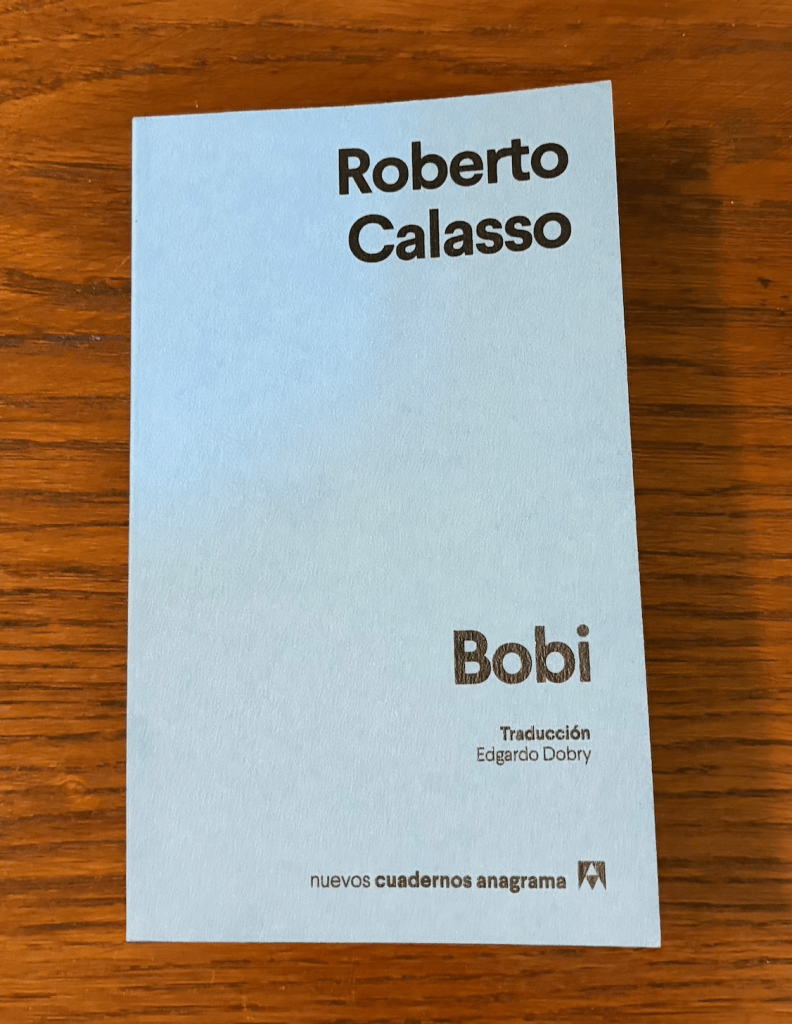
Roberto Calasso’s short and epigrammatic posthumous book Bobi (Anagrama, 2026) on the opaque figure of Roberto Bazlen has just appeared in Spanish. It is a nebular autobiographical book that does not attempt to render legible the subterranean and oblique figure of Robert Bazlen, but rather to filter some of his obsessions and tonalities, many times through his own voice. Calasso is well qualified to write such book as a frequent stroller companion of the anonymous man of Trieste. There is no aura of the detective mystery about the person’s auratic psychic life, establishing a sharp contrast to Del Guiudice’s polyphonic narrative in Lo stadio di Wimbledon (1983). But in this short memoir book, I am particularly intrigued by a moment when Calasso inscribes Bazlen’s vortex of thought and life as an affinity for the acoustic.
Calasso quotes Bazlen (we assume that from his own memory): “Bazlen used to say regularly: “This does not sound too good”, and immediately we knew what he meant. His capacity to recognize sound was thorough” [1]. Calasso tells us, moreover, that he cared little about cultural or intellectual polemics of his time. All that matter was sound, the grain of the voice. His meridian crossing was the song and rhythm of another. It is this proximity to the light of the voice what allowed Bazlen to conceive life and writing as a unified sensible reality; mutually interdependent, and always intertwined like the threads in a rigged tablecloth. To inhabit the world without judgement – of History, of morality, of punishment and guilt, of retribution – means to secure an aperture to an acoustics that will remain close to us, albeit incomplete, in the dissonance and impropriety of meaning.
To be able to attune oneself to the voice is a practice that retreats from the order of the world; that is, to descend into anonymity in order to inhabit a subterranean region, which speaks to Bazlen’s insistence on tugurios or spelonche, which Calasso does not hesitate to render as naked spaces, miniature deserts or caves to immunize oneself from the chatter of the world: minima chôra where something could take place or not. It is hard to define them but we know perfectly well what these are. Perhaps we can be more emphatic: to listen to the voice is already the encounter. And very much like Osip Mandelstam’s figure of the interlocutor, true poetics (and first and foremost that of life) “is ever moving toward that more or less distant, unknown addressee, whose existence the poet cannot doubt without also doubting himself. Only a reality can bring to life another reality” [2].
Bazlen’s notion of writing as the writing of life, experience as writing, very much like Mandelstam’s dialogic poetics, finds a tugurio so that language can emerge in absolute presence. And this is precisely what Bazlen understood in the becoming of life against the metabolic strain of survival, since the repression of the voice will result in the annihilation of what is most alive. Calasso recalls Bazlen’s affirmation: “In a world of death – there was an epoch where one was born alive and would later die. Today, on the contrary, one is born dead – and only a few are able, little by little, to be alive” [3].
For Bazlen there is no community of the living granted in immanence, because to live means to conquer the putrefaction of the culture of death, which is only permanent revolution and hostility. But one cannot conquer death from death; that is, by means of the beautiful soul’s literary prose of the world. It does not take Hegel to say that this is still unwarranted insubordination and permanent bondage. What is then to be alive? It is a resurrection that takes place as an existential decision, that is “at a point in life when a fundamental decision has to be made. I believe that was his passion, and his masterpiece” [4]. This is Del Giudice’s indictment, although surely not fully at odds with Calasso’s autobiographical sketch of Bazlen. In the melodic contact the possibility of a vita nuova is transfigured in not-knowing because the Western modernity is devoid of any notion of ethical destiny. Indeed, “et tout le reste est littérature”, as Verlaine famously wrote. For Calasso’s spectral portraiture in Bobbi (2026), the adventure is to remain alive well beyond completion and needs, as evidenced in our encounter with his languishing voice and memory.
.
.
Notes
1. Roberto Calasso. Bobi (Anagrama, 2026), 83.
2. Osip Mandelstam. “El interlocutor”, en Gozo y misterio de la poesía (El Cobre Ediciones, 2005), 71.
3. Roberto Calasso. Bobi (Anagrama, 2026), 55-56.
4. Daniele Del Giudice. A Fictional Inquiry (New Vessel Press, 2021), 123.
Let us imagine a person that in a short period of time finds himself haunted by successive deaths, abandonments, missed encounters, displacements, and lost possibilities – the list could go on. All of this amounts to a loss of world. This is obviously the narration of anyone’s life, and every moment of it would seem to imply an internal necessity of its unfolding as felt in the weight of its coming together in remembrance. Obviously factical life will continue on – and it always goes on – but the ultimate question will reside in the relationship between existence and the narrative order of that past. All of Duras’ narrative world is almost entirely a direct wrestling with the possibility of going against this specific weight of narrativization, because to narrate means to forget oneself from the experience of being in the world here and now. The demand of recollection imposes rhetorical limitations to the unfathomable present. Remembrance is the courtyard of historical and religious necessity where self-transformation takes a secondary role in a massive and alienated narrative of causes and reasons.
Duras’ first novel La vie tranquille (1944) reacts strongly against the burden of memory in the name of forgetting: “Once you lose the ability to forget you are deprived for a certain life” [1]. But what could a “certain life” amount to? Obviously, this forgetting here does not mean a neutralization of conflict in life (as in the status of a civil war in a political community); rather, it entails a sort of rebirth, in which the density of life refuses the crushing force of fictitious acceptance dispensed by the order of the past. That loosely defined “certain life” does not qualify nor situates “life” to the survival of “this life”; on the contrary, it seeks to open life to its open and self-evolving possibilities. In other words, there is “only one life” because there are only irruptions of the tragic possibilities that will always elicit a vita nova. The “certain life” that is always lacking allows the infinite possibilities of rebirth in the face of the eruption of the tragedy. And tragedy requires affirmation and exposition to the world in a strong sense. This could very well be the ultimate tone and color of the adventure for Duras.
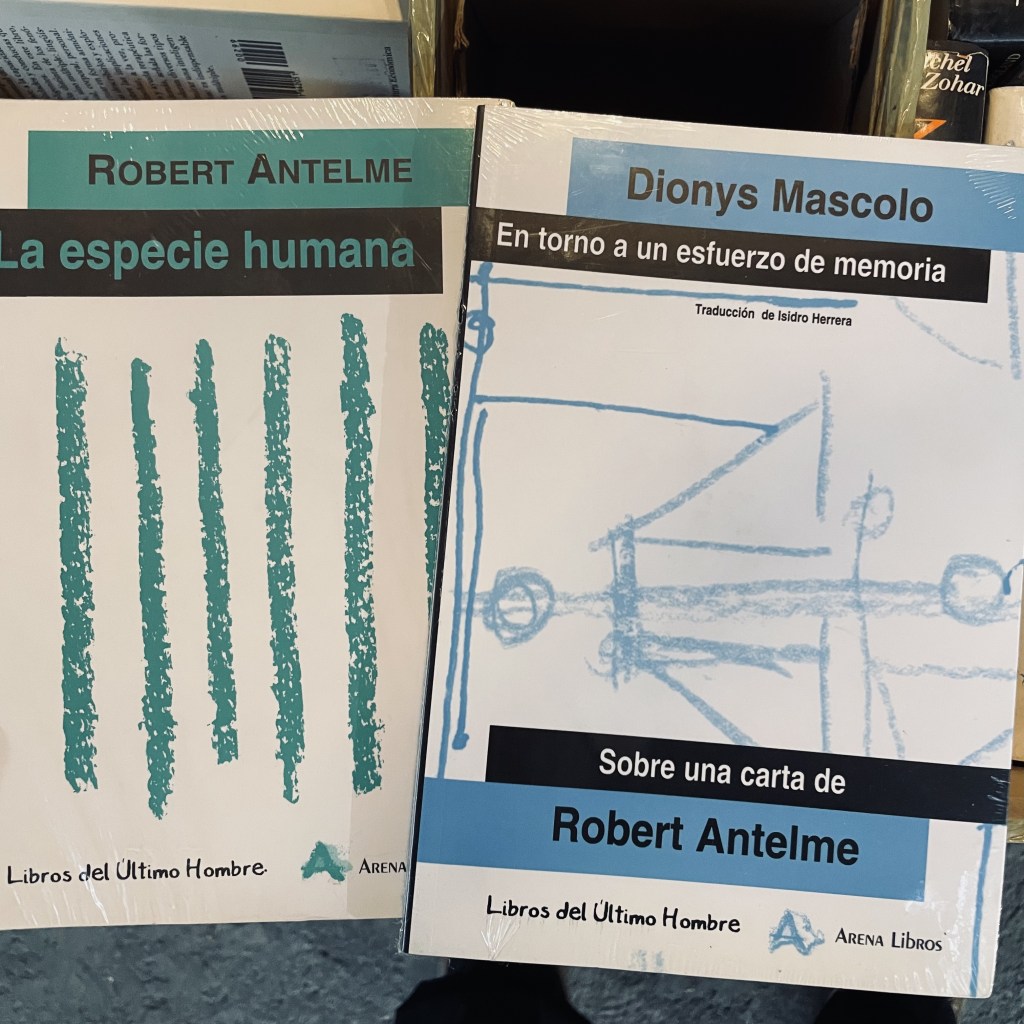
Dionys Mascolo once wrote that Marguerite Duras’ literary and cinematic work is a transfigurative elaboration of the the tragic, and for this very reason the active undoing of the civilizational narrative at least since the humans of the neolithic that had resulted in the production of justifications and reasons to live “our life” [2]. And in a way the irruption of the tragic is the confirmation that civilization does not have the last word of absolute moral order. But life – and this is the “mystery” coloring a good part of Duras’ imagination – is always about keep afloat the possibility of the certain life without the threats of self-absorption and destruction in the wake of nihilism and abstract political equality between beings in the world. A “certain life” (our certain life without qualifications other than being attuned to the object of our passions) is always elsewhere, and for this very same reason as a transfigured revelation outside of what appears as the enclosed necessities of ‘this life’. “A certain life” is a higher indented form of the theos unto life, whose transcendence is not regulated by an article of faith or the anthropological deficiency of sin (this is at bottom the difference between Christ and Saint Paul). In other words, the tranquil life that many readers have generally understood as wilful irony wrapping Duras’ narrative bears the truth to that life – the only one worth affirming as destiny – must always be outside itself. As the character of La vie tranquille (1944) confesses in one of the peak moments of the monologue in the second part of the novel:
“I’ve existed for twenty-five years. I was very little, then I grew and reached my size, the size I am now and that I’ll be forever. I could have died in one of the thousand ways people die, and yet I managed to cover twenty-five years of life, I am still alive, not yet dead. I breathe. From my nostrils emanates real breath, wet and warm. Without trying, I managed to die of nothing. It advances stubbornly, what seems halted, in this moment: my life. …My life: a fruit I must have eaten without tasting it, without realizing it, distractedly. I am not responsible for this age or for this image…” [3].
The bite into the fruit in this monologue differs from the metaphoric self-confession that ascertains the theological irreversibility of original sin and felix culpa; it signals the passage of the narrative of life into denarrativization. Here a “certain life” might open against the fluvial current of the order of necessity that will make the subject into a bundle of legible and memorable infortunios. The passage to the tranquil or serene life, however, is not just grounded in the description of a trembling account of onself. In Duras, it has a proper name: thought. In fact, as we will find in the last part of the novel: “You must advance with the last of your powers;…with the power of thought” [4]. And following Mascolo to the letter, one could say that this ‘power’ is misplaced – it is not a power of the subject to force a will to do or act – it is rather a passion of thought (“la passion de la pensée”) that elevates itself against necessity and actualization through a “refusal” of any given historical order.
This is to say, the breakthrough to the ‘certain life’ or the ‘serene life does not presuppose a counterpolitical strategy, as much as the movement of thought enacted in refusal as condition for any democratic requirement that no one can ultimately possess, as Duras a decade later will go on to write in the third issue of Le 14 Juillet [5]. The serene life is only possible as an infinite movement of denarrativization. The inhabitation of the world in La vie tranquille (1944) was already preparatory for the gesture of ‘refusal’ where a certain life follows a retreat from the hypsipolis apolis (superpolitical apolitical) into the existential xenikos of a contemplative life that is irreducible to both the principles of humanity and the normative regulations of social interaction. The serene life is only achieved when the separation of thought and life enters into the incommunicable sense of persuasion (the ancient peitho) capable of decompressing the vector of force that has only produced a generic humanity of political depredation, acceptance, and excruciating tonality of boredom. Duras’ writing – at its best moments – is an intense search of this kind; a search does not end in neither politics nor literature, but on what remains outside of them.
.
.
Notes
1. Marguerite Duras. The Easy Life (Bloomsbury Publishing, 2022), 90.
2. Dionys Mascolo. “Naissance de la tragédie”, in A la recherche d’un communisme de pensée (fourbis, 1993), 397.
3. Marguerite Duras. The Easy Life (Bloomsbury Publishing, 2022), 96-97.
4. Ibid., 114.
5. Marguerite Duras. “Responses à l’enquête auprès d’intelectuels français”, Le 14 Juillet, N.3., 1959, 5-6.
Philippe Theophanidis has recently brought to my attention an emphatic statement in Dionys Mascolo’s Lettre polonaise sur la misère intellectuelle en France (1957): “La politique est notre passion. Nous en parlons, ne faisons que cela, et tout l’ennui du monde est dans ces dialogues-disputes, dans cette démarche perpétuellement contentieuse qui donne envie de s’occuper de n’importe quoi d’autre, de plaisanter, de se taire, de s’en aller” [1]. These are intense words not entirely divorced from a deep sense of desperation entangled with a commitment to realism – minimally understood as bringing into thought how things looked at the time. In a recent collaborative introduction to the writing scene of this group (preliminary work towards an upcoming seminar) – which included Mascolo, but also Duras, Vittorini, Blanchot, and other continental friends – we took into consideration how the heterogeneous and internal tensions were brought into bear in the effort to connect the creative act to the existential texture of communication and concrete world events [2].
Mascolo’s statement must be read as historically marked and situated, as who today could claim that “politics”, however broadly or loosely understood, is the exclusive “object” of our passion? Mascolo seems to have been aware of the subordination of passion into politics, leading to dialogues and disputes where nothing could facilitate the clearing of a way out. When politics becomes the final object of one’s passion it could only mean that the reign of chatter has liquidated our experience with the world. And it is at this point where the ‘missing word’ that attunes the search for one’s passion can regress as nihilism; that is, as mere force to steer rhetorical valence and representational exchange within the expansive intramural rules of civil society. Restricting one’s passion to the determination of politics merely inverts the order of modern legitimacy (i.e. the repression of passions by the interests), compressing both terms as a higher principle of politics.
If at the outset of modernity contractualism suppressed the passions in exchange for sovereign security from the fear of violent death; in the attempt to elevate the passion to the grammatical height of politics, what is rendered obsolete is precisely the possibility of securing an existential site of freedom outside and beyond politics, that is, in the the nonplace of the passion itself. Of course, one could also read Mascolo’s apothegm in light of his revolutionary politics, in which the name of “politics” solicited the revolutionary emancipation of the civilizational alienation of the human species towards a transformative sequence beyond the scarcity of needs. But the problem of the category of revolution is that it remains tied to the very development of the legitimacy of the political and its erosion (for Edward Gibbon in Decline and Fall of the Roman Empire the configuration of the state is the crowning revolutionary event against disorderly barbarism), which the members of the Saint-Benoît Group were first hand witnesses in the postwar epoch.
I think this speaks to my suggestion that the assertion ‘politics is our passion’ was historically embedded; a sort of last breath of trying to hold onto the utopia that will soon crumble in every active paradigm of planetary order (postcolonial, Soviet state planning, European communism and social democracy). But at least – and this is what remains of interest, as I see it – the Rue Saint-Benoît friends had the courage to confront it in order to enact a farewell to the very assumption of ‘revolution’, which already in 1968 was clearly moot. In the words of Maurice Blanchot after the events of 1968: “…but from now on I will hold onto an exigency: to become fully conscious, and always anew, that we are at the end of history, so that most of our inherited notions, beginning with the one from the revolutionary tradition, must be revised and, as such, refuted. […]. Let us put everything into question, including our own certainties and verbal hopes. The revolution is behind us: it is already an object of consumption and, occasionally, of enjoyment. But what is before us, and it is terrible, does not have a name” [3]. Thus, to conflate “politics” as the passion could no longer offer solid ground in the intra-epochal interregnum of suspended historical time. Just a few years later, Duras will claim that politics had little to offer, since there is an “absolute equivalence between all political programs, and only right ideology seems to be able to do politics as such. We no longer believe in politics…there is only a burrow of hope. We must submit ourselves to the hard evidence of its total degradation” [4]. To dwell in a delimited burrow means a return to the rooting of place and new geographies beyond the temporal axis.
One can read both Duras and Blanchot’s elucidations of the collapse of modern politics and its negation (the ius revolutionis) as a corrective posture to move past Mascolo’s hope to make the unfathomable texture of one’s passion coincide with the object of a political project, even if understood as an archipolitics. But it is precisely in the abyss opened by a terrible and nameless epoch that a new light is casted on the free-standing and ungraspable nature of the passion; the irreducible law that establishes a contact between the ethical life and the world beyond objectivation as both excess and deficit of the tribulations of political order. Perhaps a modification to Mascolo’s thesis is now necessary: passion is what escapes every possible fall into the objective world, and for this very reason it is a ‘refusal’ of what the compensatory bond of politics can offer under the sermo humilis of stagnant artificial utopias. There is no political passion just like there is no political friend, since both friendship and one’s passion remains always objectless, only mediated by the overcoming of the preconditions of fear and of delegated life. In Manuale di sopravvivenza (1974), Giorgio Cesarano will claim that passion was the name of the coming historical program of a sensible presence resisting the “annihilating force of social objectivation” of the world [5]. And the Italian poet will define the passion as the sacred taking possession of the return to appearance. A transformation of politics could only emerge after one’s passion could finally prevail experientially against the terrible and nameless (and unnamed) world organized towards planned obsolescence and generalized humiliation. And it goes without saying that we are still very much our predicament. The caesura between passion and politics has now become spectacularly absolute and irreversible.
.
.
Notes
1. Dionys Mascolo. Lettre polonaise sur la misère intellectuelle en France (Éditions de minuit, 1957).
The Rue Saint-Benoît Group, organized by Marguerite Duras, Robert Antelme, and Dionys Mascolo and other fellow-travelers of the interwar years can hardly be defined as a political movement, a literary school, nor an intellectual community with a direct orientation or aesthetic program. In fact, the Saint-Benoît Group (transnational in its composition) understood itself as a shared experience of thought that gravitated under the words of the German poet Friedrich Hölderlin: “The life of the mind among friends, thought is formed in the exchange of the written word and for those who seek”. It is also known that Hölderlin was the quintessential poet dwelling in the fracture between tradition and modernity, the flight of the gods and the eclipse of the poetic in the wake of a consummated technological Prometheism. To affirm Hölderlin’s words entails to confront the difficult questions of language and the voice as conditions for thought. How can we think of an intellectual experience in which friendship becomes inseparable from thought; and, at the same time, when thought becomes a condition for the endurance of friendship? And to what extent could this double register allow for a reinvention of the autonomy of politics in the wake of the crisis of Humanism?
These are the enduring questions that the experiential setting of the Saint-Benoît Group bequeaths to us today. If the Saint-Benoît experience has remained opaque and invisible even within monumental historiographic narratives of twentieth-century ideas, it is because only seldom have these problems been rightly posed. Under the sign of a “friendship of thought” – a transfigurative plane that immediately resonates with the immaterial common intellect, the Heideggerian incursion on the task of thinking, and the revival of a sensible Platonism – the members of the Saint-Benoît Group witnessed the catastrophe of modern politics in real time; such as, although not limited to, the concentration camp, the postcolonial wars of liberation, communist totalitarianism, and the exhaustion of the fundamental categories of political Liberalism. Taking distance from the elaboration of a normative political theory, the Saint-Benoît Group favored the heterogeneity of stylistic endeavors and expressive acts in order to grapple with the crisis of experience. And it is to their specific scenes of writing that we must attend to in a systematic and careful way.
In this eight-week course we will explore the diversity of the writings of the group, including figures such as Dionys Mascolo, Robert Antelme, Marguerite Duras, Maurice Blanchot, Elio Vittorini and other fellow-travelers to explore questions concerning the nexus between experience and creation (both of us have worked on some of these writers intermittently in the past couple of years). To the extent that we still live among the ruins of the legitimacy of modern politics, the contestatory style of Saint-Benoît Group still raises the question about the human species within our civilizational collapse.
What type of authority emerges from their writings, communication, and imagination of a fractured humanity? And how could the concept of ‘revolution’ be transformed from its moral and technical elaborations that hegemonized the twentieth century? We are aware that the Saint-Benoît Group has no “lesson” to be extracted and made “actual”; rather, we are interested in what we would call a “gesture of thinking” that prepares the condition for a life in freedom within and beyond the contours of the polis.
*For those interested in registering for the eight week seminar beginning in February 2024, please consider signing up at 17/instituto de estudios críticos: https://17instituto.org, or by writing to extension@17edu.org.