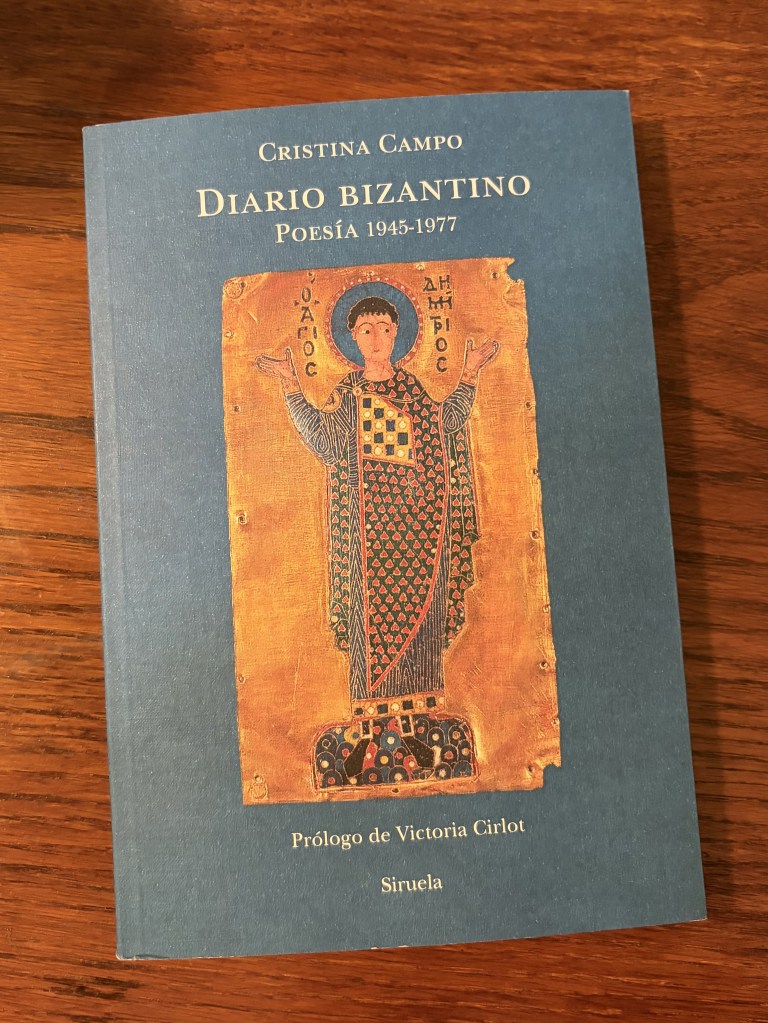
Liturgical senses. On Cristina Campo’s Diario Bizantino (2026). by Gerardo Muñoz

Cristina Campo was a modern mystic who gravitated towards the liturgy of the poetic word. Now thanks to the scholarship of Victoria Cirlot, the Spanish reader is able to read her complete poetry in the bilingual edition Diario Bizantino: Poesía (1945-1977) (Siruela, 2026), which serves the missing companion to the essays collected in Los imperdonables (Siruela 2020). It is difficult not only to differentiate modern genres in Campo’s writing scene, given that both essays and poems (and also her letters, published in multiple volumes by Adelphi, but not yet collected in Spanish) revolve around the same concern around the liturgical depth of the word and the image as indispensable units of raising to the divine transcendence lodged in a treasure chest of secrets. For Campo modernity is the temporal movement that laceration this longing for the mystery, where language insofar it serves the purposes of justification never ceases to participate in the spectacle of imagery and the tradition of the rite that grants access to the experience of the senses. Hence, mutilation does not seem a harsh verb: to slash and separate becomes a misnomer for the closure of “this world”, which is not only the material world of immanence, but one in which the autonomy of imagery – and thus the passive act of imagining – enters into a terminal pauperization elevated by fictitious, at times melodramatic, ornamentation of meaning. 

To leave the reduction of meaning implies a sense of the liturgical. As Cirlot notes in her brief, yet lucid introduction to the volume, it is impossible to not read Campo’s poetic word within the coordinates of her understanding of the liturgical praxis as a mode of artistic development. In fact, in her essay “Note on the liturgy” (1966), Campo would claim that liturgy was a celebration of the divine mystery that is instantiated by the charity of language as an “ecstatic mirror of creation” [1]. If liturgy is a mode of an ongoing work of art in the shadow between the living, the dead, and language it is because, as Florensky also noted – another figure revered by the Italian writer – it is the abyss of a sense of freedom raises to the freedom of the senses beyond fixity of mimetic representation through objective spatial groundness. Around the same years that Campo was meditating on the need to alleviate modern poetics from the maladies and the self-inflicted wounds of the Ego, the Catholic poet Octavio Smith, a member of the Orígenes group, would also celebrate the liturgy as the condition of an image that carries forth folded in the vocative, the offices and rites made possible by pure charity [2]. The partition and participation of poetic language is not just an abstract entelechy of the koine for human language; but, more importantly, it is the charitas that saves language because it appeals to the extasis of beauty. Campo will write that the liturgical scene: “…as in poetry is a splendorous charity, more on the side of necessity than of the useful. It is regulated by harmonious forms and rites that, inspired by creation, surpasses itself in extasis” (Campo, 17). It is the excess of language beyond language that finds dwelling space in the abyss that enacts as witness of a comprehensive cosmic reality. 

And charity will be less than nothing if it would not carry in its interiority the nexus with the dead and the transmigration of the soul that are now joined with the living. The examples abound: “…se nel mio trachea / contemplarai di un’altra migrazione….nessun vincolo univa questi morti / nella necropoli deserta” (Campo 38). In Campo’s poetry the liturgical charitas is not an event of absolute faith overturning, but what is already occurring, a rhythm, that is both fixed and suspended between actual presence and the non-present, “the destiny between the hand and the flower” (como il destino tra la mano e il fiore)”, that has clear echoes of Coleridge romantic dream (Campo 48). And yet in Campo’s poetic liturgy there is no moment of awakening, but realization that existence is transnatural, never hidden in the order of the natural world, but in the “perfumed cloud of language” (nell’odorosa nube della lingua) (Campo 84). If language participates in the flaming and enduring rite of the living and the dead, it is because it keeps track of the pure absence and the negative of the voice, that is both present and absent in the mouthing of every prayer, and as the symbol that longs to devour language itself: “la Tigre Assenza, ha tutto divorato, di quetso volto rivolto a voi!” (Campo, 92). In the praxis of liturgy, the highest celebration through hymns and chants seem to permanently reveal – and perform its revelation – of the abyss that cross language towards its own rebirth and pulsating elucidation. This passion for absence that devours speech becomes the transport of Campo’s poetic dwelling from beginning to end. 

Obviously, the major poem in the collection is “Diario bizatino”, that is structured around four parts and published posthumously in 1977, and whose first verse can easily become the vortex of the poetic exploration: “Due modi – e io vengo dall’altro” (“Two worlds – and I come from the other one”) (Campo 94). The poetic word assumes the reality of the gnosis as a threshold that is no longer between the past and future time of salvation, but the very schism that allows the passage from the living and the dead to resurface. It is a threshold that cuts through the soul itself: “…è il taglio vivente ed efficace / più affilato della duplice lama / che affonda sino alla separazione dell’anima veemente dallo spirto delicato” (Campo 94-96). To come from “other world” and to transit into “this one” is perhaps to be a little bit dead or undead among the living in the whirlwind of the names. As Campo writes in a defining verse of the long poem: “…al centro del Sole là dove il Nome! Rapisce in vortice immoto alla vita del mondo, zampilla nuovi sensi dal mondo della morte” (Campo 96-98). To be with the dead is no theatrical imposture of a void ritual that questions the meaning of “this life” – perhaps the most commonplace Hamletian condition inherited by modernity – but it is the instance that allows the senses of the world of the dead to creep on us as an unexpected ambush.  

This is why the mirage of the Byzantine becomes the new Sun in the middle of the darkest Night, and the moon soon gives way to eventual coming of the Sun (Campo 99). The liturgical plane of the senses extends to what language can receive in both giving and receiving through the analogical being that is lacking in sequential time. Here Campo’s East is in sharp contrast with Yeats’ “Sailing to Byzantium”, where all that lives is “caught in that sensual music / all neglect monuments of unageing intellect. An aged man is but a paltry thing” [3]. If for Yeats Byzantium is a site of alchemical rejuvenation and rebirth, Campo’s ageless Byzantinism nourishes the dead in which language finds beauty and pain as the supreme witness. In all accounts of what is invested in a language that cannot speak of the unfathomable revelation, for Campo the poetic word is weighted as a song to “testimonaire, a ferire / a insolibuilmente saldare / a inguaribilmente  separate” (Campo 118). The influx is the ultimate liturgy of separation, between language and being, the idea and reality is never completely lost. Or it could very well be lost, but only in what remains merely visible in this world.

This is why Campo never felt the need of the production of writing, not when the liturgy brings closer the excavated eyelids of pavid “gazes ingrained to the memories, to the ground, and to the dying psyche”, as she writes in the last verses of “Ràdonitza” (Campo, 120). In the way of “Burnt Norton” well-known bird – “human kind cannot bear very much reality”, and that is about right when it comes to what can be abandoned from the viewpoint of language. Between this world and its other – the triumph of Manichaeism outlives in the celebration of the fluvial depth of poetry – the divine apokatastasis of what remains unsaid, and yet well kept in the form of a diary. 

Notes 

1. Cristina Campo. “Note sopra la liturgia” (1966), in Sotto falso nome (Adelphi, 1998), 129-135 

2. Octavio Smith. “Liturgia, Poesía, Mundo”, Islas, N.2, January-August, 1960, 485-492.

On the abyss of pictorial space (work in progress notes for a seminar). by Gerardo Muñoz

We have attempted to read Florensky and Schmitt side by side, and certainly many fundamental questions have been raised converging profusely on the problem of Catholic form. At the same time, it is undoubtedly true that some questions have not been pursued at length, and they exceed the modest purpose of this short seminar. As a way of synthesis, I want to press against one question that seems to me to link both thinkers in the wake of secularization, and especially modern representation. Modernity is always too many things at once – it is purely the force of the contingent, but ultimately it is the temporalization of space through objectivity and its necessary legibility. It seems to me that the spatial question is a guiding thread, not the exclusive one, that connects Florensky and Schmitt’s interventions circa 1922. It is obviously the problem that the German jurist never ceased to reflect upon, if we recall how in the very end of his work he situated the very arcana of the law in relation to the visuality of the Homeric “kai nomon egnō”, a predicament for seeing space laying before the law; that is, subsumming the sense of worldly opening into the necessary predicate of a legitimate ground for order.

Schmitt’s purified, prima facie formalist conception of the Catholic form, is also fundamentally spatial, because the primordial essence of the duality of the ekklesia as an institution comes about through the dominion of life unifying the communities and burgs into an internal system of legitimation that builds a concrete order (in recent years the work of Anna Grzymala-Busse has convincingly tracked the morphologies from the medieval church the modern city state and the rule of law).  As we know, for Schmitt Rome (Catholic form) is Raum, spatial arrangement, dilation of orders and institutions, representation and decision elevated beyond the fundamental norm. In this sense, the thesis on the ‘visibility of the Church’ hinges upon the opening of the world as always already oriented towards salvation through the structural deficiency of human beings (original sin) and communitarian order of representation and delegation. This is why Schmitt remains a modern political thinker – perhaps the most acutely aware of thinkers when it comes to the fragility of the political project based on the specular visibility of legitimation – because the fusion of the political and that of territory remains indivisible, in spite all of his self-conscious response to the force of immanence noted in Political Theology (1922). The liquidation of the limiting autonomy of the political against technical neutralization is only possible because “space” has been first subsumed into the visible nomos of the nomon egno. 

It goes without saying that Pavel Florensky’s strategy is also extremely sensitive to visuality, but his position departs from the assumption that modernity is about the flattening of the unilateral and objective specular regime of visibility. One can recast what Alberti writes quite ostentatiously in  De Pictura: “No one will deny that things which are not visible do not concern the painter, for he strives to represent only the things that are seen. Points joined together continuously in a row constitute a line” [1]. In Alberti’s visual inception of pictorial representation, space is already orienting the direction for the flattening of pictorial space that defines modern pictorial representation in the well established argument by Clement Greenberg [2]. Obviously, Florensky wants to break against the flatness of modern representation, which is the condition of possibility for the very nihilism of subject and object that becomes worldness because it has no longer any possible carving out the “thereness” of space. It seems to me that this is what Florensky is after when elaboration of the ‘reverse’ or ‘inverted’ perspective. The inversion here is not just an aesthetic problem of the autonomy of work of art in the new distribution of labor, and here is where liturgy marks a fundamental distinction in terms of the analytical paradigm that frames Florensky’s investigations. Around the same years, Romano Guardini in his The Spirit of the Liturgy (1918) defined the liturgical experience as anti-aesthetic phenomenon, because in its communion of souls, it gathers the visible as well as the invisible, whose exclusive beauty shines in the light of truth and not of delimited notion of “work”. For Florensky moving past linear perspective, and by extension objective representation, is the path that prepares “a new structure of thinking” as such [3]. In virtue of its own experiential depth, “a certain spiritual excitement, a joly that rouses one’s attention to reality itself. In other words, perspective too, if it is worth anything, should be a language, a witness to reality” [4].

The so-called inversion of perspective is a destructive operation at the level of sensibility against the traps of illusionism and abstraction, opening in the concrete and yet not-yet-here space where life and its alterity enter into contact. This is why Florensky claims that it is “the content of space that is transmitted, but not the organization” [5]. And in a more densely and rich moment of the “Reverse perspective” (1920) he writes the most clearly expressed elaboration of this new structure of thinking: “To sum up. It is possible to represent space on a surface, but only by destroying the form of the thing represented. Yet it is form, and only form, that visual art is concerned with. Consequently, the final verdict is proclaimed for painting, as for the visual arts in general, to the degree that it claims to provide a likeness of reality: naturalism is once and for all an impossibility”  [6]. As it is obviously clear, Florensky is not thinking destruction in virtue of restating a metaphoric sacralization of nature; rather, for him the liturgical depth of the reverse perspective discloses an experience is only possible in the contact between the possibilities of the world and being. It is this region that he call the “abyss of own freedom”, and that the attempt to contain it through the hegemony of the matheme and calculation only amounts to “as tasks of insane presumptuousness” [7] 

The turning of experience must inhabit this abyss of freedom retreating from an “unmoving monumental and ontological massiveness of the world, activity by the cognising spirit that lives and labours in these thresholds of ontology” [8]. Thus, accounting for that ontological reduction makes possible inhabiting realities in the world that never become validated through representation. As Florensky writes in a short piece published around these years: “Obviously our living remoteness from reality must again destroy realism in art as well. There are realities in the world; one comes to know them by coming into living contact with them through work in the worldwide sphere….art can unite us with realities are inaccessible to our sense – such are the formal prerequisites of any artistic reality, and a tendency that rejects even one of them thereby forfeits its right to be called realism” [9].

If the Christian liturgy remains the most “realistic” experiential arrangement for Florensky it is because the texture of space appears in its non-visibility as the “missing aspect of what what we might call the surrounding world…it is this surrounding world, place as such, which the liturgy addresses” [10]. It is this surrounding world, that is both beyond the world and yet within it, almost folded unto it, what I would claim that relates tendentially to the notion of the  chora (χώρα), not as an interchangeable modulation of “place”, but as what allows externality as the requirement of experience to be indifferent to sense because it its presence is that of possibility. John Sallis in an essay on the notion of the chôra puts it in a way resonates with the abyss of freedom withdrawn by Florensky:

“One could say—though not without some risk of falling into the dream in which the chora (χώρα)  is conflated with place—that the chora (χώρα) is the other of being, not just in the sense of being other than being (as every eidos except being would be other than being), but rather in a more abysmal sense, in a sense irreducible to a difference of sense. One could say, too, that the chora (χώρα) is the outside of being, that it is what enables externality as such and thus makes it possible for something outside being nonetheless to be” [11].

We should linger on those words: “a more abysmal sense, in a sense irreducible to a difference of sense”. But this abyss is not what refers to an ontological vacancy that becomes operative for the subject; it is the excess that allows being, and for that matter “ethical being”, to have composed duration in its region.  I think it is possible to accept the minimalist thesis of the liturgy as the sanctification of “time-place that the world is” (this is the syntagm deployed by Hemming) beyond divine revelation, but only if one takes up the chôra as the space of spaces (ur-space) at the end of secularization, a transformative leap that transcends time to land somewhere in the depths of regionality. It is the region that makes the passage, as Florensky would say, fata voletem ducunt, nolentem trahunt, from interiority to exteriority without ever achieving consummation, perhaps as a folded relation. The stakes are enormous no doubt. In an entry in his recent Quaderni XIII (Quodlibet, 2025), Giorgio Agamben defines it in a particular way that traverses Heidegger, but also beyond him. This is a difficulty disclosed by the chôra, and it is the beginning of further challenging investigations waiting for us:

“It is the choice of this misleading conceptualization that leads Heidegger to privilege, like Hegel, time and action over space and contemplation. Not “Being and Space [chôra],” as in Plato, but “Being and Time,” as in Hegel. Even the “wonder that beings are” becomes a task and a “sacrifice”. Instead, the aim is to understand this wonder ethically as “use” (“to use it again in order to contemplate it”). Admittedly, in his later years, Heidegger attempts to rewrite Being and Time as “Being and Space”; yet here too, the conceptualization remains imprecise because it does not sufficiently question itself. (Although he merely acknowledges the inadequacy of language, he continues to propose terms that are necessarily deficient.)” [12].

Notes

1. Leon Battista Alberti. On Painting (Penguin Books, 2004), 37.

2. Clement Greenberg. “Modernist Painting” (1960), in The Collected Essays and Criticism (University of Chicago Press, 1993), 90.

3. Pavel Florensky. “Reverse Perspective”, in Beyond Vision: Essays on the Perception of Art (Reaktion Books, 2002), 246.

4. Ibid., 254. 

5. Ibid., 258.

6. Ibid., 258.

7. Ibid., 260. 

8. Ibid., 269. 

9. Pavel Florensky. “On Realism”,  in Beyond Vision: Essays on the Perception of Art (Reaktion Books, 2002), 181

10. Laurence Paul Hemming. Worship as Revelation: The Past Present and the Future of Catholic Liturgy (Burns & Oates, 2008), 47-48.

11. John Sallis. “The Politics of the χώρα”, in Platonic Legacies (SUNY Press, 2004), 42.

12. Giorgio Agamben. Quaderni XIII 2020-2021 (Quodlibet, 2025), 248