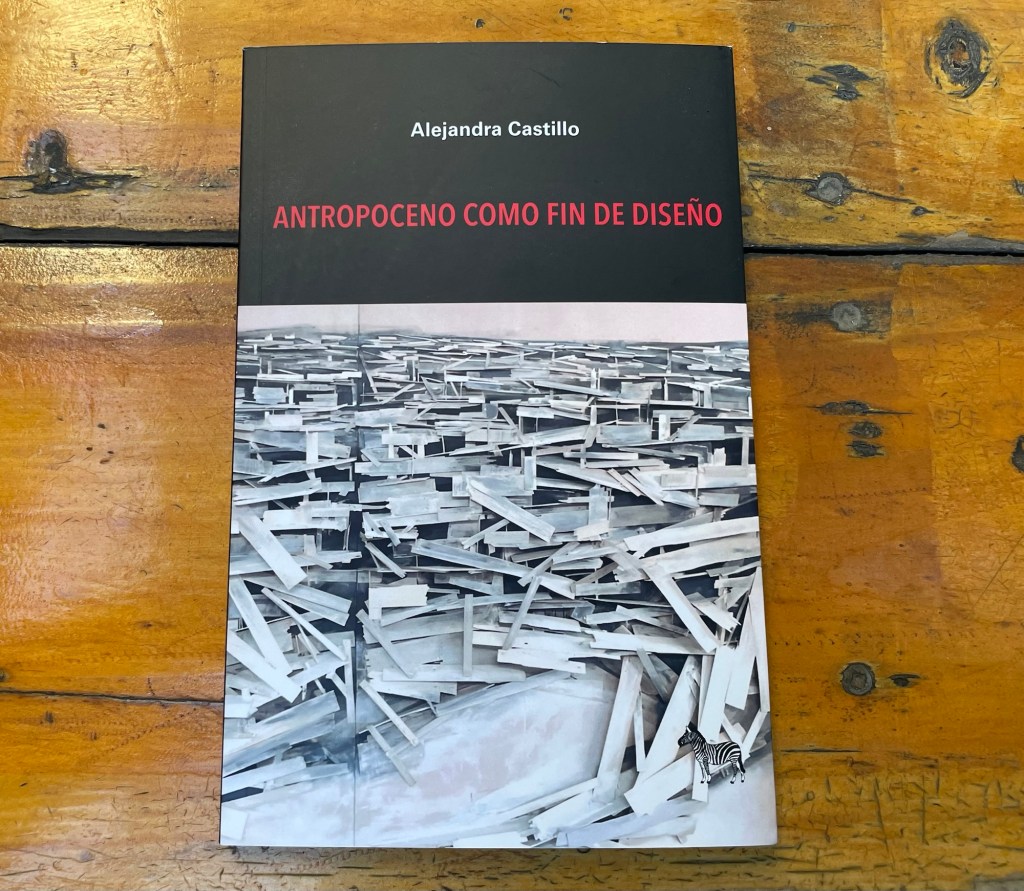
Only in rare occasions the operation of thinking finds angular or lateral points of escape. This is the gesture that characterizes Alejandra Castillo’s theoretical writing, and is particularly bright in her most recent book Antropoceno como fin de diseño (La Cebra, 2025). The zigzagging entry is an intuition that is also a guiding thread: the force of real subsumption of capitalist domination depends on the operation of design. Of course, in design one hears not only blueprint and form, but also designation, and thus the specular regime of visibility, orderability, quantification. It is the world of physiocratic forestry. In fact, Castillo’s succinct definition of the metapolitical condition of design is offered to the reader at the entrance: “Design is the figure that thinks always in advance (por adelantado) (Castillo 12). Design calculates and locates. It is through the operation of design that legibility becomes adequated to political representation so that the state can manage and attenuate the deployment of its forms and the circulations of relations of totality (Castillo 13). The design is what is common to the worker, the engineer, and the lawyer. This is why design for Castillo design is an efficacious nexus that connects the separation of objectivity and the life worlds. Understood in this sense, “design” is analogous to the enframing of the world that intensifies in the age of technology and rhetoric. But in the watershed of the end of modernity, the hegemony of design collapses, while it becomes a temporal “self-design” submerged in all spheres of expressive enactments.
The end of the second vector of the zigzag outlined in the essay is found precisely at this conjuncture: the anthropocene brings the humanist projections and design to a final wreckage. This is means that capitalist form is not formless because it has managed to subsume the time of life as exception to labour; time is a wreckage because design no longer coincides with the world of forms, as it has temporalized experience into total transparency without reminder. For Castillo this means that in the anthropocene there is no longer “struggle for visibility”, as everything has been rendered exposed and hollow; de-substantialized in the very fabric of subjectivity (in the early millennium some called this new hyperbolic figure the Bloom). Implicitly in Castillo’s writing is the assumption that the mediation between politics and design has been severed, and the new securitarian imperium can only immunize itself against the very site that in modern times granted its legitimacy (civil society, constituent power) (Castillo 37).
The end of design means the absolutization of design, a new carceral imperative for adaptation that makes any claim to subjectivity an endorsement of the prison of the ego. To live in a post-designed unworldly condition means not only to come face to face with the homogenous space of cultural exchange into image; it is also a new imperative that requires that “you must submit, without knowing to what; subject to what is the case anyway, and which, as a reflex to its power and commonsense, everyone believes anyway” [1]. The end of design paves the way for new plastic forms of domination towards an integral planetary unity.
Bordiga claimed throughout his work that the democratic design was perhaps the best fitting system for the versatility of capitalist accumulation and relentless expansion. This is why in all the political cases that Castillo introduces in a text in a manner of a shadow play do not pretend to offer a new theory of ideology, but rather show how democratic design is a one-piece suit that fits all without any needs for “ideal types” to fix normativity and institutional arrangements. Indeed, there is no longer anything like an “extreme political right” – and this is just a tweak from Castillo’s vocabulary, who does insist on the term throughout the essay – but rightward figures of the political that desperately cling to any form to distract from the abyss of social legitimation. Ultimately, the ruling over this void will be – in many ways already is – the continuation of war in the social fabric; and stasis will require new stealth development of technologies of containment that Palantir’s Alex Karp has called the new “lethal form”. This means that democratic design is not only expressively a system of sentencing to death; it is in virtue of the exchange of social forms, an inverted negation of human finitude. The point of despair would incite some to look again in the cabinet of forms; a knee-jerk reaction to the irruption of the Anthropocene against the total sum of possible designs.
Of course, this is also what Alejandra Castillo’s Antropoceno como fin de diseño (2025) avoids at all costs. Towards the last pages of the book, Castillo calls for a transformative turn that departs from the body; a corporeal insurrection that, in refusing the rectilinear and heteronormative political corpus of the modern epoch (no coincidence that Hobbes was both the founder of the autonomy of civil as well as of the physics of the body of matter in space), is capable of responding to the call of the anthropocene in all of its profuse conflictivity. Castillo proposes the necessity to gravitate towards a “maximum distance” against the general design of orderability of public domination (Castillo 77). But this can only be understood as an incommensurable distance that dissolves the ontotheological separation of subject and object of the state of confinement.
The political constitution of a corpus appears as the promise of an exit from the temporalization of the post-auratic literalism that, according to Michel Fried, dominated the structure of the object-oriented work of art, as compensatory to the corrosion of political forms and presentist autonomy [2]. Castillo does not seek to revive a last gasp of auratic objectification, which amounts to the sleepwalking condition of the image world of mere survival. In soliciting a maximum distance to what is closest (in fact, a body), Castillo invites us, as both promise and commitment, to think at the end of nondependency – not the “independence” that carries the traces of the fictitious individuality- from the crutches of design to finally conquer another liberty beyond terror and prevention; a life imbricated in the nonbeing of place (ecology) with others.
.
.
Notes
1. Thedor W. Adorno. “The Cultural Industry: A Resumé”, in Without Model (Seagull Books, 2023), 58.
2. Michael Fried. “Art and Objecthood”, in Art and Objecthood: Essays and Reviews (University of Chicago Press, 1998), 172.

 Infrapolitical Reflections