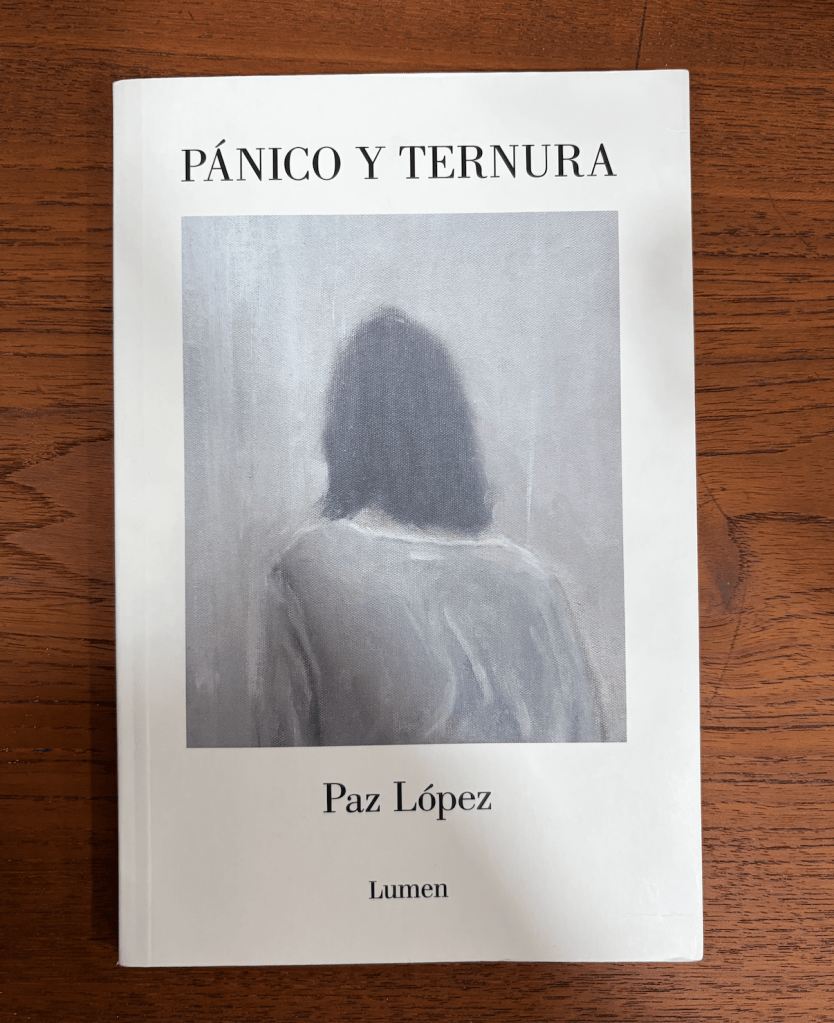
Paz López’s Pánico y Ternura (2026) opens with an analogy between life and school that immediately places us in attention to her writing: “Entramos a la vida como entra un niño a la escuela: mirando hacia atrás, con los ojos llorosos buscando la mano de quien hace un rato nos había variado el pelo, la nariz, las rodillas heridas, los diminutos labios” (López 14). Although the synecdoche (“la mano”) does not reveal to whom it belongs, in a way the mother is spectrally present, a figure overtly present in Paz’s writing. We enter life in the wake of separation and caesura, and that is the site of the original wound that will lead to all sorts of civilizational and mimetic compulsions that unfortunately we know too well. And yet, López does not say we enter the “law” (although this is also presupposed of course), but rather we enter school. Our civilization has slandered and tainted the notion of “schooling” and “school” to such an extent that we have entirely forgotten the fact that school is schola; that is, time of rest and interruption, “free time”, a lagging duration of contemplation of language and being, and of being in language. And if the notion of “school” is under ruthless attack in our present by an infantry of pedagogues and technicians, it is mainly due to the fact that what is being threatened is the very possibility of a form of life. Of course, our epoch is one in which the chatter of “life” is continuous and intoxicating, but the form of life is something altogether different: it entails to inhabit a space of a convergent and planar movement between language and world.
This is one of the regions that opens in López’s book; one out of many, allow me to follow it. As López says toward the end of the essay: “…cada vez que hay un corte tenemos la posibilidad de inventar una nueva lengua, de poner de movimiento el mundo” (López 128). It would be too convenient to follow up this claim and say that this is precisely what Paz López does in her writing; clearing language in order for a tonos or a vibration of the voice to unearth tropes that have been traced almost at the level of the flesh. This is something to this autographic practice that moves gently without fetishing the body and its materiality. Ultimately, a body is always more than surface. I want to retain from López’s scene of writing a responsive form of thought that in its inconspicuous relation to writing it refrains from the certitude of both philosophy and the letter. López’s search could perhaps be one of “tanteo”, a beautiful Spanish verb that refers to the hand that seeks and reaches out for something in space, and in my memory it immediately recalls some short stories of Carmen Martín Gaite’s fiction where this gesture figures in a cinematic fashion. Hence, for López ‘tanteo’ is to refuse the hell of a world of acrimonious security and confirmations that discards the inexorable presence of doubts and fissures (López 39). But the hand that seeks is also not a pure gesture in the void; it is one that asymptotically discloses an erotic mediation with the passing world without ever abandoning it; yet unequivocally assertive in the lamentation of the state of the world (López 56).
In other words, because we can seek (here López is enrolled in the school of Hölderlin), there is no end to the world now configured as a fragile fishing net of relations, unsaid words, glances, and incommensurable distances that make up, without exhausting it, the spectacle of life. Not “this life”, of course. For López, the brutality of our times (I am less prudent and I will say ‘onto-theology’) is precisely the general concerted opinion that we are all owners of our own little and mediocre lives, the last avatar of a self-serving will to power. Rather, for López life is always elsewhere, and this is why the “escape” or “exile” from oneself is not a place of arrival or destiny, but precisely the disposition that is always traversing every relation and every touch between bodies and souls (López 65). We are creatures of the outside, and by extension, only the cohabitation of the outside, can redeem the pain of the original laceration, as in the first image of the infant walking his path to school with his eyes turned. This is not a messianic or monastic retreat, it does not depend on the parousia, but rather one of poetic dwelling in the spaces that are both familiar and strange. It is only in them (through them) that we can only cultivate through the garden of our language. López’s anti-messianic orientation, devoid of the fiction of future time and its anxieties, is proportionally a prose of hanging spaces, of curvatures of language that affects the reader deeply without ever renouncing to the beauty that thinking that defies being brutalized through the crushing weight of technical terms or philosophical concepts.
In this sense, López’s writing is already an autographic writing at the threshold of onto-theology convinced that only style through the resources of the voice is the path that mitigates between poetry and philosophy, painting and memory, experiences and the unlived. López’s prose, if anything, is a lot about “gathering” through the tenderness; a contact where image and eros become the medium of life: “No es eso también la ternura, una forma de “recortar nuevos espacios en el vacío informa del exterior y conquistarlos a la medida de la vida (Claudio Magris)?” (López 94). To gather and to cut through the spaces: this is the highest task of the ethics of a form of life that requires a new theology of the sensible. Theology can be taken as a strange word in López’s lexicon, and I do not think that it appears even once in Pánico y Ternura. And yet, López’s proposal is completely theological if we take the theos as the highest and most beautiful light that can nominally allow for depth through the analogy of things in the net of the world. Hence, the importance of the sighting to the inner most depth in some moments of López’s writing, such as when she ponders on the fact that every time that she plunges eyes on a minuscule element or figure of the world, she senses that “se revela el elemento bestial que se enceuntra en el centro de nuestro mundo, como si la mirada fuera un cordon umbilical….amarrados todavia al vientre brumoso del origen” (López 121). And theology is not just the highest, but also the science of the first things: through the piercing expression of our senses, we elevate ourselves not with some revealed transcendence, but with the proximity with the things that have found us.
And yet we have been automatized – this is the sensible devastation that Pánico y Ternura is responding to without ever taking a political stance, because politics is thoroughly insufficient – to see every-thing, and every being at all times; all entities realized in the feast of interchangeability and availability. The heliotropic force of modernity now truly blinds and burns our skin, which means that no access to the solar totality of social existence can guarantee anything except continuous conflagration and commanded muteness. We cannot but feel “panic” in this current predicament López is completely right. Thus, we must find the flickering light and flames elsewhere, such as in the lamp of a dark night that can illuminate the page of a book that keeps us in attention without any real purpose. Nabokov’s suggestion comes to mind: in the lamp of our study, we reject the nihilist demands of the cacophonous social world. Paz López has given us a delicious essay to read under this tenuous light. It is a present memory of an abode that keeps the secret of secrets, a resting place of the soul where still some melody is heard.