
In one of the glosses in Marginalia on theology, Erik Peterson provides a remarkable pictorial image of thought of death and resurrection through the activity of washing a bowl. Peterson writes: “When washing a dirty dish, our thoughts may turn to the dead, to the dead as a genus, as an inferior genus that perhaps unconsciously influences our actions, as angels and demons do in another way. This probably happens because the dead have something in common with dirty, unclean dishes. Imagine this cleanliness however you like: perhaps we can say that death as such is an act of purification. To think of death in this way, endowed among things – like a bowl – gleam just like the voice of god in the bush” [1]. It is a fragment where Peterson comes closest to the specific nature of painting: what is painting if not the transference of muteness to the gleaming of the visible that opens before our very eyes? And like the divine voice in the bush in Exodus, what does it take to grasp and see the divine between or behind a dirty bowl as it lays on our hands? If washing a dirty dish entails receiving the dead in our thought, the passive act of painting seems always to lay a claim about the mystery of presence outside language.
If I elevate Peterson’s remarks to a terrain that the one that he intended, is connected to two Vermeer’s pictures exhibited these days at the Frick Collection gathered around the theme of “letter writing”. In both pictures there is a lady seating at a table drafting a letter – one of them has already concluded it fully attentive to the visitor on her right side; the other a maid gazes at an open window – but what is always unnerving in Vermeer’s work is the sense of the ineffable and impenetrable in the disclosure of the picture (an exposure that that is usually aided by a side curtain that welcomes us in). What is this impenetrable divinity that lurks in Vermeer picture in pure presence? Although we do not have a name for it, it is like the god that dwells in the dirty bowls or in the nocturnal bushes of Peterson’s gloss.
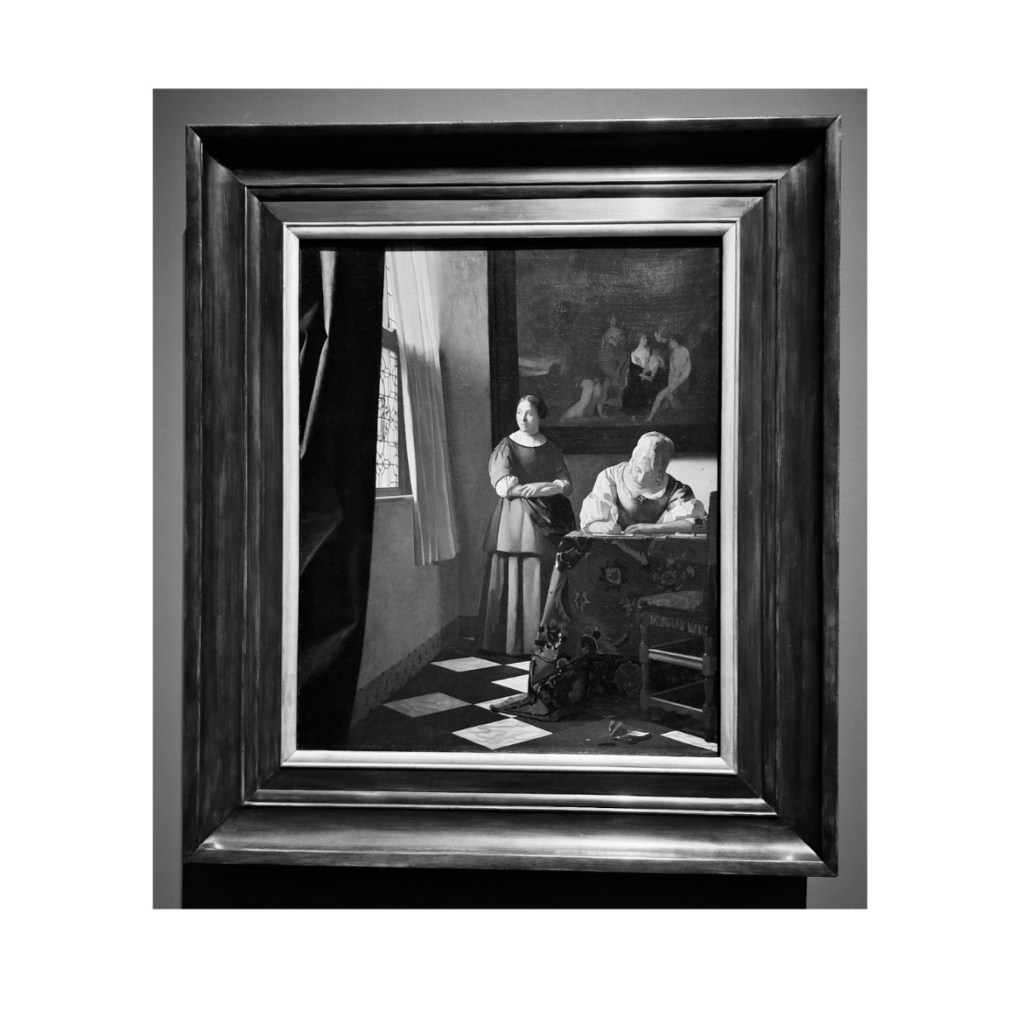
The painting does not speak in revealing, it only bear witness of the absolute fall of language as it becomes imperturbable in the picture. Contesting the vulgar interpretations on Vermeer’s Catholic conversion in Delft, Daniel Arasse notes that the vortex of his pictorial theology is bounded to the threshold in which images become alive (in the tradition of au vif) outside itself: “Vermeer’s painting are constructed such a way as tho render this life equally present inaccessible, near and impenetrable. What is seen is not a crete of nature observed, but a mystery within the painting itself” [2]. In Vermeer’s pictures, presence and the invisible collapse not through the inception of a metaphor of nature, but rather through the painting’s light when it casts a shadow beyond any instance of closure.
This is why in Vermeer’s paintings surfaces mandate an order of theatrical presence, while simultaneously making room for a perturbance that is forever barred from the conceptual. Unlike Giorgione’s “Three Philosophers”, Vermeer’s pictures are not endowed by the mysterious force of an alienated nature that man can measure and master; rather, the mystery resides in the whispering of the invisible that cosigns the amoris causa of the appearance of painting. If for Peterson what gleams in the dirty bowl is the cleansing of resurrection; what befalls Vermeer’s pictures can only be understood as the faith in the painterly emergence of appearance dependent on the path opened by its light.
The question of god as appearance is always posited as a challenge to the meaning of reality as totality no longer as what emerges in the open, but as what which retracts lagging behind. And we know that only appearance is seductive enough to stand for faith well beyond the fact of being visible [3]. Hence, a way to supreme subtlety of painting (picturae summa subtilitas): no longer a matter of perspective and contour, but of the mysterious indiscernibility that mounts depth between vision and the divinity of presence.
.
.
Notes
1. Erik Peterson. “Fragmentos”, in Tratados Teológicos (Ediciones Cristiandad, 1966), 251-252.
2. Daniel Arasse. Vermeer: Faith in Painting (Princeton University Press, 1994), 75.
3. Consider Heidegger’s response to a question in the Zurich Seminar, 1951: “If I were yet to write a theology then the word ‘being’ would not be allowed to occur in it. Faith has no need of the thinking of being. If faith has recourse to it, it is already not faith. I believe that being can never be thought as the ground of God”. Séminare de Zurich (Paris, 1980), 60-61.
 Infrapolitical Reflections