Vermeer’s weightless scales. by Gerardo Muñoz

Vermeer’s “Woman Holding a Balance” (1663) has been read as an allegory of the Final Judgement for very obvious reasons. The painting within the painting on the foreground embodies a traditional representation of the Last Judgement for the saved and the damned. But how are we to mediate between the painting in the painting and the activity that is taking place in the mute and contemplative woman that is holding a balance with her right hand? Advancing an interpretation that departs from the coins placed on the table, Herbert Rudlolph’s important thesis suggests that exchange and equilibrium is taken place at once; a movement that allows him to favor the narrative of vanitas that would have been immediately diaphanous to the spectators of his time, especially the growing Catholic community of Vermeer’s Netherlands [1]. 

The picture shines with religious piety and depth, and yet it is a work of interiority that Vermeer has notably chosen to deprive of an explicit iconographical assertion in its main figure. Could it just be a visual representation of Loyola’s  Exciertia spiritualia (1548) that recommended to be “like the equivalent scales of a balance ready to follow the course which is more for the glory and profuse of God, our Lord, and the salvation of the soul”? [2]. What are the instances of balance in the picture that would justify such a singlehanded transposition into the picture? If painting is anything, it is precisely what carries an excess to narrative and iconology. And this is what we should be interested when looking attentively to the picture. The vortex of depiction is the event that falls outside the concept through which we are attempting to arrest the meaning of a picture in its manifolds historical subtleties. 

If taken prima facie “Woman Holding a Balance” (1663) is representing a combination of the embodiment of justice and judgment, what remains an enigma is precisely the fact that the balances are empty, as is evacuating the act of weighting the unequal units of weight. In the graceful hands that hold up the weightless balance, Vermeer has given us something like an image of the suspension of judgement, and in this way, communicating esoterically with the Last Judgement that looms heavily on the foreground. Whereas the allegorical representation of the last judgement is reminiscent of Van Eyck’s “Last Judgement Diptych” (1430), the female figure appears to us in an experiential graceness restrained from any transcendence; as if only sub specie aeternitatis time had come to a halt at the very contemplative motion of her inexpressible being.  Her presence recalls Kafka’s assertion about the temporal fixation of judgment: “It is only our conception of time that makes us call the Last Judgement by its name; it is a kind of martial law” [3]. 

The nullification or void in the balance inscribes this ex tempore suspension in the sequence of historical time of salvation that subordinates faith to history oblivious to the fact that life without judgment is also an instant of faith. As Felix Weltsch, a theologian that was very close to Kafka, thought in an important work: faith is a process that overcomes itself by creation; it is not a force of judgement and belief, but the the subsumption of existence into what which already is [4]. Or, in the words of Kafka, closely following the steps of Weltsch: “faith means emancipating oneself: being indestructible or better: being”. Faith has been transfigured as a transmission of what now is the emergence of appearance as the event of life. Fleeting and yet irrevocably unbending, what appears is both incommensurable and sensuous.

After this detour, if one goes back to Vermeer’s picture, what does one see? Definitely, not an instance of allegorical portrayal towards the transcendental expectation; rather, this is an image where theos has become a presence because it is enacting the faith of being in the withdrawal of God. This invisible, and yet sliding retreat is rendered visible by the emptying of a balance that is no longer posited as judgement of post-Edenic life towards salvation; it is the opening of space that upholds life because it no longer surrenders to the martial court enabled by time. When judgement unfolds into the indestructible and visible ‘lunatic strength of faith’, to use Kafka’s singular expression, then we are entering a living grace that is only attuned to the eternity of its appearance. And is not this another way to define the emergence of painting, after all?

Against what contemporary jurists’ formulations about pondering and weighting of rights as the ideal of the rule of law; the figure of thought that emerges in the picture is that justice is neither scalable nor measurable, but rather a motionless state of grace that can only be contemplated in the mystery of life. The emancipated life staged in Vermeer’s “Woman Holding a Balance” (1663) holds an inconspicuous eloquence that knows neither waiting nor judging, because its imperturbable state is beyond all consolation. 

Notes 

1. Herbert Rudolph. “Vanitas: Die Bedeutung mittelalterlicher und humanistischer Bildinhalte in der niederländischen Malerei des 17”, in Wilhelm Pinder (Seemann, 1938), 410.

2. Gregor Weber. Johannes Vermeer: Faith, Light, and Reflection (Rijksmuseum, 2022), 127.

3. Franz Kafka. The Aphorisms (Princeton University Press, 2022), 82. 

4. Felix Weltsch. Freiheit und Gnade (Kurt Wolff, 1920), 10.

Hypocrisy as last refuge. by Gerardo Muñoz

In an entry of Dopo Nietzsche (1974), Giorgio Colli states that after the overcoming of all values and taboos, the contending moral strife finds its highest value in hypocrisy. Colli goes on to say that “hypocrisy is the last bastion where moral forces have found their refuge” [1]. One can clearly see that for Colli hypocrisy as the highest value is quite distinct from morality, since it is the “refuge” where the contending moralities invest themselves in rhetorical encroachment. That hypocrisy has become – as Colli saw with clarity in the 1970s – the last alcove of humanity, means, for one thing, that the human species have ceased to have any faith in the language that they use, and that for this very reason there is only an estimation of rhetoric, procedure and technical terms abstracted from the sensible world. If understood as such, it would come to no surprise that the majority of public institutions in advanced societies are embracing, and for the most part promoting, the incorporation of Artificial Languages and Intelligence to organize the interactions of their lives. Ultimately, the order here is clear: it is not that new technological advances will lead to a rise in untruthfulness; rather, these instrumental mutations are a consequence of the deep hypocrisy that runs through the social bond.

In fact, one can only assume that Colli was pointing at something more profound and obscure in his gloss when he referred to hypocrisy as the last refuge, and in this sense he was pointing beyond Nietzsche. After all, Nietzsche understood hypocrisy as mimesis and appearance that if incorporated over a long period of time ceases to be hypocrisy to become real [2]. A series of good acts and deeds in the spirit of friendship makes a person benevolent. In the same way that Miguel de Unamuno’s San Manuel Bueno Martir through his public faith and habits, was a symbol of Catholic faith for all the believers of his tightly knit community in spite of his interior doubts (this is the Knight of Faith). Now, Colli is pointing to a second degree hypocrisy that is no longer explicated by mimicry, but by its dependence to an ethereal value that governs and justifies any set of given actions. The actions are no longer in relation to faith or non-faith, but are properly acts of “bad faith”, since they make belief captive to the justification of the highest moral value. This will be consistent with Nicola Chiaromonte’s description that the end of secularization is not an epoch lacking faith, but one that dwells in “bad faith”. 

And what is ultimately “bad faith”? It is the realm of hypocrisy that, due to its impossibility of communication, understands its mission waged on the petty negation of one value over another. It is a mutation of Goethe’s nemo contra deum nisi deus ipse into the sphere of prevailing forces. The civilizational stage of enlightened hypocrisy prepares the human being to renounce the use of language and unmediated appearance. This means that the triumph of the technoadministration of the world would not be possible without the alluring refuge of hypocrisy that conquers reality through the very means that renders inaccessible the real presence of the world. It is not that politics and politicians have become hypocritical; it is that politics can only subsist thanks to its refuge in hypocrisy. The hypocrite is the last figure that steers in unworldliness.  

Notes 

1. Giorgio Colli. Dopo Nietzsche (Adelphi Edizioni, 1974), 50.

2. Friedrich Nietzsche. Human, All Too Human (Cambridge U Press, 1996), 39-40.

God behind painting. by Gerardo Muñoz

In one of the glosses in Marginalia on theology, Erik Peterson provides a remarkable pictorial image of thought of death and resurrection through the activity of washing a bowl. Peterson writes: “When washing a dirty dish, our thoughts may turn to the dead, to the dead as a genus, as an inferior genus that perhaps unconsciously influences our actions, as angels and demons do in another way. This probably happens because the dead have something in common with dirty, unclean dishes. Imagine this cleanliness however you like: perhaps we can say that death as such is an act of purification. To think of death in this way, endowed among things – like a bowl – gleam just like the voice of god in the bush” [1]. It is a fragment where Peterson comes closest to the specific nature of painting: what is painting if not the transference of muteness to the gleaming of the visible that opens before our very eyes? And like the divine voice in the bush in Exodus, what does it take to grasp and see the divine between or behind a dirty bowl as it lays on our hands? If washing a dirty dish entails receiving the dead in our thought, the passive act of painting seems always to lay a claim about the mystery of presence outside language. 

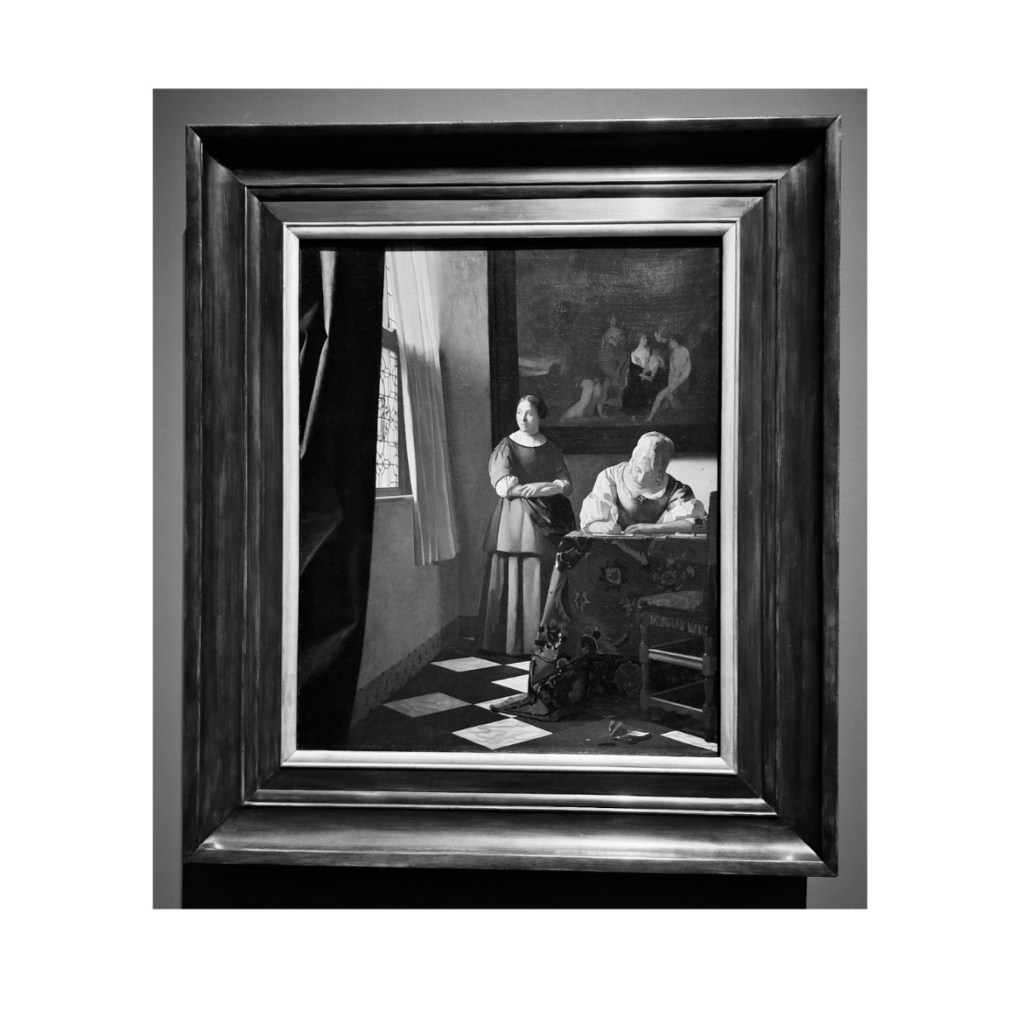
If I elevate Peterson’s remarks to a terrain that the one that he intended, is connected to two Vermeer’s pictures exhibited these days at the Frick Collection gathered around the theme of “letter writing”. In both pictures there is a lady seating at a table drafting a letter – one of them has already concluded it fully attentive to the visitor on her right side; the other a maid gazes at an open window  – but what is always unnerving in Vermeer’s work is the sense of the ineffable and impenetrable in the disclosure of the picture (an exposure that that is usually aided by a side curtain that welcomes us in). What is this impenetrable divinity that lurks in Vermeer picture in pure presence? Although we do not have a name for it, it is like the god that dwells in the dirty bowls or in the nocturnal bushes of Peterson’s gloss.

The painting does not speak in revealing, it only bear witness of the absolute fall of language as it becomes imperturbable in the picture. Contesting the vulgar interpretations on Vermeer’s Catholic conversion in Delft, Daniel Arasse notes that the vortex of his pictorial theology is bounded to the threshold in which images become alive (in the tradition of au vif) outside itself: “Vermeer’s painting are constructed such a way as tho render this life equally present inaccessible, near and impenetrable. What is seen is not a crete of nature observed, but a mystery within the painting itself” [2]. In Vermeer’s pictures, presence and the invisible collapse not through the inception of a metaphor of nature, but rather through the painting’s light when it casts a shadow beyond any instance of closure.

This is why in Vermeer’s paintings surfaces mandate an order of theatrical presence, while simultaneously making room for a perturbance that is forever barred from the conceptual. Unlike Giorgione’s “Three Philosophers”, Vermeer’s pictures are not endowed by the mysterious force of an alienated nature that man can measure and master; rather, the mystery resides in the whispering of the invisible that cosigns the amoris causa of the appearance of painting. If for Peterson what gleams in the dirty bowl is the cleansing of resurrection; what befalls Vermeer’s pictures can only be understood as the faith in the painterly emergence of appearance dependent on the path opened by its light.

The question of god as appearance is always posited as a challenge to the meaning of reality as totality no longer as what emerges in the open, but as what which retracts lagging behind. And we know that only appearance is seductive enough to stand for faith well beyond the fact of being visible [3]. Hence, a way to supreme subtlety of painting (picturae summa subtilitas): no longer a matter of perspective and contour, but of the mysterious indiscernibility that mounts depth between vision and the divinity of presence.

Notes 

1. Erik Peterson. “Fragmentos”, in Tratados Teológicos (Ediciones Cristiandad, 1966), 251-252.

2. Daniel Arasse. Vermeer: Faith in Painting (Princeton University Press, 1994), 75.

3. Consider Heidegger’s response to a question in the Zurich Seminar, 1951: “If I were yet to write a theology then the word ‘being’ would not be allowed to occur in it. Faith has no need of the thinking of being. If faith has recourse to it, it is already not faith. I believe that being can never be thought as the ground of God”. Séminare de Zurich (Paris, 1980), 60-61.

A Peitho relief. by Gerardo Muñoz

There is a small marble Roman relief of Peitho (it is about 15” x 5” wide) of what used to be a larger decorative plate illustrating Helen being persuaded by Aphrodite to accept her husband’s voyage to Troy. The personification of Peitho in the form of a seating lady accompanying Aphrodite is not rare in classical representation, and if we are to follow Friedrich W. Hamdorf’s genealogy, it was actually the norm when it came to visual depiction of the deity [1]. What is striking in this Roman relief of Peitho is precisely the unassuming silence of the figure, who is merely gazing down and touching a dove or bird with her right hand and sunk in thought. Is not this mystical silence what bathes the mythical figure of Peitho, which according to Euripides has no other sanctuary than that of language?

The Peitho relief stands as a fragmentary of an ancient memory where the event of language implicated persuasion instead of commanding; a sensibility of saying instead of legitimate validation; granting space for the poetizing in the world instead of rationalizing, in the advent of the polis and the bios politikos, the transcendental condition of the political community [2]. Peitho will become rhetorical once it has taken the autonomos form of the transaction and the mutilated word by which nothing is ever said except a lethargy of the immanent movement of the logos. In the Roman relief Peitho does not communicate because she dwells in the poetic lacuna of language. 

In fragment 81 of Aeschylus’ Niobe we read a mysterious outline of Peitho: “Death desires no gifts; one can gain nothing by making sacrifice…from him, alone among divinities, Persuasion stands aloof.” The ossification of language in hand with the general autonomization of rhetorical separation, in the words of Gianni Carchia, will mark the destitution of Peitho’s poetic magic allowing death to speak through the fierce instrument of demagoguery and and the production of justifiable certainties [3]. In a world without the irruption of the mythic-magical element personified by Peitho, there is only general declensions towards persuasion as a form of predication: to convince, to obey, to follow, and to concede belief as persuasion was transformed linguistically [4]. It is no surprise that the civilizational decline of the mythos of Peitho coincides with the rise of the rhetorical techné that guaranteed the autonomization of the world (private & public, appearance & truth); but, most fundamentally, the stabilization of the resource of rule-based lexicon as the dominion over exteriority.  

Even the Sophist Gorgias in his Encomium of Helen defines Peitho as “Language is a power ruler who with a tiny and invisible body accomplishes deeds most devine” [5]. The process of deification of language (in the sense of the sources of archê) can topple the divine in order to mobilize all the energies no longer in the “uninterest encounter between souls” (Carchia’s words), but rather by grounding a necessity that, first and foremost, establishes its ontological solvency in the unending rhetorical polemics. As the sensible myth of Peitho withers into organized grammar and rules of predication, it is noteworthy to recall that in the monotheist tradition the organization of the invisible in becomes colored by “faith” in the law. 

This could explain why Saint Paul seemed to have made a conscious attempt to oppose any remnant of the Hellenic persuasion (πειθώ) in favor of “demonstration of faith” (ἀποδείξις). As we read in Corinthians 2:4-5: “My words and proclamation were not based on the persuasion (πειθώ) of wisdom, but on demonstration (ἀποδείξις) of the Spirit and power… that your faith would not be  based on human wisdom, but on the power of God. Indeed, “apodeixis” (ἀποδείξις), the word deployed by Paul, will guarantee persuasion only in revelation and the Christian philosophy of history; meaning that Peitho will remain, like the Roman relief from the First Century, a mute aesthetic artefact and a petty reminder of the expulsion of ethōs from language. 

Notes 

1. Friedrich W. Hamdorf. “Peitho”, in Griechische Kultpersonifikationen der vorhellenistischen Zeit (Zabern, 1964), 64-65.

2. Francis Kane. “Peitho and the Polis”, Philosophy and Rhetoric, Vol.19, N.2, 1986, 118.

3. Gianni Carchia. “Eros y Logos: Peitho arcaica y retórica antigua”, in Retórica de lo sublime (Técnos, 1994), 23-24.

4. María Dolores Jimenez López, “‘Persuadir’ en griego: el marco predicativo de peitho”, in Word Classes and Related Topics in Ancient Greek (Peeters Louvain-La-Neuve, 2006), 175-176. 

5. Gorgias. Encomium of Helen (Bloomsbury, 2008), 44.