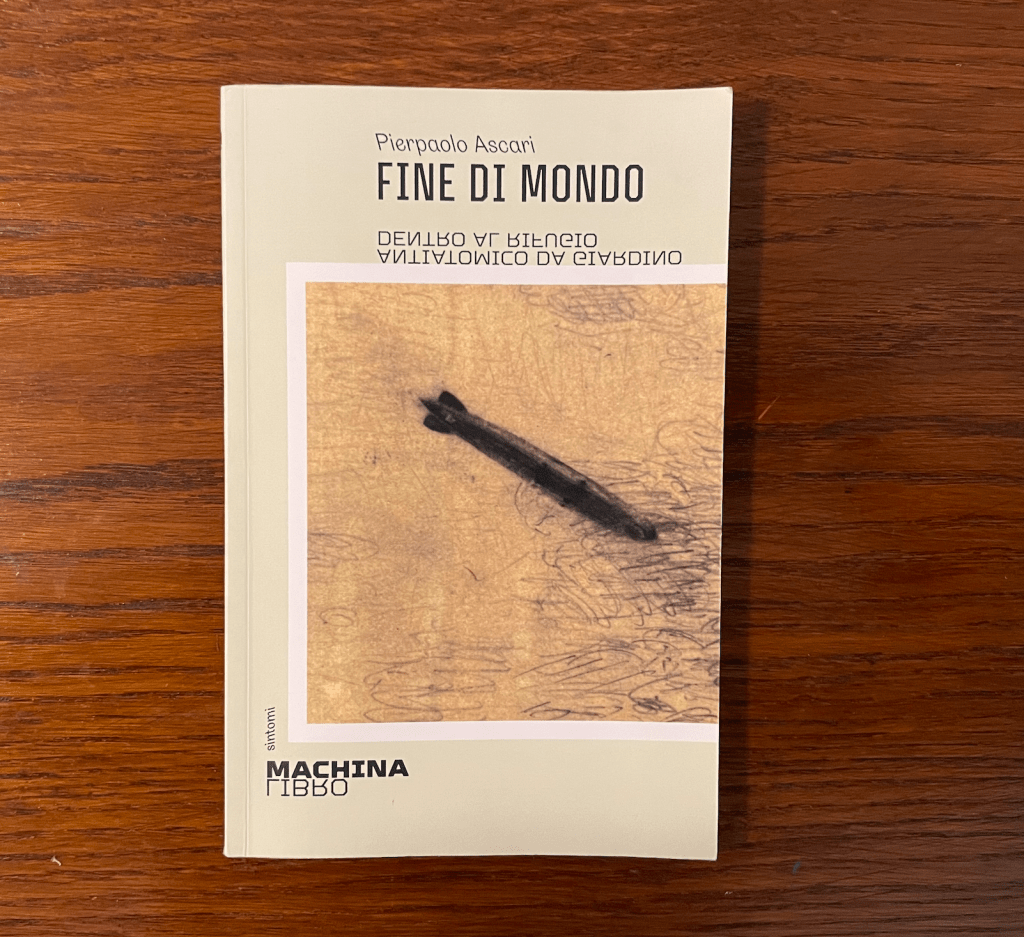
Pointing to a methodological clarification, Pierpaolo Ascari’s Fine di mondo: dentro al rifugio antiatomico da giardino (DeriveApprodi, 2024) opens with an untimely advice: the threat of atomic extermination of human life can only be told and appealed through the irony deployed in all areas of consumerist culture. Undoubtedly, this fits pretty well to the case on point, since American modernization is both the hotbed of Hollywood and the atomic bomb, two poles of the regime of a vicarious life consisted with Henry Adams’ well-known assertion that, in spite of everything, America civilizational passion has always been generalized optimism. And it is not surprising that Stanley Kubrick, when asked about the thesis of Dr. Strangelove (1964), also claimed that the only possible form to tell a story about the bomb of total extermination was through a black comedy (Ascari 11). This self-serving optimism is tested in Ascari’s Fine di mondo (2024) by looking at the construction of an apocalyptic underworld fantasy; that is, in the garden of anti-atomic sheltering that reveals the true arcana of modern Americanism as a subterfuge – but also a civil current in plain sight – parallel to the rise of mechanized labor under the conditions of the triumphant Fordism. Of course, now that our farewell to Fordism has been longed trumpeted, it does not take much to see that what remains is the infrastructure of schizophrenia and general terror in the social fabric that colors the specific tune of American apocalypticism. Ascari’s book is a superb elaboration of this tonality as historically rooted and articulated, but also open to its (pseudo)theological mutations undergoing in our present.
On the surface, Ascari’s Fine di mondo (2024) is a short compendium of the civil responses and techniques towards atomic destruction and survival; but, more deeply, is also a history of Americanism as a historical project committed to a long process of civil domestication, enclosure, and endurance of survival. Of course, the nuances here are important to grasp the subtle hypothesis of Ascari’s working scene, since we also know that modernity at large (considering both its contingency and contradiction as features of its emergence) was also a process of an optimized gnosis through alienation and the enclosure of private property towards commerce stabilization and productive growth (the nomos). But for Ascari the specificity of the American nomoi through the lenses of atomic sheltering and refuge implies a microphysis; that is, a “way of life” validated through theological premises tailored in the organization of subjective deificatio (Ascari 23). This means that the apocalyptic apparatus driving American philosophy of history is not just one of realization towards the absolute objectivation of the world – even if such endeavor is necessary and preparatory – but rather that the sheltering and self-imposed domestication of human existence has become naturalized as a threshold of the conditions of finite human life. The paradigm of sheltering as the unit of survival is a form of self-regulation of grace that is consistent with the evangelical dispensationalism and technical election analyzed in Monica Ferrando’s recent important book.
The concrete examples abound in Ascari’s short but densely illustrated book: from the Civil Protection comic to the details of the emergence of “do it yourself” assemble manuals (discussed in the correspondence between Adorno and Sohn-Rethel); from the Hulk to Godzilla in a post-atomic bombed world; form the resilient speeches on atomic menace by JFK to a 1950s study conducted at Princeton University that reassured that “fathers” will get to know their children better in conditions of total sheltering even if it results in an “ethics of the jungle” (Ascari 34). Following Guy Oakes’ groundbreaking The Imaginary War: Civil Defense and American Cold War Culture (1994), what is distilled in Ascari’s pop culture puzzle is the panorama of the “Cold War” not as a war that did not take place between two imperial powers; but rather a total war that took place beneath the crust of the earth (and this is why the topoi of the refugee becomes so telling) and at the thicket of human existence waged as psychic management of the civil sphere. In fact, the “imaginary war” is nothing else than the stazion once social life that has yet to cease to exist in our days (Ascari 48-49).
For Ascari this implied an interiorization of the ‘sublime’ in the reification of the social fabric, which cannot be divorced from the lobotomized subjectivity of the crisis of “social man” that Gianni Carchia identified as the steering project of post-enlightenment Romantic negativity. In the turbid vaults of the self-made man we encounter the liquidation of everything that is living and the projection of fictitious death that clings into “salvation” in spite of absolute destruction; because, after all, those that survive total destruction are only there to confirm the soteriological greatness of the American destiny (Ascari 78-79). The thorough “Ubu” dimension of American psychic political power definitely speaks to this well sedimented conviction of sacrificial subjectivity. Who does not remember the glorious chants for resilience and isolation of the American political elites during the peak of the COVID19 crisis management? If it came to no one’s surprise that a large majority of Americans accepted the pandemic arbitrary rules (monetized whenever needed, it goes without saying), it was because the American subjectivity has been adapted for quite too long to the ongoing separation of refugee and domestication. After reading Ascari, in fact, we think whether the emergency policies were not just another episode in the history of American sheltering now extended at a planetary scale.
There is another idiosyncrasy to American apocalypticism that must be accounted for. And this is introduced towards the end of Fine di mondo (2024), when Ascari quotes Ernesto De Martino about nuclear war; mainly, that when it comes to atomic annihilation there is no longer the symbolic mythic-ritualistic process of reintegration, but rather the mere technification of the hand that gathers scientific knowledge in convergence with the death drive” (Ascari 81). In other words, this technico-apocalypticism brings to absolute unity the originary response of the human species (the movement of the hand) with the organization of scientific rationality that, like Günther Anders saw, brings no re-symbolization of the principle of reality, but rather it can only reaffirm the layering of the principle of reality to govern over it (Ascari 85). In a way, if it as if the essence of American apocalypticism is instituted as if beyond time, since the endurance of a “time of the end” means that the triumphant death (and the dead fueling the demagoguery of its process) foreclosing the symbolization without an exit. Indeed, an apocalypse without redeeming kingdom. For Ascari the only anticipation – primordial mechanism of anthropological capacity – is that of “money”, and hence the dominance of the principle of general equivalence entails gaining the temporal illusion of some distance from the ongoing production of death. But it is evident to anyone today, as it was said not long ago, that the true dead are those petit bourgeoisie living in the American suburbs. And they keep coming as the embers of domestic happiness try to ferociously shut down the latency of a piercing pain.
Yes, the nature of permanent apocalypticism confirms that the true and final object of techno-capitalist force has always been the possibility of multiple life worlds. And its erosion implies the endless possibility of ordering the life of the city, as Elon Musk just a couple of weeks ago told the former president of the Republican Party: “Hiroshima and Nagasaki were bombed and now they are full cities again. Yeah, it is not as scary as people think”. If the enterprise of civilization has largely been understood as springing from the crust of the earth upwards, one of the important lessons of Ascari’s Fine di mondo is that it trains us to look downwards and inwards as the cruxes of America’s persistent government over the garden of our souls.
 Infrapolitical Reflections