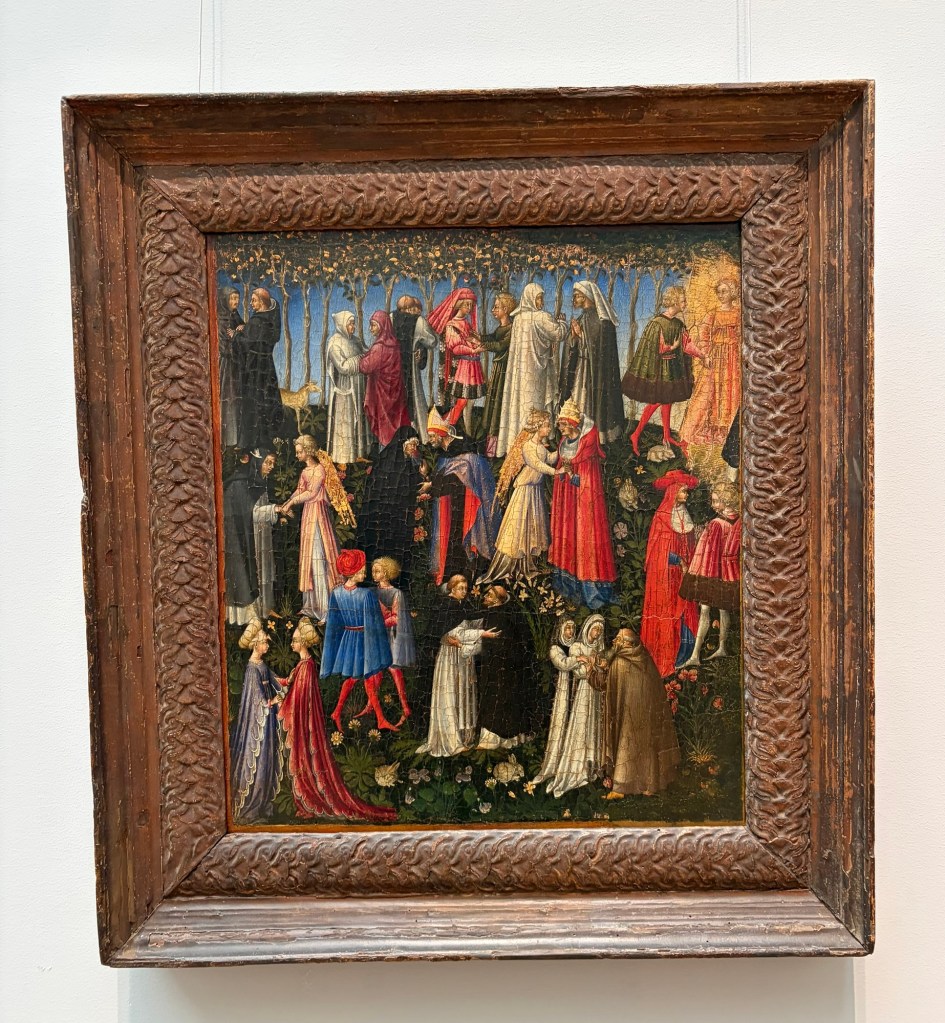
Giovanni di Paolo’s “Paradise” (1445) is a small scene once featured as a predella of an altarpiece from Siena’s San Dominica cathedral. Albeit its miniature proportions it is a striking image of Paradise that puts us in front of a choreography of encounters of the dead, as if the heaven was not a superior and separate stage of life in the cycle of salvation, but rather a continuous stretched territory that takes off where “this life” had left. In its rather simple and rhythmic composition, surrounded by citrus and vegetation, Di Paolo offers the viewer a state of paradise that is not about absolute bliss or bathed in irresistible enchantments, but rather something that in poverty reveals itself in proximity, literally face to face, with an other, perhaps a friend or lover. If we zigzag across the figures it is almost as if the picture would confirm Roberto Antelme’s intuition that “the only transcendence is the relation between beings”. And nothing else is the painterly texture of paradise beyond life. In this way, one can define the earthly paradise as a space where transcendence is dispensed because it primarily welcomes and senses otherness.
One of the striking details of the picture is precisely the positioning of the hands of each couple. Just take a second to gaze around them. These are hands that gesture towards a supreme affection; it is the hand that reciprocates and welcomes. It has been noted – for instance, in Berenson’s A Sienese Painter of the Franciscan Legend (1910), that Sienese painting of the fifteenth century introduced a new pictorial attention that manifested the coming to life of the spiritual. In Giovanni di Paolo’s Paradise the flickering hands, moving around the bodies, are perhaps signifying the initial touch of renewal between heaven and earth. In fact, it is almost as if the sliding of hands was the vehicle for the nongranular transition into the arrival of heaven. In a way of synthesis, one could say that paradise is always at the distance of the hand; which is why painting and happiness remain in an intimate dialogue regardless of themes or historical epochs.
And one can ponder whether the absence of paradise from imagination in the wake of the absolute intrusion of hell in reality, is not precisely a world where the incommensurability between hand, nature, and language become indistinguishable; the transparency of sameness in an expansive totality well beyond reach. To be in nearness is not just an ethical transcendence between beings, but ultimately allowing a divine region to flourish for possible encounters. This is why Angelus Silesius says that “nothing exists except you and I, without both of us then god would not be god, and the heavens will cease to exist” [1]. Paradise is, as Di Paolo’s painting reveals, not the utopia to come in another time, but the inconceivable place never fully detached from the experiences in this earth. As Karl Barth once wrote: “As the place of God in heaven is, of course, a place which is inconceivable to us. It cannot be compared with any other real or imaginary place. It is inaccessible. It cannot be explored or described or even indicated. All that can be affirmed concerning it is that it is a created place like earth itself and the accessible reality of earth which we can explore and describe or at least indicate; and that it is the place of God” [2].
This inconceivable place of God is the apocatastasis of what sorrounds us, of what has touched us, and of what we have touched; and this includes above all, the nexus of the living and the dead in a strenuous thought that gathers itself in what has loved. This space outlives the world of the living in order to express the divine that is, precisely, the unmediated appearance of each encounter. This means that painting paradise does not commission what a new life should look like as a way to overcome a previous existence of deficiencies and missed opportunities inscribed in felix culpa; what is recollected, and thus the only true apocatastasis, is a path to presence that knows neither end nor name that is self-contained in the ur-space of depiction.
.
.
Notes
1. Angelus Silesius. El peregrino querúbico (Ediciones Siruela, 2005), 2005.
2. Karl Barth. Church Dogmatics: The Doctrine of Creation, III (T&T Clark, 2010), 149.
*image. Giovanni di Paolo’s “Paradise” (1445), part of the Metropolitan Museum Collection.
 Infrapolitical Reflections