
The idea of a world state. by Gerardo Muñoz

As a theme for his 1949 Aquinas Lecture at Marquette University, an American scholar, Robert Hutchins, decided to titled his conference “St. Thomas and the World State”. It is obvious that Hutchins had fresh in his mind the fact that the long European Civil War of the twentieth century, which included two World Wars, was a direct consequence of warring nationalisms and militarized nations that in our times it is once again has lavishly returned with even higher lethal consequences. There is a major historical difference, however; and that is the fact that whereas the nationalisms of the twentieth century were distinct territorial struggles in the wake of crumbling empires, the emergence of the new nationalisms are concerted, nourished, and aligned to the global commanding American imperialism. The techno-political ideal of an influential figure on American elites such as Peter Thiel takes the form of warring nations and firms against the possibility of a global world state to secure peace, interdependence, and free movement of populations across borders and communities [1]. It is fair to say that contemporary technopolitical dominance is a combination of imperial and national forces through the perpetual administration of anomia or lawlessness. 

What is striking about Hutchins’ 1949 lecture is that although Aquinas’ philosophy of law has been traditionally understood as the most important source of natural law, in his proposal Thomas’ actuality is able to fulfill positive law against the instrumental morality of nationalist empires (the United States and the Soviet Union then) that “in the absence of positive law; they may be expected to break the peace” [2]. For anyone that knows the emergence of the European state as coterminous with the secular authority of legal positivism will find this emphasis contradictory at best. The very notion of positive law requires principles of sovereign authority and normative internal recognition of its command coordination in order to consolidate a stable political form over time. This is a contradiction that Hutchins was aware of throughout his lecture. Consider, as an example, when he claims that: “The origin and meaning of the saying that a state has the natural right to sovereignty therefore, is that one state may not forcibly impose its will upon another. It means that Catholicism should oppose the foundations of a world state by force” (36). 

Or, when glossing over the obvious tension between the right of national sovereignty and a potential international federal state in the views of popes and Catholic thinkers: “I think they know that the national state is no longer the perfect community and that positive law is required to make the world community an effective political organization. I believe that they are making two points that are of the utmost importance: first, they are saying that any world government must be a federal government; and second, they see that world must come into existence by consent and not by conquest” (34). However, any student of modern political thought knows that consent and coercion are two internal modalities of governance for legitimate rule. Hutchins’ notion of “consent”, along with positive law, remains not only unthematized, but dependent on a circular of definition of law; that is, the “common good”, which is not a political concept, but a theological and moral notion extracted from the philosophy of history of Christian salvation. 

Towards the end of the lecture, Hutchins goes beyond strict positive law as if searching for some substantive ground: “…the West should not only survive, but also revive and rescue a deeper conception of human civilization than the one recently current, which enters around a religion of progress by resourceful greed and technological mastery of non-human nature” (42). But Hutchins’ plea for the retrieval of a past memory of the West runs astray when it relocates Church and State into a dual predicament of a new world state for peace on the conditions of the same structure of political theology that are no longer operative, but that actually make up the very ground of the modern collapse into nihilism – nihilism that political form does not remain immune to, quite the contrary. In fact, it is the most salient symptom of civilizational collapse. In the same way that Ernst Jünger immediately after the war called for the subsidiary spiritual assistance of the churches in the face of technological power- “the true conquest of nihilism and attainment of peace will be possible only with the help of the churches” – Hutchins will also repeat that only the conjointment of Church and State “must now work together for world peace founded on university charity…and universal democracy” (44) [3]. And the same thesis has found a clear expression in Pope Francis’ Apostolic Letter Candor Lucis Aetenae (2021): “To restore order and salvation, faith and reason, Beatrice and Virgil…Church and Empire are called to operate in harmony” [4]. This speaks directly to what we have recently called the plasticity inherent in the historical adaptations of thomism in social life [5].

This plasticity amounts to the administration of desperate souls from the structures of the state and Churches, without ever transforming the mere survival of life on Earth. This leaves us with the notion of kingdom, which Hutchins introduces in opposition to the political community of city life (polis), but only to reabsorb it into the order of political theology. And it is at this threshold, that we can claim that the kingdom is not a political theological category, but an experiential allowance in which life, the dead and languages occur beyond and before political determinations. It is no surprise, then, that Ivan Illich called the kingdom primarily a mystical experience: “I will dare to formulate a hypothesis: the kingdom is what constitutes the authentic mystical experience, if the mystic knows what experience is really constituted by. The mystical experience of the believer is the conscious experience of the kingdom before the parousia. The mystical experience is the fruit of love, and, therefore, it is also accessible to every lover. The awareness about its meaning is the fruit of faith…” [6]. 

We tend to forget that both national units and the contemporary empires of world building and destruction have been first and foremost enemies of spoken living languages and idioms. On the one hand, the historical grammars to build the unity of people’s official language, and in our days the rise of Artificial Intelligence has clearly become the last stage through which power abandons languages to computational and rhetorical obsolescence. This opening towards awareness is not an article of faith through consent nor a moral predicament that can be adequate prima facie into a political register; it is fundamentally a linguistic experience that allows for the delicate cultivation of peaceful coexistence taking place not in a world, but between them: “To learn a language in a human and mature way way is to accept the responsibility for its silences and sounds. The gift a people gives us in their language is more a gift of the rhythm, the mode, and the subtleties of its system of silences than its system of sounds…The greater the distance between two worlds, the more this silence of interest is a sign of love” [7]. 

.

.

Notes 

1. “Apocalypse Now? Peter Thiel On Ancient Prophecies And Modern Tech,” in conversation with Peter Robinson, October 2024, Hoover Institute: https://youtu.be/wTNI_lCvWZQ?si=M8-qrBh-G7bYZPfw

2. Robert M. Hutchins. St. Thomas and The World State (Marquette University Press, 1948), 15. 

3. Ernst Jünger. The Peace (Henry Regnery Company, 1948), 69. 

4. Pope Francis. “Apostolic Letter Candor Lucis Aeternae (2021)”: https://www.vatican.va/content/francesco/en/apost_letters/documents/papa-francesco-lettera-ap_20210325_centenario-dante.html 

5. Gerardo Muñoz. “The social efficacy of thomism”, Infrapolitical Reflections, August 2025: https://infrapoliticalreflections.org/2025/08/31/the-social-efficacy-of-thomism-by-gerardo-munoz/

6. Ivan Illich. “Concertning Aesthetic and Religious Experience”, in The Powerless Church and other selected writings, 1955-1985 (University of Penn State Press, 2018), 86.

7. Ivan Illich. “Missionary Silence”, in The Church, Change, and Development (Urban Center Training Press, 1970), 121.
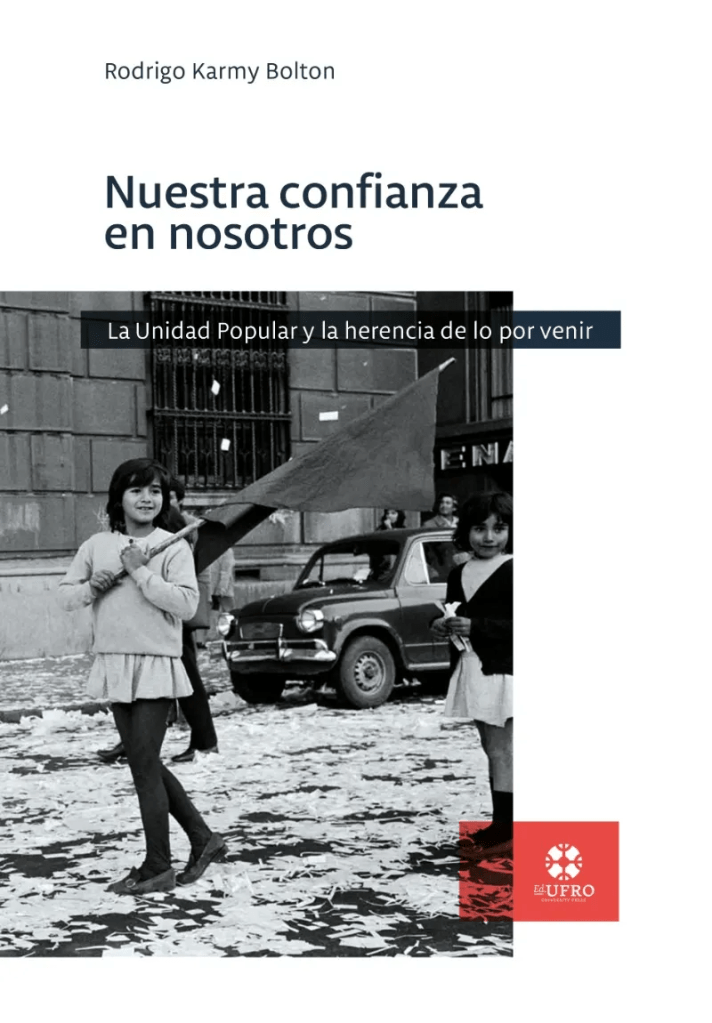
Three notes on Rodrigo Karmy’s Nuestra confianza en nosotros (2023). by Gerardo Muñoz

Transfiguration. Towards the end of Nuestra confianza en nosotros: la Unidad Popular y la herencia del por venir (Ufro, 2023), Rodrigo Karmy suggests that the experiential texture of Salvador Allende’s political years amounted to a sort of corporeal transfiguration of historical time, but also of the political subject within modern architectonics of the inter-state sovereign system. The death-martyrdom brought a new world into order, radically transforming the sense of historical assumptions and its immanent refutations and accelerations. For those of all that know Karmy’s philosophical investigations working through this intuition, it is impossible not to see that ‘transfiguration’ does not entail ‘sacrifice’, but rather it implies the figure of the martyr [1]. And we also know from Erik Peterson that martyrs are absolute witness to truth of an irrevocable event; in other words, those that transcend the core materiality of the mere opinions and matter-of-factness as to remain faithful to the unfathomable to a world brought to abrupt change (and at times, this means also despair). Karmy writes: 

“Se produce así una transfiguración radical de Allende que trastoca enteramente el juego de la teología política, tal como ha sido planteada bajo los avatares del fantasma portaliano: si en esta última, el cuerpo físico termina desmaterializado en un cuerpo institucional, tal como ocurrió con el devenir del general Pinochet,  en Allende termina desmaterializado en una potencia por venir (no en cuerpo institucional), aquello que Walter Benjamin llamaba lo «nunca sido»: «Siempre estaré junto a ustedes», dice el presidente usurpado por el golpismo esa triste mañana de septiembre” [2]. 

The truth of transfiguration – and in a sense every event of truth is always carried by the energy what is transfigured – marks the incommensurable distance between the eternal persistence of the word and the historical movement guided by the precepts of civilization. Whereas the political grammar organizes itself through an indiscriminate institutional corpus and a set of moral binding obligations upon its citizens; the truth of transfiguration is the keeper of the night of the soul that, like the myth of Er, signals the passage between the world of the living and the kingdom of the dead. When transfigured, the dead can become even more lively than those allegedly “alive”; where those alive become embodied and rigid statues or mummies. As such, the energy of transfiguration remains outside the cloisters of history and its memory sites, since its realization takes place whenever there is a drift outside and beyond the suturing of the world as mere stated and enclosed fact.

Voice.  The “we” (Nosotros) in Karmy’s thesis does not signal the constituent political unity of the People nor a partisan form that can exert force towards the inversion of the sedimented historical order. In his archeological endeavor, the ‘nosotros’ indexes a non-numerical instance through the vocative raises its own question to the past. This does not imply that there is a “collective voice” that must enact its point of annunciation through representation and mediated forms; the voice emerges as an exception to the grammaticalization of the constitutional order and its statuary production as expression of legislative will. The voice is the exteriority to every scheme of reproduction. But, what is a “voice”? Following Emilio Recabarren, Karmy connects the voice to the very act of creation: in other words, a voice to the truth implies the vocative of what has truly never been there before. Like the chorā, the voice is both at the reemergence of its origin and medium rather than substance; and this is why the voice, unlike the written language, cannot be subsumed to the reification of mimesis and generative substance [3]. The voice is what every time remains irreducible to the order of discourse difference, historiographical narrativity, and the original letter and spirit of the law. And even in traditions without “Constitutions”, law cannot escape its written and grammatical framework; this is why in Common Law, the Constitutional authority is supplanted by the historical absorption of habits, manners, and tradition into the force of legal codes and binding statutes. It is a high merit of Karmy’s Nuestra confianza (2023) to reminds us that the happiest moments (and perhaps the only moment worth saving, that infinitely returns against the grain of historical progress) of the revolutionary experiences of the twentieth century are to be found in the evocation of the voice and its popular music (something that can also be said of the Cuban Revolution, for instance). This esoteric orphic thread evidences the disjointed relation between the polis and the mythic transfiguration when facilitated by the prophetic overtones of the musical nomos in the genesis of the West [4]. Hence, whenever there is a voice, the suture of politics to the theology cannot amount to the continuous transaction upon the survival and agony of the living.

Freedom from revolution. Unlike the reverential or formalist accounts written for the fiftieth anniversary of the Chilean Unidad Popular, Karmy’s essay invites us to dwell about a political experience after its epochal exhaustion: the collapse of the horizon of the philosophy of history implies the internal implosion of the modern revolution’s infrastructure (constituent power, moral justice, militant subjectivity, sacrificial energy). For Karmy to arrive at a certain nearness to the well lighted tradition of the UP is to abandon once and for all the civilizational eon of sedentary political hegemony (“a revolution in world history” bringing about the age of the nomads to an end, claimed historian Edward Gibbon) that has now paved the way for the unlimited forms of planetary government exerted through the rationality of the management of population and the distribution of the economy [5].

The farewell to the revolution and its reverse – it is well known that De Maistre claimed in the wake of the French Revolution that the opposite of the revolution is not a counter-revolution, but what is all together contrarian to it – means to put a halt to the paradigm of force (positive and immanent hostility) that has oriented actions, expectations, passions, and even dreams taxed at the fictive illusions of an abstract Humanity devoid of any possibility of happiness in the world. It is only after we can leave behind the revolutionary metaphysical mimesis that a new sense of freedom could emerge away from the dominion of the land-surveyors of the Earth. Abandoning any clamors oriented towards the future, it is now for us to attune to the everlasting traditions that are unrelinquished to the endless rubble of time. 

Notes 

1. Rodrigo Karmy. “The Absolute Gift: Martyrdom as Destituent Power”, SAQ, 122, 2023, 157-170.

2. Rodrigo Karmy. Nuestra confianza en nosotros (Ufro, 2023), 183.

3. Ibid., 102.

4. Gianni Carchia. Orfismo e tragedia: Il mito trasfigurato (Quodlibet, 2019).

Interregnum and worldliness: on Sergio Villalobos-Ruminott’s Heterografías de la violencia. by Gerardo Muñoz

Heterografias de la violencia 2016

Sergio Villalobos-Ruminott’s Heterografías de la violencia: historia nihilismo destrucción (La Cebra, 2016) is, at first sight, an assorted compilation of fifteen programmatic essays. Mostly written during the last decade or so, these texts attend to a wide range of theoretical specificities, such as the baroque and performative violence, imperial reason and contemporary literature, sovereign-exception law and flexible capitalist accumulation. It is to Villalobos’ merit that none of these issues are restituted to academic knowledge production or leveled out as a selection of “hot topics” within the neoliberal marketplace. As in his prior Soberanías en suspenso: imaginación y violencia en América Latina (La Cebra, 2013), what is at stake, far from erecting the edifice of a ‘critical theory’ aspiring to fix the limits of reflection – as postulated in “sovereignty” “nihilism” or “destruction” – is the composition of a constellation that circumnavigates the vortex of the general horizon of the philosophy of history and the university machine.

In some way, Heterografías is auxiliary to Soberanías en suspenso, but not in the parasitical sense of amending or filling previous generalities. This new collection pushes thought beyond the specificity of the insular ‘Chilean scene’, providing for the indeterminacy of the logic of sovereignty as the arcanum of both interruption and continuity of the philosophy of the history of capital in Latin America. This is not to say that in Soberanías en suspenso the ‘local Chilean scene’ operated self-referentially as the archive for the reassertion of a cultural investigation. In the prior book, the Chilean scene is understood as a paradigm, in the sense of a singular relation to the singular, which Heterografías converts into a topical ensemble that interrogates the displacements, variations, and narratives of principial Latinamericanist reason from both nomic and anomic spatial formations.

Heterografías resists positing a new metaphorization of history, as well as yet another ‘political theory’ for what Latinamericanists identify as the object of “Latin America”. Although Villalobos does not thematize it as such, his book is full-fleshed post-Latinamericanist, and the reason is not just because it moves and weaves through the Schmitt-Kojeve debate on geopolitics and colonialism to the politics of the baroque and Catholic imperial katechon; from Latin American literature (Borges, Lamborghini, Perlongher) to debates on memory and indexing (Richard, Didi-Huberman, Segato). It is post-latinamericanist because it challenges the university praxis that administers, organizes, and provides for a linguistic transculturation to a post-katechontic ground that is today insufficient except as onto-theology and reproduction of cliché.

On the other hand, one also appreciates Villalobos’ minimal gesture of displacement of Latinamericanism not as a mere abandonment of the Latinamericanist object – which amounts to another exception, another distance with the object of desire, or its mere dis-placement – but as an otherwise relation that is not regulated by what Moreiras has called the ‘pleasure principle’ at the heart of hegemonic investment of the Latinamericanist intellectual [1]. A post-Latinamericanism, thus is necessarily posthegemonic to the extent that:

“…no se trata de elaborar una ‘mejor crítica’ de lo real ni de desenmascarar el carácter ideológico de un programa en competencia, sino de debilitar la misma lógica “fundamental” que estructura el discurso moderno universitario…. desistir del nihilismo en nombre de un pensamiento que no puede ser reducido a un principio hegemónico de producción de verdad y de saber. La post-hegemonía de la que estamos hablando, no es solo una teoría regional destinada a evidenciar los presupuestos de la teoría política contemporánea, sino también la posibilidad de establecer una relación no hegemónica entre pensamiento y realidad. Ubicarnos en esa posibilidad es abandonar el discurso de la crítica de la denuncia y particular de una práctica de pensamiento advertida de las fisuras y trizaduras que arruinan a la hegemonía como principio articulador del sentido y del mundo” (Villalobos 36).

What is offered to radical “destruction” is the principle of sovereignty that, as Villalobos painstakingly labors to display, is always already an-archic and indetermined. If according to Reiner Schürmann, the principle (archē) is what structures and accounts for the ground of presencing in any given epochality; Villalobos bears witness to the an-archic instance of every form of apparatus (literature, geopolitics, the national-popular, ethnicity, war, neoliberalism, etc.) that seeks to ground itself through principial formation, as both origin and commandment. In this way, the ‘history of metaphysics’ is not taken here as a teleo-phenomenological compression reducible to the very hyperbolic presencing of mere principles, but as a folding process that transforms the critique of metaphysics to that of its apparatuses. This has radically consequences, since it is no longer a debate about the university regime of knowledge production, or about the co-belonging between the destruction of metaphysics and the metaphysics of destruction, but rather: “…como concebir el carácter moderna y prosaico de las prácticas históricas, ya no investidas con un secreto transcendental, sino que constituidas como aperiódica radical de de-sujeción” (Villalobos 136).

The gesture does not wish to open a second order of exteriority to thought (whether geopolitically or subject-oriented), but a practice of the “non-subject” within the interregnum that lends itself to the radical historicity beyond the historicism of its apparatuses. The interregnum highlights the radical dislocation between philosophy and history, disinhibiting the categorial determinations that attest to its in-determinacy (Villalobos 145). By putting emphasis on the indeterminate character of violence, Villalobos is also indicating the flexibility and modality of effective law in every specific historical instance [2]. Thus, to amend the anomic status of the interregnum is always already to fall a step forward into nihilism and its epochal structuration of the given conditions. This is the instinct of all hegemonic principial incorporation as a pastoral or geopolitical formation. Heterografías consistently points to the folds that open to a potential constellation of singulars as an otherwise of experience de-contained from the duopoly philosophy-history and the cunning of capital (Kraniauskas).

As such, Heterografías advances the destruction of three transversal lines that feed the apparatuses of the philosophy of the history of capital in the interregnum: sovereignty, war, and accumulation. It is not the case that these lines have their own autonomy, historical foundation, or even ‘substance’. Rather, these folds that act as an assemble that partition and make up what I am willing to call the Latinamericanist exception in its metamorphosized transformations that aggregate knowledge, practices, and discourses. To dwell otherwise on the interregnum entails precisely to ‘free the lines’, as Deleuze & Guattari’s proposed in A Thousand Plateaus, crisscrossing the modalities of war (in times of peace or what Villalobos calls pax Americana); sovereignty (as still rendered in the katechontic determination of the State and fictive ethnicity); and accumulation (as an always ‘ongoing appropriation and expropriation’ from modernization processes to neoliberalist dispossession).

The scene of the interregnum as traversed by the flexible pattern of accumulation (Williams 2002) is a baroque scene. Not so much ‘baroque’ in the literary or even pragmatic sense that seeks to provide agency to subaltern informal workers in the Latin-American peripheries, but as a modal process that counteract the dynamic of sovereignty while re-inseminating a heterogeneous (heterographic) processes of violence at the heart of the common political experience [3]. The baroque also dramatizes the fissure of finitude that could put a halt to the sovereign exception. To this end, the critical gesture during times of interregnum is to abandon first principle of action, whether as purely conservationist katechon, or as immanentization of the eschatology. Villalobos calls for a third option, which is infrapolitical relation with the worldliness and the mundane freed from exclusion-inclusion logic. In an important moment in his essay on Kojeve and the geopolitical philosophy of history, Villalobos writes:

“Faltaría pensar la no-relación entre el ni-amigo-ni-enemigo, lo neutro blanchotiano, que se des-inscribe del horizonte sacrificial de la tradición política occidental, esto es, de una cierta tradición política asociada con el principio de razón, con la comunidad y la amistad, como decía Derrida, o del sujeto, como dice Alberto Moreiras, apuntando a una dimisión no afiliativa ni fraternal, no principial ni fundacional, sino infrapolítica” (Villalobos 92).

Infrapolitical relation is given as a promise that retains freedom of life during the time of the interregnum against all apparatuses of capture and conversion (it is no by accident that the marrano figure appears a few times through the book in decisive ways). How can one participate in conflict without necessarily open to war? How could one instantiate exchange without reproducing the principle of equivalence? How could there be a relation between literature and politics beyond representation and the productionist aesthetic institution and the literary canon? The potential to render thought otherwise, profanes every articulation of the apparatus allowing for a political exigency in the interregnum: an infra-political relation with the political, which brings back democracy to its post-hegemonic site. It is in this sense that Heterografías it is not a book disconnected from the “political practices” or what the althusserians call the material “conjuncture”. On the contrary, the task is achieved through a reflexive gesture that attends to every singular determination of the ‘ongoing accumulation’ that exceed the libidinal and memorialist investments in Marxian locational archives [4].

The purpose is to avoid a calculable relation with the conjuncture as always already shorthanded for hegemony, will to power, ‘movement of movements’, subjection, etc.; as to de-capture the radical historicity no longer ingrained in History’s metaphoricity. This is why Borges, the a-metaphorical thinker, disseminates Heterografías at various key moments juxtaposing politics and imagination and undoing the master-theory for political movements that always speak in the name of ’emancipation’. (The fall of Brodie in Borges’ short-story is the absolute comic negation of the Pauline’s militant conversion at Antioch).

As already specified in Soberanías, the threshold of imagination becomes the task for intra-epochal (interregnum) experience. Imagination, of course, does not point to an anthropological faculty of humanity, the prevalence of a sensible component over reason as in Kant, or a new intellect that as post-universitarian is able to secure a new site for prestige. Imagination is a preparatory relay for a turbulent de-formation of the apparatuses in to a common universality of singulars. Villalobos does not deliver a general theory of imagination, since imagination is already what we do as a form of dwelling, in the course of every form of life. I would like to un-translate Heterografías in these terms not because imagination remains the unsaid in every practice of destitution as what always escapes identity, equivalency, or the friend-enemy relation. But then, is imagination the outside of nihilism?

Imagination accounts for the heterographic processes that are flattened out by the master concepts that capture and dispense principial thought. In this sense, imagination is not reducible to the institution of literature or culture, but inscribes a singular relation with language; the possibility of speaking in the name of that which lacks its proper name [5]. The fact that today everyone speaks in the name of something it is the most visible asymptotic of the fall into technical nihilism. On the contrary, imagination is always the potentiality to speak for a minor people that interfere with the grammar of grand politics. In the last chapter “Crítica de la accumulation”, the site of imagination is the necessary metaxy for an otherwise politics of contemporary Latin America:

“En última instancia, se trata de pensar los límites históricos de la imaginación política latinoamericana, misma que necesita trascender la nostálgica identificación con una política reivindicativa y radicalizar su vocación popular en una suerte de populismo salvaje, que no se orienta heliotrópicamente a la conquista del poder del Estado, para una vez allí, disciplinar a las masas. Un populismo sin Pueblo, pero con muchos pueblos, heterogéneos y contradictorios, con una énfasis insobornable en los antagonismos y no en las alianzas, en las figuraciones catacréticas y disyuntivas…En suma, un populismo post-hegemonico…” (Villalobos 228).

The political mediation insofar as it is post-hegemonic ceases to dominate in the principial totality where life and the social, as based on fictive identity, coincide or collapse unto each other. This post-hegemonic populism cannot be said to be one at odds with institutions, or merely just cultural or charismatic supplement. Villalobos seems to be opening here the question of a distinctive form of law that would require imagination, not heterographic violence; attentiveness to singularity, and not another politics of the subject. How could one think a law that exceeds the citizen and the exception? Is it not isonomy – as the principle of the integral movement towards citizenship – what hinders and captures political life over its heterographic excess? Could one imagine a law that is consistent with democracy as the self-rule of a minor people, of a people without history, a savage people, inhabiting the true state of exception?

The answers to these questions are not to be found in Heterografías de la violencia. Villalobos-Ruminott has made a striking effort to sketch a set of common objectives, tasks, nuances, exigencies, and considerations for the possibility of critical thought (in the deleuzian sense) against the grain of interregnum’s anomie. The task is immense, even when its transparent language is deceiving: to open a fissure of worldliness (mundanidad) in preparation for a savage democracy to come; enabling the conditions for a way of thinking that is not oblivious to the production of violence within the ongoing accumulation that unfolds and whitewashes the present.

Notes

  1. Alberto Moreiras. “Poshegemonía, o más allá del principio del placer“. Poshegemonía: el final de un paradigma de la filosofía política en América Latina. Madrid: Biblioteca Nueva, 2015.
  2. It is in the quasi-concept ‘effective operation of law’, where Villalobos comes nearest  to Yan Thomas’ studies on the juridical flexibility of law. See his Les opérations du droit (EHESS, 2011).
  3. I am thinking here of Veronica Gago’s recent book La razón neoliberal: economías barrocas y pragmatica popular (Tinta Limón, 2015) which seeks to render a micropolitical form of neoliberalism from below deploying the concept of ‘baroque’ to ‘express’ its emancipatory and empowering dynamic in the informal sector. For Villalobos, on the contrary, informal economy is not an exception to the visible form of accumulation, but its flexible difference in the age of an-archic capital. The baroque is not a given instance for “emancipation” or “subjective agency”, but where sovereignty becomes dramatized in its most extreme degree: “Es decir, necesitamos pensar el barroco como una problematización de la filosofia de la historia del capital, con una interrupción que trastoca la especialización del atemporalidad propia de la metafísica moderna y más específicamente, de su correlato, política, la versión liberal-contractualista del orden y del progreso social” (78).
  4. “Diría que hay, al menos, dos formas de confrontar este problema; por un lado, la posibilidad de repensar el marxismo, Marx y sus diversas apropiaciones, según su historia, sus filologías y tradiciones, para determinar la “verdadera” imagen de Marx, hacerle justicia a su corpus, exonerarlo de los excesos de la tradición y traerlo al presente según una nueva actualidad. Por otro lado, sin renunciar a un horizonte materialista y aleatorio, la posibilidad de elaborar una crítica de la acumulación….” (215).
  5. Giorgio Agamben. “In nome di che?” Il fuoco e il racconto. Rome: nottetempo, 2014.