De Certeau’s untold night. by Gerardo Muñoz

The highest poetic moment in Michel De Certeau’s La culture au pluriel (1974) appears in the concluding pages where the historian resorts to a hunting image: “Culture is an untold night in which the revolutions of earlier times are dormant, invisible, folded into practices – but fireflies, and sometimes great nocturnal birds, cutting through it – as thrusts and creations that trace the promise of another day to come” [1]. This is De Certeau’s trope that stands for culture as opening of possibilities, the shoreline where administrators and technicians (his own terms) do not dare to cross and will probably never adventure. This is the site (the night, la noche oscura, which has a ringtone of the mystical tradition that the author knew perfectly well) where De Certeau wants to posit the possibilities of new struggles of cultural alterities [2]. A book in 1974 means many things, but for De Certeau it is an incursion into the collapse of his historical present, already showing full fledged signs of the crisis of legitimation, erosion of institutional trust, and the decomposition of social forms across Western symbolic realities. It is the nascent confirmation of the ascent of real subsumption, a term that does not appear in De Certeau’s book, although it informs it, even if negatively (the Italian Fiat wildstrikes makes a surprising cameo in the last paragraphs). Where to look, then?  

De Certeau’s answer read today does bring much naivete: cultural alterity. But this notion, which is reworked and contested in concrete fields of human activities (the university and schools, the new technological society and communication, social practices intertwined in popular and elite culture, power relations and post-statist configurations) do not appeal to the identitarian cosmopolitan horizon prima facie anchored in the diversity administration of a well integrated, albeit exploited planetary humanity. One senses that for De Certeau the nineteenth century “Social Question” has become the “cultural question” as the unit of the national sovereign state wanes and reacts. With the crisis of legitimation as backdrop, De Certeau sees the rise of a new subjectivity that he calls the new “militants without a cause”, a battalion of “exiles” that will only tacitly accept credible cultural imprints [3]. He wants to work with “culture” because at bottom De Certeau is both a historian and a realist. This new erosion of civil society-State relations entails a “new exile is in the works” [4]. And for De Certeau the exile, since biblical times, is seeking a new Earth where to “land”. 

In 1974, De Certeau’s invitation was to create the conditions for pluralist cultural landings that will foster, in the night of waiting, a new politics. But, could the same be said today even assuming concrete situations and the infuriating image of migration as a token for the workings of hegemonic politics? Does Gaia not alert us that we must “land” somewhere else on Earth? The anger and dissatisfaction that De Certeau cautiously predicated head on is already here in the form of what some of us have theorized as ongoing social stasis that is integrated in every social mediation. In the global metastasis of the 1970s De Certeau could claim that “behind anger there is the desire to create a polis and a politics; there is a desire to organize the conditions of life….” [5].

We are far removed from this desire, and even the most prominent cycle of revolts of the decade have refused in the solicitation of a new politics or a political horizon; and, even if, almost like weeds in cracks of piled urban ruins, we see again and again the last residues of the desire for hegemonic representation of the totality (the People, the Movement, the Class). In this light – now it is our own epoche – culture can only be compensatory, and still very much a symptom of the closure of exteriority. “Where there is no longer an imaginable outside we lose the possibility of an inside”, Moreiras wrote at the turn of the century against every form of culturalism [6]. Of course, De Certeau was well aware of it, which is why his proposal to cultural alterity retains zones of hermeneutical ambiguity many decades later [7]. For instance, he writes when commenting on neo-nationalist regional movements (Quebec, Catalonia, Occitania) that “cultural claims appear to be a reminder and a compensation” [8]. 

And recent events have proven De Certeau correct: what is Catalan nationalism – whether left or right, although ideological division is not a substantive difference – if not a compensatory rhetorical ruse to mobilize regional political elites to feed off the stagnant resources of a waning state form? The rhetoric of “political foundation” in the Catalan case created an “cultural alterity” that depended on the high illusion of hegemonic politics; a politics solely based on the “bad faith” of escalating and superposing values (“Spanish” v. “Catalan”) as the combustion of a fractured political social contract that ultimately deepens its fragmentation. De Certeau noted – cited with the long Augustunian tradition of political liberalism – that politics cannot bring happiness, but only create its conditions. However, today even this liberal ideal fails to account for its true source: our metapolitical collapse at the twilight of secularization means that the revival of the “social bond” is not to be found in the demand of new political principles, however narrowly or broadly defined. De Certeau in 1974 aspired at giving politics one more chance pulling it to the facticial heterogeneity of culture: “a politics that discovers in the diversity of the sky a generical….linked to the ambition of beginning over again, that is, of living” [9].

And indeed, we must begin all over again, but is really the only possibility? I believe that there are symptoms elsewhere in La culture au pluriel, and these concern language. In the second chapter, referring to the crisis of speech, De Certeau refers to the “denaturing act” of speech, as communication enters the regimen of commercial language and new computational masteries (what Jaime Semprún called neo-language) [10]. The crisis of language in the ascent of a new expressivity renders communication obsolete and obtuse; parasitic, or mushroom-like, as Hugo Von Hofmenthal had already noted in his Letter to Lord Chandos. Speech becomes a new form of blasphemy, something confirmed in recent years in the United States, which takes itself also as the homeland of “Free Speech” is increasingly under heavy surveillance by constitutionalism of codified parameters of “time, place, and manner”.

De Certeau shows himself highly consternated about blasphemous language, which is also conspiratorial language; the language that dwells on the reverse of social normativity and legal codification. But this perhaps the only language today can properly speak of pain without recurring to the transactions of violence; especially of the numbing violence of a neo-language that can communicate “everything” insofar as it ceases to communicate to no one. Could the “untold night”, that is also the night of the “unthought”, be the site of the preservation of another use of language, of nurturing language, descending into the hymnic sources of the sayable – thus, inverting the denaturing of historical severability – a language embedded in silence, in the protofigure of the mystic, assuming “the immediacy of nature and experience, to contact of things, one by one, in their primal disorder”? [11]. Ultimately, whatever the night will tell will only be possible through and in language. 

Notes 

1. Michel De Certeau. Culture in the Plural (University of Minnesota Press, 1997), 138.

2. Ibid., 11.

3. Ibid., 7.

4. Ibid., 8.

5. Ibid., 11.

6.  Alberto Moreiras. The Exhaustion of Difference: The Politics of Latin American Cultural Studies (Duke U Press, 2001), 21. 

7. Michel De Certeau. Culture in the Plural (University of Minnesota Press, 1997), 78.

8. Ibid., 70. 

9. Michel De Certeau. Culture in the Plural (University of Minnesota Press, 1997), 100.

10. Jaime Semprún. Defensa e ilustración de la neolengua (Ediciones El Salmón, 2018). 

11. Nicola Chiaromonte. “An Age of Bad Faith”, in The Paradox of History (University of Pennsylvania Press, 1985), 148. On the hymnic dimension of human speech, see the study undertaken by Nicoletta Di Vita, Il nome e la voce. Per una filosofia dell’inno (Neri Pozza, 2022).

Tacitus’ arcana and political wisdom. by Gerardo Muñoz

During the flourishing of Renaissance civic humanism, the tradition of Tacitism, as well as the work of Tacitus, was broadly understood as advisory to the problem of tyranny within the cycles of political power’s rise and decline, unmasking imperial rule’s debasement and cruel domination [1]. It is in Edward Gibbon’s erudite project where Tacitus’ political wisdom receives an integral treatment about the institutional dimension of power and its cohesive structure based on both facts and theoretical presuppositions. For Gibbon, the wisdom of Tacitus is not merely anchored in theoretical speculation; rather, the rhetorical construction takes its energy from the convergence between historical facts and the physics of a concrete political order. Tacitus’ wisdom is practical but also flexible, and this entails that political realism is not about the opportunist dimension of power (although this most certainly occurs in every political community), but about the deployment of analytical understanding regarding faults, fissures, and disequilibrium of institutions. Tacitus’ thought is about vision, and this means looking at the cracks, identifying the asymmetrical correspondences, and teasing out the nuances of a particular reality.

This presupposes that Tacitus’ enduring notion of the arcanum imperii, far from posing a ‘mystery of the state’ (its legitimacy, rule, and mystical reserve), allows for a strong narrative about the latent crisis internal to every political community. Tacitism is, insofar as it confronts the crisis and ruin of a political order, draws a negative reflection on the ongoing force of civil war as a historical and existential condition of domination. In other words, no politics can exist without the concrete legibility of the faults of conflict, which ultimately entails that civil war and political power are constantly in proximity. The arcana delimits the problem of civil war as the internal contradiction of every imperfect institutional design that cannot transcendent its own crisis through conceptual reordering.

At the center of Tacitus’ arcana in Rome is the death of Nero as well as the fault lines of civil war: “The was revealed that arcanum of state, the discovery that emperors might be made elsewhere than Rome” [2]. Of course, Rome as the glorious center of power was fundamental and indivisible; but for Tacitus the argument condensed in the arcana is precisely that the corruption of politics takes place when political representatives (power delegated at the provinces) and that of the center ceased being in coordination, losing the grip of institutional mediations. Thus, the ruin of politics is best expressed by the disjointment of formal procedures between authority and delegation, the vesting of the emperor and territorial monopoly, legitimate rule and predatory corruption. When this happens the arcana is transformed into a permanent revolution that dissolves checked political rule into the willful triumph of the uncontained and proliferated fragmentation (this is why Tacitus looked back with nostalgia to the unlived era of Roman republicanism).

For Gibbon to hold on to the Tacitan tradition of the arcana imperii meant, above all, to underscore the esoteric relationship between history and revolution as part of the desire to understand political energy, which he posed as a methodological concern: “In our larger experience of history the imagination is assisted by a perpetual series of causes and effects , to unite the most distant revolutions” [3]. The arcana is political wisdom of a secondary source; that is, it’s not a normatively established political premise or category, but an excess to description of political order. Hence, it is not that the arcana imperii is a monocausal and ultimate foundation of instability – and in this sense he was still faithful to his conception of plurality of causation in defense of the study of literature and the imagination – the emphasis is placed, on the contrary, in the way in which grasping the archeological and heterogeneous field of tension that will reveal, in turn, the historical specificity of the arcana [4].

In other words, the arcana grants access to the fundamental features of the epiphenomenon of civil strife without a recourse to abstraction and the closure of the concept. In this way, it could be said that the arcana (in part in the reading that Gibbon undertakes of Tacitus) is continuously operating in three distinct registers: a) it is a comprehensive analytic of the plurality of causation that impact political conflict and civil war, b) it reports to the center of authority, probing its direct and indirect meditations on the ground; its forms of delegation and adjudication, and its production of legality and dominium and implementation; c) it demands to design a description and a narrative of the political situation in order to properly respond to the paradox of tyranny and corruption within a specific polity.

Having sketched out the operational effect of the arcana, we can say that the notion is far from being reducible to a Renaissance “ragion di stato” scenario assisting in the consolidation of power in the hands of the price; the arcana seeks to elucidate the contours and limits of the intensification of war and its risks; a problem that becomes central to Hobbes notion of the state [5]. To claim that this political wisdom is something that merely emerges technically-placed in the Renaissance “great men”, and systematically blurred in modern liberalism is a thesis that will need further elaboration about the resources of the state and the underpinning of modern legitimacy through civil society and its late-modern mutation into planetary imperial spaces. In a certain sense “Tacitism” opens the possibility of sketching the political crisis of in each distinct epoch. It is perhaps in this sense that Carl Schmitt invites us to think the issue in an entry of his Glossarium:

“The beginning of Tacitus’ Histories has moved me. Is it just rhetoric, like Ortega told me?’ Isn’t it about the identity of the situation, that is, existential participation, participation in one and the same nuclear and ancestral situation of our eon? Every word of that chapter of Tacitus is absolutely current: «Magna ingenia cessere; opus adgredior optimum casibus, atrox proeliis, discors seditionibus, ipsa etiam pace saevum. Of course, “ipsa etiam pace sacvum, bella civilia et exterior plerumque permixta.” The relationship between international war and civil war, that is not rhetoric but the horrible reality recognized and expressed, the non-distinction between war and peace.” [6] 

The arcana never truly coincides with a philosophy of history or a rhetorical veneer of civil existence (social contract). The subversiveness of Tacitus plays out in thinking through the elaboration of a specific governmental organization [7]. And what is the “ancestral situation of the eon” if not the polar relationship between political order and stasis, the duality between civil war and the principle of authority, the nihilism of the will and the limits of a public rule of law, however ordered? Tacitus’ classical wisdom, invested in plotting legible facts with a singular narrative, far from raising itself to a “science of politics” or a set of “fundamental principles of order”, responds to potential fluctuations devoid of a universal grammar. In this way, politics remains closer to a physical experiment: an active self-evolving canvas in which the arcana is irremediably drawing upon the instituting and destituting of interconnected forces at play.

Notes 

1. Arnaldo Momigliano. “Tacitus and the Tacitist Tradition”, in The Classical Foundations of Modern Historiography (University of California Press, 1990), 120.

2. J. G. A. Pocock. Barbarism and Religion: The First Decline and Fall, Vol.III (Cambridge University Press, 2003), 25.

3. Ibid., 58. 

4. G.W. Bowersock. “Gibbon on Civil War and Rebellion in the Decline of the Roman Empire”, Daedalus, Summer, 1976.

5. Richard Tuck. “Hobbes and Tacitus”, in Hobbes and History (2000), eds. G. A. J. Rogers and Tom Sorell, 99–111.

6. Carl Schmitt. Glossarium: Anotaciones desde 1947 hasta 1958 (El Paseo, 2019), 7.

7. Ronald Syme. “Who was Tacitus?”, Harvard Library Bulletin XI, Spring 195, 185.

A memory of Jean Franco (1924-2022). by Gerardo Muñoz

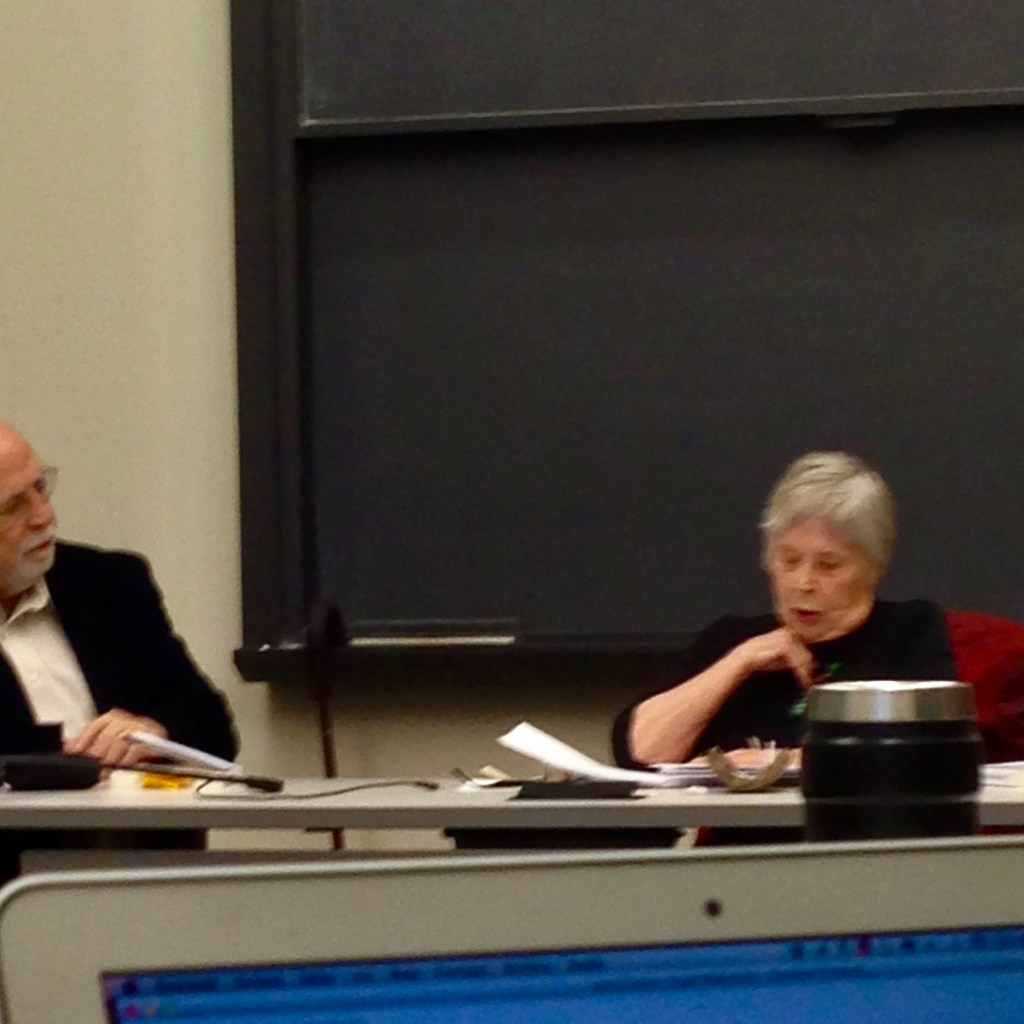
Jean Franco, pioneer of Latin American Cultural Studies and witness to its Cold War gigantomachy, passed away a couple of weeks in December at age 98. She remained lively and curious even at the very end of her scholarly life, and for some of us that saw her in action she embodied the memory of the century. The photograph above is of Jean’s visit to Arcadio Díaz Quiñones graduate seminar in the fall of 2015 where she discussed some of the main arguments of her last book Cruel Modernity (Duke U Press, 2014), a cartography showing the definite closure of the Latin American insomnia for political modernity in light of its most oblique mutations: narcoviolence, the emergence of a dualist state structure, and new global economic forces that putted an end to the vigil of the revolutionary enterprise. I write “definite” purposely, since Jean’s own The Decline and Fall of the Lettered City (Harvard U Press, 2002) already hinted at a certain exhaustion (to borrow the strategic term of Alberto Moreiras also writing during these years), most definitely a thorough disillusion, in the sense deployed by Claudio Magris, of cultural substitution for the belated state-making modernization. The function of “culture” (and its hegemonic state apparatus) was always insufficient, dragging behind, or simply put, unintentionally laboring for the cunning of a project forever postponed in the sweatshop of the newest ideologue, or for the hidden interests of the “local” marketplace of moral academicism. All of this has come crashing down rather quickly even if the demand for culturalist janitorial or housekeeping services are still in demand to sustain the illusion sans reve et sans merci.

What always impressed me about Franco’s scholarship was her intellectual honesty to record, even if through an adjacent detours and academic finesse, the destitution of all the main categories of the Latin American modern wardrobe: developmentalism, state-civil society relations, the intellectual, cultural hegemony, revolutionary violence, the “rights revolution”, and the intra-national spatiality (rural/metropolitan divide). From now on it is hard to say that there is a “task of the critic”, if we are to understand the critic in the Kantian aspiration of sponsoring modern values and perceptiveness to an enthusiastic disposition (definitely optimistic towards action) to transforming the present. As a witness to the twilight of the Latin American modern epoch, Franco univocally resisted the inflationary, value-driven, demand for politicity and ‘more politics’. This is why her attitude remained at the threshold of any given effective political panaceas or half-baked illusions.

Does her biographical experience say anything to this particular inclination? It is difficult to say, although as a witness of the century Jean had lived through the coup in Guatemala in 1954, visited the Cuban Revolution during its most “intense years” of the sugar cane milestone (La Zafra de los Diez Millones), and followed with attentiveness the rise and transformation of the Southern Cone dictatorships in the 1980s coupled with the irreversible social transformation of neoliberalism in the 1990s signaling the effective end to regional integration in the face of planetary unity. All of this to say that I find it hard – at least leaving aside the many nuances – to see in Jean’s scholarly witness an enthusiasm for the Latin American Pink Tide, the communal state, or abstract regional historicizing that could finally bring about the moral universe of the national-popular state (as if said moral realization would be anything worthwhile, which we some of us seriously doubt). If Jon Beasley-Murray once said that John Beverley was the “Latin American unconscious”, I guess it is fair to claim that Jean Franco was an authentic Latin americanist realist; that is, someone that was up to task to see in the face of the tragic, the cruel, and the heinous as the proper elements of the interregnum. Or to better qualify this: she was a worldly realist, leaving aside utopias and its abstractions. At the end end of the day, Leninists are also realists, or at least claim to be so. What places Jean’s earthly realism apart from the Leninist realism is the subtraction from the seduction of Idealization, which even in the name of the “idea” (“the idea of communism”, say) or “immanent higher causes” must bear and render effective the logic of sacrifice at whatever cost, even the real sense of freedom if demanded by the party, the leader, or the community. This is why at the closure of Latin American modernizing enterprise communitarian arrangements, posthistorical subjects / identities, or grand-spaces that mimic the constitution of Earth are foul dishes for a final banquet. It is always convenient to refuse them.


Going back to my conversations with Franco at Princeton, and some exchanges a few months later in a cafe near Columbia University, for her there was remaining only the anomic geography of Santa Teresa in Bolaño’s 2666, a novel that charts the current ongoing planetary civil war in the wake of the crisis of modern principles of political authority. I can recall one remark from Jean during these exchanges: “¿Y quién pudiera mirar hacia otra parte?” This is the general contour of her witnessing: how not to look somewhere else? In other words, how not to look here and now, into the abyss that is no longer regional or national, Latin American or cultural specific, but rather proper to our own civilization? A civilization is, after all, nothing but the organization of a civis, which has now abdicated to both the metropolitan dominium, as well as the campo santo of sacrificed life at the hand of techno-administrative operators (the new praetorian guard) of a well lighted and fully integrated Earth.

There is no alternative modernity, decolonial state, or hegemonic culture that will not serve to the compensatory and sadistic interests of the cruel policing of death and value, as the only masters in town. We are in Santa Teresa as a species of energy extraction. Can reflection be courageous enough to look through and against them? This is the lasting and eternal question that Franco left for those who are willing to see. It does not take much, although it amounts to everything: mirar / to gaze – in an opening where human form is lacking and categories are wretched – is the the most contemplative of all human actions. Whatever we make of it, this practice now becomes the daring task of the coming scholar.

The enemy from the argument of purity. by Gerardo Muñoz

A rebuttal against the notion of enemy frequently hinges on conflating the enemy with total enmity. It usually takes the form of a hypothetical: once an enemy is declared as such, is there anything that can deter the escalation into total enmity? The historical record provides analytical reassurance to the hypothetical, but it does not eliminate its generality, since its ultimate probe is conditioned by an ideal of conceptual purity. Not every hypothetical is idealistic, but every hypothetical exerted from purity is. This concerns any understanding of politics, given that the notion of the enemy presupposes an impure origin of conflict, threats, disorder, or unjustified propensity towards evil. If the enemy is best understood as an operative principle between repression and totalization of enmity, it also entails a rejection of purity as sacralization of the political.

The argument from purity has been deployed with equal force by both Liberalism and Marxism, although they are not the only two contenders. Whereas the first suppresses the enemy from civility and economic utility; for the second, there are no necessary enemies given that politics is a process that will culminate in moral emancipation. For both Liberalism and Marxism, the problem of separation is fixed in two opposite poles: for Liberalism the separation is originary and consubstantial to the genesis of modernity as the separation of Church and State; for Marxism, the separation comes to end in the future collapse of the alienation of ideal and manual labor, and state and civil society. The argument from purity liquidates the enemy as the operative function because it doesn’t consider conflict intra muros on its merits. It is always surpassed or to come.

From the argument of impurity, the notion of the enemy demands that the political be understood as here and now (more than temporal it is topological: externality). Let us consider Shakespeare’s Hamlet. It is a tragedy that stages the friction between the suppression of the political enemy in medieval society and the not-yet autonomy of the political of the moderns. In an old essay Leo Lowenstein noted that Hamlet is an existential limbo as to whether to judge and execute his father’s murderer, or to desist in his decision of revenge and become paranoid crossing the line into madness [1]. The world of Hamlet’s indecision is no longer that of imperium theologiae where the enemy is an entity to be deposed of; but rather it vacillates because it knows the fracture between wrongdoing and action, legality and legitimacy. The malaise of Hamlet condition is the impossibility of enemy mediation: “Shakespeare’s theatre, in general, and his Hamlet, in particular, are no longer ecclesiastical, in the medieval sense. On the other hand, they are not yet a political state theatre, in the concrete sense state and politics acquired on the Continent as a result of the development of state sovereignty.” [2]. The intrusion of historical time reminds us that original separation will not be enough in the face of a concrete conflict.

The tragic dimension in Hamlet is given negatively: the paralysis of not being able to establish the proper mediation to deal with political enmity. This paralysis – or the inconceivable regicide of naturalist theologians – can only amount to madness. Indeed, one becomes one’s enemy, because the enemy (the usurper King) lacks the mediation with its exteriority: “Hamlet is of the faction that is wronged / His madness is poor Hamlet’s enemy…That I have shot my arrow o’er the house / And hurt my brother” [3]. What does it mean to be one’s own enemy, and who could decide here? The incapability of generating an external hostis will prompt bad consciousness and perpetual resentment.

From the side of impurity, the enemy as “one’s own form” means a depersonalization of the political and the neutralization of the stasiological force that places reasons, justifications, and actions as primary ends. But a civil war waged on internal reasons do not imply mediation. From the argument of purity the dismissal of the enemy is no longer Hamlet’s negativity; it turns itself into subjectivism and unfettered self-autonomy that will require not the judge but the priest, and not political form but the police.

.

.

Notes 

1. Leo Lowenstein. “Terror’s Atomization of Man”, Commentary, 1946, 7.

2. Carl Schmitt. Hamlet or Hecuba: The Intrusion of the Time into the Play (Telos Press, 2009), 51.

3. William Shakespeare. The Tragedy of Hamlet (Signet Classics, 1987), 168. 

John Rawls and the justice of civil war. by Gerardo Muñoz

Nowhere in his published work does John Rawls treats the concept of civil war explicitly or by that matter in relation of his concept of political liberalism, although it is central to genesis. In a Spring semester of 1969 lecture at Harvard University, which remains for the most part unknown and only alluded by specialists of his (although never subject to substantive treatment), “Moral Problems: Nations and War”, Rawls takes up the problem on its merits [1]. This is a lecture that took place in the wake of the Vietnam war, the post-1968 context, and during the years of the definite settling of “global civil war” intensifying in every corner of the world. There is little that Rawls when treating the problem of war within the tradition of liberalism, was also aware of the factical nature of war of his present; that is, the transformation of war as a legitimate declaration between nations (at that point outlawed by the international Kellogg-Briand Pact) to a predominately a war within nations, that is, a permanent civil war. In this lecture – which one does not need to summarize given its broad historical strokes and technical determinations – Rawls crafts an typology wars in international law, as construed by the ius gentium, a theme that will later be the subject of his late book in international relations principles Laws of the People (1993). What is surprising is that in this typology, Rawls defines civil war as a thorough conflict aiming at “social justice” to transform the state. A civil war, then, is no longer what precedes the foundation of ‘legitimate authority’ proper to sovereignty, but it is rather the means by which something like “justice” becomes the mediation of the “Social”.

From this it follows, that for Rawls civil wars either neither wars of aggression or wars of sessions, two forms that would be exclusionary to his definition grounded on ‘Justice’. Hence, the “justification” of civil war could only be a just war insofar as its aim grounded in social justice as the effective realization of the well-being of all the inhabitants of the polity. For Rawls this was the ‘active’ continuation of the ideal of the French Revolution of 1789. Indeed, one could claim that for Rawls civil war is the continuation of revolution after the principle of universal recognition was achieved through rights. The ideal of Justice, then, was never the well-ordered natural law theory of revolutionary change (endorsed by many Jacobins, such as Saint-Just), but rather an intra-level recognition of social rules within the plural system of value differences. Coinciding with the development of positive law as grounded in social facts and guided by a ‘rule of recognition’ (in H.L.A Hart’s well-known elaboration), Rawls’ theory of civil war was the mechanism for a social fact-based conception of justice that was predicated in the optimization of risks, regulations, and re-distrubution of post-recognition equity of the activist state. Indeed, social justice insofar it was no longer merely sovereign authority, took the function of social facts through the administration of a permanent social civil war.

Neither an event nor an exception, civil war for Rawls is a free-standing metapolitical paradigm of the new “transformative” conception of the Social ordered purposely around the principle of Justice. Paradoxically, the conditions of promoting “social justice” (whose echoes we still hear today from the political class as well as from the jargon of academic political ideology) is not limited to the “veil of ignorance” or the “originary position” for social action, but rather in the actualization of a latent stasiological paradigm. This esoteric unity is neither an exception nor a deviation from Rawls’ mature political thinking around social justice; but as all true political paradigms, an invariant mode of his thinking. This is why he points in the 1969 lecture the Spanish civil war as paradigm of stasis as social justice, and in his essay “My religion”, the American Civil War led by the exceptional executive authority of Abraham Lincoln as necessary to the “original sin” of human slavery [2]. And as Eric Nelson has convincingly argued, the anti-pelagian conception of sin in Rawls’ thought amounts to a secularized theodicy of social force: a regulatory physics in the aftermath of the crisis of the sovereign state. Although ignored by Nelson, the full picture of Rawlsian conception of the “Social” is not complete if one does not take into account the stasiological paradigm that legitimizes the aims of social justice. And if the internal conflict is latent within the Trinitarian ontology (as Political Theology II suggests) there is little doubt that the transformative model of Liberalism rather than moving the conditions of politics forward, ends up descending to the terrain of Christian political theology that it never abandoned.

But is it even ‘transformative’ within the conditions of the Christian model that it allegedly secularized? Is the primacy on social justice on civil war truly a political theology, or rather the consequential triumph of theology over the institutionality to restrain the ballistic aspiration of social hegemony? Both questions collapse if tested on the grounds offered by Carl Schmitt regarding both political theology and the critique of moral neutralization of values as direct application of the principle of Justice, which would turn social relations into pure subjection, a form of Homo homini Radbruch (Rabruch referring to the Radbruch formula of an unjust of law as non-law, thus requiring principles) [3]. What is “just” to a hegemonic stance indicates a clear crisis of institutional deficiency in the face of what values determine the scope and content of the “Just”.

Similarly, the transformative conception of Rawlsian “activist liberalism” is closer to the realism of latent civil war than what the Christian idea required on a thing and minimalist basis; which, according to Ladner implied retreat form the social as well as from liturgical participation. On the contrary, rather than moral unity, reform entailed a separation, solus ad solum, in order to transform the habits and costumes without direct enforcement [4]. Contrary to the Christian monastic ius reformandi, Rawls’ renovation of political liberalism, vis-à-vis the civil war paradigm, accepted the hellish reality of the social by affirming “social justice” as the only real means for subjective social cohesion. And if the just war principle stood largely under the guidance of positive sovereign rules and commands; the deployment of justice of civil war will be based on the exertion of principles and higher content without end. The true efficacy of civil war alien to the concept of the political, made possible a regime of socialization on the mere basis of values stratification and moral abstraction.

.

Notes 

1. John Rawls. “Moral Problems: Nations and War”, Spring 1969, Harvard University. Harvard U Library Archives. 

2. John Rawls. “On my religion”, in A brief inquiry into the meaning of sin and faith (Harvard U Press, 2009), 263.

3. Carl Schmitt. “Un jurista frente a sí mismo: entrevista de Fulco Lanchester a Carl Schmitt”, Carl-Schmitt-Studien, 1. Jg. 2017, 212.

4. Gerhart B. Ladner. The Idea of Reform: Its Impact on Christian Thought and Action (Harper Torchbooks, 1969), 322.

A New Priest: Notes on Gramsci’s Pre-Prison Writings. by Gerardo Muñoz

While reading the articles of the young Antonio Gramsci (penned from 1914 to 1920) it becomes evident that he was a keen observer of the historical and geopolitical reality of his time. Gramsci was a realist thinker but of a strange kind. The emphasis on “faith”, for instance, runs through the articles conforming a providential design of history. There are many “entities” that incarnate this providentialism: the Party, the transitional state, the proletarian culture, the organizational discipline, and the productionism of the working class. In fact, all of these subjects are vicarious and obedient to historical developmentalism. In a way, Gramsci appears as a “new Priest” (humanist, Hegelian, and providential) rather than a “new Prince” (Machiavellian, contigent, desicionist), which has become the gentle image through which he is remembered today. The 1914-1920 newspaper articles are filled with theological deposits, but I will limit these notes to three subdivisions, which do not exhaust other possible combinations.

  • The Party. The conception of the “Party” is understood by Gramsci in the same way that official authorities of the Church understood the providential mission; that is, as “the structure and platform” for salvation. But it is also a subjunctivizing apparatus that demands submission and supreme cohesion under a party-culture. For instance, in “Socialism and Culture” (1916) he writes: “Culture is something quite different. It is the organization, the discipling of one’s inner self; the mastery of one’s personality, the attainment of a higher awareness, through which come to understand our value and plea within history, our proper function in life, our rights and duties” (9-10). So, for Gramsci, it is through the energic investment with the Party that one “becomes master of oneself, assert one’s own identity, to enter from choke and become an agent of order, but of one’s own order, one’s own disciplined dedication to an ideal” (11). In the same way that official Church administered the “soul” through a regulatory exercise of “sin”; Gramsci’s conception of the Party is limited to an administration of “revolutionary energy” vis-à-vis discipline and sacrifice in the name of an objective ideal of “philosophy of history”.


  • Faith. The notion of faith in Gramsci is intimately intertwined with History. To have faith is to “transcend” the otherwise empty void of History. In this well-known theological conception, faith is the force to have true “objects of History”. The object here means two things: both the intention and “end” to carry forth the revolutionary process. But faith here is nothing like the “knight of faith” who stands beyond the ethical and universalist positions. On the contrary, faith is always a communal faith of believers, whose are the resilient militants of the communist idea. As Gramsci says clearly in “The Conquest of the State” (1919): “And it must be ensured that the men who are active in them are communist, aware of the revolutionary mission that their institution must fulfill. Otherwise all our enthusiasm and faith of the working classes will not be enough to prevent the revolution from degenerating wretchedly…” (114). Or as confirmed in “History” (1916): “Our religion becomes, once again, history. Our father becomes; one again, man’s will and his capacity for action” (14). We see the double movement produced by the apparatus of “faith”: it unifies under a command (the Party), but it also instantiates an objectification to cover the void of History. Indeed, “life without an end’ is a ‘life not worth living”, says Gramsci. This particular instrumentalization of faith legitimizes the struggle against the bourgeois cosmos.


  • Order. Throughout these articles the defense of order is quite explicit. It is in this point where Gramsci comes closer to upholding a political theology that transposes the principles of liberalism unto “socialism”. He writes in “Three Principles and Three Kinds of Political order” (1917): “And the socialist program is a concrete universal; it can be realized by the will. It is a principle of order, of socialist order” (25). There is never a substantive idea of “order”, in the same way that there is no clear “transformation” of the state once the state has been occupied and functional to “administrating”, “managerial”, “productive systematization”, “vertical planning’, and “coordinating functions” (“The Conquest of the State”, 113). Gramsci goes as far as to say that “the proletarian state is a process of development…a process of organization and propaganda” (114). And although he claims that it is not, the occupation of the state is a pure “thaumaturgic” act pushed by the community of believers. Isn’t someone like Álvaro García Linera today a faithful follower of this strategy?

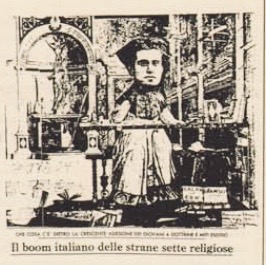
So, in this early Gramsci I find a priest rather than a modern prince. A priest driven by a substantive and coordinated theological effort to establish a voluntarist and teleological dogma for historical change, which really does not differ much from the principles of modern Liberalism and its potestas indirecta. It is interesting that in the last issue (1977) of the mythical Italian journal L’erba Voglio, there is a small satirical portrait of Gramsci dressed as a bishop with pen in hand, which speaks to the theological garments of Gramscianism well into our days. But the problem is not theology; it is rather that it is a theology of submission organized around order, reproduction, and history as idols in the name of consented domination.

Finally, I could very well imagine that some could rebuttal these theological imprints by claiming that this is only early Gramsci, and that things change later on. I am not too sure about this. It seems that this heuristic claim is analogous to Kafka’s “Leopards in the Temple” parable. In other words, isolating an “early” from a “late” Gramsci becomes a general ceremony to save the philosopher in spite of himself. But this is a self-defeating maneuvering from the very start.


*Image source: from the magazine L’erba Voglio, N.30, 1977.