Out of all of the Zürau aphorisms of Kafka there is one that reads as follows: “You are the task. No pupil far and wide (Du bist die Aufgabe. kein Schüler weit und breit) [1]. It resonates profoundly in our days as the idea of “education” and its inherited traditions are liquidated by the essence of technology. What Kafka could have meant by the idea of “task” (in German Aufgabe or in Spanish tarea) is to be deciphered in the intellectual context of the time. In his gloss to this aphorism, Reiner Stach has emphasized something elementary and yet quite essential; that is, that the task is not an action of the subject, but the meeting place of both subject and object. There is only the task of existence, and only to this extent we are always students of life before everything else comes into being. In a later aphorism, Kafka seems to return to the question of task by adding: “Two tasks at the beginning of life: to keep reining in your sphere, and to keep checking whether you might have gone into hiding somewhere outside your sphere” [2]. Something escapes, and that which is other than what is appropriate in life might just be the infinite work of the task of existence.
If there is a “theology” in Kafka it is something other than one conditioned by an efficacious action directed towards God. Again, these questions were up in the air in Kafka’s milieu at the time, and it suffices to remember Max Brod’s Tycho Brahe’s Path to God (1915) as an emblem, when the old astronomer tells his pupil Kepler: “One thing alone: carry out my work; do not let this tremendous labor utterly perish…” [3]. Writing in close proximity to Felix Weltsch’s theology of transcendent action in Freiheit und Gnade (1920), Brod understood that humans are only legitimate and participating in the “good” if it assists in the poetic energy of God. Here the notion of the task corresponds to the higher and more geometrico order of God. For Kafka, on the contrary, there is no task that is oriented as a supplement to a divine order that must be realized; it is rather a sensible education that had no beginning and no end, learning without texture because it has no fixed object. This Kafka’s task is an exilic (galuth) practice that cannot be territorialized in a promise of nationhood or state authority. The paradigmatic figure of “this task” is Sancho Panza, because as a lucid and sensible fool he is able to enjoy life to the very end. To experience the task without a destiny is to be able to stretch experience to the end of life.
This is precisely why Sancho Panza stands the paradigm of the task of a life that dwells in freedom. Let us recall carefully what Kafka writes in his short parable “The truth about Sancho Panza”: “Sancho Panza, a free man, maybe out of a certain feeling of responsibility, yet imperturbable, followed Quixote on his adventures and from them he had a grand and successful entertainment to the end of his days” [4]. The condition of ‘freedom’ that is proper to the task is imperturbable (gleichmütig), in which the pursuit of struggle and conflict is abandoned in order to complete and follow the task. But this “following” is not one of submission, but of segundear or sekundiere: “In the struggle between you and the world, second the world”, as he writes in another mysterious Zürau aphorism [5]. We remain in a state of the pure imperturbable when we second the world, because nothing appears to inflict us existence with the force of submission or obedience. Thus, freedom is not a substantive political category, but a lived and almost painterly instance in language that puts us closer (or apart) from our task.
.
.
Notes
1. Reiner Stach. The Aphorisms of Franz Kafka (Princeton University Press, 2022), 42. Translation modified.
2. Ibid., 186.
3. Max Brod’s Tycho Brahe’s Path to God (Northwestern University Press, 2007), 124.
4. Franz Kafka. “The truth about Sancho Panza”, in The Complete Stories (Schocken Books, 1971), 610.
5. Reiner Stach. The Aphorisms of Franz Kafka (Princeton University Press, 2022), 106.
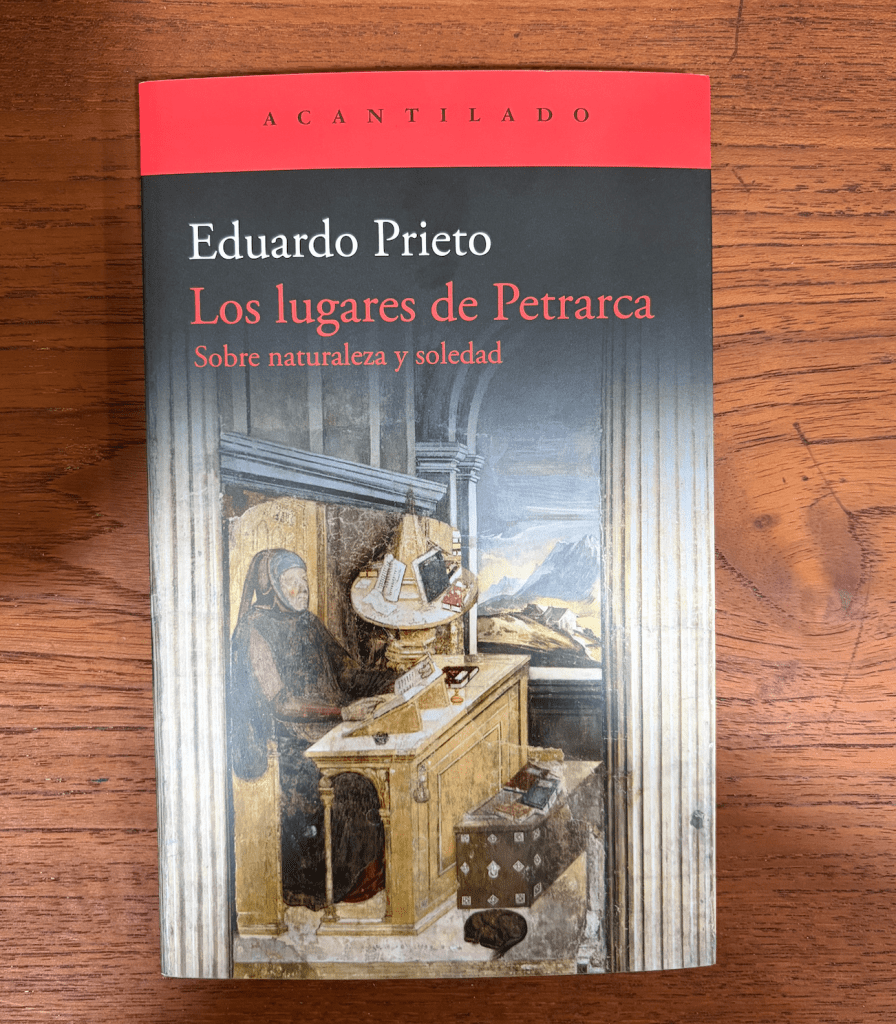
Eduardo Prieto’s slim book Los lugares de Petrarca: Sobre naturaleza y soledad (Acantilado, 2026) counts not just as a book on the great Italian lyricist, but also as a coherent reflection on what it means to write and create from concrete places and in the mood of the genius loci. Before the world became infatuated with nationhood, borders, and migratory laws, there were only territories of changing topographies and natural phenomena, a gleaming spectacle to the eyes and an adventure to the those on foot. Petrarch lived in such a world of early modern Europe – this is the world after the crisis of twelfth century to use Thomas Bisson’s historical marker – hopping from locations to landscapes, making him an absolute peregrinus ubique, and thus a permanent exile (Prieto 20).
Petrarch’s itinerary is expansive in the fourteenth century: from Monteppilier to Bologna to Napoles and Rome; from Fontaine de Vaucluse to Arquá in Padua, the different dwelling places of Petrarch are also analogical to figures of the surrounding of life, such as the river, the path, the garden, and the studiolo. For the peregrinus ubique, the ideal life was not to live outside of his homeland, but rather to find the attunement between place and soul as the ultimate liaison of the equanimous life. And this is precisely what Eduardo Prieto achieves in his wonderful book Los lugares de Petrarca (2026), which avoids the commonplaces of unidirectional biographies in order to weave a history of a mind that can only be written, as if were, from the the contours of its displacements and attentive to its landscape. This is why the famous, now topical, Mount of Ventoux rarely appears in Prieto’s essay; for one thing, because the rumor of the landscape is present in its invisibility in each and every of those places, and not just from centered on that text.
To speak of places is, first and foremost, to assume a certain distance from the life of the city life. Already during the time of Petrarch the emergence of urban centers, tied to economic abundance and growth, was becoming the new ground of what soon enough would become the nexus of social reproduction. Petrarch’s sensibility – which is the sensibility of the life of the poet at large – already takes notices of the corrosive allure of this social space, which will elicit corruption and “dirty vices” in the trades of the new public condition (Prieto 44-45). If otium is to be maintained, it needs to be an exile from the public and into the desert where solitude of mind can cultivate a sense of freedom and autonomy. But as Prieto reminds us, the desert of Petrarch is not that of the excruciating nothingness or abyss, but the locus horridus: “ámbito opuesto a la ciudad, el desierto se concebía menos como un espacio verídico que una utopía ambiental que se ofrecía a quienes buscaban un hábitat adecuado a su carácter: los héroes de lo solitario” (Prieto 45). Prieto will speak of a proximity with the divine of nature using the expression “ofrendas ambientales” (environmental gifts) of God that allow for a peaceful life within the limits of nature. In this sense, the solitary life of the peregrinus ubique it is ultimately not that exclusive: it is full of specters and the voices of the dead that emerges from the an existential depth that is more than just a handful of metaphors and rhetorical tropes (Prieto 49). This exiled life cannot be disconnected from its surroundings and its immersion into the landscapes in which it dwelled.
However, it is also thanks to Prieto’s own analytical efforts that we see that the notion of landscape is not limited to the horizontal vantage point of the spectator; it is also the underworld of the geopolitical cavities, where caves, hidden myths, and overflows of ocean water nourish the human imagination with the infused sensation of the mythical (Prieto 67). If the exilic life is to inhabit a burrow like an animal, as Kafka thought, then the topographical landscape can only be understood as a complex texture of memories and forgettings that, given their ecological scale, embrace the human experience while also exceeding it. Hence the importance of the graden in Petrarch’s poetic cosmos until his last days in Vaucluse, because it is in this piece of nurtured land where the poet communicates and disputes belonging with the deities.
As Prieto writes in an incisive moment of his book: “Rodeado de tales aguas, existe un pequeño campo de piedras, y es allí donde Petrarca quiere planear un jardín para consagrarlo a esas musas que inspiran sus trabajos. Pero, para consagrarlo, Petrarca debe quitarse antes a las deidades que viven en común con la naturaleza, las misteriosas e impredecibles ninfas, tal vez acompañado de sátiros, silenos, o incluso del mismísimo Pan” (Prieto 87). And if already during Petrarch’s time, a post-mythical epoch, Pan was already declared dead, before the Nietzschean declaration of the dead of God; what was at least obvious in the loci of the garden is that it was a nourishment for the elevation of the soul, in the same way that only those with a beautiful soul could dedicate themselves to the microscopic civilization art of putting together a garden, a thesis that centuries later Ernst Jünger will repeat verbatim in his late diaries.
Petrarch will spend his last days in his house of Arquà between the Euganian Hills of Padua, a landscape that can be discerned in the forthteenth century anonymous fresco that depicts Petrarch in his studiolo next to a right side open window (this is featured in the cover of Prieto’s book). The preparation for one’s death seems to require a slight alteration for the life of the peregrinus ubique; since it is not just the embodiment of truth of existence to death, but also of how that existence is embedded in the radiant opening of a place. In fact, this is what Petrarch longed for in his last days of Arquà: a dwelling place where exteriority and interiority can communicate within the tripartite arrangements of the home, the landscape, and the studiolo (Prieto 122). In a sense, ‘home, landscape, studiolo’ is the triangular form of the life of the soul that finally learns how to live beyond abundance and survival. It is the architecture of eternal life as its own indivisible garden. When in the nineteenth century, Count Conde Leoni opened up the tomb of Petrarch to examine his skull, the entire ossuary shattered into pieces, as if reminding us that life is never some bone relics in a grave (Prieto 134). What remains is the shadow of the pilgrim’s life, in its own voice and figure, that will endure throughout the centuries, and at times it will find an illuminated and candid resting place in wonderful book such Los lugares de Petrarca (2026).
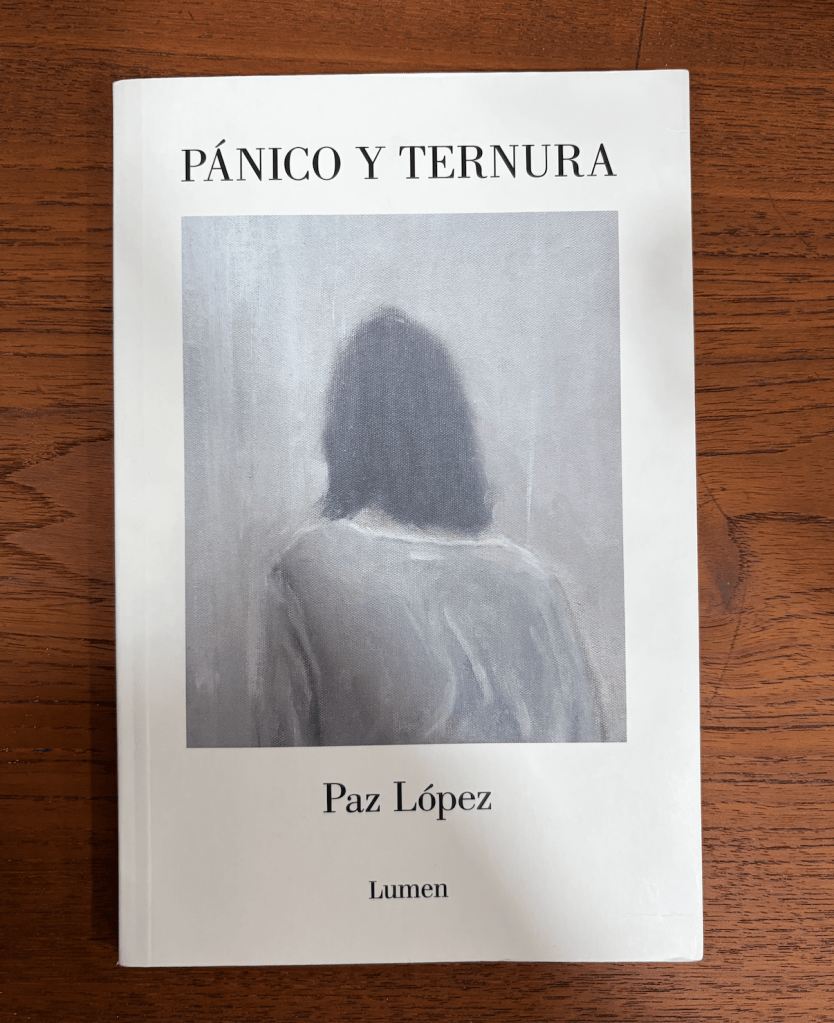
Paz López’s Pánico y Ternura (2026) opens with an analogy between life and school that immediately places us in attention to her writing: “Entramos a la vida como entra un niño a la escuela: mirando hacia atrás, con los ojos llorosos buscando la mano de quien hace un rato nos había variado el pelo, la nariz, las rodillas heridas, los diminutos labios” (López 14). Although the synecdoche (“la mano”) does not reveal to whom it belongs, in a way the mother is spectrally present, a figure overtly present in Paz’s writing. We enter life in the wake of separation and caesura, and that is the site of the original wound that will lead to all sorts of civilizational and mimetic compulsions that unfortunately we know too well. And yet, López does not say we enter the “law” (although this is also presupposed of course), but rather we enter school. Our civilization has slandered and tainted the notion of “schooling” and “school” to such an extent that we have entirely forgotten the fact that school is schola; that is, time of rest and interruption, “free time”, a lagging duration of contemplation of language and being, and of being in language. And if the notion of “school” is under ruthless attack in our present by an infantry of pedagogues and technicians, it is mainly due to the fact that what is being threatened is the very possibility of a form of life. Of course, our epoch is one in which the chatter of “life” is continuous and intoxicating, but the form of life is something altogether different: it entails to inhabit a space of a convergent and planar movement between language and world.
This is one of the regions that opens in López’s book; one out of many, allow me to follow it. As López says toward the end of the essay: “…cada vez que hay un corte tenemos la posibilidad de inventar una nueva lengua, de poner de movimiento el mundo” (López 128). It would be too convenient to follow up this claim and say that this is precisely what Paz López does in her writing; clearing language in order for a tonos or a vibration of the voice to unearth tropes that have been traced almost at the level of the flesh. This is something to this autographic practice that moves gently without fetishing the body and its materiality. Ultimately, a body is always more than surface. I want to retain from López’s scene of writing a responsive form of thought that in its inconspicuous relation to writing it refrains from the certitude of both philosophy and the letter. López’s search could perhaps be one of “tanteo”, a beautiful Spanish verb that refers to the hand that seeks and reaches out for something in space, and in my memory it immediately recalls some short stories of Carmen Martín Gaite’s fiction where this gesture figures in a cinematic fashion. Hence, for López ‘tanteo’ is to refuse the hell of a world of acrimonious security and confirmations that discards the inexorable presence of doubts and fissures (López 39). But the hand that seeks is also not a pure gesture in the void; it is one that asymptotically discloses an erotic mediation with the passing world without ever abandoning it; yet unequivocally assertive in the lamentation of the state of the world (López 56).
In other words, because we can seek (here López is enrolled in the school of Hölderlin), there is no end to the world now configured as a fragile fishing net of relations, unsaid words, glances, and incommensurable distances that make up, without exhausting it, the spectacle of life. Not “this life”, of course. For López, the brutality of our times (I am less prudent and I will say ‘onto-theology’) is precisely the general concerted opinion that we are all owners of our own little and mediocre lives, the last avatar of a self-serving will to power. Rather, for López life is always elsewhere, and this is why the “escape” or “exile” from oneself is not a place of arrival or destiny, but precisely the disposition that is always traversing every relation and every touch between bodies and souls (López 65). We are creatures of the outside, and by extension, only the cohabitation of the outside, can redeem the pain of the original laceration, as in the first image of the infant walking his path to school with his eyes turned. This is not a messianic or monastic retreat, it does not depend on the parousia, but rather one of poetic dwelling in the spaces that are both familiar and strange. It is only in them (through them) that we can only cultivate through the garden of our language. López’s anti-messianic orientation, devoid of the fiction of future time and its anxieties, is proportionally a prose of hanging spaces, of curvatures of language that affects the reader deeply without ever renouncing to the beauty that thinking that defies being brutalized through the crushing weight of technical terms or philosophical concepts.
In this sense, López’s writing is already an autographic writing at the threshold of onto-theology convinced that only style through the resources of the voice is the path that mitigates between poetry and philosophy, painting and memory, experiences and the unlived. López’s prose, if anything, is a lot about “gathering” through the tenderness; a contact where image and eros become the medium of life: “No es eso también la ternura, una forma de “recortar nuevos espacios en el vacío informa del exterior y conquistarlos a la medida de la vida (Claudio Magris)?” (López 94). To gather and to cut through the spaces: this is the highest task of the ethics of a form of life that requires a new theology of the sensible. Theology can be taken as a strange word in López’s lexicon, and I do not think that it appears even once in Pánico y Ternura. And yet, López’s proposal is completely theological if we take the theos as the highest and most beautiful light that can nominally allow for depth through the analogy of things in the net of the world. Hence, the importance of the sighting to the inner most depth in some moments of López’s writing, such as when she ponders on the fact that every time that she plunges eyes on a minuscule element or figure of the world, she senses that “se revela el elemento bestial que se enceuntra en el centro de nuestro mundo, como si la mirada fuera un cordon umbilical….amarrados todavia al vientre brumoso del origen” (López 121). And theology is not just the highest, but also the science of the first things: through the piercing expression of our senses, we elevate ourselves not with some revealed transcendence, but with the proximity with the things that have found us.
And yet we have been automatized – this is the sensible devastation that Pánico y Ternura is responding to without ever taking a political stance, because politics is thoroughly insufficient – to see every-thing, and every being at all times; all entities realized in the feast of interchangeability and availability. The heliotropic force of modernity now truly blinds and burns our skin, which means that no access to the solar totality of social existence can guarantee anything except continuous conflagration and commanded muteness. We cannot but feel “panic” in this current predicament López is completely right. Thus, we must find the flickering light and flames elsewhere, such as in the lamp of a dark night that can illuminate the page of a book that keeps us in attention without any real purpose. Nabokov’s suggestion comes to mind: in the lamp of our study, we reject the nihilist demands of the cacophonous social world. Paz López has given us a delicious essay to read under this tenuous light. It is a present memory of an abode that keeps the secret of secrets, a resting place of the soul where still some melody is heard.
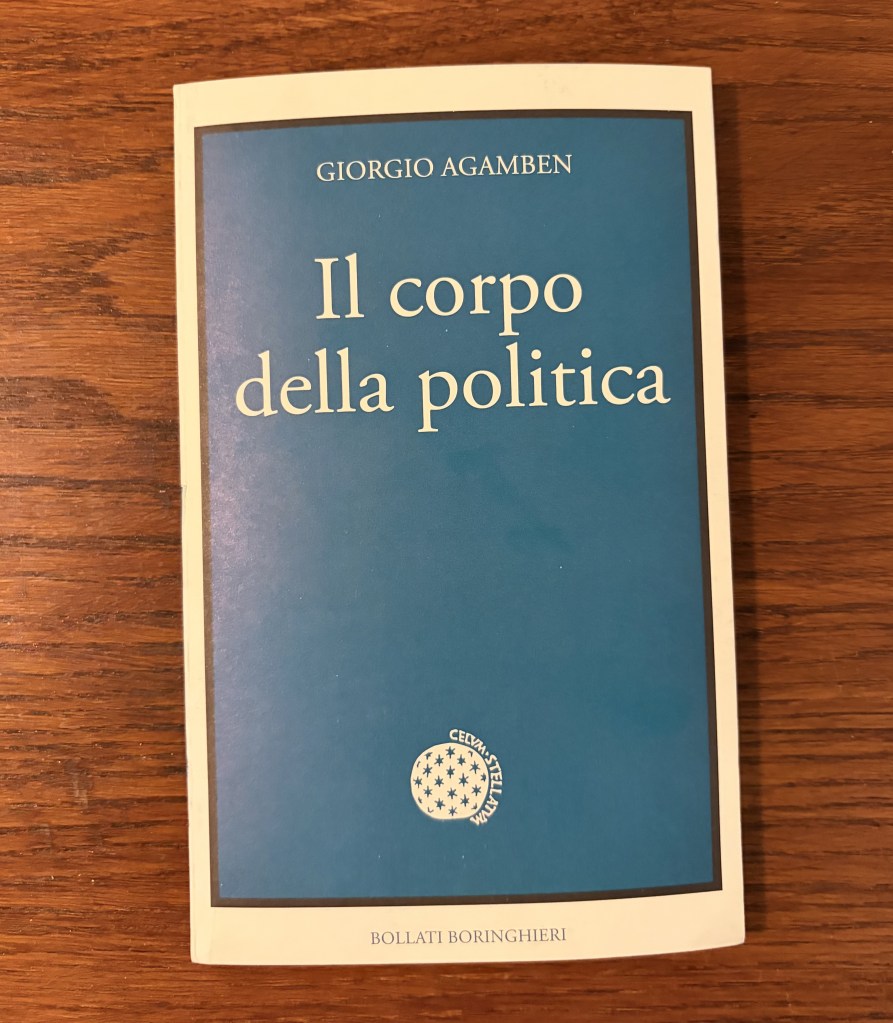
One of the decisive lessons of Giorgio Agamben’s archeological examination of Western politics is that the imperative to confront the closure of representation, sooner or later it must also come to terms with the notion of the body (corpo) as a central metapolitical condition in the genesis of modernity. If L’uso dei corpi (Neri Pozza, 2014) brought to its final stage the philosophical exploration of Western ontology of politics defined by efficacy and realization; in most recent opuscules, Agamben has shown how the fixation and regulation of the body is also embedded in the regions of language and sensation of human life as well. In this sense, it is impossible not to read Il corpo della politica (Bollati Boringhieri, 2026) along with Il corpo della lingua (Einaudi, 2024), as two parallel commentaries on the defining stature of political representation. If a new beginning is one of the decisive questions of our times, then one of the pending tasks is precisely to think the body (corpo) against the ontotheological assumptions of calculative reason.
Similar to Il corpo della lingua (2024), Il corpo della politica (2026) starts with the treatment of the Copernican revolution of bodies in Hobbes and Newton, which in the face of the cosmological infinity inscribed a notion of two bodies in order to allow for representation within spatial coordinates. In other words, Hobbes’ artificial sovereign represented by the mortal god Leviathan (state normative authority) will have an autonomous colorary in the autonomy of the subject that will become “political” as long as it becomes coterminous with the civic body of the “People”. Thus, to speak of “bodies” is not just to rationalize physicality in space – although it is also this from a technical viewpoint that state legibility will soon demand of the incipient civil society – but more importantly, it entails the administration of energy and movement (in Agamben’s well known lexicon, the domestication of potency to the realization of purposeful ends). For Agamben, Spinoza’s conatus, which appears in the Baroque period in critical dialogue with Hobbesian and Newtonian frameworks should be read precisely a way to think past the body as substance, following the steps of the tradition of ancient Stoicism in which beings are corporeal insofar as they are in tension with the world, allowing the tonos or acoustics to animate being in its movement towards preservation and exposure (Agamben 20-21).
If all beings are traversed by a tonos – a tension that crosses as its medium in virtue of its contact with the world – this means that they are no longer defined by a substance, but as intensity within a field of forces once thrown in the world. As Agamben writes in passing with explicit confrontation with Heidegger’s Being and Time: “…con la tesi perentoria ‘l’essenza dell’esserci giace (liegt) nell’esistenza’. L’esserci è stato “gettato” nel mondo, ma si direbbe che, una volta gettato, non cade in piedi, ma giace (liegen significa innanzitutto essere sdraiato). E questa concezione sub-stanziale dell’essere che il conatus mette radicalmente in questione” (Agamben 23). In an archeological gesture that is already signatura of his work, Agamben reminds us that Hobbes’ substantive and artificial division of the “two bodies” that anchors modern politics can be traced to the corpus mysticum and the theological debates concerning transubstantiation that will later be recasted in the intersecting works of both Ernst Kantorowicz and Carl Schmitt, in which the impolitical dimension of the multitude becomes political through the artifice of decision and representation of a unified and indivisible body (Agamben 25-26).
The catastrophe of modern politics takes place when the body, once reduced to a substance and computable object in space, ceases to be understood as an inteusum or intensity of an irreducible multitude that expressed a generic and universal human species, as it was for Dante: “La politico – il finis totius humanae civilitatis che Dante intende definirie nel suo trattato – è ancora una volta un campo di tensioni interne allo stesso genere umano e questa intensità ha la foram di una moltitudine” (Agamben 39). In other words, for Agamben following the implicit tonus present in Dante’s Monarchia, the political is neither action nor mediation, but what names the very site of the possible. Agamben calls the hypothesis of an “anarchic politics” (politica anarchica), which no longer defines itself in relation to a formal mediation of government and state, but rather as the intensity of the multitude through the generic being (Marx) or the universal humanity (Dante) that takes the form of sensible Empire devoid of principial politics mediated by constituent power (Agamben 47).
Where does the multitude dwell outside the constituted representation of a community of belonging or the social mediation of the state? Already in 1990s Agamben had written a gloss on the politics of exile collected in Mezzi senza fine (1996), and the last part of Il corpo della politica (2026) he returns to philosophical and theological notion of the exile vis-a-vis the historical experience of the Jewish tradition as an errant or stateless people, as Erich Unger called it in 1922, whose existence has been defined by exile or galut (Agamben 48). It is a bit of a misnomer to call the exilic experience a “politics”, since for Agamben the authentic tradition of exile does not entail the right or duty fixed to a community of belonging; rather, what outlives the law is the only path capable of deposing it (in the manner of Paul, that is, as katargeo). In this way, justice is now understood not as a procedure in a normative system, but as a written tradition that can only be studied and reflected upon and ultimately experienced as a state of passivity.
Hence, the exilic experience is the caesura between language and world, in which we touch the exteriority with a renewed intimacy that unfolds the uncommunicative solitude that keeps the mystery of our use of language. Following the neoplatonic formulation “phygé monou pros monon” – understood by Erik Peterson as an expressive mystical relation of a “fuga di un solo presso un solo” – there is intimacy and authentic belonging whenever there is sensible separation in being (Agamben 55). Following Plutarch and Plato, for Agamben the exilic dimension is the very home of philosophy and thought, which confirms, against Crito’s suggestions at the end of Socrates’ life, that there life outside of the polis and the conglomerate of the demos, because life is outside itself once it is assimilated in the virtuality of a divine that nourishes its own potency. In what stands as one of the most precise formulations of the pheugein (exile) condition as a figure of existence, Agamben writes of its precise ascesis:
“La celebre definizione ascetica della fuga dal mondo come assimilazione a Dio andrà resa, pertanto, restituendo tutta la sua forza alla metafora politica: “l’assimilazione a Dio virtualmente un esilio” (kata ton dynaton significa qui, secondo il sense più proprio del termine dynatos, “virtualmente, secondo la potenza). L’affermazione e tanto piu significativa in quanto, con queste parole, Platone rompe con l’insegnamento socratico del Critone, secondo cui la possibilità di phygé offerta al condannato non potrà che essere rifiutata, perché non vi è vita possibile fuora dalla polis” (Agamben 57).
This region that precedes and exceeds politics – in the language of Sophocles, the well known ypsipolis apolis – is akin to the tone that runs to the forgetting of any substantive ontology of politics that seeks to subsumes life into the confinement of external forces. It is in this paradoxical situation of assimilation in exile, and a permanent exile that assimilates itself in God as shared thought that politics can be transfigured as an apodemia that refuses the closure of life into principles of government and dominium, and away from the community form of propriety and rooted belonging. Agamben recalls that in the history of Christianity, it is the time of the parish (paroikias) what allows the soul to live in earth as foreigner and exile, in proximity of the medium of the kingdom, and that only later with Saint Augustine it was transformed into a territorial institution for the communio and communal salvation (Agamben 60-61). In the paroikias, Agamben returns to the kingdom not as a retheologization of the politics, but as a figural parable in which a poetic dwelling is enacted in the measureless passivity of a form of life, a project consistent with the formulation of the singular whatever being articulated in La comunita che viene (1990).
The assimilation in the exile of the divine, which recalls the forgetting of oneself and the god announced by Hölderlin in“Note on the Oedipus”, is refined in the last essay of the book entitled “Il corpo dell’Europa”, which reproduces a lecture delivered in Venice in May 2024 about idea of Europe. As a sort of concluding reflection or apostilla, we are now able to say that for Agamben the only possibility of dwelling in the vestiges of the European tradition and memory is to rescue, from the wreckage of its history, the sediments of a texture of the phygén: to be exiled is not just a vitalist affirmation of this life, but more importantly, it also implies disclosing the possibilities buried in the past with the dead, that is, in contact not only with Gaia, but also in the downward movement to the domus of the infraworld (a figure that receives a novel treatment Agamben’s recent book La lingua che resta). Agamben exemplifies this exile with the dead with three poetic moments of high european modernism: Ezra Pound’ Cantos, T.S. Eliot’s The Wasteland, and Eric Auerbach’s masterpiece Mimesis written from his exile in Turkey – and of course, we could also think here of Kafka’s parables and Joseph Roth’s narratives of Jewish errancy; as well as Alexandre Lerrnet Holenia’s phantasmatic crumbling of Empire in The Standard and Osip Mandelstam’s “The Fourth Prose”, where the end of the work leads to the human voice as the supreme poetic task in the face of nihilism and political totalitarianism.
It should be clear, however, that the problem is not found a temporary refuge or a last stand in the fortress of modern literature, but of coming to terms with the phygé as a fundamental problem of language that, in virtue of its unique and irreplaceable experience, delivers a world nested in the affection of remembrance. As Agamben asks towards the end of the lecture: “Is there a sensibility and a form of life that we can call European?” (Agamben 82). This question can only be answered when we dwell and assimilate into the exile of thought that harbors the residues, figures, and voices that speak to us from the dead in a tradition because it is no longer transmitted, we can only access it poetically. In the only moment that the word anima (soul) appears in the text, in the very last sentences, it becomes clear that it is only in the intensity of thought that life accounts for the inseparability of the body and the soul that historical abstraction has rendered oblivious and alien from the tonos of presence. We are not yet ready to declare a return to the appearance between being and world, and for that very reason even the presence of the divine, as Agamben says following Isaac Luria, is itself exiled from the creation of the world until the advent of the tiqqun in the night of restitution. The exilic dwelling of life outside itself is marked by this sort of secret unfaithfulness in the absence of the god. In the meantime, the task of an ethical life is to passively reside in an exile where the reality of the soul returns what is possible and breathable to the appearance of the real.
In Book V of his Latin Language, and immediately after commenting the duality of Earth and Sky, Varro writes an enduring and yet enigmatic gloss of worldly life. In Roland Kent’s translation from 1938 we read: “Inasmuch as the separation of life and body is the exitus, ‘way out’ for all creates born, from that comes exitium, ‘destruction’, just as when they ineunt ‘go into’ unity, it is their initia, ‘beginnings’ [1]. It is probable that Kent had to leave the latinized terms next to familiar reiteration of modern English in order to allow the text to breath in all of its complexity, for what is Varro ultimately attempting to tell us can very depending what we want to stress, and how we read in the scope of his discussion starting in section 58. Is it that life is always marked by the wound of separation with the natural world? Or that destruction and caducity (exitium) is a necessary condition for all new beginnings, as if life understood as an enclosed organism or entity is always insufficient, because of the order of excess at the very moment that it recognizes its propriety? This excess is what cannot be contained in neither life nor in social form or political mediation; it is the initia of thought in its relation to phenomena of the world but without ever being reduced in them. In this sense, there can only be a beginning in the passion that thought grants to the separation from the world.
This is perhaps what Pindar had in mind when writing in Isthmian 8 – in clear tone of his disenchantment before political strife – of a need to return to a shared language among friends (a language that cannot be that of the rhetorical antinomies of the polis): “It is always best to look at each thing right at our feet / for treacherous time hangs over men and twist awry the path of life. But even those things may be healed by men if freedom is with them; and a man should give care to [that] noble hope” [2]. In his commentary on these lines C.M. Bowra notes that the awry and treacherous time of life that Pindar refers is not just a personal account, but rather a state of the world of his own generation and friends [3]. Politics brings to ruin; it brings fear, but more importantly it brings oblivion to the nearness of each and every thing that stamps irreducibility. But what Bowra does not thematize is the central stress of these lines; mainly, that the Ancient poet makes a plea to the examination of proximity and nearness “look at each thing right at our feet”. The plea to take care of a true life harmonized is preoccupied with this lying out before our feet is so inapparent that it provides texture and rhythm to every appearance; it is so invisible that it can disclose the very possibility of the beginning or end of a visible world.
It seems that Pindar’s solicitation of proximity speaks to Varro’s initia; but not because there is something like a true origin or original position (a category that modern political thought later elevate to the physics of social stratification and positional distribution), but rather because another idea of “freedom” can be rethought from the excess of what appears spatially in the world; an absolute instance of appropriation beyond life. This is perhaps beautifully expressed in one of Cézanne’s most acute images of his creative process: “I breathe the virginity of the world…a sharp sense of nuances works on me. At that moment I am as one with my paintings” [4]. Before painting and creation there is a sensuous region in which the separation of objects and subjects do not longer sustain totality except as catastrophe or force.
This means that to disclose regions of life in the world is not just about the claim of autonomy and normativity of a place; on the contrary, it is the very inapparent, almost imperceptible, possibility that lies in the wrinkled proximity when we withdraw from things ad they seem. Quod natis exitus – because we are always exiled from each and every place, it is through the thinking of the inconspicuous of each and every being that revisitation of an ethical life calls on us from the outside. Ultimately, the ethical life is nothing but the imperative of «lech lechà» in a separation that unites when overcoming the deceit of time.
.
.
Notes
1. Varro. On the Latin Language, Books 5-7 (Loeb Classical Library, 1951), 59.
2. Pindar. “Isthmian 8”, in Pindar (Loeb Library, 1997), 211.
3. C.M. Bowra. Pindar (Oxford University Press, 1964), 114.
4. Joachim Gasquet. Cézanne: A memoir with conversations (Thames&Hudson, 1991), 45.
The highest poetic moment in Michel De Certeau’s La culture au pluriel (1974) appears in the concluding pages where the historian resorts to a hunting image: “Culture is an untold night in which the revolutions of earlier times are dormant, invisible, folded into practices – but fireflies, and sometimes great nocturnal birds, cutting through it – as thrusts and creations that trace the promise of another day to come” [1]. This is De Certeau’s trope that stands for culture as opening of possibilities, the shoreline where administrators and technicians (his own terms) do not dare to cross and will probably never adventure. This is the site (the night, la noche oscura, which has a ringtone of the mystical tradition that the author knew perfectly well) where De Certeau wants to posit the possibilities of new struggles of cultural alterities [2]. A book in 1974 means many things, but for De Certeau it is an incursion into the collapse of his historical present, already showing full fledged signs of the crisis of legitimation, erosion of institutional trust, and the decomposition of social forms across Western symbolic realities. It is the nascent confirmation of the ascent of real subsumption, a term that does not appear in De Certeau’s book, although it informs it, even if negatively (the Italian Fiat wildstrikes makes a surprising cameo in the last paragraphs). Where to look, then?
De Certeau’s answer read today does bring much naivete: cultural alterity. But this notion, which is reworked and contested in concrete fields of human activities (the university and schools, the new technological society and communication, social practices intertwined in popular and elite culture, power relations and post-statist configurations) do not appeal to the identitarian cosmopolitan horizon prima facie anchored in the diversity administration of a well integrated, albeit exploited planetary humanity. One senses that for De Certeau the nineteenth century “Social Question” has become the “cultural question” as the unit of the national sovereign state wanes and reacts. With the crisis of legitimation as backdrop, De Certeau sees the rise of a new subjectivity that he calls the new “militants without a cause”, a battalion of “exiles” that will only tacitly accept credible cultural imprints [3]. He wants to work with “culture” because at bottom De Certeau is both a historian and a realist. This new erosion of civil society-State relations entails a “new exile is in the works” [4]. And for De Certeau the exile, since biblical times, is seeking a new Earth where to “land”.
In 1974, De Certeau’s invitation was to create the conditions for pluralist cultural landings that will foster, in the night of waiting, a new politics. But, could the same be said today even assuming concrete situations and the infuriating image of migration as a token for the workings of hegemonic politics? Does Gaia not alert us that we must “land” somewhere else on Earth? The anger and dissatisfaction that De Certeau cautiously predicated head on is already here in the form of what some of us have theorized as ongoing social stasis that is integrated in every social mediation. In the global metastasis of the 1970s De Certeau could claim that “behind anger there is the desire to create a polis and a politics; there is a desire to organize the conditions of life….” [5].
We are far removed from this desire, and even the most prominent cycle of revolts of the decade have refused in the solicitation of a new politics or a political horizon; and, even if, almost like weeds in cracks of piled urban ruins, we see again and again the last residues of the desire for hegemonic representation of the totality (the People, the Movement, the Class). In this light – now it is our own epoche – culture can only be compensatory, and still very much a symptom of the closure of exteriority. “Where there is no longer an imaginable outside we lose the possibility of an inside”, Moreiras wrote at the turn of the century against every form of culturalism [6]. Of course, De Certeau was well aware of it, which is why his proposal to cultural alterity retains zones of hermeneutical ambiguity many decades later [7]. For instance, he writes when commenting on neo-nationalist regional movements (Quebec, Catalonia, Occitania) that “cultural claims appear to be a reminder and a compensation” [8].
And recent events have proven De Certeau correct: what is Catalan nationalism – whether left or right, although ideological division is not a substantive difference – if not a compensatory rhetorical ruse to mobilize regional political elites to feed off the stagnant resources of a waning state form? The rhetoric of “political foundation” in the Catalan case created an “cultural alterity” that depended on the high illusion of hegemonic politics; a politics solely based on the “bad faith” of escalating and superposing values (“Spanish” v. “Catalan”) as the combustion of a fractured political social contract that ultimately deepens its fragmentation. De Certeau noted – cited with the long Augustunian tradition of political liberalism – that politics cannot bring happiness, but only create its conditions. However, today even this liberal ideal fails to account for its true source: our metapolitical collapse at the twilight of secularization means that the revival of the “social bond” is not to be found in the demand of new political principles, however narrowly or broadly defined. De Certeau in 1974 aspired at giving politics one more chance pulling it to the facticial heterogeneity of culture: “a politics that discovers in the diversity of the sky a generical….linked to the ambition of beginning over again, that is, of living” [9].
And indeed, we must begin all over again, but is really the only possibility? I believe that there are symptoms elsewhere in La culture au pluriel, and these concern language. In the second chapter, referring to the crisis of speech, De Certeau refers to the “denaturing act” of speech, as communication enters the regimen of commercial language and new computational masteries (what Jaime Semprún called neo-language) [10]. The crisis of language in the ascent of a new expressivity renders communication obsolete and obtuse; parasitic, or mushroom-like, as Hugo Von Hofmenthal had already noted in his Letter to Lord Chandos. Speech becomes a new form of blasphemy, something confirmed in recent years in the United States, which takes itself also as the homeland of “Free Speech” is increasingly under heavy surveillance by constitutionalism of codified parameters of “time, place, and manner”.
De Certeau shows himself highly consternated about blasphemous language, which is also conspiratorial language; the language that dwells on the reverse of social normativity and legal codification. But this perhaps the only language today can properly speak of pain without recurring to the transactions of violence; especially of the numbing violence of a neo-language that can communicate “everything” insofar as it ceases to communicate to no one. Could the “untold night”, that is also the night of the “unthought”, be the site of the preservation of another use of language, of nurturing language, descending into the hymnic sources of the sayable – thus, inverting the denaturing of historical severability – a language embedded in silence, in the protofigure of the mystic, assuming “the immediacy of nature and experience, to contact of things, one by one, in their primal disorder”? [11]. Ultimately, whatever the night will tell will only be possible through and in language.
.
.
Notes
1. Michel De Certeau. Culture in the Plural (University of Minnesota Press, 1997), 138.
2. Ibid., 11.
3. Ibid., 7.
4. Ibid., 8.
5. Ibid., 11.
6. Alberto Moreiras. The Exhaustion of Difference: The Politics of Latin American Cultural Studies (Duke U Press, 2001), 21.
7. Michel De Certeau. Culture in the Plural (University of Minnesota Press, 1997), 78.
8. Ibid., 70.
9. Michel De Certeau. Culture in the Plural (University of Minnesota Press, 1997), 100.
10. Jaime Semprún. Defensa e ilustración de la neolengua (Ediciones El Salmón, 2018).
11. Nicola Chiaromonte. “An Age of Bad Faith”, in The Paradox of History (University of Pennsylvania Press, 1985), 148. On the hymnic dimension of human speech, see the study undertaken by Nicoletta Di Vita, Il nome e la voce. Per una filosofia dell’inno (Neri Pozza, 2022).