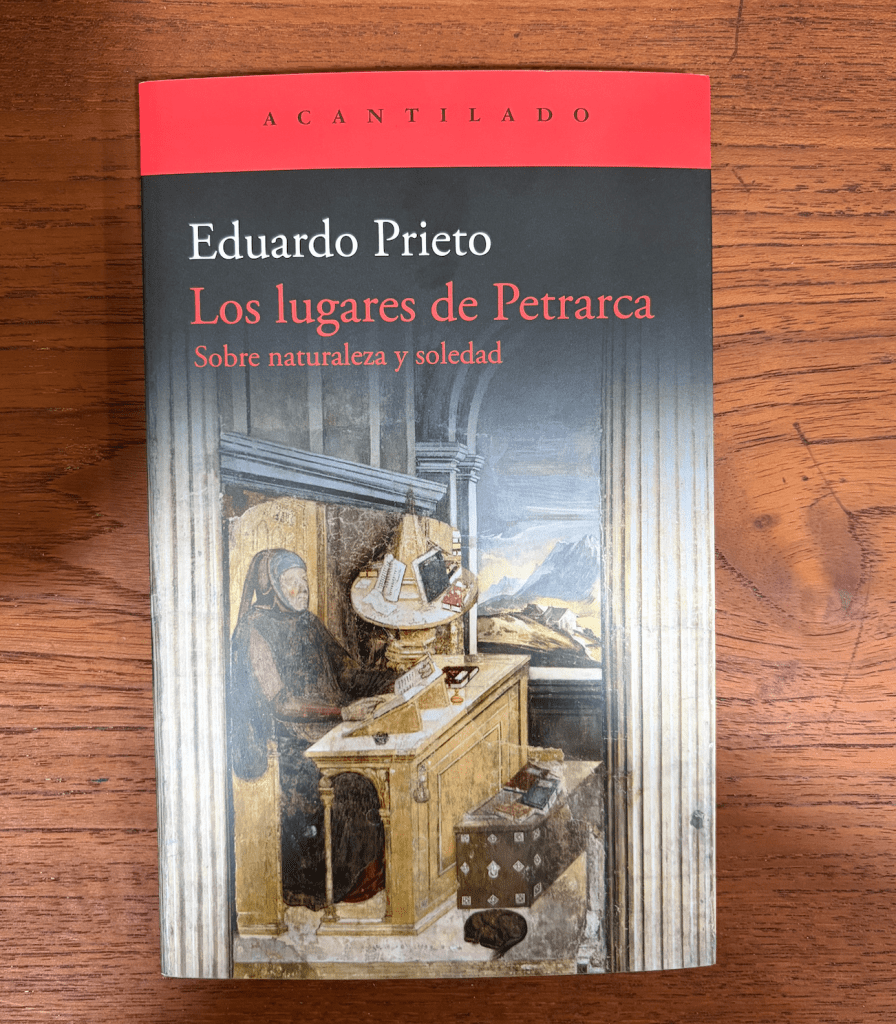
Eduardo Prieto’s slim book Los lugares de Petrarca: Sobre naturaleza y soledad (Acantilado, 2026) counts not just as a book on the great Italian lyricist, but also as a coherent reflection on what it means to write and create from concrete places and in the mood of the genius loci. Before the world became infatuated with nationhood, borders, and migratory laws, there were only territories of changing topographies and natural phenomena, a gleaming spectacle to the eyes and an adventure to the those on foot. Petrarch lived in such a world of early modern Europe – this is the world after the crisis of twelfth century to use Thomas Bisson’s historical marker – hopping from locations to landscapes, making him an absolute peregrinus ubique, and thus a permanent exile (Prieto 20).
Petrarch’s itinerary is expansive in the fourteenth century: from Monteppilier to Bologna to Napoles and Rome; from Fontaine de Vaucluse to Arquá in Padua, the different dwelling places of Petrarch are also analogical to figures of the surrounding of life, such as the river, the path, the garden, and the studiolo. For the peregrinus ubique, the ideal life was not to live outside of his homeland, but rather to find the attunement between place and soul as the ultimate liaison of the equanimous life. And this is precisely what Eduardo Prieto achieves in his wonderful book Los lugares de Petrarca (2026), which avoids the commonplaces of unidirectional biographies in order to weave a history of a mind that can only be written, as if were, from the the contours of its displacements and attentive to its landscape. This is why the famous, now topical, Mount of Ventoux rarely appears in Prieto’s essay; for one thing, because the rumor of the landscape is present in its invisibility in each and every of those places, and not just from centered on that text.
To speak of places is, first and foremost, to assume a certain distance from the life of the city life. Already during the time of Petrarch the emergence of urban centers, tied to economic abundance and growth, was becoming the new ground of what soon enough would become the nexus of social reproduction. Petrarch’s sensibility – which is the sensibility of the life of the poet at large – already takes notices of the corrosive allure of this social space, which will elicit corruption and “dirty vices” in the trades of the new public condition (Prieto 44-45). If otium is to be maintained, it needs to be an exile from the public and into the desert where solitude of mind can cultivate a sense of freedom and autonomy. But as Prieto reminds us, the desert of Petrarch is not that of the excruciating nothingness or abyss, but the locus horridus: “ámbito opuesto a la ciudad, el desierto se concebía menos como un espacio verídico que una utopía ambiental que se ofrecía a quienes buscaban un hábitat adecuado a su carácter: los héroes de lo solitario” (Prieto 45). Prieto will speak of a proximity with the divine of nature using the expression “ofrendas ambientales” (environmental gifts) of God that allow for a peaceful life within the limits of nature. In this sense, the solitary life of the peregrinus ubique it is ultimately not that exclusive: it is full of specters and the voices of the dead that emerges from the an existential depth that is more than just a handful of metaphors and rhetorical tropes (Prieto 49). This exiled life cannot be disconnected from its surroundings and its immersion into the landscapes in which it dwelled.
However, it is also thanks to Prieto’s own analytical efforts that we see that the notion of landscape is not limited to the horizontal vantage point of the spectator; it is also the underworld of the geopolitical cavities, where caves, hidden myths, and overflows of ocean water nourish the human imagination with the infused sensation of the mythical (Prieto 67). If the exilic life is to inhabit a burrow like an animal, as Kafka thought, then the topographical landscape can only be understood as a complex texture of memories and forgettings that, given their ecological scale, embrace the human experience while also exceeding it. Hence the importance of the graden in Petrarch’s poetic cosmos until his last days in Vaucluse, because it is in this piece of nurtured land where the poet communicates and disputes belonging with the deities.
As Prieto writes in an incisive moment of his book: “Rodeado de tales aguas, existe un pequeño campo de piedras, y es allí donde Petrarca quiere planear un jardín para consagrarlo a esas musas que inspiran sus trabajos. Pero, para consagrarlo, Petrarca debe quitarse antes a las deidades que viven en común con la naturaleza, las misteriosas e impredecibles ninfas, tal vez acompañado de sátiros, silenos, o incluso del mismísimo Pan” (Prieto 87). And if already during Petrarch’s time, a post-mythical epoch, Pan was already declared dead, before the Nietzschean declaration of the dead of God; what was at least obvious in the loci of the garden is that it was a nourishment for the elevation of the soul, in the same way that only those with a beautiful soul could dedicate themselves to the microscopic civilization art of putting together a garden, a thesis that centuries later Ernst Jünger will repeat verbatim in his late diaries.
Petrarch will spend his last days in his house of Arquà between the Euganian Hills of Padua, a landscape that can be discerned in the forthteenth century anonymous fresco that depicts Petrarch in his studiolo next to a right side open window (this is featured in the cover of Prieto’s book). The preparation for one’s death seems to require a slight alteration for the life of the peregrinus ubique; since it is not just the embodiment of truth of existence to death, but also of how that existence is embedded in the radiant opening of a place. In fact, this is what Petrarch longed for in his last days of Arquà: a dwelling place where exteriority and interiority can communicate within the tripartite arrangements of the home, the landscape, and the studiolo (Prieto 122). In a sense, ‘home, landscape, studiolo’ is the triangular form of the life of the soul that finally learns how to live beyond abundance and survival. It is the architecture of eternal life as its own indivisible garden. When in the nineteenth century, Count Conde Leoni opened up the tomb of Petrarch to examine his skull, the entire ossuary shattered into pieces, as if reminding us that life is never some bone relics in a grave (Prieto 134). What remains is the shadow of the pilgrim’s life, in its own voice and figure, that will endure throughout the centuries, and at times it will find an illuminated and candid resting place in wonderful book such Los lugares de Petrarca (2026).

