Peregrinus ubique. On Eduardo Prieto’s Los lugares de Petrarca (2026). by Gerardo Muñoz

Eduardo Prieto’s slim book Los lugares de Petrarca: Sobre naturaleza y soledad (Acantilado, 2026) counts not just as a book on the great Italian lyricist, but also as a coherent reflection on what it means to write and create from concrete places and in the mood of the genius loci. Before the world became infatuated with nationhood, borders, and migratory laws, there were only territories of changing topographies and natural phenomena, a gleaming spectacle to the eyes and an adventure to the those on foot. Petrarch lived in such a world of early modern Europe – this is the world after the crisis of twelfth century to use Thomas Bisson’s historical marker – hopping from locations to landscapes, making him an absolute peregrinus ubique, and thus a permanent exile (Prieto 20). 

Petrarch’s itinerary is expansive in the fourteenth century: from Monteppilier to Bologna to Napoles and Rome; from Fontaine de Vaucluse to Arquá in Padua, the different dwelling places of Petrarch are also analogical to figures of the surrounding of life, such as the river, the path, the garden, and the studiolo. For the peregrinus ubique, the ideal life was not to live outside of his homeland, but rather to find the attunement between place and soul as the ultimate liaison of the equanimous life. And this is precisely what Eduardo Prieto achieves in his wonderful book Los lugares de Petrarca (2026), which avoids the commonplaces of unidirectional biographies in order to weave a history of a mind that can only be written, as if were, from the the contours of its displacements and attentive to its landscape. This is why the famous, now topical, Mount of Ventoux rarely appears in Prieto’s essay; for one thing, because the rumor of the landscape is present in its invisibility in each and every of those places, and not just from centered on that text.

To speak of places is, first and foremost, to assume a certain distance from the life of the city life. Already during the time of Petrarch the emergence of urban centers, tied to economic abundance and growth, was becoming the new ground of what soon enough would become the nexus of social reproduction. Petrarch’s sensibility – which is the sensibility of the life of the poet at large – already takes notices of the corrosive allure of this social space, which will elicit corruption and “dirty vices” in the trades of the new public condition (Prieto 44-45). If otium is to be maintained, it needs to be an exile from the public and into the desert where solitude of mind can cultivate a sense of freedom and autonomy. But as Prieto reminds us, the desert of Petrarch is not that of the excruciating nothingness or abyss, but the locus horridus: “ámbito opuesto a la ciudad, el desierto se concebía menos como un espacio verídico que una utopía ambiental que se ofrecía a quienes buscaban un hábitat adecuado a su carácter: los héroes de lo solitario” (Prieto 45). Prieto will speak of a proximity with the divine of nature using the expression “ofrendas ambientales” (environmental gifts) of God that allow for a peaceful life within the limits of nature. In this sense, the solitary life of the peregrinus ubique it is ultimately not that exclusive: it is full of specters and the voices of the dead that emerges from the an existential depth that is more than just a handful of metaphors and rhetorical tropes (Prieto 49). This exiled life cannot be disconnected from its surroundings and its immersion into the landscapes in which it dwelled. 

However, it is also thanks to Prieto’s own analytical efforts that we see that the notion of landscape is not limited to the horizontal vantage point of the spectator; it is also the underworld of the geopolitical cavities, where caves, hidden myths, and overflows of ocean water nourish the human imagination with the infused sensation of the mythical (Prieto 67). If the exilic life is to inhabit a burrow like an animal, as Kafka thought, then the topographical landscape can only be understood as a complex texture of memories and forgettings that, given their ecological scale, embrace the human experience while also exceeding it. Hence the importance of the graden in Petrarch’s poetic cosmos until his last days in Vaucluse, because it is in this piece of nurtured land where the poet communicates and disputes belonging with the deities.

As Prieto writes in an incisive moment of his book: “Rodeado de tales aguas, existe un pequeño campo de piedras, y es allí donde Petrarca quiere planear un jardín para consagrarlo a esas musas que inspiran sus trabajos. Pero, para consagrarlo, Petrarca debe quitarse antes a las deidades que viven en común con la naturaleza, las misteriosas e impredecibles ninfas, tal vez acompañado de sátiros, silenos, o incluso del mismísimo Pan” (Prieto 87). And if already during Petrarch’s time, a post-mythical epoch, Pan was already declared dead, before the Nietzschean declaration of the dead of God; what was at least obvious in the loci of the garden is that it was a nourishment for the elevation of the soul, in the same way that only those with a beautiful soul could dedicate themselves to the microscopic civilization art of putting together a garden, a thesis that centuries later Ernst Jünger will repeat verbatim in his late diaries. 

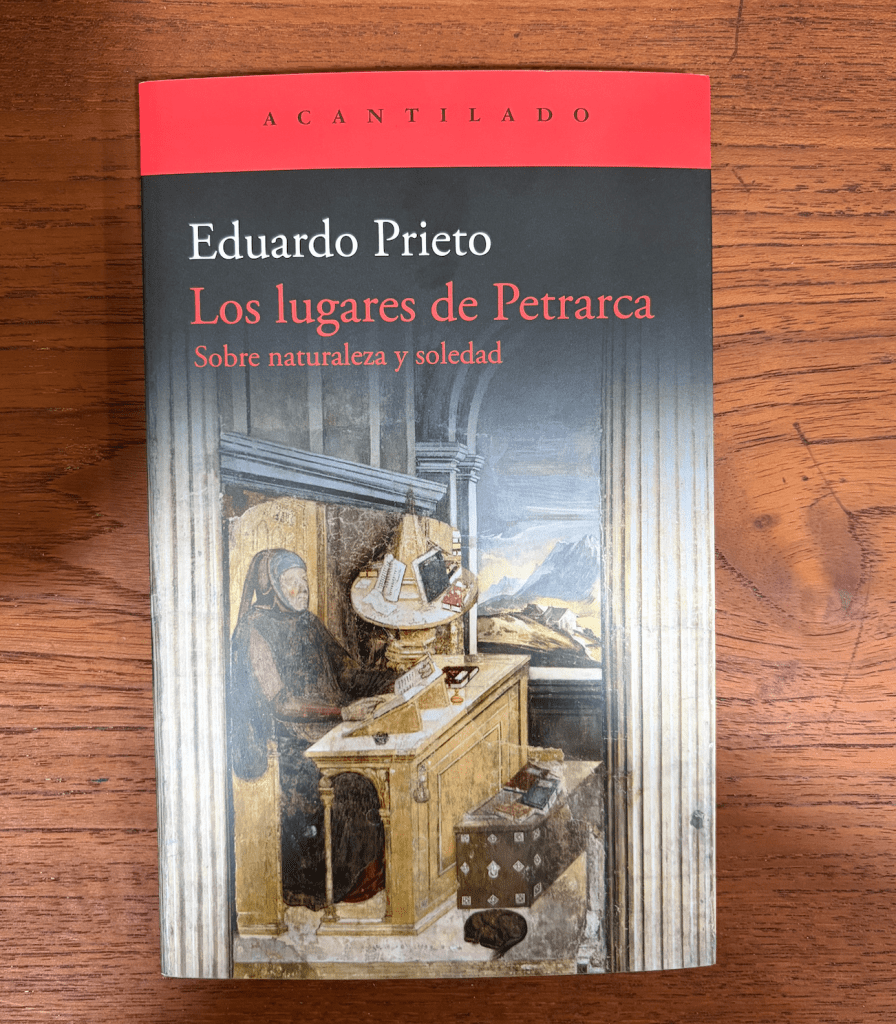
Petrarch will spend his last days in his house of Arquà between the Euganian Hills of Padua, a landscape that can be discerned in the forthteenth century anonymous fresco that depicts Petrarch in his studiolo next to a right side open window (this is featured in the cover of Prieto’s book). The preparation for one’s death seems to require a slight alteration for the life of the peregrinus ubique; since it is not just the embodiment of truth of existence to death, but also of how that existence is embedded in the radiant opening of a place. In fact, this is what Petrarch longed for in his last days of Arquà: a dwelling place where exteriority and interiority can communicate within the tripartite arrangements of the home, the landscape, and the studiolo (Prieto 122). In a sense, ‘home, landscape, studiolo’ is the triangular form of the life of the soul that finally learns how to live beyond abundance and survival. It is the architecture of eternal life as its own indivisible garden. When in the nineteenth century, Count Conde Leoni opened up the tomb of Petrarch to examine his skull, the entire ossuary shattered into pieces, as if reminding us that life is never some bone relics in a grave (Prieto 134). What remains is the shadow of the pilgrim’s life, in its own voice and figure, that will endure throughout the centuries, and at times it will find an illuminated and candid resting place in wonderful book such Los lugares de Petrarca (2026).
Marruz’s Mount of Transfiguration. by Gerardo Muñoz

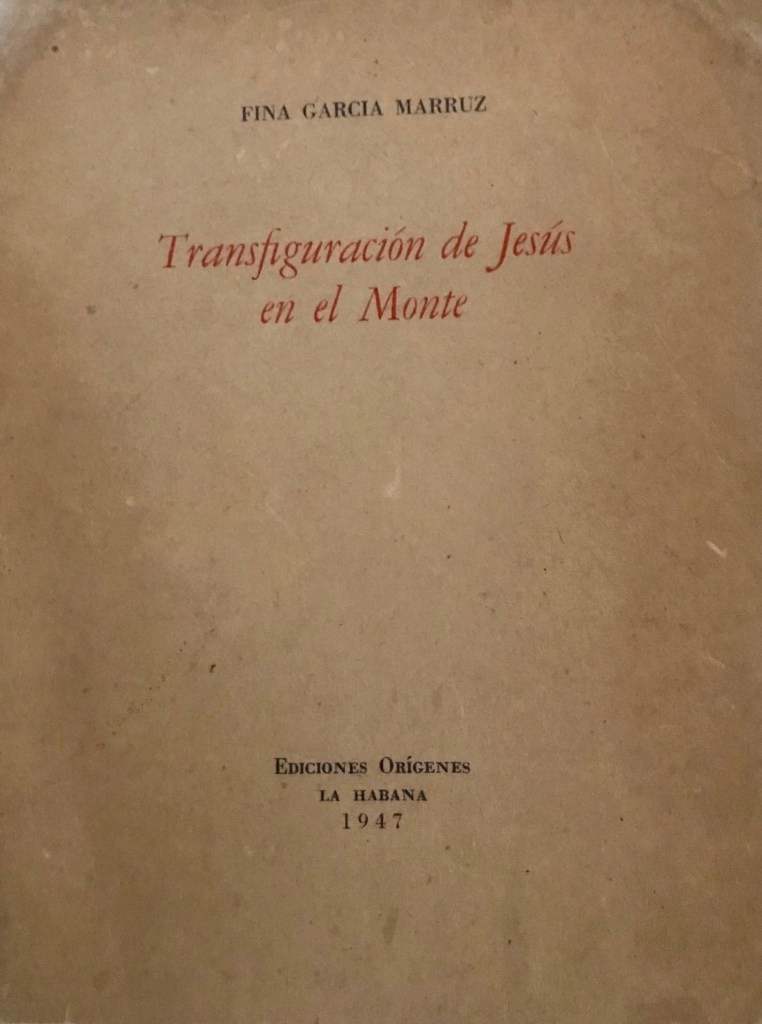
In 1947, the very young Cuban poet Fina García Marruz published the liturgical poem Transfiguración de Jesús en el Monte (Ediciones Orígenes, 1947), which stands in the modernist tradition series of attempts to probe the divine nature of language after the flight of gods and the triumph of the new secular jargons. If earlier in the century a well known Italian philosopher will predict that the international language of the future will be that of technical terms; the English Catholic poet David Jones, will reaffirm that we are “living in a world where the symbolic life (the life of the true cultures, of institutional religion and of all artists) is progressive eliminated – the technician is master. In a manner of speaking the priest and the artists are already in the catacombs, but separate catacombs – for the technician divides to rule” [1]. And if “liturgy” originally meant “public service” and the sphere of gestures, as suggested by Lubienska de Lenval, then Transfiguración has to be read, even into our days, as an attempt for language to measure to the transfiguration of revelation, in which the poem is a sacramental form that retracts language to possibilities of retaining communication.

In fact, Transfiguración de Jesús en el Monte, reinforcing the liturgical repetitions of an hymn and a sacred chant, enacts a flowing rhythm (“en tanto que”) that assesses the limits of the ineffable; a pure exteriority that is the negative or wound of language without ever being able to transcend it. In this sense, Marruz’s poem is only the poetic anabasis to the impossibility of a guided sacrament to organize interiority and visibility. Only the mystical can mediate between exteriority and the crisis of appearance. In an almost programmatic fashion, we read in the second part of the poem: “oh, difícilmente podríamos comprenderlo / Él se ha vuelto totalmente exterior como la luz; / Él ha rehusado la intimidad y se ha echado totalmente fuera de sí mismo” [2]. Transfiguration is the event that exiles oneself from the self (phygé), and in which language can generate contact with something other than its own conventions. This is why they [the witnesses and the martyrs] cannot provide an account about the transfigured revelation – just like anyone cannot truly provide a narrative, except by betraying the experience – except by their hearts as if being mysteriously called by a singular name (“ellos sienten que dentro de su corazón alguien / los ha llamado misteriosamente por su nombre”). 

How can language disclose a sense of exteriority that is capable of moving past the autonomy of signification and self-referentiality of language? Can language befall into exteriority? Marruz provides an answer to this question, which can be taken as her contribution to the aporias of modern poetics: poetry can only attune to transfiguration as a cohabitual of a communicating being. In the year that the poem was published, Marruz also wrote in the winter issue of 1947 Orígenes a dense essay titled “Lo Exterior en la Poesía” (“The exterior in poetry) where she claims that “the heart of poem is always outside of it – it should not be that the poet can offer infinite variations of a secret self-possessed knowledge, but rather to rediscover the liturgy of the real; the extreme degree of visibility, which is also its great escape” [3]. What could the “liturgia de lo real” have meant for Marruz in 1947? Marruz does provide a clearcut theological definition of the exteriority as the “angelic”, which does corroborate the hymnological dimension of language, a transcendence between beings of the invisible. The liturgy of the real that defines the exteriority of the poetics of life does not entail a Romantic elevation by the Poet, but the effort to animate reality beyond an alienated monologue. This is why Marruz writes that “only a dialogue can realize an impossible communication, mystical, whenever it does take place in all of its purity” [4].

In 1947 Marruz went a step further than her fellow poets Gaztelu & Lezama Lima, who had defined transfiguration as a learning exercise of the potentia dei of the divine (“a todo transfigurarse sigue una suspension y el ejercicio del Monte era solo un aprendizaje”) [5]. Read side by side with Antelme’s Angel of Reims, one could very well say that for Marruz there is an event of transfiguration whenever transcendence delivers communication between beings, soul to soul; a relation that can one truly speak of the ungrounded and commencement. The liturgy clamored in language is not the memory of an original Adam severed from Nature, but the transfiguration of a linguistic relationship with the world. This might be the secret to Marruz last two verses: “como la infancia que acuña nuestro Rostro allí / donde no puede ser despertado”. If transfiguration also entails recapitulation, this means that this is not a process of forward becoming, but of retaining the atemporal detention that, like that of childhood, traces our silhouette as both figural and pure presence in the bushes of language. 

Notes 

1. David Jones. “Religion and the Muses” (1941), in Epoch and Artist (Faber&Faber, 1959), 134.

2. Fina García Marruz. Transfiguración de Jesús en el Monte (Orígenes, 1947), 6.

3. Fina García Marruz. “Lo Exterior en la Poesía”, 19. 

3. Fina García Marruz. “Lo Exterior en la Poesía”, 22

4. Ángel Gaztelu & José Lezama Lima. Editorial: “Éxtasis de la Sustancia Destruida”, Nadie Parecía, Número IX, Nov, 1943, 1.

Clandestine life in the open. by Gerardo Muñoz

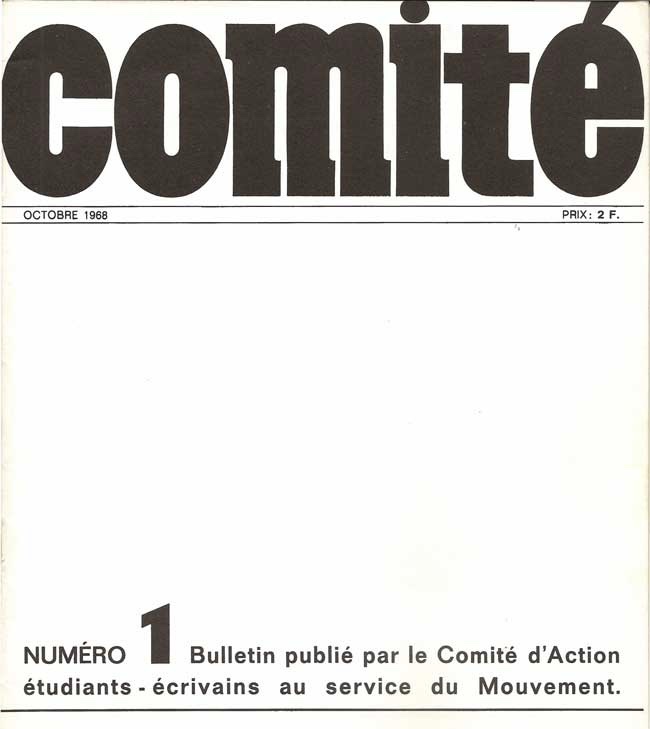
In the very last article that Maurice Blanchot wrote for the collective publication Comité in the wake of May 68, he draws a scenario that is still very much with us in the present. The “realism” is almost outstanding when Blanchot writes the following: “…from now on I will hold onto an exigency: to become fully conscious that we at the end of history, so that most of our inherited notions, beginning with the from the revolutionary tradition, must be reexamined and, as such, refuted. Let us put everything into question, including your own certainties and verbal hopes. The revolution is behind us: it is already an object of consumption, and occasionally, of enjoyment.” [1]. There was no question that the crisis of the very foundation of modern political thought has collapsed, including, as it couldn’t be otherwise, the generative principle of revolution. Blanchot did not even attempt to convince himself that the revolution could be brought back in an astronomical sense to revitalize a naturalism previous to Rousseau’s social contract.

So, for Blanchot the revolution was over, and yet, whatever it was that followed had no name. What was left, then? In order to avoid paralysis, Blanchot toyed during those months at the Comité (September-December 1968) with two possible maneuvers. The first position resided in what he called the “movement of possible speech” in order to establish an ardent and rigorous relation between the sequence of the French May and the Czech May, Soviet domination and Gaullian State. Blanchot called for (in the spirit of Bataille) a “transgressive speech”: “the impetus of outrageous, ways speaking beyond, spilling over, and thus threatening everything that contains and has limits” [2]. But we know that transgression is still within the logistics of the administration of order and temporal containment of the regulated exception. This was, in fact, the very rupture of the revolutionary break that was in crisis.

But Blanchot was up to something along with his friend Dionys Mascolo in thinking through language and communication as a path towards the outside. Hence the second option, which is really a third option (after the sleepwalking of ideological revolutionary ‘racketing’ of voluntarism); mainly, what he calls, although does not get to tease it out, the “clandestine resistance in the open”. Blanchot only tells us what he is thinking about through a recent example: some members of the Czech resistance when law was suspended had to confront the raw enemy military power, but they also experienced a freedom “through words and through writing than ever before”, tells us Blanchot. But this still does not explain much, given that if there is a naked military power threatening us, how could something like a clandestine form of life take place in the open? And at what risk?

I think one way to read this incorrectly or insufficiently would be to think of Blanchot’s suggestions as a sort of martyrdom or self-immolation. But it is no less true that Blanchot wanted to avoid a sort of Batallian “inner experience” or monastic xeniteia. Thus, he “refused” the fiction of self-clandestine life as sponsored by the Situationists; while, at the same time, also rejecting subjective revolutionary militancy. A third way emerges: the clandestine life into presence by way of friendship. A new “estilo de vida”, which I think could be read in the way that cryptojews and averroists lived in early Modern Spain: “a modo de sociedades secretas o semi-clandestinas, deben haber concebido la filosofía como un estilo de vida para sus iniciados…” [3]. Unlike the bogus image of the secret society as an alienated community of knuckleheads, I think what emerges in the clandestine open region is a form of shared friendship that does not retreat from the world, but rather that is capable of living in it. This was most definitely the transformative practice that during these years, Dionys Mascolo, dared to call the communism of thought that for him belonged to Hölderlin rather than to Marx. If open conspiracy is an act of the sharing and participating in language without meaning or command dependence, then this is already a poetic practice. After all, for Hölderlin the poets reveal an originary loss from nature. It is no surprise that Hölderlin favors a world opening even after the destruction of the leader-figure of the poet (Empedocles).

So, there is only clandestine life in the open when the sharing of language among friends take place (an event). This use of language is always harboring on the threshold of the last word to come. In short, the clandestine form of life has nothing oblique with respect to the world – it is not necessarily the space of an infinite night of contemplation, and it is also indifferent about fugitivity – it demands a return to appearance by way of experience. This might explain what Gilles Deleuze tells Dionys Mascolo at the end of their correspondence about friendship and thought: “it is a question of what we call and experience as philosophy” [4]. This form of experiential thought against the dissatisfaction of political domestication points a way out. For Blanchot this was a “fragmentary, lengthy, and instantaneous” path; a conspiratio unlocked by philia.

.

.

Notes

1. Maurice Blanchot. “On the Movement”, in Political Writings 1953-1993 (Fordham University Press, 2010), 106.

2. Maurice Blanchot. “Clandestine resistance in the open”, in Political Writings 1953-1993 (Fordham University Press, 2010), 106.

3. Francisco Márquez Villanueva. “El caso del averroísmo popular español”, in Cinco Siglos de La Celestina: aportaciones interpretativas (1997), 121-134.

4. Gilles Deleuze. “Correspondence with Dionys Mascolo”, in Two Regimes of Madness (Semiotexte, 2007), 332-338.