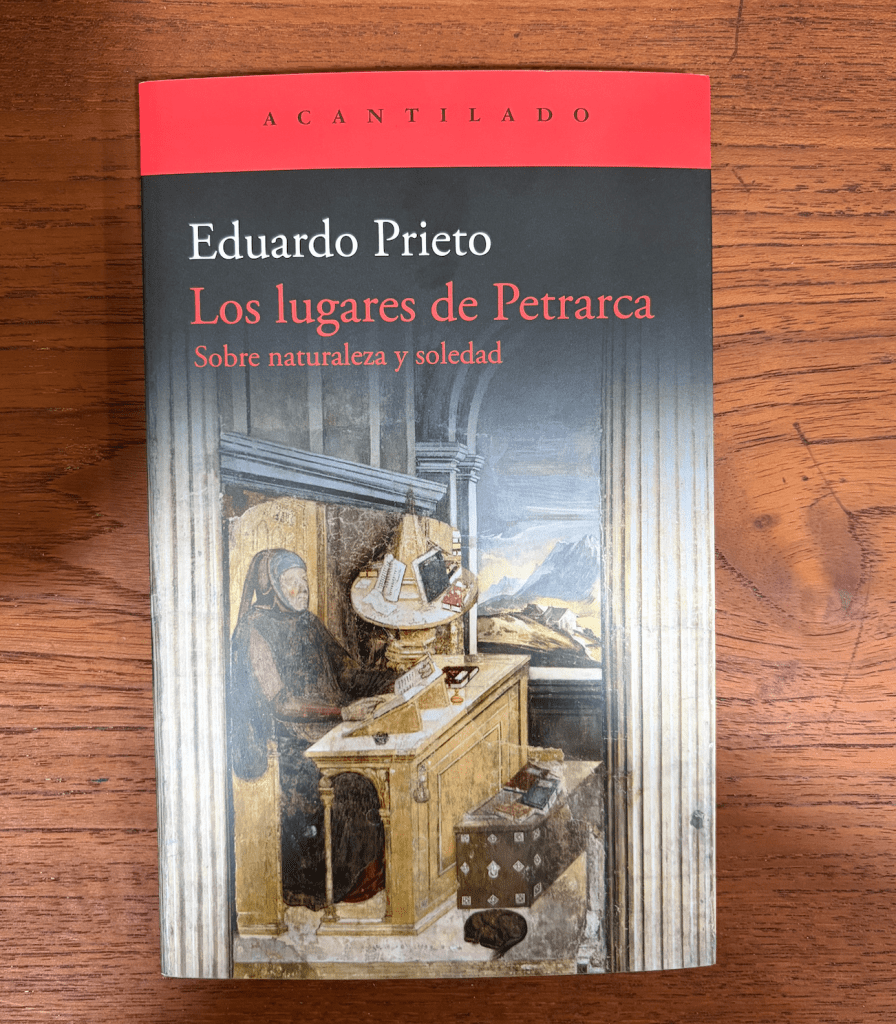
Peregrinus ubique. On Eduardo Prieto’s Los lugares de Petrarca (2026). by Gerardo Muñoz

Eduardo Prieto’s slim book Los lugares de Petrarca: Sobre naturaleza y soledad (Acantilado, 2026) counts not just as a book on the great Italian lyricist, but also as a coherent reflection on what it means to write and create from concrete places and in the mood of the genius loci. Before the world became infatuated with nationhood, borders, and migratory laws, there were only territories of changing topographies and natural phenomena, a gleaming spectacle to the eyes and an adventure to the those on foot. Petrarch lived in such a world of early modern Europe – this is the world after the crisis of twelfth century to use Thomas Bisson’s historical marker – hopping from locations to landscapes, making him an absolute peregrinus ubique, and thus a permanent exile (Prieto 20). 

Petrarch’s itinerary is expansive in the fourteenth century: from Monteppilier to Bologna to Napoles and Rome; from Fontaine de Vaucluse to Arquá in Padua, the different dwelling places of Petrarch are also analogical to figures of the surrounding of life, such as the river, the path, the garden, and the studiolo. For the peregrinus ubique, the ideal life was not to live outside of his homeland, but rather to find the attunement between place and soul as the ultimate liaison of the equanimous life. And this is precisely what Eduardo Prieto achieves in his wonderful book Los lugares de Petrarca (2026), which avoids the commonplaces of unidirectional biographies in order to weave a history of a mind that can only be written, as if were, from the the contours of its displacements and attentive to its landscape. This is why the famous, now topical, Mount of Ventoux rarely appears in Prieto’s essay; for one thing, because the rumor of the landscape is present in its invisibility in each and every of those places, and not just from centered on that text.

To speak of places is, first and foremost, to assume a certain distance from the life of the city life. Already during the time of Petrarch the emergence of urban centers, tied to economic abundance and growth, was becoming the new ground of what soon enough would become the nexus of social reproduction. Petrarch’s sensibility – which is the sensibility of the life of the poet at large – already takes notices of the corrosive allure of this social space, which will elicit corruption and “dirty vices” in the trades of the new public condition (Prieto 44-45). If otium is to be maintained, it needs to be an exile from the public and into the desert where solitude of mind can cultivate a sense of freedom and autonomy. But as Prieto reminds us, the desert of Petrarch is not that of the excruciating nothingness or abyss, but the locus horridus: “ámbito opuesto a la ciudad, el desierto se concebía menos como un espacio verídico que una utopía ambiental que se ofrecía a quienes buscaban un hábitat adecuado a su carácter: los héroes de lo solitario” (Prieto 45). Prieto will speak of a proximity with the divine of nature using the expression “ofrendas ambientales” (environmental gifts) of God that allow for a peaceful life within the limits of nature. In this sense, the solitary life of the peregrinus ubique it is ultimately not that exclusive: it is full of specters and the voices of the dead that emerges from the an existential depth that is more than just a handful of metaphors and rhetorical tropes (Prieto 49). This exiled life cannot be disconnected from its surroundings and its immersion into the landscapes in which it dwelled. 

However, it is also thanks to Prieto’s own analytical efforts that we see that the notion of landscape is not limited to the horizontal vantage point of the spectator; it is also the underworld of the geopolitical cavities, where caves, hidden myths, and overflows of ocean water nourish the human imagination with the infused sensation of the mythical (Prieto 67). If the exilic life is to inhabit a burrow like an animal, as Kafka thought, then the topographical landscape can only be understood as a complex texture of memories and forgettings that, given their ecological scale, embrace the human experience while also exceeding it. Hence the importance of the graden in Petrarch’s poetic cosmos until his last days in Vaucluse, because it is in this piece of nurtured land where the poet communicates and disputes belonging with the deities.

As Prieto writes in an incisive moment of his book: “Rodeado de tales aguas, existe un pequeño campo de piedras, y es allí donde Petrarca quiere planear un jardín para consagrarlo a esas musas que inspiran sus trabajos. Pero, para consagrarlo, Petrarca debe quitarse antes a las deidades que viven en común con la naturaleza, las misteriosas e impredecibles ninfas, tal vez acompañado de sátiros, silenos, o incluso del mismísimo Pan” (Prieto 87). And if already during Petrarch’s time, a post-mythical epoch, Pan was already declared dead, before the Nietzschean declaration of the dead of God; what was at least obvious in the loci of the garden is that it was a nourishment for the elevation of the soul, in the same way that only those with a beautiful soul could dedicate themselves to the microscopic civilization art of putting together a garden, a thesis that centuries later Ernst Jünger will repeat verbatim in his late diaries. 

Petrarch will spend his last days in his house of Arquà between the Euganian Hills of Padua, a landscape that can be discerned in the forthteenth century anonymous fresco that depicts Petrarch in his studiolo next to a right side open window (this is featured in the cover of Prieto’s book). The preparation for one’s death seems to require a slight alteration for the life of the peregrinus ubique; since it is not just the embodiment of truth of existence to death, but also of how that existence is embedded in the radiant opening of a place. In fact, this is what Petrarch longed for in his last days of Arquà: a dwelling place where exteriority and interiority can communicate within the tripartite arrangements of the home, the landscape, and the studiolo (Prieto 122). In a sense, ‘home, landscape, studiolo’ is the triangular form of the life of the soul that finally learns how to live beyond abundance and survival. It is the architecture of eternal life as its own indivisible garden. When in the nineteenth century, Count Conde Leoni opened up the tomb of Petrarch to examine his skull, the entire ossuary shattered into pieces, as if reminding us that life is never some bone relics in a grave (Prieto 134). What remains is the shadow of the pilgrim’s life, in its own voice and figure, that will endure throughout the centuries, and at times it will find an illuminated and candid resting place in wonderful book such Los lugares de Petrarca (2026).

The necessity of Penia. by Gerardo Muñoz

It is well known that Aristophanes’ late comic work on wealth, Plutus (388), provides us with what is perhaps the most dramatic and conceptual elaboration of the mythic personification of poverty (Penia) of late antiquity. What is remarkable is that in her self-presentation to the character Chremylus, Penia draws on a political parallelism that colors the ongoing crisis of governance of the ancient polis. If the Greek comedy is dependent on the function of the pólos (which is the vortex of movement that makes possible grasping the specificity of the being that is said), always prior to the arrangement of the polis, then it would follow that Aristophanes’ commentary on the centrality of Penia is neither mockery nor irony within the structure of the play, but rather an element fundamental to the historical presentation of the consciousness of historical public life. The emergence of Penia in Plutus is recorded in the lines 550-554 (a paraphrase might be adequate here): “Thrasybulus and Dionysius are one and the same according to you. No, my life is not like that and will never be. The beggar, whom you have depicted to us, never possesses anything. The poor man lives threfitly and attentively to his work; he has not got too much, but does not lack what he really needs” [1]. Poverty is an intimate relationship with needs; perhaps an unsaid relation, but one that must be accounted for nonetheless.

At her entrance into the play, we are told that Penia’s complexion is both mad (makaron) and tragic (tragōdikon); she could very well be an Erinyes companion from the underworld of the dead. Penia as a mythic figure is a fullfilled form of life. More importantly, what is crucial in the Plutus is that Penia defines herself in sharp contrast to the life of beggars or ptochos. This means that while the penetes is tied to a constitutive need as condition for a form of life; the ptochoi is a being that merely lives in a state of survival, and endures his absence of proper needs. Because Penia is contrasted to the destitute life embodied by ptochos, she can state in one moment primacy over wealth: “all your blessing….you have all that you need in abundance, thanks to me” [2]. Hence, as it has been noted, the irrevocable presence of Penia in the polis is the condition of possibility for Ploutus, god of wealth and abundance, shown in ancient representations as holding the flourishing cornucopia from the fertile harvest season. 

What is important to note is that the close and fluid relationship between Ploutus and Penia; that is, between abundance and need, far from being opposition is relational and nourished by its pólos. In this way, the being of need, the penetes, is only able to flourish if he is capable of attaining a free relation with its desire of its vital making, and not from an external power that can determine the functions directed to abstract modeling of population survival. If Aristophanes’ Penia is defined against the ptochos is not because there is a difference of degrees in terms of dispossession, negative or quantitative, but rather it is because it is a disjointed relationship between poverty as a transfigured life, and a life that become destitute because it has ceased to be attentive to its own needs. In the incommensurable ground of the polis, it could be said that the ptochoi were unformed lives that merely persisted in time on the margin of the system of relation of the human community, and for this reason they dwelled in a permanent state of apolis, since their only viable horizon was the result of economic abstraction for secondary needs. In other words, the beggars of the apolis are ultimately effects of economic forces that they do not control, precisely because they no longer have any existential relation with the realm of necessity, that is, with poverty as understood under the shadow of Penia. 

In this sense, the condition of beggar is an ultimate economic subjection that is already beyond the sufficient limitation of needs, and thus it has lost all contact with the world. It is has become deprived of the world without being truly dead. Here, one should not forget that as Plato registers the genetic relationship between Penia and Eros in an important moment of The Symposium: “Eros is the son of Poros and Penia, and partakes of the nature of both parents, the fertile vigor of the one, the wastrel neediness of the other. As he is a mean between mortal and immortal” [3]. But the erotic soul in the last resort is nothing but the desire for immortality; and, as a daimon, it mediates between passions and the beautiful, between the divine and the mortal, between need and wealth towards the depth of a harmous life [4]. As Sandrine Coin-Longeray has shown in her exemplary study, Penia (πενία) exceeds the effective qualification of the “good life” based on labour; rather it is a route of life that outlives itself in the erotic transfiguration of world towards the preservation of irreducible homeostasis of common life [5]. 

This is why Plato’s conception of the ‘happy city’ or the kallipolis was imagined as a deposition of the process of abstraction between “rich” and “poor” that ultimately has come to regulate the modern organization of social rationality proper to accumulation, production, and distribution to supply to rhe demand of ever expanding secondary needs in the general field of consumption. As Plato writes in Book III of The Laws in a section precisely dedicated to showing how to bring civil war to an end: “Because of all this, they were not intolerably poor, not driven by poverty to quarrel with each other; but presumably they did not grow rich either, in view of the prevailing lack of gold and silver. Now the community in which neither wealth nor poverty exists will generally produce the finest characters, because tendencies to violence and crime, and feelings of jealousy and envy, simply do not arise” [6]. The civilizational path undertaken by West since the rise of institutionalized isonomy could not be but exactly the opposite of the platonic deposition of the autonomy of alienated classes. Today it is all too apparent that every sphere of social reproduction stimulates a ferocious race to the bottom between a kleptocracy and a vast administered population of ptochoi that, precisely because they have no relation to Penia, is left pursuing compensatory reactions within the social mechanism of organized begging that they are forced to endure. Under the oblique light of Penia, it becomes clear that both redistributionist policies through state institutions, as well as the autonomous market initiatives of financial models tend to be two sides of the same defense of abstract abundance on the back of the human community of penetes

The negative subsumption of material needs, and thus of poverty into quantifiable assets that characterize abundance and growth at a civilizational scale – with the collaboration of all modern political ideologies without exception always oriented towards production – has contributed to thwart the path of Penia that is necessary to live freely between passions and needs. This is why in his 1945 lecture “Die Armut” (“Poverty”), Martin Heidegger, departing from a well-known intuition from Hölderlin, claimed that ‘being-poor’ does not mean the absence of some property or substance, but a relation to needs; because only in poverty do we preserve a free relation unto what we need (not-wedigkeit) as necessary. And only this can be taken as the true and ultimate wealth: ‘we have become poor in order to be rich’, means that only through the preserving necessity of Penia will there be a liberating dislocation for human life beyond the indigence of mere exchange and the endless struggle over material goods and the private property. As the world becomes a more vast wasteland of beggars and disposable bodies at the service of technology, Heidegger, in Eckhartian tenor, was not wrong to claim that poverty and Penia will ultimately be the ethical destiny of the people of the West only if they become attune to the divine overtone of poverty as their destiny. Thus, the only possible abundance in a declining world can be realized through the enduring necessity and disquiet return of the essence of poverty – to come near the nothing, because there we find the dearth of the earth. Indeed, as Penia says in Plutus before leaving the stage: “One day you will speedily send for me back” [7]. 

Notes 

1. Aristophanes. Plutus (Loeb 1946), 550-555, 421. 

2. Ibid., 501-511, 409.

3. Plato. The Symposium (Penguin Books, 1987), 203b, 82. 

4. F. M. Cornford. “The Doctrine of Eros in Plato’s Symposium” (1937), in The Unwritten Philosophy and Other Essays (Cambridge University Press, 1950), 74. 

5. Sandrine Coin-Longeray. Poésie de la richesse et de la pauvreté: Étude du vocabulaire de la richesse et de la pauvreté dans la poésie grecque antique, d’Homère à Aristophane: ἄφενος, ὄλβος, πλοῦτος, πενία, πτωχός (Publications de l’Université de Saint-Etienne, 2014), 153-56.

6. Plato. The Laws (Penguin Books, 1975), 122. 

7. Aristophanes. Plutus (Loeb 1946), 630, 421.

Movements at dusk. A note to a conversation. by Gerardo Muñoz

A recent roundtable entitled “American Constitutional Collapse”, organized at Red May, and now archived here, with Aziz Rana, Camila Vergara, and Michael Hardt should confront us with the limit of political form today. All the interventions were able to shed light on distinct angles of the current collapse of the American constitutional order, which has only intensified since the beginning of the new current administration, although its sedimentation, as it is well known, has deep historical legal-political itineraries. However, here I just want to register the question that I posed to the panel, which is one not alien to some of the chapters of La fisura posthegemónica (2025), and that concerns the exhaustion of constituent power. There are many ways of posing this question, but in the tradition of American republicanism, the most clearcut of the problem is to take seriously the end of historical social majorities as vehicles for enacting a ‘constitutional moment’ of democratic reformation.

Some of us remember that towards the end of the third volume of We The People: The Civil Rights Revolution (2014), Bruce Ackerman claims that in our epoch we might very well be entering into the dusk of social movements. Ackerman’s book is from 2014, that is, a couple of years before the landmark victory of Donald J. Trump’s first electoral victory of 2016, and written in the wake of the decision of Shelby County v. Holder (2013), which abolished substantive parts of the Voting Rights Act of 1965. The sequence of the last decade has only validated Ackerman’s intuition about the effective collapse of movements as the driving force of American ius reformandi within the constitutional order (in other countries is no different, take Chile for instance, which we discussed two years ago at Red May, and that is also the story of the the ills of transformative constitutionalism).

However, to anyone that has paid any attention to the political turmoil in the United States in the last decade, it is completely clear that the paralysis of the constitutional system is far from being a state rigidity or stability, but rather it has shown itself to measure every social pressure through an equal force of legal force, testing the durability, probing the reach, and outsourcing the validity of implicit norms and guardrails within the tripartite structure of powers through an enacted process that some American legal theorists have called “liquidation”; that is, the adjudication of fixing and enforcing textural legal provisions in historical time. This means that what animates the internal process of American law is no longer that axiological conditions of political republicanism – representation and minimalist judicial review, separation of powers and state authority, congressional representation and autonomy of the legislation – but rather a stasis, that is both paralysis with respect to the the formal aspiration of classical social representation; and, at the same time, total legal mobilization, in which social majorities are oriented under the nexus of the administrative presidency that can take (it has taken) priority over institutional mediation and process – if anything should be learned in the last decade is precisely the effects of Moore v. Harper (2023) on the doctrine of the independent state legislature (in spite of its ruling at the Supreme Court); and, most recently, the legal showdown regarding process (or lack thereof) and the suspension of habeas corpus for migrants residents and illegal aliens, which according to an American Federal Judge, could prefigure as a potential invasion.

We have good reasons to assume that mobilization and social movements from below can no longer stand as the source of constitutional change. They must be taken at face value in order to avoid rhetorical platitudes: mainly, that any movement today is a vector in the ongoing stasis and decomposition, that ultimately animates (even if against its own intentions, as the progressives seems to ignore) the verisimilitude of state form in the age of stagnation. But this is not very different from the inchoate promises of the new right-wing populism that projects new historical heights of economic growth in epochal decline (and now the progressive programmatic calls for technocratic abundance coextensive to the administrative state).

It is perhaps in demobilization and a de-socialization derives where other horizons might soon emerge. If the modern epochality was defined by the energetic transfer of total social movements, our epoch of collapse will be shaped by that of non-movements outside political hegemony. There is no doubt that it brings paralysis and distress to the political thinker looking for historical reiterations. But then again, the anxiety for mimesis before a breakthrough is always dreadfully sharp.