Peregrinus ubique. On Eduardo Prieto’s Los lugares de Petrarca (2026). by Gerardo Muñoz

Eduardo Prieto’s slim book Los lugares de Petrarca: Sobre naturaleza y soledad (Acantilado, 2026) counts not just as a book on the great Italian lyricist, but also as a coherent reflection on what it means to write and create from concrete places and in the mood of the genius loci. Before the world became infatuated with nationhood, borders, and migratory laws, there were only territories of changing topographies and natural phenomena, a gleaming spectacle to the eyes and an adventure to the those on foot. Petrarch lived in such a world of early modern Europe – this is the world after the crisis of twelfth century to use Thomas Bisson’s historical marker – hopping from locations to landscapes, making him an absolute peregrinus ubique, and thus a permanent exile (Prieto 20). 

Petrarch’s itinerary is expansive in the fourteenth century: from Monteppilier to Bologna to Napoles and Rome; from Fontaine de Vaucluse to Arquá in Padua, the different dwelling places of Petrarch are also analogical to figures of the surrounding of life, such as the river, the path, the garden, and the studiolo. For the peregrinus ubique, the ideal life was not to live outside of his homeland, but rather to find the attunement between place and soul as the ultimate liaison of the equanimous life. And this is precisely what Eduardo Prieto achieves in his wonderful book Los lugares de Petrarca (2026), which avoids the commonplaces of unidirectional biographies in order to weave a history of a mind that can only be written, as if were, from the the contours of its displacements and attentive to its landscape. This is why the famous, now topical, Mount of Ventoux rarely appears in Prieto’s essay; for one thing, because the rumor of the landscape is present in its invisibility in each and every of those places, and not just from centered on that text.

To speak of places is, first and foremost, to assume a certain distance from the life of the city life. Already during the time of Petrarch the emergence of urban centers, tied to economic abundance and growth, was becoming the new ground of what soon enough would become the nexus of social reproduction. Petrarch’s sensibility – which is the sensibility of the life of the poet at large – already takes notices of the corrosive allure of this social space, which will elicit corruption and “dirty vices” in the trades of the new public condition (Prieto 44-45). If otium is to be maintained, it needs to be an exile from the public and into the desert where solitude of mind can cultivate a sense of freedom and autonomy. But as Prieto reminds us, the desert of Petrarch is not that of the excruciating nothingness or abyss, but the locus horridus: “ámbito opuesto a la ciudad, el desierto se concebía menos como un espacio verídico que una utopía ambiental que se ofrecía a quienes buscaban un hábitat adecuado a su carácter: los héroes de lo solitario” (Prieto 45). Prieto will speak of a proximity with the divine of nature using the expression “ofrendas ambientales” (environmental gifts) of God that allow for a peaceful life within the limits of nature. In this sense, the solitary life of the peregrinus ubique it is ultimately not that exclusive: it is full of specters and the voices of the dead that emerges from the an existential depth that is more than just a handful of metaphors and rhetorical tropes (Prieto 49). This exiled life cannot be disconnected from its surroundings and its immersion into the landscapes in which it dwelled. 

However, it is also thanks to Prieto’s own analytical efforts that we see that the notion of landscape is not limited to the horizontal vantage point of the spectator; it is also the underworld of the geopolitical cavities, where caves, hidden myths, and overflows of ocean water nourish the human imagination with the infused sensation of the mythical (Prieto 67). If the exilic life is to inhabit a burrow like an animal, as Kafka thought, then the topographical landscape can only be understood as a complex texture of memories and forgettings that, given their ecological scale, embrace the human experience while also exceeding it. Hence the importance of the graden in Petrarch’s poetic cosmos until his last days in Vaucluse, because it is in this piece of nurtured land where the poet communicates and disputes belonging with the deities.

As Prieto writes in an incisive moment of his book: “Rodeado de tales aguas, existe un pequeño campo de piedras, y es allí donde Petrarca quiere planear un jardín para consagrarlo a esas musas que inspiran sus trabajos. Pero, para consagrarlo, Petrarca debe quitarse antes a las deidades que viven en común con la naturaleza, las misteriosas e impredecibles ninfas, tal vez acompañado de sátiros, silenos, o incluso del mismísimo Pan” (Prieto 87). And if already during Petrarch’s time, a post-mythical epoch, Pan was already declared dead, before the Nietzschean declaration of the dead of God; what was at least obvious in the loci of the garden is that it was a nourishment for the elevation of the soul, in the same way that only those with a beautiful soul could dedicate themselves to the microscopic civilization art of putting together a garden, a thesis that centuries later Ernst Jünger will repeat verbatim in his late diaries. 

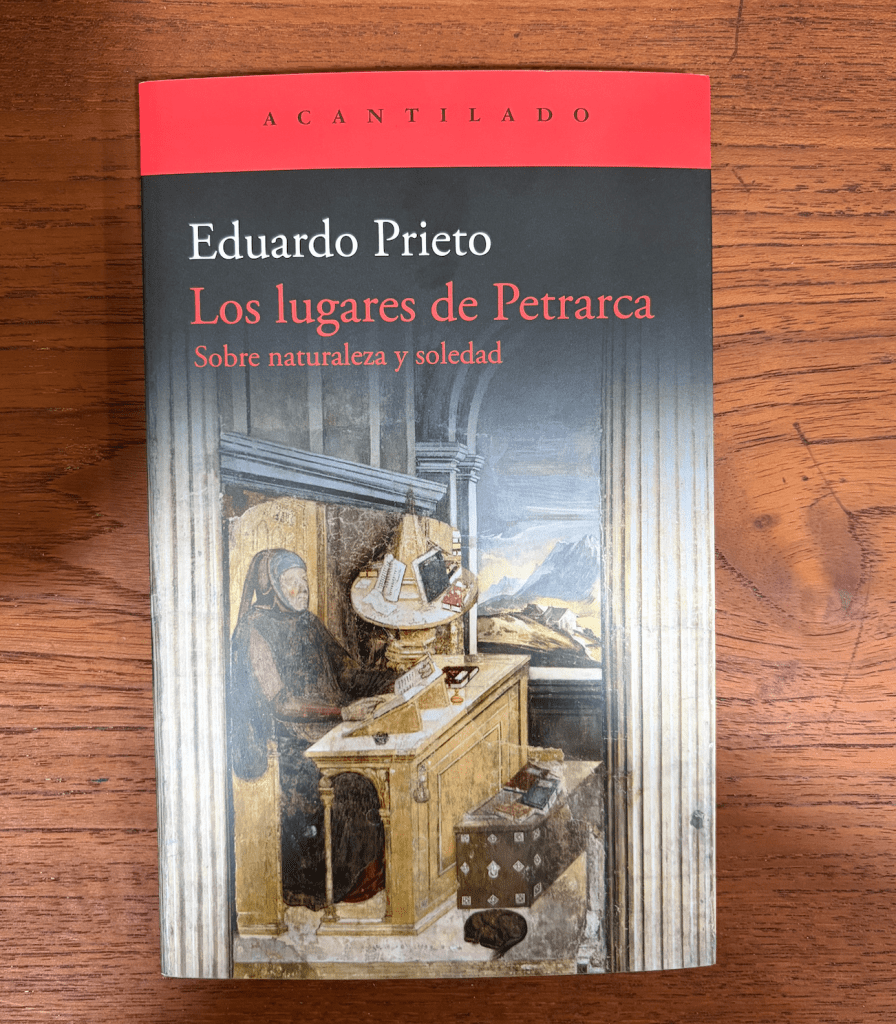
Petrarch will spend his last days in his house of Arquà between the Euganian Hills of Padua, a landscape that can be discerned in the forthteenth century anonymous fresco that depicts Petrarch in his studiolo next to a right side open window (this is featured in the cover of Prieto’s book). The preparation for one’s death seems to require a slight alteration for the life of the peregrinus ubique; since it is not just the embodiment of truth of existence to death, but also of how that existence is embedded in the radiant opening of a place. In fact, this is what Petrarch longed for in his last days of Arquà: a dwelling place where exteriority and interiority can communicate within the tripartite arrangements of the home, the landscape, and the studiolo (Prieto 122). In a sense, ‘home, landscape, studiolo’ is the triangular form of the life of the soul that finally learns how to live beyond abundance and survival. It is the architecture of eternal life as its own indivisible garden. When in the nineteenth century, Count Conde Leoni opened up the tomb of Petrarch to examine his skull, the entire ossuary shattered into pieces, as if reminding us that life is never some bone relics in a grave (Prieto 134). What remains is the shadow of the pilgrim’s life, in its own voice and figure, that will endure throughout the centuries, and at times it will find an illuminated and candid resting place in wonderful book such Los lugares de Petrarca (2026).
Dialogue with Jacques Camatte (1935-2025)

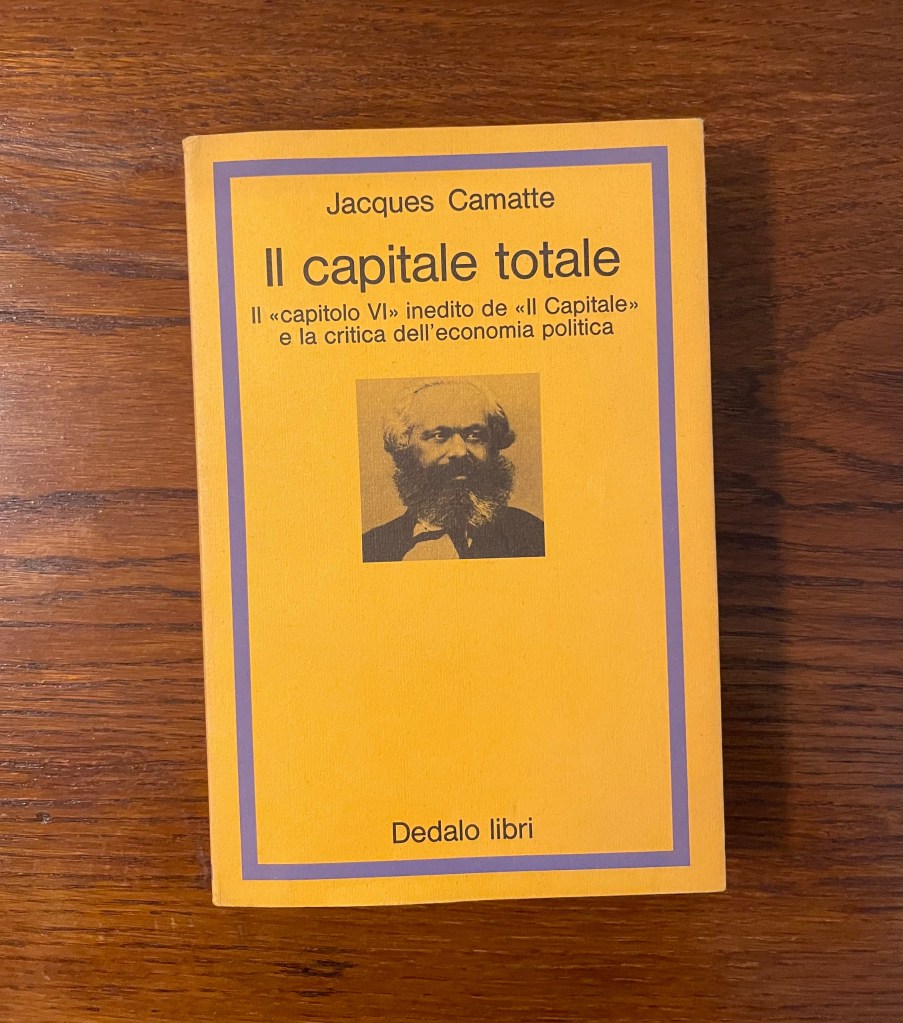
The passing of Jacques Camatte (1935-2025) a week ago from the writing of this text recalls a life that ostentatiously lingered in thought, and a thought that was entirely enmeshed and intertwined in the irreducibility of life. For some of us that had the good fortune to interact – however briefly and momentary, although every contact is always destinial and inescapable – Camatte transpired generosity and authenticity, and his voice evoked an almost Adanic happiness that has become rare among human beings. A common friend these days has recalled that somewhere in Camatte’s writing there is an endorsement of a capacious phrase from Chernyshevsky that could very well serve to remember his enduring ethical pursuit: ‘we have finally understood that the Earth is a place of life rather than judgement’. The opening the Earth as a dwelling place for life forms means that it is insufficient to conceive of domination as an organization of modes of production, since capital is first and foremost a spatial-temporal arrangement towards the future of the human species, and thus of a certain conquest of the world sensuous life. 

This was the outstanding triumph of real sumption: the modulated and ongoing alienation of the human community (Gemeinwesen) into a community of capital that has arrested time of life to the point of adjusting it to homogenized agony of historical time. Against the dynamic of revolution and counter-revolution that theologically exported the polarity of the eschaton and the ho katechon, already in the inception of 1970s Invariance Camatte called for an exteriority of any philosophy of history in order to rework of “a new relationship between human beings and nature”, and “breaking the lock that inhabits the creation of a new form of life”. The two citations in dialogue with each other come from “Against domestication” (1973) and the introduction to Urtext: frammento del testo originario di Critica dell’economia politica” (the 1977 Italian edition curated by Gianni Carchia), although these are variations from the depth of the emergence of the invariance of truth as a vantage point of the world. At the center is a form of life that renews the world that transitions beyond all forms of metaphysical logistics of appropriation, mere standing reserve, and the general arrangement for the mobilization of production. Any point of departure against domestication measures itself against the totality of this fluctuating dominion.

As it has been said of other great thinkers, Camatte’s ultimate passion was rooted in thinking one idea to the end and not of endorsing a system of concepts. For him it was the schism, that is, how to undo the historical process of domestication of a fictive community against the absorption of the increasing autonomization of fictive capital. The schism against the capitalist general equivalent also demands advancing a secondary schism against all humanism and its originary separation from nature. In schism, there is something of Gaunilo of Marmoutiers’ “thought of the word alone” that is receptive to the movement of the soul tries to account for the perceived voice. This precisely what Camatte carried as the lesson from Bordiga’s idiosyncratic original communist program: a movement against the historical benchmark of the development and political economy of growth, which will entail the exhaustion of the revolutionary horizon driven by an ideological political technification that tends to deepen the power towards the positionality of epochal nihilism expressed in the revitalization of strife and the ‘errancy of humanity’ (contrary to Martin Heidegger’s notion of errancy as a play between unconcealment and truth, for Camatte errancy is another name for the civilizational narrative that exemplifies the withering of the  human community into organized and protracted social reproduction and historical abstraction). Hence, as for Bordiga, Camatte conceived the ontology of communism as a world view (not as a political program oriented by concrete historical subject or distributive economic reproduction; not a soteriological dogma nor a transhistorical material idea); that is, broadly speaking, thinking the relationship between the human beings and the earth. A question more pressing than ever given the current planetary conflagration, which exposes the civilizational course that has lead to an inhospitable world where the survival of the human being has become the byproduct of an effective hostis of the community of capital integrated to the global surplus value accumulation.

In Camatte’s unrealized thought – but perhaps all forms of thinking are so – the bordigist gesture persists in locating the schism at the threshold of the force of real subsumption of the anthropomorphization of capital, where the notion of revolution itself is transfigured since, unlike Delacroix’s paradigmatic romantic painting, ‘liberty’ no longer guides the spirit of the “living”. Its redeeming voice also carries downwards unto the depth of the souls of the dead. Amadeo Bordiga himself in “Dialogato coi morti “(1956) writes that “The Revolution…it is always, in the course of an immense historical arc that will close as it opened and where it promised, where it has an appointment with many of the living, but certainly with the unborn, as with the dead: they knew that it never fails, never deceives”. True life can also take place with the nearness of that which seems remote (as Gustav Landauer once claimed: “For me, the dead also live”).

If both the collapse of the future and the increasing adaptation of social life has entered a gnostic dialectic of endless self-legitimation, it is paramount to capture not just the insurrectionary, but the resurrection flight in Camatte’s gesture that opens possibilities lodged in the dead as an emblem for the return to the world “full of joy and exuberant life”, as he wrote in an apostrophe in “Scatologie et résurrection” (1975): “I will draw from mother earth the vital and infinite power and I will resurface full of wisdom, joy and an exuberant life which will allow me to reach this human community…I will have left your world and been resurrected!” Does holding on to the unity of the Gemeinwesen require a theological undercurrent? Is not the passion for schism, and by the same token the stazion, the energy within the very dispensation withheld between mystery and revelation that has prompted the congenital forms of formal mediations and institutions for the political community? These are the questions that we are exposed to in the enduring task if we are to take seriously a continuous ‘dialogue with Camatte’, which carries the voices of the dead. Ultimately, any authentic conversation that dwells in thought does not have to invent anything new; we are depositories of an endless communication that is handed over, interrupted, and transmitted to anyone willing to hear and capable of being traversed by the shared word. 

In his last year of thinking, Camatte insisted on the notion of “inversion” in the wake of the civilizational phase of extinction, which would require deposing all forms of hostilities and bringing to an end the partisan positions invested in orienting technology and morality (nature) in their seditious defense of the real dominium over the passing of the world. For the current depressing (and depressed) times, writes Camattes in “Instauration du risque d’extinction” (2020), what could very well be a prelude to a return to the repressed allowing a return to the past to initiate an inversion that would allow liquidation of lall exhibition abandoning enmity. This is why, as he told me in an exchange that we undertook five years ago, “inversion cannot be a strategy, as it is totally outside of politics, which is the dynamic of organizing people, of controlling them”. A breakthrough, then, only as a mystical downwards leap into the past? Absolutely – but only insofar as the mystic is the ethical witness to his own openness to the word, and whose exodus from the social machination prepares a return to the world beyond the flattening and dominant language molded by rhetorical dishonesty or passive narcissism of the subjectivity.

This is why according to Carlo Michelstaedter to have courage in the world means to decide between two irreducible figures: the dishonest trickster, or the mystic in the desert. There are no third terms in between. And whereas the dishonest subject knows how to play the hand to his best outcome in each given moment; the mystic knows that his decisive moment is always commencing because the genesis of the human species has yet to take place. This beginning is always at the brink of an untimely auratic experience. And aura names the incommensurable distance from the rational containment of the world — unlike Teilhard de Chardin’s internal introspection in the noosphere that will bring the fullfilment of a spiritualized humanity upon Earth (realized in part by the unification of the sciences by cybernetics); in other words, an exodus from the temporal nominalism that inhabits another life attuned to its genesis: “devenu-devenant ce monde et sur cette vie autre au moment où s’effectue sa création”, he writes in “La séparation nécessaire et l’immense refus” (1979).

The visitation of Jacques Camatte in the world bears witness to that invisible freedom of the human species ready to jump and traverse the catastrophic trumpeting into the living and the dead, making possible the refractions of thinking as original texture of existence. From now on, the exodus from the immanence of this world will embrace a disempowered but perpetual dialogue with Camatte’s demure schism of the living. Indeed, we are always on the path to an earthly beginning. 

A noncatastrophic politics. Some notes on Erich Unger’s Politics and Metaphysics (1921). by Gerardo Muñoz

Erich Unger’s Politics and Metaphysics (1921), published just a year before Political Theology (1922), fully captures the spirit of the epoch: it is the moment when politics becomes catastrophic; a vehicle for war conflagration, an instrument for the acceleration of technology, and the spatial fragmentation of civil society and state. The overcoming of man through technology meant a new ‘reality principle’ in which the species were forced to adapt to an abstract process of catastrophic metabolic regulation. Unger’s essay, thoroughly ignored at the time of its publication, was a product of what in Political Theology (1922) was labeled as the force of indirect immanent powers. And from his side, Walter Benjamin, in his preparatory notes for his essay on violence, made the obscure remark that Unger’s Politics and Metaphysics (1921) ultimately favored the ‘overcoming of capitalism’ through errancy (at times translated as “migration”, which has been recently corrected by Fenves & Ng’s critical edition of the “Critique of Violence”) [1]. Indeed, in his short tract, Unger called for a “non-catastrophic politics”, which he understood as coming to terms with the problem of metaphysical structuration and positionality, and for politics to have a chance a principle of exodus was needed. This goes to show why Schmitt reacted against this spirit of the epoch, going as far as to say that his “concept of the political ” was the unified response to a sentiment of a whole generation, as well as the detector of enemies of the political demarcation [2]. In contrast, for Unger modern political autonomy had collapsed, and catastrophe now expressed itself as a civilizational problem of living forms, and so it demanded a confrontation with the problem of unity and separation of politics and metaphysics.

Politics is not metaphysics, but it had to be confronted with it if a non-catastrophic politics is to be imagined. This meant a new conception of the problem of “life”, which in Unger’s speculative philosophy received its historicity from immanence through the temporality of the tragic. The psychic separation between metaphysics and politics (a politics of the subject and subjection) meant fundamentally a catastrophic politics, which Unger read against the backdrop of the Oskar Goldberg’s Hebrew speculative reversal as a new re-constitution of the people (Volk) outside the fixation of the state. All of this is connected to his previous work on the stateless dimension of the Hebrew people in a short tract entitled Die staatslose Bildung eines jüdischen Volkes (1922). For Unger, the Hebrew prophetic rulers were not just a form of government, but rather also of healers, practitioners of a “techné alupias” of psychic intensification in the business of instituting an autoregulation between the metaphysical and the political.

The contrast with Carl Schmitt’s position is, once again, illuminating to say the least: whereas the figure central to Schmitt’s juridical thinking is that of the Pauline Katechon, the restrainer against the apocalyptic catastrophe; for Unger, no stranger to theological myth, appealed to a Parakletos of a universal People (Volk), coming to one as a single consciousness against unreality. The theological drama that informed the positions of both Schmitt and Unger, recasted the problem of separation the central concern of a particular thinking in a time of constituent power (and its infrastructure in the principle of civil society). But whereas Schmitt’s Katechon depends on an institutional mediation conditioned by revelation and authority; Unger’s non-catastrophic politics evokes a ‘people’ emptied of patrimony as reservoir of new energies for the unification of reality against psychic imbalance. Against the “relentless forms of domination”, Unger did not appeal to institutional mediation of the moderns, but instead to the interiority of the species that, in turn, required a “political principle of exodus”:

The principle of the exodus can end the civil war and represent the presupposition for the emergence of real political units, thus putting an end to those centrifugal tendencies which are lethal for any real synthesis. This principle of separation of communities operates an external delimitation of the Material to give rise to a possible real unity. It now considers establishing the basic regulatory principles of its internal structure.” [3]

The principle of exodus of politics meant, all things considered, the opening the metaphysical order of the possible against what was understood as domination of the species within the paradigm of civil war. It is telling that for Unger, like for Carl Schmitt, the true force to be confronted is that of the stasiological force, or nihilism, as the condition for the catastrophic politics in the perpetuity of separation during time of finality (Endgultigkeit) in historical transformation. For Unger this was no easy task, nor fully passive and open to gnostic reversal. On the contrary, it is connected to “a kind of intellectual orientation required of anything who might wish to understand this reflection” [4]. This is ultimately tied to Unger’s most enduring idea in Politics and Metaphysics (1922) – at least for some of us that look with suspicion anything that the contemporary has to offer today, or that has ever offered – which is the metapolitical universities, not mere supplementary communities against the politics of catastrophe, but rather practical forms of encounter, languages, and exercises in thought that return the dignity to the shipwrecked fragments in the field of immanence.

Unger knew very well that there was no absolute “exteriority”, and so the defense of a metapolitical university was offered not as a “new political unit” of intellectuals leading the masses, but something quite different: the encounter of a finality that is not knowledge but “the effective treatment of the concrete” elevating itself from mundane understanding of social knowledge [5]. This is no collective practice either, since the discriminatory point assumes the internal perspective of the instance of “intensification” [6]. And intensification is not executed from the coordinates immanence of the social but rather as a ‘possibility of an elevation (Steigerbarkeit) capable of returning to reality against a non-catastrophic politics. For Unger the notion of elevation – necessarily to destroy the compulsory mimesis and automatic recursiveness of subjection – is predicated as a path of innerness, “that is, in the inclusion of originally alien psychical factors within a single consciousness” [7]. The metapolitical universities were, hypothetically, hubs for the concrete practice of elevation vacant of any universal pretensions of unreality. Here Unger, like Schmitt, does not propose an exodus from politics, but rather an elevation to a coming politics whose mediation is neither annihilation nor exchange, but rather the imagination and concrete practice of organization. The question, of course, is whether the politics of exodus today has not also collapsed to the catastrophic (no longer an exception to it but immanent to the logic of equivalence), which means implies a relocation: the practice of the metapolitical university, mutatis mutandi, now presupposes an exodus from politics.

.

.

Notes 

1. Peter Fenves & Julia Ng (eds.). Walter Benjamin: Toward The Critique of Violence: A Critical Edition (Stanford University Press, 2022), 92.

2. Carl Schmitt. Glossarium: Anotaciones desde 1947 hasta 1958 (El Paseo, 2019), 240. 

3. Erich Unger. Politica e metafisica (Edizioni Cronopio, 2009), 87.

4. Ibid., 92.

5. Ibid., 23.

6. Ibid., 100.

7. Ibid., 24.