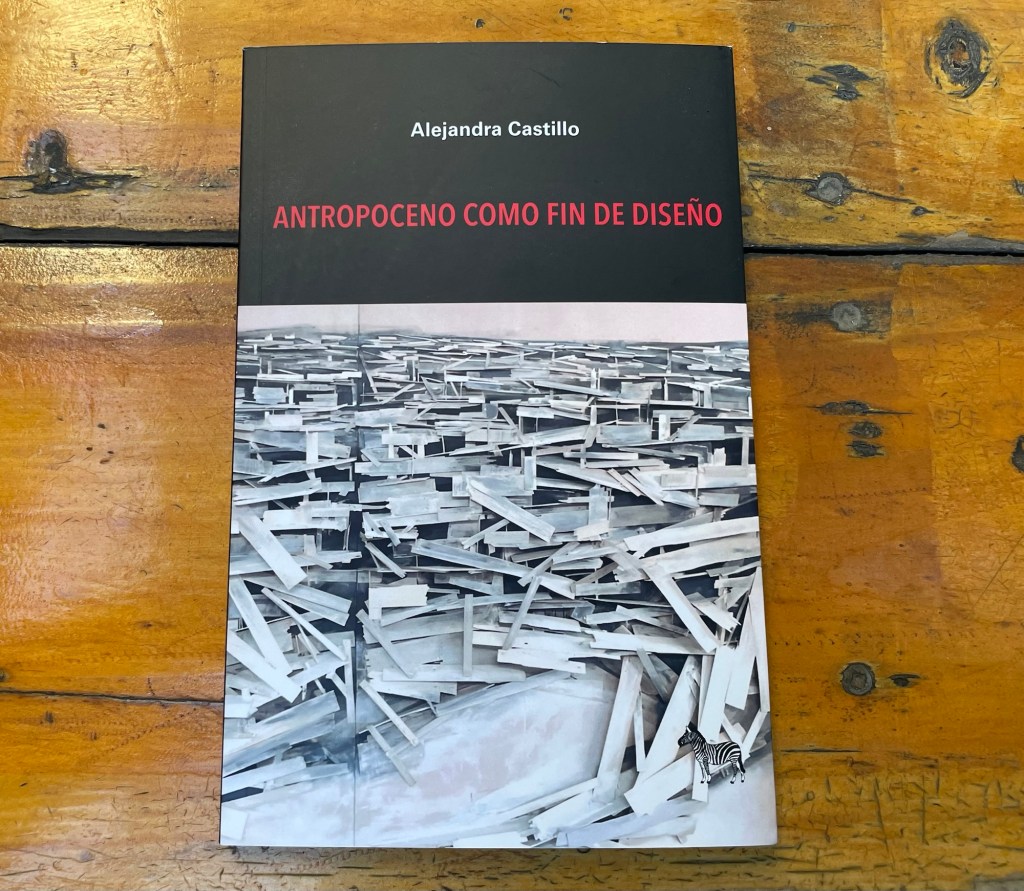
The wreckage of design. On Alejandra Castillo’s Antropoceno como fin de diseño (2025). by Gerardo Muñoz

Only in rare occasions the operation of thinking finds angular or lateral points of escape. This is the gesture that characterizes Alejandra Castillo’s theoretical writing, and is particularly bright in her most recent book Antropoceno como fin de diseño (La Cebra, 2025). The zigzagging entry is an intuition that is also a guiding thread: the force of real subsumption of capitalist domination depends on the operation of design. Of course, in design one hears not only blueprint and form, but also designation, and thus the specular regime of visibility, orderability, quantification. It is the world of physiocratic forestry. In fact, Castillo’s succinct definition of the metapolitical condition of design is offered to the reader at the entrance: “Design is the figure that thinks always in advance (por adelantado) (Castillo 12). Design calculates and locates. It is through the operation of design that legibility becomes adequated to political representation so that the state can manage and attenuate the deployment of its forms and the circulations of relations of totality (Castillo 13). The design is what is common to the worker, the engineer, and the lawyer. This is why design for Castillo design is an efficacious nexus that connects the separation of objectivity and the life worlds. Understood in this sense, “design” is analogous to the enframing of the world that intensifies in the age of technology and rhetoric. But in the watershed of the end of modernity, the hegemony of design collapses, while it becomes a temporal “self-design” submerged in all spheres of expressive enactments. 

The end of the second vector of the zigzag outlined in the essay is found precisely at this conjuncture: the anthropocene brings the humanist projections and design to a final wreckage. This is means that capitalist form is not formless because it has managed to subsume the time of life as exception to labour; time is a wreckage because design no longer coincides with the world of forms, as it has temporalized experience into total transparency without reminder. For Castillo this means that in the anthropocene there is no longer “struggle for visibility”, as everything has been rendered exposed and hollow; de-substantialized in the very fabric of subjectivity (in the early millennium some called this new hyperbolic figure the Bloom). Implicitly in Castillo’s writing is the assumption that the mediation between politics and design has been severed, and the new securitarian imperium can only immunize itself against the very site that in modern times granted its legitimacy (civil society, constituent power) (Castillo 37). 

The end of design means the absolutization of design, a new carceral imperative for adaptation that makes any claim to subjectivity an endorsement of the prison of the ego. To live in a post-designed unworldly condition means not only to come face to face with the homogenous space of cultural exchange into image; it is also a new imperative that requires that “you must submit, without knowing to what; subject to what is the case anyway, and which, as a reflex to its power and commonsense, everyone believes anyway” [1]. The end of design paves the way for new plastic forms of domination towards an integral planetary unity. 

Bordiga claimed throughout his work that the democratic design was perhaps the best fitting system for the versatility of capitalist accumulation and relentless expansion. This is why in all the political cases that Castillo introduces in a text in a manner of a shadow play do not pretend to offer a new theory of ideology, but rather show how democratic design is a one-piece suit that fits all without any needs for “ideal types” to fix normativity and institutional arrangements. Indeed, there is no longer anything like an “extreme political right” – and this is just a tweak from Castillo’s vocabulary, who does insist on the term throughout the essay – but rightward figures of the political that desperately cling to any form to distract from the abyss of social legitimation. Ultimately, the ruling over this void will be  – in many ways already is – the continuation of war in the social fabric; and stasis will require new stealth development of technologies of containment that Palantir’s Alex Karp has called the new “lethal form”. This means that democratic design is not only expressively a system of sentencing to death; it is in virtue of the exchange of social forms, an inverted negation of human finitude. The point of despair would incite some to look again in the cabinet of forms; a knee-jerk reaction to the irruption of the Anthropocene against the total sum of possible designs. 

Of course, this is also what Alejandra Castillo’s Antropoceno como fin de diseño (2025) avoids at all costs. Towards the last pages of the book, Castillo calls for a transformative turn that departs from the body; a corporeal insurrection that, in refusing the rectilinear and heteronormative political corpus of the modern epoch (no coincidence that Hobbes was both the founder of the autonomy of civil as well as of the physics of the body of matter in space), is capable of responding to the call of the anthropocene in all of its profuse conflictivity. Castillo proposes the necessity to gravitate towards a “maximum distance” against the general design of orderability of public domination (Castillo 77). But this can only be understood as an incommensurable distance that dissolves the ontotheological separation of subject and object of the state of confinement.

The political constitution of a corpus appears as the promise of an exit from the temporalization of the post-auratic literalism that, according to Michel Fried, dominated the structure of the object-oriented work of art, as compensatory to the corrosion of political forms and presentist autonomy [2]. Castillo does not seek to revive a last gasp of auratic objectification, which amounts to the sleepwalking condition of the image world of mere survival. In soliciting a maximum distance to what is closest (in fact, a body), Castillo invites us, as both promise and commitment, to think at the end of nondependency – not the “independence” that carries the traces of the fictitious individuality- from the crutches of design to finally conquer another liberty beyond terror and prevention; a life imbricated in the nonbeing of place (ecology) with others.

Notes 

1. Thedor W. Adorno. “The Cultural Industry: A Resumé”, in Without Model (Seagull Books, 2023), 58.

2. Michael Fried. “Art and Objecthood”, in Art and Objecthood: Essays and Reviews (University of Chicago Press, 1998), 172.

Hunger and gluttony after civilization. by Gerardo Muñoz

It could easily be argued that one of the central immaterial characters of Robert Antelme’s L’espèce humaine (1947) is the constant state of hunger. It is the more telling that Antelme – and it is also surprising that most of his relevant critics have been unattentive to this problem – does not reflect explicitly about the nature of hunger in his account, as if already hunger as “facticity” of the destruction of human experience in the camp was enough to show how the crisis of effective symbolization with the world means, ultimately, the struggle for the maintenance of the nutritional condition for survival [1]. It is a particular state of nutritional privation that colors not just every community or social relation in L’espèce humaine, but also every thought, passive meandering, and even moral clarity of the deportee life in the camp. The pathetic struggles over pieces of bread or scoops of putrid soup while deposing the human race from the world brings them back, at the level of consciousness, to the raw origins of its anthropological self-affirmation. And this means that every bite of food and every bit of  protein digested by the human being is only the antecedent of the future need to meet the elemental nutritional gain for survival. The ‘consciousness towards hunger’ colored in the camp becomes the mirror image of the incessant eating disorder of hypermodern social adaptation as two forms of predatory struggle over the exchange goods of the world. 

Excessive eating and nutritional deficiency are, in this sense, two pothistorical temporal circuit of human beings as a species of hunger and gluttony. About a decade ago a book entitled Hunger: the oldest problem (2014), written by Martín Caparrós, stood out as a proof of a materialist conception at a planetary scale, which for the novelist could easily be solved by drafting the legibility of material inequality and charting the regional disproportionate asymmetries between the “good eaters” (and good feeders), and those in permanent hunger, malnutrition, localized famine, and potential starvation. For Caparros, given the height of our “civilizational progress”, hunger revealed the “original plague of humanity….which now can be solved through a political decision” [2]. The substance of the “political decision” for hunger of the human race was as empty as the very nauseating fatigue of real starvation, although as a rhetorical ploy it does contribute, even against its own presuppositions, to the civilizational paradigm that structures the poles of gluttony and hunger that sustains the domestication of the human species in conformity – under the terror imposed by the glacial tonality of nihilism – with a ‘good enough life’, as an American cultural scholar univocally upheld it [3]. A deconstructed Michelin rated restaurant is as much of the ‘good enough life’ as the oversized pots of soup delivered by World Central Kitchen in any of the ongoing war zones.

A ‘good enough life’, always marching towards the absolute postponement of an absolute hunger in any part of the planet, whose most recent avatar (not the final by any means) is the well wrapped brown bag of “food app delivery” that is silently placed in front of your house door. The food delivery package, very much like the breadcrumbs of the concentration camp described in  L’espèce humaine, enter full circle even if the arrangement of symbolic reality says otherwise. It does not matter that there are human hand struggles for dregs in the camp while in civil society there is a seemingly untouched brown bag; what makes them equivalent is how the autonomization of hunger and gluttony have been deprived of everything except its own functionalization. In other words, the absolutization of gluttony and hunger as abstract nexus of social reproduction entails the complete devastation of commensality, and all features of experiential sharing that in the ancient tradition is gathered in the banquet or in wine festivities [4].

This absolute autonomization turns its back to the world, which has now been transformed as a mere reserve and container. This is why the analogies with the wild cornucopia of the elastic worlds of Gargantua or Pantagruel, or even the mythical land of Cockaigne fall short, and can only contribute to fetichize the problem of the “true hunger” of the human species beyond nutritional and biological  arrangement. The dialectical movement at work in the alleged returned to the primal anthropological condition comes at a price: the sensible and meaningful relation, which is no longer to be invented but rather to be renounced in the elaborate thickening of a social space organized through depredation and adaptation. In his Manuale di sopravvivenza, Giorigo Cesarano noted that the problem of hunger exceeded the political and biological determinations, since hunger was first and foremost the problem of the completion of nihilism – the only hunger was that of the wandering of the human species reveals the hunger of meaning as a the true double negation: 

“At the end of prehistoric times, the most ancient problem signals the return of the negative instinct: hunger. But this time is about the hunger of meaning  that exceeds, while bringing it to synthesis, the anxiety of survival as merely an animal and its false resolution as a life that transcendentals the idealist forms of the human “ideal”. …both the negative instinct and the rational separation, having conquered some coherence in its praxis, from a possible totality seeks to insert being in a real university in order to be known truly as such” [5].

In this dense moment of his book, Cesarano seems to be arriving at an important inflection point: that is, the primal instinct of hunger, precisely as fealt and maximized in the new existential poverty of the human experience, is already compensatory to the concrete realization of an absolute hunger of meaning that emerges in both the privative stage of hunger, and in the consummation of any imaginable and desirable meal. Hence, the return to the facticity of the prehistoric stage of instinct negativity is ultimately the final exclusive dish: the nothingness of nihilism to retain the illusion of, in the words of Antelme’s poem “The soup”, going to far (or as far as it needs to be that the “world doesn’t end” [6]. The anthropophagic energies are the last tools of self-burial of the bicameral man in the wake of intramundane extinction [7].

But the dialectical vengeance in the epoch of real subsumption is hereby expressed in its uttermost kernel: the material world can only take the image of a predatory park of hunters and preys, of eating and being eaten. In the privation of death, the fictitious life of being is already a form of expropriating death as ongoing struggle for survival and self-conquest of life’s own organic illness, as it appears in Anatole France’s fragment: “No, I would rather think that organic life is an illness peculiar to our unlovely planet. It would be intolerable to believe that throughout the infinite universe there was nothing but eating and being eaten” [8]. The poverty of a restricted vitalist self-reflection can only described the organization of the world as a civilization that resembles a Pac-Man maze of the circulation of the equivalent. It is not difficult agree with Adorno that this is a perfect image of the integral society without any residue – as it continues to be in any point of the planet – is the last possible well administered utopia.


Notes 

1. See the essays in the volume On Robert Antelme’s The Human Race: Essays and Commentaries (The Malboro Press, 2003), 55-203.

2. Martín Caparrós. Hunger: The Oldest Problem (Melville House, 2020).

3. Avram Alpert. The Good-Enough Life (Princeton University Press, 2022).

4. Albert Hirschman. “Melding the public and private spheres: taking commensality seriously”, in Crossing Boundaries: Selected Essays (Zone Books, 1998), 11-28.

5. Giorgio Cesarano. Manuale di sopravvivenza (Bollati Boringhieri, 2000), 70.

6. Robert Antelme. “The Soup”, in On Robert Antelme’s The Human Race: Essays and Commentaries (The Malboro Press, 2003), 36.

7. Julian Jayne. The Origin of Consciousness in the Breakdown of the Bicameral Mind (Msriner Book, 2000).

8. Theodor Adorno. Minima Moralia: Reflections from Damaged Life (Verso, 2020), 83-84.

Cuaderno de apuntes sobre la obra de Rafael Sánchez Ferlosio. Octava Parte. Por Gerardo Muñoz

Ahora me gustaría detenerme sobre un elemento gramatical que ocupa un lugar central en la reflexión de Ferlosio sobre el lenguaje: la hipotaxis. Podemos decir, sin exagerar, que el estilo de Ferlosio es un intento por sostener en equilibrio de las subordinadas en la lengua castellana. Esto también es evidencia de una práctica manierista que busca desvincularse de las formas tradicionales. Ciertamente, Ferlosio no escribió mucho sobre la hipotaxis salvo el programático “Sobre la hipotaxis y el aliento de lectura” (1997). En esta breve nota, Ferlosio sugiere varias cosas muy atendibles. Primero, y es algo que repite varias veces, la hipotaxis es “viciosa”, ya que está íntimamente ligada al deseo de escritura y a la idea de un capricho personal. ¿Qué es un capricho? En el diccionario de Ramón Domínguez (1846) se nos dice que capricho es “el nombre de un deseo repentino y de un antojo, que, como en las cabras, cuando una salta, todas quieren saltar”. Obviamente, la hipotaxis no es un capricho para cualquier escritor, ya que podría no emplearla. Para Ferlosio, la subordinada tiene que ver con una combinatoria con gracia, esto es, una remota permanencia en el tiempo del lenguaje. De ahí la metafórica náutica, que ya habíamos tratado en relación con la figura del ‘pecio’:

“….la hipotaxis es muy viciosa y un galeón no se puede construir….sin un viento de elocución; si la frase hipotáctica de la bola de brillar que he transcrito mas arriba no parece exigir, por lo que creo, que el lector suspenda en algún momento la respiración, para poder recobrar el aliento fuera de la continuidad de la lectura, he llegado a empeñarse en armar algunos grandes galeones que, por decirlo de algún modo, no pasaron, desde luego, el cabo de Hornos; y es que, como ya he dicho por dos veces, la hipotaxis tiene el peligro de que es muy viciosa. Lo cual no quiere decir, en modo alguno, que, a despecho de prestarse a complacencias lúdicas que acaban en catastróficos naufragios, deje yo de considerar el “gran camino” de la lengua, frente a la “pequeña tranquilidad” de la prosa” (huelga ya anteponerle, tras lo dicho, el adjetivo ‘bella”)” (p.XXVI).

La postura sobre la hipotaxis es una toma de partida por el manierismo contra las bondades de la letra perfecta de las convenciones y de los manuales. Por lo tanto, la hipotaxis cumple dos objetivos muy precisos: crea un ritmo en el tiempo de lectura, pero también arriesga desde el estilo, un contacto con su propio fracaso (su naufragio). No podemos descifrar del todo si, para Ferlosio, el éxito se tiene una vez que el barco atraviesa el cabo de Hornos; o, por contrario, si la historia de la escritura hipotáctica es el intento mismo de llegar a esa región (a pesar nunca conseguirlo). Tal vez podemos proponer que la hipotaxis es algo así como el “capricho” del fracaso de la escritura en la escritura. Pero, ¿por qué inscribir esta discusión en el elemento gramatical de la hipotaxis?

Ahora es necesario que pasemos a un libro que sin lugar a dudas influyó directamente en el interés ferlosiono por la gramática de la lengua: Teoría del lenguaje (1934) del lingüista y psicólogo alemán Karl Bühler. Como evidencia la biografía de Benito Fernández, Ferlosio reconoció pocas influencias de lectura en su vida. En realidad, fueron muy pocas: Karl Bühler, Walter Benjamin, o T.W. Adorno. La Teoría del lenguaje de Bühler tiene un interés inmediato en esta discusión en torno a la hipotaxis en la medida en que esta función gramatical aparece en el último capítulo de su obra. En efecto, en el capítulo 27, “El mundo formal de las oraciones subordinadas”, Bühler glosa las teorías de lingüistas como Brugmann para quien la existencia de subordinadas no es un mero accesorio suplementario de la lengua, sino “el acto primario de la creación [del lenguaje]” (p.452).

Partiendo del origen egipcio de la forma hipotáctica, Bühler desarrolla dos teorías principales y divergentes del ascenso formal de la hipotaxis en el lenguaje Indo-europeo (un prototipo no hipotáctico, como nos aclara). La primera teoría es la del lingüista Hermann Paul, para quien la hipotaxis coincide, en un mismo arche, con la génesis de la sintaxis gramatical. En otras palabras, para Paul no hay una “superación de la parataxis por la hipotaxis” en un proceso de desarrollo condicionado por la insuficiencia de la paratáctica. Por el contrario, para Paul la aparición de la conjunción “y | und” es suficiente para la construcción de las subordinadas en la estructura sintáctica: el “y” desde el principio es lo que aglutina a las oraciones y también lo que resuelve su tensión (p.459). La segunda teoría es la del lingüista Paul Kretschmer, para quien la forma hipotáctica surge desde una dimensión experiencial de los hechos en la realidad. Como nos dice Bühler, mientras que la teoría de Paul es relacional (el “entre” de varios estados de una situación); la de Kretschmer claramente tiende a la unidad intencional entre forma y experiencia. Ambas direcciones no tienen que ser irreconciliables.

Como nos dice Bühler, años más tarde otro lingüista alemán, Wilhem Brandenstein, en el artículo “Patrones críticos en las nuevas teorías de las cláusulas subordinadas” (1927) argumentó que: “El término “clausula subordinada quiere decir dos cosas. Primero, que las cláusulas tienen una relación con la apariencia externa; y segundo, que las cláusulas tienen rasgos semánticos siempre por determinar. Estos dos conceptos continuamente operan en el término “cláusula subordinada”, a veces de manera convergente, pero no siempre” (p.469). Lo curioso con la forma hipotáctica es que, como nos recuerda Bühler, se trata de una forma que tiende a la estructura de juicios condicionales o esperables (ej.: si llueve, es que tronará; si canto es que tengo buena voz; si no me ducho, entonces apesto, etc.). Pareciera ser que, la forma hipotáctica encierra en su forma una capacidad proyectiva de la acción en el lenguaje.

El reverso de la hipotaxis es, como sabemos, la parataxis, esto es, la forma sintáctica que no depende de las subordinadas y que las excluye. Para terminar esta discusión quisiera detenerme en un ensayo de Theodor W. Adorno, titulado “Parataxis: sobre la poesía tardía de Hölderlin” (1963), donde el pensador alemán nos da algunas pistas para pensar un contraste con la hipotaxis de Ferlosio. Obviamente que se trata de un ensayo extenso y complejo; en parte, es un diálogo fuerte con los seminarios de Martin Heidegger sobre el poeta alemán, por lo que sólo vamos a enfocarnos en el momento preciso cuando Adorno habla de la técnica paratáctica de Hölderlin. En realidad, la discusión sobre la parataxis en Hölderlin aparece en el momento en que se está hablando de la musicalidad “como una síntesis aconceptual, puesto que se libera de la forma del juicio y de la forma del concepto (p.130). En otras palabras: la música es una liberación de la coordinación de hipotaxis. Luego dice Adorno sobre Hölderlin:

“…Benjamin relaciona la metafísica de Hölderlin entre el polo de lo viviente y lo divino mediante una técnica lingüística. Y esa técnica lingüística de Hölderlin, inspirada del griego, lengua que no podemos decir que no abunde en formas hipotácticas, es plenamente paratáctica…la parataxis crear disturbios que evaden la lógica jerárquica de la sintaxis de las subordinadas” (p.130-131).

En otras palabras, la parataxis hölderliniana transforma la lengua en una musicalidad que difiere sustancialmente de la formas de juicio de la hipotaxis. No es este el lugar de entrar en lo que Adorno llama la “prehistoria de la tendencia paratáctica de Hölderlin” que pasa por la influencia decisiva de Píndaro. Sólo basta recordar aquí la reconstrucción del tema por Eulalia Blay en su magnífico libro Píndaro desde Hölderlin (La Oficina, 2018). Lo importante aquí es que, como menciona Adorno, la forma paratáctica de Hölderlin inaugura una operación de destrucción de la unicidad de la lengua que, sin abandonar la unidad, muestra su dimensión inconclusa (p.136).

Desde el “estilo poético”, Hölderlin no se subordina “al contrato social” (orden y secuencia), sino que “deja ser a la vida, como existencia inamovible y pasividad plena, hacia una verdadera esencia de todo carácter valiente” (p.135). A través de la tendencia del “nombrar” paratáctico – el nombrar que es una construcción vocativa, de “no-persona” en el sentido de Benveniste – Hölderlin depone en cada instancia la abstracción del concepto, así como la destitución del ciclo vicioso entre naturaleza y dominación (p.148). Pero esto sólo puede llevarse a cabo desde la paratáctica del genio del poeta. El poeta paratácticamente funda destinos propios. Si esto es asi, ¿no encontraríamos en la hipotaxis un límite en cuanto relación con la lengua, a pesar de su combate contra el dispositivo de la narración, de la alegoría, o del barroco? ¿Existe una parataxis de la musicalidad para Ferlosio? Terminemos con esta cita de “Sobre la hipotaxis y el aliento de la lectura”:

“Pensar que el aliento de lectura, en la medida en que se presta a este acomodo, no está encerrado entre los ciegos límites de la mecánica fisiológica de la respiración, sino que puede ser regido y modulado por la disposición intelectiva de una lectura con sentido, de tal manera que la frase no cuantitativa sino cualitativamente ‘irrespirable’ compartiría realmente una falta de continuidad de intelección. El escritor hipotáctico ayuda con avisos gráficos…” (p.XXVII).

La respiración es uno de los elementos poéticos de la prosa. De hecho, ¿no es la respiración una instancia paratáctica que desobra la hipotaxis en cada caso? Es curioso que, para Hölderlin , como nos recuerda Adorno, la esfera no-pictórica del mundo (no representativa), y plenamente experiencial, tiene que ver con una suposición atmosférica: “Ich verstand die Stille des Aethers / Der Menschen Wrote verstand ich nie” (“Yo he comprendido el aire / su quietud / jamás el lenguaje de los hombres”) (p.126).

¿No es eso lo que, de otra manera, Ferlosio quería conseguir desde un manierismo extremo en el interior de la herencia de la prosa castellana, haciendo del aire de las velas del galeón y de las pausas de lectura, el vórtice más seductor de su relación singular con la lengua? Y sin embargo, ¿no es cada fracaso en las orillas del cabo del Horno, ese momento paratáctico, siempre poético, que hunde el buque de las frágiles subordinadas?


Séptima parte

Sexta entrega

Quinta entrega

Cuarta entrega

Tercera entrega

Segunda Entrada

Primera entrega