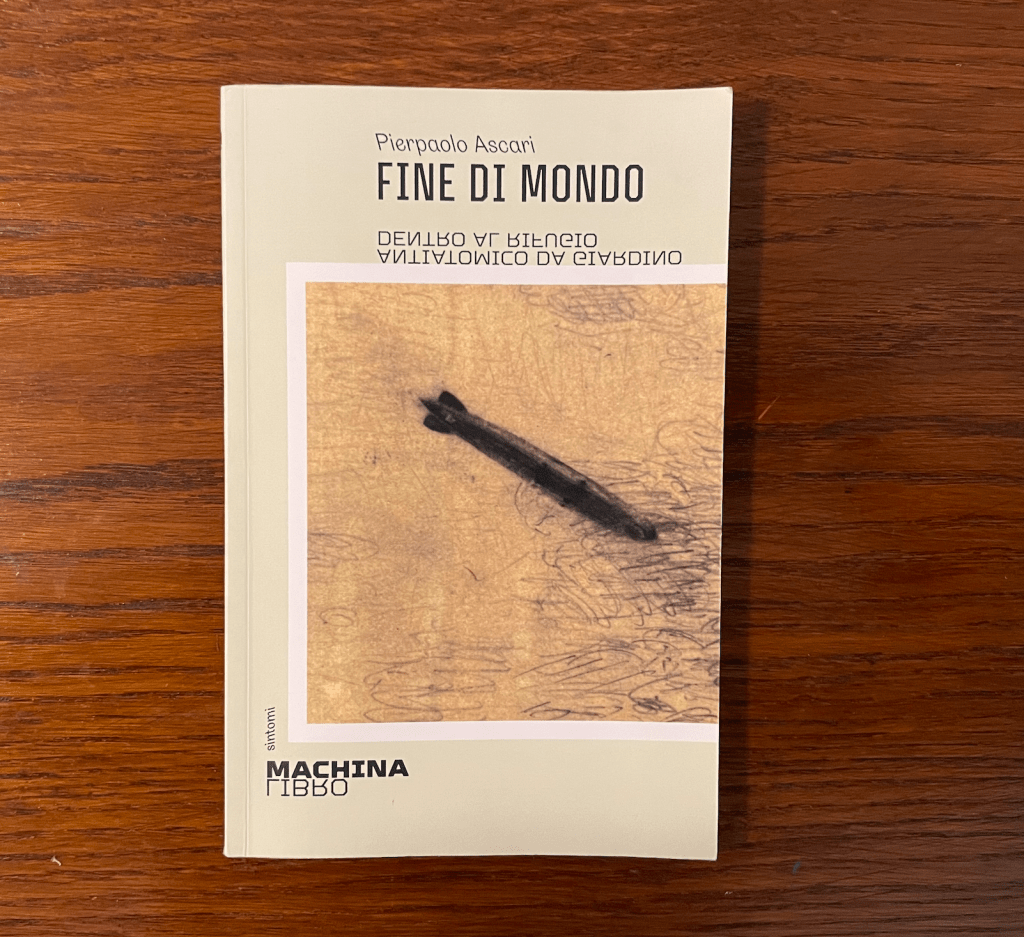
American apocalypticism. On Pierpaolo Ascari’s Fine di mondo: dentro al rifugio antiatomico da giardino (2024). by Gerardo Muñoz

Pointing to a methodological clarification, Pierpaolo Ascari’s Fine di mondo: dentro al rifugio antiatomico da giardino (DeriveApprodi, 2024) opens with an untimely advice: the threat of atomic extermination of human life can only be told and appealed through the irony deployed in all areas of consumerist culture. Undoubtedly, this fits pretty well to the case on point, since American modernization is both the hotbed of Hollywood and the atomic bomb, two poles of the regime of a vicarious life consisted with Henry Adams’ well-known assertion that, in spite of everything, America civilizational passion has always been generalized optimism. And it is not surprising that Stanley Kubrick, when asked about the thesis of Dr. Strangelove (1964), also claimed that the only possible form to tell a story about the bomb of total extermination was through a black comedy (Ascari 11). This self-serving optimism is tested in Ascari’s Fine di mondo (2024) by looking at the construction of an apocalyptic underworld fantasy; that is, in the garden of anti-atomic sheltering that reveals the true arcana of modern Americanism as a subterfuge – but also a civil current in plain sight – parallel to the rise of mechanized labor under the conditions of the triumphant Fordism. Of course, now that our farewell to Fordism has been longed trumpeted, it does not take much to see that what remains is the infrastructure of schizophrenia and general terror in the social fabric that colors the specific tune of American apocalypticism. Ascari’s book is a superb elaboration of this tonality as historically rooted and articulated, but also open to its (pseudo)theological mutations undergoing in our present. 

On the surface, Ascari’s Fine di mondo (2024) is a short compendium of the civil responses and techniques towards atomic destruction and survival; but, more deeply, is also a history of Americanism as a historical project committed to a long process of civil domestication, enclosure, and endurance of survival. Of course, the nuances here are important to grasp the subtle hypothesis of Ascari’s working scene, since we also know that modernity at large (considering both its contingency and contradiction as features of its emergence) was also a process of an optimized gnosis through alienation and the enclosure of private property towards commerce stabilization and productive growth (the nomos). But for Ascari the specificity of the American nomoi through the lenses of atomic sheltering and refuge implies a microphysis; that is, a “way of life” validated through theological premises tailored in the organization of subjective deificatio (Ascari 23). This means that the apocalyptic apparatus driving American philosophy of history is not just one of realization towards the absolute objectivation of the world – even if such endeavor is necessary and preparatory – but rather that the sheltering and self-imposed domestication of human existence has become naturalized as a threshold of the conditions of finite human life. The paradigm of sheltering as the unit of survival is a form of self-regulation of grace that is consistent with the evangelical dispensationalism and technical election analyzed in Monica Ferrando’s recent important book.

The concrete examples abound in Ascari’s short but densely illustrated book: from the Civil Protection comic to the details of the emergence of “do it yourself” assemble manuals (discussed in the correspondence between Adorno and Sohn-Rethel); from the Hulk to Godzilla in a post-atomic bombed world; form the resilient speeches on atomic menace by JFK to a 1950s study conducted at Princeton University that reassured that “fathers” will get to know their children better in conditions of total sheltering even if it results in an “ethics of the jungle” (Ascari 34). Following Guy Oakes’ groundbreaking The Imaginary War: Civil Defense and American Cold War Culture (1994), what is distilled in Ascari’s pop culture puzzle is the panorama of the “Cold War” not as a war that did not take place between two imperial powers; but rather a total war that took place beneath the crust of the earth (and this is why the topoi of the refugee becomes so telling) and at the thicket of human existence waged as psychic management of the civil sphere. In fact, the “imaginary war” is nothing else than the stazion once social life that has yet to cease to exist in our days (Ascari 48-49). 

For Ascari this implied an interiorization of the ‘sublime’ in the reification of the social fabric, which cannot be divorced from the lobotomized subjectivity of the crisis of “social man” that Gianni Carchia identified as the steering project of post-enlightenment Romantic negativity. In the turbid vaults of the self-made man we encounter the liquidation of everything that is living and the projection of fictitious death that clings into “salvation” in spite of absolute destruction; because, after all, those that survive total destruction are only there to confirm the soteriological greatness of the American destiny (Ascari 78-79). The thorough “Ubu” dimension of American psychic political power definitely speaks to this well sedimented conviction of sacrificial subjectivity. Who does not remember the glorious chants for resilience and isolation of the American political elites during the peak of the COVID19 crisis management? If it came to no one’s surprise that a large majority of Americans accepted the pandemic arbitrary rules (monetized whenever needed, it goes without saying), it was because the American subjectivity has been adapted for quite too long to the ongoing separation of refugee and domestication. After reading Ascari, in fact, we think whether the emergency policies were not just another episode in the history of American sheltering now extended at a planetary scale.

There is another idiosyncrasy to American apocalypticism that must be accounted for. And this is introduced towards the end of Fine di mondo (2024), when Ascari quotes Ernesto De Martino about nuclear war; mainly, that when it comes to atomic annihilation there is no longer the symbolic mythic-ritualistic process of reintegration, but rather the mere technification of the hand that gathers scientific knowledge in convergence with the death drive” (Ascari 81). In other words, this technico-apocalypticism brings to absolute unity the originary response of the human species (the movement of the hand) with the organization of scientific rationality that, like Günther Anders saw, brings no re-symbolization of the principle of reality, but rather it can only reaffirm the layering of the principle of reality to govern over it (Ascari 85). In a way, if it as if the essence of American apocalypticism is instituted as if beyond time, since the endurance of a “time of the end” means that the triumphant death (and the dead fueling the demagoguery of its process) foreclosing the symbolization without an exit. Indeed, an apocalypse without redeeming kingdom. For Ascari the only anticipation – primordial mechanism of anthropological capacity – is that of “money”, and hence the dominance of the principle of general equivalence entails gaining the temporal illusion of some distance from the ongoing production of death. But it is evident to anyone today, as it was said not long ago, that the true dead are those petit bourgeoisie living in the American suburbs. And they keep coming as the embers of domestic happiness try to ferociously shut down the latency of a piercing pain. 

Yes, the nature of permanent apocalypticism confirms that the true and final object of techno-capitalist force has always been the possibility of multiple life worlds. And its erosion implies the endless possibility of ordering the life of the city, as Elon Musk just a couple of weeks ago told the former president of the Republican Party: “Hiroshima and Nagasaki were bombed and now they are full cities again. Yeah, it is not as scary as people think”. If the enterprise of civilization has largely been understood as springing from the crust of the earth upwards, one of the important lessons of Ascari’s Fine di mondo is that it trains us to look downwards and inwards as the cruxes of America’s persistent government over the garden of our souls. 
A memory of Jean Franco (1924-2022). by Gerardo Muñoz

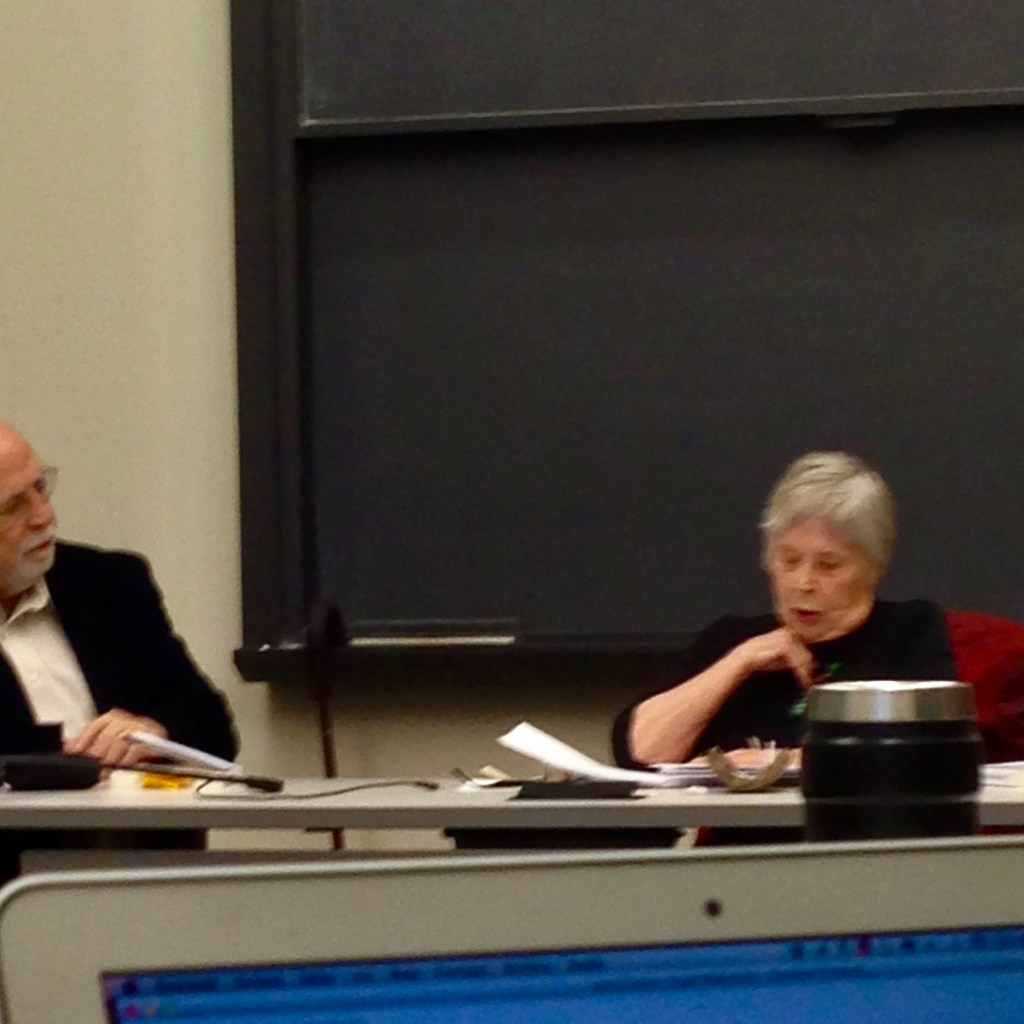
Jean Franco, pioneer of Latin American Cultural Studies and witness to its Cold War gigantomachy, passed away a couple of weeks in December at age 98. She remained lively and curious even at the very end of her scholarly life, and for some of us that saw her in action she embodied the memory of the century. The photograph above is of Jean’s visit to Arcadio Díaz Quiñones graduate seminar in the fall of 2015 where she discussed some of the main arguments of her last book Cruel Modernity (Duke U Press, 2014), a cartography showing the definite closure of the Latin American insomnia for political modernity in light of its most oblique mutations: narcoviolence, the emergence of a dualist state structure, and new global economic forces that putted an end to the vigil of the revolutionary enterprise. I write “definite” purposely, since Jean’s own The Decline and Fall of the Lettered City (Harvard U Press, 2002) already hinted at a certain exhaustion (to borrow the strategic term of Alberto Moreiras also writing during these years), most definitely a thorough disillusion, in the sense deployed by Claudio Magris, of cultural substitution for the belated state-making modernization. The function of “culture” (and its hegemonic state apparatus) was always insufficient, dragging behind, or simply put, unintentionally laboring for the cunning of a project forever postponed in the sweatshop of the newest ideologue, or for the hidden interests of the “local” marketplace of moral academicism. All of this has come crashing down rather quickly even if the demand for culturalist janitorial or housekeeping services are still in demand to sustain the illusion sans reve et sans merci.

What always impressed me about Franco’s scholarship was her intellectual honesty to record, even if through an adjacent detours and academic finesse, the destitution of all the main categories of the Latin American modern wardrobe: developmentalism, state-civil society relations, the intellectual, cultural hegemony, revolutionary violence, the “rights revolution”, and the intra-national spatiality (rural/metropolitan divide). From now on it is hard to say that there is a “task of the critic”, if we are to understand the critic in the Kantian aspiration of sponsoring modern values and perceptiveness to an enthusiastic disposition (definitely optimistic towards action) to transforming the present. As a witness to the twilight of the Latin American modern epoch, Franco univocally resisted the inflationary, value-driven, demand for politicity and ‘more politics’. This is why her attitude remained at the threshold of any given effective political panaceas or half-baked illusions.

Does her biographical experience say anything to this particular inclination? It is difficult to say, although as a witness of the century Jean had lived through the coup in Guatemala in 1954, visited the Cuban Revolution during its most “intense years” of the sugar cane milestone (La Zafra de los Diez Millones), and followed with attentiveness the rise and transformation of the Southern Cone dictatorships in the 1980s coupled with the irreversible social transformation of neoliberalism in the 1990s signaling the effective end to regional integration in the face of planetary unity. All of this to say that I find it hard – at least leaving aside the many nuances – to see in Jean’s scholarly witness an enthusiasm for the Latin American Pink Tide, the communal state, or abstract regional historicizing that could finally bring about the moral universe of the national-popular state (as if said moral realization would be anything worthwhile, which we some of us seriously doubt). If Jon Beasley-Murray once said that John Beverley was the “Latin American unconscious”, I guess it is fair to claim that Jean Franco was an authentic Latin americanist realist; that is, someone that was up to task to see in the face of the tragic, the cruel, and the heinous as the proper elements of the interregnum. Or to better qualify this: she was a worldly realist, leaving aside utopias and its abstractions. At the end end of the day, Leninists are also realists, or at least claim to be so. What places Jean’s earthly realism apart from the Leninist realism is the subtraction from the seduction of Idealization, which even in the name of the “idea” (“the idea of communism”, say) or “immanent higher causes” must bear and render effective the logic of sacrifice at whatever cost, even the real sense of freedom if demanded by the party, the leader, or the community. This is why at the closure of Latin American modernizing enterprise communitarian arrangements, posthistorical subjects / identities, or grand-spaces that mimic the constitution of Earth are foul dishes for a final banquet. It is always convenient to refuse them.


Going back to my conversations with Franco at Princeton, and some exchanges a few months later in a cafe near Columbia University, for her there was remaining only the anomic geography of Santa Teresa in Bolaño’s 2666, a novel that charts the current ongoing planetary civil war in the wake of the crisis of modern principles of political authority. I can recall one remark from Jean during these exchanges: “¿Y quién pudiera mirar hacia otra parte?” This is the general contour of her witnessing: how not to look somewhere else? In other words, how not to look here and now, into the abyss that is no longer regional or national, Latin American or cultural specific, but rather proper to our own civilization? A civilization is, after all, nothing but the organization of a civis, which has now abdicated to both the metropolitan dominium, as well as the campo santo of sacrificed life at the hand of techno-administrative operators (the new praetorian guard) of a well lighted and fully integrated Earth.

There is no alternative modernity, decolonial state, or hegemonic culture that will not serve to the compensatory and sadistic interests of the cruel policing of death and value, as the only masters in town. We are in Santa Teresa as a species of energy extraction. Can reflection be courageous enough to look through and against them? This is the lasting and eternal question that Franco left for those who are willing to see. It does not take much, although it amounts to everything: mirar / to gaze – in an opening where human form is lacking and categories are wretched – is the the most contemplative of all human actions. Whatever we make of it, this practice now becomes the daring task of the coming scholar.

Ironic gramscianism: on Patrick Iber’s Neither Peace nor Freedom: the Cultural Cold War in Latin America. (Gerardo Muñoz)


Iber Peace Freedom 2015Patrick Iber’s Neither Peace nor Freedom: The Cultural Cold War in Latin America (Harvard Press, 2015) is a very much-welcomed piece of historiographical investigation on Hemispheric Cold War in the Americas, and I think it is not just circumscribed within conventional historiography, since it also speaks to us as Latinamercanists, that is, some of us not precisely invested in writing history of Latin America. Its publication coincides with other recent books that reexamine the “culture battles” during the Latin American Cold War, such as Jean Franco’s Cruel Modernity (Duke, 2014) Mabel Moraña’s Arguedas/Vargas Llosa (Iberoamericana, 2014), or Rafael Rojas’ Fighting over Fidel (Princeton, 2015). Neither Peace nor Freedom studies the Cold War structuration in the region as a long durè process– spanning from the late twenties (take the assassination of Julio Antonio Mella in Mexico) to Sandinismo and the Marea Rosada or Leftist progressive governments that began with Hugo Chavez’s 1999 election. The Cold War took place in a climate of political and cultural conflictivity that the historian is not hesitant to call a “civil war”: “…the work of political and intellectual currents whose existence predate the Cold War, and whose sources lay in what might be described as the international Left’s civil war. The arrival of the Cold War meant that the Left’s internal conflicts would be inscribed onto superpower competition, and thus that struggles for justice around the world would be refracted through imperial interests of the United States and the USSR. In Latin America, that would leave the Left with almost no viable options for pursuing its aims without compromising them” (3).

The event of the Cold War in Latin America was in this sense a long and costly civil war overdetermined by a dual structuration. However, as Patrick Iber’s studies moves on to argue, this structuration didn’t always lead to political or cultural closure on either side. This duality had multiple replications throughout the book: there was the World Peace Council (WPC) and the Congress for Cultural Freedom (CCF), Casa de las Americas and Mundo Nuevo, along with the principles of “peace” (promoted by the geopolitical interests of the Soviet Union) and that of “freedom” (promoted by anti-communist and largely financed by the CIA). Of course, every reader could input their favorite artist, intellectual, or country for either side. It might be superfluous to say that Neither Peace nor Freedom maps a heterogeneous and conflicting history of the Cold War in the Americas (as opposed to being a “Latin American narrative” that only “happened to them” so engrained in the common position of anti-imperialist mapping. Some of us, not all, associate this second with John Beverley’s work and in particular with his Latinamericanism after 9/11).

But perhaps less obvious is the fact that Iber’s commitment to historical writing has abandoned a model of political militancy to generate an otherwise relation with the cultural Cold War archive. I want to expand on this point. At the center of Iber’s argument is that this dual structuration – whether you were anti-communist or anti-anti-communist – encompassed both a technology of liberation and a position in favor of occasional oppression (149). If this is in fact what ‘contained’ the logic of the Cold War, then one can see that Iber’s own position as a historian is consistent with not being on the side of ‘liberation’ or of ‘oppression’. To affirm this, either side would have to hold on to some principle of imperialism. These are the stakes in Patrick’s own book, and I am bringing up this point as to allow for a reexamination of the “dual structure” of the Cold War epoch in light of our present. I think there is something to this. If Patrick is neither on the side of “peace” or “freedom”, ‘liberation’ or ‘oppression’, ‘Latin American anti-imperialism’ or ‘neo-conservative domination’, what is his ground? Where is he standing?

I think there is commitment in Neither Peace nor Freedom, but only in so far as it uncovers another space beyond ideology. This dislocation is the excess of the cold war duopoly. One of the places in which one could start discussing this space, is where Iber argues the following, which can be found at the very end of the introduction of his book:

“Each camp would accuse the others of corruption and operating in the service of foreign empire. But it was not so much an issue of corruption as of the inscription of intellectuals’ preexisting campaigns onto Cold War. The evidence from Latin America suggests that the Cultural Cold War is best understood within a framework of “ironic gramscianism” – the pursuit of cultural hegemony through a combination of coercion and consent, incorporating many agendas. But the consequences were so varied that cultural fronts produced nearly as many ironies as they did movement in the direction that their patrons hoped…And the experience of Lain America’s Left during the Cold War was less a betrayal of democracy than a true paucity of options” (18).

This notion of “ironic gramscianism” – that also makes an important come back at the very end of the book- remains an underdeveloped quasi-concept making it even more suggestive for understanding the endgame of the cultural Cold War [1]. To finish, I want just to elaborate on two aspects that seem latent in this fragment of Iber’s text, and I take them to be hyperbolic of some of the strong claims laid out. First, “ironic gramscianism” seem to be understood by Iber as the contamination by way of the effects of hegemony. Hegemony here is taken as producing not just ‘other effects’ than those desired or intended, but more importantly, perverse effects. As I understand it – not just explicitly in this fragment, but more implicitly in Iber’s study cases– ironic gramscianism breaks the very closure and suture logic of hegemonic articulation, opening itself to an excess that it cannot contain ideologically. That explains why there were “many ironies counter to the direction that the patrons hoped”.

Iber seriously puts hegemony theory in crisis. As we know, hegemony theory is not just a theory, but also inevitably the principial political theory of and about modern Latin America State form. I do not know to what extent hegemony theory can come back unscathed as a viable political option (another example: to what extent the valence of Estado Integral as Estado Aparente in Álvaro Garcia Linera not an ‘irony’ in a deep sense?) [2]. If gramscianism is always ironic, this means that gramscianism does the work in the negative (the “cunning of imperialist reason”), and this negative is the limit of what is no longer “tolerable” in history (think dictatorship, or forms of oppression) (244). If Gramsci (consent and coercion) is always a machine that generates other effects, then it cannot but be ironic. A fundamental consequence here is that hegemony theory does not produce democracy (it cannot do this labor). It is my impression that it is not just a matter of perception, but that gramscianism (hegemony) is irony tout court. Is the ‘irony’ constitutive of hegemony not the very excess and ruin of itself as shown consistently through the Cold War disjunction?

Secondly, I want to raise the question of democracy that lies at the heart of Iber’s intervention. Fundamentally, the question about the Cold War is also a genitive question about democracy in the region: why has there always been a demise and impossibility of democracy? Why the condemnation, the open repudiation across intellectual groups and politico-cultural ideologies? I don’t think that this is something that Iber takes up in his book, nor should we demand an answer from it. In my view, Patrick Iber makes a modest plea: democracy (or let’s call it republicanist democracy) was impossible because there were no options that allowed for such a drift. It is here where I want to open another question for Patrick – as well as for our debate more generally– and this is: what about populism in the Cold War? The national popular State (Peronism, Cardenismo, Varguismo) with all its limitations and authoritarian drives has been the closest to true democratic experiment in the region. Early castrismo, for instance, is in a sense-liquidated populism [3]. Perhaps populism is what the negative does not let be in time. My point is not that populism is something like a “Latin American destiny”. What I wonder is if populism is not what could allow for a republicanist drift (as I suggested recently reading Jose Luis Villacañas’ Populismo) as to establish long lasting democratic institutionalization, perhaps for the first time in the region’s history since the independences of 1810.

I realize that this a highly speculative question, since with the demise of what some of us are calling the “exhaustion of the Latin America political progressive cycle”, populism is not even a viable option. What is worse, the neo-populisms from the Right are neither desirable nor consistent with a democratic opening. The Marea Rosada was a fundamental moment of the Latin American Leftist democratic desire, but not for the reasons proposed by Beverley (geopolitical inversion or State-subaltern alliance), but rather because of the implementation of a certain “fiesta del consumo” that expanded the borders of democratization. Now, to keep insisting on ‘gramscianism’ – and its categories, such as the Integral State, hegemony theory, “identity”, “correlation of forces”, albeit the admiration for Garcia Linera’s thinking, whose work is the most systematic effort to re-inscribe Gramsci in the present – is more of the same, and in an ‘ironic’ way, an option that is highly consistent with neoliberal machination and de-hiarchization (Hatfield 2015).

The end of the Latin American progressive cycle puts to the test the populist democratic articulation that conditions the national popular state form. As we know, this past Sunday, Evo’s MAS lost the referendum in two of its most important political bastions (Potosí and El Alto). If las nuevas derechas are able to keep the level of consumption on the side of large underprivileged popular sectors, then this would mark the final collapse of Latin American populism as a potential democratizing force, obliging us (scholars, and students) to rethink the nature of the political anew.


Notes

  1. Patrick Iber. Neither Peace nor Freedom: The Cultural Cold War in Latin America. Harvard University Press, 2015. In the conclusion, Iber writes: “The history of the MLN is another reminder that prodemocracy movements in Latin America, whether of the anti-Communist or anti-anti-Communist variety, used languages of liberation that were implicated in support for empire somewhere on the globe. Perhaps there was no other way” (149). Also see (195) his emphasis on “truncated Leninism” as the modernizing drive of the anti-communist intelligentsia.
  1. For this conceptual translation in Garcia Linera, see Gareth Williams’s excellent “Social Disjointedness and State-Form in Álvaro García Linera”. Culture, Theory, and Critique, 2015.
  1. On the Cuban Revolution as hegemony, see El Viejo traje de la Revolución: identidad colectiva, mito, y hegemonía política en Cuba (Universidad de Valencia, 2007) by Sergio López Rivero.

*Introductory remarks for Patrick Iber’s book worskshop at Priceton University, February 23, 2016.