It is noteworthy to remember that around the same moment in mid-twentieth century, two dissertations on the notion of sin were written by two emblematic representatives of late liberal political thought: John Rawls’ undergraduate thesis A Brief Inquiry Into The Meaning of Sin and Faith written at Princeton University in 1942; and only a few months later Torcuato Fernández-Miranda’s El pecado como concepto fundamental del problema filosófico, a través del pensamiento agustiniano (1943), a doctoral dissertation written at the Law School of the Universidad de Madrid. Both scholars would soon become exemplary figures of Atlantic liberalism in their own ways; the first developing the most consequential and systematic work of normative political thought since Kant; and, his Spanish counterpart, becoming the leading constitutional reformist in the Spanish transition to democracy and architect of the “Ley para la Reforma Política” of 1976 enacted that year in parliament.
Leaving aside major conceptual difference between the two programmatic works, what is symptomatic of them is precisely that a fundamental theologicalconcept is transplanted and weaved for the needs of a political vocabulary that aims at the reinvention of a tradition that could not longer sustained its own secular commitments to individual autonomy and the rational control of state authority. And if we are to follow Eric Nelson’s reading, the intrusion of the doctrine of sin in late modern political thought was the last nail in the coffin of a secularized Pelagianism that dominated the basis of the different normative projects of modern political theory.
In the new administered world the ground of mediation and legitimacy is wobbly and precarious, thus the notion of sin will infuse an exoteric desecularizing anthropology that ironically attempts to “save” politics through its impolitical other that deploys an instrumental conception of original in order to redeem human collective action through divine grace and mercy (clearly a benevolent inversion of Calvinist damnation). This is why in Rawls’ dissertation levels a critique of individual egotism and moral arbitrariness through the operative efficacy of sin. Rawls traced this morphology from Philip Leon who had already articulated it in his Ethics of Power (1935): “What is the nature of this delight in sin itself? It is, Augustine suggests , a delight in at least a factional opposition to the right, in doing unpunished what one ought not to do, in an imitation of godliness, in a shadowy symbol of omnipotence in the search for a shadow – in sort, in the romantic adventurous for the absoluteness” [1]. What political thought in its reduction of civil society– now distinct from the source of authority and concerted legislation – will craft is the regulatory and counterbalancing mechanisms of social ordering without exception. Precisely, one could say that in the wake of the introduction of sin into late political philosophy the new heresy becomes the shadow or the conspiracy against the social domain that will amount to absolute infraction, a plain crime.
If the primal scene of sin originally emerged in the context of a fratricide – and thus, in relation to the dead and to the burial and wandering, which will lead to the justification of territorial settlement – it is altogether symptomatic that this snapshot of the slowpaced instance of desecularization appears as a force that only makes living possible within the social bond, fusing Kingdom and justice, compensation and salvation, punishment and rewards, retribution and distribution in an endless cycle that, because it has lost any mediation to redemption, it can only outlive itself by the coordinating services of social force (and there is no surprise that post-rawlsian thinkers precisely developed a theory of exclusive positive law from the conception of service).
One of the consequences is this mutation is that it allows us to think how the end of secularization is not just the usurpation of the theological sphere, but also the realization of the subsumption of human deficiency and stratification as social leveling (a central operative notion that will later enter Rawls’ A Theory of Justice with decisive consequences) will offer legitimation through the total administration of social life even when done in heuristic ideal of a “classless society” dependent on the enforce of a “priestly service” (hierourgounta) that deifies itself as an indivisible administrative of the social temple. Sin guarantees a vicarious subjectivity that is the starting point for implementing the social distribution of needs and services.
At this point, one can recall Erik Peterson’s humorous exposition of this closure that speaks to the ‘social progressive politics’ that still dominates well into our days: “There is perhaps no better symptom of this than the construction of roads between China and Tibet with the purpose to destroy the places in which there are still ascetic practices outside society…our capacity for leveling, as least theologically understood, will ultimately generate the collapse of Heaven and Hell” [2]. For Peterson, the inaccessibility of exteriority [of the desert of the Fathers, and the ‘desert of deserts’ that opens a place] leaves us with the unbreathable and darkening atmosphere of the Social.
.
.
Notes
1. Philip Leon. The Ethics of Power or the Problem of Evil (George Allen&Unwin, 1935), 240-241.
2. Erik Peterson. “Fragmentos”, in Tratados Teológicos (Ediciones Cristiandad, 1966), 251.
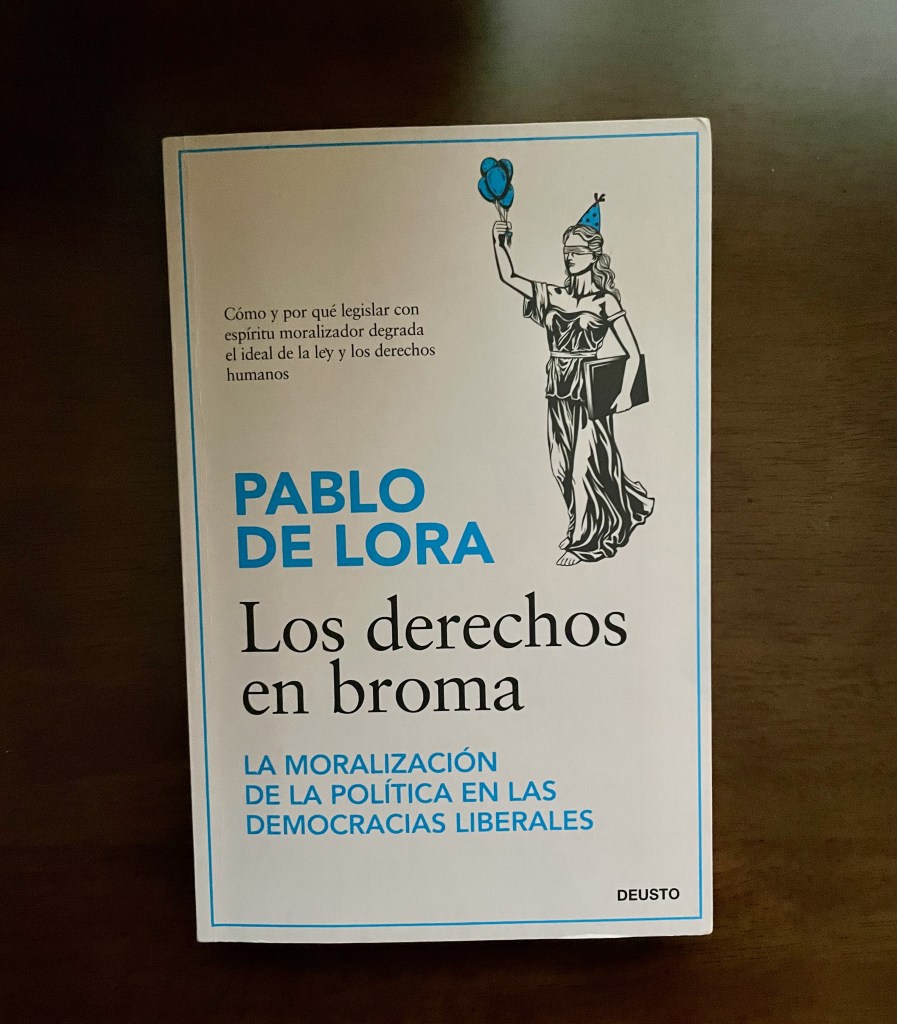
The crisis of the liberal legislative state is almost as old as the very project of the modern liberal state itself. And if we are to believe Carl Schmitt, the rise of the supreme values of the French revolution and ‘human rights’ (with its corollary of universal recognition within its normative system) also meant walking the fine line from the political theology of generative reform to the nihilism of ius revolutionis commanded by new discharges of individual will, political and technical movements, and immanent forces bringing the collapse of the separation between state and civil society. We are still living under its protracted shadow, albeit with a different intensity and intent. In his new book Los derechos en broma: la moralización de la política en las democracias liberales (Deusto, 2023), Pablo De Lora co-shares this point of departure, while daring to suggest a new sequence after the collapse of modern political form and legal order: we are currently living under a particular epochal transformation that is anti-legalist (sic) in nature – precisely because of its surplus of legal motorization – that erects a “nursery state” for the totality of the political community’s reasons and justification for action (De Lora 23).
Although De Lora case studies shown are almost entirely derived from the Spanish and Latin American contemporary social contexts, I do think that his sharp diagnosis could be extended to the epoch itself without blurring the important nuances. This is an epoch of a reigning “emphatic constitutionalism” (Laporta) or the total Constitution (Loughlin), at the same time that it no longer takes too much effort to imagine a political community devoid of a legislative body, as one eminent constitutional scholar has said repeatedly [1]. We are already here. In other words, whether by excess or deficit, the overall purpose of moral driven legislation announces the internal transformation of modern politics as we know it, extending itself to a civilizational regression from the ideals and norms of the Enlightenment rooted in the fiction of the citizen, the binding of the social contract, and the invention of the principle of sovereign authority.
De Lora does not quite says it in this way, but I think I am not diverting too much of his cartography when extracting some of the central consequences of these internal moral substitutions that are palpable everywhere across the West: ecological legislation that increases social conductivity and expansion of natural destruction; ‘feminist’ anti-sexual aggression that leads to lowering of sentences for convicted sexual predators; the inflationary instrumental use of “Human Rights” for persons and things, but only defined narrowly by those that, under the thick haze of institutional hegemony, can deprive their political adversaries and enemies of the most basic legal guarantees of due process transforming them into non-persons. These ‘moral substitutions’ is part of the “ironic” and “futile” consequence of the sacralization of morality whose end is the management of the “social model” at all costs. According to Pablo De Lora, within the limits of confronting a social dilemma such as disability, the specificity of the “case” is turned on its head; what matters is the overall structural design of the social order and its infinite adaptive changes (De Lora 71-72).
This mutation generates all sorts of unintended consequences when the rhetoric of “social benefit” takes the lead. As De Lora writes: “No hay apoyo anticipado a la discapacidad mental sin reconocimiento de que el discapacitado mental no puede ejercer su autonomía en el futuro. Dicho de otro modo, la institución de las voluntades anticipada de la lógica desideratum de modelo “médico” de la discapacidad mental que se rehuye en beneficio del modelo social” (De Lora 85). And in spite of normative incoherence within an institutional system, the deflection to the “social model” requires ever-expanding commands, rules, principles, and hyper-amendments to guide the adverse proliferation of reasons for action within the social state (in the United States this is soften by the police powers of inter-agency statutes of the administrative state through cost&benefit balancing of discretionary principles under the supervision of the executive branch). This transformation entails the collapse of the internal mediation between the validity of norms and its foundation in social facts as in the classical construction. Thus, the expansion of value-driven legislation that also requires of specific adjudicative constitutional theories, such as legal interpretation and the theory of balancing of principles advocated by Robert Alexy, the sponsors of social neo-constitutionalism, but also the embedded dialogic ideological positions of constitutional scholars such as Roberto Gargarella (or in the United States context, the work of Mark Tushnet and the so-called anti-originalist ‘living constitutionalists’).
All things considered, the fundamental problem for De Lora is that this specific transformation enacts what he calls a “Estado parvulario” or ‘nursery state’ that he defines as: “El que denominado “Estado parvulario” da pábulo a que el poder público, en sus diversos instancias y encarnaciones, escamotee las realidades y consecuencias que conllevan algunas discapacidad per oa que lo haga de manera internamente inconsistente: tratando a los menores como adultos, pero sólo simbólicamente, y, en cambio, de manera efectiva, a todos los ciudada como menores, congénitamente desvalidos, incapaces de encarar la realidad” (De Lora 87). In the framework of the nursery state within its specific moral legislative apparatus, children become adults and the mature civil society regresses to an infantile stage. And like in a nursery setting, the democratic virtues pave the way for new dramatic effects where the function of rhetorical annunciation – so central for the any credentials of moral hegemony – forecloses the void between morality and politics in the wake of the unification that the social model requires to begin with (De Lora 89).
This slippery slope can only lead straight to a sacralization of the political system that runs co-extensively with the infinite expansion of social rights; which, in turn, leads to an ever increasing conflict over the assumptions regarding its social facts (De Lora 151). In this narrow form, De Lora is audacious when citing Martin Loughlin’s recent indictment from his Against Constitutionalism (2022): “En la era de la Constitución total, el gobierno bajo el imperio de la ley ya no significa el gobierno sujeto a reglas formales independientemente pulgadas. Significa gobierno de acuerdo con principios abstractos de legalidad que adquieren significado sólo cuando son insuflados con valores…” (De Lora 188). And we know perhaps too well that values cannot be reasoned, but only weighted; values are commanded and taxed on the permanent devalorization of other values. This is why the rise of the value fabric of constitutionalism coincides with the ‘weighting’ proportionality of principles of law’s ideal social efficacy, to paraphrase Robert Alexy’s influential position as claim for “anti positivist legal justice” [2]. The nursery social state cannot be corrected merely from the position of the legislator; it can also be tracked as a triumph of moral jurisprudential theories of law that seek to overcome (and provide answers) to the overall crisis of institutional authority that characterized the so-called ordered liberty of the moderns.
Is there anything to be done beyond a description? It is quite clear that Pablo De Lora’s ambition is not so much the proposition of a new political or legal philosophy as much as the sketch of the current epochal predicament in its current practice. This is already enough to welcome a robust analytical discussion of our predicament in Los derechos en broma (2023). However, there is a cobweb of affinities in De Lora’s own position towards the end of the book that, even if not fully developed, must be registered as a mode of conclusion. First, there is an affinity with John Hart Ely’s deferential conception of judicial power that aims at overseeing the procedural mechanism for the democratic deliberation and legislation over a hot-button issues. In this vein, De Lora shares Akhil Amar’s position regarding the overturning of Roe in the Dobbs’ decision; a conception that fully embodies judicial deference to diverse legislative majorities [3]. Secondly, De Lora favors a judicial minimalism associated with the doctrinal theory sponsored by James Bradley Thayer over the practice of judicial review of the Court (De Lora 233). And last, but not least, De Lora sees transformative potential in John Rawls’ assertion in his late Political Liberalism (1993) that the use of public reason is a comprehensive doctrine to deal with our fundamental disagreements and contentions over shared political values (De Lora 241).
I am not sure how deep or for how long does De Lora wants to go with Rawls; however, it is important to remember – and specially given the treatment of the ‘social model’ in the morality presented in Los derechos en broma (2023) – that insofar as social paternalism is concerned, Rawls’ late liberal political philosophy at the heart of the crisis of the secular liberal state amounts to a political conception that, as Eric Nelson has brilliantly shown, abandons the commitment of individual non-cooperation or refusal to cooperate with unjust moral legislative burdens, and thus making everyone stuck in the same ship [4]. This ship is the management and balancing of the totalization of the values being trafficked in the Social as ‘egalitarian’, although they are fully endowed as a seterological scheme of “election” (and who is elected) balanced by secondary compensations.
On a larger canvas, if the current political structure is defined as a nursery state of social rights, then this means that appealing to ideal positions of justified reasons, “diaphanous” deliberation, and well crafted citizen arguments belong to the age of maturity of the Enlightenment, but not to the stage of social infantile disorder. And demanding political qualifications to the contemporary citizen today is not only naif, but at odds with what what institutional thinking requires. In other words, the concrete transformation of the post-liberal state is one of permanent optimization of conflict, which is why John Gray has lucidly defined the (contemporary) ‘new Leviathans’ are “engineers of the soul” with broad and sweeping capacities to govern over every inch of the social space [5]. In the wake of these institutional mutations, the call endorse a “moral critique” might be taken as a post-enlightened lullaby that among the blasting and striding cries of infants of the nursery will most likely just pass unheard.
Nowhere in his published work does John Rawls treats the concept of civil war explicitly or by that matter in relation of his concept of political liberalism, although it is central to genesis. In a Spring semester of 1969 lecture at Harvard University, which remains for the most part unknown and only alluded by specialists of his (although never subject to substantive treatment), “Moral Problems: Nations and War”, Rawls takes up the problem on its merits [1]. This is a lecture that took place in the wake of the Vietnam war, the post-1968 context, and during the years of the definite settling of “global civil war” intensifying in every corner of the world. There is little that Rawls when treating the problem of war within the tradition of liberalism, was also aware of the factical nature of war of his present; that is, the transformation of war as a legitimate declaration between nations (at that point outlawed by the international Kellogg-Briand Pact) to a predominately a war within nations, that is, a permanent civil war. In this lecture – which one does not need to summarize given its broad historical strokes and technical determinations – Rawls crafts an typology wars in international law, as construed by the ius gentium, a theme that will later be the subject of his late book in international relations principles Laws of the People (1993). What is surprising is that in this typology, Rawls defines civil war as a thorough conflict aiming at “social justice” to transform the state. A civil war, then, is no longer what precedes the foundation of ‘legitimate authority’ proper to sovereignty, but it is rather the means by which something like “justice” becomes the mediation of the “Social”.
From this it follows, that for Rawls civil wars either neither wars of aggression or wars of sessions, two forms that would be exclusionary to his definition grounded on ‘Justice’. Hence, the “justification” of civil war could only be a just war insofar as its aim grounded in social justice as the effective realization of the well-being of all the inhabitants of the polity. For Rawls this was the ‘active’ continuation of the ideal of the French Revolution of 1789. Indeed, one could claim that for Rawls civil war is the continuation of revolution after the principle of universal recognition was achieved through rights. The ideal of Justice, then, was never the well-ordered natural law theory of revolutionary change (endorsed by many Jacobins, such as Saint-Just), but rather an intra-level recognition of social rules within the plural system of value differences. Coinciding with the development of positive law as grounded in social facts and guided by a ‘rule of recognition’ (in H.L.A Hart’s well-known elaboration), Rawls’ theory of civil war was the mechanism for a social fact-based conception of justice that was predicated in the optimization of risks, regulations, and re-distrubution of post-recognition equity of the activist state. Indeed, social justice insofar it was no longer merely sovereign authority, took the function of social facts through the administration of a permanent social civil war.
Neither an event nor an exception, civil war for Rawls is a free-standing metapolitical paradigm of the new “transformative” conception of the Social ordered purposely around the principle of Justice. Paradoxically, the conditions of promoting “social justice” (whose echoes we still hear today from the political class as well as from the jargon of academic political ideology) is not limited to the “veil of ignorance” or the “originary position” for social action, but rather in the actualization of a latent stasiological paradigm. This esoteric unity is neither an exception nor a deviation from Rawls’ mature political thinking around social justice; but as all true political paradigms, an invariant mode of his thinking. This is why he points in the 1969 lecture the Spanish civil war as paradigm of stasis as social justice, and in his essay “My religion”, the American Civil War led by the exceptional executive authority of Abraham Lincoln as necessary to the “original sin” of human slavery [2]. And as Eric Nelson has convincingly argued, the anti-pelagian conception of sin in Rawls’ thought amounts to a secularized theodicy of social force: a regulatory physics in the aftermath of the crisis of the sovereign state. Although ignored by Nelson, the full picture of Rawlsian conception of the “Social” is not complete if one does not take into account the stasiological paradigm that legitimizes the aims of social justice. And if the internal conflict is latent within the Trinitarian ontology (as Political Theology II suggests) there is little doubt that the transformative model of Liberalism rather than moving the conditions of politics forward, ends up descending to the terrain of Christian political theology that it never abandoned.
But is it even ‘transformative’ within the conditions of the Christian model that it allegedly secularized? Is the primacy on social justice on civil war truly a political theology, or rather the consequential triumph of theology over the institutionality to restrain the ballistic aspiration of social hegemony? Both questions collapse if tested on the grounds offered by Carl Schmitt regarding both political theology and the critique of moral neutralization of values as direct application of the principle of Justice, which would turn social relations into pure subjection, a form of Homo homini Radbruch (Rabruch referring to the Radbruch formula of an unjust of law as non-law, thus requiring principles) [3]. What is “just” to a hegemonic stance indicates a clear crisis of institutional deficiency in the face of what values determine the scope and content of the “Just”.
Similarly, the transformative conception of Rawlsian “activist liberalism” is closer to the realism of latent civil war than what the Christian idea required on a thing and minimalist basis; which, according to Ladner implied retreat form the social as well as from liturgical participation. On the contrary, rather than moral unity, reform entailed a separation, solus ad solum, in order to transform the habits and costumes without direct enforcement [4]. Contrary to the Christian monastic ius reformandi, Rawls’ renovation of political liberalism, vis-à-vis the civil war paradigm, accepted the hellish reality of the social by affirming “social justice” as the only real means for subjective social cohesion. And if the just war principle stood largely under the guidance of positive sovereign rules and commands; the deployment of justice of civil war will be based on the exertion of principles and higher content without end. The true efficacy of civil war alien to the concept of the political, made possible a regime of socialization on the mere basis of values stratification and moral abstraction.
.
.
Notes
1. John Rawls. “Moral Problems: Nations and War”, Spring 1969, Harvard University. Harvard U Library Archives.
2. John Rawls. “On my religion”, in A brief inquiry into the meaning of sin and faith (Harvard U Press, 2009), 263.
3. Carl Schmitt. “Un jurista frente a sí mismo: entrevista de Fulco Lanchester a Carl Schmitt”, Carl-Schmitt-Studien, 1. Jg. 2017, 212.
4. Gerhart B. Ladner. The Idea of Reform: Its Impact on Christian Thought and Action (Harper Torchbooks, 1969), 322.
Como lo cuenta el propio David Cayley, el testimonio de Ivan Illich en Los ríos al norte del futuro (2005) fue concebido por el exsacerdote de Cuernavaca como una “mera hipótesis de trabajo”, una especie de candelabro que no tenía otra pretensión que arrojar luz a la oscuridad de un presente que transitaba al interior del mysterium iniquitatis [1]. Como no podría haber sido de otra forma, Los ríos al norte del futuro es también un recorrido autobiográfico por la vida de un peregrino espiritual cuya confrontación existencial estuvo atravesada por la pasión del laberinto teológico de Occidente. Si Los ríos al norte del futuro puede ser considerado un “testimonio existencial” esto se debe, en parte, a que en ese último libro Illich vuelve a las raíces y a los arcanos del cristianismo, algo que ciertamente no había hecho de manera “polémica” desde su renuncia a la misión pastoral de la Iglesia en América Latina.
Me gustaría sugerir que el escándalo esotérico del silencio de Illich sobre la Iglesia Romana – la dimensión fundamental de su corruptio optimi pessima – se debe a la crítica de uno de sus núcleos centrales, desde el cual se despliega la génesis misma del eón cristiano y de su secularización: la noción del pecado. Por ello, solo confrontando cara a cara la transformación de la noción del pecado era posible explicar las aristas de la expansión apocalíptica del misterio del mal: desde la antropología a la agregación de “necesidades”; desde la crisis de legitimidad a la burocratización de la iglesia; desde la diferenciación de los géneros a la institucionalización de los aspectos sagrados de la vida (aspectos que el propio Illich había tratado en casos concretos a lo largo de su obra divulgativa). El dispositivo del pecado lo había transformado todo, a cambio de impedir cualquier tipo de autoreforma sin que estuviese hipotecada al tiempo abstracto del futuro de una religión instituida.
En diálogo con lo que luego sería Una Historia De La Justicia: De la Pluralidad de fueros al dualismo moderno entre conciencia y derecho (Katz, 2008) de su amigo Paolo Prodi, Illich identifica la nueva criminalización del pecado como el instrumento jurídico que da entrada a la forma y a las reglas de una nueva organización de relaciones humanas desde la textura más íntima de la compenetración entre singulares. La legalización de las almas entregaba la promesa, la hospitalidad, el don, o el compromiso hombre-mujer a la estructura del juramento operativa del officum eclesiástico. El pasaje del pecado como revelación mediante el perdón, ahora se desplegaba bajo el mecanismo ontológico de “poder pecar”, lo cual remitía a la voluntad del sujeto; y, por lo tanto, a su necesaria regulación mediante la confesión. La corrupción del dogma teológico había tenido lugar mediante una sutura jurídica, puesto que, si “Cristo había venido a hacernos libre de la ley, había sido el cristianismo el que permitió se instalase en el corazón mismo del amor” [2]. De esta manera el dispositivo del “pecado” funcionó como un meta-principio regulatorio de la propia yuxtaposición entre moral y derecho que nutriría de manera fundamental al iusnaturalismo, pero también al principialismo moral de nuestra época. Por eso dice Illich con mucha razón – otra vez, siguiendo de cerca el argumento de Paolo Prodi – que el fuero interno (forum internum) ahora gobierna sobre lo que es el bien y el mal, y no sobre lo que es legal o ilegal [3]. Algo importante aquí debe subrayarse: Illich no asume una postura contra el derecho; sino más bien, quiero sugerir, insiste en la inseparabilidad entre moral y derecho desde donde era posible establecer mediante una economía de la conciencia que los sacerdotes podían comandar. Esta fue la lógica de la corruptio optimi. Illich concluye el capítulo sobre la criminalización del pecado insistiendo que de esta manera se instala el miedo, una pasión que terminaría siendo funcional al gobernante de turno para gobernar sin tregua. Pues bien, creo que el problema es más profundo que un problema de esta pasión. La sutura entre moral y derecho habilitada por la conjuratio del pecado como oikonomia de las almas, conducía a una producción sin freno de la legalidad (de la criminalización de infracción de la norma) para la cual ya no existe legitimidad ni perdón alguno; o bien, si existe, queda secuestrada y subordinada a la instancia de la legalidad y de ciertos valores absolutos.
Así, la Iglesia como institución había quedado desnuda, puesto que había sido fundada bajo un procedimiento de técnico y moral, que había llevado a la desaparición de la excepción del pecado que Illich identifica como conspiratio [4]. La conspiración, nos dice Illich, no debe ser entendida como una la táctica de un grupo de rebeldes anarquistas intentando tomar o subvertir el poder; sino más bien como algo más originario, un beso boca-a-boca (osculum) que constata una dimensión somática en el mundo, pero fuera de él. La conspiratio se substrae de mandatos y de una legalidad que asume una falsa autoridad sobre el fuero interno o la conciencia. Y así, la conspiración es una unidad sui generis porque afirma un principio de separabilidad entre moral y derecho, exterioridad e interioridad que rechaza toda “medida” medible (distributiva o cualitativa) entre entes de una comunidad política. En otras palabras, pudiéramos decir que la conspiratio es lo que nunca tiene como propósito la reproducción de la garantía de un orden basado en un principio moral desde el “bien común” de la comunidad. La “corrupción de lo mejor”, entonces, había tenido lugar en la profanación de la conspiratio en nombre de una estructura burocrática legal sin resto y sin fin, salvo el de ella misma.
Desde luego, esto ya Illich lo había comprendido con nitidez y prudencia en su temprano ensayo “The Vanishing Clergyman” – y que antecede a su salida de la vida pastoral de la iglesia – en el que advierte que la Iglesia en su función ecuménica estaba más preocupada por un “performance profesionalizante” propia de la expansión administrativa que por cuestiones teológicas de la “sensus ecclesia”. Sin embargo , Illich recordaba que solo la fidelidad a su “sentido eclesiástico” podía permitir un retiro de demandas compromisos sociales que ofuscaban la presencia del “reino entre los seres humanos” [5]. Todavía en estos años, Illich contemplaba la posibilidad de una conspiratio ecclesiam, una reforma con la exterioridad del mundo, como lo demuestran las experiencias latinoamericanas en la comunidad puertorriqueña de Washington Heights (NYC), Puerto Rico, así como Bolivia, y más tarde México. Pero como vemos en la correspondencia con su amigo Paolo Prodi, ya por aquellos años, Illich preveía la expansión del dominio sacerdotal en todas las esferas de la praxis humana, incluyendo la política-administrativa. Por eso Prodi le sugería en una carta: “Nosotros debemos pensar espacios de libertad en las estructuras sociales existentes, desde luego. Y, sin embargo, debe quedar claro que nuestro destino no puede estar en la política ni tampoco en los compromisos partisanos” [6]. La tesis moderna del destino como política, a la luz de la efectividad operativa del pecado, solo podía aparecer como una cojuratio secularizada compensatoria en la que liderazgos o jueces aparecían, como en la máxima de Ulpiano, como los “verdaderos sacerdotes” de una administración intrusa en el reino humeante del humano.
Voy a ir terminando este comentario con una última observación. No deja de sorprender que entre los años en que Illich percibe la ruina institucional de la Iglesia y cuando finalmente publica Los ríos al norte del futuro, la renovación teórica-política más influyente de la segunda mitad de siglo veinte – el “redistribucionismo social” derivado de A Theory of Justice (1971) de John Rawls – tenía como presupuesto teológico el dispositivo del pecado para rechazar “el egoísmo individualista” (al que tempranamente, en su tesis de grado en Princeton, asoció con la amenaza del Pelagianismo) de suturar de una vez por todas, la rebeldía del pecado a la imagen y semejanza de Dios en comunidad [7]. Desde luego, ya por aquellos años no se hablaba de comunidad de salvación, de pecado, o Dios; pero sí de velo de ignorancia, justicia como equidad, o equilibrio distributivo. En la más influyente y regeneradora teoría liberal-progresista en un momento de crisis de la legitimidad, lo político emergía desde los presupuestos teológicos del pecado con la finalidad de poner un freno (Katechon) al egoísmo y a la destrucción de una comunidad, a cambio de garantizar la gracia de valores y necesidades de la racionalidad de un estado administrativo. Ciertamente, esto fue lo Illich pudo alertarnos con candidez en Los ríos al norte del futuro para evitar salidas moralistas, tecnificadas, y desatendidas de la separabilidad a la que nos invita el reino de la teología.
.
.
Notas
1. David Cayley. Ivan Illich: An Intellectual Journey (The Pennsylvania State University Press, 2021).
2. Ivan Illich. The Rivers North of the Future: The Testament of Ivan Illich as told to David Cayley (Anansi, 2005).
3. Ibid., 182.
4. Ibid., 390.
5. Ivan Illich. “The Vanishing Clergyman”, en The Church, Change & Development (Seabury Press, 1977), 81.
6. Paolo Prodi. “Cuernavaca, Estate 1966″, Revista di Storia de Cristianesimo, Vol, 10, 2013, 471-494.
7. John Rawls. A Brief Inquiry into the Meaning of Sin and Faith (Harvard University Press, 2009), 206.



 Infrapolitical Reflections