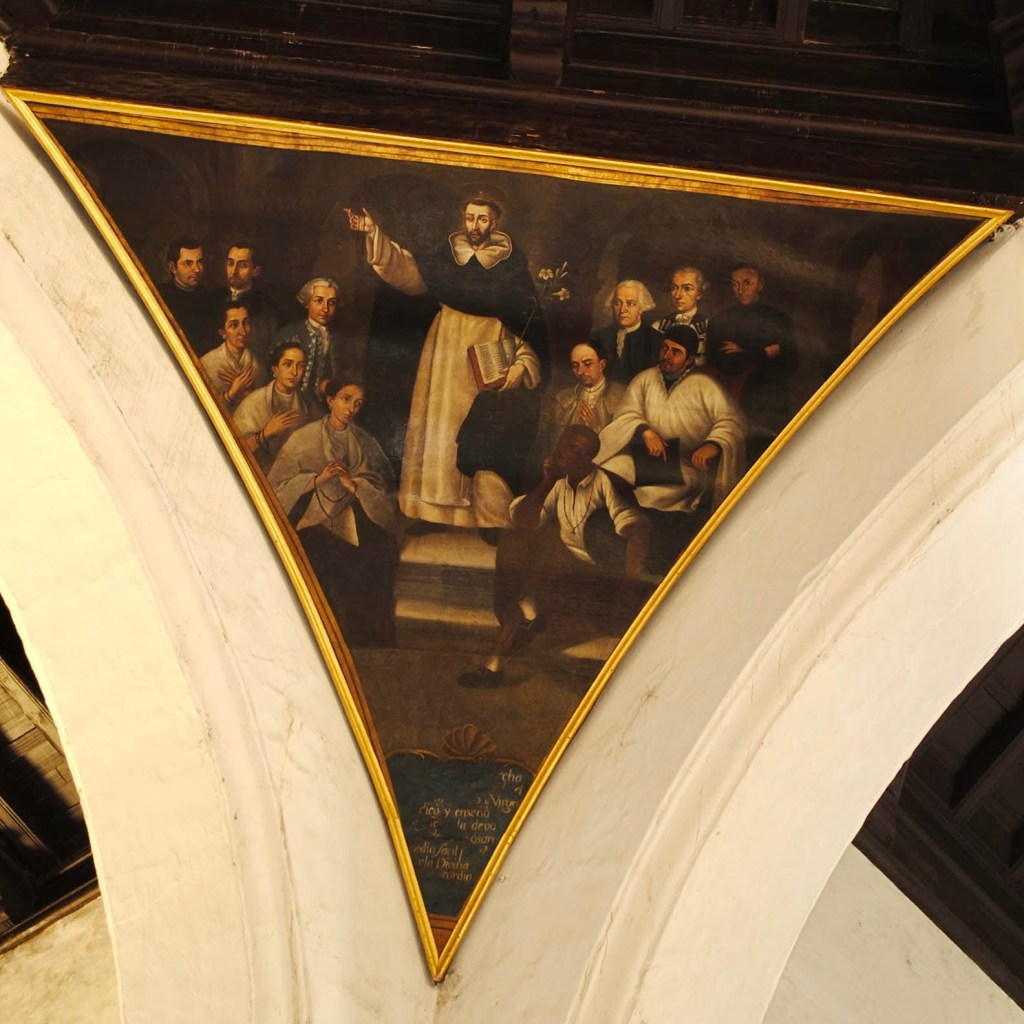
In the Church Santa María del Rosario of Havana there is a pendentive cycle completed in the 1770s painted by the baroque artist José Nicolás de Escalera – whom according to Guy Pérez Cisneros, was truly the first professional Cuban painter of the tradition – that includes a black slave in a pensive pose seating on a lower step, just below a Dominican priest who figures prominently in the middle of the picture holding a Bible and raising his right arm forward [1]. It has been noted that the figure of the black slave is also the first portrait of a slave in the New World, and its meaning has been highly disputed. The enigmatic slave or liberto portrait shows the man in a thinking pose, with a folded long white shirt, and what seems to be a wooden rosary hanging in plain sight. It is hard to make the details of his facial expressions, but it is obvious that his gaze is neither upwards nor directed at the viewer, but rather suspended, as if were, in a moment of attention and rest (and also listening?). The context here is fundamental, since Santa María del Rosario Church was commissioned by the Count of Bayona, a wealthy member of the sacarocracia (sugar plantation owner) after a previous church was burned to the ground by a slave revolt that took place in 1727 in an act of complete defiance to Christian indoctrination.
The event that only has come down to us in just a handful of mentions and erasures of the colonial archive is featured prominently, as we know, in Manuel Moreno Fraginals’ El Ingenio when the historian documents the spiritual schism of the eighteenth century colonial plantations of the island. According to Fraginals’ historical account, the slave insurrection in the plantation took place in the wake of a theatrical enactment proposed by the Count of Casa Bayona in an act of repentance and humility aiming to mimic a well known moment of the Christian story: one day the Count washed the feet of twelve slaves, and when he finished he made them sat with him for dinner. Later that afternoon the slaves revolted and burnt down the whole sugar mill, including the chapel, to the ground. The episode ended with a plantation mayoral officer hunting down the runaway slaves, who was ordered to place the heads of the dead slaves high in spikes for the Count and everyone to see them [2]. It is an early staging of visibility and bodily dominion that the modern epoch will take to its final conclusion.
The portrayal of human suffering was a symptom of the impossible hegemony of christianization of body and soul that the missionary Nicolás Duque de Estrada decades later will try to deploy in his pedagogical treatise Explicación de la doctirna cristiana acomoada a la capacidad de los negros bozales (1823), which argued that obedience of slaves could be achieved by implating “guilt” and work ethic in the affective interiority, in the forum internum of their souls. But even Estrada was of the fact that after sixteen hour workdays the Christian ascesis was imperceptible and little more than convoluted chatter to the ears of the slave. It is almost as if the slave, separated from the politico-theological inscription of salvation, was already outside the subjective domination of productive bondage and political freedom.
When Escalera was commissioned to do the cycle of frescos at Santa María del Rosario he was asked to combine a twofold narrative: the history of Christian salvation and the story of the Casa Bayona. At the center of the altar piece is the world as a common house or oikos, that carries history and its bodily sovereignty forward. One possible reading of the pensive slave shown in Santa María del Rosario’s pendentive is to assume that this figure is completely outside the eschatological vision embodying a sense of freedom that only painting could have documented in its unique and mute language. This raises the question about the relation between painting and freedom in which the figural emerges unmistakably fixed beyond historical narration. Although writing about Cézanne’s late work, Kurt Badt once suggested that there is no such a thing as the representation of freedom, but rather “painting generates a concept of freedom as two-faced: negatively, it is liberation from isolation and resistance, positively to the serious gentleness of freedom….expression in freedom to the scene from nature, which declares the world to be existing together, a mutual self-supporting and carrying of things” [3]. The pensive slave portrayed in the pendentive does not embody freedom understood as the spiritual accumulation of rights and duties known to the order of historical transformation; rather is an absolute pictorial appearance of freedom because it embodies, in its non-separation of life and thought, a static moment of a being that contemplates the liberty of his potency.
What is striking about the collective portrait where Escalera inserted the former slave is what we can call, following Bernard Berenson, a dimension of the ineloquent that appears just as “mute, with no urgent communication to make, and no thought of rousing us with look and gesture. If they express anything it is the character, essence rather than momentary feeling or purpose. They manifest potentiality rather than activity. It is enough that they exist in themselves” [4]. In the pensive gesture of his pose, the slave is the untouched existence and the revolt that rips the escathological narrative that ordains the interiors of Santa María del Rosario. Malraux once noted that the age of the divine disdained the realistic portrait of an ordinary person, because he was too distant and mundane from the stone conclave of the gaze of the gods. The slave’s inexpressive ‘naturalness’ refrains from partaking into a mood compensated by the semantic compulsion of the colonial painter, because his naturalness discloses the indestructible soul that has transfigured the realm of the divine.
The unfathomable mystery of the pensive slave or liberto is the obscure and yet luminous portrait of a life in thought that is, at the same time, the thought of a life that is forever inexpressive, and as such the highest state of imperturbable freedom in the aftermath of worldly destruction. The ‘gentleness of freedom’ that Badt locates at the heart of painting is the imperative of the stream that carries, and yet restrains, thought and appearance into the figure of life. The freedom that anchors painting – because such freedom is never realized in painting except as vulgarity – becomes a tacit secret for which ultimately there is no image.
.
.
Notes
1.Guy Pérez Cisneros. Características de la evolución de la pintura en Cuba (Ministerio de Educación, 1959).
2. Manuel Moreno Fraginals. El Ingenio (Crítica, 2001), 99.
3. Kurt Badt. The Art of Cézanne (Faber & Faber, 1965), 314.
4. Bernard Berenson. Piero Della Francesca: The Ineloquent in Art (Chapman & Hall 1954), 7.

 Infrapolitical Reflections