According to the Talmudic tradition there is a certain number of just persons, called the tzaddikim, that exist in every generation. Their divine and singular existence is known only to God, and according to the tradition if the world continues to exist it is only for their sake. They live in the desert of the world without ever being known by anyone in the public eyes. In this sense, the tzaddikim could be anywhere and everywhere as long as there is a nuance of humilitas. It is not clear, however, that the tzaddik is an ethical being in the polarity of thinking and action; but it is precisely this depth that renders him an opaque and mysterious figure. How many tzaddikim are there in each generation?
Although Borges directs our attention to Max Brod as a modern source regarding the tzaddikim, it is actually Gershom Schlem who in an illuminating essay of this tradition records that it was the fourth century Babylonian teacher Abbaye who attached a number to these “saviors of the world” to thirty-six: “The world is never without thirty just men who daily receive the Divine Countenance” [1]. The world is not saved by the promise of redemption alone; what the tradition of the tzaddikim teaches future generations is that there is only redemption whenever something like a depth of existence is treasured as an embodied mysterium. In other words, it is almost as if in the tzaddikim the idea that “life is always elsewhere” is not only confirmed on the basis of faith, but on the inconspicuous existence that is divine in virtue of ceasing to be public and translucid. As Scholem says later on in his essay: “…these hidden just men belong to a higher order because they are not subject to the temptation of conscience which is virtually inseparable from public life”.
In a world pushed into full transparency, absolutely transformed into a reservoir of energy extraction and dispensation like the one that we are currently living, it is not all too difficult to imagine that even the secret lives of the tzaddikim are at risk of survival. And if the apocalyptic tone of our current gnosis has become predominant within the accelerated technological development, one could imagine that the opacity of the tzaddikim is slowly drying out, very much like the way that major rivers in the American desert are continuously being pushed to planned obsolescence and slow extinction.
In fact, one could go further and say that there is a clear analogy between rivers and the tzaddikim insofar as they are both pathways of generational communication of the human species with the world whose mouths that for millennia have made the condition of life possible. This means that in the same way that river mouths dry up, human language, with the advent of the barbarism of “Artificial Intelligence”, also becomes a new phase of desperate muteness, losing its capacity to pass forward its traditions and memories. Who is the last tzaddikim today? He or she will be the secret agent of language itself, the keeper of a divine surge that erupts even in the meanderings of a world out of tune.
.
Notes
1. Gershom Scholem. “The Tradition of the Thirty-Six Hidden Just Men”, in The Messianic Idea in Judaism (Schoken Edition, 1971), 252.
First published in the Chilean publishing house Mundana back in 2016 and long out of print, Victoria Cirlot’s Imágenes Negativas: las nubes en la tradición mística y en la modernidad (2026) finally appears in a new and upgraded edition from Siruela Ediciones. This short essay, initially a conference delivered at the Universidad Católica de Valparaíso, is another contribution to Cirlot’s important work on European mystical tradition of European early modernity, but like other of Circlot’s book its value also resides in its prudential contribution to contemporary thought. In this sense, Cirlot’s visual exploration of the cloud allows us to raise the question without much hesitation: what is a cloud in a field of vision, anyways? In Kurt Badt’s John Constable’s Clouds (1950), a book that is curiously missing from Cirlot’s commentary and bibliography, the cloud is merely a modern phenomenon in painting; a specular effect of the rise of meteorology in post-Enlightenment England that paved the way for a new construction of the modern landscape painting.
If Cirlot does not need to follow Badt’s insights, it is due to the fact that she wants to take a step back, even if her point of departure is Von Dillis’ drawings from the nineteenth century that she encountered in the Alte Pinakothek in Munich. These are relatively small works, and more profusely unfinished than Constable’s cloud exercises in oil painting. I seriously wonder if Cirlot’s would have taken another direction in her analysis if she had confronted another series of cloud paintings of the modern tradition. Perhaps not. Following Gombrich’s dictum that clouds are accidental forms reserved in the mind and extended to the pictorial space, Cirlot immediately goes on to document the long mystical tradition where the cloud stands for theosgnophos, or the incandescent light that descend from the divinity right into the human’s heart (Cirlot 18). In the mystical tradition the cloud of the story of Moses, later deployed as a trope by Pseudo-Dionysus and Gregory of Nyssa, the cloud refuses to be an accident of substance; it is rather the image of substance itself: the impossibility of knowing and having access to the divine, and thus the need for the recollection of the light of ignorance.
If mysticism and painting go hand in hand it is because what the divine cannot be said in language, but it be disclosed through the spectacular persuasion of an image that is carved in the veil of theology. In this way, the cloud is a bit like a dress in a painting, both conceptually and figuratively: Cirlot does not fail to note that in Medieval representations one can grasp the figure of God swerving in a cloud before a horned Moses, but it is also the turbulence in the depth of the picture that allows for the ascension of the gaze that fails to establish a horizon and the linear perspective. Although Cirlot does not put it in this way – she is obviously more refined and attentive to her historical sources – one could easily find an opposition between clouds (and perhaps clouding of the background of a picture, an activity) and horizon of pictorial representation. It is in this sense that Cirlot defines the “via negativa” that clouds appeal to the impossible knowledge of God (in my translation): “The images of ascension and clouds are modes of making visible the negative way of the proximity with God…the fact that the experience of god takes place through the mode of negative images is something that persist from Pseudo-Dionysus to Mechthild of Magdeburg, and San Juan de la Cruz” (Cirlot 23-25).
In other words, the cloud is the non-human figure of a mode of cohabitation in God – Cirlot goes as far as quoting that it is the medium, “el entre”, the incommensurable distance between the sensible being and god (Cirlot 27). This is why the cloud, in virtue of what it discloses in its non-disclosure, is a bit like a hole in the picture, and we fail to account for its potency to stabilize its mystery through the categories of the autonomy of the work of art. This is why it is very fruitful when Cirlot tells the reader that the cloud defies vision in its very appearance, since through its clearing and light, it can only “sense through the inner soul” (Cirlot 30). This was also present, at least residually in Badt’s Constable Clouds, when referring to the externalization of the clouds as the spiritual organ of the living. But it is precisely this exteriority that defies the epistemological grounds of meteorological knowledge that would facilitate the technical ability to condense the cloud into force and energy, whose ultimate expression is crowned in a work such as Hans Haacke’s Condensation Cube (1963). A fallen cloud from the sky that can only be experienced in the abstraction degrees and measurements of its objective “data”.
There is an intimate and communicate vessel between painting and clouds that can be derived from Imágenes Negativas (2026), and that can be sound in the state of imperturbable contemplation where life and thought convergence without the energy of struggle that would define modern artistic creation and its fall into autonomization (Cirlot 33). If painting is to release and live as a mode folded in God; the modern sensibility would require the energy of creation in order to open the passage between worlds. Following Puech’s important work on Gnosticism, Cirlot sees that the nebular trope of the cloud persists in modernity well beyond San Juan de la Cruz: one can sense in the attempts to “escape this world” – from Piranesi’s ladders to Thomas De Quincety’s prose, and of course, Charles Bauderlaire – a hymnal longing for the clouds that depends on the energy of the reversibility of the modern seen as a form of confinement (and from the pictorial space, I would argue also as the triumph of flatness in modern painting) (Cirlot 44). The cloud becomes a window for gnostic imagination, although this could very well be a sort of self-serving pleonasm, given that the “possible” of the gnostic remnant in the work of art only appears as momentary reversibility; a temporality that necessarily subsists without transforming the plane of sensibility. These are wonderful experiments in poetry, painting, photography; and yet, the negative, I take it, cannot be refused its place in the historical wealth of historical capture of exteriority. Both Hölderlin and Baudealire’s clouding of poetry is already the document of the impossible attempt to live the serene life in god. Thus, any attempt at a full-fleshed exodus via negativa, runs into catastrophe and possibly madness in the wake of disenchantment.
In her final and short essay of the volume, titled “La estrella y la nube”, Cirlot speaks of the return of the cloud in modern photography, concrete the work of André Kertész, as ‘laceration in the sky” (“agujerear el cielo”), or a tear in the heavens (Cirlot 60). The passage here appeals to an inverse tonality, where lamentation becomes an inexorable dimension of affection in the world now organized through massification and urbanization of all spaces. Disenchantment is ultimately spatial enclosure. But this tear in the sky is a remnant of a memory of the divine, as well as the absence of the divine in the world; the failure of establishing a transcendence with the unknown and the inapparent. But it is thanks to Victoria Cirlot’s pictorial explorations that we can raise these questions, which are also more than mere questions pertinent to theology and art.
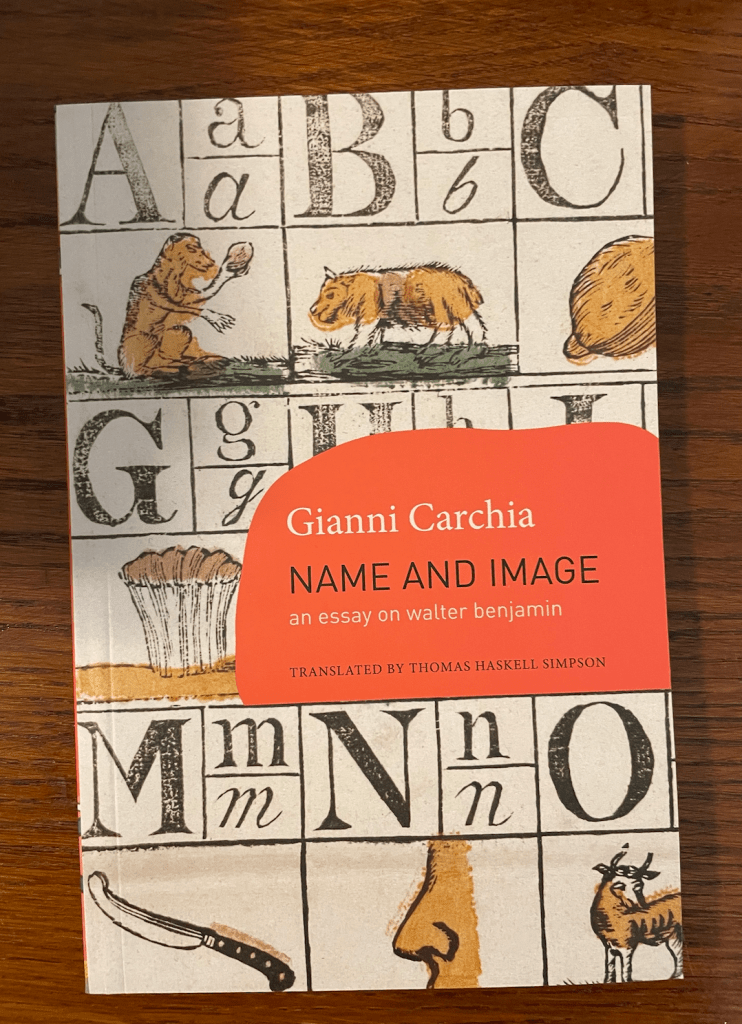
At long last readers in the English speaking world will be able to read Gianni Carchia’s work in translation thanks to the publication of Name and image: an essay on Walter Benjamin (Seagull Books, 2025), which was the Italian philosopher very last book published posthumously in 2008. This is not a work of late style as such, since these four essays on Walter Benjamin serve as an oblique and angular entry point to the thinking form of Carchia’s own philosophical concerns on sensibility, the survival of the myth through aesthetic mediation, and the post-kantian elaboration of the appearance as the condition for experiencing the world. This is a project without systematic architecture that dates back to his first books of the late seventies such as Orfismo e tragedia (1979) and Estetica ed erotica (1981), both published in the Milanese publisher Celuc Libri. It must be noted that although this is a marvelous introduction to Carchia’s philosophical idiosyncrasies and recurring themes, it is perhaps not the best introduction to Walter Benjamin, who in these four essays is read against the grain of dominant hermeneutical frameworks; that is, beyond Frankfurt Critical Theory and dialectics of the image, and on the other hand, the theologico-political concerned with messianic temporality as a transformative philosophy of history.
It does not mean that Carchia is oblivious to these constitutive elements in the corpus of the German thinker; but it does mean that the profile constructed is one that favors a critical project that has disinhibited affinity with the Platonist project of beauty as condition of the critical endeavor committed to truth. For Carchia it is at this vortex where one should locate the “brilliant degree of illumination” that awakens philosophy from its slumber, overturning the texture of thinking to an erotics of the lost detail and the enduring fragment. Citing the correspondences to Florens Rang and The Origin of the German Tragic Drama, we know that for Benjamin “without at least an intuitive grasp of the life of the detail in the structure all love of beauty is no more than empty daydreaming” (Carchia 33). The task of the critic is one capable of arresting the inexpressible, only because beauty lives in the world as a state of silence and expressed revelation (Carchia 38). And it must be said that platonism in Carchia never manages to crystallize into a doctrine of being, pivoting to persuasion as the route to an idea without form.
Carchia shows that for Benjamin the reinvention of the critical method cannot aspire to the totalization of origins and principles – or even that of the status of the visible (Schau), as he brought to bear in his comment to Max Kommerell’s Der Dichter als Führer in der deutschen Klassik (1928) – underpinning the emergence of the idea where the seeds of truth germinate to unfold the interstices of historical sedimentation (Carchia 62). Unapologetically, Carchia suggests that Benjamin’s critical method, if there is such a thing, must be read as a “philosophy of the infinitesimal aim to shatter the prejudice that attributes to totality predominance over phenomena…at the price of their insignificance” (Carchia 61-62). In turn, this means that “the smallest cell of visualized reality outweighs the rest of the world” (Carchia 63). The infinite cuts through the world as a remnant that must be redeemed precisely because of its incongruence in the face of the triumph of immanence and the distribution of forms. And this is yet another sign that Carchia’s Benjamin must read as a thinker of a platonism of the immanence that by folding forms it is able to escape modernity’s temporalization of the sensible reality and its lethargic material objectivity [1]. This hits a hight note about Benjamin’s philosophical thought as anointed in the ancient currents of Stocism, since as Pohlenz taught us, the material forms of this world are the hurdles that neutralize the inception of the divine in a reality governed by the necessity of kakia.
Hence the confrontation with language occupies the center of every critico-historical reflection, which means how to live the immemorial language that is neither an instrument nor the “medium of prophecy or domination” (Carchia 85). Carchia reminds us that for Benjamin Karl Kraus’ language is platonische sprachliebe, or platonic love of language, which means a voice that overcomes the separations of signification and symbol, object and subject, and the consolidation of exchange through the voice of gratitude and use: “thanking and dedication – for to thank is to put feelings under a name” (Carchia 85). The word as apophantic revelation places judgement under erasure, enacting not a return to Edenic pristine nature of divinization or virtuality that attests to the figure and repetition of appearances and the medium of the “spiritual verbalization that animates reality” (Carchia 92). The abdication of an original language survives as the mythic memory of a voice porously open to translation: “All higher language is a translation of lower one, until the ultimate clarity the word of God unfolds, which is the unity of this movement made up of language” (Carchia 92). If for Benjamin the problem of translation is coterminous with that of the mystery of language, it is because it reveals the fragments of a vessel that removes the ground of rhetoric through “variation and discontinuity” (Carchia 96).
In fact, reading Carchia one can infer that rhetoric is to language what the destiny is to human existence in its becoming. Thus, the destitution of language, its internal rhetorical and objective liquidation, appeals to the possibility of the event of happiness and bliss that is the only well illuminated path for redemption, that is, for the flourishing of the “nexus of truth and beauty” of the liberty of the soul. We are painfully aware that modernity is many contradictory elements at once, but Carchia tells us following Simmel, it is ultimately the historical project of Entseelung or loss of soul of the world, and thus “the faculty of memory as particular gift of the soul” (Carchia 121). The historical time of progress, its formal assumption and increasing autonomization, means a ritual situation that “seizes control in exteriority – as as continuum of temporal unfolding – of that entertainment, flashing, discontinuous awareness of the irrevocability of the past held firm by the image-memory” (Carchia 121). Hence, the exercise of thought and memory through the redemption of appearance is the necessary struggle against the usurpation of caducity, and thus the only promise of salvation through the dead, the defeated, and the forgotten. There are clear echoes of Hölderlin’s “Andenken” here that Carchia formulates as the necessity of memory in the repeated dispensation for the clearing of appearance. As he writes in one of the most formidable moments of the book when discussing the self-offering of the memory that guards the catacombs of the dead:
“…for Benjamin, aesthetic temporality, as temporality of the soul absorbed in the contemplation of the nexus of truth and beauty, is the very origin of temporality’s self-offering, of temporality tour court as the space of memory. The salvation of appearance and the dimension of memory are all one: here is rooted the connection between temporality and the aesthetic dimension. The appearance constitutive of the space of redemption, and the beauty whose sacrifice would sacrifice the space of truth itself, are nothing other than memory continuously rescuing them from the space of historical time. It is precisely this connection, between the sphere of appearance as the sphere of the irremediable caducity, and the counter-movement of memory in the involuntary image, that forms the nexus that some of the most subtle passages struggle to delineate as the world of the soul, or rather the world of the past” (Carchia 120).
Thinking the fragment becomes indistinguishable from retaining the sensible participation of the soul. It is this arresting breath (Hauch) of the soul that clears a path on which appearance is saved from the crushing weight of historical self-sufficiency. This confirms, if anything, that Benjamin’s sensibility for Carchia does not end in the confines of postromantic critique, nor in the utopia of totality and abstraction imposed by the metaphysics realized in money form over the living and the dead. As Carchia asserts: “utopia is the end of the constructive and generative ideal of knowledge” at the base of human anthropology and material conditions of social existence, but a whole “redirection underpinning what we have called thinking the informal” (Carchia 127, 135).
What does it mean to think the informal, and what accounts a thought of the informal where Carchia posits Benjamin’s most enduring and clandestine signature? Avoiding all false exists in neopaganism of worldly immanence, Carchia connects the formless dispensation of thought with a nirvana state of para-rūpa (a hypostasis of God that does not presuppose a form, but that it is transformational), the instance of imagination without an image and place that speaks of a chôra as the last refuge of the living. A refuge that, like the platonic cave, does not entail the accumulation or wealth of signification, but that retreats from the perils of insignificance and unhappy consciousness of nihilism. This is one way to understand what Benjamin writes in one of the glosses in “Short Shadows”: “…an image that has already crossed the threshold of the image and property, and knows only the power of the name, from which the lover lives, transforms, ages…and imageless, is refuge of all images”. An existence devoid of a central and authorized image can only prepare for the idea of justice that, because it is experienced it can retreat from the aleatory predication of the world. This enacts a descent into “an anarchy of being in this side of form”, as Carchia would beautifully call it towards the end of book; an inward saturation that is also a reservoir of sensibility because it is able to take a breath. And because it is breathing, it can assent to the external penumbra that restores the appearance of every thinking being in its very image and name.
.
.
Notes
1. On the platonic immanence and the soul, the central reference is Gianni Carchia’s essay “Platonismo dell’immanenza: Fenomenologia e storia in Hans Blumenberg”, Hans Blumenberg: Mito, Metafora, Modernità (il Mulino, 1999), 215-26.
Vermeer’s “Woman Holding a Balance” (1663) has been read as an allegory of the Final Judgement for very obvious reasons. The painting within the painting on the foreground embodies a traditional representation of the Last Judgement for the saved and the damned. But how are we to mediate between the painting in the painting and the activity that is taking place in the mute and contemplative woman that is holding a balance with her right hand? Advancing an interpretation that departs from the coins placed on the table, Herbert Rudlolph’s important thesis suggests that exchange and equilibrium is taken place at once; a movement that allows him to favor the narrative of vanitas that would have been immediately diaphanous to the spectators of his time, especially the growing Catholic community of Vermeer’s Netherlands [1].
The picture shines with religious piety and depth, and yet it is a work of interiority that Vermeer has notably chosen to deprive of an explicit iconographical assertion in its main figure. Could it just be a visual representation of Loyola’s Exciertia spiritualia (1548) that recommended to be “like the equivalent scales of a balance ready to follow the course which is more for the glory and profuse of God, our Lord, and the salvation of the soul”? [2]. What are the instances of balance in the picture that would justify such a singlehanded transposition into the picture? If painting is anything, it is precisely what carries an excess to narrative and iconology. And this is what we should be interested when looking attentively to the picture. The vortex of depiction is the event that falls outside the concept through which we are attempting to arrest the meaning of a picture in its manifolds historical subtleties.
If taken prima facie “Woman Holding a Balance” (1663) is representing a combination of the embodiment of justice and judgment, what remains an enigma is precisely the fact that the balances are empty, as is evacuating the act of weighting the unequal units of weight. In the graceful hands that hold up the weightless balance, Vermeer has given us something like an image of the suspension of judgement, and in this way, communicating esoterically with the Last Judgement that looms heavily on the foreground. Whereas the allegorical representation of the last judgement is reminiscent of Van Eyck’s “Last Judgement Diptych” (1430), the female figure appears to us in an experiential graceness restrained from any transcendence; as if only sub specie aeternitatis time had come to a halt at the very contemplative motion of her inexpressible being. Her presence recalls Kafka’s assertion about the temporal fixation of judgment: “It is only our conception of time that makes us call the Last Judgement by its name; it is a kind of martial law” [3].
The nullification or void in the balance inscribes this ex tempore suspension in the sequence of historical time of salvation that subordinates faith to history oblivious to the fact that life without judgment is also an instant of faith. As Felix Weltsch, a theologian that was very close to Kafka, thought in an important work: faith is a process that overcomes itself by creation; it is not a force of judgement and belief, but the the subsumption of existence into what which already is [4]. Or, in the words of Kafka, closely following the steps of Weltsch: “faith means emancipating oneself: being indestructible or better: being”. Faith has been transfigured as a transmission of what now is the emergence of appearance as the event of life. Fleeting and yet irrevocably unbending, what appears is both incommensurable and sensuous.
After this detour, if one goes back to Vermeer’s picture, what does one see? Definitely, not an instance of allegorical portrayal towards the transcendental expectation; rather, this is an image where theos has become a presence because it is enacting the faith of being in the withdrawal of God. This invisible, and yet sliding retreat is rendered visible by the emptying of a balance that is no longer posited as judgement of post-Edenic life towards salvation; it is the opening of space that upholds life because it no longer surrenders to the martial court enabled by time. When judgement unfolds into the indestructible and visible ‘lunatic strength of faith’, to use Kafka’s singular expression, then we are entering a living grace that is only attuned to the eternity of its appearance. And is not this another way to define the emergence of painting, after all?
Against what contemporary jurists’ formulations about pondering and weighting of rights as the ideal of the rule of law; the figure of thought that emerges in the picture is that justice is neither scalable nor measurable, but rather a motionless state of grace that can only be contemplated in the mystery of life. The emancipated life staged in Vermeer’s “Woman Holding a Balance” (1663) holds an inconspicuous eloquence that knows neither waiting nor judging, because its imperturbable state is beyond all consolation.
.
.
Notes
1. Herbert Rudolph. “Vanitas: Die Bedeutung mittelalterlicher und humanistischer Bildinhalte in der niederländischen Malerei des 17”, in Wilhelm Pinder (Seemann, 1938), 410.
2. Gregor Weber. Johannes Vermeer: Faith, Light, and Reflection (Rijksmuseum, 2022), 127.
3. Franz Kafka. The Aphorisms (Princeton University Press, 2022), 82.
4. Felix Weltsch. Freiheit und Gnade (Kurt Wolff, 1920), 10.
Many interpretations of Hölderlin’s “Andenken” (“Remembrance”) have taken for granted that the hymn’s last verse might have been a paraphrasis and creative translation of Pindar’s ode Pythian 3. In the philological scholarship of the poem, it was Günter Zuntz who took notice of the analogical semblance to shed light on “Andenken” final verse as something more than mere imitation: “Never, however – unlike Pindar who does so frequently – does Hölderlin begins a hymn with a praise of the Muse, which would be an imitation, but not an analogy…the “Andeken” conclusion, “Yet what remains, the poets found” – corresponds almost verbatim to Pindar’s Pythian 3 final verse…” [1]. If we reread Pindar’s Pythian 3 from Race translation (Loeb, 1997, 263), we encounter the following verse: “Excellence endures in glorious songs for a long time. But few can win them easily”. If on Hölderlin’s side we encounter the “remnant” of the sayable in language, in Pindar’s ode we are presented with the endurance of a “glorious song” of the festivity that is carried out in struggle and forward in time.
Ignoring the common place interpretation that assumes that Hölderlin’s concluding verse is a distortion of the translation from the Greek, Zuntz goes to note that the pindaric remnant in Hölderlin’s hymn effectively “constitutes in essence an analogy – not an imitation; it rises from the affinity of spirit not from an act of self-effacement” [2]. This analogical relation with the past, and thus the memory of Antiquity speaks directly to the modality of the improper that is common to the hermeneutical debate on the poem. All things considered, and following Zuntz’s hermeneutics, we could say that the pindaric intrusion in the concluding verse is a way in which the poet is enacting the harmonious poetic creation as it finds external resonance in tradition. As Hölderlin notes in his difficult note “On the mode of proceeding of the poetic spirit” (“Die Verfahrungsweise des poetischen Geistes”): “Put yourself through free choice in harmonious opposition with an outer sphere, just as you in yourself are in harmonious opposition, by nature, but unrecognizably, as long you remain in yourself” [3]. The solicitation of the irreducible distance from the creation is always the preparatory transitional space of poetic cohabitation that rejects a notion of life consolidated in modern representation.
In this sense, the poetic spirit in Höderlin is a keeper of the analogia of the incurable separation between the language and gods; this means that remembrance is only possible because there is an abyss cured by the song. And here the maximum proximity between the German poet with Pindar comes to the forefront, as the distance that separates him from the inaccessible world of the Greek means that one cannot longer proceed from myth, but rather from the “remnant” of the festivity of the song that seeks the harmonious through expropriation with nonbeing. What “remains”, via analogia, is the flowing of the song as “capacity for the solitary school for the world” in postmythic historical time [4]. The poet does not “remember” what the substantive essence of the song as if the past is a reservoir of retrievable expenses; rather, what remains is the possibility of what must be said “amid the many things that remain to be borne in the long time and to be said in song” [5]. The song is a prelogical meandering that overflows reality because it is persistently remembered.
And yet, this is a song without ideal form, because after the tragic age of the titans “we lack song that loosens the mind” as Hölderlin notes [6]. This poetic tension conquers and frees itself from the world at the risk of absolute loss. The analogia musicae retains the highest of the divine in suspended disbelief, which according to Hölderlin occurs “at a moment when man forgets both himself and the God, and in a sacred manner, turns himself around like a traitor” [7]. Here we are already at a distance from Pindar’s verbal testimony for Hieron and glorious fame, since what “remains” is the pure event of the song that transfigures presence so that “the memory of the heavenly ones does not die out” [8].
I remember that around 2007 there was a graffiti in Venice that read: “Non c’è nessun Virgilio a guidarci nell’inferno”, which can be rendered as “There is no Virgil that can guide us in this hell”. Many street graffitis come and go, and are easy to forget, but not this one. What does it mean that we live in an epoch without the company of the Roman poet Virgil? The suggestion prima facie is quite clear: if our voyage in the present entails a concrete hell (the subjection into economic domination and nihilism), it is an evermore so repulsive voyage as we lack the presence of the poet who can bear witness to the passing of an epoch and the possibility of the coming of a new earth.
But why Virgil? As Erich Auerbach already noted, for Dante the historical Virgil is both the poet and the historical witness, given that the Roman poet’s exemplary descent into hell was the preparation of a “terrene Jerusalem (earthy Jerusalem), the universal peace that came to pass during the Roman Empire, proposed and glorified in light of its future mission…Virgil led the way as a poet because of his description of the realm of the dead; he was thus a guide through the afterlife because he knew the way. But it was not only as a poet that was destined to lead. He was destined because he was a Roman and a human being” [1]. It would follow that an age dominated by the realization of absolute indifferentiation – this is the frame of nihilism after all – highly repressive of any proximity with the dead, can have no use of any Virgil even if one would offer to open a path to leave hell behind. The artist will not be understood or recognized as either human or poet, but rather taken as fully inhuman and incomprehensible. And this perhaps speaks to the tonality of terror and blindness that defines the undifferentiated suspended posthistorical time.
That there are no Virgils to cast a forward light outside the epocal hellish condition entails that we are left with an absolute politicization over life and death that takes the form of a novel technical imperium. We know that in Antiquity, political unhappiness and disarray was a common state of affairs (and also exile from civil life); life was conditioned, although not totally subsumed, by cycles of domination and insubordination during volatile civil stasis. But still in that historical epoch, a poet like Virgil, as both human and poet, was able to turn away from the “harsh and evil world, and sets out for Arcadia where he allows no hope, not even any desire to do something about the suffering world, to lighten his sorrow and despair” in the communion of friendship and concordia to retreat from static political absorption [2]. When we say that our predicament is that of a a world without Virgil, this should not be understood as a reiteration of Max Kommerell’s paradigmatic Jugend ohne Goethe (“a youth without Goethe”); but rather, more fundamentally, as the impossibility for the human species to imagine a sense of redemption in world that reduces itself to exchange and strife. In other words, the absence of the memory of Virgil speaks directly to the ever-increasing incapacity of existence to dwell beyond the imperatives of a calamitous attenuation of destruction and oblivion. We should keep in mind that Dante’s memory of Virgil was a symbol for the poetizing myths of a new life; and, in turn, Virgil’s own Arcadian nomos was the confabulation of reality and myth expressed in a language that measured itself against the orderability of imperial force. The triumph of total politicity, which is to say the coupling of the political into effective dispensation of technology, mutes not only the voice of the poets, as much the contact of speech and the passing of the world into nothingness.
In The Death of Virgil, Hermann Broch describes this very passage through the mystical death and cosmic transcendence of the Roman poet himself, who now enters “a primal darkness which had held itself hidden behind the furthermost starry orb and now, independent of the arching path of lights, indeed, without putting out a single one of them it filled the dome of existence with impenetrable darkness: the essential world-darkness burst forth, that uncreated darkness which is infinitely more than the mere loss of light or absence of light…” [3]. For Broch, the passing of the world in the wake of the death of the poet does not coincide with the silence constitutive of speech, but with the severability of a language transformed as fully transparent and unmediated, in Broch’s words “all understanding, consummating, might and commanding; the world of pledge, the pure word, becoming so overpowering that nothing could withstand it” [4].
Extrapolated to our times, the liquidation of language takes form of absolute theatricality of the word, ascending to rhetorical and computational transparency. And in this unnerving cacophony, where everything is communicated, is realized in the historical project of cybernetics and automatized languages. The ethical texture of speech becomes unattainable for both humans, as poetizing beings, as they become incapable of inhabiting the dislocated abyss between myth and reality, now pivoted to a linguistic closure that commands them into the high noon of despair. An endless despair that has relentlessly lost with the inception of the divine.
.
.
Notes
1. Erich Auerbach. “Figura” (1938), in Selected Essays: Time, History, and Literature (Princeton University Press, 2014), 108
2. Bruno Snell. The Discovery of the Mind (Dover Publications, 1982), 293.
3. Hermann Broch. The Death of Virgil (Vintage, 1972), 471.
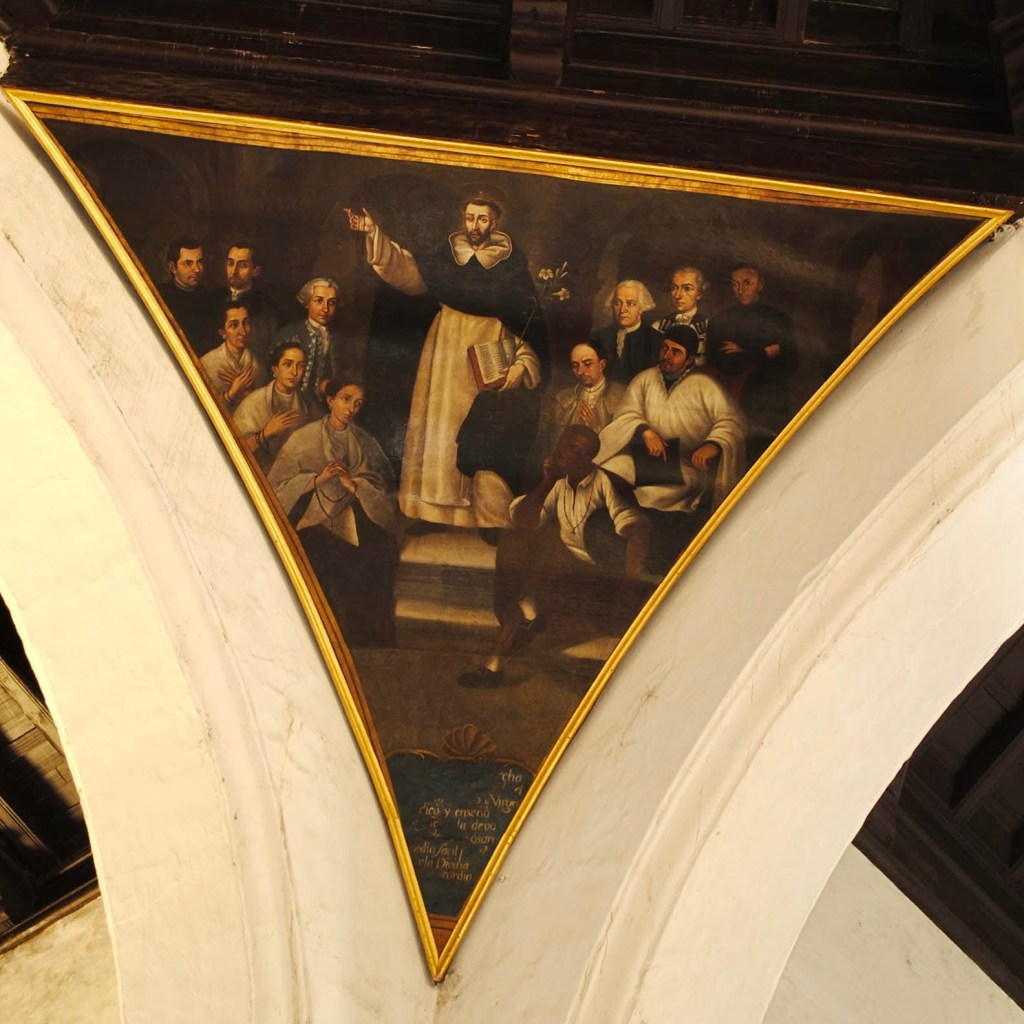
In the Church Santa María del Rosario of Havana there is a pendentive cycle completed in the 1770s painted by the baroque artist José Nicolás de Escalera – whom according to Guy Pérez Cisneros, was truly the first professional Cuban painter of the tradition – that includes a black slave in a pensive pose seating on a lower step, just below a Dominican priest who figures prominently in the middle of the picture holding a Bible and raising his right arm forward [1]. It has been noted that the figure of the black slave is also the first portrait of a slave in the New World, and its meaning has been highly disputed. The enigmatic slave or liberto portrait shows the man in a thinking pose, with a folded long white shirt, and what seems to be a wooden rosary hanging in plain sight. It is hard to make the details of his facial expressions, but it is obvious that his gaze is neither upwards nor directed at the viewer, but rather suspended, as if were, in a moment of attention and rest (and also listening?). The context here is fundamental, since Santa María del Rosario Church was commissioned by the Count of Bayona, a wealthy member of the sacarocracia (sugar plantation owner) after a previous church was burned to the ground by a slave revolt that took place in 1727 in an act of complete defiance to Christian indoctrination.
The event that only has come down to us in just a handful of mentions and erasures of the colonial archive is featured prominently, as we know, in Manuel Moreno Fraginals’ El Ingenio when the historian documents the spiritual schism of the eighteenth century colonial plantations of the island. According to Fraginals’ historical account, the slave insurrection in the plantation took place in the wake of a theatrical enactment proposed by the Count of Casa Bayona in an act of repentance and humility aiming to mimic a well known moment of the Christian story: one day the Count washed the feet of twelve slaves, and when he finished he made them sat with him for dinner. Later that afternoon the slaves revolted and burnt down the whole sugar mill, including the chapel, to the ground. The episode ended with a plantation mayoral officer hunting down the runaway slaves, who was ordered to place the heads of the dead slaves high in spikes for the Count and everyone to see them [2]. It is an early staging of visibility and bodily dominion that the modern epoch will take to its final conclusion.
The portrayal of human suffering was a symptom of the impossible hegemony of christianization of body and soul that the missionary Nicolás Duque de Estrada decades later will try to deploy in his pedagogical treatise Explicación de la doctirna cristiana acomoada a la capacidad de los negros bozales (1823), which argued that obedience of slaves could be achieved by implating “guilt” and work ethic in the affective interiority, in the forum internum of their souls. But even Estrada was of the fact that after sixteen hour workdays the Christian ascesis was imperceptible and little more than convoluted chatter to the ears of the slave. It is almost as if the slave, separated from the politico-theological inscription of salvation, was already outside the subjective domination of productive bondage and political freedom.
When Escalera was commissioned to do the cycle of frescos at Santa María del Rosario he was asked to combine a twofold narrative: the history of Christian salvation and the story of the Casa Bayona. At the center of the altar piece is the world as a common house or oikos, that carries history and its bodily sovereignty forward. One possible reading of the pensive slave shown in Santa María del Rosario’s pendentive is to assume that this figure is completely outside the eschatological vision embodying a sense of freedom that only painting could have documented in its unique and mute language. This raises the question about the relation between painting and freedom in which the figural emerges unmistakably fixed beyond historical narration. Although writing about Cézanne’s late work, Kurt Badt once suggested that there is no such a thing as the representation of freedom, but rather “painting generates a concept of freedom as two-faced: negatively, it is liberation from isolation and resistance, positively to the serious gentleness of freedom….expression in freedom to the scene from nature, which declares the world to be existing together, a mutual self-supporting and carrying of things” [3]. The pensive slave portrayed in the pendentive does not embody freedom understood as the spiritual accumulation of rights and duties known to the order of historical transformation; rather is an absolute pictorial appearance of freedom because it embodies, in its non-separation of life and thought, a static moment of a being that contemplates the liberty of his potency.
What is striking about the collective portrait where Escalera inserted the former slave is what we can call, following Bernard Berenson, a dimension of the ineloquent that appears just as “mute, with no urgent communication to make, and no thought of rousing us with look and gesture. If they express anything it is the character, essence rather than momentary feeling or purpose. They manifest potentiality rather than activity. It is enough that they exist in themselves” [4]. In the pensive gesture of his pose, the slave is the untouched existence and the revolt that rips the escathological narrative that ordains the interiors of Santa María del Rosario. Malraux once noted that the age of the divine disdained the realistic portrait of an ordinary person, because he was too distant and mundane from the stone conclave of the gaze of the gods. The slave’s inexpressive ‘naturalness’ refrains from partaking into a mood compensated by the semantic compulsion of the colonial painter, because his naturalness discloses the indestructible soul that has transfigured the realm of the divine.
The unfathomable mystery of the pensive slave or liberto is the obscure and yet luminous portrait of a life in thought that is, at the same time, the thought of a life that is forever inexpressive, and as such the highest state of imperturbable freedom in the aftermath of worldly destruction. The ‘gentleness of freedom’ that Badt locates at the heart of painting is the imperative of the stream that carries, and yet restrains, thought and appearance into the figure of life. The freedom that anchors painting – because such freedom is never realized in painting except as vulgarity – becomes a tacit secret for which ultimately there is no image.
.
.
Notes
1.Guy Pérez Cisneros. Características de la evolución de la pintura en Cuba (Ministerio de Educación, 1959).
2. Manuel Moreno Fraginals. El Ingenio (Crítica, 2001), 99.
3. Kurt Badt. The Art of Cézanne (Faber & Faber, 1965), 314.
4. Bernard Berenson. Piero Della Francesca: The Ineloquent in Art (Chapman & Hall 1954), 7.
The central question that “The Aleph” raises is as banal as difficult to answer: who is Beatriz Viterbo? For one, she is dead. Borges’ Leibnizian experiment with the infinite point of the universe is that even assuming that we account for all the possible predicates of this person we still cannot exhaust who lurks behind “Beatriz Viterbo”. In a way, Beatriz remains encrypted in a house soon to be demolished, remaining unattainable and mysterious in the passing of the world. As we know, there have been critics that have taken up the detective task to understand the significance of the name Beatriz Viterbo by probing the story’s dedication to Estela Canto, who later became the rightful owner of the original manuscript, and that connects to Dante’s Divine Comedy in terms of its cantiche structure as well as the figure of Beatrice [1]. However, as Giorgio Agamben once said regarding the Italian poet, it is utterly senseless to attempt to identify a subject behind Beatrice, since what is at stake in Dante’s poetics, perhaps of all poetics, is the experiment of language as an experience of love [2]. What the name Beatriz Viterbo enacts is no different.
Indeed, in Borges’ Beatriz Viterbo this experience of love is one that fundamentally lacks images and predicates of this world; which means that love, if to be held as an intensity of the living, in the name harbors the region between life and death, between memory and forgetting. These distinctions are not oppositional, but rather an angular index that defines erotic intensity; and, as we know, the name is the supreme vehicle of the impropriety of oneself because it precedes it. As Borges writes in “The theologians” also included in The Aleph: “There are some that look for love in a woman in order to forget her; in order to cease thinking about her” [3]. The fundamental formlessness of love does not depend on neither images nor acts, but on the enduring vocative or song (canto) that shines forth in the open secret of the name.
This is why the portrait of the deceased is insufficient for the narrator of the story. In a moment that is the clearest parallelism to the concatenation of “things seen” in the aleph, the name appears four times in repetition: “Beaitriz, Beatriz Elena Viterbo, Beatriz querida, Beatriz perdida para siempre…” [4]. If Osip Mandelstam once remarked that the “eye is an instrument of thought”, one could say that the the voice of the name is the instance where language and thought coincide without remainder; a convergence of Heaven and Earth, of the dead and the living in the grain of the voice. There are no static images of Viterbo because her mysterious life, the unlived life with the narrator, is precisely the missing image guarded by the name. In the basement, facing upwards to peek into the aleph, we are told that he, Borges, will be able to “establish a dialogue with all the images of Beatriz” (“podrás entablar un diálogo con todas la imágenes de Beatriz”). But what the aleph cannot yield is the missing image that is only the event of his irreducible linguistic contact proper to his memory. Once again Maldelstam: “The word, the name, is a psyche…does not signify an object, but freely chooses, as though for a dwelling place, some beloved body. And around the thing the word hovers freely, like a soul around a body that has been abandoned but not forgotten” [5]. But what is not forgotten is not that quality or that image of a person, but the enduring rustling of a name that recalls the oldest human experience: the mystery of the voice.
It might also be for this reason that Beatriz Viterbo recalls not just Dante’s divine and eternal Muse, but the world of the dead; the vetus in ‘Viterbo’, that is, the oldest or ‘most ancient’ life that dwells in the underworld, because its direct provenance is the archaic Etruscan civilization [6]. If Beatrice, as the trope of transcendence beyond the Earth has been a repeated object of literary interpretation, Viterbo as the vetus burial has rarely generated any interest (if the house of Viterbo is being demolished, this also means that in her proper name is the burial site at the end of remembrance).
In the cadence of the name “Beatriz Viterbo” we can hear the transit between the living and the dead, the invisible and the present, the possible predications as well as the defaced; a work of oblivion in virtue of its own caducity. “Me trabajó otra vez el olvido”, writes Borges towards the end evoking the erosion of forgetting in the void of nonpresence: the working of eros pushes to the end, towards absolute oblivion through the very accruing of remembrance. Life is this immemorial that is encrypted, as if were, in a handful of names.
.
.
Notes
1. Emir Rodríguez Monegal. Jorge Luis Borges : A Literary Biography (Paragon House, 1988), 414.
2. Giorgio Agamben. “No amanece el cantor”, in En torno a la obra de José Ángel Valente (Alianza Editorial, 1996), 49.
3. Jorge Luis Borges. “Los teólogos”, in El Aleph (Alianza Editorial, 1999), 50.
4. Jorge Luis Borges. “El Aleph”, in El Aleph (Alianza Editorial, 1999), 189.
5. Osip Mandelstam. “The Word and Culture” (1921), Arion: A Journal of Humanities and the Classics, Vol. 2, No. 4, 1975, 531.
6. Adolfo Zavaroni. Etymological Dictionary of Etruscan Words (2024), 310.
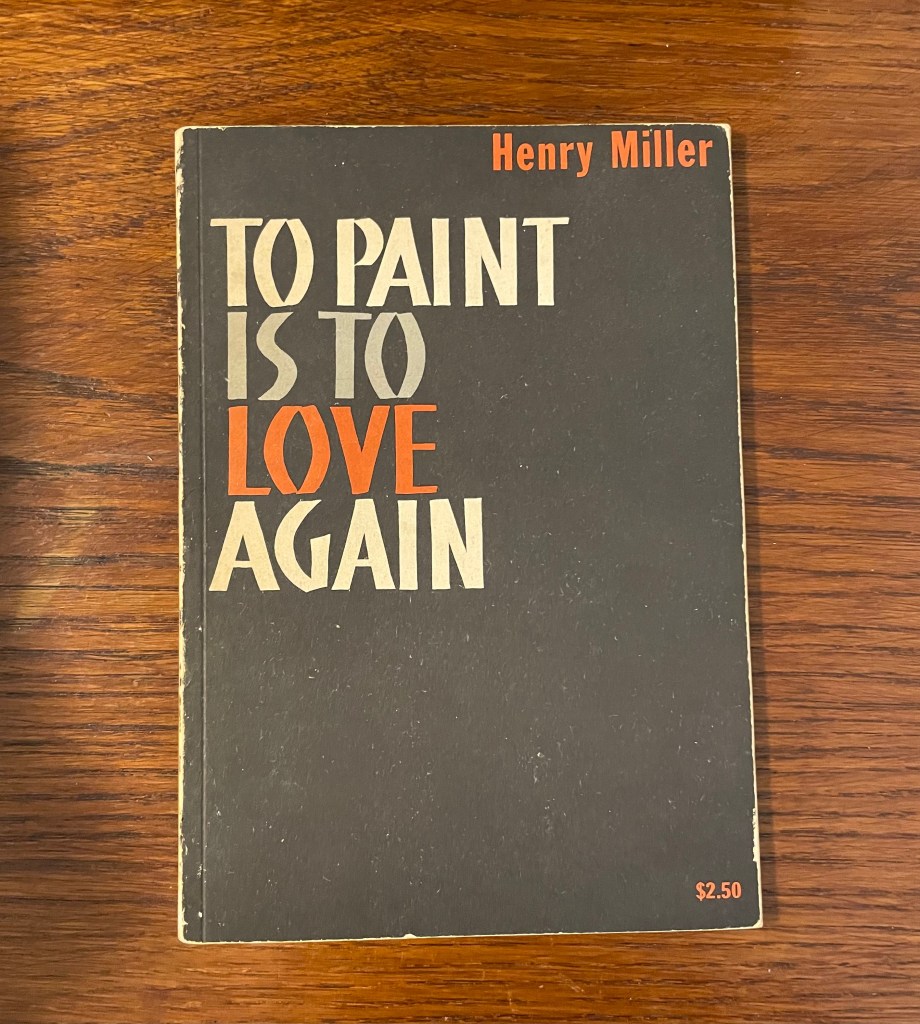
There might very well be an internal affinity between painting and love that at some point it becomes indistinguishable. A painterly picture can become love unquenched for that which remains persistently fixed and unrealizable. In one of the short essay books of his Big Sur period, Henry Miller asked this very question of painting. For him panting had a wondering origin that crosses the hand, undoing what we can easily enact. The erotic dimension of painting, thus, has nothing to do with the image or figure of the beloved, but rather with a specular limitation staged in the ability to allow the unseen to be incorporated in the visible scheme of the world. Only if we are able to see – and by the same token, only if there we are facing an event of painting – can something like use can be liberated from the constraints of mimetic compulsion. Miller writes in To Paint is to Love Again (1960):
“To paint is to love again. It is only when we look with eyes of love that we see as the painter sees. His is a love, moreover, which is free of possessiveness. What the painter sees he is duty bound to share. Usually he makes us see and feel what ordinarily we ignore or are immune to a certain manner of approaching the world tells us, in effect, that nothing is vile or hideous, nothing is stale, flat or unpalatable unless it is our power of vision. To see is not merely to look. One must look-see .See into and around. Or, as John Marin, once put it – “art must show what goes on in the world” [1].
The place of painting for Miller is an imperturbable state that refuses to be fixated on objects, but in the invisible region (as in the figure of the chora) that allows for the thing in the world to be used. This is why Miller considered Japanese watercolor and prints an absolute primer of the pictorial: it taught him the appearance of worlds within the world, regionalizing the surroundings never logically stated unto itself, which in modernity it became the catastrophic horizon of autonomy towards its posterior liquidation. This is why Miller, very much like Carlo Levi, understood that the crisis of painting in the Western tradition ultimately signaled a general sense of social terror as a new phase of human desperation attenuated by the circulation of social fictions.
At the height of the the closure of civilization, painting reemerged, if Kurt Badt’s axiom is correct, as the last metaphysical activity of human praxis. A metaphysical activity that holds on to the experience of belief in suspended appearance of originary anthropogenesis. For Miller, in painting as much as in love “one must be a true believer” [2]. And this assertion must be understood in the backdrop of Miller’s experiential retreat in the landscape of Big Sur: an experience away from the closure of American city life in research of a “feeling of aloness as spiritual achievement”, as a relation of oneself towards disclosure [3]. In this sense, the painter is a counter-social figure that, refusing to make stir in the world, turns to serenity, silence, and to the pressing contours of the unfathomable beyond any prefiguration. The believer in painting – who is a figure of belief in the desert, after the flight of the gods in the nocturnal vigil of history – is the thrust to the experience of things without barristers or shortcuts to what is revealed.
The age of automation in mid-century transformation of American industrial production serves as the historical backdrop of Miller’s indictment regarding the poverty and eventual disappearance of painting due to the autonomization of human praxis and the gigantic scale in spatial organization. Following Georges Duhamel’s prognosis in America: the menace (1931), he shared the intuition that the crisis of dexterity meant the impossibility of realizing painting, now situated beyond the grasp of human absorption [4]. A land without landscape that, as Adorno noted, bears no traces of the human hand. And this was seen already in the 1950s when the rise of abstract expressionism in North American announced not just the end of easel painting, but the funeral of the whole pictorial tradition. The barbarism of gigantic and unlimited Americanism would run counter to painting as a sensorial activity that embraced the vital limitations of its region.
Miller’s insistence on painting was an eulogy to a life as experience – painting is indistinguishable from the hands and souls of the painters that he encountered and shared his life – and the value of poverty as absolute necessity for a life that regionalizes our contact with the world. It was through the love of painting that humanity could only restore its divine presence without rest.
.
.
Notes
1. Henry Miller. To Paint is to Love Again (Cambria Books, 1960), 17.
2. Ibid., 39
3. Henry Miller. Big Sur and the Oranges of Hieronymus Bosch (New Directions, 1957), 34.
4. Georges Duhamel. America: the menace (Houghton Mifflin, 1931), 85.
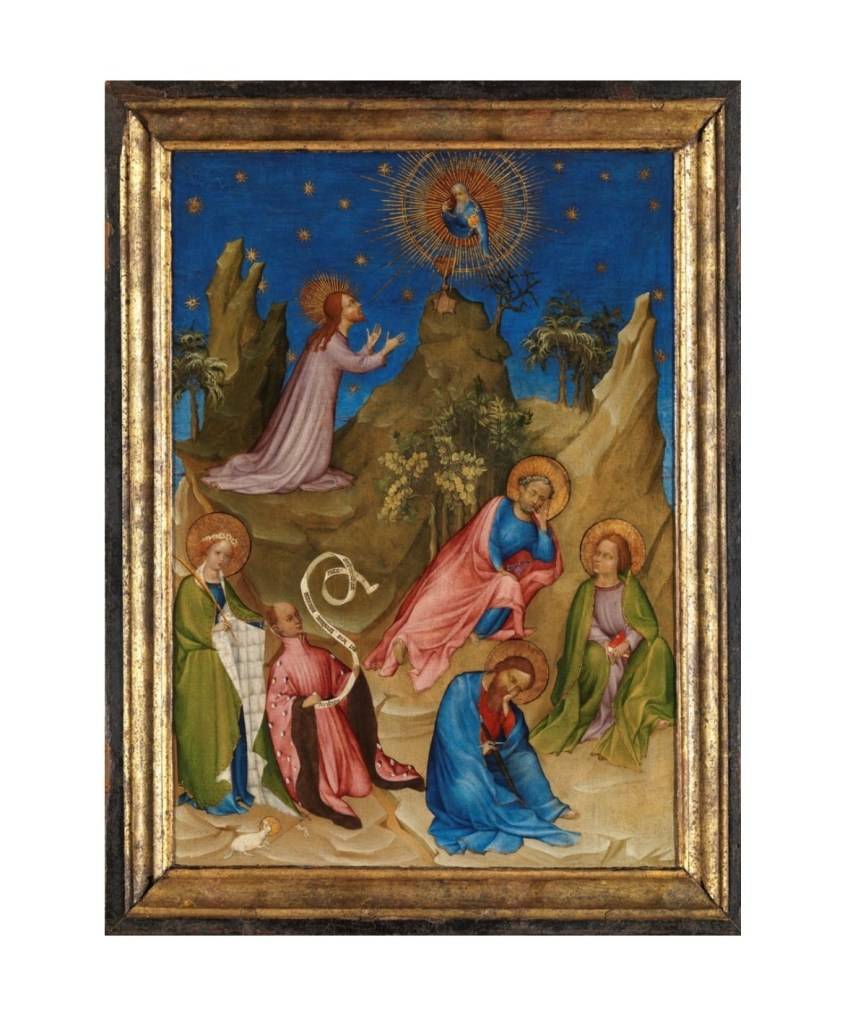
There is a panel in the Museo del Prado titled “Agony in the Garden”, attributed to the French painter Colart de Laon (1377) whose religious work barely survives (this panel is, in fact, one piece from an original triptych). The scene portrays the well known stay of Jesus in the Garden of Gethsamane on the Mount of Olives, where solitude and abandonment prepares the interval for the moment of transfiguration. If anything, Gethsamane is an experience of inwardness outside itself, which the painter has marvelously captured in the figure of Jesus raising his hands in supplication to the starry skies and god. Or so we think. The crisp blue tone of the sky immediately reminds the view of the vault of the Villa Farnesina that Fritz Saxl has interpreted as the transmission of a previous pagan astrological faith in the pictorial composition. The intense blue tone coupled with the emphatic stars arrest our imagination, but also that of the humane and worldly Christ.
What kind of experience is to look up into the firmament from man’s place on Earth and the cosmos? And what are we to make of the inability of the civilized human being to look into the blue depth not as a mirror of Nature, but of the non-totalizable and irreducible experience of solitude? It must be said that in a post-mythical world, the increasing loss of the opening of the sky goes hand in hand with the boundless loss of the Earth. And this is why we are tempted to read Colart de Laon’s picture as a gesture that renders legible the passage of the same movement: the Jesus that raises his hands outwards to the sky; and, simultaneously, the dozing Jesus that inhabits the contemplative state at the center bottom of the picture. To live in the world is defined neither by the experience of the time of arrival of the sky nor by the inward experience of the soul, but by the ability of transiting from one state to the other. And only there the worldly divine can be disclosed beyond the sclerosis of form.
This might also explain why Søren Kierkegaard following the German hymnist Gerhard Tersteegen could write in a gloss of his diaries that Jesus arises from the love feat into the path of Gethsemane: “It is always this way: Gethsemane lies closest to the highest bliss” [1]. The highest place is not the moment of absolute transcendence through faith; it is the secret that for Tersteegen expresses a kenotic hymn that empties life in the direction of poverty and death. In other words, the “highest bliss” is the experience of expropriation of every life; making life and death become indistinguishable in the vacillating night. A night beyond time and without god.
Perhaps not just the “religious experience”, but allexperience has as its central paradigm, the highest bliss in the face of death in which language can only account for it in its muteness and reverence. This is not an experience of vital teleology of humanity, but of a furtive relation. “Hacía sobre ella la experiencia”, as a Chilean writer once put it in the imperfect tense. But this can only mean to do an experience on the dissolution of oneself.
.
Notes
1. Søren Kierkegaard. Journals and Notebooks V.7 (Princeton University Press, 2014), 368.