Social hostilities. On Julia Yost’s Jane Austen Darkness (2024). by Gerardo Muñoz

There is always something ominous and shady that harbors the apparently simple narrative worlds of Jane Austen’s novels. It has been too long since I have read them thoroughly, so I have to take Julia Yost’s word for it, especially when it comes to her extensive citations and character judgments in her most recent book essay Jane Austen’s Darkness (Wiseblood 2024) solely dedicated to the British novelist. But Yost’ initial intuition – the vortex of her argumentative edifice – is to make Austen more than a critic of the modern social sphere. Departing from D.W. Harding’s “Regulated Hatred” (1940), for whom the the civility of the Social (its overcodification and transmutation of norms and values) means the regulation of averted passions, Austen’s darkness reveals that that moral order is already an artificial and fallen production of lesser evils. In the nascent historical epoch of the birth of the Social, the rhetorical order of the polis will translate the alleged ‘elemental topics’ of community life into the orderly scene of ongoing civilizational depredation, in which accumulation is just one of its avatars. Towards the end of her book, Yost cites Austen’s unfinished novel Sanditon as the height point of the end of the world of manners and sentiments into an “economy” that fulfills the “demand for everything” (Yost 65). 

This is the moment in which the world will become the object solely justified by the movement of civilization itself. “Civilization, civilization, indeed”, says Mr. Parker in Sanditon. What is never clear in Austen’s work – and this is precisely the problem of the darkening hue that Yost wants to claim in her essay – is whether there civility of manners and sentiments proved insufficient for the civilizational force towards objectivation; or, rather, whether manners (and its Burkean ideal of the little platoon as corollary to modern liberal normative pressure) will become an indirect force within the new fabric of civil and state mediations. At any rate, this dialectical valance is an index of the dissonances of Austen’s social world, which allows us to see, in dialogic slow motion, the reduction of the taking place of the world into the transactional exchange of forms. 

According to Yost there is a cure in Austen’s medical toolbox for the enduring the social disappearance of morality and conviction to elucidate the question of personal “spiritual fate”: marriage. Yost is emphatic: “Marriage is the heroine’s only defense against darkness and with one sparking exception, it is an uncertain one” (Yost 2). The institution of marriage in the wake of the nascent post-confessional state will be a regulatory intramural test by the forces of reaction, and it does not take reading Louis de Bonald’s treatise on divorce form 1801 to arrive at this conclusion. But the sacramental institution is not freed from its own internal contradictions; after all, marriage will only be a regulatory social practice within the stratified and regulated autonomous sphere of modern society.

The aspiration to elevate the moral sacramental praxis of the pre-confessional state will be staged within the topological arrangement of the social space in which domesticity becomes a site of potential imprisonment that, in the words of Austen’s Mansfield Park, “will deaden the sense of what was lost” (Yost 28). As Yost claims, domestic space during Asuten’s age becomes deleterious and of potential imprisonment. Topological closure entails that the outside is only possible through the inside (think of conditions for formal labor during classical industrialization), and that the inside has become become exteriority ordered by general process of rationalization and the liberation of the ego, as Theodor Adorno explains in his short “On the Problem of the Family” (1955). In fact, the historical social trend that Adorno identified as “[the transformation of the family] as a mere association of convenience, the more it loses those features of the ‘primary’ group which until  recent developments were attributed to it as invariant” do not have to be circumscribed to the epochal crisis of the family in the zenith of Fordism; it is already in nuce in Austen’s desperate attempt to find a way to carve the depths of social domestication and biological maintenance.

For Yost, almost intuitively, marriage is a second-best (of course, she does not call it like this), because “poverty takes many forms; lack of a husband and children is one” (Yost 36). But can marriage absorbed by social totality provide an exit from the originary poverty of its anthropological decay? Even for Edmund Burke (as it was for De Bonald), domesticity is a triumph of anthropological freedom; but, only insofar as this anthropological condition accepts the decaying positioning of human existence both corporeality and linguistically. In other words, to speak of anthropological self-affirmation is already a retranslation of the oikos in an epoch in which the totalization of the “Social Man” will absolutely color the entire process of autonomization. In this sense, within the flashes of Austen’s world this color is oblique and hazily obscure. What does it mean to lose the appearance of the world once everything becomes legible, permissible, and exchangeable? Austen’s originality is to have been able to guide us in direction at a moment where everything was in the making. 

 Jane Austen’s Darkness is not only short but unpretentious; and, as part of lacking pretension theses here are rough and underdeveloped but they do carry weight. And some of them carry a lot of weight and durable resonances. This is the case towards the end where the “darkest” symptom of Austen’s scene of writing assigned to an effective degeneration of language that, according to Yost, paints Austen’s dark view of modernity: “Language genderates, as medical jargon makes a commercial purpose that folds itself healing purpose and the advertisement remedies become inexorable from the advertisement of maladies” (Yost 67). Yost here speaks almost in the register of Karl Marx writing in the pages of Rheinische Zeitung in 1842: “What is any illness except life that is hampered in its freedom? A perpetual physician would be an illness in which one would not even have the prospect of dying, but only of living. Let life die; death must not live”. The rise of the social figures of doctors and soldiers are expressive of the living body of the social fabric and its reduction into biopolitical administration. Yost plays with the idea that perhaps Austen’s last work is the revenge (this is perhaps too strong of a verb) against the expansion of the social mimicry induced by sentimental life (Yost 68). After all, the romantic subjective negation of the enlightenment shortcomings pays the price of arousing the vulgarity of competing feelings for the acceptance of social recognition.

This intuition unwrites the conceptual narrative regarding the taming of the passions and the privalining neutral space of diverging interests: the contract form of the new commerce society will tame passions while generalizing the social production of pain and circulation of hatred as sublation of the new. Thus the need to anesthetize language from its own capacity of the sayable; expiation will only take its form as either opinions or justifications. At this point, the sacralization of death and its unrestrained standardization will reasonably justify the condition for the overpowering of secular sacrificial history at that altar of abstraction (Progress, Growth, Freedom). Yost’s emphasis on Austen’s laughter as “salubrious” can be read as a comic exception from the stage of abstraction; the refusal of language to clog the imagination and the invisible into the codification of norms. In this distance, language embraces the pain of separation; and, like the laughter of the Thracian Woman, the incommunicable abandons the conceptual inertia of hostile protuberances of social life. And making way into the abyss clears up the heavy fog of darkness. At least a bit.

Thrasymachus, the paradigm of force. by Gerardo Muñoz

Few characters are more memorable in the first book of Plato’s The Republic than the sophist Thrasymachus, whose shadow is still very much looming around us given that it is obvious that today everything in our contemporary world is optimized through force. Thrasymachus’s strict identification of reserve power (potentia) with justice (ius) is in many respects prophetic, since it already subordinates the ideal of justice with practical reason and effective norms, a crowning achievement of modern political power. This is why Leo Strauss could claim in The City and Man that Thrasymachus’ position is ultimately a defense of the thesis of “legal positivism” that brings to fruition the legitimate order and the police powers of the city. In other words, Thrasymachus discovered that the requirements for the permanence of an active social order of a police entails the mediation of the two dimensions of legal authority: obedience and the internal recognition of a secondary rule that liquidates the possibility of raising the question of what is “just” (now internal to the organization of internal powers). If the aim of “justice” becomes the optimal application of effective rules and norms that provide the services of the city, then political rule becomes an infallible and uncontested logic. Politics is ultimately force, and force is the energy organized by politics in the city. 

As Strauss writes: “Thrasymachus acts like the city, he resembles the city, and this means according to a way reasonably acceptable to both…Thrasymachus is the city. It is because he is the city that he maintains the thesis of the city regarding justice and that he is angry at Socrates for his antagonism to the thesis of the city. Thrasymachus’ rhetoric was especially concerned with both arousing and appeasing the angry passions of the multitude, with both attacking a man’s character and counteracting such attacks, as well as with play-acting as an ingredient of oratory” [1]. Well before the general equivalent of contractual commercial relations, Thrasymachus’ rhetorical deployment functioned as a techne alupias against the unwarranted passions of human beings. And, contrary to the common opinion that separates the craft of sophistry from the unity of rational discourse (logos), Thrasymachus’ defense of force presupposes the autonomy of language in the rhetorical construction (very much like modern poetry centuries later) to serve as the hospice of rational pondering in the polis. To make language the exclusive battle ground: even in antiquity it was said of Thrasymachus, “you are just like your name, bold in battle”. And Plato wanted to hold on to this picture. This ultimately means – and it is still at the center of our contemporary predicament – that the coming of the “Social man” in the city is only possible on the condition of a primary transformation of the event of language and the speaking being. This is why if Thrasymachus was the “pioneer of rhetoric and elocution”, as it has been claimed, it is only because his appeal to the pragmatics of political power was mediated by the invention of the ‘mystery of the prose style’; that is, of reducing the non-grammatical mediation to the orderability of a prose adjusted as an instrument to the world [2]. The enslavement of the passions is the commencement of the social prose in which we are forced to act in our alienated roles.

Only when language becomes rhetorical communication it is possible to grasp the world as a case of an entity of legibility and knowability, where reasons (inclusive and exclusive, that is, as what can be delegated for my own interests) and political rule converge without residue. What will become obvious through the cybernetic dominion over “information”, it was first elaborated as the pressure of rhetoric where the logical force of predication took its force to disclaim myth as the unappropriated experience of worldly phenomena. The art of rhetoric does not render “truth” obsolete; it rather incorporates theoretical and systemic deductions – a flattening of logos without myth -, so that the event of truth can no longer stand as the unsurveyed horizon of the intelligibility [3]. The consolidation of force means this much: that Thrasymachus’ prose of the world is not just an exclusive political program of the “fictitious”, as much as a program for the total attainability of the world; a world that by becoming fully accessible and objective, it pays the high price of eclipsing the presence of things, and the event of truth and naming in language. A world without kallipolis that will only distribute and perpetuate ad infinitum injustice as the corollary for the triumph of immanence of force.

Notes 

1. Leo Strauss. The City and Man (University of Chicago Press, 1964), 78.

2. Bromley Smith. “Thrasymachus: a pioneer rhetorician”, Quarterly Journal of Speech, 1927.

3. Gianni Carchia. “La persuasión y la retórica de los sofistas”, in Retórica de lo sublime (Tecnos, 1994), 60.

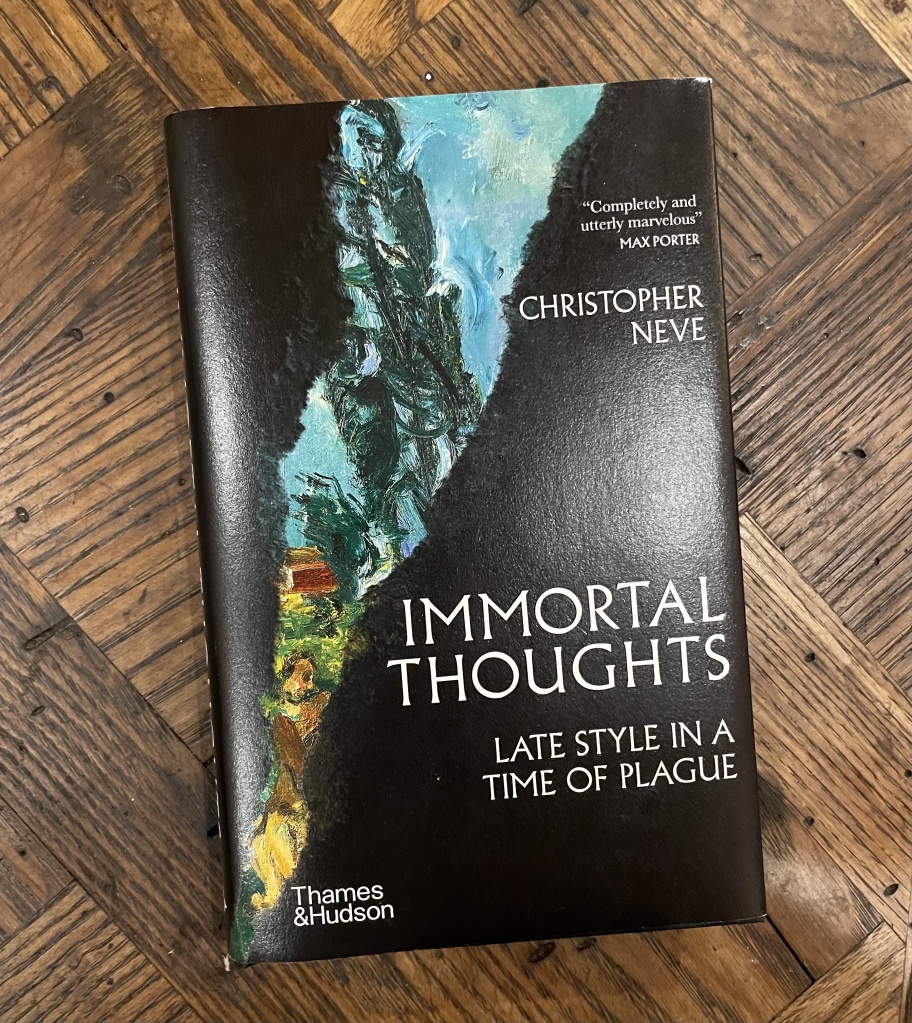
Under a single statement: on Christopher Neve’s Immortal Thoughts: Late Style (2023). by Gerardo Muñoz

In his Immortal Thoughts: Late Style in a Time of Plague (Thames & Hudson, 2023), Christopher Neve ponders whether there is something like an “experience” of late style in painting. He immediately sets up himself to the task in the last works of great modern masters, from Cézanne to Soutine. The notion of “late style” can only be raised at the definitive end of the artist’s path. The old age style is an aspotilla no longer dependent on approval and excellence; it favors inner capacity and dexterity of seeing. This is why late style is, probably, always self-transformative: it poses the notion of work under erasure as it comes near the zenith of retraction. For Adorno late style registers the failure of synthesis as well as the force of dissociation in the permanence of the catastrophic. Neve will perhaps agree this much: painting is not about fixing temporality (the density of the history, the vulgarity of the contemporary, the monumentality of the past); rather what remains is the fugitive scene of depiction. If the question of “late style” is immensely difficult to raise, that is because it resists conceptualization: it merely seeks to denote achievement and the ruinous; appearance and retreat; unlearning schematics and producing “from life” itself, to put it with Poussin’s pictorial vocabulary. Late style is not about the moment of judgement and recapitulation – it is what depiction can achieve in the twilight of creative powers. As Goethe once defined old age: “Old age is gradual retreat from appearance”. But this retreat animates the space that had remained secluded in the order of temporal abstraction.

There is no theory (and there will never be) of late style of pictorial representation. It is a question that merits the weight of description – which Neve combines, quite successfully, with that of emblematic instances of the artists’ form of life. In other words, late style does not require conceptual renditions; it demands the elaboration of strong descriptions that can grasp the resonance of a fundamental ethos. Neve glosses Delacroix’s ethical imperative: ‘only in old age does a painter finally know what sort of artist he should have been all along’. In late style there is coming to conclusion because there is a path for homecoming. This ethical dimension of the artist is neither regulated by form nor by epistemological conditions. Late style implies a stripping away of things; it bares a specific nudity: it can reveal interiority (the invariant) without argumentative absorption. If anything else, it is the non-knowledge of the gesturing hand. Neve points calls this “statement” when offering a treatment of Rembrandt’s old age: “…technique and the process of getting older, and that this was somehow done all in one, summed up and expressed undeniable and in confidence of one blow and as a single statement. And I wished that all painting could be like this” (46). We suppose Neve’s desire as hyperbolic, since painting under a single statement also implies the moment when the picture approaches the abyss between the hand and the order of reality.

Painting gravitates towards a single statement when it surpasses life by taking death seriously. There is much truth in reminding that the work of art aspires to its bare lyrical moment of decline and unworking of itself – this was also Cézanne’s moment of “not being able to realize!”- in order to flee from the objective fixation of the “thisness of nature”. Painting assembles a transfigurative force against the temporal succession of the pro-duction of a specific work on a surface. As expressed by the old Pisarro from the window of his studio quoted by Neve: “A little more work before dying” (54). True, nothing else but painting mattered to Pisarro, as Neve reminds us. Now, does this mean that he is holding on to the unchanged and muted essence of things as a “metaphysical solace” in the face of the whirling of a world in chaos? Perhaps there is something to this suspicion that must be reckoned with – painting comes close to theological presuppositions insofar as creation unsettles a disenchanted world and its fictitious mimesis. Alas, this is a question not fully posed by Neve, but it is also one of the ways in which his book could travel without much effort. The question of immortality of a picture has a point of departure here. But is immortality conceivable as a form of solace and fallen piety? One should refuse to ask this question in the form of generality. The works Titian, Goya, Cézanne, the dreary and posthumous glory of Velázquez or the suffering Soutine during the Nazi occupation are all efforts to pose the problem of late style painting as the ethical attunement of each artist.

In the most elevated and charged moment of Neve’s efforts to grapple with the notion of style he recurs to Soutine (and it requires us to turn to the picture “Children playing at Champigny” from 1942): “What you are seeing, when Soutine paints the Auxerre trees, is what I think happens in the work of most of the artists I haven written about here. This storm of temperament is true painting, an inexplicable combination of seeing, feeling, memory, response, imagination, and profound oddness. And so he turns away in exhaustion” (122). Late style registers the collapse of a possible fulfillment with the world by indexing a detour to the point where realization seeks to “return to simplicity and order”. Truth indicates the literal thereness on the surface devoid of illusions. So, solace does not have the last word; this is not how a painting subsists under a single statement. And that accounts for the ultimate risk: the ethical presupposition of painting exposes the artist to the “terrible freedom” as the distance between the passions (temperament) and the gesture within profound disorder and arbitrariness of nature.


Someone like Carlo Levi will find himself at home: true freedom cannot begin by the suppression of the passions in the name of interests; rather, the burden of freedom is the caesura of passions that displaces the otherwise inexorable fear of civilizational progress. Painting as the event of truth dethrones fear as the primary attunement in reality. Through our emperament one finds the exit from alienation, gathering the moment of depiction into order. There is a gentleness of freedom in the mutual self-supporting carrying of things, as Kurt Badt saw in Cézanne’s old style. And this might be the tragic element of painting and its fundamental antinomy.

For Neve this means nothing shorter than “the world reduced to a series of prodigious impulses, the revelation of the inner intact, the change taken to see the universe in a new light at the risk of failing utterly” (130). Late style is what reveals inner intact to the fruition of exteriority – this is the compass of visibility. A failed world followed by decline – two terms where mythic transfiguration moves painting to the eccentric luminosity of altering the jarring relation with the world. Old style enacts a catastrophe that refuses the insolvency of pulsation that binds character to the harmony of form. One might add that it could very well be that painting is, as revealed in the abyssal caesura of a late style, a stated mystery: a passionate life that profoundly perturbs the world, a transcendence that falls into an irrevocable eternity.

Second thoughts on Giorgio Agamben and civil war. by Gerardo Muñoz

In a recent entry in his Quodlibet roster entitled “Sul diritto di resistenza“, Giorgio Agamben takes up once more time the question of civil war, but this time tested against the “right to resistance” (diritto di resistenza) as included in many Western constitutions. What is interesting in this note is that the for the first time – as far as I know, although it complements superbly an old intervention a propos of the publication of Tiqqun, along with Fulvia Carnevale and Eric Hazan – Agamben lays out quite explicitly how the “planetary civil war” tips the enumerated constitutional right of resistance on its head, making it indistinguishable from the management of civil war and the blurring of the category of formal enemy and that of the terrorist.

Indeed, the very notion of “planetary civil war” in an unified society without a strong discriminatory principle of enmity turns politics, as Carl Schmitt noted in his prologue to the 1971 Italian edition of The Concept of the Political, into something like a world police [1]. And the historical present has given Schmitt his due. Following Schmitt’s sound diagnosis, Agamben says nothing different, although this is the thesis that marks the limit of Schmitt’s modern categorical delimitations as well. In other words, if the unity of friend-enemy collapses, and now there is only the stratified value of association based on moral justifications, how can one speak of the “political” in this scenario (it is no longer about war, as we commented in a previous occasion). Is there even one?

And, if the political collapses so do the total sum of actions oriented as political resistance, and even resistance to the collapse of the political. For Schmitt it is very clear that it is even the internal exhaustion of the juridical order (ius publicum europeum) insofar as positivism is concerned, leading the way to the rise of what he called a world legal revolution consistent with what Karl Loewenstein already in the 1930s had termed “militant democracy” (1937). Once the modern state loses its monopoly on the legitimacy of authority, then anyone can establish an authoritative force; while, in turn, every enmity becomes a potential absolute enmity (even more so in legality, as we clearly see in the American context). In this sense, it is a misnomer to call a state “the state” if its function becomes a full equipped instrument of the optimization of civil war that rests on a sort of dual structure: on the one hand there is civil war at the limit of the collapse of legitimacy, but also the total domination that incorporates stasis as a functioning vector of its regulatory order.

In this sense, the advent of civil war after the collapse of the state is not a return to the confessional civil wars of early modern Europe, but rather the total unification of state and society without residue. So, if “right to resistance” presupposes not just the formal limitation of enmity but also the separation of society and state, it only makes sense that this category becomes defunct once the social emerges as proper site of the total administration: “the reunification gave us a new tyrant: the social” [2]. This entails that proper civil resistance is already subsumed in the process of civil war in the threshold of the political. In the context of civil war, resistances can mean both administration of the stasis, and the embedded position of a sacrificial subject, which has been costly (and it remains so) for the any calls for contestation, striking, or insubordination. Resistance here could only amount as a shadow apocalypticism. And sacrifice insofar as it is the fuel of any philosophy of history, merely relocates the energy of hostilities as measured by the factors of optimization.

It is only implicitly that Agamben concludes by suggesting that any “true resistance” must be imagined as a form of life in retreat from the social and its sacrificial idiolatry, from which one must draw its consequences or effects. This is the grounds of an ethical life, but also the way of reimagining another possibility of freedom, which in the brilliant definition of Carlo Levi, it means to live in freedom within our passions instead of being free of passions (precisely, because no principle can determine the true object of our passions, this demands a total reworking of modern notions of liberal and republican determinations of liberty) [3]. The time of the civil war, then, is best understood as a time of the affirmation of the conatus essendi, which rediscovers freedom through the sense of the event insofar as we are capable of attuning to the separability from any principle of socialization.

.

Notes

1.  Carl Schmitt. “Premessa all’edizione italiana”, Le categorie del politico (ll Mulino 1972), 34.

2. Tiqqun. Introduction to Civil War (Semiotext, 2010), 61.

2. Carlo Levi. Paura della libertà (Neri Pozza, 2018), 45.