The ascent of the Shadow Docket. by Gerardo Muñoz

In recent years there has been a steady but increasing practice in the American legal system that has passed unnoticed outside the corridors of law professors and practitioners of litigation, including the federal state that has summoned to its practical use: the emergency relief, or ‘shadow docket’ that puts the burden on the Supreme Court to decide on concrete questions without a formal hearing, fact finding, or without proper argumentative opinions of visible authorship (the judge who pens the opinion tends to deface his authorship). Since the outbreak of the Covid-19 pandemic, the Supreme Court of the United States has increasingly expanded its so-called ‘shadow-docket’ in parallel with the merits docket to such an extent that, as some legal theorists have noted, the blurring of the borders between the first and the second have become so tenuous and intertwined that it would seem that the merits docket depends on the prior selection mustered in the shadow docket. As constitutional scholar Stephen Vladeck has registered in his The Shadow Docket (2023), a practice that historically was strictly tied to emergency relief for capital punishment executions, it has now become a normal vehicle to decide on the emergency contingencies, while at the same time exercise discretionary judgement regarding the merits, or actual dispute, of case pending future review that might never be considered at all [1]. 

It must be said that the selective practice of cases by the court through the notion of “certiorari” on merits cases was in itself a decision on the exclusivity of relief based on the criteria of major legal questions of interest to the court. But precisely the differentiation between certiorari and the shadow dockets grants sharp focus on their differences. On the one hand, the shadow docket fails to decide on “legal questions” – in fact, it avoids tailoring the boundaries between the other branches of government and itself, as some have noted – and, by the same token, its non-decision produces a precedent lacuna that further entrenches the ascension of the shadow docket, inviting an evermore practice of emergency relief to increase chances of ‘cert’. Contrary to expert opinion, this is a juridical situation that does not create the conditions for the normalization of the “state of exception”, since there is really no authoritative decision to stabilize a concrete order, which was the purpose of Carl Schmitt’s well known formulation about sovereign arcana in political theology. In a certain sense, we have already crossed this threshold. Rather, the shadow-docket as a juridical practice in the American legal order is an institutional symptom in which decision has been evacuated or rendered inoperative, so that emergent social needs enforce any specific arrangements and political vectors through an enacted order. 

Furthermore, the shadow-docket as a regularized legal practice at the highest court confirms the historical shift within American legal system from the empire of the courts to administrative departmentalized commands, which ultimately means that the formal tendency towards “delegation” should not be solely circumscribed in allocated powers of the different branches’ oversight and control, but rather is a product of a holistic tendency towards the emergence of a new form of social indeterminacy in which authority resides in the shadows. As Supreme Court Jackson writes in the “Per Curiam” dissent in Trump v. JGG  (April 7, 2025): “With more and more of our most significant rulings taking place in the shadows of our emergency docket, today’s Court leaves less and less of a trace. But make no mistake: we are just as wrong now has we have been in the past, with similar devastating consequences”. It is an astonishing statement from the Judge not only because of what it states, but also what it silences; mainly, that by leaving no trace at all of their argumentative reasons there is no precedent, and for that matter no process and thus no case. And what is a rule of law devoid of a case and precedent? The historical schism with respect to the tradition of Common Law that gives birth to its formal constrains should be utterly obvious. Ultimately, this evidences the uttermost decline of the legal positivist horizon of the modern law rooted in legitimate authority (authoritas, non veritas, facit legem), in which arbitrary decisionism, legal motorization, and appeals to external values align themselves in order to render absolute determinacy between social life and legal execution without any preclusion in the form of a social trial without end. In this sense, it would be foolish to assume that the crisis of authority with the dissolution of auctoritas in the social spheres compartmentalized in functions of the “political community”; on the contrary, in the shadow docket scenario, authority “becomes more and more abstract, more and more inhuman and inexorable; more and more demanding” [2]. The orientation of executive commands is met with proportional digression of adjudicated moral pondering, and each time the force of legalization is vigorously expanded.

The decline of the juridical decision, one would be tempted to say, paves the way for the infinite demands at the expense of the arbitrary values formation of social gigantism. In the opinion about college admissions and racial discrimination of the 2023 merits docket cycle (Students for Fair Admissions v. Harvard College), Justice Roberts wrote that “What cannot be done directly cannot be done indirectly. The constitution deals with substance, not shadows”. An ironic statement, indeed, given the preeminence of the shadow-docket in the adjudicative practice of the Supreme Court itself. While the administration of justice becomes a practice in the shadows, one cannot but be reminded of Plato’s protofigure of the Guardian of Constitution, the Nocturnal Council, as elaborated in the last pages of The Laws. And for Plato “if a state lacks such constituent [a Nocturnal Council], no one will be surprise to see it staggering from one irrational and senseless expedient to another in its affairs…that body must posses virtue in all of its completeness which amens that it will not take erratic aim at one target after another but keep its eye on single target and shoot all its arrow at that” [3]. On the tail opposite end of the platonic Nocturnal Council, the United States’ highest court’s gliding abdication seems to erratically aim at repeated targets that emerge blasting flickering lights from within the ever present shadow docket – indeed, a momentary luminosity, full of ‘technical terms’ and deferrals, that aim to showcase that the rule of law still endures in the House of Justice.

Notes

1. Stephen Vladeck. The Shadow Docket: How the Supreme Court uses stealth rulings to amass power and undermine the republic (Basic Books, 2023), 19.

2. Theodor W. Adorno. “On the Problem of the Family” (1955), Endnotes, 2022: https://endnotes.org.uk/posts/theodor-adorno-on-the-problem-of-the-family-1955 

3. Plato. The Laws (Penguin Books, 1975), 520.
Justification and the demonic State. by Gerardo Muñoz

In the broadest sense of the term, questions about the law are predominantly about its justifications, and more specifically about where to locate the act of justifying. That one of the most important elaborations of exclusive positive authority was dependent on a theory of justification to transfer norms of authority (a theory labeled the “normal justification theory”) goes to show that the traditional opposition between positive law as pertaining to the sphere of rights and guarantees and natural law to that of justification comes short in the understanding of the internal development of judicial reasoning in the second half of the twentieth century that unsurprisingly coincides with the crisis of the secular liberal state [1]. The reliance on a “justification theory” will imply not only a new conception of legitimation, but also the outsourcing of the self-referential determination of “Nature” through which Roman Law constructed its principle of the rule of law and the validity of adjudication. As we know, Roman Law did not speak of “justification” but rather of necessity emanating from Nature, which could not oblige to performance or act through by what by nature is impossible or wrong [Ius plurimis modis dicitur: uno modo, cum id quod semper aequum et bonum est ius dicitur, ut est lus naturale]. The natural source of law, as famously defined by Ulpian in the Digest, is in this way permanently tilting between the good and the equitable (ius est ars boni et aequi). This is a matter of first principles of the law (ius), which did not solicit “argumentation” or second order reasoning to uphold its internal legal validity. 

The passage from natural necessity in the “hands of the priest”, in Ulpian’s conception, to the modern autonomy of justification takes place when principles are no longer the exclusive framework parameters for operative claims, but the very activity that defines the elasticity of an actual norm and its argumentation within a concrete positive order. This is one way in which one should define the specificity of the American practical legal order (not just its legal philosophies, which tends to run counter to this, cloaked under the vestigates of positivism vis-à-vis the letter and spirit of the Constitution) through juridical administration, whose structural polarity of command and justification defines the administrative process. Early in the twentieth century, Guglielmo Ferrero noted that one of defining characteristics of the American political model rested on a magistrate judicial power that fundamentally differed from European Common Law or positivist tradition in its practice [2]. Contrasting the independence of a limited bureaucracy to the predominance of an all encompassing “juridical administration”, Ferrero noted (although lacking the legal vocabulary to articulate it positively) that the administrative nexus will infinitely expand over social practical reasoning due to the unrestricted force of justification. And the need for justification is what outsources the ancient principles of natural law (ius) to the executive authority that renders operative every sphere of social action and interaction even if they are not explicitly declared prima facie by those principles. The efficacy of justification is the linguistic deployment – a rhetorical craft through rational argumentation – that will generate specific verisimilitude to the otherwise arbitrary and uncontested enactment of its principles. Justification could be said to appear as the work of language that provides internal cohesion of an array of coordinated conditions for secondary social actions. 

Since the inception of modern secularization, the nature of justification is the realization of the works without end, which inverts the notion of “justification” in the theological sphere that we owe to Paul. For the Apostle the idea of justification or dikaiōsis implies the making of righteousness through the soteriological narrative of Christianity that subsumes humanity’s fall (sin) for a redeeming liquidation of law. This means that man’s just act in faith generates “justification” (dikaiōsis) of life for all people (Roman 5:18). And as we read from Galatians 2:6: “Know that a person is not justified by the works of the law, but by faith in Jesus Christ. So we, too, have put our faith in Christ Jesus that we may be justified by faith”. The force of justification (dikaiōsis) trumps the production of the works of law that divides human beings in the immanence of this world between the saved and the condemned, the free and the imprisoned, the friend and the enemy. Whereas justification in the theological sense can only imply the ‘end of law’ for righteousness (Roman 10:4), in its late secularized rendition it implies exactly its distorted mirror image: to justify is transformed into the binding force over the void of authority that renders effective the hollow machinery of its own self-validation. 

It is telling that in an essay that was first published in German in 1938 under the title “Justification and Justice” (“Rechtfertigung Und Recht”), the German theologian Karl Barth takes note on the transformation of the State becoming “demonic” not due to its utter demise, but as a profanation of the theological justification of “unwarrantable assumption of autonomy as by the loss of its legitimate, relative independence, as by a renunciation of its true substance, dignity, function, and purpose…a renunciation which out in Caesar worship, the myth of the state and the like” [3]. The emergence of the “demonic nature” of the State was internal of its own making , since it conflated faith and people at the same level of social immanence, while preparing the actual realization of an authoritarian world without escape. Following Heinrich Schlier’s work on the figure of the State in the New Testament, Barth will suggest that this political totalization secularized the limit posited by the suum cuique of justification into an instrument of endless domination that characterized the emerging political reality. In fact, in his essay “The State according to the New Testament”, Schlier will define the phase of the demonic State as one colored by the inception of the sphragis, that is, “the sign of the state party as it were the secularized seal of baptism which levels all differences between men and only distinguishes between friend and energies of the ruling system. Those who refuse the new metaphysical slave are deprived of their economic foundations. Even economic life is directed by the spirit of the beast” [4]. 

Only in such context does the true light of the force of justification comes in full display: the sphragis can only labour to justify the vicarious social existence of the mystery of iniquity infinitely redressing itself as legal argumentation and juridical principles, administrative determinations and executive commands. And Schlier could not let the question pass: “What will Christians do in this situation? They will no longer want to have any part in this caricare of a state, they will “go out…they will simply be outlawed and persecuted” [5]. More than ever today, we are in desperate need of elaborating the elementary aspects of a political theory of demonology that defines a certain point where there is no turning back. To outlive persecution and tear the bond of justification shatters the civilizational course that has sublimated the end of time as an instrument of daemonic absorption into endless legal statues.

Notes 

1. Joseph Raz defines “normal justification thesis” of legal authority in this way: “I shall call it the normal justification thesis. It claims that the normal and primary way to establish that a person should be acknowledged to have authority over another person involves showing that the alleged subject is likely better to comply with reasons which apply to him (other than the alleged authoritative directives) if he accepts the directives of the alleged authority as authoritatively binding and tries to follow them, rather than by trying to follow the reasons which apply to him directly”, in “Authority and Justification”, Authority (NYU Press, 1990), 129.

2. Guglielmo Ferrero. “American characteristics” (1910), The Atlantic. 226. 

3. Karl Barth. Community, State, and Church (Peter Smith, 1968), 118.

4. Heinrich Schlier. “The State  according to the New Testament”, in The relevance of the New Testament (Herder and Herder, 1968), 236.

5. Ibid., 237.

Due Process and justification. by Gerardo Muñoz

Even if it is appalling to witness the brute amount of executive force in the current American political system, it is nonetheless “business as usual” if understood within the internal development of its own legal order. In other words, what is emerging is not a drastic rupture or abdication due to external pressure against “legal liberalism”, broadly understood as a package of normative rights to solve social conflicts in a political community, but rather the consequential effect of the decline of the legitimating force of positive law, the modern legislative state, and the principles such as the right to due process – which includes but it is not limited to a public hearing, a defense, the right to a defense, cross-examination of witnesses, or an impartial jury. The slow erosion of constitutional due process has not only resulted in an unprecedented upsurge of civil cases resulting in “guilty pleas” devoid of legal process (about 95% of cases according to Supreme Court Judge Neil Gorsuch), but also in the collapse of remedies from government even if a federal court decides against the state. As Aziz Huq shows in The Collapse of Constitutional Remedies (2021), the demise of legal remedies means that the federal courts at large can only “interpret the constitution” but remains silent and inoperative in terms of the practical solutions to amend injuries, seizures, or plain violence enacted.

Any attentive student of the history of law does not second guess that many centuries before the ratification of the Constitution of 1789, the principles of modern criminal procedure, such as due process, fair trial and reasonable doubt, were already sedimented to such an extent that the Medieval canonist Guillaume Durand in Speculum iudiciale (1291) claimed that the right to defend himself should not be denied even to the devil if he were summoned to the court. In this sense, the so-called “Due Process Clause” of the Fifth Amendment of the U.S. Constitution that claims that “No person shall be deprived of life, liberty, or property, without due process of law” is a latecomer to the internal development of Common Law’s theological secularization. And it should not go unnoticed that the clause explicits states “person”, instead of the narrow privilege to the “citizen” or the “legal resident”, which is why during the Founding Era even foreign pirates accused of illegal activities were still subjects of the Due Process clause under the international and domestic legal order. As crude as it may sound, in the current moment one could very well say that the “concept of piracy” had more footing in a juridical concrete order than in the current legal stasis operative in a post-positive scenario. 

Even those constitutional scholars that in the wake of the “War on Terror” defended the Sedition Act of 1798 in order to defend a “process reduction” during an instance of political emergency, also warned of governmental overreach could very well upset political opposition and public support or loyalty (Vermuele & Posner, 2007, 235). Today we are in muddier waters (although fully “rational”) in which the punitive juridical order increasingly acts without a “process”, and the Federal Courts are incapable of offering clear cut remedies. This begs the question: what comes after the classical paradigm of due process inherited from the historical dispensation of Common Law? In other words, if the rule of law can now fully prescind, under ordinary times (there is no “emergency declaration”), of the right to due process and to the guarantee of remedies, what is the source of its legal authority? 

This is an ambitious question that we cannot even attempt to answer here, but there is at least one possible working hypothesis: mainly, that post-positive rule of law adjudicates from the production of its own justification. It goes without saying that legal justification has always been an internal mechanism of legal authority; but only now is the force of justification taking over formal procedures, normative guarantees, and written and unenumerated rights. Justification makes its way as a rhetorical subsumption of any sphere of social reality. This is why, for the Federal Judge James Ho, “migration” can be understood as hostile forces if properly justified as an “invasion”. As a further task to be explored, one should bear in mind as a symptom that the most influential and enduring legal philosophy to have emerged within the crumbling edifice of modern legal positivism was precisely a concept of law defined by two guiding criteria: “fit and justification”. This means that law’s empire is no longer ordered through the “process” but through what becomes “justified”.

The nursery social state. On Pablo de Lora’s Los derechos en broma (2023). by Gerardo Muñoz

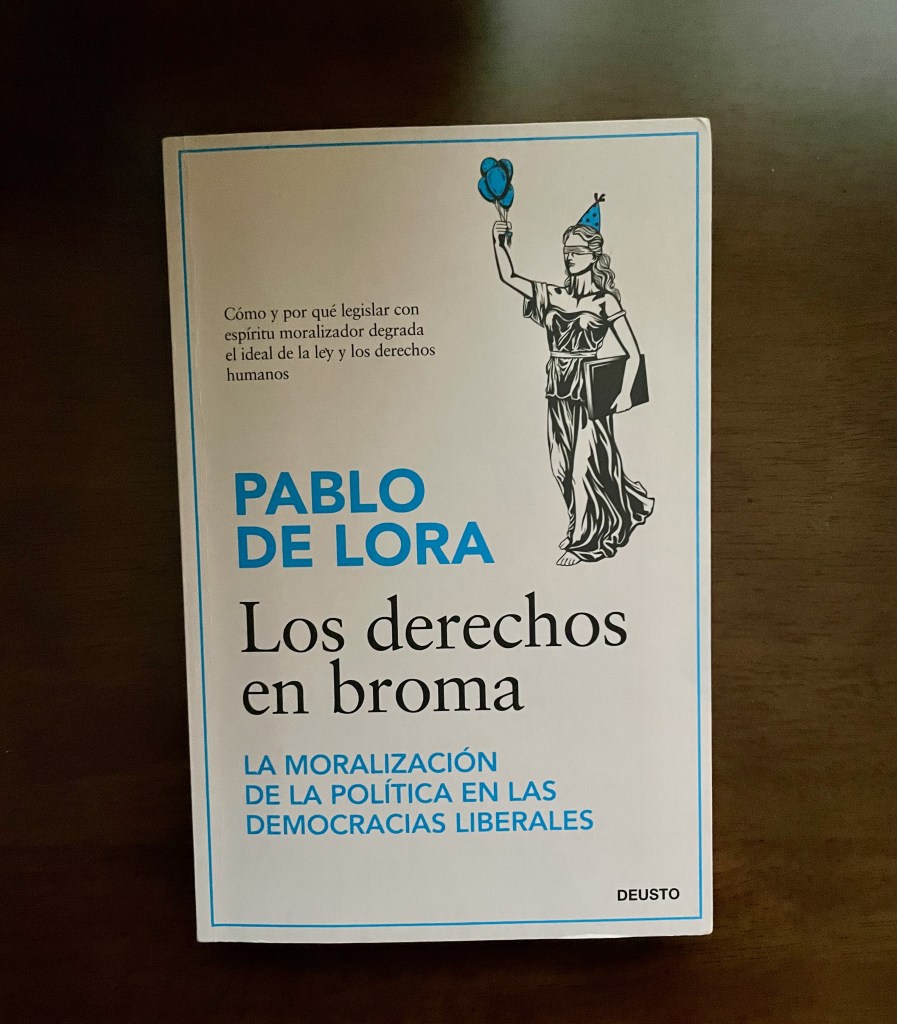
The crisis of the liberal legislative state is almost as old as the very project of the modern liberal state itself. And if we are to believe Carl Schmitt, the rise of the supreme values of the French revolution and ‘human rights’ (with its corollary of universal recognition within its normative system) also meant walking the fine line from the political theology of generative reform to the nihilism of ius revolutionis commanded by new discharges of individual will, political and technical movements, and immanent forces bringing the collapse of the separation between state and civil society. We are still living under its protracted shadow, albeit with a different intensity and intent. In his new book Los derechos en broma: la moralización de la política en las democracias liberales (Deusto, 2023), Pablo De Lora co-shares this point of departure, while daring to suggest a new sequence after the collapse of modern political form and legal order: we are currently living under a particular epochal transformation that is anti-legalist (sic) in nature – precisely because of its surplus of legal motorization – that erects a “nursery state” for the totality of the political community’s reasons and justification for action (De Lora 23). 

Although De Lora case studies shown are almost entirely derived from the Spanish and Latin American contemporary social contexts, I do think that his sharp diagnosis could be extended to the epoch itself without blurring the important nuances. This is an epoch of a reigning “emphatic constitutionalism” (Laporta) or the total Constitution (Loughlin), at the same time that it no longer takes too much effort to imagine a political community devoid of a legislative body, as one eminent constitutional scholar has said repeatedly [1]. We are already here. In other words, whether by excess or deficit, the overall purpose of moral driven legislation announces the internal transformation of modern politics as we know it, extending itself to a civilizational regression from the ideals and norms of the Enlightenment rooted in the fiction of the citizen, the binding of the social contract, and the invention of the principle of sovereign authority.

De Lora does not quite says it in this way, but I think I am not diverting too much of his cartography when extracting some of the central consequences of these internal moral substitutions that are palpable everywhere across the West: ecological legislation that increases social conductivity and expansion of natural destruction; ‘feminist’ anti-sexual aggression that leads to lowering of sentences for convicted sexual predators; the inflationary instrumental use of “Human Rights” for persons and things, but only defined narrowly by those that, under the thick haze of institutional hegemony, can deprive their political adversaries and enemies of the most basic legal guarantees of due process transforming them into non-persons. These ‘moral substitutions’ is part of the “ironic” and “futile” consequence of the sacralization of morality whose end is the management of the “social model” at all costs. According to Pablo De Lora, within the limits of confronting a social dilemma such as disability, the specificity of the “case” is turned on its head; what matters is the overall structural design of the social order and its infinite adaptive changes (De Lora 71-72).

This mutation generates all sorts of unintended consequences when the rhetoric of “social benefit” takes the lead. As De Lora writes: “No hay apoyo anticipado a la discapacidad mental sin reconocimiento de que el discapacitado mental no puede ejercer su autonomía en el futuro. Dicho de otro modo, la institución de las voluntades anticipada de la lógica desideratum de modelo “médico” de la discapacidad mental que se rehuye en beneficio del modelo social” (De Lora 85). And in spite of normative incoherence within an institutional system, the deflection to the “social model” requires ever-expanding commands, rules, principles, and hyper-amendments to guide the adverse proliferation of reasons for action within the social state (in the United States this is soften by the police powers of inter-agency statutes of the administrative state through cost&benefit balancing of discretionary principles under the supervision of the executive branch). This transformation entails the collapse of the internal mediation between the validity of norms and its foundation in social facts as in the classical construction. Thus, the expansion of value-driven legislation that also requires of specific adjudicative constitutional theories, such as legal interpretation and the theory of balancing of principles advocated by Robert Alexy, the sponsors of social neo-constitutionalism, but also the embedded dialogic ideological positions of constitutional scholars such as Roberto Gargarella (or in the United States context, the work of Mark Tushnet and the so-called anti-originalist ‘living constitutionalists’).

All things considered, the fundamental problem for De Lora is that this specific transformation enacts what he calls a “Estado parvulario” or ‘nursery state’ that he defines as: “El que denominado “Estado parvulario” da pábulo a que el poder público, en sus diversos instancias y encarnaciones, escamotee las realidades y consecuencias que conllevan algunas discapacidad per oa que lo haga de manera internamente inconsistente: tratando a los menores como adultos, pero sólo simbólicamente, y, en cambio, de manera efectiva, a todos los ciudada como menores, congénitamente desvalidos, incapaces de encarar la realidad” (De Lora 87). In the framework of the nursery state within its specific moral legislative apparatus, children become adults and the mature civil society regresses to an infantile stage. And like in a nursery setting, the democratic virtues pave the way for new dramatic effects where the function of rhetorical annunciation – so central for the any credentials of moral hegemony – forecloses the void between morality and politics in the wake of the unification that the social model requires to begin with (De Lora 89). 

This slippery slope can only lead straight to a sacralization of the political system that runs co-extensively with the infinite expansion of social rights; which, in turn, leads to an ever increasing conflict over the assumptions regarding its social facts (De Lora 151). In this narrow form, De Lora is audacious when citing Martin Loughlin’s recent indictment from his Against Constitutionalism (2022): “En la era de la Constitución total, el gobierno bajo el imperio de la ley ya no significa el gobierno sujeto a reglas formales independientemente pulgadas. Significa gobierno de acuerdo con principios abstractos de legalidad que adquieren significado sólo cuando son insuflados con valores…” (De Lora 188). And we know perhaps too well that values cannot be reasoned, but only weighted; values are commanded and taxed on the permanent devalorization of other values. This is why the rise of the value fabric of constitutionalism coincides with the ‘weighting’ proportionality of principles of law’s ideal social efficacy, to paraphrase Robert Alexy’s influential position as claim for “anti positivist legal justice” [2]. The nursery social state cannot be corrected merely from the position of the legislator; it can also be tracked as a triumph of moral jurisprudential theories of law that seek to overcome (and provide answers) to the overall crisis of institutional authority that characterized the so-called ordered liberty of the moderns. 

Is there anything to be done beyond a description? It is quite clear that Pablo De Lora’s ambition is not so much the proposition of a new political or legal philosophy as much as the sketch of the current epochal predicament in its current practice. This is already enough to welcome a robust analytical discussion of our predicament in Los derechos en broma (2023). However, there is a cobweb of affinities in De Lora’s own position towards the end of the book that, even if not fully developed, must be registered as a mode of conclusion. First, there is an affinity with John Hart Ely’s deferential conception of judicial power that aims at overseeing the procedural mechanism for the democratic deliberation and legislation over a hot-button issues. In this vein, De Lora shares Akhil Amar’s position regarding the overturning of Roe in the Dobbs’ decision; a conception that fully embodies judicial deference to diverse legislative majorities [3]. Secondly, De Lora favors a judicial minimalism associated with the doctrinal theory sponsored by James Bradley Thayer over the practice of judicial review of the Court (De Lora 233). And last, but not least, De Lora sees transformative potential in John Rawls’ assertion in his late Political Liberalism (1993) that the use of public reason is a comprehensive doctrine to deal with our fundamental disagreements and contentions over shared political values (De Lora 241).

I am not sure how deep or for how long does De Lora wants to go with Rawls; however, it is important to remember – and specially given the treatment of the ‘social model’ in the morality presented in Los derechos en broma (2023) – that insofar as social paternalism is concerned, Rawls’ late liberal political philosophy at the heart of the crisis of the secular liberal state amounts to a political conception that, as Eric Nelson has brilliantly shown, abandons the commitment of individual non-cooperation or refusal to cooperate with unjust moral legislative burdens, and thus making everyone stuck in the same ship [4]. This ship is the management and balancing of the totalization of the values being trafficked in the Social as ‘egalitarian’, although they are fully endowed as a seterological scheme of “election” (and who is elected) balanced by secondary compensations.

On a larger canvas, if the current political structure is defined as a nursery state of social rights, then this means that appealing to ideal positions of justified reasons, “diaphanous” deliberation, and well crafted citizen arguments belong to the age of maturity of the Enlightenment, but not to the stage of social infantile disorder. And demanding political qualifications to the contemporary citizen today is not only naif, but at odds with what what institutional thinking requires. In other words, the concrete transformation of the post-liberal state is one of permanent optimization of conflict, which is why John Gray has lucidly defined the (contemporary) ‘new Leviathans’ are “engineers of the soul” with broad and sweeping capacities to govern over every inch of the social space [5]. In the wake of these institutional mutations, the call endorse a “moral critique” might be taken as a post-enlightened lullaby that among the blasting and striding cries of infants of the nursery will most likely just pass unheard.

Notas 

1. Adrian Vermuele. “Imagine there is no Congress”, Washington Post, 2016: https://www.washingtonpost.com/news/in-theory/wp/2016/01/11/imagine-theres-no-congress/ 

2. Robert Alexy. “The Rationality of Balancing”, in Law’s Ideal Dimension (Oxford U Press, 2021), 122.

3. Akhil Reed Amar. “The end of Roe v. Wade”, The Wall Street Journal, 2022: https://www.wsj.com/articles/the-end-of-roe-v-wade-11652453609 

4. Eric Nelson. The Theology of Liberalism: Political Philosophy and the Justice of God (Harvard U Press, 2019), 164.

5. John Gray. The New Leviathans: Thoughts After Liberalism (Farrar, Straus, and Giroux, 2023), 5. 

Tacitus’ arcana and political wisdom. by Gerardo Muñoz

During the flourishing of Renaissance civic humanism, the tradition of Tacitism, as well as the work of Tacitus, was broadly understood as advisory to the problem of tyranny within the cycles of political power’s rise and decline, unmasking imperial rule’s debasement and cruel domination [1]. It is in Edward Gibbon’s erudite project where Tacitus’ political wisdom receives an integral treatment about the institutional dimension of power and its cohesive structure based on both facts and theoretical presuppositions. For Gibbon, the wisdom of Tacitus is not merely anchored in theoretical speculation; rather, the rhetorical construction takes its energy from the convergence between historical facts and the physics of a concrete political order. Tacitus’ wisdom is practical but also flexible, and this entails that political realism is not about the opportunist dimension of power (although this most certainly occurs in every political community), but about the deployment of analytical understanding regarding faults, fissures, and disequilibrium of institutions. Tacitus’ thought is about vision, and this means looking at the cracks, identifying the asymmetrical correspondences, and teasing out the nuances of a particular reality.

This presupposes that Tacitus’ enduring notion of the arcanum imperii, far from posing a ‘mystery of the state’ (its legitimacy, rule, and mystical reserve), allows for a strong narrative about the latent crisis internal to every political community. Tacitism is, insofar as it confronts the crisis and ruin of a political order, draws a negative reflection on the ongoing force of civil war as a historical and existential condition of domination. In other words, no politics can exist without the concrete legibility of the faults of conflict, which ultimately entails that civil war and political power are constantly in proximity. The arcana delimits the problem of civil war as the internal contradiction of every imperfect institutional design that cannot transcendent its own crisis through conceptual reordering.

At the center of Tacitus’ arcana in Rome is the death of Nero as well as the fault lines of civil war: “The was revealed that arcanum of state, the discovery that emperors might be made elsewhere than Rome” [2]. Of course, Rome as the glorious center of power was fundamental and indivisible; but for Tacitus the argument condensed in the arcana is precisely that the corruption of politics takes place when political representatives (power delegated at the provinces) and that of the center ceased being in coordination, losing the grip of institutional mediations. Thus, the ruin of politics is best expressed by the disjointment of formal procedures between authority and delegation, the vesting of the emperor and territorial monopoly, legitimate rule and predatory corruption. When this happens the arcana is transformed into a permanent revolution that dissolves checked political rule into the willful triumph of the uncontained and proliferated fragmentation (this is why Tacitus looked back with nostalgia to the unlived era of Roman republicanism).

For Gibbon to hold on to the Tacitan tradition of the arcana imperii meant, above all, to underscore the esoteric relationship between history and revolution as part of the desire to understand political energy, which he posed as a methodological concern: “In our larger experience of history the imagination is assisted by a perpetual series of causes and effects , to unite the most distant revolutions” [3]. The arcana is political wisdom of a secondary source; that is, it’s not a normatively established political premise or category, but an excess to description of political order. Hence, it is not that the arcana imperii is a monocausal and ultimate foundation of instability – and in this sense he was still faithful to his conception of plurality of causation in defense of the study of literature and the imagination – the emphasis is placed, on the contrary, in the way in which grasping the archeological and heterogeneous field of tension that will reveal, in turn, the historical specificity of the arcana [4].

In other words, the arcana grants access to the fundamental features of the epiphenomenon of civil strife without a recourse to abstraction and the closure of the concept. In this way, it could be said that the arcana (in part in the reading that Gibbon undertakes of Tacitus) is continuously operating in three distinct registers: a) it is a comprehensive analytic of the plurality of causation that impact political conflict and civil war, b) it reports to the center of authority, probing its direct and indirect meditations on the ground; its forms of delegation and adjudication, and its production of legality and dominium and implementation; c) it demands to design a description and a narrative of the political situation in order to properly respond to the paradox of tyranny and corruption within a specific polity.

Having sketched out the operational effect of the arcana, we can say that the notion is far from being reducible to a Renaissance “ragion di stato” scenario assisting in the consolidation of power in the hands of the price; the arcana seeks to elucidate the contours and limits of the intensification of war and its risks; a problem that becomes central to Hobbes notion of the state [5]. To claim that this political wisdom is something that merely emerges technically-placed in the Renaissance “great men”, and systematically blurred in modern liberalism is a thesis that will need further elaboration about the resources of the state and the underpinning of modern legitimacy through civil society and its late-modern mutation into planetary imperial spaces. In a certain sense “Tacitism” opens the possibility of sketching the political crisis of in each distinct epoch. It is perhaps in this sense that Carl Schmitt invites us to think the issue in an entry of his Glossarium:

“The beginning of Tacitus’ Histories has moved me. Is it just rhetoric, like Ortega told me?’ Isn’t it about the identity of the situation, that is, existential participation, participation in one and the same nuclear and ancestral situation of our eon? Every word of that chapter of Tacitus is absolutely current: «Magna ingenia cessere; opus adgredior optimum casibus, atrox proeliis, discors seditionibus, ipsa etiam pace saevum. Of course, “ipsa etiam pace sacvum, bella civilia et exterior plerumque permixta.” The relationship between international war and civil war, that is not rhetoric but the horrible reality recognized and expressed, the non-distinction between war and peace.” [6] 

The arcana never truly coincides with a philosophy of history or a rhetorical veneer of civil existence (social contract). The subversiveness of Tacitus plays out in thinking through the elaboration of a specific governmental organization [7]. And what is the “ancestral situation of the eon” if not the polar relationship between political order and stasis, the duality between civil war and the principle of authority, the nihilism of the will and the limits of a public rule of law, however ordered? Tacitus’ classical wisdom, invested in plotting legible facts with a singular narrative, far from raising itself to a “science of politics” or a set of “fundamental principles of order”, responds to potential fluctuations devoid of a universal grammar. In this way, politics remains closer to a physical experiment: an active self-evolving canvas in which the arcana is irremediably drawing upon the instituting and destituting of interconnected forces at play.

Notes 

1. Arnaldo Momigliano. “Tacitus and the Tacitist Tradition”, in The Classical Foundations of Modern Historiography (University of California Press, 1990), 120.

2. J. G. A. Pocock. Barbarism and Religion: The First Decline and Fall, Vol.III (Cambridge University Press, 2003), 25.

3. Ibid., 58. 

4. G.W. Bowersock. “Gibbon on Civil War and Rebellion in the Decline of the Roman Empire”, Daedalus, Summer, 1976.

5. Richard Tuck. “Hobbes and Tacitus”, in Hobbes and History (2000), eds. G. A. J. Rogers and Tom Sorell, 99–111.

6. Carl Schmitt. Glossarium: Anotaciones desde 1947 hasta 1958 (El Paseo, 2019), 7.

7. Ronald Syme. “Who was Tacitus?”, Harvard Library Bulletin XI, Spring 195, 185.

Two side notes on Anna Grzymala-Busse’s Sacred Foundations: The Religious and Medieval Roots of the European State (2023). by Gerardo Muñoz

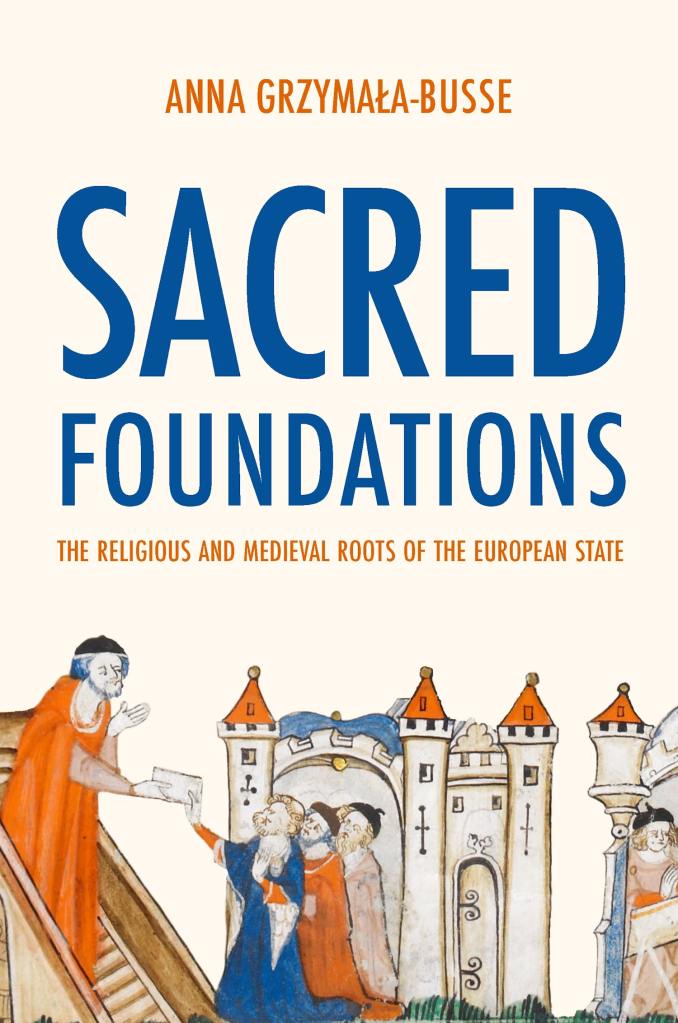
Anna Grzymala-Busse’s recent study Sacred Foundations: The Religious and Medieval Roots of the Modern State (Princeton U Press, 2023) makes a compelling historical and data analysis grounded case for the emergence of the modern state through the process of the Church’s autonomization in its ongoing disputes with the European monarchs across the centuries. This process of the secularization of ecclesiastical forms (conciliarism, legal administration, the uniformity of procedures, rules for governing institutions, the emergence of educational training and mechanisms for political representation and fiscal control, etc), however, is silent about two defining features of the modern secular state. And I do not think it is an exaggeration to say that these two elements bring forth the way in which political authority was established after the victory of modern European Enlightenment. Busse’s book, if anything, has the felicity of putting in perspective, even if only in negative, the two pieces of the puzzle: a) coercion as guarantee by a legal process (not just the monopoly of force); b) and the inter-institutional coordination that we tend to associate with a ‘principle of an internal rule of recognition’ between different spheres of bureaucratic rationality. Busse admits for (a) that “….the authority of the people over the whole Church was not statelike. It depends on moral authority and influence, not on coercive control. Both kings and popes cajoled, convinced, and threatened rather than demanded or extracted force” (Busse, 78). But ruling on morality and influence are two weak presuppositions to guarantee systemic, homogeneous and uniform process required by institutional authority.

In other words, the Church was able to construct forms of civil mediations, although it lacked the power of efficacy; that is, a coherent set of reasons for action that would define a strong concept of sovereign authority as service (to put it in Raz’s well-known formulation). The classical apothegm by which ‘kings rule rule but do not govern’ (Rex regnat sed non gubernat) now is protracted by the exercise of an efficacious rule, which means laying out a combination of forms and a well-ordered power over coercive forms. In fact, this is one feature that will define the legitimacy of the Enlightenment according to historian Franco Venturi; the discovery of punishment understood within the scheme of a trade off between the “necessity of the right to punish when man was not able to re-establish communism” [1]. Hence, the genesis of modern legitimation is not exclusively “a given” vis-a-vis the structure of separation of powers and the ultimate source of the plenitudo potestatis; rather, it requires a second-step rule, as it were, to convalidate the specificity of institutional authority with ample concrete efficacy of police powers in charge of compliance and punishment. The reach and exercise of public police powers and the systematic ordering of penal codes through a criminal procedure and its guarantees (reasonable doubt, fair trial and due process, no crime published without a previous enacted law, nullum crimen sine lege) is what renders effective and “energic” the principle of authority.

Now, broadly speaking, when it comes to (b) Busse admits that (and this is in spite of its institutional schemes) laying down justice “…the church relied on secular enforcement, for example when it came to religious orthodoxy. […] The carrying out of sentences against heretics and apostates lay in secular hands – those found guilty were handed over the temporal authorities so as to not sully the clergy. Legal coevolution and influence, the struggles between popes and monarchs, and the diffusion of both canon law and personnel into the juridical systems were critical to the rise of constitutionalism and the rule of law in Europe” (Busse, 132-133). This asymmetry between two systems of legal jurisdiction confirm the inexistence of a strong internal rule of recognition that for H.L.A. Hart defines any robust modern legal system of public law. The internal rule of recognition, one must remember, is not a set of principles or norms for social action, but rather the internal mediation between a legislative authority and its internal obedience within a concrete application thereof. The internal rule of recognition binds a central authority with its specific formal enforcement in institutional union of primary rules and secondary rules to avoid the pathology of uncertainty. This is thoroughly absent from the free-floating institutional forms of the medieval church whose principal construction of primary rules was divorced from the objective and rational procedures of its internal coherence (the rule of recognition) that would ground, in time and place, the otherwise abstract primary norm and the pressure of contested social conflict.

But going straight to the crux of the matter, it follows that medieval templates as superbly redrawn in Busse’s studies lack the two fundamental determinations that ground the modern concept of law: law as the necessarily monopoly over coercion (the Austin thesis), and the concept of law as the construction of an internal rule of recognition to unite primary and secondary rules (the Hart thesis). But insofar as all major modern political concepts and mediations are secularized forms of religious and medieval forms – something we can say that Busse’s scholarship also confirms – we can then say that modern legitimacy will consist in the congruence of these two determinations to organize the mediations between civil society and state. Already in his early The value of the state and the significance of the individual (1914), Carl Schmitt will note of this formal transplant: “…the Catholic doctrine of the Pope as the infallible interpreter of the natural moral law and of the content of revelation, who receives the competence to declare state statutes that stand in contradiction with the moral law or ius divino-naturale to be non-obligatory in conscience. The exercise of his potestas indirecta which is regarded as an act of jurisdiction, and which is held, by many canonists, to be determinative of a statute’s validity in state law – contains real vis coactiva, even where the expression potestas directiva is employed in place of potestas indirecta (Suárez, de fide cath, 3.22.1)” [2].

For Schmitt, then, the process of rationalization between ecclesiastical form and the modern legal norms of the state is very much straightforward. This is what constitutes the very texture of secular modernity. But as we know, for Schmitt the secularization of forms was not enough – it must be said that he himself did not negate in his theory of adjudication of his constitutional thought – which is why the construction parameters of his ‘political theology’ proposes supplemental safeguards to isolate law and power, extending the power of secularization into the decision of the potentia dei asoluta (at times this was contained in the theological figure of the Katechon) [3]. But as Carlo Galli has noted, Schmitt’s political theology is far from a “political christology” or a substantive theological politics grounded in natural law; rather it is a resolute affirmation to defend any concrete order from the potential fallouts of the secularized cornerstones of rational neutralization (potentia directiva and potestas coactivva) of state authority [4]. Neither mechanic state forms nor a higher source of morality (natural law) would define the modern law; rather the autonomy of the political in the existential situation could provide the sufficient energy to avoid the self-defeating circularity of ius revolutionis (this is what most of the times is obliterated from the so called question of “decisionism”)[5]. If Busse is correct in making the case that all modern institutions have sacred medieval foundations; Schmitt’s concurrence in the wake of modern secularization will be to define the energy of the political as the defining element that must stand as the threshold of formal transplantations to have a chance within nihilism and against nihilism. It is both things. In other words, formlessness is the constitutive dimension of political forms; an element that defines, in my view at least, the strongest practical element of what it is to inherit a Christian political foundation. The process of secularization is thus infinite and groundless, ultimately without a moral foundation and universal design. Among its many achievements, a book like Sacred Foundations: The Religious and Medieval Roots of the Modern State (Princeton U Press, 2023) has the ability to refine what political theology is, what it meant, and what to make of its endurance and possible iterations in our present.

Notas 

1. Franco Venturi. Utopia and Reform in the Enlightenment (Cambridge University Press, 1971), 116.

2. Carl Schmitt. The value of the state and the significance of the individual, in Carl Schmitt’s Early Legal-Theoretical Writings (Cambridge University Press, 2022), eds. Zeitlin & Vinx, 215.

3. See my “Schmitt y Hart: los puntos fijos del concepto de derecho”, 2022: https://infrapoliticalreflections.org/2022/11/07/schmitt-y-hart-los-puntos-fijos-del-concepto-de-derecho-por-gerardo-munoz/ 

4. Carlo Galli. Genealogía de la política : Carl Schmitt y la crisis del pensamiento político moderno (Unipe, 2019), 301. 

5. Jorge Dotti. “Sobre el decisionismo”, en Lo cóncavo y lo convexo (Guillermo Escolar Editor, 2022), 391.

The End of the Constitution of the Earth. A review of Samuel Zeitlin’s edition of Tyranny of Values & Other Texts (Telos 2018), by Carl Schmitt. By Gerardo Muñoz.

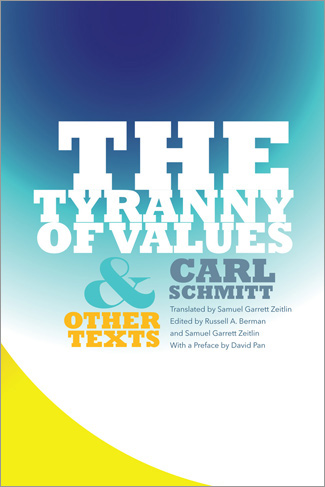
Samuel Zeitlin’s edition of Tyranny of Values and Other Texts (Telos Press, 2018) fills an important gap in the English publication of Carl Schmitt’s work, in particular, as it relates to his lesser known essays written during the interwar period. This edition is still meant as an introduction to Schmitt’s political thought and it does not pretend to exhaust all the topics that preoccupied the Catholic jurist, such as the geopolitical transformations of the European legal order, the rise of economicism at a planetary scale, or the ruminations over the early modern theories of sovereignty and its defenders. Indeed, these essays sheds light on the complexity of a thinker as he was coming to terms with the weakening of the ius publicum europeum as the framework of European legality and legitimacy, and of which Schmitt understood himself to be the last concrete representative, as he repeatedly claims in Ex captivate salus.

As David Pan correctly observes in the Preface, the Schmitt that we encounter here is one that is confronting the transformations of political enmity in light of a gloomy and dangerous takeover of a global civil war. In fact, one could most definitely argue that the Schmitt thinking within the Cold War epochality is one that is painstakingly searching for a “Katechon”, that restraining force inherited from Christian theology in order to give form to the ruination of modern legal and political order. The global civil war, cloaked under a sense of acknowledged Humanism, now aimed at the destruction of the enemy social’s order and form of life. This thematizes the existential dilemma of a jurist who was conscious of the dark shadow floating over the efficacy of Western jurisprudence. In other words, the post-war Schmitt is one marked by a profound hamletian condition in the face of the technical neutralization of every effective political theology. This condition puts Schmitt on the defensive, rather than on the offensive, as his later replies to Erik Peterson, Hans Blumenberg, or Jacob Taubes render visible.

The essays in the collection can be divided in three different categories: those on particular political thinkers, some that reflect on political enmity and the concept of war, and two major pieces that deal directly with the crisis of nihilism in the wake of the Cold War (those two essays are “The Tyranny of Values” and “The Order of the World after the Second World War”). Zeitlin includes an early essay on Machiavelli (1927), a brief piece on Hobbes’ three hundred years anniversary (1951), a reflection on his own book Hamlet and Hecuba (1957), and a succinct note on J.J. Rousseau (1962). These are all not necessarily celebratory of each of these figures. Indeed, while in the piece on Hobbes Schmitt celebrates the author of Leviathan as a true political analyst of the English Civil War against Lockean contractualism; the piece on Machiavelli is a clear exposition of his loathe for the Florentine statesman. In fact, to the contemporary student of intellectual history these words might sound unjust: “[Machiavelli] was neither a great statesman nor a great theorist” (Schmitt 46). If politics is understood as the art of reserving an arcanum, as mystery of power against all forces of moral relativism and technical procedures, then, machiavellism’s endgame amounts to a mystified anti-machiavellinism that favors individual pathos over political decisionism. Machiavelli might have said “too much” about politics; and for Schmitt, this excess, points to the flawed human anthropology at the heart of his incapacity for thinking political unity (Schmitt 50).

If juxtaposed with the essay on Hobbes, it becomes clear that Schmitt’s anxiety against Machiavelli is also the result of the impossibility of extracting a Christian philosophy of history, which only the Leviathan was able to guarantee in the wake of a post-confessional world. Whereas Hobbes provided a political theology based on auctoritas, non veritas, facit legem, Machiavellism stood for an impolitical structure devoid of a concrete political kernel. In such light, the essay on Rousseau is astonishingly curious. For one thing, Schmitt paints a portrait of Rousseau that does not adequately fits the contours of a political theologian of Jacobinism. On the reverse side of this, Schmitt also avoids making the case for The Social Contract as a precursor of totalitarianism. Rather, following Julien Freund, Schmitt polishes a Rousseau that stands for limited freedom and equality; a sort of intra-katechon within Liberalism, and in this sense a mirror image of every potential Hegelianism for the unfolding of world history (Schmitt 173). Finally, the piece “What Have I done?”, a response to a critic of his Hamlet and Hecuba, is aimed not so much at the making of a “political Shakespeare”, but rather at shaking up both the “monopoly of dialectical materialist history of art” as well as the “well-rehearsed division of labor” of the university” (Schmitt 139-41). This is critique has not lost any of its relevance in our present.

Whereas the pieces on political thinkers is an exercise in reactroactive gazing on the tradition, the essays on political enmity and war are direct confrontations on the erosion of the European ius publicum europeum in the wake of the Cold War, dominated by the rise of international political entities (NATO, UN), and anticolonial movements of a new global order. It is in this context that Schmitt’s interest in the figure of the partisan begins to take shape as a way to come to terms with the new forms of mobility, irregularity, and changes in its territorial placement of the enemy. In “Dialogue on the Partisan”, Schmitt revises some of his major claims in Theory of the Partisan, while reminding that “the great error of the pacifists…was to claim that one need simply abolish warfare, then there would be peace” (Schmitt 182).The destitution of the ius publicum europeum, that oriented war making vis-a-vis the recognition of political enmity has, in fact, opened up for a de-contained partisanship in which the destiny of populations now was at the center. This new stage of political conflict intensifies the nihilism where potentially anyone is an enemy to be destroyed (Schmitt 194).

As Schmitt claims in the short piece “On the TV-Democracy”, the question becomes who will hold political power and to what extent, as techno-economical machination becomes the force that directly expresses the Goethean myth of nemo eontra deum nisi dens ipse. With the only difference that the mythic in the essence of technology has no political force, but mere force of mobilization of abstract identities and what Heidegger called “standing reserve”. In this new epoch, the human ceases to have a place on earth, not merely because his political persona cannot be defined, but rather because he can no longer identify himself as human (Schmitt 205). Schmitt’s sibylline maxim from poet Theodor Daubler, “The enemy is our question as Gestalt”, thus loses its capacity for orientation. Already in the 1940s, Schmitt is contemplating a crisis that he does not entirely resolve.

This is one way in which the important essay “The Forming of the French Spirit via the Legists”, from 1941, must be understood. This text on the one hand it is a remarkable sketch of French jurisprudence, grounded on “mesura”, “order”, “rationalism”, and sovereignty. It is no doubt an essay directed against royalist French intellectuals (Henri Massis and Charles Maurras are implicitly alluded to); but also at the concept of state sovereignty. Indeed, the most productive way to read this essay is next to The Leviathan in the State Theory of Thomas Hobbes (1938) written a couple of years prior. The impossibility of crafting a theory of the political in the wake of the exhaustion of the sovereign state form will eminently leave the doors wide open for a global civil war, as he argues in the post-war essay “Amnesty or the Force of Forgetting”. Schmitt’s defense of the a formation of the Reich in the 1940s will be translated in his general theory of a ‘new nomos of the earth’ immediately after the war.

The two most important pieces included in The Tyranny of Values and Other Texts (2018) are “The Tyranny of Values” (1960), and “The Order of the World after the Second World War”. The “actuality” of Schmitt’s political thought has a felicitous grounds on these essays, although by no account should we claim that they adjust themselves to the intensification of nihilism in our current moment. There is much to be said about the weight that Schmitt puts on the “economic question”, a certain pull that comes from the emphasis of the much debated question then concerning “development-underdevelopment”, which does not really capture the metastasis of value in the global form of the general principle of equivalence today. Schmitt also deserves credit in having captured in “The Tyranny of Values”, the ascent of the supremacy of “value” in relation to the philosophies of life (Schmitt 12). Schmitt quotes Heidegger’s analysis, for whom “value and the valuable become the positivistic ersatz for the metaphysical” (Schmitt 29), which we can have only intensified in the twenty-first century. Perhaps with the only difference that “value” is no longer articulated explicitly. But who can deny that identitarian discourse is a mere transposition of the tyranny of values? Who can negate that the cost-benefit analysis, “silent revolution of our times” as one of the most important constitutionalists has called it, now stands as the hegemonic form of contemporary technical rationality? [2].

At one point in the “Tyranny” essay, while commenting on Scheler’s philosophy, Schmitt says something that it has clearly not lost any of its legibility in our times: “Max Scheler, the great master of objective value theory has: the negation of a negation value is a positive value. That is mathematically clear, as a negative times a negative yields a positive. One can see from this that the binding of the thinking of value to its old value-free opposition is not so lightly to be dissolved. This sentence of Max Scheler’s allows evil to be requited with evil and in this way, to transform our earth into a hell, the hell however to be transform into a paradise of values” (Schmitt 38). It is a remarkable conclusion, and one in which the “mystery of evil” (the Pauline mysterium iniquitatis) becomes the primary function of the art of government in our times. It is here where we most clearly see the essence of the techno-political as the last reserve of legal liberalism. Schmitt would have been surprised (or perhaps not) to see that the disappearance of the rhetoric of values also coincides with a new regulation of disorder, whether it takes the name of “security”, “cost and benefits”, or “identity and diversification”. Indeed, now politics even has its own place in the consummation of the race for the “highest values”, since anything can be masked a “political” at the request of the latest demand.

In his 1962 conference “The Order of the World after the Second World War”, delivered in Madrid by invitation of his friend Manuel Fraga, Schmitt still is convinced that he can see through the interregnum. Let me quote him one last time: “I used the word nomos as a characteristic denomination for the concrete division and distribution of the earth. If you now ask me, in this sense of the term nomos, what is, today, the nomos of the earth, I can answer clearly : it is the division of the earth into industrially developed regions or less developed regions, joined with the immediate question of who accepts development f aidrom whom…This distribution is today the true constitution of the earth” (Schmitt 163). It is a sweeping claim, one that seeks to illuminate a specific opaque moment in history.

But I am not convinced that we can say the same thing today. Here I am in agreement with Galli and Williams, who have noted that the disappearance of a Zentralgebiet no longer solicits the force of the Katechon [3]. And it is the Katechon that guarantees an effective philosophy of history for the Christian eon. The Katechon provides for a juridical sense of order against a mere transposition of the theological. Indeed, it is never a matter of theological reduction, which is why Schmitt had to evoke Gentilis’ outcry: Silenti theologi, in munere alieno!  I guess the question really amounts to the following: can a constitution of the earth, even if holding potestas spiritualis, regulate the triumph of anomia and the unlimited? Do the bureaucrat and the technician have the last world over the legitimacy of the world? Here the gaze of the jurist turns blank and emits no answer. One only wonders where Schmitt would have looked for new strengths in seeking the revival of a constitution of the earth; or if this entails, once and for all, the closure of the political as we know it.


Notes

  1. Carl Schmitt. The Tyranny of Values and Other Texts, Translated by Samuel Garrett Zeitlit. New York: Telos Publishing Press, 2018.
  2. Cass Sunstein. The Cost Benefit Revolution. Massachusetts: MIT Press 2018.
  3. See Carlo Galli, “Schmitt and the Global Era”, in Janus’s Gaze: Essays on Carl Schmitt. Durham: Duke University Press, 2015, p.129. Also, Gareth Williams, “Decontainment: The Collapse of the Katechon and the End of Hegemony”, in The Anomie of the Earth (Duke University Press 2015), p.159-173.

An explanation for ‘deconstructing the administrative state’. By Gerardo Muñoz.

A few weeks ago at CPAC (Conservative Political Action Conference), when Steve Bannon, Donald J. Trump’s White House chief strategist, laid out the principle of “the deconstruction of the administrative state” as one of the immediate objectives of the Trump administration, there followed a storm of commentaries. For academics in the humanities, it was a perfect setting to mock ‘deconstruction’, and assert the un-political character of this so called “theoretical trend” in the academia, easily linking Derrida with Bannon’s strategic plan.

Just to cite one of many examples, French writer Alain Mabanckou twitted: “Steve Bannon, le mentor de Trump parle de “deconstruction” du povuir de Washington. Deconstrution? Srait-il un lecteur de Derrida?”. Many more followed on social media and in academic groups. These witty remarks were, of course, written under the sign of irony, which is certainly a central stimmung of our time. But irony is also one of the most serious genres to discuss a serious affair, of which I would like to briefly contemplate. Of course, my intention is not to defend Derrida, or even worse, to prove that Bannon has not read Derrida. I am sure that Bannon has not read Derrida, and even if he has heard of him, or someone told him a few things about deconstruction as a critical strategy of contemporary thought, this is irrelevant.

Bannon’s usage of deconstruction of the administrative state is correct, although in another sense. For one thing, deconstructing the administrate state is a technical term used in sociology and political science analysis as it relates to the fiscal state. In his new book Democracy against Domination (2017), Sebeel Rahman discusses the deconstructive force of computative fiscal logic over institutional structures and governmental regulatory bureaucracy [1]. In a good portion of the literature, whenever the notion of deconstruction of the administrative state is used, it refers directly to the dismantling of the fiscal regulatory apparatus (see Norris 2000). Whereas it might, at first sight, seem that Bannon is misinformed or just downright clownish, he is deeply versed in the specific discipline that he wants to target; mainly, political science of the welfare state as it has been discussed from the New Deal onwards.

One could press this point even further: the idea that Bannon wants to ‘deconstruct the administrative state’ does not merely amount to ‘more neoliberalism’ as cultural critics seem to reduce the problem. This is part of the truth, but not the whole truth. The attempt to attack the administrative state entails a serious assault on the rule of law, since as the most intelligent constitutionalists have recently noted, the administrative state is today the legal structure that has supplanted legitimacy over the deficit of presidentialism of the executive branch. Adrian Vermuele (2016) makes it clear that the administrative state is the law’s greatest triumph after the weakening of the separation of powers. This ultimately entails, that perhaps Bannon is well aware that it is not enough to destroy a democratic society from the standpoint of a sovereign executive, since it must be done from the very place where the rule of law resides, and this is where the administrative state plays a fundamental role. Bannon’s deconstructive gesture goes to the heart of the rule of law, which we have already started seeing as a check mechanism to Trump’s rampant executive unilateralism. Hence, the rumor that says that Bannon is a Leninst should be taken very seriously: Leninism seeks the destruction of the state and rule of law in order to create a dictatorship of the proletariat, which is Bannon’s civilizational response to globalization [2]. Bannon is a full-fleshed anti-institutionalist who admires not only Lenin, but also the decade of the thirties that he has called “exciting”.

At this point, it is perhaps almost unnecessary to say that Derrida’s deconstruction has little do with Bannon’s loaded attack on institutions of the welfare state. However, what is important is to note that Bannon’s articulation of deconstruction is inequivalent to Derrida, and a comparison becomes only possible if one subscribes to a transparent conceptual reservoir of the linguistic turn in order to abuse it. Thus, whenever a linguistic component is emphasized as hyperbolic of intellectual thought, the latter is suspended to favor an easy advantage in tandem with anti-politics.

Derrida emphasized that deconstruction was a condition of democracy, and that democracy could not take place without deconstruction. Democracy is really not a political concept in Derrida’s thought. It is not reducible to a tradition of “intellectual history”, and not even to the primal causation of life as predicated in the political. Such was, for Derrida, the exemplary nature of Mandela [3]. But to the extent that it solicits unconditional hospitality, it alters the alterity of the singular that is never reducible to political finality. This coming of friendship or non-enmity is another way of thinking through an infrapolitical existence. It is this demotic existence beyond the political what Bannon wants to destroy and obstruct in a move that is both fully ultra-political and non-political.

Notes

  1. K. Sebeel Rahman. Democracy against Domination. Manhattan: Oxford University Press, 2016.
  2. “Steve Bannon, Trump’s top guy, told me he was ‘A Leninst’ who wants to ‘destroy the State’. http://www.thedailybeast.com/articles/2016/08/22/steve-bannon-trump-s-top-guy-told-me-he-was-a-leninist.html
  3. Jacques Derrida. The Politics of Friendship. London: Verso, 2005. P.102-106. “Admiration of Nelson Mandela, or The Laws of Reflection”, Law & Literature, Vol.26, 2014.