Following the heart’s voice. On Chaim Bialik’s Halakhah e Aggadah: sulla legge ebraica (2025). by Gerardo Muñoz

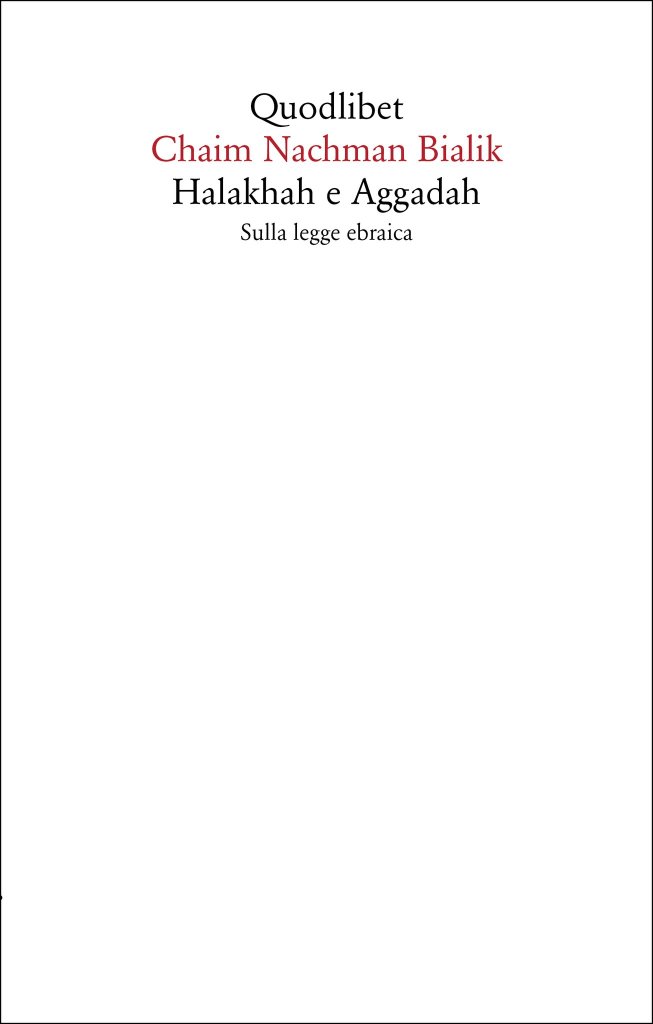
If the modern age is characterized by the triumphant claim to legitimacy thanks to some major forgetting, then there is much to learn from Chaim Bialik’s 1917 enduring essay on Jewish Law, Halakhah e Aggadah: Sulla Legge ebraica (Quodlibet, 2025), which has just been republished in a very timely fashion in Italian. Bialik in 1917 means being in good company of many other names: Franz Kafka and Gustav Landauer, Walter Benjamin and Martin Buber, Ahad Ha’am and Carlo Michelstaedter, and many other names that surely have been eroded by the dust of historical time. This very erosion is at the center of Bialik’s essay that in the thunderstorm of the First Great War, the imperial consolidation of political Zionism, and the disintegration of the Austro-Hungarian Empire where many Jewish marranos dwelled, decides to take a step back from the modern acceleration and ask about the two poles of Ancient Judaic Law: the Haggadah and Halakhah. Immediately taking distance from the modern scheme of positive law and natural law, norms and principles, Bialik reminds us that Haggadah and Halakhah are two faces of the divine dispensation of Judaic law, in which temporal continuity and the statute, the heart and the shelter appear to communicate each and every time through the life of a people (5). 

As someone writing in the waning of Halakhah due to modern secularism, Bialik’s essay is first and foremost invested in preserving the Halakhah as a living tradition, “an art of concrete life” that allows for the form of life of human beings in the world (7). It is from Bialik’s essay where Walter Benjamin in the 1934 Kafka essay would later incorporate the notion that Judaic law as void of content, open to the pure means of its own transmissibility. But perhaps in Benjamin’s materialist rendition Bialik’s central notion of the Hallakah is also blurred, since for the Jewish theologian what is central is the spiritual formation of the soul, a sort of subterranean facticity that is passed throughout the ages, just like that Chrisitan masons built major Medieval cathedrals across the centuries (11) (the metaphor is indeed his). The Halakhah insofar as it inspires the soul is an endless formation, although it is also “the imagination of becoming a living soul, with a body and a sense of beauty” (13). The Halakhah is a region of de-autonomized sublime that Bialik compares to a crossgenerational Shabbat in which a people are observant to a way of living in its own becoming (14). In other words, the Halakhah is not a moral principle for personal virtue as arete as in the ancient metaphysical ethics; it is the absorption of the life of the community into the “voice of the heart” that can regenerate forms of sensible wisdom (16). It is wisdom without a master or priest that teaches the law, since it is not a knowledge that must be interrupted through mental capacities. According to Bialik’s theory, once the Jewish people are thrown into a temporality of dilation, what appears to shine in a powerful light is the cultivation of a life against the abuse and corruption of historical obsolescence. As Bialik writes in one of the most striking passages of his essay:

“Che questi «vasi di vita» siano rimasti da parte per qualche tempo non significa che siano inutili. È una grande legge: ogni forma di vita durante la sua creazione, finché dura questo periodo, rappresenta a sua volta un contenuto nello spirito del suo creatore. Appena la sua creazione è compiuta, essa si separa, si confonde con le altre, e ormai priva di essenza propria decade a strumento: chiunque vi trova quel che vi mette ogni volta che la usa. Essa deve tutto all’uomo e allo spirito dell’uomo a cui tocca in sorte come un bene abbandonato. Se egli vi mette oro, troverà oro; se polvere, polvere. Se non sa cosa mettervi, può anche lasciare che questo strumento arrugginisca. Ma quell’uomo non deve dire: lo strumento è inservibile, da buttare; deve dire invece: io sono povero!” (19).

This means that for Bialik the theological conception of “creation” does not stand for a mythical origin unconcealed by some authority; rather, it is a “vase of life” that allows life to be attuned to the the spirit of the creator, and for the creator to be rendered unfinished because the texture of the form of life is always to be written. At bottom, this modal structure of theological interdependency is at the heart of Bialik’s underappreciated theory of the letter and spirit of law that still resonates in our days. It is not that there is unwritten tradition and then it becomes a written norm to adjudicate the force of law (as in the current American jurisprudential debates about the “History and Tradition” test); on the contrary, Bialik’s legal contribution, well beyond the confines of Ancient Judaic Law, is that there is an abyss in the soul in every enigmatic life because the legal force cannot yet (and cannot for a long time) adjudicate a resolute execution of judgment (23). Counterintuitively, we can thus say that to really “live in the Law” cannot be expressively taken to be to defend court orders and police powers, but rather to allow life to live concretely as enigmatic life that is deprived of temporary ad hoc fictions suited to social domination. That is to say, to live according to the law means coherently with the Hakkhalah entails to an awareness that the law remains fully unknown, in this way incapable of becoming a part of social and penal organization that in our days it has thoroughly transformed the legal systems of the West (37).

This is why Bialik also includes a strong warning towards the end of Halakkah e Aggadah: the rise of substantive qualifications of Judaic culture (Jewish art, education, work, nationalism, theology) bending towards identitarian abstractions amount to what he called “ethereal love” (38). This ethereal love not only dissolves into the solution of modern humanism, but betrays the enigmatic form of Jewish life in the time of dilated waiting. A time of dilation (Aufschub) that does not mean that there is nothing to do – consummated boredom and alienated experience – it is rather the opening to a whole field of possibilities and relations, of worlds and the attunement of the imagination in its exposure. This non-closure of the theological experience provided by the fine attunement of the heart cannot be properly called political; which is why Bialik understood the land of Palestine as a vitam nomoi and not one of nationalist settlement validated by the institutional authority of the modern state.

As Andrea Cavalletti records in his illuminating Postface Bialik telling Hannah Arendt: “La mia convinzione politica, se ve n’è una, è anarchica” (64). Like in Oskar Goldberg’s theology, what is at stake in Bialik is an anarchic Hebraism that allows the presence of God in the world to deter the emergence of poisonous deifications (the individual and the state). Far away instrumentally infused pseudo-messianic overtones of an “elected People” for historical assertion and depredation, Bialik understood that only in the free relation between Halakhah and Haggadah, could the gordian knot of life and law be considered if we are to avoid the slippage into the seductions of the ethereal forces.

Holding on to painting. by Gerardo Muñoz

Paying a visit to a painter’s studio is a rare experience, but definitely gratifying. Or at least, it has been for a long time even before I could put it to words. At her studio, I confirm that Laura Carralero’s commitment to painting as a practical activity has an unfathomable dimension, and I was pleasantly surprised that she shared the same sentiment that our current epoch is not one in which painting has a minimal breathing space. And whenever painting emerges in the official market circuits of art, it seems that it is always already parasitical to some verbose rhetorical apparatus or heteronomic planning that distortions the painterly sentiment. But was not painting the task of speaking the engagement regarding  “mute things”, as Poussin would have it? There is little doubt that rhetorical inflation that thrives in mechanisms to legitimate art continuously devalorizes the mysterious proximity of painting with things in the world. We should reflect – or we should continue to reflect – about what it means to be in a point in the history of humankind where the obsolescence of painting and the disappearance of the dexterous achievement of the hand has thoroughly been realized (Focillon’s praise of the hand remains as actual as when it was first written: “The artist that cuts wood, twerks metal or rock keeps alive a very ancient human past that without which we would immediately cease to exist. Is not admirable to see in the mechanical age this stubborn human survivor of the ages of the hand?”) [1].

The task is immense and abnormal, and it defies (because it exceeds it) the theoretical concept and the absolutism of the philosopher. The engagement of the painters – a secret community that still exists here and there, in different geographies of the world – is precisely a keeping of the divine vortex of the human in the abyss without higher pretensions. And there is something stubbornly strange about painting against the mounting force of destruction. Although perhaps ‘resistance’ here means nothing but to hold on to the originary instance of appropriation of experience in the wake of the epochal mutation of anthropogenic composure; as if the end of the species is also pulsating its commencement.

Holding to painting is not just a substitute to the act of refusal (something that I have recently mapped out); rather, it refuses the very negation of the anthropological erosion in its soulful interaction with what it remains outside of language. To hold on to painting means to engage in the imperturbable: what discourse cannot mold and relocate; what previously is poor in language so that a new language, and thus a new world, could emerge anew among the rubble. In his forthcoming book Those Passions, T.J. Clark states, quite forcefully, that no political transformation or epochal breakthrough can emerge without a preliminary transformation in language; and, I am tempted to say, that practice of painting is the topoi in which eye, world, and hand come together in the very act of separation of said renewal.

The terror of painting – only aggravated in the last decades or so, although a process that took off the postwar years and continued into schools of art where militant pedagogues can only shout “don’t bother to paint!” – is the general stimulus of the reified world; a world in which the paradigm of “objethood” now stands as the compensatory empty experience for poignant idolization of nothingness and “mere stuff”. Sure, there is no return to painting in its grandiose historical sequences – Renaissance, French modern painting, the European Baroque, Van Eyck’s optical discoveries – which ultimately means that painting’s instantiation with the tradition is also bare and unexplored; or, absolutely uncharted whenever there the event of true painting. While I glance at Carralero’s diminutive wooden oil paintings I have this in mind at least. There is a return to the divinity of the icon, but it is not a restitution of its theological investiture and its purported liturgy; the pictorial exercise takes into account the structural void in which painting finds itself resisting, for better or worse, representational excess.

And this speaks, I take it, to the muteness of painting as such, which is also Carralero’s silence about the import of medieval icons into the present. In a way, the painterly operation (I realize that this expression is awful) is executed in a paradoxical redemption, since space always calls forth presentism, a here and now. One is reminded of Stevens’ verses in “Ordinary Evening in New Haven”: “To say good-bye to the past and to live and to be / in the present state of things as, say, to paint / In the present state of painting and not the state of thirty years ago”. The emphasis of the verse declines towards that injunction “as say, to paint”, which fixes a current state of being in the world where we are in it but outside of it. Is not this, precisely, another description of the “Just”? I am eager to work through painting’s stubborn position to this description, which means to hold on to the imperturbable. 

The imperturbable seems to me like a fitting term to grasp what Carralero is doing in her pictures, although with no pretensions to exhaust her pictorial adventure. The solemnity of the icon and its inverted gnosis yields something palpable as well as unattainable. What is being held is the vortex of painting’s mystery going back to Lascaux and ancient burial paintings. Carralero rationalizes her interest in medieval and Eastern European religious painting as a retreat from the unbreathable decay of contemporary pictorial practice as a general tendency. Here the renewal of painting is only possible through the sensible dimension of an integrative imagination. Hence, to live in the present, in the hour Stevens’ simile, is also to dwell in the flashes of painting’s general economy of sensible forms. A new history of freedom can take this as its point of departure; that is, to posit no longer the social functionalization of norms and rules for relations, but to expand the sensible space of the innumerable symbols of existence. 

In the well-known essay “The Pathology of Freedom”, Günther Anders says something significant about painting’s imperturbable nature: “Painting that fixes the aspect of a man or a thing in a picture seems as it were to repeat the act by which each thing is already condemned to itself” [2]. This “being-precisely-this” could be taken as the closure of contingency in relation to all possible forms; although it is also painting in which the contingency of the non-visible in the visible what arranges the possibility of what is precisely absolute contingent as absolute in each picture. This is why in great pictures we tend to feel that the consummation of form reveals as a necessary tradition that, by virtue of being thus, it assume the thisness of the particular rendition. This commitment that weighs heavy in each of Carralero’s paintings is a testamentary to the imperturbable even if we are already entering (or already in it) the eclipsing world of the mystery of the senses, a world that can no longer see the redeeming and unassuming vision that painting can offer.

Notes 
1. Henri Focillon. Elogio de la mano (UNAM, 2010), 131-132.

2. Günther Anders. “The Pathology of Freedom: An Essay on Non-Identification”, Deleuze Studies, Vol.3. 2009, 283.

Naturae species ratioque. On Guillermo García Ureña’s Las semillas y el vacío: pensar con Lucrecio (2023). by Gerardo Muñoz

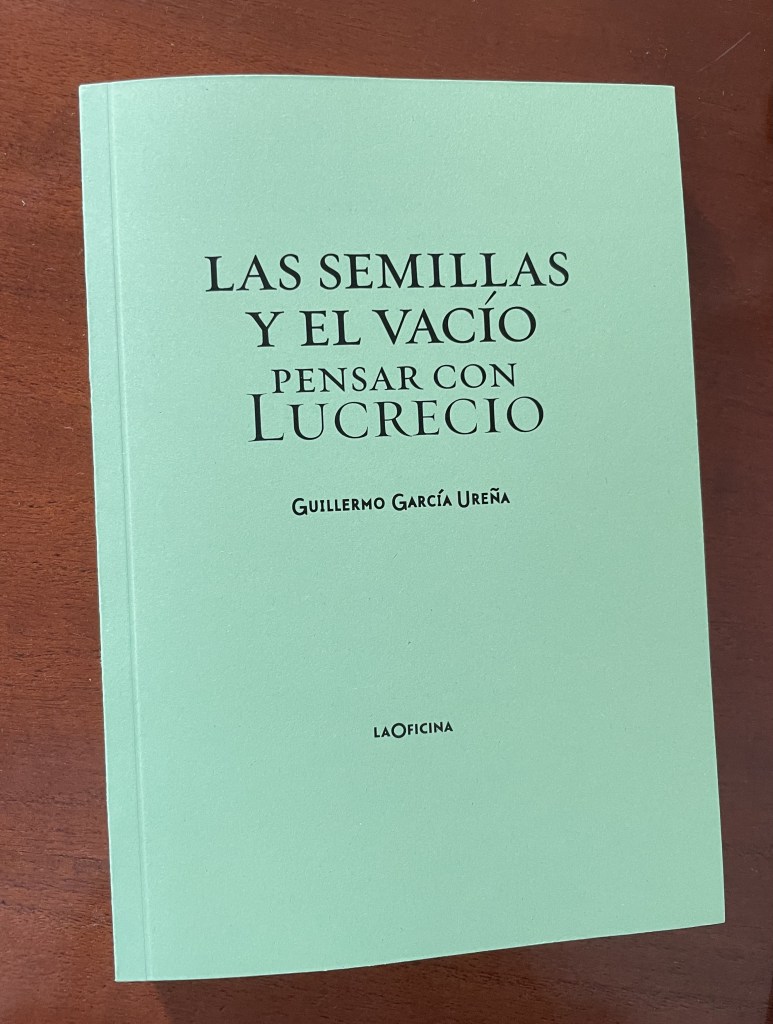
Lucretius’ poem De rerum natura is one of the most used and abused texts of the tradition, and like all classics it has had the most diverse receptions imaginable: the poem of modern science, a baroque expression of creationism for the English metaphysical poets, the precursor of historical materialism and atheism, and a tract of scientific positivism that laid the foundation for the regulation of nineteenth century social order. Once a text becomes an emblem, it usually means that it has lost its prehistoric imprint and place in the tradition. Against this backdrop, Guillermo García Ureña’s just published Las semillas y el vacío: pensar con Lucrecio (La Oficina, 2023) has the prudential gesture of disclosing the great Roman poem to its fundamental structure; attentively listening to its original complex articulation difficult to grasp with the categories of modern philosophical thought. In this sense, Ureña’s purpose is not to deploy another “philosophical account” of De rerum natura – endorsing and subscribing the influence of Epicurus and its later resonances in modern theories of physicalism and materialism of the continental schools – but rather to engage in its own ground exerting an original philological exploration of the text that opens up an array of different problems for thought. Whoever is looking for a “theory” of Lucretius will find none in this brilliant and well articulated essay. But the reader will find, nonetheless, a comprehensive hermeneutics of a text that stands as a threshold between the closure of Greek classical antiquity and the Roman reintegration of the tradition. Now, for Ureña De rerum natura proem discloses the originary understand of the epic, or épos, through which the stability of the things as they appear takes place; whether it is the Muses, the gods, being and language, the simulacra or the soul, the physical declination of creation (the atomic clinamen) and the final document of language invigorated in the corpus of the poem itself. De rerum natura is both a cosmology and a poetics with the ambition of elucidating the most obscure things of this world: Lucretius’ text defies a fixed representation through a choreography (a term that it is not used by Ureña, it must be said) that discloses the possibilities of worlds; the combination of worlds only to posit the question of how to live within them, which is another way of saying how to account for a form of life.

One of Ureña’s commitments is to hold on to Lucretius’ aesthetic and philosophical autonomy. This implies treating the influence of Epicureanism with great care; engaging with Epicurus insofar as the aesthetic autonomy and its loci of poetization reject the classical structure of the epic hero incarnated by the soteriological impulse of the great poet-philosopher (we know that this is the same problem that centuries later Hölderlin will identify through the tragic drama of Empedocles). Lucretius is writing after the twilight of the classical Greek genres. Furthermore, there is no community under an organized program of leadership and telos; on the contrary, there is only an existence that “one day will want to desert all of us” (41). True, the Epicurean notion of serenity (ataraxía) is retained and treasured; but only as the aspiration of every living being who seeks to transfigure the shadows of superstitiousness and fear that govern over the perceptive mediating forces in the world. In this sense, to dwell in the world does not consist in the limitless relationship with the simulacra; it is rather, the self-transformative exercise of freeing possibilities within the void in which forms of life can emerge. As Ureña reminds, the rainfall of the atom is as fast as that of thought itself. It is already an image of thought, as well as the figure of imagination. And the image of thought validates the history of cosmos as a patchwork of accumulations and deflections, creations and destructions, repetitions and disintegrations in a swerve of forms that infinitely recline on its ethical possibilities (139). It is altogether interesting that Ureña reminds us that, in fact, De rerum natura is not interested in staging the things in Nature; on the contrary, at the center there is the question of the ‘nature of things’ in the luminous expression of their irreducibility. This is what modern onto-theological closure brings to a process of domestication, whether through the composition of the civil structure (limitless exchange according to philosopher Felipe Martínez Marzoa, who figures prominently in Ureña’s book) or through the progressive historical structure commanded by the essence of technology that blurs the relations between forms and techniques.

If De rerum natura abandons universal history and historical narration, it is because its structure is profoundly kenotic: it can only be assigned as contingent historical transmission of the most immediate and sensorial (not necessarily “true” in the metaphysical sense) that allows the convergence of the history of forms of life and natural history (140). The operation of subtraction implies the transfiguration of freedom through the becoming of forms – their interests, constructions, and pacts (foedera naturae) as guarantee for a plastic relationship between things in a world that is always already a fragment in the void. The highly attractive Lucretian notion of foedera or “pact” (that expresses separation in coming together: a com-pact that de-compacts) is almost the inversion of the modern principle of irreversibility, if one were to take Hans Blumenberg’s  legitimation hypothesis at face value. And this is so because a foedus or pact is insufficiently strong to resist the impact of the clinamen, but indispensable for the emergence of a body that materializes its own fate towards dissolution.

The lack of unity of being allows for the existence of simulacra as that which does not have sufficient matter to compose itself as foedera; and so, it is a material semblance as an image without figure that makes it an ephemeral entelechy. In this choreography between the downwards of atoms and ephemeral intermittence of events the taking place of the world emerges a topoi of a combination of rhythms that intertwine the weight of bodies and the animation of souls. The possible combination and stylization of multiplicities in separation is the way in which a form of life emerges as the desertion from superstition and fear that hinges upon the irreversible stabilization of a principle of reality. Ureña does not go this far into the wager of Lucretius’s text – and he does not have to in his close reading of the text – but it is precisely this thick dimension of the ethical primacy that makes Lucretius’ dislocated comprehension of materiality a vibrant tune against the weight of alienation that we are still struggling to abandon.

The struggle against the alienated life – the alienation from the world, and the external manipulation of the simulacra that has become a gnostic planetary form of “TV Democracy’ (Schmitt) of the “society of the spectacle” (Debord), which implies the usurpation of our imaginal and erotic relationship with the world – well understood, does not mean to relocate the confrontation at the level of political order; it rather, rests on what we have understood by order and disorder for the reconstitution of a happy or contemplative life (naturae species ratioque). This serene life declines the offer to negotiate at the arena of sacrifice and legitimate domination, favoring the event of friendship. At this point Lucretius comes closest to Epicurus’s society of friends – studied by Carlo Diano in an important 1966 conference in relation to the organization of the passions and the transmission of love – that can guarantee a content life in the presence of “other joyous gazes” (glossing Diano’s terms) away from the persistence of war and the compensatory administration of pain. This is the ultimate treat of De rerum natura: the exemplary dimension of the serene life takes shape through the community of friends, the civilizational invariant of the human experience (prehistoric times, the classical epoch, and in our times) that abandons the paradigm of perpetual war that obfuscates omnia cordi.

It is not too ambitious to claim that only at this point we finally grasp the full extent of the Lucretian épos: not just an ephemeral and contingent declension of the primacy of atoms in the void; but, more importantly, it can disclose the irreducibility of an experience with friends. Ureña wisely closest his book with an image of the “buena vida en compañía” (the good life in companion) that insists that serenity is only possible (or desirable) in the open landscape, a nowhere-land of an eternal foedera (or a sinousia, as it appears in Plato’s Symposium) that even if temporarily too short-lived or inconsequential it paints an earthly paradise just above the grass: “poder tendernos unos juntos a otros en el césped suave, cabe un arroyuelo, a la sombra de un árbol copudo, y regalar el cuerpo sin grandes dispendios; sobre todo si el cielo sonríe y la estación del año esparce de flores el verdor de la hierba (II, 29-33)” (203). It is this inconspicuous and mute experience that strangely holds on to the passing of the world.